Showing posts with label red states. Show all posts

Friday, July 24, 2020

Why America Failed to Beat Covid-19 in One Word: Trump

The myth of American exceptionalism drives me to distraction.  Almost every nation sees itself as exceptional in some ways and history is littered with former empires and so-called great powers that disappeared or seen their glory days fade away.  Now, in the age of a worldwide pandemic, America has shown itself to be exceptional in the worse way possible: the pandemic is out of control in many states and Americans are banned from traveling to most parts of the world. Europe, Canada, Mexico, most of the Caribbean region, including the Bahamas, will not allow Americans to visit.  America finds itself somewhere between a laughing stock and an object of pity.  How did this happen?  One word - actually, one name - explains it all: Trump.  A column in the New York Times compares the US response to that of Italy, a country often viewed by many as dysfunctional, especially its bureaucracy, and the comparison is damning.   Of course, besides Trump, America has another huge negative working against it: the fake news outlets of the far right and "conservatives" who reject science and knowledge and blindly support the con-artist in the White House.  Here are column highlights:

A few days ago The Times published a long, damning article about how the Trump administration managed to fail so completely in responding to the coronavirus. Much of the content confirmed what anyone following the debacle suspected. One thing I didn’t see coming, however, was the apparently central role played by Italy’s experience.
Italy, you see, was the first Western nation to experience a major wave of infections. Hospitals were overwhelmed; partly as a result, the initial death toll was terrible. Yet cases peaked after a few weeks and began a steep decline. And White House officials were seemingly confident that America would follow a similar track.
We didn’t. U.S. cases plateaued for a couple of months, then began rising rapidly. Death rates followed with a lag. At this point we can only look longingly at Italy’s success in containing the coronavirus: Restaurants and cafes are open, albeit with restrictions, much of normal life has resumed, yet Italy’s current death rate is less than a 10th of America’s.
Donald Trump keeps boasting that we’ve had the best coronavirus response in the world, and some credulous supporters may actually believe him, my guess is that many people are aware that our handling of the virus has fallen tragically short compared with, say, that of Germany. It may not seem surprising, however, that German discipline and competence have paid off (although we used to think that we were better prepared than anyone else to deal with a pandemic). But how can America be doing so much worse than Italy?
For all its problems, Italy is a serious and sophisticated country, not a comic-opera stage set. Still, Italy entered this pandemic with major disadvantages compared with the United States.
Unfavorable demography and economic troubles are also major Italian disadvantages. The ratio of seniors to working-age adults is the highest in the Western world. Italy’s growth record is deeply disappointing: Per capita G.D.P. has stagnated for two decades.
When it came to dealing with Covid-19, however, all these Italian disadvantages were outweighed by one huge advantage: Italy wasn’t burdened with America’s disastrous leadership.
Italy quickly moved to do what was necessary to deal with the coronavirus. It instituted a very severe lockdown, and kept to it. Government aid helped sustain workers and businesses through the lockdown. The safety net had holes in it, but top officials tried to make it work; in a supreme case of non-Trumpism, the prime minister even apologized for delays in aid.
And, crucially, Italy crushed the curve: It kept the lockdown in place until cases were relatively few, and it was cautious about reopening.
America could have followed the same path. . . . But the Trump administration and its allies pushed for rapid reopening, ignoring warnings from epidemiologists. Because we didn’t do what Italy did, we didn’t crush the curve; quite the opposite. Matters were made worse by pathological opposition to things like wearing masks, the way even obvious precautions became battlegrounds in the culture wars.
So cases and then deaths surged. Even the promised economic payoff from rapid, what-me-worry reopening was a mirage
Incredibly, Trump and his allies seem to have given no thought at all about what to do if the overwhelming view of experts was right, and their gamble on ignoring the coronavirus didn’t pan out. A miraculous boom was Plan A; there was no Plan B.
[T]ens of millions of workers are about to lose crucial unemployment benefits, and Republicans haven’t even settled on a bad response. On Wednesday Senate Republicans floated the idea of reducing supplemental benefits from $600 a week to just $100, which would spell disaster for many families.
For someone like Trump, all this must be humiliating — or would be if anyone dared tell him about it. After three and a half years of Making America Great Again, we’ve become a pathetic figure on the world stage, a cautionary tale about pride going before a fall.
These days Americans can only envy Italy’s success in weathering the coronavirus, its rapid return to a kind of normalcy that is a distant dream in a nation that used to congratulate itself for its can-do culture. Italy is often referred to as “the sick man of Europe”; what does that make us?

Sunday, July 19, 2020

Trump's Critical Role in Leading America to a Pandemic Catastrophe

Covid-19 is out of control in a number of states - included GOP led states that rushed to reopen at the demand of Donald Trump - and now Trump is trying to block more funds for testing and contact tracing and refuses to back a nationwide mandate that masks be worn in public settings.  Trump's reasons for blocking the funding is that in his mind more testing will show the magnitude of the pandemic and further highlight his regime's failure to properly lead in fighting the pandemic in the manner successfully used in other advanced nations. The resistance to masks seems to be part of Trump - and his knuckle dragging base's rejection of science and expertise in general.  Sadly, Trump's current conduct is more of what has played a critical role in what might have been a successfully contained pandemic to one that is now gripping much of the country and forcing a number of states to reconsider shutting down their economies.  A very long piece in the New York Times looks at Trump's role in leading much of the country to disaster.  Here are article highlights:

Each morning at 8 as the coronavirus crisis was raging in April, Mark Meadows, the White House chief of staff, convened a small group of aides to steer the administration through what had become a public health, economic and political disaster.
Seated around Mr. Meadows’s conference table and on a couch in his office down the hall from the Oval Office, they saw their immediate role as practical problem solvers. Produce more ventilators. Find more personal protective equipment. Provide more testing.
But their ultimate goal was to shift responsibility for leading the fight against the pandemic from the White House to the states.  . . . an attempt to escape blame for a crisis that had engulfed the country — perhaps one of the greatest failures of presidential leadership in generations.
Over a critical period beginning in mid-April, President Trump and his team convinced themselves that the outbreak was fading, that they had given state governments all the resources they needed to contain its remaining “embers” and that it was time to ease up on the lockdown.
In doing so, he was ignoring warnings that the numbers would continue to drop only if social distancing was kept in place, rushing instead to restart the economy and tend to his battered re-election hopes.
A sharp pivot soon followed, with consequences that continue to plague the country today as the virus surges anew.
Even as a chorus of state officials and health experts warned that the pandemic was far from under control, Mr. Trump went, in a matter of days, from proclaiming that he alone had the authority to decide when the economy would reopen to pushing that responsibility onto the states. The government issued detailed reopening guidelines, but almost immediately, Mr. Trump began criticizing Democratic governors who did not “liberate” their states.
Mr. Trump’s bet that the crisis would fade away proved wrong. But an examination of the shift in April and its aftermath shows that the approach he embraced was not just a misjudgment. Instead, it was a deliberate strategy that he would stick doggedly to as evidence mounted that, in the absence of strong leadership from the White House, the virus would continue to infect and kill large numbers of Americans.
He and his top aides would openly disdain the scientific research into the disease and the advice of experts on how to contain it, seek to muzzle more authoritative voices like Dr. Anthony S. Fauci and continue to distort reality even as it became clear that his hopes for a rapid rebound in the economy and his electoral prospects were not materializing.
Now, interviews with more than two dozen officials inside the administration and in the states, and a review of emails and documents, reveal previously unreported details about how the White House put the nation on its current course during a fateful period this spring.
·         Key elements of the administration’s strategy were formulated out of sight in Mr. Meadows’s daily meetings, by aides who for the most part had no experience with public health emergencies and were taking their cues from [Trump] the president.
·         Dr. Birx . . . failed to account for a vital variable: how Mr. Trump’s rush to urge a return to normal would help undercut the social distancing and other measures that were holding down the numbers.
·        [Trump] The president quickly came to feel trapped by his own reopening guidelines. States needed declining cases to reopen, or at least a declining rate of positive tests. But more testing meant overall cases were destined to go up, undercutting [Trump's] the president’s push to crank up the economy. The result was to intensify Mr. Trump’s remarkable public campaign against testing, a vivid example of how he often waged war with science and his own administration’s experts and stated policies.
·         Mr. Trump’s bizarre public statements, his refusal to wear a mask and his pressure on states to get their economies going again left governors and other state officials scrambling to deal with a leadership vacuum.
·         Not until early June did White House officials even begin to recognize that their assumptions about the course of the pandemic had proved wrong.
It was the end of March and his initial, 15-day effort to slow the spread of the virus by essentially shutting down the country was expiring in days. Sitting in front of the Resolute Desk in the Oval Office were Drs. Fauci and Birx, along with other top officials. Days earlier, Mr. Trump had said he envisioned the country being “opened up and raring to go” by Easter, but now he was on the verge of announcing that he would keep the country shut down for another 30 days.
“Do you really think we need to do this?” the president asked Dr. Fauci. “Yeah, we really do need to do it,” Dr. Fauci replied, explaining again the federal government’s role in making sure the virus did not explode across the country.
But even as [Trump] the president was acknowledging the need for tough decisions, he and his aides would soon be looking to do the opposite — build a public case that the federal government had completed its job and unshackle the president from ownership of the response.
By mid-April, Mr. Trump had grown publicly impatient with the stay-at-home recommendations he had reluctantly endorsed. Weekly unemployment claims made clear the economy was cratering and polling was showing his campaign bleeding support. Republican governors were agitating to lift the lockdown and the conservative political machinery was mobilizing to oppose what it saw as constraints on individual freedom.
The wind down of the federal government’s response would play out over the next several weeks. The daily briefings with Mr. Trump ended on April 24. The Meadows team started barring Dr. Fauci from making most television appearances, lest he go off message and suggest continued high risk from the virus.
By June the president was regularly making nonsensical statements like, “If we stop testing right now, we’d have very few cases, if any.”
Later, it was clear that states that rushed to reopen before meeting the criteria in the guidelines — like Arizona, Texas and Alabama — would have among the worst surges in new cases.
Dr. Birx’s belief that the United States would mirror Italy turned out to be disastrously wrong. The Italians had been almost entirely compliant with stay-at-home orders and social distancing, squelching new infections to negligible levels before the country slowly reopened. Americans, by contrast, began backing away by late April from what social distancing efforts they had been making, egged on by Mr. Trump.
The real-world consequences of Mr. Trump’s abdication of responsibility rippled across the country.
Other nations had moved aggressively to employ an array of techniques that Mr. Trump never mobilized on a federal level, including national testing strategies and contact tracing to track down and isolate people who had interacted with newly diagnosed patients.
“These things were done in Germany, in Italy, in Greece, Vietnam, in Singapore, in New Zealand and in China,” said Andy Slavitt, a former federal health care official who had been advising the White House.
“They were not secret,” he said. “Not mysterious. And these were not all wealthy countries. They just took accountability for getting it done. But we did not do that here. There was zero chance here that we would ever have been in a situation where we would be dealing with ‘embers.’ ”
By early June, it was clear that the White House had gotten it wrong. . . . . Digging into new data from Dr. Birx, they concluded the virus was in fact spreading with invisible ferocity during the weeks in May when states were opening up with Mr. Trump’s encouragement and many were all but declaring victory.
The number of new cases has now surged far higher than the previous peak of more than 36,000 a day in mid-April. On Thursday, there were more than 75,000 confirmed new cases, a record.
Mr. Trump’s disdain for testing continues to affect the country.
“When we were trying to get people to wear masks, they would point to the president and say, well, not something that we need to do,” he said.
Mr. Suarez expressed similar frustrations with Mr. Trump’s dismissive approach to mask wearing. “People follow leaders,” he said, before rephrasing his remarks. “People follow the people who are supposed to be leaders.”
Trump has thousands of avoidable deaths on his hands.

Tuesday, July 14, 2020

Is Donald Trump Beginning to Implode?


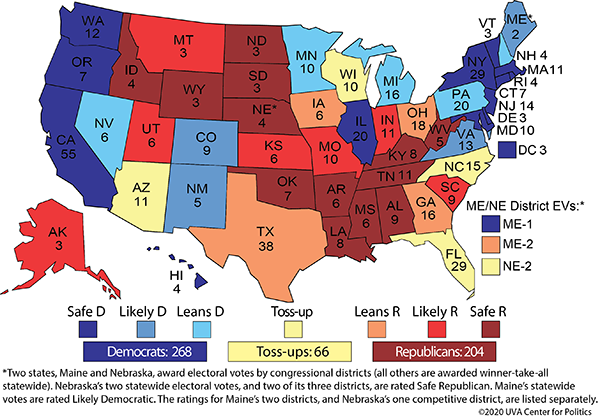
As Donald Trump continues to double down on rhetoric that thrills his core base of racists and Christian extremists in the hope of turning out his base in November, the opposite effect is happening with the rest of the population.  Indeed, the more ugly Trump's rhetoric becomes, the more voters he appears to be driving away.  A piece in Larry Sabato's Crystal Ball even shows Trump's lead in reliably red states dwindling and has caused GOP stalwart states like Alaska, Indiana, Kansas, Missouri, Montana, South Carolina, and Utah from "safe Republican" to "likely Republican."  One can only hope that Trump's hemorrhaging of support continues and that the presidential election becomes a rout with Biden winning by a landslide.  Personally, I want this to happen because it would restore some shred of faith in the American public as a whole and because it would devastate Trump's ego - Trump's pain is my pleasure, if you will.  Here are highlights from the Crystal Ball:

We are now about six weeks into a downturn in Donald Trump’s polling numbers. It’s worth thinking about the ramifications of this change if it endures.
In the RealClearPolitics average of national approval polling, Trump went from about early December to late May without ever dipping below -10 in net approval (approval minus disapproval). He has spent every day since June 1 at or below -10 net approval, and he’s currently at about -15.
Joe Biden’s national polling lead over Trump through May was in the four-to-six-point range. That is a decent lead, but not one that suggested Biden was a towering favorite . . . . But since early June, Biden’s lead has ballooned to the eight-to-10-point range. He has also enjoyed healthy leads in many polls of the most important swing states, like Florida, Michigan, Pennsylvania, and Wisconsin.
The bottom line here is that the nation is in a state of terrible crisis, and the public has, at least for now, judged the president’s responses to both coronavirus and protests of racial inequalities in policing to be lacking.
In an ABC News/Ipsos poll released Friday, 67% of respondents disapproved of Trump’s handling of coronavirus and of race relations. . . . . It is not the kind of year when one wants to be an incumbent running for reelection, and a majority of the public appears to believe that this president is not meeting the moment.
A few weeks into the public health crisis, we explored the possibility of Trump being the second iteration of Jimmy Carter, whose reelection bid fell apart among myriad crises in 1980. Since then, the Trump-as-Carter scenario has grown even more plausible.
There is time for the situation to change — as we wrote a few weeks ago, we want to see where things stand after the conventions, around Labor Day. But Trump is extremely unlikely to win if the polls continue to look the way they do now. And if these numbers represent a new normal, we need to account for the possibility that this election won’t be particularly close, and that new states may come into play. In other words, if the national picture remains bleak for Trump, then the slippage he’s seen from earlier this year wouldn’t just be limited to a handful of swing states.
The very well-sourced New York Times trio of Maggie Haberman, Jonathan Martin, and Alexander Burns recently reported that internal Republican data showed Trump with only a small lead in Montana and trailing in Kansas, two states that Trump carried by about 20 points apiece in 2016 (both have competitive Senate races, too).
Trump’s position is weak enough in mid-July that we have to concede there are some signs of competitiveness in states that were not competitive in 2016. This sort of thing can happen when the overall election is tilted toward one side over the other, which is the state of play at the moment and the advantage Biden currently holds.
[W]e continue to rate states like Colorado, New Mexico, and Virginia as Likely, not Safe, Democratic. That’s despite it being hard to imagine Trump carrying any of them, even if his position dramatically improves.
So we’re moving seven Safe Republican states to Likely Republican: Alaska, Indiana, Kansas, Missouri, Montana, South Carolina, and Utah. . . . In all likelihood, these red states are going to vote for Trump, and not just by a few points.
But could one or more flip if Biden wins decisively in November? Possibly. Let’s remember: A “Likely” rating still means we see one side — in this case, the Republicans — clearly favored in a state. We just don’t feel 100% certain about these states in the event of a lopsided election.
We think we’ll get more clarity about which scenario is more likely following the conventions — whatever the conventions actually look like. Even with 2020’s scaled down, undramatic, and overshadowed conventions, voters and media see them as departure points into the general election. Casting a ballot is no longer just on the distant horizon. It’s a reality that will firm up people’s choices — and our ratings.

Sunday, July 12, 2020

Texas and Other States Report Record Covid-19 Infections

Moving into mid-July it is clear that America's response to the Covid-19 pandemic on the national front has been an unmitigated disaster.  There was never a coordinated national response and states are all over the map in their handling of the pandemic. Not surprisingly, leading the nation in the current catastrophe are Florida and Texas whose Republican governors rushed to reopen economic activity at the urging of the foul occupant of the White House who cares nothing about how many will dies, only his reelection chances. Adding to the catastrophe too are those who refuse to wear masks - claiming it infringes on their personal liberty - and care nothing about infecting others. Meanwhile, Americans are not welcomed in Europe, and the USA's neighboring countries.  A piece in the New York Times looks at the latest numbers:
New coronavirus cases reached record highs in states across the country Saturday, even as weekly testing plateaued nationwide, offering more stark evidence that the United States was failing to control new waves of infection and death.
Nine states in nearly every major region of the country reported record new single-day caseloads on Saturday: South Carolina, Texas, Alaska, Arkansas, North Carolina, Idaho, Wisconsin, Oregon and Hawaii. Six of those states, along with 10 others, registered new seven-day average case highs, . . .
Saturday also marked the first time since the beginning of the pandemic that multiple states reported more than 10,000 cases in a day, with Texas tallying a record 10,351 and Florida reporting 10,360.
In total, there were 62,715 new infections on Saturday, an increase of 11,564 from the same day last week. The single-day death toll was 724, compared with 289 a week ago.
Seven-day averages for new coronavirus-related deaths reached record levels in Arizona, California, Florida, South Carolina, Tennessee and Texas, according to The Post’s analysis. And average daily deaths were up more at least 40 percent in more than a third of U.S. states.
Testing, meanwhile, has tapered off nationwide, a sign that the surge in infections was the result of the virus’s accelerating spread in many places.


Saturday, July 11, 2020

Coronavirus Will Be the Real Swing Voter in November

Less than four months before the 2020 presidential election, America is the laughing stock of the world and the Trump/Pence regime has demonstrated its incompetence in dealing with the pandemic. "Old Europe" so demeaned by many of the right, has done a far better job and is reopening on a much sounder and safer basis.  Meanwhile GOP led states - especially Texas, Florida and Arizona where governors heeded Trumps demands to reopen to save the economy and Trump's reelection chances - things are dire.  In Texas the GOP dolt in the governor's mansion has indicated that perhaps a new lock down will be needed and belatedly officials are pleading for Texans to wear masks.   Ignoring the recommendations of health care experts to satisfy Trump' narcissism and self-centered focus is having deadly consequences.  In this nightmare situation, Andrew Sullivan suggests where things are with the virus come November will be the real swing determinant in the presidential election.  The choice will be between the horrifically incompetent Trump/Pence regime and Joe Biden and whoever his VP choice turns out to be.  Many will feel, if nothing else, Biden - who actually will listen to medical experts - is the safer choice.  Here are highlights from Sullivan's column:

If you want to see the appeal of Joe Biden, I urge you to watch a recent appearance on ABC News. It was tweeted out, in a doozy of a self-own, by Sean Hannity no less. Grandpa Joe is in front of a window that looks out on a calming, summery garden. His speech just a little bit slurry, he says the following to the camera: “All the talk in the last 20 years about driving down the rationale for unions, all of a sudden, this phrase ‘Everybody’s been woked,’ well, guess what, the rest of the working-class people in America have been awakened and realized, ‘Whoa, why, because I work at a fast-food restaurant that I have to sign an agreement that I will not compete, a non-compete agreement, that I will not go across town to another fast-food restaurant to try to get a raise?’ What in the hell is that about?”
He somewhat inartfully makes a good point about the weak leverage workers have at the bottom end of the income scale, he speaks in simple language, and, rather wonderfully, he proves he doesn’t really have a very good idea what being “woke” is. He appears completely normal, unthreatening and reassuring.
[T]he decision largely to get out of the way of Trump’s constant bouts of self-destruction has so far seemed a smart one. Trump is currently losing this election, and there’s no reason to intervene in any major way. And if the election really is a referendum on Trump, then it is very hard to see how the president can win at this point. The only word for this administration’s handling of a dangerous epidemic is catastrophic. The first wave is becoming a tsunami in the South and Southwest.
The economy, already cratered, could very well falter again in the next few months if new shutdowns are forced upon us, and even if they’re not, workers and consumers are simply not going to have sufficient confidence to rebound when the virus still lurks. The comparison with Europe is devastating. Even those countries that have done poorly, like the U.K., now look like success stories compared with America. The only mildly good news is that the death rates have not yet reflected the soaring infection rate. . . . All one can say politically is that a new jump in death rates would render Trump’s reelection even less likely than today. How does he win an election with a 200,000 death record looming?
So what could go wrong? The press went apeshit over Trump’s Mount Rushmore speech, decrying its divisiveness, bigotry, base-pandering, and so on. But when I read the transcript (forgive me, but my mental health couldn’t endure actually watching the speech itself), I could see what he was trying to do, and it isn’t strategically crazy.  In the surge of emotion after the murder of George Floyd, rhetoric on the left kept upping the ante.
I don’t believe for a second that this loathing of the Founders is felt much in the broader Democratic Party — but that doesn’t mean some protesters and media figures haven’t already given the GOP plenty of ammunition. And although the public has been generally supportive of police reforms, there’s always a point at which attacks on law enforcement can backfire.
The culture war is always there, and Trump is an expert in igniting it.
But a few things defuse this, I think. One is that the electorate of 2020 is nothing like that of, say, 1968 — and these core law-and-order and cultural appeals have less traction than they once did. Trump’s main achievement in immigration policy has been to permanently stigmatize the whole idea of lowering immigration to help the working poor, thus actually moving the U.S. to the left on the issue. Voters are also a bit more sophisticated than they may have been: Polling suggests that many Americans understand, for example, that “Defund the Police” is shorthand for reforming them.
Another reason Biden might avoid a culture-war election is that every issue has now been subsumed into or dwarfed by the pandemic and unemployment crisis and a fight over trans rights, say, seems peripheral in contrast. And then there’s simply Joe Biden’s affect, record, and faith. It’s hard to see this lifelong Catholic really conniving with neo-Marxist atheists pledging to “dismantle whiteness.” He’s clearly not in favor of allowing crime to run rampant in the streets. He has made a critical distinction between Confederate statues and those of the Founders, and he has insisted that any removal of monuments be done peacefully and democratically. It’s just hard to paint him as a stalking horse for Ilhan Omar, as some on the right hope to. It doesn’t work.
I suspect, the veep choice will be more important than usual. No men need apply, Biden has told us. No white women either, perhaps, if Amy Klobuchar’s withdrawal from consideration turns out to be dispositive. And the nonwhite woman who will therefore be nominated will have yet another burden: Because of Biden’s advanced age, and the likelihood of his serving only one term, she will be deemed the future leader-in-waiting. The GOP media-industrial-complex will define her pretty quickly as the person who is really in charge and try to run against her, rather than against Biden.
I hope Biden is figuring out how to counter this obvious strategy and doesn’t walk into a trap. Kamala Harris? Susan Rice? To be honest, I don’t know. But if the Trump narrative is that Biden’s surface centrism disguises a resurgent far left, and that he’ll be a puppet of the woke, the veep choice may matter more than it otherwise might.
Trump’s last gambit will be the debates. Tom Friedman is obviously a bit worried that Biden might stumble in a mud fight with the one-man clown car he’ll be up against. And I see his point.
But the virus will be the real swing voter in this election. The sheer scale of the health crisis, and its current trajectory, obviously sweeps every other issue before it, as it should. It sure hasn’t ended the culture war, which at the elite level is arguably more intense than ever, but it is in the driving seat of the economy, and that is almost always dispositive. If we enter November closing in on 200,000 deaths, with the toll rising, and in a virally caused economic slump, I just can’t see how any incumbent can get elected, and I’m usually pretty good at seeing the worst.
The only way Trump can win is to ignore the pandemic or lie about it. He is trying both right now, and neither tactic is working. And as it becomes clearer and clearer that the U.S. is now a disgraced and humiliated outlier in the developed world in its tackling of the virus, Trump’s ultimate responsibility for this dismal response and thereby our struggling economy will be harder and harder to deny. . . . Which suggests to me a Biden and Democratic landslide is no longer out of the question.
The world is laughing at us, when they are not crying at what we have become. And if that isn’t the Trumpiest reason to vote against Trump, I don’t know what could be.

Sunday, June 21, 2020

The Best and Worse States to Live if You are LGBT

Last weeks ruling in Bostock v. Clayton County granted federal employment non-discrimination protections to LGBT Americans nationwide and some have suggested perhaps the gay rights movement has finished its work and accomplished its goals. My response to this ludicrous suggestion is "hell no" since there remains huge amounts of work to be done at the state level and even with the newly granted federal protections, I suspect in many red states and even rural areas of some blue states being LGBT will continue to be a potentially life threatening situation.  Thus, the questions becomes what states should one consider moving to or visiting on vacations if you are LGBT and want to have some sense of safety and legal protections.  USA Today is reporting the results of a national survey of states ranking the states from worse to best places for LGBT citizens.  The rankings include laws protection LGBT citizens and is slightly out of date because it uses 2019 laws  which, as a result does not include the panoply of laws enacted in Virginia this spring.  As a result, per the survey, Virginia earns a 35th place ranking (hopefully, this ranking will move up markedly next year.  Not surprisingly, Alabama wins the worse place ranking and surprisingly, Mississippi ranks a number of rungs higher, thereby depriving Alabamians the often cited saying "thank god for Mississippi" for saving them from last place.  Below are the rankings of several states.  Take the time to read the entire piece, especially if you are thinking of relocating - both individually or moving a business - or traveling domestically during the coming year.  Here are article excerpts:

Across the United States, Americans have increasingly embraced equal treatment and access for lesbian, gay, bisexual, transgender, and queer (LGBTQ) Americans over the last decade. According to a Gallup poll in 2019, 63% of Americans supported same-sex marriage, compared with about 44% in 2010.  Some cities are more welcoming to the LGBTQ community than their respective states – Austin, Texas, is one example – but, in general, entire states (rather than just cities within them) are moving toward  protecting and empowering their LGBTQ residents.
In acknowledgement of Pride month, 24/7 Wall St. reviewed the states most and least welcoming to the LGBTQ community. We created an index of three measures – hate crimes motivated by gender and sexual orientation reported per 100,000 people, laws protecting the LGTBQ community, and the percentage of each state's population who identifies as LGTBQ – to identify the best and worst states for LGBTQ people.
While there has been no doubt progress toward equality, anti-equality activists and politicians still have a lot of influence – in some states more than others. In Texas alone, 19 anti-LGBTQ bills were filed in 2019. In Iowa, transgender health care benefits were removed from the state’s medical plan. Across the country, 102 anti-LGBTQ bills were introduced, and seven became laws. 
Even though the U.S. – and the world – is slowly becoming a more welcoming place for LGBTQ people, there are still many places where same-sex relationships are considered criminal behavior. 
50. AlabamaBased on its relatively small LGBTQ population and lack of progress passing laws that protect LGBTQ communities, Alabama is the worst state in the nation for LGBTQ Americans. Unlike the vast majority of states, which have mandatory hate crime reporting laws, Alabama police jurisdictions do not participate in reporting of hate crimes motivated by gender or sexual orientation.
In fact, the state has very few laws that positively affect LGTBQ residents, and plenty of rules that negatively affect LGBTQ communities. For example, in 2017, Gov. Kay Ivey signed legislation that would permit religious agencies to deny placing an adopted child in LGBTQ families. Alabama also restricts inclusion of LGBTQ topics in schools, and the state is one of 26 states that criminalize behaviors that carry low or negligible risk of HIV transmission (such as anti-sodomy laws). Such laws are considered archaic and frequently lead to abuse and discrimination against HIV-positive individuals and harms public health efforts.
49. WyomingJust 3.3% of Wyoming's population identifies as LGBTQ, the ninth lowest such share of any state. Relatively low numbers of LGBTQ state residents could reflect lower likelihood of identifying as LGBTQ and a generally less hospitable state for the community.
Wyoming is the state where Matthew Shepard, a gay college student, was beaten and left to die in the town of Laramie in 1998, in an incident that shocked the nation. There have been other incidents against gay people in recent years, and a gay man who was bullied committed suicide in 2016. Tragic incidents such as these are unfortunately common across the country, but considering the general inhospitable environment in the state, including lacking laws that would protect basic LGBTQ civil rights, these incidents take perhaps additional meaning in Wyoming. Still, there are people in Wyoming who continue to struggle for equal rights under the law. The cities of Casper and Cheyenne held their first pride marches in 2017.
35. VirginiaUntil very recently, Virginia was not making progress toward equality for the LGBTQ community. In April 2020, a few months after the HRC latest report was published, the state passed several laws that provided anti-discrimination protections to the LGBTQ community, making Virginia the first state in the South to do so. The state made it easier for people to update the gender marker on their birth certificate. The laws will take effect July 1.
While progress has been made, LGBTQ residents still face challenges that non-LGBTQ residents do not. Virginia has legal provisions that allow adoption and foster care agencies to turn away prospective LGBTQ parents on the grounds of religious freedom. The state does not have laws protecting students from discrimination in schools based on their sexual orientation or gender identity.
3. New YorkNew York has special significance to the LGBTQ community, as the Stonewall riots of 1969 in New York City helped spark massive changes in the nation's understanding of LGBTQ issues and paved the way for more equality to the LGBTQ community.
Today, New York ranks as one of the best states for LGBTQ people. In the last decade, the state legislature has passed 30 laws protecting the rights and safety of its LGBTQ residents. The state has some of the most comprehensive non discrimination laws of any state.
2. VermontVermont ranks as one of the best states for LGBTQ people. It provides better access to CenterLink pride centers than any other state. Vermont has an estimated 26,000 LGBTQ people and three pride centers.
The state also has some of the most comprehensive health and safety laws for LGBTQ residents among all states. It ensures that transgender people cannot be excluded from health care. Vermont also collects data on the health and well being of LGBTQ youth and adults. It also has extensive nondiscrimination laws.
1. NevadaNevada ranks as the best state in America for LGBTQ people. It has a relatively low share of hate crimes motivated by gender identity or sexual orientation. It also has nearly all laws suggested by the HRC for LGBTQ rights, including nondiscrimination laws, parenting laws, statutes against hate crimes, and those ensuring protections for health care access.
Nevada passed 34 laws protecting the rights and safety of its LGBTQ residents from 2009 to 2019. The state also has no laws considered infringing on these protections, according to the HRC.
To identify the best and worst states for LGBTQ people, 24/7 Wall St. created an index of three measures: hate crimes reported per 100,000 people, laws protecting LGTBQ communities, and the percentage of each state's population who identify as LGTBQ. Each of these three measures were weighted equally in the index.
State laws affecting LGBTQ communities came from the Human Rights Campaign’s 2019 State Equality Index, which defined such laws as positive or negative to LGBTQ Americans. The Equality Index classified each state into one of four categories: “high priority for basic equality,” "building equality," "solidifying equality," “working toward innovative equality.” 24/7 Wall St. assigned scores to each of the categories that could be normalized for the index. States that were labeled a “high priority for basic equality” received the lowest score, while states that were “working toward innovative equality” were ranked higher on our list.

Monday, May 25, 2020

Covid-19’s New Surge Across Rural America

Crowd not social distancing in Alamance County, North Carolina, on Saturday.
Back in early April Alabama governor Kay Ivey said the following: “Y’all, we are not Louisiana, we are not New York state, we are not California,” she said, suggesting that the fate of hard-hit parts of the country would not be shared by Alabama.  Now, Alabama's Capital, Montgomery, has so many covid-19 cases that the infected are being sent to Birmingham since Montgomery lacks sufficient hospital capacity.  Ivey represents the mind-set of far too many residents of rural areas and red states that almost seemed to take glee as the pandemic hit New York City and other large urban areas especially hard,  Now, the pandemic is moving into the very same rural areas and red states, many of which are woefully unprepared and lack hospitals and medical personnel to deal with the crisis.   A piece in the Washington Post looks at the situation, noting that the pandemic "has taken hold in counties where residents flout social distancing guidelines or believe the pandemic to be exaggerated, the virus’s lethality a myth spread by President Trump’s political foes and a liberal media."  Here are article highlights:
The novel coronavirus arrived in an Indiana farm town mid-planting season and took root faster than the fields of seed corn, infecting hundreds and killing dozens. It tore though a pork processing plant and spread outward in a desolate stretch of the Oklahoma Panhandle. And in Colorado’s sparsely populated eastern plains, the virus erupted in a nursing home and a pair of factories, burning through the crowded quarters of immigrant workers and a vulnerable elderly population.
As the death toll nears 100,000, the disease caused by the virus has made a fundamental shift in who it touches and where it reaches in America, according to a Washington Post analysis of case data and interviews with public health professionals in several states. The pandemic that first struck in major metropolises is now increasingly finding its front line in the country’s rural areas; counties with acres of farmland, cramped meatpacking plants, out-of-the-way prisons and few hospital beds.
In these areas, where 60 million Americans live, populations are poorer, older and more prone to health problems such as diabetes and obesity than those of urban areas. They include immigrants and the undocumented — the “essential” workers who have kept the country’s sprawling food industry running, but who rarely have the luxury of taking time off for illness.
Rural counties now have some of the highest rates of covid-19 cases and deaths in the country, topping even the hardest-hit New York City boroughs and signaling a new phase of the pandemic — one of halting, scattered outbreaks that could devastate still more of America’s most vulnerable towns as states lift stay-at-home orders.
In many of those places, where the health-care system is already stretched thin, even a minor surge in patients is enough to overwhelm.
Where and when hot spots arise in America’s most isolated counties is, in part, a matter of chance. But crowded spaces, and populations with poor access to health care, quickly facilitate the spread.
Of the 25 rural counties with the highest per capita case rates, 20 have a meatpacking plant or prison where the virus took hold and spread with abandon, then leaped into the community when workers took it home.
It has taken hold in counties where residents flout social distancing guidelines or believe the pandemic to be exaggerated, the virus’s lethality a myth spread by President Trump’s political foes and a liberal media.
“We’ve got a little bit of everything: folks who feel their rights have been taken away because they’ve been asked to stay home and they lost jobs and they’re really hurting, and we have folks who are very concerned and frightened and won’t leave their house,” said Rebecca Burns, a health officer for the agency that covers Hillsdale County, Mich., which last month topped the state for the highest death toll among rural counties, after a nursing home outbreak. . . . . We have to continue to watch,” Burns added, during a week when members of a conservative militia stood outside a Hillsdale County barbershop, brandishing guns to “protect” its reopening, in defiance of the governor’s orders. “Anyone who thinks this is one and done is probably wrong,” she said.
Lim also fears the outbreak is facilitated by people in the conservative farming community not following preventive measures.  “If you go to the local Walmart, I would say 10 percent of people are wearing masks, and the restaurants … that are open are packed,” Lim said. “I’m a registered Republican, by the way,” he added. “But [people] don’t seem to know the science behind it. Even though they see the news, they just think it’s all overblown.”
To epidemiologists and physicians, this checkerboard spread was all very predictable. It was never a question of whether the virus would hit rural America, but when.
Early on, two warning signals blared from opposite sides of the country.
In Blaine County, Idaho, population 2,200, an outbreak spurred by the annual influx of wealthy tourists seeking ski slopes turned the resort region into one of the first rural hot spots. The infection rate soared and was, at one point in late March, the highest in the nation.
That same month, more than 2,000 miles away, the virus began its siege on southwest Georgia. Most believe it was introduced at a well-attended Dougherty County funeral, an event that soon led to many more funerals. From Albany, the county seat and a regional hub, infections radiated to neighboring locales with ferocious intensity.
Health officials have estimated that urban areas have more than twice the number of physicians per capita as rural areas and more than 8.5 times the number of specialists.
And in many more regions, there are no hospitals for hundreds of miles, the result of closures amid crushing financial pressures. Since 2010, 130 rural hospitals have shut their doors, according to an ongoing study from the University of North Carolina.

Tuesday, May 05, 2020

Trump's Damage Is Done and He May Not Be Able to Save Himself

A mass grave on New York’s Hart Island.
Earlier this evening I shared a great Lincoln Project anti-Trump ad - aptly entitled "Mourning in America" - on Facebook and now I am ready an op-ed in the Washington Post by a former Republican and former GOP apologist columnist.  Both the ad and the column take aim at Donald Trump, a/k/a Der Trumpenführer, but by extension the Republican Party as represented by nasty trolls like Mitch McConnell and self-prostituting  individuals like Lindsey Graham who have demonstrated that there ids no limit to the self-degradation they will engage in rather than draw the ire of Trump's knuckle dragging, white supremacist/Christian extremist base. One can only hope that the column's premise that Trump's goose is already cooked proves true. Here are column highlights:
In the latest Monmouth poll on Trump’s handling of the pandemic, “42% say he has done a good job and 51% say he has done a bad job. His prior ratings on handling the outbreak were 46% good job to 49% bad job in April and a positive 50% good job to 45% bad job rating in March.” The pollsters found that “the overall trendline suggests that the public is growing less satisfied with Trump’s response to the pandemic.” Not unexpectedly, as the deaths increase and Trump’s lies and crackpot conspiracy theories contradict Americans’ nightmarish experience, they are less and less enamored of him.
The voters are at odds with Trump on the most fundamental question, namely whether to prioritize health or the economy. Among voters, 63 percent are concerned about opening up business too soon (consistent with other recent polls) and 54 percent think the federal government is not doing enough.
To the extent the election becomes a referendum on Trump’s handling of the pandemic, he will find it hard slogging, even in red states. Some stunning polls suggest the race is competitive in places where Trump should be winning easily. . . . . In Texas, the last two polls show Trump and Biden in a statistical dead heat. (Trump won by nine points in 2016.) And in North Carolina, which Trump won by almost four points, one poll shows Biden leading by seven points, and others show a dead heat.
Several points deserve emphasis.
First, if the draft government memo obtained by The Post forecasting 200,000 new coronavirus cases per day by June 1 is accurate, Trump’s numbers certainly will not improve.
Second, as the coronavirus invades rural America and red states, the definition of a “safe” seat may change. The New York Times reports: “Rural towns that one month ago were unscathed are suddenly hot spots for the virus. It is rampaging through nursing homes, meatpacking plants and prisons, killing the medically vulnerable and the poor, and new outbreaks keep emerging in grocery stores, Walmarts or factories, an ominous harbinger of what a full reopening of the economy will bring.” And it’s not just big cities in red states.
Third, Trump’s increasingly negative tone toward “blue-state bailouts” means not only plenty of negative ads for Biden in places such as Michigan and Pennsylvania, but also a federal government failure of epic proportions. New York Gov. Andrew M. Cuomo (D) took this head-on during a news conference Tuesday. “First of all, this is not a blue-state issue. Every state has coronavirus cases.” He warned, “You need a bipartisan bill to pass. You go down this path of partisanship and politics, you will never pass a bill. If you never pass legislation, you’ll never get this economy back on its feet. So you go down this path of division, you will defeat all of us, because we’re all in the same boat.”
He might have added: If Trump keeps going down this path, he will face a brutal defeat in November. Then again, the damage is already done, and whatever Trump does may not save him or the Republicans who have lashed themselves to his mast.

Monday, May 04, 2020

Models Shift to Predict Dramatically More U.S. Covid-19 Deaths

Virginia's governor Ralph Northam - the only US governor who is a physician - just extended Virginia's business shutdown for another week as reported by the Virginian Pilot. Whether the May 15, 2020, opening date gets further delayed will depend on whether Virginia sees 14 days of improvement.  Meanwhile, a number of GOP lead states are opening up businesses and playing a game of Russian roulette with their citizens' lives.  New reports on models predicting the Covid- 19 death rate suggest that  Northam may be taking the wiser choice given the new predictions that 134,000 Americans will die of Covid-19 between now and August (243,000 if one includes the upper end of the margin of error).  A Johns Hpkins report predicted 3,000 deaths per day by June (that would be a daily death rate not too much less than the 9-11 fatality number).   It goes without saying that Trump is cheering on governors reopening their states focusing as always only on himself and what a weak economy could mean for his re-election hopes. The Washington Post looks at the disturbing model predictions.  Here are excerpts:
A key model of the coronavirus pandemic favored by the White House nearly doubled its prediction Monday for how many people will die from the virus in the U.S. by August – primarily because states are reopening too soon.
The Institute for Health Metrics and Evaluation at the University of Washington’s School of Medicine is now projecting 134,000 coronavirus-related fatalities, up from a previous prediction of 72,000. Factoring in the scientists’ margin of error, the new prediction ranges from 95,000 to 243,000.
Dr. Christopher Murray, the director of IHME, told reporters on a call Monday the primary reason for the increase is many states’ “premature relaxation of social distancing.”
For the first time, Murray explained, the model is factoring in data from four different cell phone providers showing a major uptick in Americans’ going out in public. This rise of mobility in the last week or 10 days is likely leading to an increase in transmission, he said.
Even with its latest forecast, the University of Washington model is still far more optimistic than a model developed by Johns Hopkins for CDC predicting as many as 3,000 deaths per day by June.
In a statement on Monday evening, the Johns Hopkins Bloomberg School of Public Health called the leaked models “preliminary analyses,“ saying that they had been provided to the Federal Emergency Management Agency to help in scenario planning, were not a final version and were not meant to be used or presented as forecasts.
Still, the statement added, “the information illustrates that there are some scenarios, including the premature relaxation of social distancing, that are likely to cause significant increases in the number of COVID-19 cases and deaths in the United States.“
In a statement to reporters, White House deputy press secretary Judd Deere said that the internal report obtained by The New York Times was “not a White House document” and hadn’t been presented to the coronavirus task force.
The CDC document projects north of 175,000 new cases of Covid-19, the respiratory illness caused by the novel coronavirus, each day. That’s up from about 25,000 new cases per day last week and more than four times the peak of about 37,000 new cases per day.
The alarming modeling comes as some states are already beginning to put parts of the White House’s phased reopening plan into motion despite concerns that the administration’s guidelines for doing so have not yet been met. It also underscores fears that moving too fast to relax strict social-distancing restrictions could fuel a dangerous second wave of infections.
The CDC document found some reason for optimism, noting that nationwide, the trajectory of new illnesses in "multiple counties, including hard hit areas in Louisiana and in the New York City region" has continued to decrease, and that incidence rates have recently plateaued around Chicago.
Still, it found that there "remains a large number of counties whose burden [of illness] continues to grow or are in an elevated incidence plateau, including in the Great Lakes region, parts of the Southeast, Northeast, and around southern California." The document includes a color-coded map of the country with darker spots peppered throughout, and it states that the goal "is to have all communities be represented in the lighter colors, demonstrating little to no disease burden and no increase in trajectory."
Murray also noted that the updated University of Washington model also now takes into account the ramping up of testing in most states, as well as warming temperatures heading into late spring and early summer. But he cautioned that the impact of temperature on coronavirus transmission is not yet fully understood, and likely will not be for several more months.
For now, IHME is assuming that every degree Celsius the temperature goes up will lead to a 2 percent decline in transmission. “Are we sure about that? No,” he said.

Friday, April 03, 2020

Will Red States Residence Bear the Cost of GOP Idiocy?

Alabama governor, Kay Ivey.
The last number I heard was that 12 states still have no "stay at home" or mandatory "social distancing" orders.  All 12 are states with right wing Republican governors who seemingly see Covid-19 as purely a blue state problem.  Florida likely belatedly adopted such a measure but even then exempted church gathers from the social distancing requirements and the ban on large gatherings.  As one friend stated, if these Christofascists would only infect themselves and die, it might be a positive thing socially, but unfortunately, they will infect others and put medical personnel at risk,  Sadly, from 25 years following right wing "Christian" groups, the last thing they think about is others, it's always all about them.  The governor of Alabama - a state where George Wallace would not be able to be elected today because he'd be too liberal - exemplifies the idiocy that courses through GOP controlled governors' mansions.  A piece in the Washington Post looks at the phenomenon and what may come home to roost in this sates.  Here are article excerpts (Hobby Lobby mentioned in the article is privately owned by Christofascists):
Kay Ivey, the Republican governor of Alabama, put down a marker last week in affirming that it was “not the time to order people to shelter in place.”
“Y’all, we are not Louisiana, we are not New York state, we are not California,” she said, suggesting that the fate of hard-hit parts of the country would not be shared by Alabama.
In Missouri, Republican Gov. Mike Parson said he was not inclined to “make a blanket policy,” adding, “It’s going to come down to individual responsibilities.”
And in Florida, where Gov. Ron DeSantis issued a statewide stay-at-home order this week under growing pressure as his state’s death toll mounted, a Tampa-area megachurch pastor who was arrested for holding services in violation of a local order announced Thursday he was considering reopening the church in time for Easter and is “praying and seeking the Lord for wisdom.”
[G]overnment and private-sector leaders across a large swath of the country remain defiant that the devastation unfolding in New York and other seemingly faraway cities should not curtail life in their own communities.
In some cases, skeptics have been slow to acknowledge the science behind the spread of the novel coronavirus. In others, such as Florida, politicians took heed of demands from the business community, which lobbied DeSantis as recently as during a Monday webinar to balance medical imperatives with economic needs. Elsewhere, adamance about local autonomy was pronounced. Some, meanwhile, maintained that it was religious authority that mattered.
Experts are now warning that a group of governors in the South and the Great Plains — largely Republican-led states — risk acting too late.
Alabama, for example, has more than 1,100 cases, with just five counties untouched by the virus. New infections have risen as sharply as in California.
In some cases, the resistance has led to rising political tensions, with often Democratic mayors imposing orders of their own that they acknowledge have limited effect when surrounding jurisdictions do not act. “As a city, we need to operate as if we could be anyone else,” said Mayor Randall Woodfin of Birmingham, Ala. “I think we’re in the middle of a storm.”
Lyda Krewson, the mayor of St. Louis, said her city’s stay-at-home order was undermined by the absence of a blanket policy, warning, “We have a fluid society, frankly.”
The pleas have not been from politicians alone. Joining Krew­son and others in appealing to the Missouri governor was the state’s medical association, which sent a letter to Parson saying a statewide order was the “only way to curb the exponential spread of covid-19 in Missouri.” In Texas, the state’s hospital and nurses associations sent a joint letter to the Republican governor, Greg Abbott, telling him, “The time has come for Texas to issue a statewide stay-at-home order.” Abbott announced a new statewide directive Tuesday but refused to call it a stay-at-home order.
“Part of the problem is just reluctance to wrap your head around the fact that the numbers could get that bad that fast,” said W. Craig Fugate, a former FEMA administrator.
He singled out the South, saying, “It’s almost a different approach, waiting to know it’s bad. I’m afraid that by the time they have reports of cases, it’s already too late.”
Effective planning has been thwarted by the multiple models available to state officials, who choose to rely on certain numbers and not others, the official said, based on a “political decision that is out of the hands of the responders.”
Interviews with mayors, business leaders and health officials in states where stay-at-home orders were recently imposed illustrated how decisive Tuesday’s White House briefing was to their thinking, as Trump struck a newly solemn tone and his advisers unveiled grim projections even with best-case mitigation efforts.
DeSantis acknowledged as much in remarks Wednesday, saying of his statewide order, “I did speak with the president about it.”
The industries exempted from his order, including landscaping and boating in addition to food service and others, resembled the catalogue of essential services requested by the Florida Chamber of Commerce, which sent a letter to DeSantis outlining its view of an appropriate government response on March 22., . . . . “we must be mindful that the policies intended to protect human health and curb the pandemic do not also cause an even worse effect on the economy and jobs.”
After initially barring local jurisdictions from ordering residents to stay at home, Arizona’s governor, Republican Doug Ducey, this week reversed himself and issued a statewide order.
But Will Humble, a former director of the state’s health department, said it was unenforceable. “It says it’s a stay-at-home order, but try to find something that’s not exempted that wasn’t already closed,” he said.
Within states that have issued sweeping directives, there has also been defiance from businesses, as well as religious leaders and vacationers.
The decision by Hobby Lobby to reopen stores in multiple states that had ordered nonessential businesses closed prompted state law enforcement officials to send cease-and-desist letters to the company, which is based in Oklahoma City. . . . . Hobby Lobby’s corporate office did not respond to a request for comment.


Thursday, April 02, 2020

What Will Happen When Red States Need Help with Covid-19?

By many accounts Donald Trump has played political favoritism in doling out coronavirus aid and has bad mouthed governors of blue states yet at some point the virus crisis is going to engulf red states - many of which have been slow to enact stay home orders and other measures to slow the spread of the virus. Some red states still have not taken such measures.  While Trump hasn't paid a price as yet since blue states won't vote for him anyway, the equation could rapidly change as red states find themselves slipping into crisis mode.  Suddenly, Trump's failed leadership and ego driven reaction to the crisis could have serious political consequences.  A piece in The Atlantic looks at what may transpire in the near term.  Here are excerpts:
On Sunday morning, President Donald Trump got on the phone with Mayor Bill de Blasio to discuss what New York City needs to survive a white-hot outbreak that is only getting worse. De Blasio asked him to send more ventilators and military personnel, warning that in a week’s time, the health-care system could be overwhelmed.  
Until recently, de Blasio told me, none of his calls to the upper reaches of the White House were returned. Two weeks ago, the Democratic mayor said publicly that Trump was “betraying” his native city by not sending more life-saving medical equipment. Ever sensitive to criticism, Trump said, in turn: “I’m not dealing with him.”
Defeating a pandemic is hard enough, but Trump has introduced another layer of complexity: He has personalized the battlefield. He calls COVID-19 “the invisible enemy,” but he also seems fixated on the visible variety—all Democratic leaders, who in his view have been insufficiently grateful for the federal government’s response.
But Democrats can be useful foils for only so long—the virus is already moving beyond blue-state hot spots into the rural red states that are the pillars of Trump’s support. As more people become infected in broader swaths of the country, Trump will face a fresh wave of calls for ventilators, masks, and money. It won’t be so easy to demonize a handful of discontented governors and mayors. Complaints will be coming from friends.Trump has called Washington Governor Jay Inslee a “snake” and said he won’t speak to him. Inslee’s team sounds utterly baffled about what to do. “We’re trying to act as if we’re interacting with a normal president, or at least a normal Republican president,” an aide in Inslee’s administration told me.
“The administration’s response in general has been an abysmal failure, and he compounds that failure by regularly attacking the governors to whom he has passed the buck,” Senator Chris Murphy, a Connecticut Democrat, told me. “I just don’t think we can allow ourselves to normalize a president who is politically attacking the very governors who are trying to save lives right now in the absence of real federal leadership.”
Inside the White House, there seems to be little sympathy for some of the Democratic governors who have complained the loudest. . . . . Trump, though, is sensitive to anything he sees as ingratitude. If his administration sends planeloads of ventilators—a national resource—he wants a thank you, not a complaint about why it didn’t come sooner.
“It’s unprecedented that a president in the middle of something like this would ask you to bow down and kiss his you-know-what in order to get things that every citizen in the United States should get right now,” Jim Ananich, the Democratic leader of the Michigan state Senate, told me.
The virus’s spread will create political pressures Trump has so far escaped. At first the disease took root in densely packed blue states where many residents travel internationally and to which tourists flock. Trump seized on that fact, pointing to red states that have had comparatively few infections.
Conservative pundits have amplified Trump’s message. “These spreads are mainly in the blue states,” the author Dinesh D’Souza said in a recent Fox News appearance. “What I find kind of interesting is these blue-state governors and mayors, they’re criticizing Trump, but they also have the outstretched hand.”
Over time, though, Trump may find even some of his closest political allies demanding more help from the White House. Republicans’ traditional aversion to government intervention and economic aid will face a severe test as more and more of their constituents fall ill. Health experts expect infections to appear more widely as people living in red America travel out of state and then return home, and as people in stricken areas venture out.
“New York is the hardest-hit state right now only because New York has been doing more testing per capita pretty much than anyone else, and New York has a much higher population density, which is what we would expect,” Michael LeVasseur, an epidemiology and biostatistics professor at Drexel University, told me.
Before long, Republicans may be the ones with the outstretched hands. How Trump responds will prove revealing. Will he see pleas for help as more legitimate when they’re coming from red states rather than blue?