Showing posts with label internal polls. Show all posts

Tuesday, July 14, 2020

Is Donald Trump Beginning to Implode?


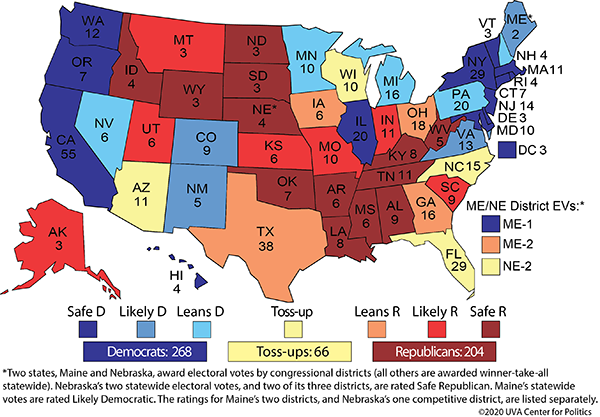
As Donald Trump continues to double down on rhetoric that thrills his core base of racists and Christian extremists in the hope of turning out his base in November, the opposite effect is happening with the rest of the population.  Indeed, the more ugly Trump's rhetoric becomes, the more voters he appears to be driving away.  A piece in Larry Sabato's Crystal Ball even shows Trump's lead in reliably red states dwindling and has caused GOP stalwart states like Alaska, Indiana, Kansas, Missouri, Montana, South Carolina, and Utah from "safe Republican" to "likely Republican."  One can only hope that Trump's hemorrhaging of support continues and that the presidential election becomes a rout with Biden winning by a landslide.  Personally, I want this to happen because it would restore some shred of faith in the American public as a whole and because it would devastate Trump's ego - Trump's pain is my pleasure, if you will.  Here are highlights from the Crystal Ball:

We are now about six weeks into a downturn in Donald Trump’s polling numbers. It’s worth thinking about the ramifications of this change if it endures.
In the RealClearPolitics average of national approval polling, Trump went from about early December to late May without ever dipping below -10 in net approval (approval minus disapproval). He has spent every day since June 1 at or below -10 net approval, and he’s currently at about -15.
Joe Biden’s national polling lead over Trump through May was in the four-to-six-point range. That is a decent lead, but not one that suggested Biden was a towering favorite . . . . But since early June, Biden’s lead has ballooned to the eight-to-10-point range. He has also enjoyed healthy leads in many polls of the most important swing states, like Florida, Michigan, Pennsylvania, and Wisconsin.
The bottom line here is that the nation is in a state of terrible crisis, and the public has, at least for now, judged the president’s responses to both coronavirus and protests of racial inequalities in policing to be lacking.
In an ABC News/Ipsos poll released Friday, 67% of respondents disapproved of Trump’s handling of coronavirus and of race relations. . . . . It is not the kind of year when one wants to be an incumbent running for reelection, and a majority of the public appears to believe that this president is not meeting the moment.
A few weeks into the public health crisis, we explored the possibility of Trump being the second iteration of Jimmy Carter, whose reelection bid fell apart among myriad crises in 1980. Since then, the Trump-as-Carter scenario has grown even more plausible.
There is time for the situation to change — as we wrote a few weeks ago, we want to see where things stand after the conventions, around Labor Day. But Trump is extremely unlikely to win if the polls continue to look the way they do now. And if these numbers represent a new normal, we need to account for the possibility that this election won’t be particularly close, and that new states may come into play. In other words, if the national picture remains bleak for Trump, then the slippage he’s seen from earlier this year wouldn’t just be limited to a handful of swing states.
The very well-sourced New York Times trio of Maggie Haberman, Jonathan Martin, and Alexander Burns recently reported that internal Republican data showed Trump with only a small lead in Montana and trailing in Kansas, two states that Trump carried by about 20 points apiece in 2016 (both have competitive Senate races, too).
Trump’s position is weak enough in mid-July that we have to concede there are some signs of competitiveness in states that were not competitive in 2016. This sort of thing can happen when the overall election is tilted toward one side over the other, which is the state of play at the moment and the advantage Biden currently holds.
[W]e continue to rate states like Colorado, New Mexico, and Virginia as Likely, not Safe, Democratic. That’s despite it being hard to imagine Trump carrying any of them, even if his position dramatically improves.
So we’re moving seven Safe Republican states to Likely Republican: Alaska, Indiana, Kansas, Missouri, Montana, South Carolina, and Utah. . . . In all likelihood, these red states are going to vote for Trump, and not just by a few points.
But could one or more flip if Biden wins decisively in November? Possibly. Let’s remember: A “Likely” rating still means we see one side — in this case, the Republicans — clearly favored in a state. We just don’t feel 100% certain about these states in the event of a lopsided election.
We think we’ll get more clarity about which scenario is more likely following the conventions — whatever the conventions actually look like. Even with 2020’s scaled down, undramatic, and overshadowed conventions, voters and media see them as departure points into the general election. Casting a ballot is no longer just on the distant horizon. It’s a reality that will firm up people’s choices — and our ratings.

Monday, May 18, 2020

Republicans Warn Trump's Re-Election is on Shaky Ground

It is still over five months to the November, 2020, elections, but two news stories point to good news for decent, moral Americans - a group that excludes the majority of evangelicals - who are sickened by the Trump/Pence regime.  One in Politico reports on the danger signs in swing states that suggest that Trump is losing to Joe Biden.  The other is at FiveThirtyEight which suggests that older Americans, especially those over 65 are beginning to abandon Trump.  It goes without saying that Trump will shriek and whine about "fake news" even though internal Republican polling confirms the news reports.  One can only hope that the trend continues and that, as Republicans fear, Trump is irrevocably attached to his bungling of the response to the Covid-19 pandemic.  First these highlights from Politico:
Donald Trump has made clear he will attack Joe Biden unmercifully in order to ensure the election is a choice between him and Joe Biden — rather than an up-or-down vote on [Trump's] the president’s handling of the coronavirus.
Scott Walker has a different view, at least when it comes to Trump's chances in the all-important battleground of Wisconsin.
“I think it still boils down to a referendum on [Trump] the president. They’ll beat up on Biden and they’ll raise some concerns,” said the former two-term Republican governor of Wisconsin, who lost his seat in 2018. But in the end, if people felt good about their health and the state of the economy, Trump will probably carry Wisconsin. If not, Walker said, “it’s much more difficult” for [Trump] the president.
Walker is not alone among swing-state Republicans in his assessment of [Trump's] the president’s political prospects. Interviews with nearly a dozen former governors, members of Congress, and other current and former party leaders revealed widespread apprehension about Trump’s standing six months out from the election.
Many fret that Trump’s hopes are now hitched to the pandemic; others point to demographic changes in once-reliably red states and to the challenge of running against a hard-to-define Democratic opponent who appeals to a wide swath of voters. The concerns give voice to an assortment of recent battleground state polling showing Trump struggling against Biden.
[T]hroughout 2016, many Republicans thought he wouldn't win.  But that hasn’t quelled GOP fears, even in some traditionally friendly states.
Georgia hasn’t gone for a Democratic presidential nominee since 1992. But last week, Republicans released two internal surveys showing a neck-and-neck race, one of which had Biden narrowly ahead. “Georgia is absolutely at risk for Republicans in 2020 — up and down the ballot, everything is in play. . . . said Republican State Leadership Committee President Austin Chambers, who has deep experience in Georgia politics and recently released a memo warning the party to take the state seriously.
It's a similar story in Arizona. Public polling over the course of the spring has consistently shown Biden ahead, and a recent private GOP survey had the former vice president with a small lead. Though Democrats haven’t won Arizona in a presidential election since Bill Clinton in 1996, the party flipped four statewide offices in 2018.
Most of the GOP’s attention is focused on a trifecta of Rust Belt states that catapulted Trump to the presidency, but where he now trails.
Republicans, including Trump’s own advisers, are most concerned about Michigan. A Fox News survey taken last month showed Biden leading by 8 percentage points; two recent internal Republican surveys similarly had Trump trailing, but by smaller margins.Democrats are unlikely to repeat their mistake of 2016, when they failed to turn out voters in liberal Wayne County, an area that encompasses the heavily black Detroit metro area.
Recent surveys have also shown Trump behind in Pennsylvania, where Republicans suffered across-the-board losses in 2018. . . . . Former Pennsylvania Rep. Phil English said the state’s Democratic governor would face backlash for his management of the coronavirus but that voters would likely focus any frustrations toward national Republicans in power.
“I think there is too much blame-mongering going on, but that is predictable and I think that is going to complicate the political landscape for Republicans in Pennsylvania because they’re the party with the White House, so all negatives are going to first be set at their direction,” said English.
Former North Carolina Gov. Pat McCrory said he was confident Trump would win the state, which he carried by less than 4 percentage points in 2016. But with multiple competitive statewide races on the ballot, the former governor was less certain that Trump's popularity would carry over to other Republicans.
Though Florida has drifted toward Republicans in recent statewide elections — Trump carried it in 2016, and the party won races for governor and Senate in 2018 — recent surveys have shown [Trump] the president trailing in his newly adopted home state.
Five ThirtyEight has equally encouraging news about the possible mass defection of older voters from Trump whose policies - as well as the GOP controlled Senate - ought to be setting off alarm bells among the over 65 voters.  Here are story excerpts:
There are different “gaps” in American politics, but one that has consistently shown up in recent presidential elections is the age gap. That is, younger voters tend to vote more Democratic and older voters tend to vote more Republican.
In 2016, for instance, President Trump performed best among voters 65 years and older. . . . . However, recent public polls — and [Trump's] the president’s own private polling — suggest that Trump may be doing worse among older voters against former Vice President Joe Biden, the presumptive Democratic nominee.
In national head-to-head polls conducted since April 1, Trump is barely breaking even with most older Americans — and in some age groups, he’s even trailing Biden by as much as 1.4 points (see 45- to 64-year-olds).
The most startling shift, though, is among voters age 65 and older. Four years ago, Trump bested Hillary Clinton by 13 points, 55 percent to 42 percent, . . . . But now Biden narrowly leads Trump 48 percent to 47 percent, based on an average of 48 national polls that included that age group.1 If those figures hold until November, they would represent a seismic shift in the voting behavior of America’s oldest voters.
But it’s not just among voters 65 and older where Trump is slipping. He’s also fallen almost as far among voters 55 and older. Trump is essentially tied with Biden among that age group, even after winning these voters by 10 points in 2016, 53 percent to 43 percent, according to the CCES. Trump’s numbers have also fallen with 45- to 64-year-olds, as well as 50- to 64-year-olds . . . .
We don’t have as much state-level polling to work with, but there’s evidence that Biden is also doing better with older voters in some key swing states. Take two recent surveys from Florida, a state with one of the oldest populations in the country. A Fox News poll from mid-April found Biden with a slim 3-point lead over Trump and running even among voters 45 and older, while a Quinnipiac University survey from the same period found Biden up 4 points overall in Florida and leading Trump 52 percent to 42 percent among voters 65 and older.
Yes, things can change over five months, but the message to decent, moral Americans is that they need to do all they can to convince friends and family members to jettison Trump and ideally vote a straight Democrat ticket - especially if they live in Kentucky or South Carolina.  Moscow Mitch McConnell needs to be sent into retirement as does Lindsey Graham, the Palmetto Queen.

Friday, June 14, 2019

ABC Gets Internal Polls Trump Said Don’t Exist

The one constant with Donald Trump is that he lies - all the time and about almost everything.  Thus, when rumors got out that his re-election campaign had done internal polls that were devastating to Trump's 2020 hopes, it is no surprise that Trump lied.  Indeed, he claimed the internal polls did not exist - I head a replay of his lie just this morning.  Now, the lie has been exposed.  ABC News secured the internal polls and they were indeed grim for Trump and his unwashed, knuckle dragging supporters.  Here are highlights from ABC News: 
Data from President Donald Trump's first internal reelection campaign poll conducted in March, obtained exclusively by ABC News, showed him losing a matchup by wide margins to former Vice President Joe Biden in key battleground states.
Trump has repeatedly denied that such data exists.
The polling data, revealed for the first time by ABC News, showed a double-digit lead for Biden in Pennsylvania 55-39 and Wisconsin 51-41 and had Biden leading by seven points in Florida. In Texas, a Republican stronghold, the numbers showed the president only leading by two points.
ABC News did not obtain the poll’s early matchups against other candidates.  The New York Times was first to report the existence of the internal polls.
When presented by ABC News with these numbers, the Trump campaign confirmed the data saying in a statement that the numbers were old and that they have seen huge swings in Trump’s favor. The Trump campaign did not provide the results of the full 17 state poll, matchups against other candidates nor any updated polling figures. In the recent days [Trump] the president has continued to lash out against reports that his campaign’s internal polling showed him trailing in key battleground states, slamming the numbers as “phony polling information.” Trump has called his internal poll numbers “unbelievable” and that he was “the strongest I’ve ever been.” When Stephanopoulos mentioned reports of polls commissioned by the Trump campaign that showed Biden ahead of him in key states, [Trump] the president said “those polls don't exist.” A day later, the president took to Twitter and again claimed internal polling showing him behind in battleground states didn’t exist.


Liar, liar pants on fire.  Trump is despicable.