
Saturday, June 14, 2025


Trump’s Dangerous Dictator Cosplay

Call it Donald Trump’s Strongman Week. Over the course of just a few days, the [Felon]
Presidenthas ordered the military into the streets of Los Angeles—over the objections of California’s Democratic governor—to curb protests against his immigration crackdown, appeared with cheering uniformed troops at what amounted to a political rally, and planned to hold a military parade featuring the rare spectacle of tanks rolling through the streets of Washington. Trump’s martial rhetoric accompanying these militarized photo ops has portrayed a nation that is all but on the brink of war—with itself.That any of this is even happening amounts to the most striking contrast possible with his first term, when Trump craved similar displays of military might but found himself stymied by his own senior officials, who balked, stalled, and, at times, outright disagreed with his demands.
In 2017, the President returned from an impressively bellicose Bastille Day celebration in France determined to host his own version of a military parade. It never took place, largely because the Pentagon’s leadership and Trump’s White House chief of staff, a retired four-star marine general, were adamantly opposed to such a display. In a passionate outburst that I learned about several years later, the vice-chairman of the Joint Chiefs of Staff at the time, Paul Selva, confronted Trump about it directly in the Oval Office. Such a parade, he warned Trump, would be profoundly un-American, “what dictators do.” But Trump, of course, wanted to do it anyway.
The truth is that the parade is the least of it—an empty spectacle that is surely to be quickly forgotten except in the District of Columbia itself, where tens of millions of dollars will have to be spent to repair the damage done by heavy weapons of war ripping up its pavement. The plan for thousands of simultaneous anti-Trump “No Kings” protests around the country on Saturday means that the day is just as likely expected to be remembered as an example of America’s tragic divisions right now as for its display of a Commander-in-Chief’s unchecked power.
It’s on the front lines in Los Angeles, rather than from a reviewing stand in D.C., where Trump seems tempted to take the leap from performative strongmanism to something more approaching the real thing. When protests against increasingly heavy-handed raids by agents of his Department of Homeland Security escalated there last weekend, the President rushed to do what his advisers had stopped him from attempting in his first term—sending in the uniformed military to quell a domestic political disturbance. Nearly five years ago to the day, on June 1, 2020, Attorney General Bill Barr, Defense Secretary Mark Esper, and chairman of the Joint Chiefs of Staff Mark Milley—Trump appointees all—teamed up to talk him out of invoking the Insurrection Act and mobilizing the military to stop the Black Lives Matter protests that had sprung up across the nation . . . . Trump never stopped regretting that decision, and his quick move to escalate in Los Angeles looked like an exorcism of sorts. The message? This is Trump unfettered, erasing the lingering frustrations from his first term and no longer constrained by any dissenting voices on his own staff.
[T]he deployment in California is political theatre just as irresistible as his parade; he is forever playing Richard Nixon in 1968, the “law and order” candidate who will save America’s cities from left-wing riots. One problem for Trump with this vision is that the citizens of Los Angeles mostly failed to coöperate with his plan and did not actually torch their own downtown . . . . Another hard-to-overlook obstacle for Trump are the federal courts, which will now consider whether Trump had the right to overrule California’s Democratic governor, Gavin Newsom, and order the deployments of thousands of the state’s National Guard, along with seven hundred marines.
In a speech on Tuesday night, Newsom denounced Trump’s move as a “brazen abuse of power.” But what’s struck me is the response by Trump and his officials, who are warning not only that they may defy the federal courts regarding California but that this is the new template for them wherever they choose to use it in America. . . . . This is the real escalation—a Trump-led federal government that has now redefined national security to include dissent from its policies by American citizens. The threats that most animate this President are those not from malign foreign actors but from “the enemy from within.” And he told us so himself, even before the 2024 election, whether people paid attention to it or not.
Reality itself is now so conditioned on political identity that, for a large swath of Trump’s supporters, it does not matter what conditions in California actually are: if Trump and his acolytes such as Sanders say that it is a crime-ridden hellscape under invasion by foreign masses and native-born “insurrectionists,” as Trump put it when he appeared at Fort Bragg on Tuesday, then that is what it must be.
On Saturday, Trump may not show up to his parade in full Saddam regalia; he’s more likely to wear a suit and a red MAGA hat than the shades and medal-bedecked uniform of one of those thugs, such as Kim Jong Un, whom he so admires. But I’d say watch out just the same: All this dictator cosplay may, sooner or later, persuade him to try out the real thing. Happy seventy-ninth, Dear Leader!

Friday, June 13, 2025

Thursday, June 12, 2025

Trump's Military Play in Los Angeles Follows a Long, Disturbing Pattern

Revolutions have a logic. The revolutionaries start with a big, transformative, impossible goal. They want to remake society, smash existing institutions, replace them with something different. They know they will do damage on the road to their utopia, and they know people will object. Committed to their ideology, the revolutionaries pursue their goals anyway.
Inevitably, a crisis appears. Perhaps many people, even most people, don’t want regime change, or don’t share the revolutionaries’ utopian vision. . . . . But whatever the nature of the crisis, it forces the revolutionaries to make a choice. Give up—or radicalize. Find compromises—or polarize society further. Slow down—or use violence.
The bloodiest, most damaging revolutions have all been shaped by people making the most extreme choices. When the Bolsheviks ran into opposition in 1918, they unleashed the Red Terror. When the Chinese Communists encountered resistance, Mao sent teenage Red Guards to torment professors and civil servants. Sometimes the violence was mere theater, lecture halls full of people demanding that victims recant. Sometimes it was real. But it always served a purpose: to provoke, to divide, and then to allow the revolutionaries to suspend the law, create an emergency, and rule by decree.
I doubt very much that Donald Trump knows a lot about the methods of Bolsheviks or Maoists, although I am certain that some of his entourage does. But he is now leading an assault on what some around him call the administrative state, which the rest of us call the U.S. government. This assault is revolutionary in nature. Trump’s henchmen have a set of radical, sometimes competing goals, all of which require fundamental changes in the nature of the American state. The concentration of power in the hands of the president. The replacement of the federal civil service with loyalists. The transfer of resources from the poor to the rich, especially rich insiders with connections to Trump. The removal, to the extent possible, of brown-skinned people from America, and the return to an older American racial hierarchy.
Trump and his allies also have revolutionary methods. Elon Musk sent DOGE engineers, some the same age as Mao’s Red Guards, into one government department after the next to capture computers, take data, and fire staff. Trump has launched targeted attacks on institutions that symbolize the power and prestige of the old regime. . . . . Trump’s family and friends have rapidly destroyed a matrix of ethical checks and balances in order to enrich the president and themselves.
But their revolutionary project is now running into reality. More than 200 times, courts have questioned the legality of Trump’s decisions, including the arbitrary tariffs and the deportations of people without due process. Judges have ordered the administration to rehire people who were illegally fired. DOGE is slowly being revealed as a failure, maybe even a hoax . . . . Now Trump faces the same choice as his revolutionary predecessors: Give up—or radicalize. Find compromises—or polarize society further. Slow down—or use violence. Like his revolutionary predecessors, Trump has chosen radicalization and polarization, and he is openly seeking to provoke violence.
For the moment, the administration’s demonstration of force is mostly performative, a made-for-TV show designed to pit the United States military against protesters in a big Democratic city. The choice of venue for sweeping, indiscriminate raids—Home Depot stores around Los Angeles, and not, say, a golf club in Florida—seems orchestrated to appeal to Trump voters. The deployment of the U.S. military is designed to create frightening images, not to fulfill an actual need.
The Marines in Los Angeles may provoke more violence, and that may indeed be the true purpose of their mission; after all, the Marines are primarily trained not to do civilian crowd control, but to kill the enemies of the United States. In an ominous speech at Fort Bragg yesterday, Trump reverted to the dehumanizing rhetoric he used during the election campaign, calling protesters “animals” and “a foreign enemy,” language that seems to give permission to the Marines to kill people. Even if this confrontation ends without violence, the presence of the military in Los Angeles breaks another set of norms and prepares the way for another escalation, another set of emergency decrees, another opportunity to discard the rule of law later on.
The logic of revolution often traps revolutionaries: They start out thinking that the task will be swift and easy. The people will support them. Their cause is just. But as their project falters, their vision narrows. At each obstacle, after each catastrophe, the turn to violence becomes that much swifter, the harsh decisions that much easier. If not stopped, by Congress or the courts, the Trump revolution will follow that logic too.

Wednesday, June 11, 2025

Pro-Theocracy SBC Endorses Overturning Same-Sex Marriage

Southern Baptists voted overwhelmingly on Tuesday to call for the overturning of the Supreme Court ruling that legalized same-sex marriage, with strategists citing the successful effort that overturned the right to legal abortions as a possible blueprint for the new fight.
The denomination has long opposed gay marriage, but Tuesday was the first time its members have voted to work to legally end it. Expanding on conservatives’ success in overturning Roe v. Wade in 2022, the vote signals growing evangelical ambitions to overturn Obergefell v. Hodges, the Supreme Court ruling that was handed down 10 years ago this month.
Baptists, he said, are taking the long view, inspired by the tactics of the anti-abortion movement. Roe v. Wade granted a constitutional right to abortion that stood for nearly 50 years before activists and legal strategists defeated it, powered by support from Christian conservatives.
[T]he meeting is being closely watched as a snapshot of evangelical sentiment on a range of political, theological and cultural issues.
The measure opposing same-sex marriage was part of a sweeping and unusually long resolution under the title, “On Restoring Moral Clarity through God’s Design for Gender, Marriage, and the Family.” It includes calls for defunding Planned Parenthood, for “parental rights in education and healthcare,” and ensuring “safety and fairness in female athletic competition,” a reference to the debate over transgender women in women’s sports.
The resolution is nonbinding, but suggests that evangelicals have long-term ambitions to dismantle an institution that many Americans now accept as a basic right. Southern Baptists who supported the resolution acknowledged that same-sex marriage has wide support.
The resolution also echoes the language of pronatalism that has taken hold in many conservative circles, including those influencing the second Trump administration. The resolution that passed on Tuesday criticizes the pursuit of “willful childlessness” and refers to the country’s declining fertility rate as a crisis. That language goes beyond Baptists’ traditional support of general “family values,” embracing a cultural agenda that encourages larger families as a matter of civilizational survival. Baptist theology does not oppose birth control per se.
Other resolutions passed on Tuesday called for banning pornography, and condemning sports betting. “We denounce the promotion and normalization of this predatory industry in every athletic context,” the gambling resolution stated. It called on corporations involved to “cease their exploitative practices,” on policymakers to curtail sports betting, and on Christians to refuse to participate.
Like many Christian denominations, it is broadly in decline, with about 12.7 million members in 2024, a 2 percent decline from the year before. But church attendance and baptisms were up, suggesting an ongoing vitality in the pews.
Passing the resolution against same-sex marriage could suggest to policymakers that conservative Christians have the will to sustain long-term opposition to positions without much popular support, including from some conservative politicians.
Last year, the convention adopted a resolution opposing the use of in vitro fertilization, frustrating many Republicans who wanted to reassure voters that their opposition to abortion would not endanger widely popular fertility treatments.
They will also discuss a constitutional amendment cracking down on women pastors, which failed to pass last year but seems to have gained support.
In short, the SBC is anti-women's rights, gay rights, and modernity in general.

Tuesday, June 10, 2025

Legal Scholars: Trump’s Troop Deployment is a Warning Sign

Trump’s deployment of 2,000 National Guard troops to Los Angeles is stretching the legal limits of how the military can be used to enforce domestic laws on American streets, constitutional law experts say.
Trump, for now, has given the troops a limited mission: protecting federal immigration agents and buildings amid a wave of street protests against the administration’s mass deportation policies. To justify the deployment, Trump cited a provision of federal law that allows the president to use the National Guard to quell domestic unrest.
But Trump’s stated rationale, legal scholars say, appears to be a flimsy and even contrived basis for such a rare and dramatic step. The real purpose, they worry, may be to amass more power over blue states that have resisted Trump’s deportation agenda. And the effect, whether intentional or not, may be to inflame the tension in L.A., potentially leading to a vicious cycle in which Trump calls up even more troops or broadens their mission.
“It does appear to be largely pretextual, or at least motivated more by politics than on-the-ground need,” said Chris Mirasolo, a national security law professor at the University of Houston.
California Gov. Gavin Newsom called the deployment “unlawful” and said he would sue Monday. “This is about authoritarian tendencies. This is about command and control. This is about power. This is about ego,” Newsom, a Democrat, said Sunday on MSNBC. “This is a consistent pattern.”
At issue is the president’s authority to deploy the military for domestic purposes. A federal law, the Posse Comitatus Act of 1878, generally bars the president from using federal troops — the Army, Navy, Marines, Air Force or Space Force — to enforce domestic laws.
But there are exceptional circumstances when the president can use troops domestically. The most prominent exception is the Insurrection Act, which authorizes the president to deploy the military to suppress insurrections, “domestic violence” or conspiracies that undermine constitutional rights or federal laws. At the end of Trump’s first term, some of his most ardent supporters urged and expected him to invoke the Insurrection Act to push aside state election authorities and essentially void the 2020 presidential election results, although he never did so. During his 2024 campaign, he said he would invoke the act to subdue unrest if reelected.
But so far, Trump has not invoked the Insurrection Act. Instead, in a Saturday order, he cited a different statutory provision: a terse section of the U.S. code that allows the president to use the National Guard — but not any other military forces — to suppress the “danger of a rebellion” or to “execute” federal laws when “regular forces” are unable to do so.
“Federalizing Guard troops in this situation — and raising the specter of also sending in active duty military personnel — is a political stunt, and a dangerous one.” . . . . Trump has fueled the fears of further escalation, actively commenting on the protests while attacking the state’s response.
Trump is not the first president to deploy the military over a governor’s objection. But it’s the first time since 1965, when President Lyndon Johnson ordered troops to protect civil rights protesters in Alabama. President Dwight Eisenhower similarly overrode objections from Alabama’s governor, deploying troops to help enforce the desegregation of public schools. When presidents view state and local authorities as being ineffective or recalcitrant, those steps may be justified, some experts say.
“Usually the President calls out the troops with the cooperation of the governor, which happened in LA itself during the Rodney King riots,” said John Yoo, a legal counselor to President George W. Bush.
Newsom has railed against Trump’s unilateral action, saying it will inflame rather than ease tensions on the streets and that state and local law enforcement were appropriately responding to the unrest outside federal buildings. Newsom got backup from Democratic governors across the country, who signed a letter calling Trump’s National Guard deployment an “alarming abuse of power.”
“The military appears to be clashing with protesters in the streets of our country. That’s not supposed to happen,” said Elizabeth Goitein, a national security law expert at New York University’s Brennan Center. “It’s such a dangerous situation. It’s dangerous for liberty. It’s dangerous for democracy.”
Congress passed an appropriations rider in 2007 that explicitly granted the president that authority during “a natural disaster, epidemic, or other serious public health emergency, terrorist attack or Incident” and in reaction to an “insurrection, domestic violence, unlawful combination, or conspiracy.”
While some legal experts said the measure simply reiterated existing law, an unusually broad coalition — including all 50 U.S. governors — called for repeal of the amendment. And the following year, Congress did repeal it, allowing the law to revert to language in place since the 1950s.
Be very afraid.
Monday, June 09, 2025


Threats and Intimidation in LA: Trump's Dress Rehearsal
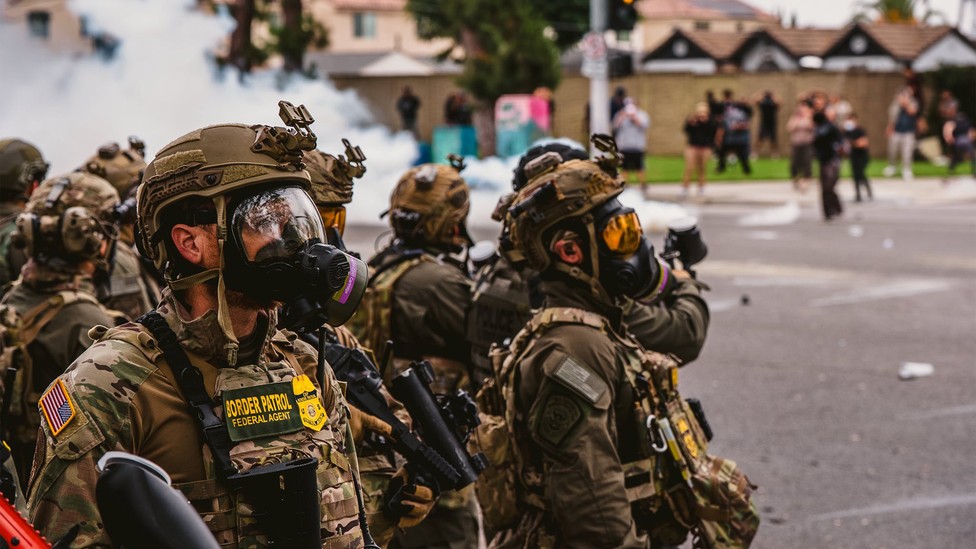
Yesterday, President Donald Trump ordered the National Guard to quell disorderly protests against immigration-enforcement personnel in Los Angeles. Secretary of Defense Pete Hegseth declared his readiness to obey Trump by mobilizing the U.S. Marines as well. These threats look theatrical and pointless. The state, counties, and cities of California employ more than 75,000 uniformed law-enforcement personnel with arrest powers. The Los Angeles Police Department alone numbers nearly 9,000 uniformed officers. They can surely handle some dozens of agitators throwing rocks, shooting fireworks, and impeding vehicular traffic.
If and when those 75,000 uniformed personnel feel overmatched by the agitators, California can request federal help of its own volition. . . . Trump is now forcing help that the city and state do not need and do not want, not to restore law but to assert his personal dominance over the normal procedures to enforce the law.
But if the Trump-Hegseth threats have little purpose as law enforcement, they signify great purpose as political strategy. Since Trump’s reelection, close observers of his presidency have feared a specific sequence of events that could play out ahead of midterm voting in 2026:
Step 1: Use federal powers in ways to provoke some kind of made-for-TV disturbance—flames, smoke, loud noises, waving of foreign flags.
Step 2: Invoke the disturbance to declare a state of emergency and deploy federal troops.
Step 3: Seize control of local operations of government—policing in June 2025; voting in November 2026.
Some of Trump’s most fervent supporters urged him to follow this plan in November 2020. But in 2020, they waited too long—until after the votes were cast. Using the military to overturn an election already completed was too extreme a step for a Department of Defense headed by a law-respecting Cabinet secretary such as Mark Esper. Trump looked to the courts instead. Only after the courts disappointed him did Trump attempt violence, and then the only available tool of violence was the lightly armed mob he summoned to Washington, D.C., on January 6, 2021. Harrowing as those events were, they never stood much chance of success: Without the support of any element of the military, Trump’s rioters could not impose the outcome Trump wanted.
But the methods Trump threatened in Los Angeles this weekend could be much more effective in November 2026 than the attempted civilian coup of January 2021.
If Trump can incite disturbances in blue states before the midterm elections, he can assert emergency powers to impose federal control over the voting process, which is to say his control. Or he might suspend voting until, in his opinion, order has been restored. Either way, blue-state seats could be rendered vacant for some time.
In his first term, Trump repeatedly talked more radically than he acted. He was usually constrained by his own appointees. Chairman of the Joint Chiefs Mark Milley rebuffed Trump’s suggestion during the George Floyd unrest that the military shoot protesters, which sufficed to dissuade Trump from upgrading the suggestion into a direct order.
But instead of Esper and Milley, the second Trump administration’s military is headed by a former talk-show host facing troubling allegations of heavy drinking and sexual misconduct. . . . . . Hegseth owes everything to Trump. The Department of Homeland Security and the Federal Bureau of Investigation are likewise headed by radical partisans with dubious records, abjectly beholden to Trump. This Trump administration is sending masked agents into the streets to seize and detain people—and, in some cases, sending detainees to a prison in El Salvador without a hearing—on the basis of a 1798 law originally designed to defend the United States against invasion by the army and navy of revolutionary France.
Since Trump’s return to the presidency in January, many political observers have puzzled over a seeming paradox. On the one hand, Trump keeps doing corrupt and illegal things. If and when his party loses its majorities in Congress—and thus the ability to protect Trump from investigation and accountability—he will likely face severe legal danger. On the other hand, Trump is doing extreme and unpopular things that seem certain to doom his party’s majorities in the 2026 elections. Doesn’t Trump know that the midterms are coming? Why isn’t he more worried?
This weekend’s events suggest an answer. Trump knows full well that the midterms are coming. He is worried. But he might already be testing ways to protect himself that could end in subverting those elections’ integrity. So far, the results must be gratifying to him—and deeply ominous to anyone who hopes to preserve free and fair elections in the United States under this corrupt, authoritarian, and lawless presidency.

Sunday, June 08, 2025

Musk Remains A Potentially Danger for Trump and the GOP

Trump says he is surprised and disappointed with Elon Musk over the messy public meltdown of their partnership. He also should be wary.
It’s not Musk’s ownership of one of the most influential social media platforms that should give the president pause. Nor is it the billionaire tech mogul’s status as the world’s richest man, with a recent history of bankrolling Republican causes.
It’s Musk’s stratospheric popularity with the Republican base, as revealed in the polls.
Musk is not about to overtake Trump himself as the dominant figure in the party, to be clear. But the jilted former “special government employee” is uniquely suited to become a chaos agent who could terrorize the GOP — potentially wreaking havoc on Trump’s legislative agenda and the party’s midterm election plans. Musk’s tenure leading the Department of Government Efficiency captured the GOP’s imagination, even if it ended ingloriously. . . . . Despite the furor over his slashing budgetary cuts, the scrutiny for DOGE’s secretive approach and the criticism for failing to deliver on his initial promises of $1 or $2 trillion in savings, Musk’s popularity with the GOP base has stayed fairly consistent.
That may change after Musk’s scorched earth break-up with Trump, but the odds aren’t great. Musk’s standing within the GOP has remained remarkably high since the beginning of the Trump administration — over 70 percent in most polls. That makes him far more popular than House Speaker Mike Johnson, Senate Majority Leader John Thune and almost everyone else in the party.
In part, that’s because the grassroots have been deep believers in Musk’s DOGE mission from the start. Nearly 90 percent of the party supports cutting the size of government. A similar share believes DOGE has been effective at cutting government spending, reports a recent Harvard-Harris poll.
The Trump-era GOP is a party where staffers feel free to publicly attack principals, where elected officials regularly attack each other for deviations from MAGA orthodoxy and where the unofficial mantra is Trump’s “fight, fight, fight.” Yet for days after Musk’s initial broadsides against the “big, beautiful bill,” no one — not even Trump, who’s known for nuking even the mildest of critics — laid a glove on Musk.
The silence was a tacit acknowledgement of a new apex predator in the political and media ecosystem, a Godzilla to Trump’s King Kong.
The stature accorded by Musk’s DOGE portfolio, its alignment with traditional Republican values surrounding government spending and budget deficit reduction, his limitless wealth and social media megaphone make him a uniquely dangerous rival, not just for Trump but for the party as a whole. He is part William Hearst and part Howard Hughes, not so much a threat to win the party’s affection from Trump as he is a potential bomb that could blow up the party’s plans.
Musk boasts his own base of support that exists outside traditional partisan boundaries, particularly marked by the parasocial relationship young men have with him. That makes him a danger to the fragile coalition Republicans relied on in 2024.
Musk knows MAGA’s pressure points. He’s been in the room where MAGA happened, on stage at the rallies, present for the Cabinet dog-and-pony shows.
The old axiom about never picking fights with those who buy ink by the barrel applies here: It’s a bad idea to feud with a tycoon who can not only deplatform you, but trash you to his 220 million followers.
There are limits to Musk’s reach — his bruising, polarizing run atop DOGE made him a pariah on the left and a political liability in a general election context. But his ability to dominate the attention economy makes him uniquely suited to upend Trump’s agenda on Capitol Hill and Republican efforts to hold on to Congress in 2026.
Like Trump, Musk learned fast about politics. When he embarked on his crusade to sink the sweeping tax-cut package, he recognized the precise language to employ to cut through the noise and provoke a reaction from the GOP base — “a disgusting abomination,” he called it, “[a] massive, outrageous, pork-filled Congressional spending bill.”
Musk also knew exactly how to trigger the [Felon]
president. He picked at the impeachment scab, suggested Trump couldn’t have won the White House without his help and predicted Trump’s tariffs will cause a recession. Musk went straight for the jugular by suggesting the president’s name appears in records of the investigation into the late convicted sex offender Jeffrey Epstein; . . . . Musk fueled the GOP base’s penchant for conspiracy theories by claiming records “have not been made public.”It’s a page ripped straight out of Trump’s playbook, timed to perfection just as MAGA adherents are growing restless with the Justice Department over its failure to deliver evidence of “deep state” involvement in one of the leading conspiracies animating the far right.
Musk also managed to roll a grenade into the Capitol, where he’s already undermined GOP congressional leadership by blasting them by name, and emboldened hardliners who were likely to be steamrolled. His potential for mischief remains considerable even in the event of a personal truce with Trump since the megabill, if it passes the Senate, still must make it back through the House.
If it seems like the GOP cavalry has been slow to aid Trump so far, that’s because Musk strikes fear into officeholders who can easily envision him funding primary challenges and hounding them on social media. And it’s not just the individual electeds who have cause for concern. Musk on Thursday floated the idea of creating a new political party “that actually represents the 80% in the middle” in an online X poll.
In less than 24 hours, more than 5 million votes had been cast.

Subscribe to:
Posts (Atom)