
Saturday, November 08, 2025


188+ Christian & Republican Leaders Charged With of Child Sex Abuse this Year

I first got involved in LGBT activism back in 2003 when I worked with Mike Rogers to "out" former Congressman Ed Shrock who had the second most anti-LGBT voting record in Congress at the time yet was trolling for gay trysts. Shrock made the mistake of trying to hookup with someone I knew who told me of the encounter. Then, as now, one of the things that motivated me was the rank hypocrisy displayed by Schrock whom I had known back in my days as a Republican activist (when I came out, to say I was not treated kindly by former colleagues would be an understatement). Nowadays, we see the same hypocrisy on the part of anti-LGBT Republicans and anti-LGBT pastors who demonizes members of the LGBT community and describe us as "groomers" and a threat to children. Meanwhile, in reality there are almost no instances where drag queens or gays have molested children. The same cannot be said about "Christian" and Republican leaders. A piece in LBGTQ Nation looks at data compiled by Evan Hurst - a FB friend of mine and fellow activist - that details how at least 188 Christian and Republican leaders have been charged with sexual abuse of children or child pornography so far this year alone. The number in all likelihood is even higher (several organizations have newsletters filled with the misdeeds of pastors and youth pastors). The sad truth is that for minors of both genders, church is often the most dangerous place when it comes to sexual predators. Here are article highlights:
Anti-LGBTQ+ conservatives have long crowed about how queer adults, drag queens, and their allies have been “grooming” and “sexualizing” children for abuse. Notably, these concern-trolls ignore all the child abuse scandals regularly coming out of the Republican party and the Christian church.
But journalist Evan Hurst — managing editor of the catty and left-leaning political website, Wonkette — has been keeping an ongoing list of Christian and Republican leaders who have been caught, accused, sued, or convicted for abusing and/or exploiting kids. Hurst has identified 188 Christian and Republican leaders this year, so far, stating, “If MAGA is so upset about Epstein, they should hear about Baptists!”
Hurst’s lists — which can be viewed here, here, and here — all link to local reports of church and GOP leaders being accused of abusing kids. His most recent update, published on Halloween, featured 49 new names of accused child abusers and pedophiles.
In fact, Hurst is having such a hard time keeping up with updates that he has asked for donors and subscribers to aid in his continuing efforts.
“Conservative Christian leaders are such prolific groomers and abusers of kids, the news is so full of these stories, they are published in such a rapid-fire manner, that if you let it go ANY MORE THAN A MONTH, then it will take you hours and hours and hours and days and weeks to compile an update,” Hurst wrote in his most recent update.
“If you are tracking drag queens or trans people or just LGBTQ+ people abusing children, you can take sabbaticals to Europe as often as you f**kin’ want,” Hurst added, “because those stories just don’t happen much, despite the lies vile MAGA Christians tell.”
Hurst notes that, according to Trump’s new National Security Directive (NSPM-7) for “countering domestic terrorism and organized political violence,” both “anti-Christianity” and “hostility towards those who hold traditional American views on religion” are listed as sentiments that can indicate one’s inclination to become a full-fledged “antifa” terrorist.
As such, Hurst wondered, “Is it ‘anti-Christian extremism’ or ‘hostility to traditional American values’ … to tell the truth about who is really sexually abusing children in this country, and how more often than not it’s conservative Christian religious leaders?”

None of Tuesday's Results Are Good for Republicans

President Trump’s[The Felon's] Halloween party at Mar-a-Lago, set to the theme of “The Great Gatsby,” reenacted the decadence of that story’s licentious era: befeathered flappers shimmying in the crowd; gilded and onyx décor; scantily clad women posing in an enormous champagne coupe. The revelatory moment says so much about where we stand today — and what we could be lurching into next.Published a century ago, F. Scott Fitzgerald’s “The Great Gatsby” captured the culture of an overheated economy on the brink of demise. Just as Jay Gatsby fell from the height of fortune to an ignominious death, the 1920s roared with financial overindulgence until the markets drowned in the Wall Street crash of 1929. The Great Depression followed, and the consequences for the global economy proved calamitous.
Today we find ourselves again dancing toward new highs in the stock market. Speculative money is once more pouring into risky investment schemes, with staggering sums of money being thrown at artificial intelligence and cryptocurrencies. But rather than heed a century of hard-won lessons, the Trump administration’s financial regulators are embracing dissolute policies to keep the punch flowing. The parallels between the 1920s and the 2020s are numerous — and ominous.
Again, the total disconnect of most Republicans and most certainly the Felon is shocking. Equally bad is the refusal of most Republicans to admit that the Felon is viewed as toxic by growing numbers of Americans - including those who swung Republican in 2024 only to see the Felon's campaign promise on the economy being broken and unfulfilled. As another column in the Times notes:
The scale of the Democratic wins should be a flashing warning sign to the Republican Party. Not just that the national environment is very favorable to Democrats, but that voters have ceased making distinctions between Trump and other Republicans. They’re treating other Republicans like they would treat Trump. And that is the nightmare scenario. It makes it much more difficult for incumbents next year to distance themselves from the president.
Yet, seemingly most Republicans continue to fear the Felon's wrath or the hint of a primary challenge by MAGA cultist more than a potential general election wipe out. A piece in The Atlantic continues this theme and how the Felon and the self-prostituting members of the GOP are ignoring the flashing warning signs. Here are column highlights:
President Donald Trump’s[The Felon's] gerrymandering war has never looked riskier for his party.Prodded by Trump, Republicans earlier this year launched an audacious plan to entrench their congressional majority by redrawing House-district maps to squeeze out Democrats—anywhere and everywhere they could. The gambit was an exercise in political power and, coming outside of the traditional decennial redistricting process, without precedent in modern history.
Yet if Democrats feared not long ago that they would be locked out of a House majority, their decisive victories across the country last night have made them, arguably, the favorites heading into next year’s midterm elections.
In California, an overwhelming majority voted to redistrict, essentially canceling out the five House seats that Republicans had thought they gained through redistricting in Texas over the summer. The GOP’s steep losses farther east cast even more doubt on the wisdom of its redistricting push. Voters repudiated Republicans virtually across the board, handing Democrats convincing victories for the governorships of New Jersey and Virginia, important judicial and legislative races in Pennsylvania, and, for the first time in two decades, a pair of statewide elections in Georgia. In Virginia, the breadth of the Democrats’ win gave them their largest majority in the state House of Delegates since 1989.
For Democrats, the results were reminiscent of—and in many cases stronger than—the victories they posted during the 2017 elections, in Trump’s first term, which presaged the wave that delivered them the House majority a year later. Even if the GOP’s gerrymandering advantage nets the party a few additional seats, Democrats will have a narrower gap to overcome next year than they did eight years ago.
Among the constituencies that swung the hardest toward Democrats yesterday were Latinos, who helped power Trump’s presidential win last year and were key to the GOP’s redrawn congressional map in Texas. The Republicans’ chances of flipping five additional House seats there rest in part on their holding Trump’s gains among Latino voters. That was a questionable assumption from the start, the longtime GOP strategist Mike Madrid told me. It appears even shakier in light of Tuesday’s election results . . .
“None of this is good for Republicans. It’s all their own doing, though,” Madrid said. Latinos in Texas border towns may vote differently in 2026 than Latinos in New Jersey did this year. But the anti-GOP shift in this week’s elections could boost the Democrats’ chances of winning two and possibly three of the five Texas seats that Republicans redrew in their favor, Madrid told me. It could also open up even more opportunities for Democrats, because to create the additional red-leaning seats, Republicans had to cut into previously safe GOP districts.
Yesterday’s election results could complicate both parties’ plans to escalate their gerrymandering tit-for-tat across the country. In addition to their Texas effort, Republicans have enacted newly drawn congressional maps in Missouri and North Carolina that could yield them an additional House seat in each state. . . . . Internal opposition, however, has slowed the GOP’s drive elsewhere. Ohio Republicans cut a deal with Democrats on revised districts that are more favorable for the GOP but not nearly as aggressive as some party leaders had advocated for. In Indiana, Republicans remain short of the votes they would need in the state legislature to gerrymander both of its House Democrats out of their seats, despite an intense pressure campaign from the White House. And just as polls were closing in eastern states last night, Kansas Republicans announced that they lacked support to call a special legislative session to redraw the House seat of Representative Sharice Davids, the lone Democrat in the state’s congressional delegation.
Some Democrats, meanwhile, were emboldened by the success of California’s Proposition 50, the ballot measure devised by Governor Gavin Newsom that temporarily redraws the state congressional map to target five Republican-held House seats and strengthen five additional swing districts represented by Democrats. With 75 percent of precincts reporting today, the referendum was leading by more than 25 points. . . . . The GOP’s “biggest strategy for trying to steal the 2026 election is falling apart before their eyes,” Ken Martin, the chair of the Democratic National Committee, told reporters on a conference call trumpeting the party’s electoral wins.
Even before Democrats swept Virginia’s elections last night, the party’s state legislative majorities began a two-year process to gerrymander two or three Republicans out of their House seats in the 2026 elections. House Minority Leader Hakeem Jeffries has pushed Democratic leaders in Illinois and Maryland to similarly redraw their state’s congressional maps. But the effort has met resistance from some Democratic lawmakers.
Martin said he hoped Tuesday’s election results, and especially the Prop 50 vote in California, would “send a chilling effect to Republicans” who are trying to gerrymander more states. “It’s not going to net you enough seats to guarantee that you’re going to control the U.S. House next year,” he said. “So knock it off now.”
There was no signal from Republicans that they planned to abandon their efforts. Although Trump voiced disappointment in the election results, other party leaders dismissed them. . . . . One GOP strategist, who was granted anonymity to candidly assess the party’s performance, told me that yesterday’s results were “a wake-up call.” But the strategist said Republicans remained “full-steam ahead” on their redistricting push in Florida.
Madrid said the elections should send each party a message on redistricting. Republicans should “pause and stop and contemplate. Say, ‘Wait a second. Maybe we made a mistake here.’” At the same time, Democrats should understand, he said, that they can win elections at the ballot box without sacrificing the moral high ground on gerrymandering. Madrid wasn’t optimistic, however: “There’s a lesson for both parties in this, and neither one of them will learn it.”

Friday, November 07, 2025

Marjorie Taylor Greene's Calculated Break With Trump
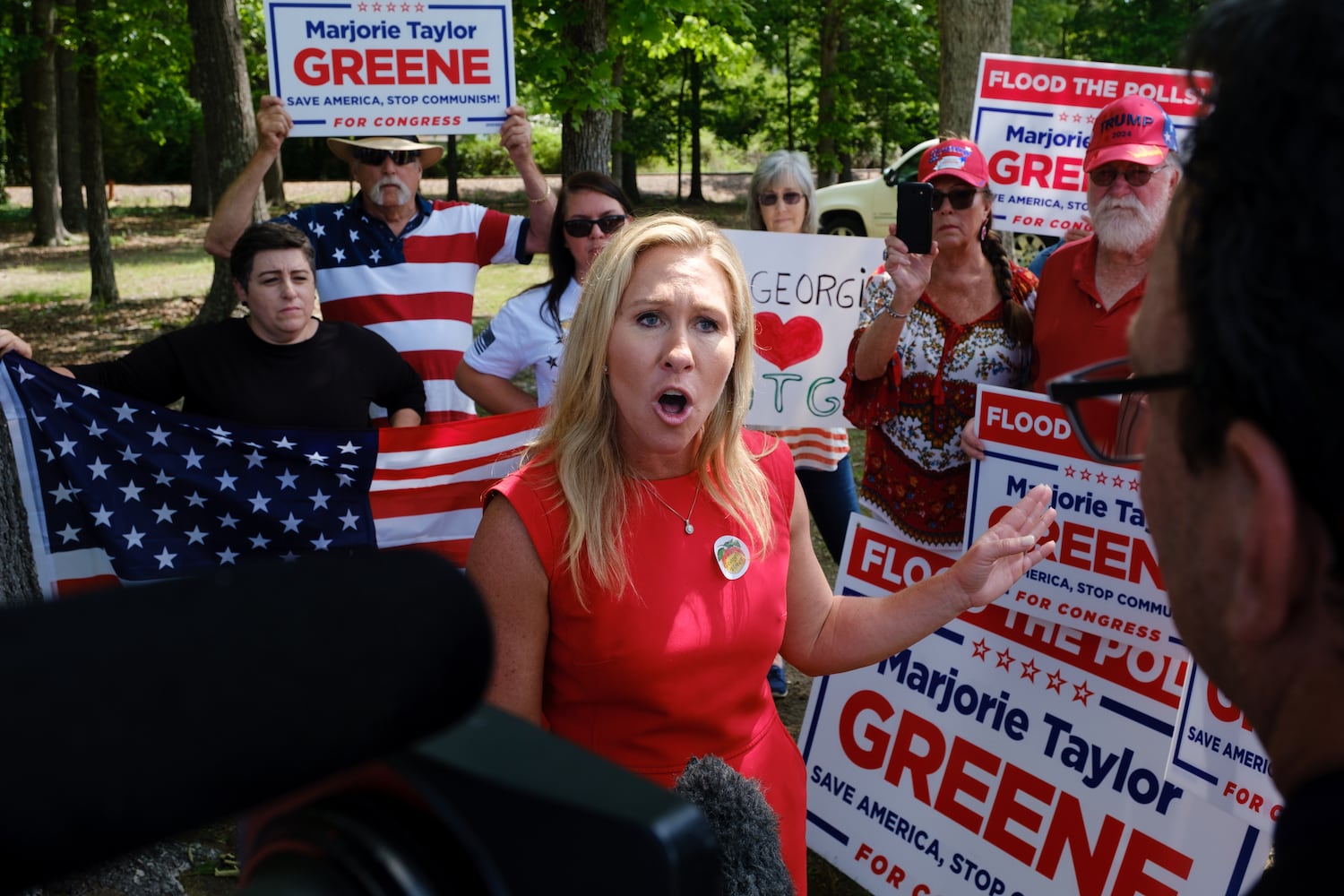
Representative Marjorie Taylor Greene has been bucking the Republican party line with increasing frequency—standing with Democrats to demand that the Justice Department release the Epstein files, decrying the spike in health-care premiums, and holding love-ins with the hosts of The View. Many people are trying to get their heads around the fact that the “Jewish space lasers” lady is now a leading voice of heterodoxy and, at least intermittently, common sense.
The prevailing theory for this bout of independence is that Greene is angry at the Felon
President Donald Trumpfor foiling her plans to run for Senate. “Here’s some tea for you,” explained Representative Alexandria Ocasio-Cortez, a longtime Greene antagonist, on social media this week: “The White House and Trumpland shut down Marjorie Taylor Greene’s personal ambitions to run for Senate, and she has been on a revenge tour ever since.” The journalist Tara Palmeri suggested in her newsletter, “As much as I’d like to believe Greene’s recent critiques are born of sudden enlightenment—that it was just fearing that her adult sons will have to pay higher Obamacare premiums that changed her mind on health care or that she’s suddenly opposed to mass deportations—the simpler, messier truth is often personal.”Having initially judged Greene to be a wildly uninformed conspiracy theorist, I was similarly predisposed to dismiss her evolution as a kind of revenge for being slighted. But having listened closely to her commentary of late, I’ve concluded that she is up to something more interesting and strategic. Greene seems to have recognized that the president has broken faith with his own followers. That realization may also now be dawning on other Republicans after Tuesday’s electoral mini-rout, but Greene not only saw it happening sooner; she began planning her future around it. She may be planning for a day when the MAGA movement is not led by Trump, or even by a member of his administration, but by a leader who can speak on behalf of its disgruntled base. Somebody like her.
When Greene announced in May that she wouldn’t seek her party’s nomination for Senate in Georgia next year, she insisted that Trump had not pressured her to stay out of the race. But Greene’s rebellion against him began around the same time. It takes a lot for Trump to disqualify a loyal candidate, but Greene’s history of conspiratorial claims—such as that 9/11 was an inside job, and that the Parkland and Sandy Hook shootings were staged—yielded polls that had her reportedly trailing incumbent Democratic Senator Jon Ossoff by double digits. Although Greene may have been diverted from her path to the Senate, she seems to have found an even bigger opportunity.
Her first major break with the administration came on the Epstein files. Right-wing activists devoted years to building up Jeffrey Epstein as not only a deviant and a monster but the beating heart of a nexus of dark power. It was odd, then, for Trump to suddenly declare the entire issue too boring even to merit discussion, let alone a full public disclosure.
Most of Trump’s supporters eventually, if reluctantly, came around to his position. After initially demanding more information, Charlie Kirk announced in July, “Honestly, I’m done talking about Epstein for the time being. I’m going to trust my friends in the administration. I’m going to trust my friends in the government to do what needs to be done.” Greene seemed to recognize that “trust my friends in the government” was not the most satisfying resolution to the saga that had gripped MAGA devotees, so she pounded the table for the files to come out.
Greene has also positioned herself as a vocal critic of Israel who has been willing to flirt with anti-Semitic conspiracy theories. She has voted to cut aid to Israel, including missile defense, and to protect the Boycott, Divestment, and Sanctions (BDS) movement from a ban backed by fellow Republicans.
Greene’s stances on these issues may be motivated by bigotry, but her views are consistent: She denounces most foreign aid, including to Israel, Ukraine, and Argentina, which is getting a $40 billion bailout from Trump. She has noticed that the party’s base remains attached to “America First” nationalism, some of which is inflected with anti-Semitism. Trump stoked these sentiments and rode them to victory, but in office has straddled the divide between MAGA ideals and standard conservative policy goals, such as lower taxes for the rich and a muscular foreign policy.
The representative’s most surprising act of deviation has come on health care. Democrats shut down the government to force Republicans to extend subsidies, without which premiums for health insurance bought through the Affordable Care Act marketplace will spike for millions of people. Republicans, still gripped by a dogmatic opposition to universal health care, have adamantly refused. Greene, however, has identified herself with the cause of constituents whose health insurance is suddenly unaffordable. “I’m absolutely disgusted that health insurance premiums will DOUBLE if the tax credits expire this year,” she wrote on X in early October, but swiftly added, “Also, I think health insurance and all insurance is a scam, just be clear!” (Greene’s views on the value of modern medicine are, well, idiosyncratic.)
Greene is essentially doing to Trump what Trump did to the Republican Party of George W. Bush: She is recognizing the gaping void between the values of the party’s leaders and those of its followers, and ruthlessly exploiting it.
When Trump ran for president a decade ago, he grasped that, although conservative voters loyally followed the party’s culture wars, they had little interest in the priorities of their leaders, such as a hawkish foreign policy and deep cuts to social welfare.
Greene seems to have stumbled onto the insight that Trump, despite his almost-theological hold on the base, has nonetheless betrayed it. Republican voters may not say they oppose aspects of Trump’s agenda, or even admit it to themselves. But Trump has used their loyalty to advance a series of causes—a regressive tax cut, slashes to Medicaid and food stamps, a bailout for Argentina—that his voters, at best, are willing to abide or, at worst, quietly resent.
Greene’s most shocking apostasy is her almost casual admission that Trump has not ended inflation and revived prosperity, as he routinely claims. “Prices have not come down at all,” she told the podcaster Tim Dillon in October. “The job market is still extremely difficult. Wages have not gone up. Health-insurance premiums are going to go up. Car insurance goes up every year.” . . . . they reflect public sentiment, which is the reason that Trump’s approval ratings have sagged, and that Democrats were able to run successfully everywhere on affordability in this week’s elections.
Imagine a Republican presidential primary three years from now. If the economy is booming, the party’s voters will probably crave the continuity promised by J. D. Vance. If inflation remains stubbornly high and the job market is still soft, or if the economy has plunged into outright recession, then matters will look different. The aperture will widen for a new populist MAGA leader who will carry out the promises Trump failed to fulfill. Greene appears to be making a bet on inheriting control of MAGA after a failed Trump presidency.
Greene has reportedly confided in colleagues that she has designs on the top office, apparently firm in the belief that she is “real MAGA and that the others have strayed.” Yet when Dillon asked whether she wished to run for president in 2028, Greene demurred. “Do I know what that means two years down the road or four years down the road?” she mused. “I don’t know what that means.”
Perhaps she doesn’t. But for a politician who may or may not know what she is doing, Greene is positioning herself for a future that, not long ago, would have appeared as absurd as a Trump presidency once did.
If Greene can cause the GOP to engage in a circular firing squad, I say kudos to her.

Thursday, November 06, 2025

SCOTUS Tariffs Arguments Were a Bloodbath for Trump

Going into Supreme Court arguments over President Donald Trump’s tariffs on Wednesday, it was genuinely difficult to guess how the justices would rule. Within minutes, that suspense vanished. The hearing was a bloodbath for the Trump administration: Six justices lined up to bash the Justice Department’s defense of the tariffs, barely disguising their annoyance with the government’s barrage of blustery nonsense. At the halfway point, it would’ve saved everyone time had the court just huddled, announced its decision from the bench, and recessed early for lunch. Trump’s signature trade policy—which he expected to raise trillions of dollars for him to use as he wished—looks dead on arrival at SCOTUS. We have spent ten months waiting to see if, and when, this court would set a limit on Trump’s power. Perhaps we should’ve guessed that its extraordinary deference to this president could be outweighed only by its hatred of taxes.
Wednesday’s case, Learning Resources v. Trump, marks a direct challenge to Trump’s unprecedented, unilateral imposition of global tariffs on almost every foreign nation. Although the Constitution vests the tariff power in Congress, not the president, the Justice Department asserts that Congress delegated this authority to the executive branch. Specifically, it cites a 1977 law called International Emergency Economic Powers Act—a strange choice, since that statute does not mention tariffs, customs, duties, or anything else that would imply a license for taxation. Solicitor General John Sauer told SCOTUS that IEEPA permits tariffs because it allows the president to “regulate” foreign “importation” to “deal with” an “unusual and extraordinary threat” abroad. “Regulation,” Sauer argued, includes tariffs, and the word “threat” is capacious enough to include fentanyl smuggling and even our trade deficit (which is, in reality, not a problem at all).
From the outset, a majority of justices weren’t buying what Sauer was selling. He stumbled early by irritating Chief Justice John Roberts with a heavy-handed invocation of Dames & Moore v. Regan, a 1981 decision about IEEPA. Roberts, who may have helped draft the opinion as a clerk, was plainly displeased by Sauer’s distortion of it. “That argument surprises me,” he told Sauer sternly, before reeling off passages from the ruling that undercut Trump’s position—including its warning that the case carries “little precedential value for subsequent cases.” With audible derision, Roberts concluded: “I don’t understand how you can get as much out of Dames & Moore as you’re trying to get.”
The solicitor general whiffed again with Roberts when he argued that the “major questions doctrine” does not apply to Trump’s tariffs. This doctrine bars the president from enacting an initiative of “vast economic or political significance” without explicit congressional authorization. Sauer insisted that it doesn’t apply here because tariffs implicate the president’s “foreign affairs” authority rather than domestic policy, giving him heightened constitutional discretion to do what he pleases. The chief was not convinced.
“It seems that it might be directly applicable,” he lectured Sauer. “You have a claimed source, IEEPA, that had never before been used to justify tariffs. No one has argued that it does till this particular case.” Yet now Trump claims it allows him to “impose tariffs on any product from any country in any amount for any length of time.” The “basis for the claim” of this “major authority,” Roberts concluded, “seems to be a misfit.”
Sauer shot back that tariffs are exempt from such scrutiny because they involve international relations, a core presidential power. But Roberts reminded him that, at bottom, tariffs are an “imposition of taxes on Americans,” something that “has always been the core power of Congress.” Sauer insisted that “foreign producers” shoulder the tariffs, but the chief wasn’t buying it. “Well, who pays the tax?” he asked. “If a tariff is imposed on automobiles, who pays them?”
Justice Neil Gorsuch zeroed in on Sauer’s attempt to quietly transfer Congress’ taxing authority to the executive branch. “You say we shouldn’t be concerned because this is foreign affairs and the president has inherent authority,” Gorsuch said. “If that’s true, what would prohibit Congress from just abdicating all responsibility to regulate foreign commerce—for that matter, declare war—to the president?” Could Congress decide that “we’re tired of this legislating business” and “hand it all off to the president?” Sauer backtracked a bit, acknowledging that Congress could not undertake an “abdication” of its duties; the justice wryly told him he was “delighted to hear that.”
Gorsuch followed up with a straightforward query: “Could the president impose a 50 percent tariff on gas-powered cars and autoparts to deal with the unusual and extraordinary threat from abroad of climate change?” Sauer admitted that he probably could, though he added that Trump would not because he rejects the “hoax” of climate change. “I think that has to be the logic of your view,” Gorsuch said sharply. He then asked: If Congress really did give the executive branch absolute freedom over tariffs, “what president is ever going to give that power back” by signing a bill that reins in IEEPA? Sauer hedged, but Gorsuch answered for him: “As a practical matter, in the real world,” Congress “can never get that power back.”
Justice Amy Coney Barrett sounded frustrated by the solicitor general’s hodgepodge of half-formed arguments, too, and cut through them with a poison dart of a question: “Can you point to any other place in the code, any other time in history, where that phrase together—’regulate importation’—has been used to confer tariff-imposing authority?” All Sauer could point to was a predecessor to IEEPA that President Richard Nixon used to impose a 10 percent tariff in 1971. But, as Barrett pointed out, that dubious action was only approved by an “intermediate appellate court,” not SCOTUS. And more to the point, Congress narrowed the president’s powers when it replaced the former statute with IEEPA, in direct response to Nixon’s actions. So, Barrett wondered, is there any other example? Sauer waffled, prompting Justice Sonia Sotomayor to leap in and tell him: “Could you just answer the justice’s question?” (It is never a good sign for your side when Sotomayor and Barrett are teaming up against you.) Finally, the solicitor general had to admit that he had no other examples.
Sotomayor, along with Justices Elena Kagan and Ketanji Brown Jackson, played backup nicely throughout the morning, pressing Sauer on the areas where their colleagues expressed the most skepticism. . . . Sotomayor drilled down on the obviously pretextual nature of the stated “emergencies” at issue, leading Barrett to ask if “every country” truly “needed to be tariffed because of threats to the defense and industrial base.” How does slapping tariffs on Spain and France protect the nation’s security? All Sauer could cite was Executive Order 14257, Trump’s “Liberation Day” tariffs. Barrett, a former law professor, did not seem persuaded that this notoriously sloppy and economically illiterate document was a substitute for reality-based reasoning.
[I]t’s hard to see how this case comes out as anything less than a 6–3 loss for the administration. Roberts, Gorsuch, and Barrett’s questioning of Katyal was far friendlier than their grilling of Sauer, who spoke in a frothy jumble of run-on sentences that was often hard to understand. (Jackson even noted at one point that he was speaking too quickly.) It sounded as if this trio was trying to figure out how they’ll rule against Trump: Must they invoke the major questions doctrine, as Gorsuch suggested to Katyal? Or can they rest a decision on the plain text alone?
More questions remain: What happens to the $200 billion in tariffs that the government has already collected? Will the court order it paid back, or only issue relief moving forward (or perhaps merely to the specific plaintiffs in this case, whom the government promised to reimburse should it lose)? Can the justices rush out an opinion before that figure balloons higher? Will Trump try to issue new tariffs under narrower statutes that do authorize them, or will he bristle at the constraints they impose? But all that can wait another day. For now, it’s just a comfort to watch the Republican-appointed justices rediscover principle after ten months of bowing to Trump. Are they motivated by widespread hostility toward tariffs among the corporate interests they typically favor? Maybe. But who cares? What’s important is that, for the first time in a long time, they have finally found a line they won’t let Donald Trump cross.

Wednesday, November 05, 2025

Message to GOP: Trump Is an Albatross

As a presidential candidate, Donald Trump is a phenomenally effective vote-winner, capable of turning out millions of otherwise infrequent voters to deliver the White House and Congress to the Republican Party. But as president, Trump has been an albatross around the neck of his party.
Consider his record as party leader. In the 2017 elections, Republicans suffered sharp defeats in the Virginia and New Jersey governor’s races, with Virginia Democrats sweeping all three statewide offices and winning a majority in the state General Assembly. The following year, in the 2018 midterm elections, Democrats won a landslide victory in the House of Representatives, their largest since 2006. Trump came close to victory in the 2020 presidential but may have contributed to the Republican Party’s defeat in the Georgia Senate runoff election, handing the Democratic Party full control of Washington for the first time since 2011.
Even 2022, a midterm under President Joe Biden, was less successful than it could have been for the Republican Party because of Trump’s influence in the battle for the Senate, where voters rejected MAGA-aligned candidates in Arizona, Georgia, Nevada and Pennsylvania. With the 2024 presidential election came another strong Trump performance as he brought out the voters who support him and him alone.
Tuesday was the first major election since Trump entered the White House for a second term. And although voters across Virginia, New Jersey and New York City were most concerned with the particulars of their respective states and localities, there was no question that this was also a chance to register their discontent in a way that might send a message to Washington and the rest of America.
In each place, Democrats delivered crushing defeats to their Republican opponents. In the Virginia race for governor, Abigail Spanberger, the Democratic nominee for governor, cruised to victory along with Ghazala Hashmi, the Democratic nominee for lieutenant governor, and Jay Jones, the Democratic nominee for attorney general, who struggled with scandal in the final weeks of the race. In the New Jersey election for governor, Mikie Sherrill delivered an unambiguous defeat to the Republican Jack Ciattarelli, and in New York City’s three-way mayoral election, Zohran Mamdani prevailed over both a former governor, Andrew Cuomo, who ran as an independent, and the Republican nominee, Curtis Sliwa.
Supporters of the president might pooh-pooh these results as unrepresentative. This isn’t a presidential electorate, they might say; there are different circumstances. But New Jersey and New York City both had high turnout for off-year elections (Virginia had a slight increase). In other words, it really is the case that Trump specifically, in his capacity as president, inspires ferocious energy and opposition against him among a large part of the voting public.
The results, then, are a marked contrast to the accommodation, capitulation and outright surrender of prominent individuals and institutions in the face of Trump’s demands. They also serve to remind us of what ought to be a fundamental maxim of democracy: that there is no singular “people” and there are no permanent majorities.
As I have stressed again and again, it is a profound mistake to treat the 2024 presidential election as a referendum on the ideological direction of the United States or as evidence of a realignment or whatever else you happen to have as your hobbyhorse.
For some observers, the 2024 election seemed to show a shift of young people and Latinos to the Republican Party. This was said to herald a “vibe shift” in American politics and perhaps a durable turn to the political right. But the truth of the matter is that voters, and especially those who are new and infrequent participants in the political process, are as driven by events and circumstances as anything else. And the key factor last year was voters’ reaction to the inflation that plagued Biden’s term in office.
Americans voted in Trump to lower the cost of living and return the United States to the political and economic status quo as it was before the pandemic. But rather than meet the public where it was, Trump and his cadre of ideologues in the White House took their victory to mean that they could pursue their most radical dreams and try to make good on their extreme preoccupations.
In 2024, the Americans who decided the election voted for lower prices and a lower cost of living. What they got instead were soldiers on the streets, masked agents leading violent immigration raids, arbitrary tariffs, new conflicts abroad, dictatorial aspirations, endless chaos and a president more interested in taking a wrecking ball to the White House to build his garish ballroom than delivering anything of value to the public. . . . Trump is still talking about defying multiple court orders to restore food assistance to hungry families, even though his own administration announced that it would partially comply.
Both Trump and his administration are less interested in helping ordinary Americans than they are in fulfilling their idiosyncratic program of austerity, pain and deprivation. They are all stick, no carrot.
It’s against this backdrop that voters just went to the polls and cast millions of votes against the president by way of Democratic candidates, moderate and progressive, who stood for both affordability and the nation’s most cherished values, who pledged to use their time in office to protect their new constituents from the provocations and assaults coming from the government in Washington.
Tuesday was a Democratic victory. And the party didn’t just win — it won by commanding majorities on virtually every field of play. In polls, in focus groups and now at the ballot box, the public is telling us something very clearly: Trump is simply too much. If this is an opportunity for Democrats to win back lost ground — and it is — then it is also a warning to a Republican Party that has tied its entire identity to the man from Mar-a-Lago.
Will Republicans get the message and end their endless self-prostitution to the Felon?

Tuesday, November 04, 2025

White-Supremacist Influencers Are Entering the MAGA Mainstream

Tucker Carlson slapped his nicotine-pouch container down on the table and got straight into it: “Nick Fuentes, thank you for doing this,” he said. “I want to understand what you believe, and I want to give you a chance, in a minute, to just lay it out.” The two were sitting in Carlson’s barn turned podcast studio at his home in Maine. In a more-than-two-hour-long episode of The Tucker Carlson Show that aired earlier this week, Carlson gave Fuentes, the 27-year-old white-nationalist influencer, access to one of the largest audiences he has ever had.
Although Fuentes has many dedicated fans, who call themselves “Groypers,” mainstream conservatives have long ignored him. Even as the Republican Party has come to embrace more extreme ideologies, he has been seen as too radioactive: Fuentes has praised Hitler on multiple occasions, likened “organized Jewry” to a “transnational gang,” and said that Chicago is “nigger hell”—in addition to many other racist and anti-Semitic statements. Just a few months ago, Carlson himself likened Fuentes to David Duke, the former Ku Klux Klan leader, and accused Fuentes of being part of a campaign to say the most bigoted things possible to make the rest of the right look bad.
In the interview this week, Carlson was critical of Fuentes’s anti-Semitism. “It’s against my Christian faith,” he said, referring to Fuentes’s history of blaming Jewish people for political problems. Otherwise, the episode was notably friendly. Carlson largely focused on their shared beliefs—among them, opposing foreign intervention and racial diversity—and only lightly probed Fuentes at other points in their discussion.
The conversation seems to have marked a shift in the right’s attitudes about Fuentes. In the past several months, he has appeared on podcasts with Candace Owens and Dinesh D’Souza, but their conversations with Fuentes were much more critical than Carlson’s. The latest sit-down represents “the crumbling of the last kind of firewall on the right against Nick,” Ben Lorber, an analyst with Political Research Associates, a group that monitors the far right, told me.
Some conservatives, including writers for Breitbart News and The Daily Wire, have criticized Carlson’s softball interview. But many others are standing by Carlson. Yesterday, Kevin Roberts, the president of the Heritage Foundation, a right-wing think tank, posted a video statement defending Carlson from “the venomous coalition attacking him.” . . . . . If Carlson can maintain support after talking to Fuentes, so can others.
In a 2021 episode of his livestreamed show, Fuentes said he wants to drag the Republican Party “kicking and screaming into the future, into the right wing, into a truly reactionary party.” His vision is coming true. Consider the leaked group chats of Young Republican leaders that were revealed by Politico earlier this month. The messages are full of the kind of anti-Semitic and racist jokes about the Holocaust and Black people that Fuentes has made as a livestreamer. . . . . Vice President J. D. Vance called the messages “offensive jokes” and dismissed outrage over the texts as irrational “pearl clutching.”
The gap between Fuentes and the rest of the right is narrower than it has ever been. The White House’s approach to social media now resembles the polemical, trolling, vicious manner of posting that Fuentes and his fans helped pioneer. . . . “He’s a barometer and a whisperer of real segments of the MAGA base that people like Tucker can’t ignore,” Lorber said.
The interview has more than 4 million views on YouTube; Fuentes’s own videos, which are posted on Rumble, typically do not get even one-tenth of that. If your introduction to Fuentes was solely via his interview with Carlson, you wouldn’t quite know how bigoted Fuentes’s views are. He elided significant parts of his racist history during their conversation, and Carlson did not press him on it. When Fuentes spoke of his political awakening as a college student, neither he nor Carlson mentioned a major reason Fuentes decided to drop out of Boston University: In 2017, he told a reporter that he’d received backlash and death threats after attending Unite the Right, the infamous white-supremacist rally in Charlottesville, Virginia.
During a lengthy back-and-forth in which he and Carlson found common ground on matters of gender, Fuentes said that “your wife ultimately is subordinate to you” and intimated that no-fault divorce gets in the way of relegating women to their supposed natural lower status. (“I’m a little sexist,” Carlson openly admitted at one point.)
Fuentes also gave some advice to Trump about the immigration crackdown in Chicago, where he lives. “Bring in the troops and say the federal government is supreme,” he said. “The immigration law is the law of the land. If you’re not on board with that, you’re going to jail.” Arrests aren’t enough; there must be a total autocratic military takeover of Illinois. For years now, Fuentes has been both an embarrassment to the right and an indicator of what’s brewing in the id of conservatism. Now that he has entered the fold of MAGA, his visions for a truly reactionary party are closer than ever to being realized.

Sunday, November 02, 2025

Trump’s Dictatorial Plan Is Now Out in the Open

Give Donald Trump this much: He has never tried to hide his malice, his lawlessness, or his desire to inflict pain on others. These were on vivid display when he engaged in a multipart conspiracy to overturn the results of the 2020 presidential election and stood by as a mob of supporters sought to hang his vice president. These were displayed, as well, every day during his 2024 vengeance campaign. Yet more than 77 million Americans decided that he was the man with whom they wanted to entrust the care of this nation.
For more Americans than not, and for many more evangelical Christians than not, Trump is the representative man of our time. His ethic is theirs. So are his corruptions. And for those of us who, in our younger years, revered America as a shining city upon a hill, a nation of nations, the “last, best hope of earth,” this is quite a painful period. America has lost its moral bearings; as a result, it has also lost its moral standing in the world.
A curtain of darkness is settling over our nation. And it’s getting ever harder to avoid connecting the authoritarian dots.
Trump is in the process of building his own paramilitary force. He is invoking wartime powers to deport people without due process, even suggesting that American citizens may be sent to foreign prisons. He has deployed National Guard troops to cities over the objections of local officials. In a speech to American troops in Japan, he warned: “If we need more than the National Guard, we’ll send more than the National Guard.”
Trump has signaled that he is open to invoking the Insurrection Act, an 1807 law that allows the president to deploy the military in the United States. And he has claimed, without legal justification, that he has the right to order the military to summarily kill people suspected of smuggling drugs on boats off the coast of South America. (The administration has yet to provide evidence to support its claims that the individuals who have been killed were cartel members or that the vessels were transporting drugs.)
My colleague Tom Nichols, a retired professor at the U.S. Naval War College, warns that eventually what Trump is doing will become a new principle for the use of force: “He is acclimating people to the notion that the military is his private army, unconstrained by law, unconstrained by norms, unconstrained by American traditions.”
Earlier this year, Secretary of Defense Pete Hegseth fired the senior judge advocates general, removing the officials who could obstruct the execution of unlawful orders from the commander in chief. Their dismissals will also have a chilling effect on those who remain. The firing of the JAGs is just one element of a broader purge of the military, which started at the beginning of Trump’s second term.
Trump views himself as the final arbiter of the legality of anything he does. An executive order he signed in February says, “The President and the Attorney General’s opinions on questions of law are controlling on all employees in the conduct of their official duties. No employee of the executive branch acting in their official capacity may advance an interpretation of the law as the position of the United States that contravenes the President or the Attorney General’s opinion on a matter of law.”
There’s more. Trump is the most corrupt and self-enriching president ever. He is also conducting what The New York Times’ Jim Rutenberg describes as “the most punishing government crackdown against major American media institutions in modern times, using what seems like every tool at his disposal to eradicate reporting and commentary with which he disagrees.” That includes suggesting that the Federal Communications Commission should revoke the licenses of television broadcasters that give him too much “bad publicity” and suing major newspapers and networks.
He has targeted law firms for political reasons and universities for ideological reasons. As part of his disinformation campaign, he fired the nonpartisan commissioner of the Bureau of Labor Statistics after the agency reported weaker-than-expected jobs numbers for July. He has called judges who rule against him “lunatics” and “monsters who want our country to go to hell.”
Trump has pressured the Department of Justice to target, indict, and destroy those he considers to be his political enemies. And he signed memorandums targeting two officials from his first term, including Chris Krebs, the former cybersecurity official who rejected Trump’s false claim of widespread election fraud.
As for free elections, the cornerstone of democracy, the Trump administration is using the levers of government to target “the financial, digital and legal machinery that powers the Democratic Party and much of the progressive political world,” The New York Times reports. Trump has ordered the Department of Justice to investigate ActBlue, the main Democratic fundraising platform. He has also said he’s going to “lead a movement” to outlaw electronic-voting machines and mail-in balloting, in an effort to disadvantage Democrats. . . . he Atlantic’s David A. Graham warns that Trump’s plan to subvert the midterms is already well under way. “The insurrection failed the first time,” Graham writes, “but the second try might be more effective.”
Trump learned from his first term; in his second go-around, he’s placed MAGA cultists in every key position of power. They will follow Trump to the ends of the Earth, knowing that a presidential pardon is there for the asking, if necessary.
There’s little indication that the central institutions of American life, including the Supreme Court, are willing to check Trump as he seeks unprecedented and nearly unlimited power. Nor is it clear that if they tried to do so, they would succeed. Trump has so far largely abided by court decisions, but beyond a certain point, on things he really cares about, he’ll likely ignore them. He will ask about Chief Justice John Roberts a variation of the question Joseph Stalin is supposed to have asked about the pope: How many divisions does he have?
We’re less than one-fifth of the way through Trump’s second term; things will get much worse. So it’s too early to know whether the damage that Trump and his MAGA movement are inflicting on the foundations of the United States is reversible, or whether the injury to our civic and political culture is repairable.
If America recovers, the path will lie not simply through electoral politics. The fate of the country rests on the recovery of republican virtue, the cultivation of an active passion for the public interest, and a willingness to sacrifice individual interests for the common good. Words and phrases such as honor and love of country have to stir people out of their lethargy and into action.
We saw some of that in the “No Kings” protests, but much more needs to happen. My colleague David Brooks, citing the work of the political scientists Erica Chenoweth and Maria Stephan, reminds us that “citizens are not powerless; they have many ways to defend democracy.” Whether we step up or not is a matter of civic will and civic courage. Can we summon those virtues at a moment when American ideals are under sustained assault by the American president?
Subscribe to:
Posts (Atom)