The U.S. could see an unprecedented 15,000 churches shut their doors this year, far more than the few thousand expected to open, according to denominational reports and church consultants.
The unprecedented contraction, expected to continue over the next decade, risks leaving gaps in communities nationwide — particularly rural ones, where churches often are crucial providers of food aid, child care and disaster relief.
The decline of traditional brick-and-mortar churches comes as a record number of Americans (29%) are identifying as religiously unaffiliated, and as 62% identify as Christians — down from 78% in 2007, according to the Pew Research Center. . . . . There are fewer and fewer communities built around local churches, but rising pressure from conservative citizens and government officials to inject more religion into public schools, settings and institutions.
The record number of church closings forecast this year stems from struggles many churches face — including retaining full-time pastors, said Thom Rainer, a former president of LifeWay Christian Resources, an entity of the Southern Baptist Convention that provides resources for churches.
The closures mark a shift away from once-powerful denominations in the U.S. that brought people of diverse political views together, said Burge, author of the upcoming "The Vanishing Church: How the Hollowing Out of Moderate Congregations Is Hurting Democracy, Faith, and Us." Burge said that as a result, many communities are left with empty church buildings that can be difficult to sell because they often are next to historic cemeteries.
Evangelical megachurches, however, tend to have fluid memberships despite their growing influence in Republican Party politics, Burge said. "The large churches have a lot of churn. A lot of new people come in every year, but a lot of people leave too, because they never build strong and deep ties." Their success is based on one or two leaders, and a death or scandal can damage or bring an end to that church, he said.
Megachurches could take membership hits in the future if younger Americans feel they're being forced to accept religion in public spaces, Chesnut predicted. "I think evangelicals are going to pay the price for so closely hitching their wagon to MAGA," he said. "If you're making kids pray in school, as I've learned anytime I make my kids do something, they'll do the opposite."
Thoughts on Life, Love, Politics, Hypocrisy and Coming Out in Mid-Life
Saturday, October 04, 2025
15,000 Churches Could Close This Year
The Felon's/MAGA's Ugly Vision for America
He is not a complicated man, the [Felon]
president of the United States. Donald Trumpis a 79-year-old who is going on 14, displaying without filter all the disordered thinking of a child reared in the insular bubble of wealthy, white America.To say that Trump operates on the level of a median racist adolescent is not intended as a cheap shot, but analysis that goes further in contextualizing his actions — and his success in politics — than the sort of explainers-for-liberals popular in his first term. . . . . Trump’s appeal is distilled in the even more explicit rhetoric of his followers.
Chaya Raichik, an adult woman who runs an account called “Libs of TikTok,” is not trying or perhaps capable of being subtle when she posts a photo of a Black politician like Minneapolis’ Omar Fateh and writes: “The average IQ in Somalia is 68.”
The late Charlie Kirk was not making an academic, delicate argument about assimilation and cultural cohesion when, in response to a video of that same dark-skinned, U.S.-born child of immigrants, he wrote: “Mass migration from the third world must be stopped.”
Similarly, the New York Young Republican Club was not appealing to — say what you will — the high-minded principles of a John Locke or even an Edmund Burke when it posted a photo of mayoral candidate Zohran Mamdani and asked White House officials to revoke his citizenship “and promptly deport him.”
And the far-right influencer and de facto White House advisor Laura Loomer wasn’t making a really interesting point about the global refugee crisis when, in response to a news report about 2,000 human beings perishing in the Mediterranean Sea, she wrote: “Good” — with a hand-clapping emoji — “Here’s to 2,000 more.”
In their unvarnished brutishness, the MAGA movement is also playing politics on “easy” mode. It is not hard to play to people’s basest fears and insecurities — to assure the white and mediocre that there’s a person of a different color to blame for their middling performance in life; to promise the wimpy, embittered men of suburbia that they too can be bullies, vicariously, through Donald Trump and the agents of ICE.
It is more difficult to appeal to people’s better natures. But that also isn’t reason to despair: in cities across America, whatever their faults, majorities have assembled multiracial coalitions based on tolerance and mutual respect. And while American history is defined by swings between its progressive and reactionary ids ֫— the latter now putting on a pathetic show of its dominance — comfort can be taken, for now, in that these swings do not last forever.
Still, the future is not now. Trump and his coalition may only have the approval of the 4 in 10 Americans who view life through the dynamics and slights of the high school cafeteria, but the fragility of its power does not appear to be recognized at the top. A majority of white Americans is the only majority that appears to matter and for whom this administration is governing. And it is mobilizing the full force of the federal government in a self-described “war” against the “enemy within,” as Trump told those he perceives as his own generals, to ensure that minority majority can remain in power in the absence of true popular support.
That is why cities, those multi-ethnic anathemas, are under siege, from Washington to Los Angeles. The president spoke of them not as the country’s leaders, for all their faults, once did — as quintessentially American melting pots in a nation of immigrants — but as “training grounds” for the U.S. military, urging men trained for war to help him “straighten them out, one by one.”
Lest the president’s remarks be insufficient to demonstrate the point that other Americans, with their competing vision of a country made great through its incredible diversity, we can once again rely on his supporters. “I want blood in the streets,” wrote the editor-at-large of The Daily Caller, a right-wing news outlet founded by former Fox News personality Tucker Carlson. “Is this a call for violence? Yes. Explicitly it is.”
A better world with a better version of America is still possible, a fact demonstrated by Trump and his allies feeling the need to quash any alternative to MAGA with military force. Like a child with a gun, their relative weakness — the performative masculinity of an insecure adolescent — should not blind us to the harm they can cause, nor assure anyone that their failure is inevitable. But we should also not despair: theirs is a small, fearful, ugly America and, try as they might, they will never extinguish the hopeful vision and, for many Americans, the lived experience of a diverse and beautiful country that treats with dignity all who call it home.
Friday, October 03, 2025
White Male Incompetence Isn’t an Upgrade Over D.E.I.
On Tuesday morning, Defense Secretary Pete Hegseth summoned hundreds of American generals and admirals from across the world to a military base in Virginia for a blistering, mandatory briefing. He railed against poor physical fitness standards, he called for more lethality and aggression in the military, and he — of course — decried diversity, equity and inclusion.
“No more identity months,” he said, “D.E.I. offices, dudes in dresses. No more climate change worship. No more division, distraction or gender delusions. No more debris.” . . . “we are done with that shit.”
But as he spoke, I kept thinking … isn’t this the same person who shared almost certainly classified information about an imminent American military strike on a group text in a civilian messaging app called Signal? And didn’t that group — incredibly enough — include Jeffrey Goldberg, the editor in chief of The Atlantic?
Didn’t that mean that, thanks in large part to Hegseth, the safety of the entire mission turned on the security of a civilian app and the integrity of a civilian journalist?
It’s difficult to put into words the sheer incompetence of that moment. If I’d done something that colossally stupid during my military career, it would have ended my career, instantly. It most likely would have led to prosecution. I should know: I’ve helped discipline soldiers for less egregious misconduct — far less.
A senior leader committed gross misconduct and put lives at risk. He was never formally held accountable. That is not what a meritocracy looks like.
One of the most important distinctions in politics is the difference between people who are mainly motivated to vote against their opponents rather than for their allies. Their hatred or fear of their opponents is far more important than their embrace of any particular policy or ideology.
This concept, called “negative partisanship,” is spreading like a virus across American politics, and it’s reaching its culmination in Donald Trump’s Republican Party.
Ben Shapiro, one of the most popular right-wing podcasters in America,. . . [said] “I think that on the right there is such a rage that has arisen,” he said, “at least on part of the right, that the tendency is to just rip things out by their roots, rather than trying to correct or even determining whether the thing can be corrected.”
He is exactly right, and in few areas of American life is that distinction more obvious — and more consequential — than in MAGA’s war against diversity, equity and inclusion. It’s a war against the left far more than it’s a fight for American justice and equality, and it’s producing a new reality that’s worse than the system they’re MAGA faithful are ripping apart.
I write these words as someone who firmly believes that the pre-existing D.E.I. infrastructure suffered from profound problems. Time and time again, even the most well-meaning administrators carried out policies that turned out to suppress free speech or threaten due process or created systemic hurdles and challenges . . . My experience in the military, however, was substantially different. It was the most purely meritocratic institution I’ve ever belonged to — as well as the most diverse. If I was to list the military’s top problems, wokeness wouldn’t make the list.
But if you’re going to demolish D.E.I., what are you going to replace it with? Because if one thing is clear from the Trump administration so far, it’s that the cure can be clearly and unequivocally worse than the disease.
No one should think for a moment that the world before D.E.I. was fair and meritocratic. I remember growing up in a Southern hometown that was a functional nepotocracy — the most important question you could be asked was, “Who’s your dad?”
Explicit racism was absolutely frowned upon, but family history meant (almost) everything. And, of course, since many prominent families dated back to well before the Civil Rights Act, the answer to that question disproportionately benefited the white kids whose families had been powerful and prominent for a very long time.
In fact, life before affirmative action was often shot through with discrimination. Affirmative action (the move to take proactive steps to address the consequences of past racism) didn’t disrupt a pre-existing American meritocracy; it disrupted American bigotry.
The solution, however, wasn’t on display on Tuesday. When Americans watched a strutting, arrogant, underqualified Pete Hegseth lecture men and women with far more combat and leadership experience than he’ll ever possess about transforming the American military, they weren’t watching meritocracy at work. Instead, they were watching something much worse than D.E.I. — a political commissar who conceals his rank incompetence behind posturing and peacocking.
Trump, the commander in chief, who also addressed the generals and admirals on Tuesday, actually suggested that “we should use some of these dangerous cities as training grounds for our military.” He also absurdly suggested that Washington, D.C., was more dangerous than Afghanistan.
Would any military leader of any experience believe for even five seconds that one of the best ways to prepare troops to deter or (God forbid) fight our nuclear-armed foes is by walking through cities, picking up trash and occasionally confronting left-wing protesters?
Nothing about that exercise prepares troops to face deadly, drone-filled skies or the hypersonic missile barrages that characterize modern warfare.
Justice Scalia believed universities could accord admission preferences on the basis of nonracial criteria even if they disproportionately — indeed, even if those preferences exclusively — redounded to the benefit of Black applicants.”
That’s what genuine conservatism looks like. It recognizes an urgent social problem — including the systemic disadvantages suffered by Black citizens as a result of centuries of legalized bigotry advanced through both state and vigilante violence — and attempts to address those disadvantages through means that also respect foundational constitutional values, including freedom of speech and equal protection under the law.
Applied to the military, this means understanding that the American military should draw from every American community, and every American community should feel directly invested in America’s defense.
Trumpism, by contrast, all too often denies the existence of systemic disadvantage (even the very argument is deemed woke), demolishes D.E.I. and replaces it with a degree of authoritarianism and incompetence that makes a mockery of the very idea of meritocracy.
Did a meritocracy give us Trump’s cabinet? Does a meritocracy give us Robert F. Kennedy Jr.’s Department of Health and Human Services, in which sound medicine is replaced by conspiratorial quackery?
Given a sufficient time horizon, the American story is a good story . . . . But the American story also contains years — sometimes even generations — of backsliding before we correct ourselves. The most salient example is the descent into segregation after the early promise of Reconstruction. In some places in the South, it took Black Americans a century to recover the political power they had in the years immediately after the Civil War.
Trump has initiated another era of American regression. He isn’t replacing D.E.I. with merit. He’s replacing it with sycophancy and malice.
And if you doubt that truth, look to that military base in Virginia, where an underqualified secretary of defense snarled and strutted before an audience of leaders who knew that he’d already betrayed their trust.
Thursday, October 02, 2025
China Weaponizes Agricultural Imports to Target Trump
As the clock ticks down on President Donald Trump’s deadline to seal a trade deal with China, a top U.S. farming industry is becoming collateral damage — again.
Trump launched his tariff war earlier this year expressing confidence that China’s reliance on the U.S. market would force Beijing to accept trade terms that benefited American businesses and consumers. Six months after the president’s “Liberation Day” tariffs and weeks from the Nov. 10 White House cutoff for a trade pact between the two countries, U.S. soybean farmers are learning that China — long the predominant market for their product — doesn’t need them anymore.
China has not purchased any U.S. soybeans since May, according to the American Soybean Association. Beijing has pivoted to suppliers in Brazil and Argentina — logging huge orders for Latin American beans and leaving U.S. farmers in the cold and panicking.
The dramatic shift echoes China’s response to the tariff war during Trump’s first term when the value of U.S. soybean exports plunged to $3.1 billion in 2018 from $14 billion in 2016.
“How can we be surprised? It’s a repeat of Trump 1.0,” said Marc Busch, who has advised both the Office of the U.S. Trade Representative and the Commerce Department from 2012 to 2018 on trade and is a professor of international business diplomacy at Georgetown University. “They didn’t need Liberation Day or fentanyl tariffs to get them to rush to this playbook — it had been well worn in the first Trump administration and to great effect.”
Beijing’s new pullback hits especially hard because some U.S. farmers have never fully recovered from the impact of Trump’s first-term trade wars on their access to China, which had previously made up about 60 percent of soybean exports.
All agriculture exports to China were down 53 percent in the first seven months of 2025, compared with the same period last year, according to USDA data. China’s move to stop buying U.S. soybeans underscores how Trump’s ambitions to use aggressive tariffs as a lever for better trade deals with Beijing have repeatedly backfired. The Chinese government has responded with counter-tariffs, an array of non-tariff trade retaliation tactics, export restrictions on critical minerals and has now slammed the brakes on a key U.S. agricultural export sector that faces potential ruin if Chinese buyers stay away.
The effective boycott of the U.S. soybean industry at the height of the September harvest season suggests more than just a tit-for-tat import curb. The midwestern soybean producing states of Illinois, Iowa, Minnesota, Nebraska and Indiana are a key political constituency for the GOP in the run-up to congressional midterm elections next year. . . . they’re also doing so because they know that these are in areas where votes matter.”
It’s a strategy that appears to be working. Powerful agriculture lobbying groups, traditionally Trump allies, have flooded the White House with complaints that the tariffs are responsible for China’s snub of the U.S. soybean crop.
Amid the outcry from farmers, Trump announced Thursday that he plans to use tariff revenue for cash bailouts to farmers “until the tariffs kick in to their benefit.” That will require congressional approval and aid likely won’t reach farmers until early 2026.
China made clear it’s not budging and that soybean farmers should blame Trump’s tariffs rather than Beijing. . . . . The Trump administration’s plan to provide Argentina with a potential $20 billion-dollar financial backstop to reboot its ailing economy is worsening the domestic political fallout, particularly given the South American country’s position as a soybean export competitor. “Why would USA help bail out Argentina while they take American soybean producers’ biggest market???
The longer-term outlook for a return to large-volume soybean sales to China looks equally grim. Beijing’s distrust of the durability of Trump administration trade pledges — and Xi’s drive for self-sufficiency to insulate his economy from foreign pressure — may mean that U.S. farmers have lost access to the Chinese soybean market for the foreseeable future.
“For China, the U.S. is now considered unreliable — at what point will the U.S. cut off soybeans or other natural gas or other resources, because they’re doing it with chips and other things,” said Cameron Johnson, a senior partner at Shanghai-based supply chain consultancy Tidalwave Solutions.
“The supply lines are going to get solidified, and once they solidify, China will be like ‘Why would I deal with an American supplier when I can still get the same material from Brazil or Argentina, and maybe it’s slightly more expensive, but I know those guys aren’t going to cut me off or screw with my shipments, unlike the U.S. government,’” Johnson said.
Beijing also has geostrategic reasons to leave behind U.S. soybean producers in favor of Latin American suppliers. China’s sharp increase in purchases of Brazilian soybeans coincides with sky-high political tensions between Washington and Brasilia.
The Trump administration has hammered Brazil with 50 percent tariffs and imposed sanctions on Brazilian Supreme Court Justice Alexandre de Moraesky in response to what Trump has called the politicized prosecution and conviction of Brazil’s former President Jair Bolsonaro for a coup attempt in 2022.
Meanwhile, China has romanced Latin America in recent years with massive investments through its Belt and Road international infrastructure investment initiative, a $9 billion credit line announced in May and a growing number of free-trade deals with countries including Peru, Chile and Costa Rica.
“The U.S. is actually helping expand Beijing’s influence in Latin America by sharply reducing foreign aid and raising taxes on their exports to the U.S.” said Benjamin Geden, a former National Security Council director for the southern half of the region and now a fellow at Johns Hopkins University.
Chinese state media has trumpeted the U.S.’ aggressive trade policies as an opportunity for Beijing to deepen ties in the region. “In the face of U.S. unpredictability, Beijing is cutting tariffs and providing preferential access, all of which supports more trade,” state media reported Thursday.
That reflects Beijing’s confidence that its decades of efforts to deepen ties with Latin American countries is paying off by allowing it to lessen China’s trade dependency on the U.S.
“It’s a way to send a clear message — that China has other friends in the world, especially in the global South,” said Leland Lazarus, a former special assistant to the head of U.S. Southern Command. “Now those countries are providing a safety valve for China and strengthen its negotiating position with the U.S.”
Wednesday, October 01, 2025
The Commander in Chief Is Not Okay
Secretary of Defense Pete Hegseth’s convocation of hundreds of generals and admirals today turned out to be, in the main, a nothingburger. Hegseth strutted and paced and lectured and hectored, warning the officers that he was tired of seeing fat people in the halls of the Pentagon and promising to take the men who have medical or religious exemptions from shaving—read: mostly Black men—and kick them out of the military. He assured them that the “woke” Department of Defense was now a robust and manly Department of War, and that they would no longer have to worry about people “smearing” them as “toxic” leaders.
All in all, an utterly embarrassing address. But that wasn’t the worst of it. The assembled military leaders likely already knew that Hegseth is unqualified for his job, and they could mostly tune out the sloganeering that Hegseth, a former TV host, was probably aiming more at Fox News and the White House than at the military itself. What they could not ignore, however, was the spectacle that President Donald Trump put on when he spoke after Hegseth.
The president talked at length, and his comments should have confirmed to even the most sympathetic observer that he is, as the kids say, not okay. Several of Hegseth’s people said in advance of the senior-officer conclave that its goal was to energize America’s top military leaders and get them to focus on Hegseth’s vision for a new Department of War. But the generals and admirals should be forgiven if they walked out of the auditorium and wondered: What on earth is wrong with the commander in chief?
Trump seemed quieter and more confused than usual; he is not accustomed to audiences who do not clap and react to obvious applause lines. “I’ve never walked into a room so silent before,” he said at the outset. . . . . The president announced his participation only days ago, and he certainly seemed unprepared.
Trump started rambling right out of the gate. . . . . Trump then wandered around, lost in the halls of history. He talked about how the Department of War was renamed in the 1950s. (It was in the late 1940s.) At one point, he mentioned that the Atomic Energy Commission had confirmed that his strike on Iran had destroyed Tehran’s nuclear program. (Iran still has a nuclear program, and the AEC hasn’t existed since the mid-’70s.) He whined about the “Gulf of America” and how he beat the Associated Press in court on the issue.
And so it went, as Trump recycled old rally speeches, full of his usual grievances, lies, and misrepresentations; his obsessions with former Presidents Joe Biden and Barack Obama; and his sour disappointment in the Nobel Prize committee.
Even if these officers had never attended a MAGA event or even seen one, they were now in the middle of a typical, unhinged Trump diatribe. The president had a speech waiting for him on the teleprompter, and now and then Trump would hunch his shoulders and apparently pick off a stray word or phrase from it, like a distracted hunter firing random buckshot from a duck blind. . . . .
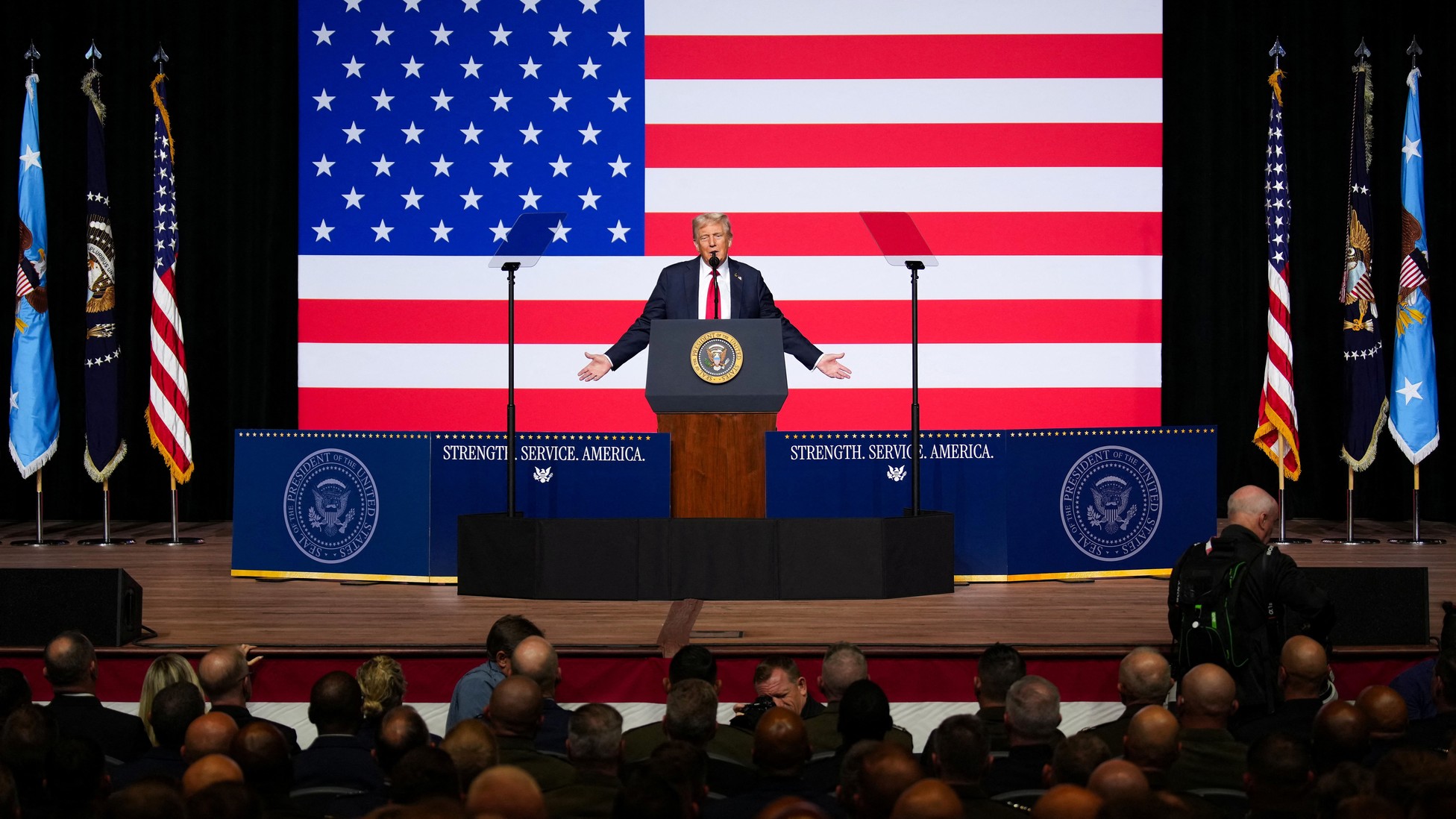
As comical as many of Trump’s comments were, the president’s nakedly partisan appeal to U.S. military officers was a violation of every standard of American civil-military relations, and exactly what George Washington feared could happen with an unscrupulous commander in chief. The most ominous part of his speech came when he told the military officers that they would be part of the solution to domestic threats, fighting the “enemy from within.” He added, almost as a kind of trollish afterthought, that he’d told Hegseth, “We should use some of these dangerous cities as training grounds for our military—National Guard, but military—because we’re going into Chicago very soon.
This farrago of fantasy, menace, and autocratic peacocking is the kind of thing that the late Senator Daniel Patrick Moynihan evocatively called “boob bait for the Bubbas” and that George Orwell might have called “prolefeed.” It’s one thing to serve it up to an adoring MAGA crowd: They know that most of it is nonsense and only some of it is real. They find it entertaining, and they can take or leave as much of Trump’s rhetorical junk-food buffet as they would like. It is another thing entirely to aim this kind of sludge at military officers, who are trained and acculturated to treat every word from the president with respect, and to regard his thoughts as policy.
Plenty of presidents behaved badly and suffered mental and emotional setbacks: John F. Kennedy cavorted with secretaries in the White House pool, Lyndon Johnson unleashed foul-mouthed tirades on the Joint Chiefs of Staff, Richard Nixon fell into depression and paranoia, Ronald Reagan and Joe Biden wrestled with the indignities of age. But the officer corps knew that presidents were basically normal men surrounded by other normal men and women, and that the American constitutional system would insulate the military from any mad orders that might emerge from the Oval Office.
Likewise, in Trump’s first term, the president was surrounded by people who ensured that some of his nuttiest—and most dangerous—ideas were derailed before they could reach the military. Today, senior U.S. officers have to wonder who will shield them from the impulses of the person they just saw onstage. What are officers to make of Trump’s accusation that other nations, only a year ago, supposedly called America “a dead country”? . . . . How are they supposed to react when Trump slips the surly bonds of truth, insults their former commanders in chief, and talks about his close relationship with the Kremlin?
In 1973, an Air Force nuclear-missile officer named Harold Hering asked a simple question during a training session: “How can I know that an order I receive to launch my missiles came from a sane president?” The question cost him his career. Military members are trained to execute orders, not question them. But today, both the man who can order the use of nuclear arms and the man who would likely verify such an order gave disgraceful and unnerving performances in Quantico. How many officers left the room asking themselves Major Hering’s question?
Tuesday, September 30, 2025
The Divisiveness of MAGA Christianity
The contrast could hardly have been greater. During a memorial service for Charlie Kirk, held in a stadium filled with nearly 100,000 people, Erika Kirk, the wife of the slain right-wing activist, expressed both her profound love for her husband and the profound grief brought on by his death. It was the speech of a woman deeply influenced by her Christian faith. And it included remarkable words, which she struggled to say but was still able to articulate. “My husband, Charlie, he wanted to save young men, just like the one who took his life,” Kirk said. “That young man. That young man. On the cross, our Savior said, ‘Father, forgive them, for they not know what they do.’ That man—that young man—I forgive him. I forgive him because it was what Christ did. And it’s what Charlie would do. The answer to hate is not hate. The answer we know from the Gospel is love and always love. Love for our enemies and love for those who persecute us.”
The audience rose to its feet to applaud in support of the grieving widow. But there was another speaker yet to come.
Donald Trump, following Erika Kirk, said Charlie was “a missionary with a noble spirit and a great, great purpose. He did not hate his opponents. He wanted the best for them.” But then the president, diverting from his script, couldn’t resist voicing his dissent. “That’s where I disagreed with Charlie,” Trump said. “I hate my opponent. And I don’t want the best for them.” He added, “I’m sorry, Erika.” The audience began to laugh and to cheer. Trump gave them a knowing smile. A man who lies about nearly everything couldn’t bring himself to lie about his hate for his opponents.
That Trump said at the Kirk memorial service was hardly a revelation.
President Trump[the Felon] has in the past made clear his disagreement with, and even his contempt for, some of the core teachings of Jesus. So has his son Don Jr., who told a Turning Point USA gathering in 2021 that turning the other cheek has “gotten us nothing.”Donald Trump, decades before he ran for the presidency, acknowledged that he’s a man filled with hate and driven by vengeance. It’s not simply that those qualities are part of who he is . . . Trump has spent nearly every day of the past decade confirming that he lacks empathy. He sees himself as both entitled and as a victim. He’s incapable of remorse. He’s driven by an insatiable need for revenge. And he enjoys inflicting pain on others.
It’s no longer an interesting question as to why Trump is an almost perfect inversion of the moral teachings of Jesus; the answer can be traced to a damaged, disordered personality that has tragically warped his soul. What is an interesting question is why those who claim that the greatest desire of their life is to follow Jesus revere such a man and seem willing to follow him, instead, to the ends of the earth.
For a significant number of evangelical Protestants the explanation is fairly straightforward: They celebrate the Trump ethic; it pervades their church and their faith communities.
Within this world exists a subculture that includes the so-called TheoBros, men who often identify as Christian nationalists who see themselves as theological warriors. In this subculture, compassion is viewed as a weakness; bullying and abusive language, snide putdowns, misogyny, and “owning the libs” are fashionable. They’re the Christian version of shock jocks.
One example: Pastor Joel Webbon, an influential figure within this world, believes that women should be denied the right to vote. Women’s suffrage was “just one liberal attempt by people who hated Christ to sever the covenant bond between husband and wife.” Extending voting rights to women has, he believes, proved a terrible mistake.
Many of the leaders within the Christian-MAGA movement are autocratic, arrogant, and controlling; they lack accountability, demand unquestioned loyalty, and try to intimidate their critics, especially those within their church or denomination. The grievances and resentment they feel are impossible to overstate; they are suffering from a persecution complex. Fully MAGA-fied Christians view Trump as the “ultimate fighting machine,” in the words of the historian Kristin Kobes Du Mez, and they love him for it. . . . . Hard-core MAGA Christians hardly make up the whole of American evangelicalism and fundamentalism, but they do constitute a large part of it, and they are on the ascendancy.
The churches and denominations that are not militantly MAGA but are still overwhelmingly composed of Trump supporters often get less attention than churches and denominations that are hyper-politicized, but they’re also essential to the Trump coalition. So it’s useful to understand the complex dynamic at play in those spaces.
I say complex because, every Sunday, millions of Christians attend churches that are nondenominational and that are affiliated with conservative Protestant denominations. These churches aren’t particularly political, and they are led by pastors who preach thoughtfully on topics such as loving your enemy and turning the other cheek, which Jesus talked about during his Sermon on the Mount . . . . The great majority of people attending these churches wouldn’t consider those verses to be woke talking points; they would view them as the inerrant word of God.
Yet many of them will spend part of the rest of the week, and maybe much of the rest of the week, in the right-wing echo chamber, in the company of conflict entrepreneurs, having their emotions inflamed, feeling the same way toward their enemies as Donald Trump does toward his enemies. And it will all make perfect sense to them.
It grieves me to see people I’ve known for years (some as far back as the Jesus Movement of the 1970s) seduced by a mean-spirited culture-war Christianity that is but a perverse caricature of the authentic faith formed around Jesus of Nazareth,” Brian Zahnd, a pastor and author, posted on social media recently. “Yes, it grieves me terribly.”
How did the seduction of so many evangelicals happen? And how did Donald Trump, of all people, win not just their votes but their hearts? The answer is convoluted and theological in nature. For far too many Christians, faith, although an important part of their life, is not primary, and it’s even less often transformative. Russell Moore, editor in chief of Christianity Today, has said that Jesus is a “hood ornament” for many American Christians.
Christianity was supposed to bring an internal transformation, a profound inner shift in a person’s identity and motivations . . . . Throughout history, countless people have had their lives transformed by faith and by grace, and have helped to bring healing to a broken world.
But they are exceptional, and if we’re honest—if Christians are honest—the gap between how those who claim to be followers of Jesus conduct themselves versus how others in the world conduct themselves is often narrow, if it exists at all. We see that in high-profile scandals and in people’s daily lives, where abusive behavior, harsh judgmentalism, and unkindness are spread pretty equally among believers and unbelievers.
When people in church services sing hymns of praise that declare, “Make me a channel of your peace; where there is hatred let me bring your love; where there is injury, your pardon, Lord; and where there’s doubt, true faith in you,” those are authentic expressions of real desires. But they often have a short half-life; they can be undone by midweek, especially if you happen to spend time on social media or listen to podcasts that stir up the dark passions. Peacemaking is not the coin of that realm.
Politics fills the void left by faith, and it’s doing so in ways that I’ve never quite seen before. For many fundamentalists and evangelicals, politics meets the longing and the needs that aren’t being met by churches and traditional faith communities. If there is something useful that has come of the Trump era, and there’s not much, it is that it has offered a diagnostic CT scan of much of American Christianity. Trump and the MAGA movement capitalized on, and then amplified, the problems facing Christian communities, but they did not create them.
Politics, especially culture-war politics, provides many fundamentalists and evangelicals with a sense of community and a common enemy. It gives purpose and meaning to their life, turning them into protagonists in a great drama pitting good against evil. They are vivified by it. And they reassure one another, time and again, that the dark passions are actually expressions of righteousness. They consecrate their resentments.
That is why people at the Charlie Kirk memorial service could be moved by the words of forgiveness by Erika Kirk and also inspired by the words of hate by the president of the United States. They can move easily between two worlds. But they are encamping in the world of moral ugliness, a world of antipathy, and, for now, they seem quite at home there.
Monday, September 29, 2025
Sunday, September 28, 2025
How Ordinary Americans Can Stop Trump’s Revenge Spree
According to the law, Robert Morris was a criminal. The second Black lawyer in the history of the United States, Morris was among a group of abolitionists who, in 1851, stormed a Boston courtroom to free Shadrach Minkins, an escaped slave from Virginia. Minkins had been detained under the Fugitive Slave Act and was to be returned to his master.
Morris filed a writ of habeas corpus on Minkins’s behalf, but the effort failed because Minkins was property in the eyes of the law. After being rescued, Minkins escaped to Canada, where the arms of man stealers and flesh traders could not reach him. Morris was left to face the consequences and was indicted in federal court; his fate was left to a jury.
The law was clear, and under it, Morris was likely guilty—yet the jury did not convict. In modern parlance, some of the jurors “nullified” the case: They decided that a tyrannical law was not worth enforcing. And they were right.
Jury nullification is an old weapon against tyranny. America’s founding generation saw juries as charged with determining not just fact but also law—that is, jurors could decide to acquit the accused, even those who seemed guilty of what they were charged with, if jurors believed that the law itself was unjust.
Jury nullification has long had a bad reputation because of the crime it was frequently used to cover up: lynching. For generations in the South, all-white juries nullified accusations of murder involving lynchings, many of which were carried out with the participation of a town’s politicians, law enforcement, and leading businessmen. Unable or unwilling to point to the culprits, coroners would describe the murders with the haunting phrase “death at the hands of persons unknown.” Whether out of fear for their own safety or in solidarity with the murderers, jurors who refused to indict ensured that extrajudicial killings in the South were rarely punished. A tool meant to prevent tyranny was instead used to enforce it.
Yet as the Morris case shows, the tool itself is not inherently evil. Jury nullification is neutral, its morality defined by the cause for which it is employed. Now that President Donald Trump is perverting the Justice Department into an instrument of political persecution, jury nullification may be one of the only mechanisms that everyday Americans have to protect the rule of law.
Last weekend, Trump complained that “nothing is being done” to indict his political enemies, including James B. Comey, the former FBI director. On Thursday, Comey was indeed indicted, accused of lying to Congress; Comey released a video saying he’s innocent and not afraid of a trial. Prosecutors initially passed on the case, believing that the evidence was weak. But more politically motivated prosecutions are likely to follow, and the targets may not have the allies and resources that Comey has, or his connections among the legal elite. If jurors are convinced that the cases brought before them are unjust, we are likely to see a revival of nullification.
The prosecution of Trump’s political enemies requires the assent of a jury of their peers, and their peers can say no. They can say, We do not accept this corruption of the law and the Constitution; we do not accept the use of public authority as a mechanism of mafia-style coercion; we do not accept that a president who seems to believe that he is a king can throw his enemies in prison. That is the jury’s right. Every time Trump tells his lackeys in the Justice Department to prosecute his foes, the jury should refuse to let him do it.
In some places, this is already happening. People called to serve on a grand jury in Washington, D.C., have consistently refused to aid the Trump Justice Department’s attempts to throw the book at people in marginal cases, such as those prosecuting people who protested ICE raids and the former Justice Department employee who threw a sandwich at a federal agent. Jury nullification does not have to serve only elites. The wife who is indicted for obstruction for trying to protect her undocumented husband from being snatched by federal agents, the protester who is charged with assault for being thrown to the ground by a man with a badge and a gun—anyone charged or overcharged for resisting an unjust system of political persecution is entitled to the protection of a jury of their peers.
That category seems likely to grow. On Thursday, Trump signed a memo declaring his government’s intention to “investigate and disrupt networks, entities, and organizations that foment political violence so that law enforcement can intervene in criminal conspiracies before they result in violent political acts.” It is not difficult to imagine Trump attempting to prosecute those protesting his immigration policy . . . .
Since the assassination of the conservative activist Charlie Kirk, Trump flunkies have vowed to crack down on their political enemies—the rabid White House adviser Stephen Miller has called the whole Democratic Party a “domestic extremist organization.” In case you were wondering whether I’m being too alarmist about Trump’s recent memo, consider how Miller described California Governor Gavin Newsom’s criticism of “authoritarian” arrests of immigrants by masked ICE agents, with no due process: “This language incites violence and terrorism,” Miller wrote on X. If the White House doesn’t like your speech, it might label your words “violent” and order the FBI to criminally investigate.
These campaigns are grotesque corruptions of the original purpose of the Justice Department, which was founded under Ulysses S. Grant’s administration to enforce the Civil War amendments and protect equality under the law. But just because you investigate does not mean you can indict, and just because you indict does not mean you can convict. And part of the decidedly mixed legacy of the American Founders is a means for regular people to decide whether convictions are justified.
When Trump tries to indict his political enemies on pretextual grounds, grand jurors have the option of refusing to indict. When prosecutors ask for a conviction, jurors can refuse to convict. The Trump administration can treat this government of the people as his own mob enforcers, but the people need not acquiesce. When Trump abuses his power to settle political scores, the people can choose to nullify.