
Saturday, October 25, 2025


Trump's War of Choice: A Mistakenly Belief in an Easy Win in Venezuela

As a naval aviator, Alvin Holsey trained to conduct missions that required precise targeting. For years, his job was to fly helicopters over potential targets and, using radar and other detectors, assess whether they posed a threat to the United States; if so, he had to determine whether to launch an attack.
On September 2, Holsey, now an admiral leading the U.S. military’s southern command, was put in charge of a mission unlike any that has come before: The United States was, without any warning or attempt at interdiction, striking suspected drug boats in the Caribbean Sea. Early into the mission, Defense officials told us, he privately raised concerns to Pentagon leadership about the operations, which have now struck at least 10 suspected drug-trafficking vessels that the U.S. redefined as “terrorist,” killing 43 people.
Since then, the strikes have escalated even as the legal questions around them have yet to be answered. There was another strike overnight, this one killing six, according to Hegseth. And today, the Pentagon announced that the USS Gerald R. Ford aircraft-carrier strike group, a multi-ship force staffed by as many as 5,000 troops, would travel from the Mediterranean to the Caribbean. The intent, the Pentagon said, is to “bolster U.S. capacity to detect, monitor, and disrupt illicit actors.”
The U.S. hasn’t sent this many ships to the Caribbean since the Cuban missile crisis. . . . The carrier strike group also provides far more firepower than is necessary for the occasional attack on narco-trafficking targets. But the ships could be ideal for launching a steady stream of air strikes inside Venezuela.
For about two months, the flotilla of American warships in the Caribbean has kept Venezuelans in suspense. The White House calls it a “counter-narcotic” mission, but Latin American analysts see it as a regime-change operation. Some Trump-administration officials hope that the threat of attacks on Venezuelan soil, coupled with the drumbeat of strikes at sea, will be sufficient to force Maduro to flee, . . .
Maduro is not the only target of [the Felon's]
Trump’sire in the region. The president of Colombia, Gustavo Petro, started complaining this month about the Caribbean strikes, claiming that they had taken the life of an innocent fisherman. Trump accused Petro on Sunday of being a “drug leader”—the same accusation he’s made against Maduro. On Tuesday, the American military struck a boat close to Colombia’s Pacific Coast. Petro, far from seeking a de-escalation, went on Univision to invoke Freud and ruminate about genitalia and machismo. At the end of the interview, he called for Trump to be ousted.Whatever he opts to do, Trump isn’t planning to consult Congress before acting. “I’m not going to necessarily ask for a declaration of war,” he said. “I think we’re just going to kill people that are bringing drugs into our country. Okay? We’re going to kill them. You know, they’re going to be, like, dead.”
Although the U.S. has called those who have been killed in its air strikes “combatants,” the administration has not provided any evidence to either Congress or the public of the threat they posed to the U.S. When two people survived a strike last week, the United States chose not to hold them, which would have led to a court hearing at which a judge might have ordered the administration to provide legal justification for the strikes
But such a campaign would not be without peril for the troops carrying it out. Since the strikes began, Venezuela also has already flown F-16s over American destroyers operating in the region. During any attack in Venezuelan air space, U.S. pilots would likely come up against Maduro’s air defenses. Analysts differ over how much of Venezuela’s air defense is fully functional and maintained, but they are in consensus that its military has a network of anti-aircraft batteries, multiple air-defense units armed with cannons, and numerous portable air-defense systems. The military also has a sophisticated long-range-missile system capable of shooting down aircraft and ballistic missiles, according to Geoff Ramsey, a Venezuela expert at the Atlantic Council, a Washington-based think tank.
Ramsey warned that even if the strikes lead to defections and eventually the fall of the regime, multiple pro-government armed groups in the country could challenge a new government and contribute to a bloody outcome that would look something like Libya after the 2011 fall of Muammar Qaddafi.
The column in the Times looks at why such a war of choice may not play out as America's would-be Hitler and the drunk at the Department of Defense envision both in terms of ease and civilian deaths:
While the large U.S. military force now in the Caribbean is ostensibly there to fight Venezuelan drug traffickers, officials have all but acknowledged that the real goal is to oust Venezuela’s autocratic president, Nicolás Maduro. The military pressure deepened on Friday with the deployment of an American aircraft carrier to the region.
As the Trump administration doubles down on its campaign against Mr. Maduro, officials may very well have in mind Washington’s last overthrow of a Latin American leader, also accused of ties to the narcotics trade, Gen. Manuel Noriega of Panama, in 1989. It was an operation many hailed — wrongly, in some respects — as a quick and easy victory that ousted a repressive strongman and led to his imprisonment for drug trafficking.
The situation in Venezuela is far different, and seeking regime change there could be disastrous for the United States and the region. It is also important to recognize how doing so would fit into a larger pattern of American intervention in Latin America.
To begin with, the contrasts between Panama and Venezuela: Panama is a small country with a population at the time of the invasion of fewer than three million people. It is situated at a strategic choke point on the Central American isthmus and bifurcated by the Panama Canal, which was then still under U.S. control. It was home to the U.S. Southern Command and a permanent U.S. garrison.
Venezuela is a sprawling, geographically diverse country with a population of nearly 30 million. The United States maintains no military installations there, and it is not home to a strategic asset like the Panama Canal, unless you include oil reserves. Venezuela’s neighbors Colombia and Brazil have been at odds with the Trump administration. As policy analysts across the political spectrum have argued, the likeliest outcome of a U.S. invasion that topples Mr. Maduro is a surge in regional instability, and, according to a recent report by the Stimson Center, a worsening of the conditions leading to drug trafficking, conflict and migration.
The historian Greg Grandin has argued that one interpretation of U.S. involvement in 1980s civil conflicts in Central America was as an attempt by the conservative movement to redeem the failures of the Vietnam War, and, in so doing, renew the nation’s sense of purpose in the fight against Communism. But wars in El Salvador, Guatemala and Nicaragua, conducted with U.S. support for right-wing combatants, quickly became morasses, leading to political blowback in the United States and the torture, death and disappearance of thousands of people across the region. Ultimately, the wars also led to large-scale Central American migration to the United States.
The U.S. military promptly dismantled Panama’s armed forces and toppled Mr. Noriega, leading to the installation of a pro-United States civilian government. American casualties were limited; 23 service members were killed and more than 300 wounded. The operation demonstrated that, in Panama at least, Washington could still strike effectively to achieve its political goals.
Yet the truth was not nearly so neat. In the process, U.S. forces leveled El Chorrillo, a working-class neighborhood that was home to primarily Black and mixed-race Panamanians. The United States documented around 300 Panamanian civilian deaths, but the actual toll of civilian dead remains in dispute; some international organizations estimate hundreds more died, and some Panamanian organizations claim the death toll reached into the thousands. In recent years, the Panamanian government has exhumed and identified victims of the invasion who were buried in mass graves. . . . Drug trafficking through Panama to the United States did not stop, and may have actually increased.
The invasion of Panama and a possible invasion of Venezuela do have some parallels. Like Panama in 1989, Venezuela poses no imminent security threat to the United States, despite what Mr. Trump has said. Mr. Maduro is not uniquely responsible for either migration or the flow of drugs into the United States. Instead, a potential assault on Venezuela would appear to be a pre-emptive war of choice, undertaken in part, as Operation Just Cause was, to satisfy a domestic constituency of the Republican Party, represented by Secretary of State Marco Rubio, who has long advocated regime change in Venezuela, and distract critics of Mr. Trump’s domestic policies.
U.S. interventions in Latin America, whatever their underlying rationale, visit very real suffering on ordinary people who find themselves in the path of the U.S. military. Even in Panama, where circumstances in 1989 were favorable to America’s aims, the operation was neither bloodless nor painless, nor completely successful. How much more serious will the consequences of such adventurism be in Venezuela?
Obviously, to the Felon and Hegseth, the deaths of brown skinned people doesn't matter. Indeed, I suspect they see them as less than fully human.

Friday, October 24, 2025

The Office Approving Trump’s Extra-Judicial Boat Strikes; Who Is Next

Since early September, U.S. forces have carried out eight strikes on boats in the Caribbean and Pacific, killing at least 34 people. President Trump says the strikes are legal, and that the boats were trafficking drugs, but he has not offered evidence to substantiate the claim. Nor has he explained how the deliberate, premeditated killing of civilians — what Columbian and Venezuelan leaders and some jurists have called “murder”— can possibly be reconciled with domestic and international law. The Justice Department’s Office of Legal Counsel has reportedly deemed the strikes lawful, but its analysis hasn’t been disclosed.
A quarter-century after the Sept. 11 attacks, then, we find ourselves in a familiar place: Our government is once again committing grave human rights abuses on the ostensible authority of a legal opinion that is being kept secret.
The Office of Legal Counsel is a division of the Justice Department that interprets the law for the executive branch. It has played this role for decades, issuing opinions that bind federal agencies on matters ranging from Social Security to veterans’ affairs to immigrants’ rights.
After Sept. 11, the office was called on by both the Bush and Obama administrations to resolve questions relating to national security. It told President George W. Bush that the National Security Agency could listen to Americans’ phone calls without warrants and that the Taliban were not entitled to the protections usually accorded prisoners of war. It assured the C.I.A. that it could lawfully torture prisoners overseas. Later, it concluded that the Constitution’s due process clause was no obstacle to the government’s summary execution of an American terrorism suspect.
[S]ignificant errors in the office’s legal analyses went unidentified and uncorrected, even as agencies relied on them to carry out policies that were deeply inconsistent with American law and democratic values. Public debate on matters of profound consequence unfolded in an information environment distorted by official secrecy, misdirection and selective disclosure.
The office’s opinions about interrogation allowed some of the most egregious post-Sept. 11 abuses and were later discovered to include some of the most glaring legal errors. With the office’s blessing, prisoners in secret C.I.A. sites were beaten, forced into painful stress positions, deprived of sleep and waterboarded — a method intended, the office explained, to induce in the prisoner “the uncontrollable psychological sensation that the subject is drowning.” Military policemen and interrogators subsequently came to adopt cruel methods at Guantánamo, as well as in Afghanistan and Iraq. Some prisoners were tortured to death.
One of the torture memos was leaked to the press in 2004, but it was only after other opinions by the office were made public in 2009 — after years of litigation by human rights groups — that the profound defects in their reasoning came fully into focus. . . . . The Senate Intelligence Committee later concluded in a monumental report that the torture program had compromised the United States’ standing in the world as well as its security.
The memo authorizing strikes on drug traffickers in the Caribbean and Pacific may very well be an outlandish extension of the memos the office wrote about drone strikes during the Obama administration, including the al-Awlaki memo. That memo was itself flawed. Human rights lawyers faulted it for taking an unjustifiably expansive view of Congress’s 2001 authorization for use of military force, and in a 2016 book I criticized its myopic analysis of the due process clause.
But [the Felon's]
Mr. Trump’sstrikes are being conducted without any congressional authorization at all, and few jurists accept the notion that the United States is in an armed conflict with drug cartels. Whatever their defects, the Obama-era memos do not supply authority for the strikes the United States is carrying out now.We should not have to guess how the Justice Department concluded that these strikes on civilians were lawful. The public should be able to read the government’s legal justifications for itself — and not at some indefinite point in the future, by which time the Office of Legal Counsel’s opinion’s relevance will have faded, but now, when there’s still something that might be done to change the government’s policies and hold accountable the officials who are responsible for them.
When the secrecy of the Trump administration’s OLC memo comes before the courts, as it almost certainly will, it will be tragic if judges extend the same deference to an administration that has made plain its contempt for the rule of law.
The courts should not debase our democracy by pretending that there are good national security justifications for keeping us in the dark.

Thursday, October 23, 2025

Wednesday, October 22, 2025
The U.S. Economy is in Worse Shape Than it Looks

The U.S. economy is in a weird place right now on multiple fronts. One immediate problem is that policymakers are flying somewhat blind because the government shutdown has delayed the September employment report. According to the last report available (which was for August), unemployment is relatively low by historical standards. But another source of weirdness is that many people feel very bad about the economy: Consumer sentiment is much weaker than it was pre-Covid, in fact comparable to its level at the depths of the 2008-2009 financial crisis.
So are we in what Phil Gramm — remember him? — once called a “mental recession,” a sort of mass delusion that the economy is bad? It’s likely that some of Americans’ sour mood is driven by political unease. Huge and ever-changing tariffs, masked agents grabbing people off the street, assassinations, vindictive prosecutions, rising measles cases, Trump’s false claims that cities are “war zones” as pretext for sending in the National Guard, and more. Increasingly unhinged statements from the administration feed a general sense of destructive instability.
Yet it’s not only about political unease. There are some objective, measurable reasons to say that the US economy, which appears OK by the most commonly used measures, is definitely not OK once you look under the hood. One essential aspect of this weirdness is the economy is strongly bifurcated: AI is booming, but the rest of the economy isn’t. Another aspect is that in many ways the economy feels “frozen”: while there have been no mass layoffs so far, people who have lost their jobs or are just entering the work force are finding it very hard to get new jobs. Third, while the economy is growing thanks to AI spending, it’s a K-shaped expansion: People who were already affluent are becoming more so, but the less well-off are under severe pressure. For example, there are clear signs that middle-to-low income consumers are struggling: car loan and credit card delinquencies are rising, and grocers report that shoppers are buying cheaper varieties of food. At the same time, the affluent are spending freely: the top 10% of the income distribution now accounts for nearly half of all consumer spending.
What’s going on? I would argue that Trump’s wildly erratic policies are creating huge uncertainty which is deterring many companies – essentially those that are not in the AI sector or a sector catering to the affluent – from making investments. And those forgone investments include hiring new workers. The result is that much of the economy is frozen — companies aren’t hiring or investing. This freeze, in turn, explains both worker anxiety and rising inequality. Without the AI boom/bubble spending, we might very well have fallen into a recession, as some economists like Mark Zandi have claimed. And despite the AI boom, times for many workers are tough.
First, as I said, we haven’t (yet?) seen mass layoffs — except from the federal government! — but the rate at which businesses are hiring is very low by historical standards, not far above its level during the 2008-2009 financial crisis . . . . These data aren’t currently being updated because of the government shutdown, but we get a more up-to-date picture from private sources, such as job postings from Indeed.com, and they suggest that the picture is if anything getting worse . . . .
Another source of information comes from surveys that ask people about the state of the job market. In particular, the influential monthly consumer survey conducted by the Conference Board — second in influence only to the Michigan Survey — asks people whether jobs are “plentiful” or “hard to get.” . . . In late 2019, on the eve of Covid, almost half of respondents said that jobs were plentiful, versus around 10 percent saying hard to get — a spread of around 40 points. In the latest Conference Board survey the spread was only 8 points, 27 versus 19. This tells us that American workers are very worried that if they should happen to lose their job, they’ll have a hard time finding another.
And they’re right. Overall unemployment hasn’t risen that much, but the number of long-term unemployed — would-be workers who have been jobless for more than 6 months — had soared as of August, and has probably continued to rise since then . . .
Another important indicator of a troubled labor market is Black unemployment. After all these years, Black workers still tend to be “last hired, first fired.” And while the overall unemployment rate . . . hasn’t risen much so far, the Black unemployment rate . . . has soared, presumably because Black workers are finding it especially hard to find jobs in this frozen economy . . .
[M]ost workers still have their jobs. But workers believe, rightly, that if they should happen to lose their current job they will have a hard time finding another. This obviously means that workers have much less bargaining power than they did when the job market was tight. Employers don’t have to give workers big wage increases to hang on to them; they can impose onerous conditions, like ending remote work, without fearing that employees will quit, because they have no place to go.
Historically, strong demand for labor has been especially good for lower-paid workers, while weak demand has hit them hard. . . . all through the Biden-era expansion I kept hearing people say that the economic recovery was only benefiting an affluent minority, that ordinary workers were being left behind. This wasn’t at all true at the time. But it is true now. The Atlanta Fed has a wage tracker that, among other things, estimates the rate of wage growth at different parts of the wage distribution. During the Biden years wage growth for the bottom fourth of the wage distribution was consistently higher than wage growth for the top fourth. Now that equalizing process has gone into reverse.
And then there’s the stock market. Investors seem to have decided that the wonders of AI matter more than Trump’s tariff madness, so we’re seeing a stock market surge dominated by technology companies. Aside from the question of whether this is a bubble, it’s important to be aware that the top 10 percent of households own 87 percent of equities, while the bottom half own almost no stock at all and gain nothing from a rising market.
Many economists — actually, all the economists I know — are worried about a potential downturn. The AI boom is troublingly reminiscent of the 90s tech bubble. After the sudden bankruptcies first of a subprime auto lender, then an auto parts supplier built on hidden loans, JPMorgan’s Jamie Dimon suggested parallels between bad lending in the private credit market and the bad subprime lending that brought on the 2008 crisis. To quote Dimon: “I probably shouldn’t say this, but when you see one cockroach, there are probably more.” . . . My point for now is that even though we haven’t had a recession yet, the frozen state of the U.S. economy has already made life much worse for many workers.


Why the "No Kings" Protests Mattered

The "No Kings" protests last weekend were among the largest protests in American history and based on people I know include some who had never attended such a politically motivated protest. While the Felon - who posted an AI video of himself wearing a crown and literally dumping shit on Americans exercising their right to public assembly - and Republican political whores up and down the ranks of the Republican Party have tried to malign and depict protestors as left wing extremists or ludicrously claimed the protestors were paid, I suspect many of the saw the protests with fear. Indeed, as CNN is reporting, support for the protests is wide spread and view the Felon as a want to be dictator:
New polling, though, reinforces how much the thrust of the “No Kings” message has resonated with much of the American public. In fact, a majority of Americans appear sympathetic to it, at least to some extent. And their ranks appear to be growing. The survey from the Public Religion Research Institute gave people two options. One was that Trump is a “potentially dangerous dictator whose power should be limited before he destroys democracy.” The other was that he’s a “strong leader who should be given the power he needs to restore America’s greatness.” Americans chose the “dictator” option by a strong margin, 56%-41%.
Meanwhile another poll finds that "Nearly two-thirds of Americans believe the U.S. is headed in the wrong direction, fueled by dissatisfaction with President Trump’s impact on the economy, immigration, race relations and the nation’s global standing, according to a new poll with a big, broad sample."
With luck, the "No Kings" movement will grow - there are talks of a third such event - as will public disapproval and just maybe some on the fence and even some Republicans will be convinced that rejecting blind fealty to the Felon may prove less dangerous to long their political ambitions than the potential wrath voters may inflict on them for continued self-prostitution to the Felon. A piece at The Atlantic by an author who has written widely about authoritarian regimes looks at where the nation finds itself:
Lieutenant Colonel Harald Jäger was in charge of a Berlin Wall checkpoint on the evening of November 9, 1989, when a garbled televised press conference convinced thousands of East Berliners that they were allowed to cross into West Germany. People ran to the checkpoint. They started shouting at Jäger, telling him to open the barrier, even though no one had told him about any changes.
Still, “when I saw the masses of East German citizens there, I knew they were in the right,” he told an interviewer, many years later. In another interview, he recalled, “At the moment it became so clear to me … the stupidity, the lack of humanity. I finally said to myself: ‘Kiss my arse. Now I will do what I think is right.’” He opened the barrier and people started walking through.
Had these events taken place a few months earlier, Jäger might have kept the barrier shut. But the “masses of East German citizens” who had spent that autumn marching against dictatorship in East Berlin, Leipzig, and other East German cities had shaped his understanding of events. Watching them, he understood that most of his countrymen opposed the regime and hated the Wall. If everyone was against it, he no longer wanted to defend it.
The differences between the “No Kings” demonstrations that took place across the United States on Saturday and the East German protests 36 years ago are too numerous to list. . . . But they shared at least one goal: to remind the government’s supporters and enablers that the public is unhappy. The majority of Americans object to President Donald Trump’s politicization of justice, his militarization of ICE, and his usurpation of congressional power. Eventually some of those presidential supporters and enablers might, like Jäger the border guard, be persuaded to side with the majority and help bring this assault on the rule of law to an end.
The people in the White House know this too, and they reacted accordingly. . . . [the Felon] posted an AI-created video of himself as a fighter pilot, wearing a crown, flying over an American city, and dumping shit onto American protesters. The point was not subtle: Trump wanted to mock and smear millions of Americans, literally depicting them covered in excrement, precisely so that none of his own supporters would want to join them.
Mockery isn’t Trump’s only tool, nor was it the only one that his team has borrowed from other autocrats and would-be autocrats around the world. Just as the Chinese leadership once described participants in popular, broad-based Hong Kong protests as “thugs” and “radicals,” the speaker of the House of Representatives, Mike Johnson, said before Saturday’s protest that the only people protesting would be “Marxists” or “pro-Hamas.” . . . A host of Republicans tried to portray the protesters as dangerous or treasonous, or else, paradoxically, as elderly and ineffective.
For those using the oldest tools in the authoritarian playbook, the nature of the smear is unimportant. What matters is the intention behind it: Don’t answer your critics. Don’t argue with them. Don’t let them win over anyone else. Describe them as dangerous radicals even when they wear frog costumes. Imply, without evidence, that they were bribed to speak out, because there can’t possibly be any sincere idealists who criticize the Party and its Leader out of a genuine desire to help other Americans. Dump AI-generated sewage on their heads to discourage anyone else from joining them. And if they keep coming out, make the messages even harsher.
We are just at the very beginning of this familiar, predictable cycle, and we know from the experience of other countries that it can lead in many directions. Protests could fizzle out, as often happens, because mocking, angry, and, in this case, scatological propaganda discourages people from joining them. Or the official reaction to them could turn uglier: Anyone who objects to the Party or the Leader will be described as not really American, not eligible for the rights of a citizen, not really entitled to protest at all. In authoritarian countries, state institutions—tax authorities, regulators, political police—would then begin to pursue them. That isn’t supposed to happen in America, but then, this isn’t an ordinary American political cycle.
Alternatively, the people who showed up on Saturday might be inspired to do more. For years, Americans at protests have been chanting, “This is what democracy looks like.” But the No Kings marches are actually what free speech looks like. Democracy looks different. Democracy requires organized politics, support for candidates, the creation of broad coalitions. Protests can only create enthusiasm, spread goodwill, and inspire people to dedicate time and energy to real political change. And the people who created the sewage video knew that too.

Tuesday, October 21, 2025

Monday, October 20, 2025

Mike Johnson's Goal: Hide the Epstein Files
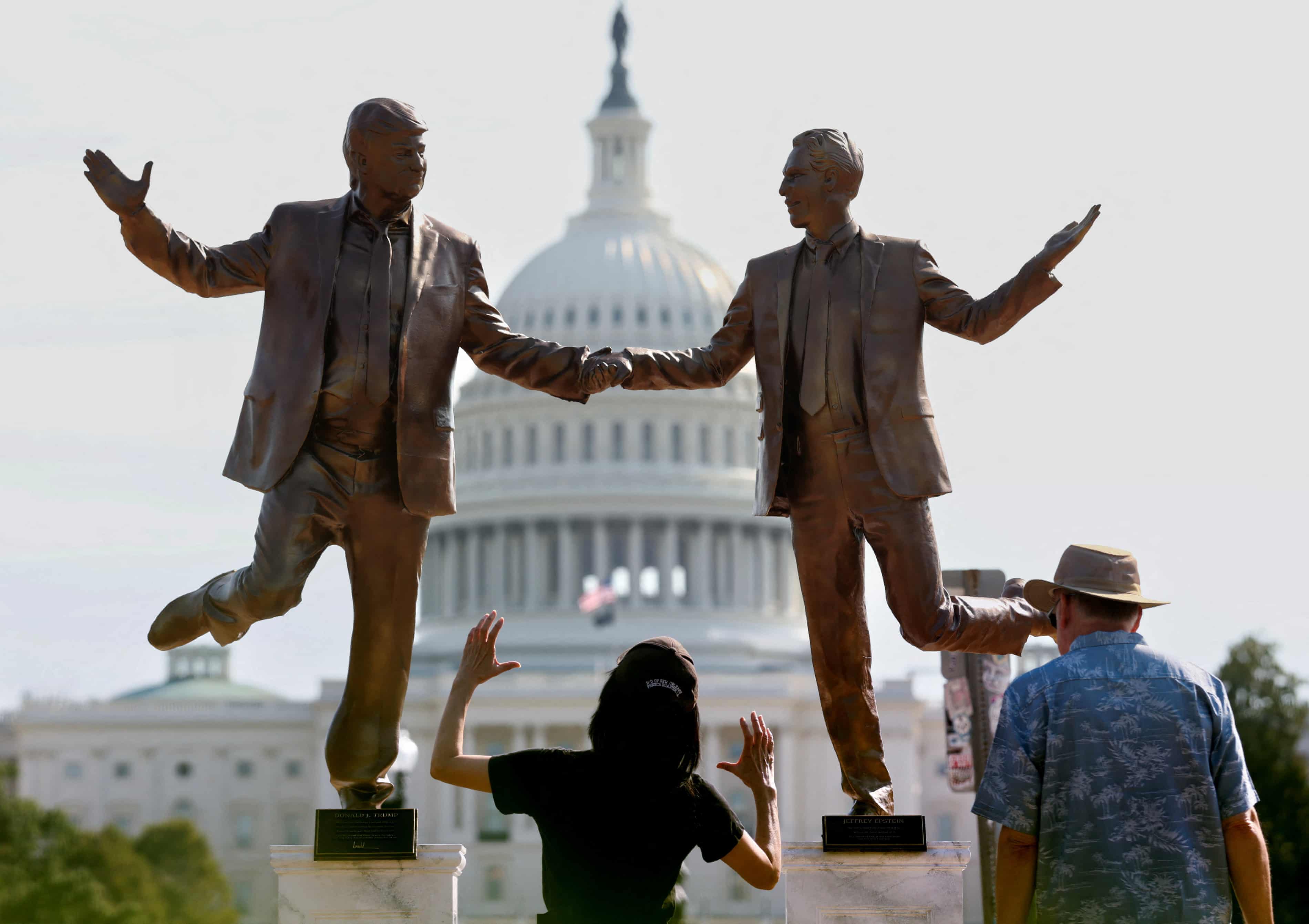
Speaker of the House Mike Johnson is lying. Yes, I know. Writing that is like writing “cats are furry” or “it’s pumpkin spice season.” But the current purpose of the lie is even more depraved than we usually get from this self-proclaimed beacon of Christian morality. The purpose is silencing the victims of infamous child sex predator Jeffrey Epstein and his alleged fellow abusers. Worse, it’s all done to protect President Donald Trump, a man who was already found by a civil jury in New York to have sexually abused journalist E. Jean Carroll in a department store dressing room.
The Louisiana Republican has already gone to great lengths to make sure FBI files chronicling the alleged misdeeds of Epstein and his associates never see the light of day. In July, Johnson started the House’s summer recess early to avoid Democrats bringing up a bill that would force the Justice Department to release the voluminous files on convicted sex offender Jeffrey Epstein, who died by suicide in jail in 2019 while awaiting trial on sex trafficking charges. The reason for Johnson’s action wasn’t mysterious. Trump, whom Epstein called his “closest friend,” is reportedly in the files. According to a lewd birthday message attributed to Trump by the Wall Street Journal — that was leaked by House Democrats — Trump wrote to his longtime buddy, “We have certain things in common, Jeffrey.”
There is allegedly more. During Attorney General Pam Bondi’s recent Senate hearing, for instance, Sen. Sheldon Whitehouse, D-R.I., asked about “photos of President Trump with half-naked young women.” Bondi refused to answer.
Now Johnson has found another excuse to block a House vote to release the Epstein files: The government shutdown. The speaker has adjourned the House and refused to seat Rep.-Elect Adelita Grijalva, D-Ariz., blaming the shutdown — despite the fact that the Senate is still open and holding votes. Grijalva has pledged to be the deciding vote on a discharge petition to release the Epstein files. In comments to the Arizona Republic, Sen. Ruben Gallego, D-Ariz., was blunt in assessing the situation: “Speaker Johnson is protecting pedophiles. That’s what this is all about.”
He [Johnson] knows that if Trump turns against him, he would likely lose the speakership. Hiding the Epstein files appears to be Johnson’s first priority, even above reopening the government so federal employees can be paid.
All this, and especially Trump’s reelection in 2024, should remove all doubt that there is a backlash to the #MeToo movement, which peaked in 2017 and 2018 amid a sea of sexual abuses being publicly outed. For years, there has been a wave of whiny “manosphere” influencers and right-wing pundits telling men that they are the real victims — that feminism has gone “too far” and masculinity is under attack. . . . Women, we’re told, got so revenge-minded about sexual abuse that they went overboard, sweeping up blameless men in the cancel culture dragnet.
This narrative is false and distressing, but Johnson’s actions tell the uglier truth: The backlash to #MeToo was never about male innocence. It was about protecting those who are likely guilty — and reasserting male privilege to abuse women, and even children, without consequence.
While we still don’t know the full extent of the information the FBI collected on Epstein and his buddies, Trump’s determination to bury the evidence shows he’s deeply worried about the truth getting out. There can be little doubt that Johnson knows he’s covering for a sexual abuser. This has been adjudicated twice by civil courts, with juries finding that Carroll told the truth when she said Trump sexually abused her in a department store dressing room. There is also a tape of Trump bragging about grabbing women by the genitals in a way that directly echoes Carroll’s experience.
It’s worth remembering that Epstein was charged in 2019 because of the #MeToo movement. Epstein had been prosecuted 11 years before, ending up with an infamous “sweetheart deal” from Trump ally Alexander Acosta, who was serving as U.S. attorney and later became labor secretary during Trump’s first term. Under his plea agreement, Epstein barely served any time; he was able to return to his playboy lifestyle without missing a beat. But because of dogged investigative reporting by the Miami Herald’s Julie K. Brown — and the determination and willingness of victims to speak out — Epstein faced federal prosecution in New York.
This struggle encapsulates why E. Jean Carroll has become such an icon, especially for those who clearly see that the #MeToo movement’s main flaw was in not going far enough, as evidenced by Trump’s current political standing. Carroll wasn’t just a victim of sexual violence. She also faced the primary backlash tactic: Falsely accusing victims of lying. She didn’t just sue Trump for sexually assaulting her, but for repeatedly defaming her by accusing her of lying. Even after she won $5 million, he continued to defame her. So she sued him again, this time winning $83 million in damages.
Those two cases laid bare the ugly truth about the backlash to #MeToo. Carroll’s critics didn’t think she was lying. They were mad she told the truth — and they want victims to shut up and let men get away with abuse. It was never about anything else.

Sunday, October 19, 2025

Why "No Kings" Terrifies Republicans

Millions of Americans are gathering across the country on Saturday — including in Washington, D.C. — to protest the monarchical pretensions of the Trump administration.
In the four months since the last No Kings protests, [the Felon]
President Trumphas gone even further down the road of claiming plenary authority over the executive branch. He has continued to claim the right to fire anyone he pleases, to cancel or spend federal funds outside congressional appropriations and to launch lethal strikes against foreign civilians without explicit authorization from Congress or evidence of imminent threat to Americans.The [Felon]
presidenthas tried to leverage the power of the federal government against his political opponents and legal adversaries, sending the Justice Department after James Comey, a former director of the F.B.I.; Attorney General Letitia James of New York; and one of Trump’s former national security advisers, John Bolton. . . . . With Trump, it’s as if you crossed the bitter paranoia of Richard Nixon with the absolutist ideology of Charles I.Today’s protesters, in other words, are standing for nothing less than the anti-royal and republican foundations of American democracy. For the leaders of the Republican Party, however, these aren’t citizens exercising their fundamental right to dissent but subversives out to undermine the fabric of the nation.
Senator John Barrasso of Wyoming said of a planned No Kings protest that it would be a “big ‘I hate America’ rally” of “far-left activist groups.” House Majority Leader Steve Scalise of Louisiana also called No Kings a “hate America rally.” House Speaker Mike Johnson told reporters that he expected to see “Hamas supporters,” “antifa types” and “Marxists” on “full display.” People, he said without a touch of irony, “who don’t want to stand and defend the foundational truths of this republic.” And all of this is of a piece with the recent declaration by the White House press secretary, Karoline Leavitt, that “the Democrat Party’s main constituency is made up of Hamas terrorists, illegal aliens and violent criminals.”
[W]hat explains the Republican Party’s posture toward these protests, beyond a desire to delegitimize their political opponents? I have two main thoughts.
First, there is the party’s precarious political position in the midst of a government shutdown. Although no one has escaped responsibility for the shutdown, a higher percentage Americans blame Trump and Republicans in Congress than they do Democrats, according to a recent poll conducted for The Associated Press. More Americans than not also want Congress to extend enhanced federal tax credits for people who buy health insurance through the Affordable Care Act, which has put Republican politicians on the defensive. In demonizing the No Kings protests, Republicans might simply be trying to turn the public’s attention somewhere else.
Second, much of Trump’s effort to extend his authority across the whole of American society depends on more or less voluntary compliance from civil society and various institutions outside of government. And that, in turn, rests on the idea that Trump is the authentic tribune of the people. . . . Nationwide protests comprised of millions of people are a direct rebuke to the president’s narrative. They send a signal to the most disconnected parts of the American public that the [Felon] president is far from as popular as he says he is, and they send a clear warning to those institutions under pressure from the administration: Bend the knee and lose our business and support.
To the degree that major protests could undermine the administration’s ability to exert political authority, it makes a whole lot of sense for Republicans and the White House to spend their energy attacking the No Kings movement.
And this, I think, should serve as an important reminder to opponents of the administration that for all its boasts and bluster, it knows as well as anyone that the president is unpopular and that his administration is vulnerable.

Subscribe to:
Posts (Atom)