
Saturday, March 21, 2026


The Felon Is Lying About the Iran War
From his first announcement of the attack on Iran on Feb. 28, [the Felon] President Trump has issued a stream of falsehoods about the war. He has said Iran wants to engage in negotiations, though its government shows no sign of it. He has claimed that the United States “destroyed 100% of Iran’s Military capability” when Tehran continues to inflict damage throughout the region. He has said the war is almost complete even as he calls in reinforcements from around the globe.
Lying is standard behavior for [the Felon]
Mr. Trump, of course. His political career began with a lie about Barack Obama’s birthplace, and he has lied about his business, his wealth, his inauguration crowd size, his defeat in the 2020 election and so much more. A CNN tally of Mr. Trump’s falsehoods during one part of his first term found that he averaged eight false claims per day. Many people are so accustomed to his lies that they hardly notice them anymore.Yet lying about war is uniquely corrosive. When a president signals that the truth does not matter in wartime, he encourages his cabinet and his generals to mislead the country and one another about how the war is going. He creates a culture in which deadly mistakes and even war crimes can become more common. He makes it harder to win by hiding the realities of conflict and by making allies wary of joining the fight. Ultimately, he undermines American values and interests.
There is a reasonable debate to have about the wisdom of this war. Iran’s murderous government does indeed present a threat — to its own people, to its region and to global stability. Mr. Trump could make a fact-based argument for confronting the regime now, . . . We are skeptical, but we acknowledge that there is a case to be made.
[The Felon]
Mr. Trumpis not making it. Instead, he has lied about the reasons for the war and about its progress, in an apparent attempt to disguise his poor planning and the war’s questionable basis.The president was only a few minutes into his Feb. 28 announcement of the start of the conflict when he offered an obviously contradictory rationale for it. He repeated his claim that American attacks last June “obliterated” Iran’s nuclear program while also citing that program as a reason to go to war. The claim of obliteration is false: Iran retains about 970 pounds of highly enriched uranium, potentially enough for 10 warheads.
The lies have continued since then. Days later, Mr. Trump said the U.S. military had a “virtually unlimited supply” of high-end munitions. The Pentagon nevertheless has had to withdraw weapons from South Korea to sustain its efforts in the Middle East. He has also asserted that “nobody” believed Iran would retaliate by attacking Arab countries. . . . . In truth, some experts had warned of precisely this scenario.
In another instance, Mr. Trump has used false information to continue his alarming penchant to portray people who contradict him as un-American. Last weekend, he posted an allegation that “Iran, working in close coordination with the Fake News Media” had spread fake videos of an American aircraft burning in the ocean. The White House has offered no examples of American media outlets having done so.
A shocking falsehood came on March 7, when Mr. Trump claimed in his typically offhand way that a strike on an elementary school in the town of Minab during the first hours of the war “was done by Iran.” The attack killed at least 175 people, most of them children. The U.S. military has conducted an investigation and preliminarily concluded that an American missile mistakenly hit the school. The military deserves credit for its honesty. The commander in chief, however, still has not retracted his statement.
This pattern is an echo of the wars in Vietnam and Iraq, when small lies grew into a bigger ones, such as the covered-up massacres in My Lai and Haditha. The consequences of those untruths were long-lasting. Americans’ faith in government never recovered from the deceptions of Vietnam. And the second Iraq war, which George W. Bush’s administration sold on the grounds of fictitious weapons of mass destruction, represents the start of our cynical modern political era. Since that war began in 2003, every Gallup poll asking about the country’s direction has shown that most Americans are dissatisfied with it.
Lies about war also make it harder to achieve victory: The more one spreads falsehoods, the less one feels obliged to face reality. In retrospect, Americans understand that their leaders’ refusal to confront the truth in Iraq and Vietnam led to strategic errors. The pattern is repeating. . . . The global economy is now dealing with the consequences of his overconfidence.
He may yet learn a more personal lesson about lying in war. Lyndon Johnson and George W. Bush will forever be remembered as having misled Americans about U.S. military action. They learned that falsehoods can boomerang on the leaders who tell them.
Starting a war is the most serious action that a political leader can take. It ends lives and can change history. The decisions that guide war must be based in reality, and presidents owe American service members and their families the truth about why they are being asked to fight. Whatever short-term gain Mr. Trump thinks he is getting by lying about the war in Iran is far exceeded by the cost, for him, the country and the world.

Friday, March 20, 2026

The Felon Has Only Himself to Blame

[The Felon]
President Trumphas created the conditions for another quagmire in the Middle East, and the question is whether American military excellence can rescue him from his own impulsiveness and incompetence.Here is the present situation, in a nutshell: The United States and Israel have established absolute air dominance over the nation of Iran. In a few short days, our combined forces have destroyed Iran’s ability to protect its own airspace, have killed much of Iran’s senior military and civilian leadership, and have sunk much of Iran’s navy.
At the same time, the United States and Israel are damaging Iran’s nuclear program from the air, and they are destroying Iran’s ability to manufacture and deploy ballistic missiles. They are also attacking the internal security forces that maintain the Iranian regime’s hold on the population.
The intention of the air campaign is clear: to destroy the regime’s capacity to harm its neighbors while also creating the conditions for a revolution on the ground. If that’s the extent of the military mission, the military is accomplishing it with remarkable efficiency. Iran is being badly battered. Even if the war ended today, it would take years for the Iranian military to fully recover from the losses it has suffered so far.
While Iran’s drones and missiles have inflicted damage on American forces and our allies, that damage is far less than what the U.S. and Israel have inflicted on Iran.
So why, then, is Trump lashing out at American allies? Why was he “shocked” that Iran struck Saudi Arabia, Qatar, the United Arab Emirates and Kuwait in response to American attacks?
Perhaps the answer lies in a Wall Street Journal report from last Friday. According to The Journal, Gen. Dan Caine, the chairman of the Joint Chiefs of Staff, warned Trump that Iran might attempt to close the Strait of Hormuz and Trump shrugged off the threat and launched the attack anyway.
“He told his team that Tehran would likely capitulate before closing the strait,” The Journal wrote, “and even if Iran tried, the U.S. military could handle it.”
But Iran did not capitulate. There is no real sign the regime is in danger of falling. Instead, it has effectively closed the strait, and it’s reportedly done so without choking off its own oil exports. In other words, while other nations can’t ship oil through the strait, Iran still is.
Iran may not be able to seriously damage Israel with its missiles (though a few missiles have gotten through Israel’s defenses and killed Israeli civilians), and it may not be able to sink American ships, but it can still potentially plunge the world economy into a state of crisis. It could well emerge from the conflict with its regime intact (and perhaps even more hard-line) and its power over the world economy undiminished.
In a recent post, the Institute for the Study of War described the problem well: “A weakened regime that remains in power after this war would be able to disrupt shipping whenever and for however long it pleases with little effort if its current, relatively limited, strike campaign on shipping proves sufficient to cause the U.S. and Israel to surrender.” “A failure to demonstrate the will and ability to deny Iran the ability to disrupt traffic,” it wrote, “will make it enormously harder to deter Iran from future disruptions.”
That’s the logic that leads to a quagmire. If America declares victory now, when the Iranian regime is still in power and the strait is closed, then Iran perversely can claim that it won. It took a huge punch, absorbed the blow, and still forced America to climb down. It employed its ultimate weapon — closing the strait — and America had no effective answer.
Commit to opening the strait (and keeping it open) by force, and the U.S. may well find itself in yet another open-ended, costly conflict with at least some American soldiers on Iranian soil. This would be war on our enemy’s terms and terrain, with the potential of slowly but surely inflicting casualties and costs on the American military until we grow tired of the conflict and leave.
Trump’s recklessness has left the United States with few good options. Indeed, the dilemma America now faces is a perfect illustration of why Trump should have taken his case for war to the Congress and the American people before he fired the first missile.
I’ve had friends ask me, “Well, if he didn’t think Congress would approve, what do you expect him to do? Sit on his hands?” The answer is simple: The Constitution doesn’t give the president the power to disregard Congress. So, no, don’t go to war if you can’t get Congress to approve.
And if a Republican president can’t get a Republican Congress to support his war, perhaps that provides even more reason to doubt the wisdom of the conflict.
Had he not alienated key allies through economic warfare and threats to seize Greenland, it could have been easier to assemble, in advance, an allied force to protect the Strait of Hormuz.
Instead, Trump launched a major war on his own initiative while announcing competing and potentially contradictory war aims. Is the goal regime change? Unconditional surrender? Or is it much narrower — the destruction of Iran’s missile and drone forces, sinking its navy, stopping its nuclear program and destroying its ability to wage war through its proxy forces, including Hezbollah, Hamas, the Houthis and the kaleidoscope of allied militias in Syria and Iraq.
The Iranian regime, by contrast, has a single, simple theory of victory: Survive. If the regime is still standing at the end of the conflict, then Iran lives to fight again. And if it survives at least in part through closing the Strait of Hormuz, then it knows exactly how to fight again.
Even when wars are carefully planned, with allies brought on board and a majority of the public in support, they are still highly volatile and unpredictable.
My great concern is that Trump has created the conditions for failure. He has taken our well-supplied, well-trained and well-led troops and has deployed them on a mission that lacks clear public support (especially compared to previous American wars), lacks clearly defined objectives, and may not ultimately be achievable without a large-scale escalation.
And now, dismayed that the war has not resulted in the regime’s immediate capitulation or destruction, he’s flailing about, once again threatening the viability of NATO if our allies don’t come and bail him out from a war they did not start and did not ask for.
As an American, I want our forces to succeed, once they are committed. I want to see the military open the Strait of Hormuz as quickly and painlessly as possible. I want to see the Iranian regime collapse and replaced by a democracy. That regime is loathsome. It’s an enemy of the United States. It deserves to fall. If it does, I will cheer its demise.
At the same time, however, my patriotism can’t blind me to reality. This is not how our democracy should go to war. Trump is not the right man to lead our nation into battle. People I respect applaud Trump for his courage in taking on Iran. But I don’t see courage. I see recklessness. I see thoughtlessness.
I see a man who plunged a nation into a conflict without fully comprehending the risks. I see a man full of hubris after achieving success in much more limited military engagements. And he’s now counting on two of the world’s most competent militaries to essentially bail him out.
Trump has only himself to blame. He led America into an unconstitutional war. And now he’s compounding that sin by proving to be every bit as reckless a commander as he is a president.

Thursday, March 19, 2026

Trump May Not Be Able to End His War of Choice

[The Felon]
President Trumpappears to careen between two opposing visions for victory in Iran: He has demanded Tehran’s “unconditional surrender” and also has signaled that he might abruptly declare victory and leave. Neither scenario is likely to end this war, because neither reflects any real understanding of the adversary.Washington appears to have begun the conflict on the assumption that sustained military pressure would either collapse the Iranian regime or force its leadership to concede to fundamental political and strategic demands. But the Islamic Republic has demonstrated a remarkable capacity to survive crises. In fact, past crises have strengthened rather than weakened the regime’s internal cohesion.
In the early years after the 1979 revolution, religious factions competed with secular and leftist movements for influence. The state’s security institutions were still consolidating power. The Islamic Revolutionary Guard Corps, which today dominates much of Iran’s military, political, and economic life, had not yet developed the institutional strength it now commands.
The turning point came when Saddam Hussein’s Iraq invaded Iran in 1980. That external threat, and the eight-year war that followed, consolidated Ayatollah Ruhollah Khomeini’s domestic authority and dramatically expanded the role of the IRGC. In later decades, under Khomeini’s successor, Ali Khamenei, the IRGC evolved into far more than a military force. It became an economic network, a political actor, and a central pillar of regime survival.
Today the IRGC’s influence extends across large portions of Iran’s economy, including energy, infrastructure, and construction. Its commanders occupy key positions across the state apparatus. These institutional entanglements mean that the Islamic Republic is not simply a government that can be easily removed; it is a deeply embedded system of political, military, and economic power.
Recent developments appear to have reinforced this structure rather than weakened it. Khamenei’s son Mojtaba has succeeded him as supreme leader. The younger Khamenei has long been viewed as a key intermediary between the clerical leadership and the IRGC, and his elevation suggests continuity rather than disruption within the regime’s core power networks.
The Islamic Republic knows that it is fighting for its life, and that all it has to do, as the saying goes about insurgencies, is not lose. The expectation that military pressure alone will produce the regime’s collapse under such circumstances is likely unrealistic. Even severe damage to military infrastructure will not necessarily translate into political disintegration. Instead, external threats could strengthen nationalist sentiment and encourage factions within the system to close ranks.
Trump’s oscillations—between maximalist calls for unconditional surrender and suggestions that he might unilaterally declare the conflict over—probably reflect competing pressures. Israel may prefer to keep tightening the screws on Iran, while Washington has to worry about global economic risks and domestic political opposition.
The Iranian regime is aware of American vulnerabilities and will seek to exploit them. At the end of last week, the United States struck Kharg Island, which houses much of Iran’s oil infrastructure. Iran can be expected to retaliate against economic targets in the region, including ports and energy facilities in the United Arab Emirates and Oman. If the United States escalates in response, Tehran will expand that regional target list. These are moves that don’t require Iranian military superiority—just its will to survive and its willingness to spread chaos throughout the region and into the global economy.
Even if its military capabilities are degraded, Tehran can keep disrupting maritime shipping through the Strait of Hormuz. It can activate proxies, as it has done in Lebanon, where Israel is battling Hezbollah. And it can make trouble through cyber operations and covert attacks. All of these are low-cost means by which a determined Islamic Republic can continue to confound a much more technologically advanced and powerful United States.
For this reason, the war may not end in a decisive victory or defeat, but with a transformation. The battlefield would not disappear in this scenario—it would simply move. Overt fighting could give way to a kind of subterranean conflict, defined by deniable actions, covert retaliation, and indirect pressure.
The Islamic Republic is ideologically and institutionally unlikely to declare its unconditional surrender. And so Trump may soon decide to cut his losses by saying that the United States has achieved its objectives and the war is finished. But wars do not always end when one side says they do. Iran’s leadership shows no sign of viewing the current conflict as a decisive defeat. As long as the regime believes it still has the capacity to resist, the confrontation may not cease.

Wednesday, March 18, 2026

Everyone but Trump Understands What He’s Done

Donald Trump does not think strategically. Nor does he think historically, geographically, or even rationally. He does not connect actions he takes on one day to events that occur weeks later. He does not think about how his behavior in one place will change the behavior of other people in other places.
He does not consider the wider implications of his decisions. He does not take responsibility when these decisions go wrong. Instead, he acts on whim and impulse, and when he changes his mind—when he feels new whims and new impulses—he simply lies about whatever he said or did before.
For the past 14 months, few foreign leaders have been able to acknowledge that someone without any strategy can actually be president of the United States. Surely, the foreign-policy analysts murmured, Trump thinks beyond the current moment. Surely, foreign statesmen whispered, he adheres to some ideology, some pattern, some plan. Words were thrown around—isolationism, imperialism—in an attempt to place Trump’s actions into a historical context. Solemn articles were written about the supposed significance of Greenland, for example, as if Trump’s interest in the Arctic island were not entirely derived from the fact that it looks very large on a Mercator projection.
This week, something broke. Maybe Trump does not understand the link between the past and the present, but other people do. They can see that, as a result of decisions that Trump made but cannot explain, the Strait of Hormuz is blocked by Iranian mines and drones. They can see oil prices rising around the world and they understand that it is difficult and dangerous for the U.S. Navy to solve this problem. They can also hear the president lashing out, as he has done so many times before, trying to get other people to take responsibility, threatening them if they don’t.
NATO faces a “very bad” future if it doesn’t help clear the strait, Trump told the Financial Times, apparently forgetting that the United States founded the organization and has led it since its creation in 1949. He has also said he is not asking but ordering seven countries to help. He did not specify which ones. “I’m demanding that these countries come in and protect their own territory, because it is their territory,” . . . . Actually it isn’t their territory, and it’s his fault that their energy is blocked.
But in Trump’s mind, these threats are justified: He has a problem right now, so he wants other countries to solve it. He doesn’t seem to remember or care what he said to their leaders last month or last year, nor does he know how his previous decisions shaped public opinion in their countries or harmed their interests. But they remember, they care, and they know.
Specifically, they remember that for 14 months, the American president has tariffed them, mocked their security concerns, and repeatedly insulted them. As long ago as January 2020, Trump told several European officials that “if Europe is under attack, we will never come to help you and to support you.” In February 2025, he told Ukrainian President Volodymyr Zelensky that he had no right to expect support either, because “you don’t have any cards.” Trump ridiculed Canada as the “51st state” and referred to both the present and previous Canadian prime ministers as “governor.” He claimed, incorrectly, that allied troops in Afghanistan “stayed a little back, a little off the front lines,” causing huge offense to the families of soldiers who died fighting after NATO invoked Article 5 of the organization’s treaty, on behalf of the United States, the only time it has done so. He called the British “our once-great ally,” after they refused to participate in the initial assault on Iran; when they discussed sending some aircraft carriers to the Persian Gulf conflict earlier this month, he ridiculed the idea on social media: “We don’t need people that join Wars after we’ve already won!"
Trump began hinting that he wouldn’t rule out using force to annex Greenland, a territory of Denmark, a close NATO ally. At first this seemed like a troll or a joke; by January 2026, his public and private comments persuaded the Danes to prepare for an American invasion. Danish leaders had to think about whether their military would shoot down American planes, kill American soldiers, and be killed by them, an exercise so wrenching that some still haven’t recovered. In Copenhagen a few weeks ago, I was shown a Danish app that tells users which products are American, so that they know not to buy them. At the time it was the most popular app in the country.
The economic damage is no troll either. Over the course of 2025, Trump placed tariffs on Europe, the United Kingdom, Japan, and South Korea, often randomly—or again, whimsically—and with no thought to the impact. He raised tariffs on Switzerland because he didn’t like the Swiss president, then lowered them after a Swiss business delegation brought him presents, . . . He threatened to place 100 percent tariffs on Canada should Canada dare to make a trading agreement with China. Unbothered by possible conflicts of interest, he conducted trade negotiations with Vietnam, even as his son Eric Trump was breaking ground on a $1.5 billion golf-course deal in that country.
Europeans might have tolerated the invective and even the trade damage had it not been for the real threat that Trump now poses to their security. Over the course of 14 months, he has, despite talking of peace, encouraged Russian aggression. He stopped sending military and financial aid to Ukraine, thereby giving Vladimir Putin renewed hope of victory. His envoy, Steve Witkoff, began openly negotiating business deals between the United States and Russia, although the war has not ended and the Russians have never agreed to a cease-fire.
Trump himself continues to lash out at Zelensky and to lie about American support for Ukraine, which he repeatedly describes as worth $300 billion or more. The real number is closer to $50 billion, over three years. At current rates, Trump will spend that much in three months in the Middle East, in the course of starting a war rather than trying to stop one.
The result: Canadian Prime Minister Mark Carney has declared that Canada will not participate in the “offensive operations of Israel and the U.S., and it never will.” German Defense Minister Boris Pistorius says, “This is not our war, and we didn’t start it.” The Spanish prime minister refused to let the United States use bases for the beginning of the war. The U.K. and France might send some ships to protect their own bases or allies in the Gulf, but neither will send their soldiers or sailors into offensive operations started without their assent.
This isn’t cowardice. It’s a calculation: If allied leaders thought that their sacrifice might count for something in Washington, they might choose differently. But most of them have stopped trying to find the hidden logic behind Trump’s actions, and they understand that any contribution they make will count for nothing. A few days or weeks later, Trump will not even remember that it happened.

Tuesday, March 17, 2026

Trump Can’t Spin His Way Out of This War

[The Felon]
President Trumpwent to war against Iran without explaining his strategy to the American people or the world. It now appears that he may not have had much of a strategy at all.Almost three weeks into the war, Mr. Trump has no apparent plan for bringing about the demise of the Iranian regime, something he had said he seeks. If his goal is more modest, such as the seizure of Iran’s nuclear materials, he has not offered credible ideas for accomplishing it. And he has failed to plan for a predictable side effect of a war in the Middle East: a disruption of oil supplies that causes a price spike and impairs the global economy.
The war has become an exemplar of Mr. Trump’s chaotic, ego-driven approach to the presidency. He has relied for advice on a smaller circle of aides than past presidents did when ordering military action and eschewed the careful process intended to surface objections and potential problems. He has made ridiculous and contradictory public statements, including a claim that the war has nearly achieved its goals. He has tried to mislead the world about the tragic deaths of dozens of Iranian schoolchildren, which were caused by a mistargeted American missile. Almost daily, he demonstrates why he cannot be trusted with the most consequential matters of government.
Despite all this, the war has had some tactical successes, and we believe it is important to acknowledge them even if they remain untethered to a strategy. . . . . Over the past few years, a combination of economic sanctions imposed by the United States and allies and military attacks, mostly by Israel, has left Iran less capable of sowing regional problems. The value of its currency has plunged. Many of Iran’s leaders and nuclear scientists are dead. Its aerial defenses are mostly destroyed, and its missile stockpile is depleted. Two of its terrorist proxies, Hamas and Hezbollah, are degraded. Its client state in Syria has been overthrown by local rebels.
But in launching this war two and a half weeks ago, Mr. Trump asserted larger aims than containing Iran. “To the great, proud people of Iran, I say tonight that the hour of your freedom is at hand,” Mr. Trump said shortly after the first strikes. He has called for the unconditional surrender of Iran’s government and said that he must approve the country’s next leader. He has promised to make Iran great again.
Mr. Trump has not even begun to explain how he will accomplish any of these goals. . . . . Increasingly, the truth appears to be that the president of the United States has started a war without any idea of how to end it.
Three strategic problems have become clear since the war began.
First, [the Felon]
Mr. Trumprepeated a mistake that American presidents have made for decades — in Afghanistan, Iraq, Vietnam and even Iran itself, in the 1950s — and imagined that regime change would be easier to accomplish and maintain than it was. In this instance, Mr. Trump’s hubris has been stunning. Air power alone almost never topples a government. Only troops on the ground can seize the instruments of state power and install a new leader.In defiance of this history, Mr. Trump and Prime Minister Benjamin Netanyahu of Israel have conjured dreams of regime change. . . . . There is no evidence that any of this is working. After Mr. Trump encouraged street protests in January, Iran’s regime massacred thousands of demonstrators and remained securely in charge of the country. Since then, protests have largely ended.
Second, it remains unclear how the United States will achieve a crucial goal: assuring that Iran’s murderous regime does not become a nuclear power. Its stockpile of highly enriched uranium is believed to be intact, in a tunnel complex under mountains near the city of Isfahan. If the war ends with Iran maintaining that stockpile, it will have a path to building a bomb. The military humiliations it has endured over the past few years give it an incentive to take the final steps toward a weapon that it has not previously taken.
When this war began, Secretary of State Marco Rubio acknowledged that ground troops might be the only way to capture the uranium. . . . But the scattered approach to war planning does not inspire confidence.
The third problem involves the global economy. Middle Eastern wars are notorious for causing economic turmoil by raising the price of oil. Iran had a clear way to repeat the pattern by throttling the traffic of ships in the Strait of Hormuz. Yet Mr. Trump tried to wish away this situation.
Before the war, his top military adviser, Gen. Dan Caine, warned him that Iran would likely respond by attacking ships in the strait and effectively closing it. Mr. Trump replied by suggesting that Iran’s government would capitulate before it could close the strait or that the U.S. military could keep the strait open, according to The Wall Street Journal. He was wrong, as should have been obvious. The price of oil has since jumped more than 40 percent.
His responses have had an air of desperation. He temporarily lifted oil sanctions on Russia, which is a gift to an enemy. Over the weekend, he resorted to pleading with Britain, France, Japan, South Korea — allies he has spent years disdaining — and even China to send naval forces to protect the strait.
War is uncertain, and it remains possible that any of these problems will begin to look less serious in the coming weeks. . . . . The first weeks of this war do not inspire confidence, however. They instead suggest that the behind-the-scenes planning in the White House may have been as reckless as its public behavior. It did not seek congressional approval for the war, as the Constitution requires. It did not plan ahead with allies in Europe or East Asia. It offered the American people only superficial rationales for the war.
Throughout his business and political career, Mr. Trump has often sought to create his own reality. When the truth is inconvenient, he ignores it and tells self-serving falsehoods. It has often worked out for him. But war tends to be less amenable to spin than politics or marketing. The early reality of the Iran war is not cooperating with Mr. Trump’s bluster.

Monday, March 16, 2026

Trump’s Self-Created Strait of Hormuz Problem

Donald Trump[The Felon] has made many audacious claims during his political career, and he has shown a remarkable talent for convincing people that up is down and black is white. But his latest attempt at gaslighting the nation is his most brazen yet. In the midst of a hike in gas prices the likes of which we haven’t seen in decades, Trump took to Truth Social to lecture and scold the American people. “Short term oil prices, which will drop rapidly when the destruction of the Iran nuclear threat is over, is a very small price to pay for U.S.A., and World, Safety and Peace. ONLY FOOLS WOULD THINK DIFFERENTLY!”He later went a step further in an attempt to convince people that paying more at the pump is actually benefiting them: “The United States is the largest Oil Producer in the World, by far, so when oil prices go up, we make a lot of money.”
Watching Trump squirm over oil prices would be amusing if it weren’t a result of a widening war of choice that’s leaving a growing number of Americans and Iranians dead and may well devolve further into a catastrophic regional conflict and international economic disaster.
After two weeks of airstrikes from the U.S. and Israel, and retaliations from Iran, the American people still don’t know exactly why Trump decided to pull the trigger when he did. One would have thought that if Trump understood anything, it would be that going to war with Iran would disrupt the oil markets at a time when inflation was still American voters’ number one concern leading up to the November midterms. For months he has falsely touted low gas prices as proof that the economy is roaring, and since January he has pointed to his incursion in Venezuela — and seizure of the country’s oil — as the reason why.
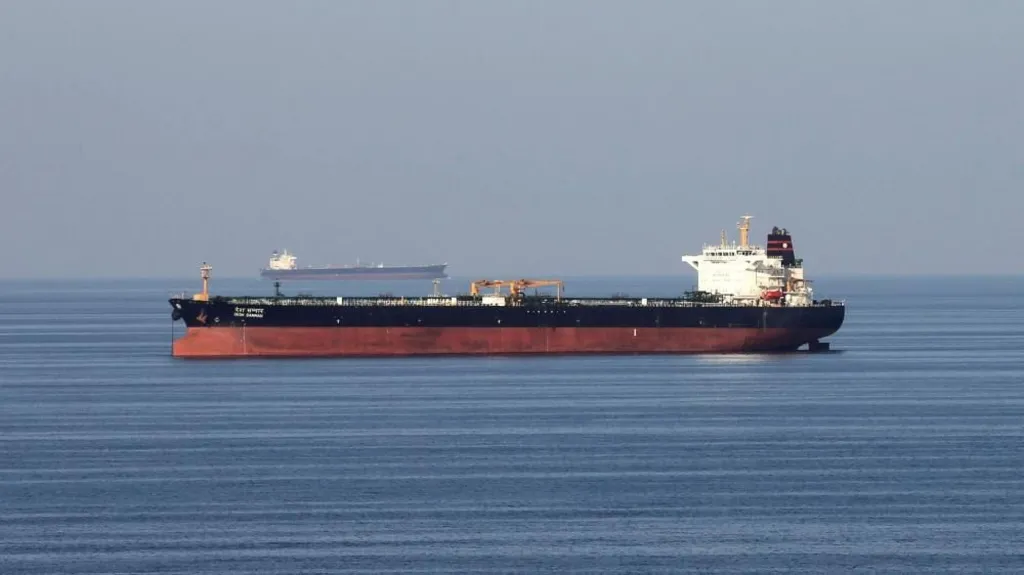
Trump certainly didn’t listen to any of his military advisers who told him that war with Iran would not be a cakewalk. And none of Trump’s briefers drew him any pictures about what would happen if the regime blocked access to the Strait of Hormuz, the choke point at the end of the Persian Gulf through which 30% of the world’s oil flows. Since the war began on Feb. 28, over 1,000 cargo ships, the majority of which are oil and gas tankers, have not been allowed to pass through the strait.
By Friday night, with frustration mounting, Trump announced the U.S. had bombed military sites on Kharg Island, which is also home to Iran’s most important oil terminal. While its oil infrastructure was left intact, he threatened to destroy the facilities if the Strait of Hormuz is not reopened. . . . The [Felon]
presidenturged Britain, China, France, Japan and South Korea to help reopen the waterway, promising that “One way or the other, we will soon get the Hormuz Strait OPEN, SAFE, and FREE!”Anyone with even rudimentary knowledge of recent history would have known this was likely. Yet CNN reported on Thursday that Trump officials acknowledged to lawmakers in recent briefings that they did not consider the possibility, a revelation that has left experts and experienced hands with their jaws on the floor. “Dumbfounded” is how one former official who served in both Republican and Democratic administrations described their response, explaining that “planning around preventing this exact scenario — impossible as it has long seemed — has been a bedrock principle of U.S. national security policy for decades.” The administration was so unprepared for Iran’s predictable response that it pulled U.S. minesweepers out of the Persian Gulf last fall after stationing them there for decades, all for the express purpose of countering a potential closure by Iran.
Since the oil shocks of the early 1970s, people who follow world events have been aware of the perils of getting into a protracted war with a large oil-producing country in the Middle East. . . . . The prospect of a war with Iran always invited the possibility that the world’s oil markets would be severely disrupted, which is one reason why political leaders of all stripes and in all countries have been leery of confronting the regime militarily.
Today we’re seeing the result of the aging Trump’s lack of inhibition and unwillingness to listen to anyone but sycophants who tell him what he wants to hear. The strait is effectively closed, just as every analyst on the planet predicted. Oil prices are hovering at just under $100 a barrel, and experts predict that could double as the war drags on. Gas is now, on average, 60 cents per gallon higher than it was in February, and prices are still climbing. As energy costs are the number one driver of inflation, we can expect that rate to rise. And all of this comes on top of an economy already reeling from Trump’s tariffs, which were beginning to bite hard.
Meanwhile, Trump has no idea what to do. The plan to underwrite the insurance for tankers to go through the strait shows a total lack of understanding of how insurance works, and any process for U.S. naval escorts is on hold because it’s too dangerous for all involved. On Monday the president told Fox News that oil tanker crews should “show some guts” and just go through the strait, which is easy for him to say. Now he has given a gift to Vladimir Putin by lifting oil sanctions on Russia, even as CNN reported that the country is aiding Iran by providing “specific advice on drone attacks.”
America’s sensitivity to oil prices is well known and well documented. There is no excuse for anyone in government to not understand this and consider the risks. It’s always possible that this will be a temporary economic blip — that the Iranians will give up the closure due to, if nothing else, the environmental horror show being visited on them by the Israelis. In the meantime, here we are, once again holding out hope that Trump — and America — will have the good luck to survive his monumentally terrible judgment.

Sunday, March 15, 2026

The Economic Numbers Are Brutal for Trump

The likelihood is growing that the economy will be in recession when voters cast their ballots in the midterm elections. Goldman Sachs on Thursday raised its 12-month estimation of a recession’s probability from 20 percent to 25 percent, and on Friday morning Polymarket, the crypto-based prediction market, put the likelihood at 34 percent within the next nine and a half months. Even if we don’t see an outright recession, Trump’s economic policies are plainly failing.
The most immediate economic problem is the Iran war, which on Friday morning had oil trading at about $100 per barrel, even after the Treasury Department rather pathetically lifted sanctions on Russian oil for tankers already at sea. In effect, war with Iran is compelling Trump to partially surrender to Russia in the Ukraine war—even as Russia helps Iran target U.S. forces in the Middle East—and it isn’t even working. Oil prices are still going through the roof. The Democrats’ attack ad writes itself.
Economic indicators were starting to go south even before the war started on February 28. According to a revised Commerce Department estimate released Friday morning, gross domestic product growth slowed to 0.7 percent from October through December 2025, down from 4.4 percent from July through September. Previously the Commerce Department knew GDP growth had dropped (the first estimate was 1.4 percent), but the growth figure turned out to be half what Commerce initially thought. A big part of the problem was reduced government spending at the state and local level. Yes, Virginia, government spending increases GDP, and one out of every three dollars in state spending lately has originated from the feds, who cut Medicaid and food stamps in Trump’s One Big, Beautiful Bill and impounded or otherwise clawed back assorted state grants. The government shutdown last fall further reduced federal aid to states during the fourth quarter.
Another major reason for weak economic growth was that imports grew from October through December, reaching a record high even as Trump slapped tariffs hither and yon. Judged as a revenue-raiser, Trump’s “Liberation Day” tariffs were a great success, raising an estimated $160 billion. But judged as trade policy, the tariffs were a dismal failure, because tariffs are supposed to make people Buy American, not pay more to keep buying foreign products. That just fuels inflation, and according to the Federal Reserve’s favorite inflation measure, the personal consumption expenditures, or PCE, price index, core inflation (i.e., minus volatile food and energy prices) was 3 percent in January. That’s significantly higher than when Trump took office one year before, after getting elected promising to reduce inflation. Rising oil prices will now send non-core inflation higher.
The trade deficit, we learned this week, narrowed in January, from $73 billion to $55 billion. (This was before the Supreme Court killed the Liberation Day tariffs.) Good news, right? Not really. The main reason was a stampede by overseas buyers to purchase American gold. That was a vote of no confidence in American dollars and American Treasury bills. Out of a $15 billion increase in exports, $4.7 billion was gold, and when you add in other precious metals, such foreign stockpiling accounts for more than half the increase. The dollar’s value fell more than 9 percent in 2025, its biggest annual drop since 2017.
Did I mention that job creation was also down before the war started? . . . . the latest jobs report showed that 92,000 jobs were lost in February, which is not good, though we’ll need one or two more monthly reports to identify this as a trend.
Uncertainty about whether Trump seeks a regime change in Iran makes all of this worse. On some days he wants one, and on other days he doesn’t. But even (especially?) if the war ends next week, the instability it created will continue to disrupt an economy that was already headed for trouble before it began. If I didn’t know any better, I’d guess Trump was deliberately trying to throw the midterm elections to the Democrats. That’s not his intention, of course. He’s just really bad at this.

Subscribe to:
Posts (Atom)