
Saturday, May 02, 2026


In Trump’s America, It Takes a King to Praise Democracy

Two hundred and fifty years into the American experiment, it turns out that it takes a King to tell us how to run our Republic.
On Tuesday, His Majesty King Charles III, the great-great-great-great-great-grandson of George III, the British monarch who lost the Revolutionary War to a bunch of impertinent colonists enamored of Enlightenment ideas about the natural rights of man, spoke to the U.S. Congress. With dry wit and a sense of irony that was surely lost on the host he so subtly trolled, Charles extolled the virtues of American-style liberal democracy now under threat by America’s own leader. What does it say about our current politics that polite British-accented clichés about the benefits of the rule of law, an independent judiciary, and the strengths that flow from “vibrant, diverse, and free societies” could end up sounding downright subversive?
The King’s biggest applause line was a tribute to Magna Carta, the thirteenth-century compact between an English monarch and his restive nobles, which, Charles noted, has become a pillar of American constitutional jurisprudence, with the Supreme Court citing it at least a hundred and sixty times in its history, not least to establish “the principle that executive power is subject to checks and balances.” It was a telling sign of our dysfunctional times that members of Congress from both parties, having been increasingly iced out of decision-making by a President claiming unprecedented executive power for himself, immediately rose for a standing ovation.
Did it matter that Donald Trump did not get the joke?
Even as Charles was speaking, Trump’s White House posted on social media an image of the two men with the caption “TWO KINGS. 👑” Later that evening, during a toast at a state dinner for his royal visitor, Trump praised his “fantastic” speech and lauded Charles for accomplishing what he could not—getting Democrats to stand and applaud him. He seemed utterly oblivious to why they had done so, and remained apparently unaware for the rest of the King’s trip. “He’s a great King,” Trump said on Thursday, at the conclusion of the state visit. “The greatest King, in my book.”
Trump spent the rest of the week proving Charles’s point about unchecked powers, with his Justice Department indicting the former F.B.I. director James Comey, for a social-media post of seashells—which prosecutors improbably claim constituted a threat on the President’s life—and his Federal Communications Commission ordering a review of the broadcast licenses for ABC stations just days after the comedian Jimmy Kimmel had used the network’s airwaves to make a joke that the First Lady did not like.
So here we are, two and a half centuries later, with a King who venerates the American Bill of Rights and a President who, increasingly, rejects it. It hardly seemed a coincidence that, on the same day as the King’s speech, reports emerged about the Trump State Department’s plans to honor America’s two-hundred-and-fiftieth anniversary with a commemorative passport whose distinguishing feature will be a large likeness of the President. Watching Trump and Charles together this week, I could not help but think of the bizarre contrast between the public modesty of the crowned monarch and the pomposity of the self-styled populist President; of these two, it’s not George III’s heir who is the one planning to erect golden statues of himself in his palaces.
The contrast between Charles and Trump was nowhere clearer than when it came to the King’s vision for America’s continued leadership in the world. In his speech, Charles, like every American President of my lifetime except Trump, hailed NATO as the foundation of our common defense. Then he exhorted Congress to defend “Ukraine and her most courageous people” with the “same unyielding resolve” that the United States has shown in fighting two world wars and other international threats to democracy over the past century. The times, he insisted, demand that America “ignore the clarion calls to become ever more inward-looking.”
These comments, as striking as they were in confirming a major international pivot by the United States, got little attention. They did, however, seem to prompt Ukraine’s President, Volodymyr Zelensky, to shift his own tactics. . . . . “If the Vice-President is proud that he’s not helping us, it means he’s helping Russians, and I’m not sure that it’s strengthening the United States.”
On Wednesday, Trump spoke on the phone with Putin about the wars in the Middle East and Europe. Although Russia has, according to intelligence officials, been aiding the Iranians with targeting information in their war with the U.S., Trump claimed that Putin would “like to be of help” in resolving the conflict. As for Ukraine, he told reporters that Putin “was ready to make a deal a while ago,” all but publicly blaming Zelensky, once again, for the continuation of the Russian invasion.
Trump, in other words, was privately trash-talking Zelensky in what he himself called another “very good” conversation with his “friend” Putin. He may not have got Zelensky to agree to peace on Russia’s terms, but, in little more than a year, Trump has practically run down a checklist of other Putin priorities: undermining America’s European allies, effectively ending billions of dollars in funding for Ukraine, attempting to shut down Radio Free Europe and other U.S. government agencies that promote democracy in the former Soviet Union, even lying publicly on Putin’s behalf to claim that Ukraine, not Russia, started the war,
Just this week, while Charles praised the NATO alliance to the U.S. Congress as the West’s indispensable bulwark, Trump was threatening to pull troops out of U.S. bases in Germany, apparently because he’s angry about criticism of his war in Iran by the German Chancellor, Friedrich Merz.
There is, sadly, no other conclusion to draw from all this than the obvious one: Trump, however personally dazzled he is by the wealth and splendor of the British monarchy, much prefers the policies and the power of the modern-day tsar he spoke with on Wednesday to those of the King he hosted with such pomp the day before.

Friday, May 01, 2026

The Iran War’s Impacts Have Only Just Begun

Another morning arrives and the Strait of Hormuz remains closed, the price of oil is more than $105/barrel, the average gasoline price in America is around $4.18/gallon, higher fuel prices are driving up the cost of numerous consumer products, and there are no schedule negotiations to end the war of choice that the Felon launched against Iran. The Felon was warned about the potential for Iran to close the Strait of Hormuz and chose to ignore the warns and now the world is living with the consequences of the Felon's arrogance and poorly thought through (if thought through at all) war. Despite the Felon's attempts to distract and spin the situation, the one thing he cannot avoid is that he and he alone is to blame for the current quagmire. Also bearing culpability are congressional Republicans who have voted down war power resolutions that would have put some constraints on the Felon. Obviously, the longer the quagmire continues, the higher the economic price to be paid by regular Americans and, hopefully, the higher the political price paid by Republicans (only 22% of Americans approve of the Felon's handling of the economy). As a piece in The Atlantic lays out, the consequences of the Felon's actions will linger for quite some time with economic pain continuing:
[The Felon
] President Trump, celebrating Tehran’s declaration that the Strait of Hormuz would reopen to commercial shipping, posted on Truth Social on April 17, “IRAN HAS JUST ANNOUNCED THAT THE STRAIT OF IRAN IS FULLY OPEN AND READY FOR FULL PASSAGE.” The opening didn’t last. But, in his haste, [the Felon]Trumphad inadvertently spelled out possibly the most consequential result of his eight-week war: The Strait of Hormuz now looks, in practice, like the “STRAIT OF IRAN.”Although none of the Trump administration’s goals—an end to Iran’s nuclear ambitions, destroying Iran’s missile capability, neutralizing proxy forces, regime change—has been fulfilled, the war has led to enduring changes. Two sweeping conclusions—one short-term, one longer—have become clear, experts in defense, diplomacy, business, and economics told us.
In the short term, despite an indefinite cease-fire that kicked in last week following an initial two-week pause in hostilities, a durable end to the war isn’t coming anytime soon. The disparity in U.S. and Iranian demands for how negotiations should proceed, along with blockades by their respective forces in the strait, has locked the two sides in a stalemate. Many Americans still expect a quick end to the war’s economic strain. But that’s unlikely. . . . A retired general, a retired CIA analyst, and an energy-industry executive said anywhere from two to nine months, prompting a collective intake of breath from the audience.
Meanwhile, the economic geography of the Persian Gulf is likely changed forever. Iran now has greater authority over the strait than before the war began and stands to benefit from its closure. Iran might start charging exorbitant tolls for all ships that cross the strait. Or a consortium of nations, including Iran, might manage the waterway and split the profits. . . . the regime has proved that it can close the strait at will, despite being confronted by the world’s most powerful military.
That gives Iran extraordinary leverage over the roughly 20 percent of global oil and liquefied-natural-gas supplies that used to pass through the strait. In response, energy companies and shippers are exploring options that could involve billions of dollars in investment in new pipelines, port expansions, and alternative (though hardly fail-safe) routes through the Red Sea. Such a rewiring of global trade routes—akin to supply-chain changes made after the coronavirus pandemic—could ultimately render passage through the Strait of Hormuz unnecessary. But any such result is likely years away.
In the meantime, the grip Iran has on the strait is expected to disrupt business, keep global energy and fertilizer prices elevated for years, exacerbate inflation—and make it much harder for Trump to claim a win in the war he started. . . . Iran has shown no inclination to abandon its leverage, and no further negotiations are scheduled. . . . . That leaves the two countries in a test of who can endure more economic pain.
[P]ushing Iran to the point of yielding could take months or even years, potentially tying up U.S. military resources to enforce the blockade, respond to disruptions, and enforce the terms of any peace settlement.
Representative Ro Khanna of California claimed that the war will cost the average American household $5,000 a year in increased gas and food prices. Trump may face his own imperative to make concessions, given those costs and what the war has done to his popularity: A Reuters/Ipsos poll released this week found that the president’s approval rating stood at 34 percent.
The White House has heard from unhappy Gulf and European allies about the strait’s closure and the unwelcome prospect of future Iranian control. China, whose economy was already struggling, depends heavily on the strait and has urged its reopening. A senior White House official told us that Trump is concerned that the issue could complicate his summit with Xi Jinping in Beijing in a little over two weeks. Yet there are no signs of a quick resolution.
The global economic damage from the first two months of the war has been stark. Traffic through the Strait of Hormuz has been reduced by about 90 percent, from some 120 to 150 daily transits to a handful, according to a new dashboard by the United Nations Conference on Trade and Development. This week, Brent crude reached its highest level in four years, at $126 a barrel. The gas-station billboards that line so many American roads reflect the increase: The average price of a gallon of gas hit $4.18. . . . The World Bank forecasts a 16 percent rise in food-commodity prices this year, driven by increased transport costs and the supply squeeze on the fertilizer industry, which relies on exports from the Gulf. The International Energy Agency has said that the world is on the brink of “the biggest energy security threat in history.”
The prevailing question facing those whose economic survival relies on Gulf exports is no longer when the Strait of Hormuz will reopen, but what role the strait will play in the postwar marketplace. Perhaps in anticipation of the disruptions to come, the UAE announced Tuesday that it was leaving OPEC, which it has long threatened to do, allowing the small country to chart its own course outside OPEC quotas.
Before investing billions, Gulf nations and companies are likely to want some reassurance that those new investments won’t become Iranian targets. In addition to shutting down traffic in the Strait of Hormuz, Iran in the past two months has hit energy infrastructure in neighboring countries. In Saudi Arabia alone, daily oil output is down by 600,000 barrels because of Iranian strikes, a Saudi state news agency said earlier this month. The Fujairah port, a potential new alternative, also has been targeted by Iranian forces.
One diplomat from the Middle East stressed to us that anything other than a return to the strait’s prewar status of being free and open would be unacceptable. But other observers aren’t sure how feasible that is, noting that countries dependent on the strait may decide to work with Tehran instead. “The longer this goes on, the higher the likelihood that countries will look to protect their own economic interests and cut deals with the Iranians, even if that triggers the wrath of the U.S.,” Richard Nephew, a former U.S. deputy special envoy for Iran, told us.
“One of the ironies of this war is that Iran discovered that it had this weapon,” he said. “There was so much talk about nuclear ability, but they have the strait.” . . . Secretary of State Marco Rubio said in a Monday appearance on Fox News that the U.S. would not tolerate Iran “trying to normalize” its control of the strait.
How the U.S. and its Gulf allies might avoid that reality is a question that will linger long after the fighting has ended.

Thursday, April 30, 2026

Energy Experts Expect Another Spike at the Gas Pump

Oil prices continued to surge on Thursday, hitting a fresh wartime high above $126 a barrel on concerns that the war in Iran could escalate, leading to a longer disruption of fuel supplies from the Middle East.
The average price of regular gasoline in the United States has followed oil higher, hitting $4.30 a gallon on Thursday, up 27 cents in a week, according to data from the AAA motor club.
Higher energy prices and the lingering effects of Mr. Trump’s tariffs are expected to keep inflation elevated through the rest of the year, Bernard Yaros, the lead U.S. economist at Oxford Economics, wrote in a note. “Inflation will get worse before it improves,” he added.
The World Bank estimated that the war in Iran would push energy prices up 24 percent this year, according to a broad index covering oil, gas and coal. “The war is hitting the global economy in cumulative waves: first through higher energy prices, then higher food prices and finally, higher inflation, which will push up interest rates and make debt even more expensive,” Indermit Gill, the World Bank’s chief economist, said this week.
The Felon promised during the 2024 campaign that he'd lower prices and inflation and supposedly many working class Americans believed the lie (rather than being attracted by the Felon's racism and bigotry) yet the opposite has been the case. The latest Comey indictment and attacks on ABC will not long distract voters from the economic pain the Felon has caused. A piece at Politico looks at the potential longer term impacts of the Felon's war of choice:
Energy experts say another oil price spike is coming — and it may be made worse by the president’s social media posts.
[The Felon]
President Donald Trumphas repeatedly spurred temporary dips in oil prices by claiming on Truth Social that the Iran war is near an end and that U.S. oil production would ensure sky high gas prices would soon retreat.The jawboning has mostly worked. Even as the global price of oil has crept up over $100 per barrel on the futures market, it is significantly less than the $140 per barrel spot price, or what it would take to buy a barrel today. But the [Felon's] president’s promises can only work for so long. Supply of oil — especially in Europe and Asia — is dwindling and a price shock is coming, said Dan Pickering, chief investment officer at Pickering Energy Partners. He said that when the summer driving season begins there will be another gas price shock that “hits people in the face.”
“There’s a day of reckoning coming,” he said. “It will be painful because I can tell you that the stock market’s ignoring this.” Another spike in prices around Memorial Day could be a fatal blow to Republican chances for holding onto the House next year, as Americans’ confidence in the economy continues to drop.
[The Felon]
Trumpon Monday was reviewing Iran’s latest peace proposal, which arrived after he canceled his top negotiators’ planned trip to Pakistan for talks. He continues to maintain that a quick resolution to the war with an agreement to reopen the Strait of Hormuz is within reach.And inside the White House, confidence remains high that markets will soon stabilize, despite U.S. gasoline prices having increased by more than $1 a gallon since the Iran war began, a major reason why the conflict is so unpopular with the American public.
Last week, [the Felon]
Trumpsaid gas prices would drop as soon as the war ends. But Rosemary Kelanic, director of the Middle East Program at the libertarian-leaning Defense Priorities think tank, said the administration’s confidence that normalcy is just over the horizon is keeping American oil companies from producing more. Why, they say, invest in production when the war is about to end. The problem is if the war doesn’t end very soon there won’t be enough oil for the world, she said.“By talking down the market so effectively, when the price spike becomes inevitable, it’s going to hurt way worse because we’ll have lost weeks or even months of time where producers could have been ramping up output,” she said.
“Our hypothesis is [that] the paper market is being manipulated,” the respondent wrote. “This will likely lead to an even worse supply and demand imbalance and higher prices in the medium term (next 12 months).”
A growing number of market analysts are reaching a similar conclusion. On Sunday, Citigroup revised upwards by $15 its expected average price for a global barrel of oil to $110 in the second quarter and $95 in the third quarter. But if the Strait of Hormuz remains closed through June, Citi forecasts a barrel of oil reaching $150.
Since the U.S. and Israel attacked Iran in February, much of the world has been using oil and liquefied natural gas loaded on tankers before the war broke out, supplemented by what’s in storage. But that will only last so long. Asia is already experiencing “steep declines” in storage, said Jenna Delaney, Rapidan Energy Group’s Director of Global Crude.
“Global refineries have already cut runs due to challenges sourcing crude,” she said. “Refined product supplies are already strained at current refinery run levels, and demand typically rises in the summer.”
Oil inventories in some countries are days or weeks away from hitting “operational minimums,” Natasha Kaneva, head of global commodities research at JPMorgan wrote in a recent note to investors. That could mean parts of the global energy system start to collapse, refineries will struggle to operate, energy flows will bottleneck and more.
[I]n a best case scenario, it will be take longer than just a few months before gas prices settled to the level they were before the war, said Emma Anderson, author of “Oil, the State, and War: The Foreign Policies of Petrostates” and a senior fellow at the Stimson Center, a foreign policy research institute in Washington. The real impact on Americans will be inflationary and is likely already locked in, she said.
“Prices at the pump are going to go up over time,” she said. “The costs of goods are going to go up as diesel goes up. Shipping will get more expensive. Trucking will get more expensive. The things you buy at the store will get more expensive.”
More "winning" thanks to the Felon.

Wednesday, April 29, 2026

Tuesday, April 28, 2026

Is The Felon Being Told the Truth About Iran?

In closed-door meetings, J. D. Vance has repeatedly questioned the Defense Department’s depiction of the war in Iran and whether the Pentagon has understated what appears to be the drastic depletion of U.S. missile stockpiles.
Two senior administration officials told us that the vice president has queried the accuracy of the information the Pentagon has provided about the war. He has also expressed his concerns about the availability of certain missile systems in discussions with President Trump, several people familiar with the situation told us. The consequences of a dramatic drawdown in munitions reserves are potentially dire: U.S. forces would need to draw from these same stockpiles to defend Taiwan against China, South Korea against North Korea, and Europe against Russia.
Both Pete Hegseth, the secretary of defense, and General Dan Caine, who chairs the Joint Chiefs of Staff, have publicly said that U.S. weapons stockpiles are robust, and portrayed the damage to Iranian forces after eight weeks of fighting as drastic. . . . . Vance is trying, the advisers suggested, to avoid making this personal, or to create divisions in Trump’s war Cabinet. Some of Vance’s confidantes, however, believe that Hegseth’s portrayal has been so positive as to be misleading.
Trump has echoed many of Hegseth and Caine’s positive statements about the war, declaring weeks ago that the damage wrought by U.S. forces already constituted victory and that U.S. stockpiles of key weapons are “virtually unlimited.” Some advisers suggested that Hegseth’s sanguine portrayals and at times combative approach with the press appear designed to give the president what he wants to hear . . . .
Pentagon leaders’ positive portrayals present an incomplete picture at best, people familiar with intelligence assessments told us. According to those internal estimates, Iran retains two-thirds of its air force, the bulk of its missile-launching capability, and most of its small, fast boats, which can lay mines and harass traffic in the Strait of Hormuz. At least in terms of resuming stalled maritime commerce, “those are the real threat,” one person told us. . . . And Tehran brings more missile launchers back online every day; roughly half are accessible again after an initial two-week cease-fire that was scheduled to expire last Tuesday, according to people familiar with the assessments.
Officials and outside advisers told us that the use of key weapons—including interceptors that defend against Iranian missiles, and offensive weapons such as Tomahawk and Joint Air-to-Surface Standoff missiles—has produced a serious shortage that erodes America’s ability to fight future wars, despite an effort to quickly manufacture replacements. Vance has raised concern about munitions shortages in meetings with the president and other national-security officials. Already, the United States may have gone through more than half of its prewar supply of four key munitions . . . . Pentagon officials have warned that the deficits jeopardized the military’s ability to prevail in a hypothetical conflict against Russia or China.
Sean Parnell, a Pentagon spokesperson, told us in a statement that Hegseth and other Pentagon leaders “consistently provide the president with the complete, unvarnished picture.”
Vance and Hegseth both have a major stake in the war’s outcome. Several people close to Trump believe Vance now sees his political future as tied to what happens in Iran, one of the senior officials told us. Other officials and individuals familiar with those involved told us Hegseth harbors his own ambitions for elected office, even possibly for president.
Hegseth’s career depends on retaining the president’s support at all costs. . . . Hegseth has fewer fans among congressional Republicans than many other Cabinet secretaries, leaving him singularly reliant on Trump’s favor. Hegseth “strives to tell the president exactly what he wants to hear,” one former official told us. “I think that’s dangerous.”
People who know Vance say that he came to believe that the Afghan and Iraq Wars were flawed from the start. “We were lied to,” he proclaimed while serving in the Senate. Vance has argued that America’s interests are best served by prioritizing resources at home. Before becoming vice president, he warned that assisting Ukraine would diminish crucial U.S. weapons stockpiles. “This is not our war,” he declared.
Far from Hegseth’s predictions of a quick, decisive win, the Iran war has now drifted into a costly, indeterminate muddle. Last Tuesday, as the minute hand ticked toward the end of the initial cease-fire, Vance’s plane idled on the runway, ready to fly him to peace talks in Pakistan. But when Iran appeared unprepared to dispatch its own negotiators, Trump backed down, extending the truce indefinitely. Meanwhile, the two countries’ standoff in the Strait of Hormuz escalated last week when the Islamic Revolutionary Guard Corps seized commercial vessels for the first time—a sign that its forces remain potent and that the war could again defy the upbeat assessments from the Pentagon’s leaders.

Monday, April 27, 2026

Trump Lost Badly in Iran

There is no way to sugarcoat the epic scale of America’s humiliation in Donald Trump’s disastrous and irrational war with Iran, or the damaging global effects that will endure years or decades into the future. With the “stable genius” and “extraordinarily brilliant person” in the White House visibly decompensating into impotent rage and erratic burst of mania, there is no obvious exit strategy that will allow him to declare victory (as he must, for interwoven and deeply unfortunate psychological and political reasons).
This war has accomplished exactly none of its stated objectives — even with those constantly shifting and being defined downward — and has almost certainly strengthened the regional power and global reputation of the Iranian regime, despite weeks of bombing and the deaths of much of its leadership. Trump’s options would seem to be a negotiated settlement that might, at best, approximate the pre-war status quo; a potentially catastrophic military escalation favored by literally no one except Lindsey Graham, the Israeli government and a handful of right-wing Iranian expatriates; or an indefinite continuation of the current phony war over the Strait of Hormuz, in hopes that the Iranian economy will suffocate before global recession sets in (an outcome that may be unavoidable no matter what else happens).
That’s a doubleplus-ungood list of options, and while it’s easy to say that the first one presents the most rational outcome for all sides, it’s not clear that even matters. . . . [the Felon]
Trumpis “quite fed up” with this war and eager to make a deal, reports Amos Harel of the Israeli newspaper Haaretz, but is trapped between Benjamin Netanyahu on one side and Iran’s new war-hardened governing faction on the other, both of whom are more than willing to fight on.We know Trump wants something he can sell as a big win to his dead-ender congressional loyalists and his declining support base, and that Netanyahu still hopes for an all-out U.S.-led war of destruction (although Harel reports that the Israeli leader now understands that’s unlikely). Opinions about what Iran’s new leaders want are all over the map, but in the words of Foreign Policy columnist Michael Hirsh, they now seem to be “calling the shots.”
From the beginning of this conflict, the Iranians identified the fundamental weakness of U.S. strategy, which was based on a litany of false assumptions, starting with the premise that total victory could be achieved with air power (something that has never happened in the history of warfare) and that killing Iran’s senior leaders would cause the regime to surrender or collapse.
Hai Nguyen, a Vietnam War scholar at the Harvard Kennedy school, told Hirsh that he saw history literally repeating itself. Like the Viet Cong of 50-odd years ago, the Iranians have perceived the American superpower’s Achilles heel: “They understand that the U.S. could drop thousands of tons of bombs, but it does not possess the patience to withstand a prolonged war.” . . . . the Iranian regime is observing a time-honored principle attributed to Napoleon: Never interrupt your opponent when he’s making a mistake.
Tucker Carlson . . . . is probably correct to describe the Iran war as the worst single decision made by any American president in his lifetime. It brings together all the worst tendencies of U.S. foreign policy since the 1960s — overconfidence, bad intelligence, inflated bluster and outright lies as a cover for irresolution and incompetence, xenophobic hubris, a misguided reliance on technical superiority and outmoded strategy, and a fundamental failure to understand the nature of asymmetrical warfare — as implemented by a team that not only failed to learn from history but proudly proclaimed that history was woke and for girls.
Whether or not this war will outdo the long-term destructive consequences of George W. Bush’s 2003 invasion of Iraq is a question for future historians to sort out (should there be any). But these military misadventures 23 years apart already appear as aspects of the same historical phenomenon, despite the ardent claims of the Trump administration and its defenders that everything is different now because real men are in charge. Both these wars represent desperate, doomed efforts to reverse the inexorable process of imperial decline that’s been underway for several decades, and has constrained or dictated the actions of at least the last five American presidents.
Let’s come back around to Tucker Carlson, whose self-serving reverse heel-turn feels partway between the old saw about rats leaving a sinking ship and a harbinger of the apocalypse. Two years ago, Carlson conducted a very long and very strange interview with Vladimir Putin, who seemed almost visibly to conclude that America wasn’t sending its top talent. It’s worth watching the whole thing, if you’re exactly the right kind of sicko. Toward the end of their conversation, Putin says that this era of history will be determined by one question: Whether America will decline in a gradual and orderly fashion, or catastrophically and all at once. We don’t have to hand it to him either, but it’s a good question and the answer is now becoming apparent.

Sunday, April 26, 2026

Trump: Iran’s Newest Hostage
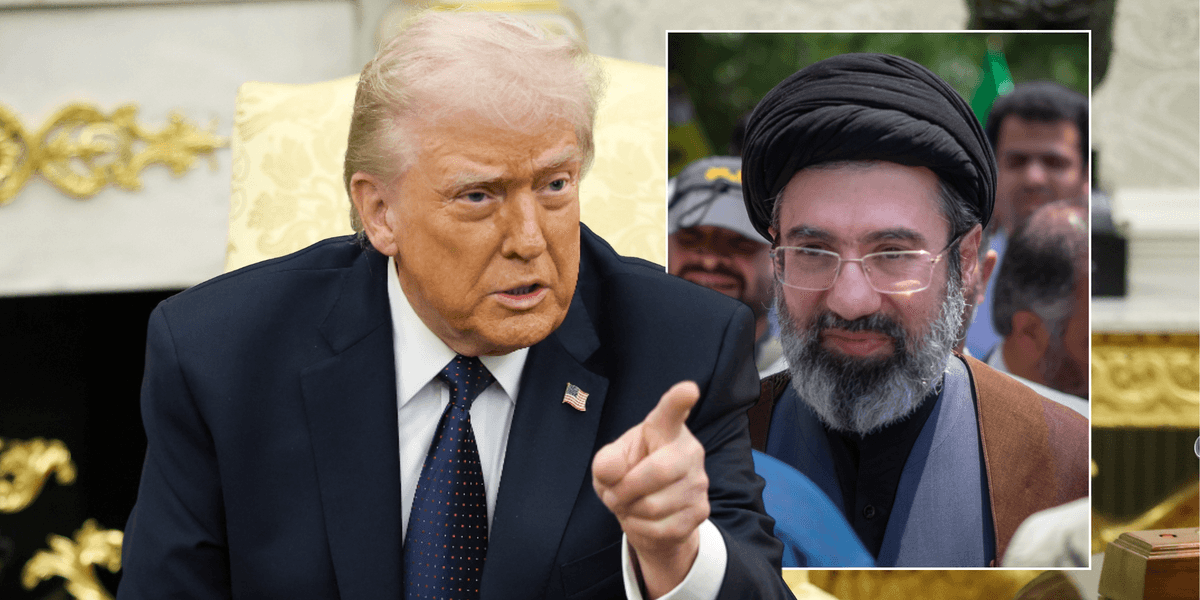
“It looked like a good thing: but wait till I tell you.” That’s the opening of the classic O. Henry short story “The Ransom of Red Chief.” The tale, written in 1907, is the ultimate parable about the perils of trying to seize and control a hellion so devious, so maniacal, so awful that the captors become the captives.
[The Felon]
President Trumpwent along with Bibi Netanyahu’s Panglossian case for slamming Iran. It looked like a good thing: but wait till I tell you.After nearly two months of tangling with the demonic Iranian leadership and its allies, [the Felon]
Trumplooks desperate to run for the hills. He constantly says he has defeated the mullahs and “obliterated” their military power, and yet Iran refuses to be subdued.Trump says there’s a new regime that’s easier to deal with, but actually it’s the same regime but worse — run by hardened, fanatical generals. Iran has not turned over its enriched uranium, and negotiations are touch-and-go. The Strait of Hormuz, which Trump keeps insisting is open, is closed. Trump is blockading the Iranian blockade.
“Iran has proven to be far more resilient and resourceful than he was prepared for,” Richard Haass, a foreign policy adviser for President George W. Bush, wrote in his newsletter, “Home & Away.” “Almost all the administration’s assumptions have been proven wrong.”
Aside from the weakening of Iran’s conventional military capability, Haass said, “virtually every other metric shows the United States, the region and the world to be worse off.”
The Iranians are tormenting Trump — even as they out-troll the master troller, viciously mocking the president as a “L.O.S.E.R.” and Bibi puppet who wants to distract from the Epstein files. One viral Iranian rap addressing Trump calls the conflict “a trap you couldn’t see. Welcome to the graveyard of your vanity.”
Now that Iran has flexed power in the strait, [the Felon]
Trumphas to bargain with it to get back to where things were before.He is pinioned in a weird nook and cranny of the planet that seems almost medieval, sitting next to a backward, villainous theocracy. And yet ships carrying over 20 percent of the world’s oil must traverse the narrow passage to get to the Arabian Sea.
[The Felon]
Trump, who grew overconfident after his adventurism in Venezuela, is being driven to distraction.He got so rattled when the two American airmen were shot down, Josh Dawsey and Annie Linskey reported in The Wall Street Journal, that he “screamed at aides for hours.” Last month, Trump talked about the danger of becoming another Jimmy Carter, spiraling amid the hostages and a failed rescue with eight helicopters lost.
Trump tried to scare the Iranians with a profane post on Easter and a wild threat to destroy their civilization. But Iran is not Afghanistan or Iraq. The Iranian mullahs and generals are the terrors of the strait.
[The Felon]
Trumphas forsaken the one good Middle East policy he had: avoiding the mirage of quick wins while getting sucked once more into “blood and sand,” as he dismissively called it during his first term.But, seduced by the detestable Bibi, he got suckered into the blood and sand. Unlike W., who had the good grace to trump up a case for war, Trump let Bibi lead him by the nose into this one, blowing off Congress, our allies and many furious MAGA acolytes.
Maggie Haberman and Jonathan Swan reveal in their forthcoming book, “Regime Change: Inside the Imperial Presidency of Donald Trump,” that the [Felon] president brushed aside Gen. Dan Caine’s warnings that a war with Iran would drastically deplete our weapons stockpiles and jeopardize the traffic in the Strait of Hormuz. . . the United States has burned through half — around 1,100 — of its long-range stealth cruise missiles built for a war with China.
The president with the attention span of a gnat posted on Truth Social that “I have all the Time in the World, but Iran doesn’t — The clock is ticking!” But he is the one who has lost control of the timeline, and himself. . . . now, in frantic Truth Social posts, in calls with reporters and in interviews, he employs hyperbolic wishful thinking. His staff is resigned to a midterm electoral disaster brought on by higher gas prices and a lack of focus on the economy.
And he keeps returning to his gargantuan ballroom. According to a Washington Post analysis, “Trump has invoked the ballroom on about a third of the days this year.” It’s a pleasant mental escape, now that he has tied himself into a Gordian knot with Iran.

Subscribe to:
Posts (Atom)