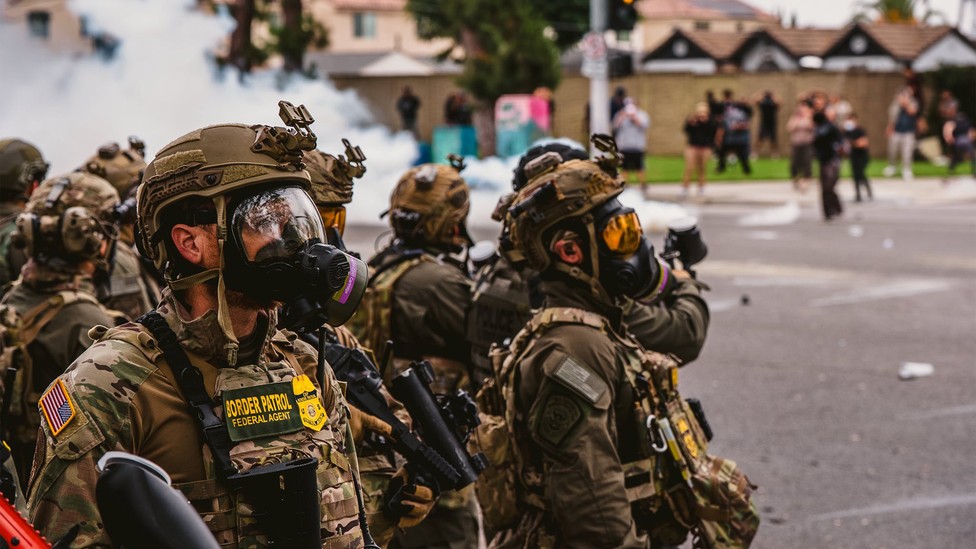
Yesterday, President Donald Trump ordered the National Guard to quell disorderly protests against immigration-enforcement personnel in Los Angeles. Secretary of Defense Pete Hegseth declared his readiness to obey Trump by mobilizing the U.S. Marines as well. These threats look theatrical and pointless. The state, counties, and cities of California employ more than 75,000 uniformed law-enforcement personnel with arrest powers. The Los Angeles Police Department alone numbers nearly 9,000 uniformed officers. They can surely handle some dozens of agitators throwing rocks, shooting fireworks, and impeding vehicular traffic.
If and when those 75,000 uniformed personnel feel overmatched by the agitators, California can request federal help of its own volition. . . . Trump is now forcing help that the city and state do not need and do not want, not to restore law but to assert his personal dominance over the normal procedures to enforce the law.
But if the Trump-Hegseth threats have little purpose as law enforcement, they signify great purpose as political strategy. Since Trump’s reelection, close observers of his presidency have feared a specific sequence of events that could play out ahead of midterm voting in 2026:
Step 1: Use federal powers in ways to provoke some kind of made-for-TV disturbance—flames, smoke, loud noises, waving of foreign flags.
Step 2: Invoke the disturbance to declare a state of emergency and deploy federal troops.
Step 3: Seize control of local operations of government—policing in June 2025; voting in November 2026.
Some of Trump’s most fervent supporters urged him to follow this plan in November 2020. But in 2020, they waited too long—until after the votes were cast. Using the military to overturn an election already completed was too extreme a step for a Department of Defense headed by a law-respecting Cabinet secretary such as Mark Esper. Trump looked to the courts instead. Only after the courts disappointed him did Trump attempt violence, and then the only available tool of violence was the lightly armed mob he summoned to Washington, D.C., on January 6, 2021. Harrowing as those events were, they never stood much chance of success: Without the support of any element of the military, Trump’s rioters could not impose the outcome Trump wanted.
But the methods Trump threatened in Los Angeles this weekend could be much more effective in November 2026 than the attempted civilian coup of January 2021.
If Trump can incite disturbances in blue states before the midterm elections, he can assert emergency powers to impose federal control over the voting process, which is to say his control. Or he might suspend voting until, in his opinion, order has been restored. Either way, blue-state seats could be rendered vacant for some time.
In his first term, Trump repeatedly talked more radically than he acted. He was usually constrained by his own appointees. Chairman of the Joint Chiefs Mark Milley rebuffed Trump’s suggestion during the George Floyd unrest that the military shoot protesters, which sufficed to dissuade Trump from upgrading the suggestion into a direct order.
But instead of Esper and Milley, the second Trump administration’s military is headed by a former talk-show host facing troubling allegations of heavy drinking and sexual misconduct. . . . . . Hegseth owes everything to Trump. The Department of Homeland Security and the Federal Bureau of Investigation are likewise headed by radical partisans with dubious records, abjectly beholden to Trump. This Trump administration is sending masked agents into the streets to seize and detain people—and, in some cases, sending detainees to a prison in El Salvador without a hearing—on the basis of a 1798 law originally designed to defend the United States against invasion by the army and navy of revolutionary France.
Since Trump’s return to the presidency in January, many political observers have puzzled over a seeming paradox. On the one hand, Trump keeps doing corrupt and illegal things. If and when his party loses its majorities in Congress—and thus the ability to protect Trump from investigation and accountability—he will likely face severe legal danger. On the other hand, Trump is doing extreme and unpopular things that seem certain to doom his party’s majorities in the 2026 elections. Doesn’t Trump know that the midterms are coming? Why isn’t he more worried?
This weekend’s events suggest an answer. Trump knows full well that the midterms are coming. He is worried. But he might already be testing ways to protect himself that could end in subverting those elections’ integrity. So far, the results must be gratifying to him—and deeply ominous to anyone who hopes to preserve free and fair elections in the United States under this corrupt, authoritarian, and lawless presidency.


No comments:
Post a Comment