Showing posts with label Donald Trump. Show all posts

Monday, July 27, 2020

America’s Global Standing is at a Low Point


It's ironic that while Donald Trump's campaign theme was to "make America great again,"the reality of his term in office so far is that America's standing in the global community of nations is at a low point even as China's military continues to build, Russia gains ground in the Middle East, and our long-time allies see us as unreliable. Add in America's failed response to the Covid-19 pandemic, about which we are either laughed at or pitied, and America's image is in tatters.  A second irony is that but for Trump's racist, religiously extreme/ignorance embracing base, who think America is the greatest, everyone else can see that its not and that it's decline has been precipitous because of their cult leader.  We cannot take much more of Trump's "winning." An very long article in the Washington Post looks at America's failed stature, most of which tracks to the malignant narcissist in the White House, on the global scene.   Here are excerpts: 

America’s standing in the world is at a low ebb. Once described as the indispensable nation, the United States is now seen as withdrawn and inward-looking, a reluctant and unreliable partner at a dangerous moment for the world. The coronavirus pandemic has only made things worse.
President Trump shattered a 70-year consensus among U.S. presidents of both political parties that was grounded in the principle of robust American leadership in the world through alliances and multilateral institutions. For decades, this approach was seen at home and abroad as good for the world and good for the United States.
In its place, Trump has substituted his America First doctrine and what his critics say is a zero-sum-game sensibility about international relationships. America First has been described variously as nationalistic, populistic, isolationist and unilateralist. [Trump] The president has demeaned allies and emboldened adversaries such as China and Russia.
At home, Trump’s handling of the pandemic has created division and confusion rather than an effective national strategy. The rest of the world sees the United States not as a leader in dealing with the coronavirus but as the country with the highest number of coronavirus infections and covid-19 deaths, and with the disease far from under control. European nations have responded with the unprecedented step of blocking Americans from entering their countries.
Before the pandemic, [Trump] the president took a number of steps that signaled a retreat from collective involvement abroad, pulling out of the Paris climate agreement, the Iran nuclear deal and the Trans-Pacific Partnership trade pact. He raised doubts about the U.S. commitment to NATO. After a long-running quarrel with German Chancellor Angela Merkel, he has called for the withdrawal of more than a quarter of the 34,500 U.S. troops stationed in Germany.
When many world leaders participated in a World Health Organization assembly on the pandemic, the president was absent. Trump’s anger with China over the virus ultimately prompted him to withdraw the United States from the WHO.
“People are stunned about the effect of incapable leadership, or of polarizing leadership, of not being able to unify and get the forces aligned so you can address the problem [of the coronavirus],” said Thomas Kleine-Brockhoff, a vice president of the German Marshall Fund and director of its Berlin office. “And that, of course, results in a nosedive in how you view [the United States]. What you’re seeing is a collapse of soft power of America.”
“I think the U.S. is seen from my perspective as being involved in its own internal reckoning — like the rest of the world doesn’t really exist,”
“It hurts our brand. It hurts the status of our institutions. It’s going to weaken our economy and our economic power and soft power as a consequence,” said Stephen J. Hadley, who was a national security adviser to President George W. Bush. “It’s potentially a real setback.”
This is not the first time the world has held America in low esteem. The U.S. invasion of Iraq cost the country dearly, in lives and in prestige. George W. Bush left office highly unpopular, especially in Europe.
Still, by the numbers, Trump had an immediate and negative impact. A Gallup survey of impressions of world leadership after the first year of Trump’s presidency saw the rating of U.S. leadership plummet by 20 points — lower than Bush’s worst rating.
The following year, approval of U.S. leadership remained similarly low, and disapproval was higher than for the leadership in Germany, China and Russia. “In this climate, China’s leadership has gained a larger advantage in the ‘great power competition,’ and the other player, Russia, is now on a more even level with the U.S.,” the Gallup report said.
The Pew Research Center issued a report in January on international attitudes toward the United States and found 64 percent of people across 32 countries saying they had no confidence in Trump as the U.S. leader, though impressions of the U.S. as a whole remained positive.
“President Trump is acting as no administration acted since the 1920s,” said Nicholas Burns, a career Foreign Service officer and former U.S. ambassador to NATO now teaching at Harvard’s Kennedy School. “Those presidents were engaged in the world. President Trump isn’t. He’s almost at war with the world.”
Ivo Daalder, president of the Chicago Council on Global Affairs and U.S. ambassador to NATO during the administration of President Barack Obama, said of Trump, “He doesn’t believe in alliances, open markets, promotion of freedom and human rights — the three pillars of [American] foreign policy. On the essential concept of the United States as the global leader of the international order, Donald Trump has thrown that all out the window.”
“By almost every measure, America’s standing and influence in the world has been damaged over the last three-and-a-half years. . . . You see it during a crisis. This is the first global crisis probably since World War II where the United States has not been in the lead. It’s kind of a stunning thing to see a transnational challenge like this without U.S. leadership.”
“I think this is the most dangerous moment the United States has faced in decades,” said the former Obama adviser Donilon. “We obviously are in the midst of multiple crises. Economic. Health. A serious societal upheaval. We have an election system that is vulnerable to outside interference. . . . We have the lowest point in our relationships with Russia and China in decades. I think democracy is under the most pressure in the world since the ’30s.”
Burns, a foreign policy adviser to the Biden campaign, said he thinks the former vice president, as president, would “quickly return the United States to a position of leadership” and that other governments would respond positively to that. “But I worry that it will take longer with the publics of these countries,” he added. “The memory of Donald Trump will not fade easily.”
[T]he last time this country’s standing was in decline, it was because of fears that the United States would exercise its vast powers excessively and unilaterally. That is not the issue today. Instead, it is a worry that the United States is no longer prepared or willing to use the powers it still has for the good of the world.

Friday, July 24, 2020

Why America Failed to Beat Covid-19 in One Word: Trump

The myth of American exceptionalism drives me to distraction.  Almost every nation sees itself as exceptional in some ways and history is littered with former empires and so-called great powers that disappeared or seen their glory days fade away.  Now, in the age of a worldwide pandemic, America has shown itself to be exceptional in the worse way possible: the pandemic is out of control in many states and Americans are banned from traveling to most parts of the world. Europe, Canada, Mexico, most of the Caribbean region, including the Bahamas, will not allow Americans to visit.  America finds itself somewhere between a laughing stock and an object of pity.  How did this happen?  One word - actually, one name - explains it all: Trump.  A column in the New York Times compares the US response to that of Italy, a country often viewed by many as dysfunctional, especially its bureaucracy, and the comparison is damning.   Of course, besides Trump, America has another huge negative working against it: the fake news outlets of the far right and "conservatives" who reject science and knowledge and blindly support the con-artist in the White House.  Here are column highlights:

A few days ago The Times published a long, damning article about how the Trump administration managed to fail so completely in responding to the coronavirus. Much of the content confirmed what anyone following the debacle suspected. One thing I didn’t see coming, however, was the apparently central role played by Italy’s experience.
Italy, you see, was the first Western nation to experience a major wave of infections. Hospitals were overwhelmed; partly as a result, the initial death toll was terrible. Yet cases peaked after a few weeks and began a steep decline. And White House officials were seemingly confident that America would follow a similar track.
We didn’t. U.S. cases plateaued for a couple of months, then began rising rapidly. Death rates followed with a lag. At this point we can only look longingly at Italy’s success in containing the coronavirus: Restaurants and cafes are open, albeit with restrictions, much of normal life has resumed, yet Italy’s current death rate is less than a 10th of America’s.
Donald Trump keeps boasting that we’ve had the best coronavirus response in the world, and some credulous supporters may actually believe him, my guess is that many people are aware that our handling of the virus has fallen tragically short compared with, say, that of Germany. It may not seem surprising, however, that German discipline and competence have paid off (although we used to think that we were better prepared than anyone else to deal with a pandemic). But how can America be doing so much worse than Italy?
For all its problems, Italy is a serious and sophisticated country, not a comic-opera stage set. Still, Italy entered this pandemic with major disadvantages compared with the United States.
Unfavorable demography and economic troubles are also major Italian disadvantages. The ratio of seniors to working-age adults is the highest in the Western world. Italy’s growth record is deeply disappointing: Per capita G.D.P. has stagnated for two decades.
When it came to dealing with Covid-19, however, all these Italian disadvantages were outweighed by one huge advantage: Italy wasn’t burdened with America’s disastrous leadership.
Italy quickly moved to do what was necessary to deal with the coronavirus. It instituted a very severe lockdown, and kept to it. Government aid helped sustain workers and businesses through the lockdown. The safety net had holes in it, but top officials tried to make it work; in a supreme case of non-Trumpism, the prime minister even apologized for delays in aid.
And, crucially, Italy crushed the curve: It kept the lockdown in place until cases were relatively few, and it was cautious about reopening.
America could have followed the same path. . . . But the Trump administration and its allies pushed for rapid reopening, ignoring warnings from epidemiologists. Because we didn’t do what Italy did, we didn’t crush the curve; quite the opposite. Matters were made worse by pathological opposition to things like wearing masks, the way even obvious precautions became battlegrounds in the culture wars.
So cases and then deaths surged. Even the promised economic payoff from rapid, what-me-worry reopening was a mirage
Incredibly, Trump and his allies seem to have given no thought at all about what to do if the overwhelming view of experts was right, and their gamble on ignoring the coronavirus didn’t pan out. A miraculous boom was Plan A; there was no Plan B.
[T]ens of millions of workers are about to lose crucial unemployment benefits, and Republicans haven’t even settled on a bad response. On Wednesday Senate Republicans floated the idea of reducing supplemental benefits from $600 a week to just $100, which would spell disaster for many families.
For someone like Trump, all this must be humiliating — or would be if anyone dared tell him about it. After three and a half years of Making America Great Again, we’ve become a pathetic figure on the world stage, a cautionary tale about pride going before a fall.
These days Americans can only envy Italy’s success in weathering the coronavirus, its rapid return to a kind of normalcy that is a distant dream in a nation that used to congratulate itself for its can-do culture. Italy is often referred to as “the sick man of Europe”; what does that make us?

Thursday, July 23, 2020

The Lincoln Project: Trump’s Enablers Must Pay a Price

Max Boot, a former Republican himself, has a great piece on the Lincoln Project in the Washington Post.  He notes that the Lincoln Project founders - and I suspect many who have made donations to the project - still hold deeply held beliefs about character, personal responsibility, foreign policy, and the national debt while the bulk of the GOP has shown all it ever has cared about is power and that it will prostitute itself to any lengths in order to retain power. The Projects ultimate goal?  To destroy the Republican Party that is now the party of Trump, white supremacists and "Christian" extremists in the hope that a new center right party can emerge that actually values what most Republicans only pretend to care about. Hence the targeting of Republican senators who have sold their souls to Trump and sold out average Americans in the process.  Here are highlights that give deserved kudos to the Lincoln Project:
“The once-mocked ‘Never Trump’ movement becomes a sudden campaign force” — Post headline, July 11
If you want any more evidence of the validity of that conclusion, look no further than the frenzied attacks on the Lincoln Project, a political action committee formed last year by four Republicans (George T. Conway III, Steve Schmidt, John Weaver and Rick Wilson) disenchanted with President Trump. With its razor-sharp videos, the Lincoln Project has drawn blood — and counterattacks mainly from the Trumpified right but also, surprisingly, from a section of the self-defeating left.
The most common charge is that, as Republican National Committee chair Ronna McDaniel put it, the organization has a “record of grift” and “profiting off attacking President Trump.” This charge has been faithfully repeated with no evidence by the lap dog conservative press, e.g., the National Review and Ben Shapiro.
This is pretty rich coming from Trump’s acolytes, since there is no more glaring example of grift in our politics than the Trump campaign and the Trump White House. According to the Center for Responsive Politics, the Trump campaign and affiliated committees have spent $22 million at Trump properties since he entered politics in 2015.
Now that’s corruption. What the Lincoln Project is doing is simply politics as usual. There is no reason to believe, the Daily Beast writes, that “Lincoln Project executives are simply pocketing the money that’s channeled through their political consulting firms.” If those working on the Lincoln Project are compensated, well, they deserve it. They’re turning out brilliant videos at a relentless pace that puts most political organizations to shame.
The attacks on the Lincoln Project’s finances are a thinly disguised attack on its tactics — which are to attack Trump and the GOP from a perspective likely to appeal to middle-of-the-road voters. Right-wingers are especially perturbed that the group has targeted vulnerable Republican senators. . . . This would seem to refute a charge heard from the far left — namely that the group is a bunch of unrepentant warmongers who haven’t really broken with the GOP.
In fact, the Lincoln Project’s founders have impeccable Republican credentials, but they are thoroughly disenchanted with the Party of Trump. One of the consultants affiliated with the Lincoln Project — Stuart Stevens — has written a forthcoming book called “It Was All a Lie: How the Republican Party Became Donald Trump” that explains in coruscating and compelling terms why he is done with a party he has served his whole life.
He calls the GOP “a white grievance party,” and writes that “there is an ugly history of code words and dog whistles in the party.” The rest of the Republican platform he dismisses as a convenient fiction: “How do you abandon deeply held beliefs about character, personal responsibility, foreign policy, and the national debt in a matter of months? You don’t. The obvious answer is those beliefs weren’t deeply held.… [I]t had always been about power. The rest? The principles? The values? It was all a lie.”
Stevens is particularly scathing about all the Republican politicians — many of them his clients — who have made common cause with Trump. “The most distinguishing characteristic of the current national Republican Party is cowardice,” he writes.
If you accept Stevens’s searing critique of the Republican Party — and I do — then it is incumbent on the Lincoln Project to target not just Trump but also his enablers. That’s just what it has done with commercials such as this one urging the defeat of Republican senators.
Does that mean the Lincoln Project favors a Democratic takeover of the Senate? Yup. But that doesn’t mean, as Trumpites blare, that it’s gone over to the far left. Its members have stayed on the center right while the Republican Party has been taken over, as Stevens writes, by “paranoids, kooks, know-nothings, and bigots.”
If we are ever again to have a sane and sober center-right party in America — something we desperately need — then the Trumpified GOP must first be demolished. That is what the Lincoln Project is trying to accomplish, and more power to it. By leading the charge against the Republican Party, its founders have shown greater fealty to conservative principles than 99 percent of elected Republicans.

Tuesday, July 21, 2020

America Needs a Third Reconstruction

A lengthy piece in The Atlantic looks at the post-Civil War efforts and failures at bringing equality to black Americans.  The first Reconstruction more or less collapsed in the late 1870's and Jim Crow laws became the law of the South and even many non-Southern states had bans on interracial marriage, among other things.  What some call the second Reconstruction - the Civil Rights movement of the 1960's - while more promising, never fully delivered on equality and in many ways fizzled as the Vietnam War came to dominate politics and social issues.  Now, with an open racist in the White House and renewed focus on racial inequality, perhaps America can complete the work it has never completed as many whites find themselves forced to look at the ugly reality of the nation's history..  Here are long article excerpts:  
Along the unbroken chain of racism that links America’s past to its present, there have been two points when the federal government—otherwise complicit or complacent—saw the mistreatment of African Americans as intolerable. During these periods, the country had a response: Reconstruction. The Reconstruction efforts were not without their flaws but, without them, the U.S. would not have made what racial progress it has. Today, another Reconstruction is needed to avoid wasting the promise of its predecessors.
The first Reconstruction came in the Civil War’s aftermath. But the concept of reconstruction—that is, what a postwar, reunified America would look like—was being discussed even before the opening shots were fired at Fort Sumter. “If another Union is formed,” one newspaper wrote in 1861, “the slave States can have no part in it except on the principles of entire and perfect equality.”
Not surprisingly, the emphasis of that first Reconstruction was on the South. Ratified shortly after the war, the Thirteenth Amendment abolished slavery, thereby ridding the South of its “slave bonus” in the House of Representatives and the Electoral College. Then, in fairly quick succession, the Fourteenth Amendment bestowed citizenship on the newly freed and Congress forced the South to enfranchise African American men, before the Fifteenth Amendment extended the franchise to men nationwide. The scale of progress ushered in over a decade was so consequential that historians have termed the era “America’s second founding.”
And yet, Reconstruction was an abysmal failure, subverted by policy makers whose acts and omissions made clear that America was giving up on Black people. First off, financial investment in the project was grossly inadequate, all but guaranteeing that formerly enslaved people would remain at the mercy of erstwhile petty tyrants. The Compromise of 1877, moreover, led the federal government to withdraw troops from the South prematurely, which emboldened regional actors to perpetrate campaigns of violence, intimidation, and political domination against African Americans. And the Supreme Court, hellbent on eviscerating the Reconstruction Amendments in the name of states’ rights and constitutional color blindness, issued a series of opinions that failed to vindicate Black liberty. Any aspirations of “entire and perfect equality” were relegated to a footnote in history, and the Fourteenth and Fifteenth Amendments, dead letters.
Jim Crow had taken a sledgehammer to the edifice of a multiracial society and, for decades, the nation stood idle to the destruction—and even wallowed in the detritus.
The sorely needed Second Reconstruction came in the middle of the next century, though its timing is less neatly bounded. Some historians trace its origins to 1948, when President Harry Truman issued the executive order desegregating the military. Others suggest that it began when President Lyndon B. Johnson signed the Civil Rights Act of 1964 into law. Most place its start between those two events, at the Supreme Court’s 1954 decision in Brown v. Board of Education. But all agree that the Second Reconstruction was erected on the foundation of the first. The Fourteenth and Fifteenth Amendments were lifted from abeyance, and soon became the basis for much of the federal government’s equality agenda.
The successes of the Second Reconstruction proved that lawmakers had learned some lessons from the failures of the first. To start, the vote was expanded dramatically—even nationally. Federal measures, most notably the 1965 Voting Rights Act, put the U.S. on a path toward becoming a true democracy. “What occurred in the course of a decade was not only the reenfranchisement of African Americans but the abolition of nearly all remaining limits on the right to vote,” the Harvard historian Alexander Keyssar wrote.
Another distinction between the post–Civil War Reconstruction and that of the mid-20th century is that the latter’s civil-rights agenda was coupled with an economic agenda. To be sure, the Johnson-era domestic policies, known as the Great Society, were not uniquely targeted to Black Americans. But unlike many programs of its forerunner, FDR’s New Deal, the Great Society’s health-care, education, housing, and economic-development initiatives envisioned Black participation.
Finally, in this Second Reconstruction, unlike in the first, the Supreme Court moved alongside advocates for progress—and sometimes ahead. The Warren Court did its share to sustain the momentum of the Second Reconstruction by ruling on the side of equality and upholding federal measures designed to further it. The Court took the lead by outlawing discrimination in schools and transportation hubs, as well as political machinations aimed at submerging Black votes. When pressed by the civil-rights movement, the executive branch racked up some crucial wins in Congress, most notably the 1964 Civil Rights Act and the Voting Rights Act.  And the Court affirmed them.
Even so, the Second Reconstruction soon came to an end. Whereas the Compromise of 1877 marked the swift and dramatic demise of the First Reconstruction, the Second faded away slowly and quietly. Johnson’s War on Poverty morphed into Nixon’s War on Drugs. Federal programs were defunded and disbanded as cities deindustrialized. And color blindness came back with a vengeance, with claims of “reverse discrimination” in the fields of education and employment.
Dog-whistle politics also came to prominence. Because a certain word was not longer acceptable to utter, the mastermind of the “southern strategy” instructed conservatives to code switch. “So you say stuff like, uh, ‘forced busing,’ ‘states’ rights,’” Lee Atwater, a top Reagan and George H. W. Bush adviser, later admitted. “Now, you’re talking about cutting taxes, and all these things you’re talking about are totally economic things, and a by-product of them is blacks get hurt worse than whites.” This approach had its intended effect: Because racism stopped rearing its ugliest faces—the George Wallaces and Bull Connors, and even police dogs—white Americans could psychologically and legally detach themselves from the nation’s racist underpinnings. With no Klan-initiated lynchings to point to, Black people could be hung out to dry.
As the rightward shift in policy continued to clip the wings of the Second Reconstruction, racial inequality soared. Circumstances in the 1990s and the 2000s began to make this painfully clear . . . . The need for Reconstruction pressed upon the country once again.
Then came a herald: President Barack Obama. Obama’s election was both problematic and promising. It was problematic because it allowed the country to applaud itself for being “post-racial” . . . . that opportunity was squandered with the election of Donald Trump, who governs as though we’re in the nadir of a Second Redemption.
This long legacy of racism has salience during the current COVID-19 pandemic: Black Americans have unequal access to health care and housing, while being overrepresented in low-paid, “essential” employment—factors that contribute to their suffering from the virus disproportionately. America’s sharp racial fault lines have proved an all-too-convenient path for the disease to follow. Even after the pandemic subsides, that trail will be littered with signs of the coronavirus’s wreckage. And yet, these dismal times, as the virus rages and historic protests continue in the wake of George Floyd’s slaying, can be the springboard for a Third Reconstruction.
So what is needed for a successful Third Reconstruction? Perhaps it begins with sweeping criminal-justice and voting reforms that could transform the United States from the world’s leading carceral state into a truly multiracial democracy. It might also entail direct investments in Black communities to guarantee stable housing, universal health care, and high-quality education, necessities for achieving a more inclusive economy and greater wealth parity. But whatever its shape, a Third Reconstruction must rekindle the aspiration of a nation molded in the ideal of perfect equality, understanding that thinking big—and going big, too—is the surest way toward “a more perfect Union.” Success also demands that national leaders heed some lessons.
The next period of Reconstruction must contend with the effects of the prior era’s deconstruction. . . . . . In addition, a Third Reconstruction will require many things, three of them vital: truth, reconciliation, and recompense. At no point in American history has there been a major national effort toward achieving any of these things separately, much less collectively. But we have no shortage of models for doing so. Many governments and universities have inquired into their ties to mass atrocities. The United States, too, should establish formal means to unearth and understand the enormity of state-sanctioned repression, dispossession, exploitation, and violence toward Black Americans, as well as the extent to which the remnants of those ills persists in our economic, political, and legal systems today.
Viruses may not discriminate but, unfortunately, U.S. policy does. The destruction from COVID-19, as Martin Luther King Jr. might have said, “is exposing evils that are rooted deeply in the whole structure of our society. It reveals systemic rather than superficial flaws and suggests that radical reconstruction of society itself is the real issue to be faced.” It has been said that life has no do-overs. When it comes to reconstruction, we can only hope that’s wrong. And if it is, we will have to undertake deep self-examination, be prepared to confront some hard truths, and remain open to substantial remedial action. The country cannot afford to lose a third chance to get things right.

Monday, July 20, 2020

Trump's Ongoing Assaults on Democracy

Events unfolding in Portland and other cities have put on display troubling efforts by the Trump/Pence regime to incite confrontations with otherwise protesters to generate visuals that Trump can use to try to frighten white/elderly voters into overlooking the threat that his field pandemic response poses to their very lives. For Virginians a name that is showing up in coverage should generate concern and/or nausea is that of Ken Cuccinelli - a far right extremist who Virginians soundly rejected when he ran for governor of Virginia - who seemingly is all onboard with creating conflict where none would otherwise exist.  It's telling that Cuccinelli holds and "acting" position since he was too extreme to garner Senate approval even with racists and extremists like Mitch McConnell wielding the gavel in the Senate.  Frighteningly, the scenes from Portland - Trump now says he is sending goons to Chicago - are like something out of Hitler's brown shirt operations as Hitler sough to overthrow Germany's democratic government.   A piece in Salon looks at the disturbing happenings.  Here are highlights:

Let's have the decency not to pretend we weren't warned about this, shall we? Since virtually the day Donald Trump was elected, if not before that, people like journalist Masha Gessen and historian Timothy Snyder have told us that his presidency would be a sustained assault on democracy, and that America stood at a historical fork in the road, with at least one of the paths leading into darkness. We began to talk about "fascism" and "authoritarianism," and maybe those terms seemed metaphorical or melodramatic, for a while. Do they seem that way now?
It didn't feel like the end of democracy, did it? To use Gessen's language, did it feel like the dangerous moment between the "autocratic attempt" and the "autocratic breakthrough"? Not the way that alarming news reports from Hungary and Russia and Turkey and the Philippines do. The problem is, as history informs us, that we're not likely to notice such dangerous moments while they're happening. So the insults and outrages piled up and the news cycle grew ever more discordant and surreal, but there was still takeout and Netflix and Amazon. . . . . There was no Reichstag fire. There were no troops in the street. Not until now. 
We can argue about whether Trump is simply the vector through which the authoritarian current flows — the Forrest Gump of fascism — or is, after his stupid-brilliant fashion, a very small Great Man of History. Both things can be true, which is effectively what Gessen argues in her new book "Surviving Autocracy." We can argue that this is all part of a larger global pattern of democratic crisis, which is clearly true, and that the United States had already become a degraded and dysfunctional pseudo-democracy in 2016, because only such a society could have allowed Trump to rise to power.
[A]ll of us — should be called to account for how we got here. Because whatever we believe we did or didn't do, it wasn't enough, and here we are: Fourteen weeks before a presidential election, there are troops in the streets.
OK, we're not supposed to call them "troops." They're not members of the military. I don't think that improves matters. For the last week, armed men in camouflage uniforms marked as "POLICE," who do not seem to have recognizable insignias or badges, and do not have names on their uniforms, have been battling Black Lives Matter protesters in Portland, Oregon. But even the language we use to describe these events grows slippery — another consequence of encroaching authoritarianism, which drains the meaning out of ordinary words. These police are not real police, and the protesters in Portland (and many other places) have moved past the Black Lives Matter agenda to something much larger and more difficult to define. They are standing up against autocracy, I think we can say, while these so-called police are trying to enforce it.
These federal paramilitaries or pseudo-cops have reportedly been seeking or inflaming confrontations with Portland protesters since at least July 14, using tear gas or pepper spray and what are described, in Orwellian cop-speak, as "less-than-lethal munitions." One protester suffered a fractured skull after being shot in the head with one of these not-quite-bullets. These federal forces have also been driving around downtown Portland in unmarked vans, according to multiple reports, sometimes pulling suspected protesters off the street for questioning without making formal arrests. 
Customs and Border Protection, one of the alphabet-soup agencies apparently supplying troops or officers or whatever we choose to call them to this effort, explained one such incident to the New York Times by claiming that "agents who made an arrest had information that indicated a suspect had assaulted federal authorities or damaged property and that they moved him to a safer location for questioning." CBP would not identify the agents in question or the suspect, and did not explain what its forces are doing in an American city 375 miles from the nearest international border.
Describing all this, Mary McCord, a Georgetown Law professor and former Department of Justice official — in other words, probably not a raging Marxist — told the Times, "This is the kind of thing we see in authoritarian regimes."
Indeed it is, which might raise the question of what kind of country this is in the summer of 2020. Let's give the big dogs of the mainstream press some credit here — after three-plus years of ceding rhetorical and political ground to the Trump regime, they have seized on the Portland story with evident alarm.
Both the New York Times and the Washington Post have made clear that these shadowy federal forces are on the streets of Portland under dubious legal authority, and against the objections of Mayor Ted Wheeler, Oregon Gov. Kate Brown and both of the state's U.S. senators, Jeff Merkley and Ron Wyden.
All those officials are Democrats, of course, which makes them illegitimate in the eyes of the Trump regime's toadies and defenders. . . . . Brown has repeatedly argued that "the presence of federal officers has inflamed the streets" rather than calming the situation, and says she told acting Homeland Security Secretary Chad Wolf to withdraw the troops: "I said it's like adding gasoline to a fire." 
Wolf refused, and has issued statements that sound as if they were dictated by his boss in the White House, claiming that Portland "has been under siege for 47 straight days by a violent mob," and that "each night, lawless anarchists destroy and desecrate property." Brown's conclusion, as she told the Washington Post, is that federal forces are deliberately provoking confrontation, "purely for political purposes."
Greg Sargent and Paul Waldman of the Post took this a step further in an opinion article published Friday, observing "that the bigger picture is that it's plainly obvious that the government is trying to inflame the situation":  We know Trump wants these scenes to be playing out on people's televisions in faraway states, such as — to select a few at random — Wisconsin, Michigan, Pennsylvania, Arizona and Florida.
It's entirely sensible to perceive nearly everything Trump does as cynical showmanship calculated (whether rightly or wrongly) to improve his dwindling chances of re-election. But it may not be sufficient. The president and his sniveling retinue of "acting" factotums up and down the national security chain may not have a coherent master plan to rip out the rest of American democracy by the roots and replace it with something more to their liking. But that is unquestionably what their collective hive-mind desires, and there are people behind them, just out of view, who are willing and able to articulate such an agenda clearly.
Is it an irrelevant side note to mention how many key posts in the Trump administration are held by acting officials? I don't think so: That speaks to the feudal or monarchic or fascistic character of the Trump regime, and no president in recent history has conducted his affairs in remotely similar fashion. Wolf, the acting DHS secretary, has not been confirmed by the Senate; neither has his acting deputy, Ken Cuccinelli, who is also the acting director of Citizenship and Immigration Services. Neither has Mark Morgan, the acting director of CBP. Neither has Matthew Albence, the acting head of ICE, or his acting deputy, Derek Benner. (Albence's chief of staff does not require congressional approval, but for some reason he's "acting" too.)
What exactly are all these wormy white men in temporary posts under a cratering presidency up to? It isn't something good. What's happening in Portland is distinctive in various ways — a small city, far from the media capitals, known, with some justification, as a hotbed of anarchist activism — but not isolated. We first saw these ambiguous "federal police," seemingly operating under the direct authority of Attorney General Bill Barr, on the streets of Washington in early June, before and after President Trump's famous photo-op sojourn across Lafayette Park. 
There are numerous reports that these goons, drawn from a laundry list of federal law enforcement agencies most of us had never previously heard of, have been seen on the ground in other cities, including Buffalo, Las Vegas, San Diego and Seattle. Less clear accounts suggest they have been used in numerous other places as well: For instance, the New York Times mentioned on Friday, almost in passing, that CBP "drones, helicopters and planes" have been used to conduct surveillance of BLM protesters in at least 15 cities. 
Wolf and Cuccinelli and Morgan and their underlings have eagerly dialed up the rhetoric, vowing not just to crush the Portland protests but to bring down the hammer of so-called federal authority with even more enthusiasm in more places. That too is part of the beta test: Trump needs them to play Mouth of Sauron, both because he lacks the courage or conviction to say those things flat out, and because he requires the latitude to throw those guys overboard if this flirty little coup-experiment blows up in his face.
What's the endgame strategy here? Is all of this "purely political," as Kate Brown said, aimed at terrifying a few white suburbanites in "battleground states" into believing that only Trump can save them from rampaging antifa hordes who want to steal their homes for government-funded Black Marxist communes? Or is this an ingenious backdoor attempt at imposing martial law, Keystone Kops-style (since the actual military wouldn't do it), with a hopeful eye toward canceling or nullifying the election and declaring democracy on hold?
[W]hen it comes to Donald Trump and the dangerous currents that flow through him, both things can be true. Either way, there are "paramilitary squads," in Sen. Ron Wyden's words, on the streets of an American city. History will judge us for how we respond.
Trump needs to be defeated in November, put on trial, convicted and, if it were up to me, dealt an extremely and permanent punishment.  The man - and those like Cuccinelli - is pure evil.

Sunday, July 19, 2020

Legacy of White Supremacy in American Christianity

The Economist has a great review (behind a paywall) of a new upcoming book entitled "White Too Long: The Legacy of White Supremacy in American Christianity" which looks at the systemic racism in American Christianity, especially among Southern Baptists and white evangelicals. The book bears out my view that the rise of racism within the Republican Party directly correlates to the rise of evangelicals and "conservative Christians" within the party base.   A piece at CNN also looks at the book to be released next month and has an overview which many white Christians - especially those in the South - will find uncomfortable to face even though the author uses numerous surveys and studies to document the book's damning conclusions.  Here are excerpts from CNN (sadly, those who most need to read the book will likely not do so):
Growing up in the South, Robert P. Jones attended Southern Baptist churches, Sunday schools, even a Southern Baptist college.
But it was only in seminary, in his mid-20s, that Jones says he learned the full truth about Southern Baptists' white supremacist roots. The denomination was founded to defend slavery and did not formally rebuke its past until 1995, when Southern Baptists voted to apologize for their history of racism.
"White Christian churches have not just been complacent; they have not only been complicit," he writes in his book, "White Too Long: The Legacy of White Supremacy in American Christianity," publishing next month.  "Rather, as the dominant cultural power in America, they have been responsible for constructing and sustaining a project to protect White supremacy and resist Black equality," he writes. "This project has framed the entire American story."
In the book Jones, CEO and founder of Public Religion Research Institute, blends church history, memoir and contemporary public opinion surveys. Together, they make a clear and compelling case for why White American Christians need to reckon with their past.
 But American Christianity's past is only part of the problem. In survey after survey, said Jones, contemporary white Christians repeatedly deny that structural racism is a problem, that shootings of unarmed Blacks are not isolated incidents, or even that African Americans still face racism and discrimination.
 One of the challenges, historically, has been that the Christian theology developed in White churches intentionally blinds White Christians to racial injustice. White Christians are nearly twice as likely as non-religious Americans to say police shootings of unarmed black men are isolated incidents. That is a moral and theological problem. As long as White supremacy has a hold on our culture, it's pretty comfortable for White Christian churches to say their theology is about personal salvation and personal lives. Theology has been constricted to be only about personal piety, disconnected from claims of social justice. Everything outside of salvation has been labeled "politics."
It's a self-protective move. If you read sermons in Mississippi in the 1950s and 1960s you would have no idea that there was a Civil Rights movement. It was a lulling of white consciences to sleep.
 I see the last four years as a moment of reckoning for White Christians. The election of President Trump, who has put White supremacy front and center, has brought these issues from just barely below the surface into plain view. Charlottesville changed things. Charleston changed things. Dylan Roof was a confirmed Lutheran, who, in his journal while imprisoned has been drawing crosses and white Jesus and is completely unrepentant. White Christians have inherited a worldview that has Christians on top of other religions, men over women, Whites over Blacks. There is a top-down authoritarian structure to it. 

Trump's Critical Role in Leading America to a Pandemic Catastrophe

Covid-19 is out of control in a number of states - included GOP led states that rushed to reopen at the demand of Donald Trump - and now Trump is trying to block more funds for testing and contact tracing and refuses to back a nationwide mandate that masks be worn in public settings.  Trump's reasons for blocking the funding is that in his mind more testing will show the magnitude of the pandemic and further highlight his regime's failure to properly lead in fighting the pandemic in the manner successfully used in other advanced nations. The resistance to masks seems to be part of Trump - and his knuckle dragging base's rejection of science and expertise in general.  Sadly, Trump's current conduct is more of what has played a critical role in what might have been a successfully contained pandemic to one that is now gripping much of the country and forcing a number of states to reconsider shutting down their economies.  A very long piece in the New York Times looks at Trump's role in leading much of the country to disaster.  Here are article highlights:

Each morning at 8 as the coronavirus crisis was raging in April, Mark Meadows, the White House chief of staff, convened a small group of aides to steer the administration through what had become a public health, economic and political disaster.
Seated around Mr. Meadows’s conference table and on a couch in his office down the hall from the Oval Office, they saw their immediate role as practical problem solvers. Produce more ventilators. Find more personal protective equipment. Provide more testing.
But their ultimate goal was to shift responsibility for leading the fight against the pandemic from the White House to the states.  . . . an attempt to escape blame for a crisis that had engulfed the country — perhaps one of the greatest failures of presidential leadership in generations.
Over a critical period beginning in mid-April, President Trump and his team convinced themselves that the outbreak was fading, that they had given state governments all the resources they needed to contain its remaining “embers” and that it was time to ease up on the lockdown.
In doing so, he was ignoring warnings that the numbers would continue to drop only if social distancing was kept in place, rushing instead to restart the economy and tend to his battered re-election hopes.
A sharp pivot soon followed, with consequences that continue to plague the country today as the virus surges anew.
Even as a chorus of state officials and health experts warned that the pandemic was far from under control, Mr. Trump went, in a matter of days, from proclaiming that he alone had the authority to decide when the economy would reopen to pushing that responsibility onto the states. The government issued detailed reopening guidelines, but almost immediately, Mr. Trump began criticizing Democratic governors who did not “liberate” their states.
Mr. Trump’s bet that the crisis would fade away proved wrong. But an examination of the shift in April and its aftermath shows that the approach he embraced was not just a misjudgment. Instead, it was a deliberate strategy that he would stick doggedly to as evidence mounted that, in the absence of strong leadership from the White House, the virus would continue to infect and kill large numbers of Americans.
He and his top aides would openly disdain the scientific research into the disease and the advice of experts on how to contain it, seek to muzzle more authoritative voices like Dr. Anthony S. Fauci and continue to distort reality even as it became clear that his hopes for a rapid rebound in the economy and his electoral prospects were not materializing.
Now, interviews with more than two dozen officials inside the administration and in the states, and a review of emails and documents, reveal previously unreported details about how the White House put the nation on its current course during a fateful period this spring.
·         Key elements of the administration’s strategy were formulated out of sight in Mr. Meadows’s daily meetings, by aides who for the most part had no experience with public health emergencies and were taking their cues from [Trump] the president.
·         Dr. Birx . . . failed to account for a vital variable: how Mr. Trump’s rush to urge a return to normal would help undercut the social distancing and other measures that were holding down the numbers.
·        [Trump] The president quickly came to feel trapped by his own reopening guidelines. States needed declining cases to reopen, or at least a declining rate of positive tests. But more testing meant overall cases were destined to go up, undercutting [Trump's] the president’s push to crank up the economy. The result was to intensify Mr. Trump’s remarkable public campaign against testing, a vivid example of how he often waged war with science and his own administration’s experts and stated policies.
·         Mr. Trump’s bizarre public statements, his refusal to wear a mask and his pressure on states to get their economies going again left governors and other state officials scrambling to deal with a leadership vacuum.
·         Not until early June did White House officials even begin to recognize that their assumptions about the course of the pandemic had proved wrong.
It was the end of March and his initial, 15-day effort to slow the spread of the virus by essentially shutting down the country was expiring in days. Sitting in front of the Resolute Desk in the Oval Office were Drs. Fauci and Birx, along with other top officials. Days earlier, Mr. Trump had said he envisioned the country being “opened up and raring to go” by Easter, but now he was on the verge of announcing that he would keep the country shut down for another 30 days.
“Do you really think we need to do this?” the president asked Dr. Fauci. “Yeah, we really do need to do it,” Dr. Fauci replied, explaining again the federal government’s role in making sure the virus did not explode across the country.
But even as [Trump] the president was acknowledging the need for tough decisions, he and his aides would soon be looking to do the opposite — build a public case that the federal government had completed its job and unshackle the president from ownership of the response.
By mid-April, Mr. Trump had grown publicly impatient with the stay-at-home recommendations he had reluctantly endorsed. Weekly unemployment claims made clear the economy was cratering and polling was showing his campaign bleeding support. Republican governors were agitating to lift the lockdown and the conservative political machinery was mobilizing to oppose what it saw as constraints on individual freedom.
The wind down of the federal government’s response would play out over the next several weeks. The daily briefings with Mr. Trump ended on April 24. The Meadows team started barring Dr. Fauci from making most television appearances, lest he go off message and suggest continued high risk from the virus.
By June the president was regularly making nonsensical statements like, “If we stop testing right now, we’d have very few cases, if any.”
Later, it was clear that states that rushed to reopen before meeting the criteria in the guidelines — like Arizona, Texas and Alabama — would have among the worst surges in new cases.
Dr. Birx’s belief that the United States would mirror Italy turned out to be disastrously wrong. The Italians had been almost entirely compliant with stay-at-home orders and social distancing, squelching new infections to negligible levels before the country slowly reopened. Americans, by contrast, began backing away by late April from what social distancing efforts they had been making, egged on by Mr. Trump.
The real-world consequences of Mr. Trump’s abdication of responsibility rippled across the country.
Other nations had moved aggressively to employ an array of techniques that Mr. Trump never mobilized on a federal level, including national testing strategies and contact tracing to track down and isolate people who had interacted with newly diagnosed patients.
“These things were done in Germany, in Italy, in Greece, Vietnam, in Singapore, in New Zealand and in China,” said Andy Slavitt, a former federal health care official who had been advising the White House.
“They were not secret,” he said. “Not mysterious. And these were not all wealthy countries. They just took accountability for getting it done. But we did not do that here. There was zero chance here that we would ever have been in a situation where we would be dealing with ‘embers.’ ”
By early June, it was clear that the White House had gotten it wrong. . . . . Digging into new data from Dr. Birx, they concluded the virus was in fact spreading with invisible ferocity during the weeks in May when states were opening up with Mr. Trump’s encouragement and many were all but declaring victory.
The number of new cases has now surged far higher than the previous peak of more than 36,000 a day in mid-April. On Thursday, there were more than 75,000 confirmed new cases, a record.
Mr. Trump’s disdain for testing continues to affect the country.
“When we were trying to get people to wear masks, they would point to the president and say, well, not something that we need to do,” he said.
Mr. Suarez expressed similar frustrations with Mr. Trump’s dismissive approach to mask wearing. “People follow leaders,” he said, before rephrasing his remarks. “People follow the people who are supposed to be leaders.”
Trump has thousands of avoidable deaths on his hands.

Thursday, July 16, 2020

America Is In a Downward Spiral. Worse is Still to Come

Like many so-called conservatives and Republicans, George Will - one of the deans of reasoned conservative thought - was an apologist for disastrous GOP policies and Republican shenanigans which harmed the country and laid the groundwork for the rise of Donald Trump.  Unlike those in the GOP who continue to prostitute themselves both to Trump and the white supremacist/religious extremists of the GOP base, Will finally opened his eyes and belatedly has come out strong in condemning the moral bankruptcy of Trump and today's Republican Party. In a column in the Washington Post he admits that America is in decline and lays much of the blame at the feet of Trump and the Republican political whores who have enabled him.   Further, he longs for a massive landslide victory by Joe Biden that will be so stark that even Trump's lies and his mindless, soulless followers will not be able to challenge the repudiation of Trump and all he and the GOP which is now a reflection of him stand for.  Here are column highlights:

Never has a U.S. election come at such a moment of national mortification. In April 1970, President Richard M. Nixon told a national television audience that futility in Vietnam would make the United States appear to the world as “a pitiful, helpless giant.” Half a century later, America, for the first time in its history, is pitied.
Not even during the Civil War, when the country was blood-soaked by a conflict involving enormous issues, was it viewed with disdainful condescension as it now is, and not without reason: Last Sunday, Germany (population 80.2 million) had 159 new cases of covid-19; Florida (population 21.5 million) had 15,300.
Under the most frivolous person ever to hold any great nation’s highest office, this nation is in a downward spiral. This spiral has not reached its nadir, but at least it has reached a point where worse is helpful, and worse can be confidently expected.
The nation’s floundering government is now administered by a gangster regime. It is helpful to have this made obvious as voters contemplate renewing the regime’s lease on the executive branch. Roger Stone adopted the argot of B-grade mobster movies when he said he would not “roll on” Donald Trump. By commuting Stone’s sentence, Stone’s beneficiary played his part in this down-market drama, showing gratitude for Stone’s version of omertà (the Mafia code of silence), which involved lots of speaking but much lying. Because the pandemic prevents both presidential candidates from bouncing around the continent like popcorn in a skillet, the electorate can concentrate on other things, including Trump’s selection of friends such as Stone and Paul Manafort, dregs from the bottom of the Republican barrel.
Today, there is a vast longing for respite from the 21st century, which — before the pandemic, two inconclusive wars and the Great Recession — began with a presidential election that turned on 537 Florida votes and was not decided until a Dec. 12, 2000, Supreme Court decision. Given Trump’s reckless lying and the supine nature of most Republican officeholders, it is imperative that the Nov. 3 result be obvious that evening.
[T]he pandemic will be an accelerant of preexisting trends: There will be a surge of early and mail voting. So, an unambiguous decision by midnight Eastern time Nov. 3 will require (in addition to state requirements that mailed ballots be postmarked, say, no later than Oct. 31) a popular-vote tsunami so large against [Trump] the president that there will be a continentwide guffaw when he makes charges, as surely he will, akin to those he made in 2016.
It is scandalous that in many places casting a ballot requires hours of standing in line. Larry Diamond of the conservative-leaning Hoover Institution at Stanford discerns another scandal: “The hard truth is that there has been a rising tide of voter suppression in recent U.S. elections. These actions — such as overeager purging of electoral registers and reducing early voting — have the appearance of enforcing abstract principles of electoral integrity but the clear effect (and apparent intent) of disproportionately disenfranchising racial minorities.
This nation built the Empire State Building, groundbreaking to official opening, in 410 days during the Depression, and the Pentagon in 16 months during wartime. Today’s less serious nation is unable to competently combat a pandemic, or even reliably conduct elections. This is what national decline looks like.
I hate to say it, but Will is 100% on the money.

Tuesday, July 14, 2020

Donald Trump Has Been a Mirror, Held Up to Us Americans

Several friends posted about an op-ed in the Philadelphia Inquirer  by a former career member of the U.S. military who comes from a military family.  At first glance given its headline the piece is upsetting since it appears to be a thank you to Donald Trump.  However, reading the column,  the piece is in reality a condemnation of Trump and those who created the pathway for his election.  Put simply, Trump embodies what is wrong with America and has made the nation's shortcomings painfully obvious to anyone not living under a rock or who is not a white supremacist and/or evangelical extremist.  Thus, the piece thanks Trump for making it clear what needs to be done to undo the stain he and principally the Republican Party have done to harm so many Americans and to usher in a national decline.  Between the GOP efforts to bring about a new Gilded Age and and its and Trump's attacks on science and objective facts, America faces not only racial strife but also a class struggle against the greed driven very wealthy.  Here are column highlights:

Of my 57 years drawing breath, I’ve spent 51 of them directly or indirectly serving this once great nation. So, as you might imagine, I found myself on Nov. 8, 2016, more than a little dismayed at the news we had elevated Donald J. Trump to the nation’s highest office — a man so clearly unfit to lead America.
But over time I’ve come to appreciate Trump in ways I did not expect. Now, I am thankful that we elected Trump. Because Donald Trump is exactly what America needed. Trump is a mirror, a warning, and ultimately a catalyst for change. Reflected in Trump is all that is wrong with the United States: the injustice of our broken social contract, the crassness of our politics, and the cruelty of our economy. Trump is also the shock that a mature democracy needs for action. To use a timely metaphor, Trump and his supporters are a virus, and they have activated our democratic antibodies. What we are seeing in the streets is the body fighting the infection.
What we are seeing in our current moment is not only a race war but a class war. America must confront systemic racism to move forward, but it also must acknowledge that we have created a permanent underclass of all colors (though mostly Black and brown). We are a society where your melanin content and your zip code determine your future.
Beginning with Newt Gingrich in 1994, Republicans stopped trying to govern and instead began accumulating power. McKay Coppins writes in his profile of Gingrich in the Atlantic, “… few figures in modern history have done more than Gingrich to lay the groundwork for Trump’s rise.” Effective governance requires compromise, trust, and mutual respect. Gingrich’s new version of Republican had no interest in that. He destroyed the bipartisan structures for governing and even resorted to name-calling and conspiracy theories — over the line at the time, but in hindsight presaging Trumpism.
A straight line can be drawn from Gingrich’s “Contract with America” to the tea party in 2009. Another outsider movement characterized by distrust of government, expertise, and experience, the tea party helped elect a rogues’ gallery of loathsome lawmakers — I’m looking at you, Rand Paul (Ky.) and Ted Cruz (Texas). Trump’s dystopian vision of America is the ultimate flowering of the outsider, populist, anti-government thinking that has metastasized in the Republican Party over the past decades.
Under both political parties, America has rolled back regulatory guardrails and created a volatile economy that values the wrong things. . . . Over the same period, we dismantled the meager social safety net we had. We have reduced access to food aid, job training, and unemployment insurance. Meanwhile, the cost of health care and higher education has skyrocketed, placing both out of reach for many Americans.
Now for the good news.
Everything wrong with America is manifested in Trump. The hunger for power, the vile derision of people who don’t look like you, the cruelty, the privilege, the gleeful ignorance, and mendacious narcissism. Our revulsion at Trump is causing Americans to ask: How did we get to this place? And how do we get out? That will take time and hard work by well-intentioned people from every corner of American society.
What is happening in our streets is how open, progressive societies improve — fitfully, imperfectly, frustratingly, sometimes tragically. But we do improve. So, thank you, President Trump. Thank you for showing us what we were becoming and helping us find the courage to confront it. We are going to be OK.
Col. Curtis Milam served 26 years on active duty and has over 4,000 flight hours in the C-130. He has served tours at the Pentagon, NATO HQ, and the U.S. Embassy in Budapest, Hungary.

The Trump virus must be exterminated and his supporters must be marginalized to the point where they can do no more damage..

Is Donald Trump Beginning to Implode?


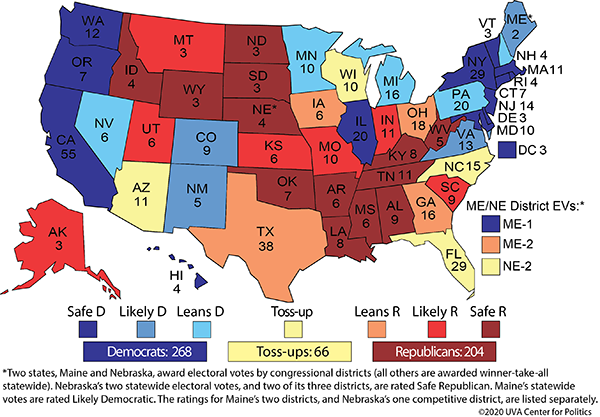
As Donald Trump continues to double down on rhetoric that thrills his core base of racists and Christian extremists in the hope of turning out his base in November, the opposite effect is happening with the rest of the population.  Indeed, the more ugly Trump's rhetoric becomes, the more voters he appears to be driving away.  A piece in Larry Sabato's Crystal Ball even shows Trump's lead in reliably red states dwindling and has caused GOP stalwart states like Alaska, Indiana, Kansas, Missouri, Montana, South Carolina, and Utah from "safe Republican" to "likely Republican."  One can only hope that Trump's hemorrhaging of support continues and that the presidential election becomes a rout with Biden winning by a landslide.  Personally, I want this to happen because it would restore some shred of faith in the American public as a whole and because it would devastate Trump's ego - Trump's pain is my pleasure, if you will.  Here are highlights from the Crystal Ball:

We are now about six weeks into a downturn in Donald Trump’s polling numbers. It’s worth thinking about the ramifications of this change if it endures.
In the RealClearPolitics average of national approval polling, Trump went from about early December to late May without ever dipping below -10 in net approval (approval minus disapproval). He has spent every day since June 1 at or below -10 net approval, and he’s currently at about -15.
Joe Biden’s national polling lead over Trump through May was in the four-to-six-point range. That is a decent lead, but not one that suggested Biden was a towering favorite . . . . But since early June, Biden’s lead has ballooned to the eight-to-10-point range. He has also enjoyed healthy leads in many polls of the most important swing states, like Florida, Michigan, Pennsylvania, and Wisconsin.
The bottom line here is that the nation is in a state of terrible crisis, and the public has, at least for now, judged the president’s responses to both coronavirus and protests of racial inequalities in policing to be lacking.
In an ABC News/Ipsos poll released Friday, 67% of respondents disapproved of Trump’s handling of coronavirus and of race relations. . . . . It is not the kind of year when one wants to be an incumbent running for reelection, and a majority of the public appears to believe that this president is not meeting the moment.
A few weeks into the public health crisis, we explored the possibility of Trump being the second iteration of Jimmy Carter, whose reelection bid fell apart among myriad crises in 1980. Since then, the Trump-as-Carter scenario has grown even more plausible.
There is time for the situation to change — as we wrote a few weeks ago, we want to see where things stand after the conventions, around Labor Day. But Trump is extremely unlikely to win if the polls continue to look the way they do now. And if these numbers represent a new normal, we need to account for the possibility that this election won’t be particularly close, and that new states may come into play. In other words, if the national picture remains bleak for Trump, then the slippage he’s seen from earlier this year wouldn’t just be limited to a handful of swing states.
The very well-sourced New York Times trio of Maggie Haberman, Jonathan Martin, and Alexander Burns recently reported that internal Republican data showed Trump with only a small lead in Montana and trailing in Kansas, two states that Trump carried by about 20 points apiece in 2016 (both have competitive Senate races, too).
Trump’s position is weak enough in mid-July that we have to concede there are some signs of competitiveness in states that were not competitive in 2016. This sort of thing can happen when the overall election is tilted toward one side over the other, which is the state of play at the moment and the advantage Biden currently holds.
[W]e continue to rate states like Colorado, New Mexico, and Virginia as Likely, not Safe, Democratic. That’s despite it being hard to imagine Trump carrying any of them, even if his position dramatically improves.
So we’re moving seven Safe Republican states to Likely Republican: Alaska, Indiana, Kansas, Missouri, Montana, South Carolina, and Utah. . . . In all likelihood, these red states are going to vote for Trump, and not just by a few points.
But could one or more flip if Biden wins decisively in November? Possibly. Let’s remember: A “Likely” rating still means we see one side — in this case, the Republicans — clearly favored in a state. We just don’t feel 100% certain about these states in the event of a lopsided election.
We think we’ll get more clarity about which scenario is more likely following the conventions — whatever the conventions actually look like. Even with 2020’s scaled down, undramatic, and overshadowed conventions, voters and media see them as departure points into the general election. Casting a ballot is no longer just on the distant horizon. It’s a reality that will firm up people’s choices — and our ratings.