|
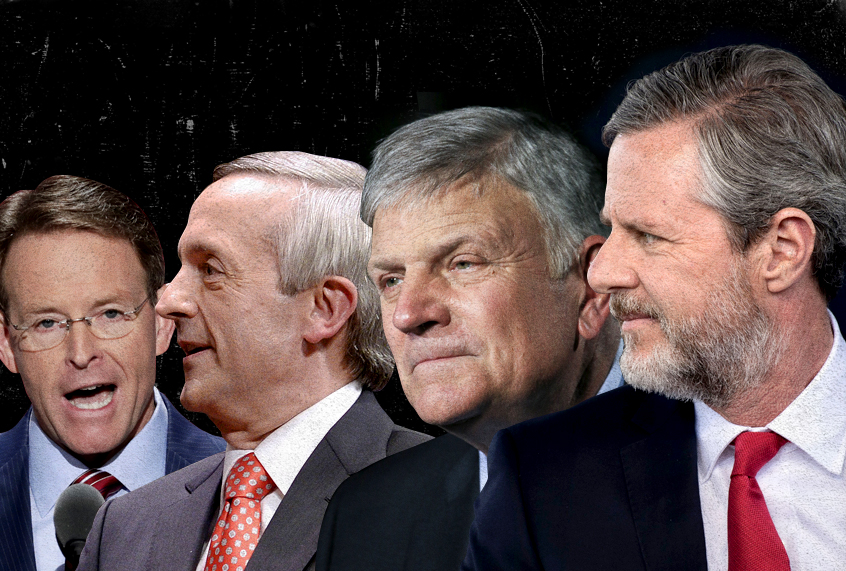
Power and money mad Trump acolytes, Franklin Graham, Ralph Reed
and Jerry Falwell, Jr. |
This blog looks at the poisonous effects of religion since one of the blog objectives is to expose hypocrisy. Few realms provide more hypocrisy on open display that religion, especially present day evangelical Christianity. Add to this the the deadly influence that conservative Christianity has inflicted on LGBT individuals worldwide, starting with European missionaries who exported homophobia across the globe and stigmatized, if not literally killed, native cultures that had previously accepted, if not embraced, homosexuality. For those interested, the historical review in
The Origins and Role of Same-Sex Relations in Human Societies traces the actions of these missionaries in place as diverse as the early American west, Japan, the South Pacific, to Africa. The common theme through out this effort was converting or, if conversion failed, destroying those who did not subscribe to "godly folks'" dogma and/or agenda. Now, in the age of Trump evangelicals have jettisoned any pretense of upholding Christ's message and their sole goal is to destroy those they deem to oppose them - liberals, gays, non-Christians, etc. - and to embrace political power regardless of the moral bankruptcy of their chosen vehicle to power. A piece in
The Atlantic looks at the crisis point evangelical Christianity has reached and its need to reject Trump and refocus on Christ's gospel message or face the loss of what little legitimacy evangelicals retain with the larger public (I myself have largely given up on institutional Christianity). Here are article highlights:
Last
week, Ralph Reed, the Faith and Freedom Coalition’s founder and chairman, told
the group, “There has never been anyone who has defended us and who has fought
for us, who we have loved more than Donald J. Trump. No one!” Reed is partially
right; for many evangelical Christians, there is no political figure whom they
have loved more than Donald Trump.
I
recently exchanged emails with a pro-Trump figure who attended the president’s
reelection rally in Orlando, Florida, on June 18. (He spoke to me on the
condition of anonymity, so as to avoid personal or professional repercussions.)
He had interviewed scores of people, many of them evangelical Christians. “I
have never witnessed the kind of excitement and enthusiasm for a political
figure in my life,” he told me. “I honestly couldn’t believe the unwavering
support they have. And to a person, it was all about ‘the fight.’
The
rallygoers, he said, told him that Trump’s era “is spiritually driven.” When I
asked whether he meant by this that Trump’s supporters believe God’s hand is on
Trump, this moment and at the election—that Donald Trump is God’s man, in
effect—he told me, “Yes—a number of people said they believe there is no other
way to explain his victories. Starting with the election and continuing with
the conclusion of the Mueller report.
Many said God has chosen him and is
protecting him.”The data seem to
bear this out. Approval for
President Trump among white evangelical Protestants is 25 points higher
than the national average.
. . . . during the period from July 2018 to January 2019, 70 percent of white
evangelicals who attend church at least once a week approved of Trump, versus
65 percent of those who attend religious services less often.
The
enthusiastic, uncritical embrace of President Trump by white evangelicals is
among the most mind-blowing developments of the Trump era. How can a group that
for decades—and especially during the Bill Clinton presidency—insisted that
character counts and that personal integrity is an essential component of
presidential leadership not only turn a blind eye to the ethical and moral
transgressions of Donald Trump, but also constantly defend him? Why are those
who have been on the vanguard of “family values” so eager to give a man with a
sordid personal and sexual history a mulligan?
Part
of the answer is their belief that they are engaged in an existential struggle
against a wicked enemy—not Russia, not North Korea, not Iran, but rather
American liberals and the left.
Many white
evangelical Christians, then, are deeply fearful of what a Trump loss would
mean for America, American culture, and American Christianity. If a Democrat is
elected president, they believe, it might all come crashing down around us. . .
. . A friend of mine described that outlook to me this way: “It’s the Flight 93 election.
FOREVER.”
Many evangelical
Christians are also filled with grievances and resentments because they feel
they have been mocked, scorned, and dishonored by the elite culture over the
years. . . . For a growing number of evangelicals, Trump’s dehumanizing tactics
and cruelty aren’t a bug; they are a feature. Trump “owns the libs,” and
they love it. He’ll bring a Glock to a cultural knife fight, and they relish
that.
There’s
a very high cost to our politics for celebrating the Trump style, but what is
most personally painful to me as a person of the Christian faith is the cost to
the Christian witness. Nonchalantly jettisoning the ethic of Jesus in favor of
a political leader who embraces the ethic of Thrasymachus and Nietzsche—might
makes right, the strong should rule over the weak, justice has no intrinsic
worth, moral values are socially constructed and subjective—is troubling
enough.
But there is
also the undeniable hypocrisy of people who once made moral character, and
especially sexual fidelity, central to their political calculus and who are now
embracing a man of boundless corruptions.
In speaking
about the widespread, reflexive evangelical support for the president,
Coppock—who is theologically orthodox and generally sympathetic to
conservatism—lamented the effect this moral freak show is having, especially on
the younger generation. With unusual passion, he told me, “We’re losing an
entire generation. They’re just gone. It’s one of the worst things to happen to
the Church.”
Proximity to
power is fine for Christians, Coppock told me, but only so long as it does not
corrupt their moral sense, only so long as they don’t allow their faith to
become politically weaponized. Yet that is precisely what’s happening today.
Evangelical
Christians need another model for cultural and political engagement, . . . a
set of sensibilities and dispositions that are fundamentally different from
what we see embodied in many white evangelical leaders who frequently speak out
on culture and politics. The sensibilities and dispositions Fujimura is
describing are characterized by a commitment to grace, beauty, and creativity,
not antipathy, disdain, and pulsating anger. It’s the difference between an
open hand and a mailed fist.
“The Church is
in one of its deepest moments of crisis—not because of some election result or
not, but because of what has been exposed to be the poverty of the American
Church in its capacity to be able to see and love and serve and engage in ways
in which we simply fail to do.
[A]s a starting
point, evangelical Christians should acknowledge the profound damage that’s
being done to their movement by its braided political relationship—its love
affair, to bring us back to the words of Ralph Reed—with a president who is an
ethical and moral wreck. Until that is undone—until followers of Jesus are once
again willing to speak truth to power rather than act like court pastors—the
crisis in American Christianity will only deepen, its public testimony only
dim, its effort to be a healing agent in a broken world only weaken.
At this point, I
can’t help but wonder whether that really matters to many of Donald Trump’s
besotted evangelical supporters.
I have to laugh in some ways about Ralph Reed's statement and his continued self-prostitution for money by pandering to an manipulating evangelicals. Reed and I met years ago and my "gaydar " went off the charts. Sadly, Reed strikes me as yet another closeted, self-loathing gay who cannot (i) let go of his childhood religious brainwashing and (ii) walk away from the money trough so dear to professional Christians. .