Showing posts with label Trump/Pence regime. Show all posts

Tuesday, June 16, 2020

The Supreme Court’s LGBT Ruling Will Extend Far Beyond Employment Law

Justices Gorsuch and Roberts: targets of Christofascist venom.
Yesterday's much welcomed U.S. Supreme Court ruling in Bostock v. Clayton County was limited to Article VII of the Civil Rights Act of 1964 and focused on employment discrimination.  However, the spill over effect will likely spread much farther and impact the application of other statutes that bar discrimination based on sex.  One likely victim of the ruling - even though court challenges will likely be required - is the Trump/Pence regimes efforts to roll back Obama era rules that bar discrimination in the health care realm. Applying the reasoning of Bostock, the Department of Health and Human Service's re-write of the rules runs head on into what the Court just ruled is illegal discrimination. Yes, the Christofascists are indeed seething because Bostock now provides a further weapon against their demands that the have a license to discriminate. A piece in Mother Jones looks at the likely spill over effects.  The irony, of course, is that a Trump appointee wrote the ruling,  Here are highlights:
On Monday, the Supreme Court handed LGBTQ Americans one of their biggest civil rights victories yet. In a 6-3 decision, the court ruled that gender identity and sexual orientation were protected under Title VII of the 1964 Civil Rights Act’s prohibition on sex discrimination in employment. The decision means LBGTQ folks can no longer lose their jobs simply for being queer. 
“In our time, few pieces of federal legislation rank in significance with the Civil Rights Act of 1964,” writes Justice Neil Gorsuch, a Trump appointee, in the majority opinion. “There, in Title VII, Congress outlawed discrimination in the workplace on the basis of race, color, religion, sex, or national origin. Today, we must decide whether an employer can fire someone simply for being homosexual or transgender. The answer is clear. An employer who fires an individual for being homosexual or transgender fires that person for traits or actions it would not have questioned in members of a different sex. Sex plays a necessary and undisguisable role in the decision, exactly what Title VII forbids.”
The ruling provides some much-needed clarity for lower courts and state officials, who are currently working with a hodgepodge of different (and sometimes conflicting) nondiscrimination policies.  
And though the case was specific to employment discrimination, the implications beyond the workplace are huge. The ruling won’t directly overturn discriminatory policies outside the realm of employment, says Sharon McGowan, Legal Director for Lambda Legal—which argued one of the Title VII cases before the Second Circuit Court—but it does set a precedent that makes it incredibly difficult to exclude gay and transgender people from other laws that prohibit discrimination on the basis of sex. 
Take, for example, the Fair Housing Act. In 1974, the act was amended to prohibit housing discrimination on the basis of sex, but to date, only 24 states interpret that to include LGBTQ people (or have passed state legislation that explicitly includes them). One additional state, Wisconsin, prohibits discrimination against gay people, but not transgender people. Through the years, studies have shown that LGBTQ renters and home owners have been overcharged, less likely to secure rental housing or even evicted because of their sexual orientation and gender identity.
Experts say the Supreme Court ruling could also effect things like Title IX of the Education Amendments Act of 1972—which prohibits sex discrimination in education and has recently been weaponized against transgender student athletes—and health care nondiscrimination policies. 
Just last week, Trump’s Health and Human Services Department released a prepublication version of a rule change that would roll back protections for transgender patients under the Affordable Care Act. The change is meant to undo an Obama-era policy that barred providers and insurance from rejecting care based on gender identity.
“There is still a chance for HHS to see the error of their ways and pull the rule back and fix their mistake, which I hope they will do,” McGowan says. “But assuming that they’re going to continue to forge ahead, they basically have put forth a rule that says ‘we, in the federal government, think that sex discrimination doesn’t mean the things that the Supreme Court has just said sex discrimination means.’

But now, the bad news: Monday’s Supreme Court ruling does nothing for laws that don’t include sex in their nondiscrimination policies—and unfortunately there are more of them than you might think. Federal law prohibits discrimination in public accommodations (e.g. restaurants, retail businesses, parks, libraries) based on race, color, religion and national origin only. The same is true of discrimination prohibitions in certain federally funded programs. 
“I remain more optimistic than I’ve ever been, that we will continue to succeed in rooting out discrimination in all of its forms,” says McGowan. “But I do think that there are going to be issues that that many courts—particularly courts that are hostile to the underlying pinnings of these rulings—may try to find wiggle room maybe where it doesn’t exist. We know that our work is going to continue.”
The struggle for full equality under the law continues.

Saturday, June 13, 2020

Trump Regime Rolls Back LGBT Healthcare Protections on Anniversary of Pulse Massacre

The Trump/Pence regime is truly perverse- hateful might be a more accurate description - as it deliberately takes actions to send messages to its ugly base and simultaneously reminds those his base hates are constant targets. First, Trump announces a rally in Tulsa - the site of perhaps the most brutal attack on blacks post Civil War - to take place on Juneteenth, the date when blacks celebrate the of the announcement of their freedom in Texas at the end of the Civil War. Then yesterday, on the fourth anniversary of the Pulse night club massacre of LGBT individuals, the foul regime rolls out its new regulations that end LGBT protections in the health care realm and  give a green light to homophobes that they are free to discriminate and/or refuse services to LGBT individuals, particularly transgender individuals. Trump apologists will no doubt whine that the timings were coincidences, but rest assured that Stephen Miller (a look alike for Hitler's Joseph Goebbels) and other Trump henchmen know exactly what they are doing.  The two happenings are messages to white supremacists and homophobic Christofascists that Trump is their man.  A piece in The Advocate looks at the gutting of LGBT healthcare protections (thanks to Democrats on July 1st, Virginia will have state laws banning such discrimination).  Here are highlights:
The U.S. Department of Health and Human Services Friday announced changes to the Affordable Care Act that reverse protections for transgender people added by the Obama administration in December 2016. The previous changes to Section 1557 of the ACA had defined gender as “one’s internal sense of gender, which may be male, female, neither, or a combination of male and female.” Today’s announcement signaled a return to the original text of the law.
“Today’s rule attempts to gut the robust nondiscrimination protections under the Health Care Rights Law, Section 1557 of the Affordable Care Act (ACA),” Winnie Stachelberg, executive vice president for external affairs at the Center for American Progress, said in a written statement. “This move by the administration to undermine anti-discrimination protections in health care for LGBTQ people, women, people with limited English proficiency, people with disabilities, and others, including those who face multiple forms of discrimination, is unconscionable at any time.”
The new language also removes antidiscrimination protections for the groups of people Stachelberg noted, and allows for wide-ranging exemptions from providing services related to abortion if health care workers have faith-based objections.
Lynn Dawson, associate director of HIV policy at the Kaiser Family Foundation, told NPR that changes will be felt beyond basic health care issues. She says insurance companies might be able to raise premium prices for LGBTQ+ people, and trans patients might find limited remedies through the legal system.
"Because of limited access to litigation, I think that it's fair to state that the ramifications [of this rule] could be pretty significant," she lamented.
Several LGBTQ+ groups, other civil rights groups, and medical organizations issued statements condemning the administration's action, and the Human Rights Campaign plans to sue over it.
Today, the Human Rights Campaign is announcing plans to sue the Trump administration for exceeding their legal authority and attempting to remove basic health care protections from vulnerable communities including LGBTQ people. And, to add insult to injury, the administration finalized this rule on the anniversary of the Pulse shooting, where a gunman killed 49 people in an LGBTQ nightclub,” said HRC President Alphonso David. “LGBTQ people get sick. LGBTQ people need health care. LGBTQ people should not live in fear that they cannot get the care they need simply because of who they are. It is clear that this administration does not believe that LGBTQ people, or other marginalized communities, deserve equality under the law. But we have a reality check for them: we will not let this attack on our basic right to be free from discrimination in health care go unchallenged.
“It is particularly brazen of Secretary of Health and Human Services Alex Azar and the President to undermine health care access at a time when the nation is confronted by the coronavirus,” said Andy Marra, Executive Director of the Transgender Legal Defense & Education Fund. “Today’s published rule demonstrates this administration would rather promote discrimination in health care than deliver a comprehensive and evidence-based response to the pandemic. We look forward to challenging these reckless regulations alongside our partners to ensure trans protections remain intact.”
In my view, Trump and many in his regime are pure evil. 

Wednesday, June 10, 2020

Trump and Barr Consider Antifa Terrorists, But Not The KKK

Via Facebook I found a piece in the Jewish Journal that brings into sharp focus the sickness of the Trump/Pence regime and Trump's consigliere, AG William Barr.  The FBI's own records show that white supremacy groups pose the largest domestic terrorist threat, yet instead Trump and Barr want to declare Antifa - a loose organization with no leaders or organizational structure - as a "terrorist organization."  As for White supremacists in Charlottesville and other far right actions since, Trump refers to them as "very good people." Just today, Trump overruled the Department of Defense move to rename military bases named after Confederate generals in an effort to win allegiance from his white supremacist supporters. Here are article highlights:
“The United States of America will be designating Antifa as a Terrorist Organization,” President Donald Trump tweeted on May 31, the morning after American cities were engulfed with protests decrying the death of George Floyd. In major metropolises including  New York, Pittsburgh, Minneapolis, Dallas and Los Angeles, the demonstrations spiraled out of control, devolving into looting, vandalism and arson. 
Trump declared the lootings were “being led by antifa,” a decentralized movement threaded together by its militant, sometimes violent opposition to fascism and the far-right. 
Pittsburgh’s chief of police, agreed. Attorney General William Barr also pointed his finger at the group, saying the protesters were using “antifa-like tactics.” However, acting Homeland Security Secretary Chad Wolf said,  “A number of different groups are involved in these whether it’s antifa or it’s others, frankly.”
Whether you agree with antifa’s ideology or approach, [Trump's] the president’s announcement is shocking, given that many of the most violent hate groups in the United States aren’t designated as terrorists. One notable example is the Ku Klux Klan, which for decades has used bloodshed, intimidation and crime to terrorize Americans.
“White supremacist extremism is currently the most lethal form of extremism in the U.S.,” American University professor Cynthia Miller-Idriss told Congress in September. According to the Anti-Defamation League, the far-right was the source of 73% of domestic extremist-related slayings from 2008 to 2019. 
However, Trump has been much more hesitant to declare these menacing groups as terrorists.
The first time the U.S. labeled a white supremacist group as a terrorist organization was in April. However, the Russian Imperial Movement was not American-based. The ultra-nationalist organization is widely known for plotting bomb attacks on asylum seekers in Sweden. Meanwhile, countless other home-grown neo-Nazi, Holocaust denial, neo-Confederate and Skinhead organizations remain undesignated. 
When the United States labels a group as “terrorist,” it is not a symbolic gesture. . . . .
Terrorist groups are under the purview of terror-related intelligence bodies such as the National Counterterrorism Center (NCTC), which is uniquely suited to handle these deadly organizations. Right now, the NCTC is prohibited from preventing violent anti-Semites like the Pittsburgh and Poway, Calif., shooters. Trump’s National Strategy for Counterterrorism includes preventing terrorists from acquiring weapons. However, known neo-Nazis still are able to obtain firearms.
Unlike white supremacist groups, which explicitly call for victimizing racial and religious minorities, antifa’s mission is not inherently violent. One could argue that by opposing fascism, the group seeks to prevent mass violence. Antifa’s rampages normally end in property damage. It’s hard to argue that the group is lethal; the only recorded death related to antifa was in January 2019 when member Charles Landeros fired at police while being arrested. He missed and was killed by returning fire.
Compare that to self-described white supremacist Robert Gregory Bowers, who is charged with walking into the Pittsburgh Tree of Life synagogue in October 2018 and killing 11 Jews. That incident was not isolated. Patrick Crusius is charged with killing 23 people at an El Paso, Texas, Walmart in August, leaving behind a white nationalist manifesto. 
Crusius had posted about his intent to kill on the website 8chan. If white nationalists were considered terrorists, the NCTC might have been able to track and potentially stop the deadliest attack on Latinos in modern American history. 
However, Trump isn’t only ignoring white supremacist terrorism but actively pushing American institutions overlook it.
According to Reuters, Trump attempted to rename the Countering Violent Extremism program to “Countering Radical Islamic Extremism” — erasing white nationalist violence from its mission entirely. Under the current administration, federal prosecutors are limited in how they can bring white nationalists to justice. 
Whether you approve of antifa’s message or tactics, it is not nearly as consequential a threat to Americans as the vast number of white supremacist groups in this country. Although it might be more politically advantageous for Trump to rail against the anarchy-loving movement, he is driving this nation, and his blind spot endangers all Americans in his backseat.

Sunday, May 24, 2020

The Obamacrats Strike Back

One of the hallmarks of the Trump/Pence regime has been its assault on environmental protection and health safety regulations which will leave the nation and world dirtier and Americans less safe and less healthy.  Part of the motivation is a contempt for average Americans and a desire to allow big business to operated unrestricted.  The other is Trump's obsession with destroying everything Barrack Obama - who occupied the White House for eight years without scandals and criminal convictions of members his administration - accomplished.  The threat to average Americans is real and, as a piece in The Atlantic notes, has caused a number of members of the Obama administration to leave the lucrative private sector and return to politics and activism and advocacy.  Their motivation?  To protect the environment and concern for their children and grandchildren.  Here are article excerpts:
Washington legend has it that bureaucrats and political operatives overwhelmingly stay in issue advocacy or politics after their bosses leave office. But that notion is decades out-of-date. These days, many top officials who leave the D.C. swamp go directly to the private sector—and are paid handsomely to do so.
More of former President Barack Obama’s top aides entered the private sector than from any other administration in the past four decades . . . . Yet as Trump’s aggressive rollback of Obama-administration policies has continued, several former Obama officials who went into academia or took private-sector jobs have since returned to politics or advocacy work.
Take Gina McCarthy, who spent seven chaotic years in Washington, four of them as the head of the Environmental Protection Agency under Obama. McCarthy was happy to pass the first years of the Trump administration in Boston, where she got to ride her bike to work every day as a professor at Harvard’s T. H. Chan School of Public Health.
Her Trump-appointed successors at the EPA announced changes to federal standards almost daily. By June 2019, they had done away with the Obama-era regulation to curb carbon emissions from power plants, and set their sights on redrafting a rule to allow cars to discharge more polluting gases—a change that the auto industry itself largely opposed. But late last year, when a rewrite of the Mercury and Air Toxics Standard, which limits the levels of mercury emitted from power plants, seemed imminent, McCarthy decided that she was ready to make a change.
So when the Natural Resources Defense Council, a leading environmental-advocacy nonprofit that had been searching for a new president, called her last fall, McCarthy said she was in.
McCarthy wasn’t alone: Last June, former Interior Secretary Sally Jewell became the interim head of the Nature Conservancy, the top environmental-lobbying spender, which takes in more money than the American Cancer Society. Tina Tchen, a former chief of staff to first lady Michelle Obama, initially joined a law firm before taking a job leading the Time’s Up Legal Defense Fund late last year. And former administration officials such as Elissa Slotkin and Lauren Underwood ran for congressional seats in 2018—and won.
The former officials who decided, instead, to stick it out in (or rejoin) the less remunerative world of politics and activism were likely spurred on by the dramatic operational and regulatory shifts seen in Trump’s White House, Neera Tanden, the president of the liberal think tank the Center for American Progress, told me.
“Many people recognize the existential threat to progressive issues and progressive values [caused] by the Trump administration,” Tanden said. “And it has called a lot of people into the battle.”
McCarthy’s NRDC, which has its own political-action committee, has emerged as one of the most aggressive challengers to the Trump administration’s environmental policies. The group plans to spend more than $5 million on federal-election efforts by June. It has donated more to candidates this election cycle than most other environmental organizations, topping the former Democratic candidate Tom Steyer’s group, NextGen Climate Action. Since Trump took office, the NRDC has sued his administration more than 100 times over a range of deregulatory actions and won more than 90 percent of the cases that have been resolved. Its victories include reinstating a ban on oil drilling in the Arctic and penalties for automakers who violate emissions rules.
The Trump administration’s actions on the mercury rule especially infuriated McCarthy. Mercury is a powerful neurotoxin that can lead to impaired vision, muscle weakness, and changes in mental function. Children and unborn infants are the most vulnerable. As Obama’s last EPA head and a top air-pollution official at the agency before that, McCarthy was intimately involved in drafting the rule, which she said was broadly accepted by all parties.
The EPA finalized changes to the mercury rule on April 16, declaring it not “appropriate and necessary.” Industry groups and environmentalists alike had opposed alterations. There’s “no basis to repeal these important and long-overdue” protections, Exelon, a major utility company, wrote to regulators in a 2019 public comment.
The Trump administration’s squabbling over the rule drove McCarthy “absolutely nuts,” she said. “That’s when I realized what they were doing made no sense from a standard-setting process. It was just to destroy everything that had been done before. It had no explanation otherwise.
NRDC certainly has the money to push its agenda. Through the group’s political arm, McCarthy will have millions to put toward endorsing and advertising for candidates in key 2020 races and promoting the ultimate goal: unseating Trump. The fund budgeted $6.2 million for election and lobbying efforts in fiscal 2018, ahead of the midterms. This money, which also supports voter-turnout efforts, can make a significant difference in close House and Senate races.
McCarthy doesn’t think of the rollbacks of her work at the EPA—or even the attacks from her critics—as a personal affront. But she sees her job as deeply personal nonetheless. . . . Everything that I thought I was working towards, which is really protecting my family and other families from damage from pollution, particularly—that was all at risk. And I couldn’t sit on the sidelines anymore.”

Sunday, May 10, 2020

How To Respond To Friends Posting False Conspiracy Theories?

Since the 2016 presidential election I have observed many otherwise sensible and decent people - many wealthy Republican women - re-posting and sharing some of the most insane and untrue things on Facebook and other social media platforms.  During the 2016 campaign many of these falsehoods ultimately were traced back to Russian sources working to cause hate and division among Americans and to aid Donald Trump.  For some, no conspiracy seems too far fetched.   In some cases I unfriended individuals since I simply did not have the patience to see the endless parade of batshit crazy stuff they posted and in another recent case I stopped following  the individual.  Now, with the coronavirus pandemic there has been an upsurge in false conspiracy theories being backed by groups ranging to far right billionaires to white supremacy groups to foreign disinformation sources.  A piece in The Atlantic looks at how one should deal with friends who continue to post false materials.  The BBC also has a piece on stopping false "news" some online friends should read. The advice in The Atlantic suggests more patience than I can at times muster perhaps since I work in a profession where facts and logic matter.  Here are article excepts:

[P]olitical scientists Joseph E. Uscinski and Adam M. Enders observed that the coronavirus has created an environment dangerously conducive to conspiracy theories. “We have a global pandemic, a crashing economy, social isolation, and restrictive government policies,” they wrote. “All of these can cause feelings of extreme anxiety, powerlessness, and stress, which in turn encourage conspiracy beliefs.”
This past week, a widely discredited video—a 26-minute clip from a slickly produced documentary called Plandemic—circulated online. It promotes a number of harmful and false ideas, including that wearing a protective mask can make people sick and that the novel coronavirus most likely emerged from a laboratory. (Facebook, YouTube, and other companies are trying to scrub it from their platforms.)
If someone you care about sends you a link to this video—or any piece of media that pushes a conspiracy theory about the pandemic—how should you respond? I put that question to experts on conspiracy thinking, public-health risk communication, and psychology, and their responses converged on some basic guidelines.
Uscinski, a professor at the University of Miami and a co-author of American Conspiracy Theories, made an important preliminary distinction: Some people are sharing links to videos like Plandemic because they are curious and uncertain about the claims being made, but others are doing so because they’re already deeply convinced. If you know someone is a “true believer,” to use Uscinski’s term, you probably can’t do much to sway them. You’ll have a better chance of getting through to the curious and the uncertain.
Whatever camp someone falls in, though, the general principles are the same. “It’s always important to respond in a way that doesn’t suggest that the other [person] is foolish, naive, or gullible, as much as you think they may be,” said Joshua Coleman, a psychologist with an expertise in family relationships.
After setting an empathetic tone, Coleman suggested continuing with something like this:
That video might be right, but I've been reading a lot these days that goes counter to that. Do you mind if I send you an article or video about that? It would be good for us to look at both and see what we think.
“First validate” the fears people might have about the pandemic “and then pivot,” Rachael Piltch-Loeb, a fellow at the Harvard T. H. Chan School of Public Health, recommended. Along those lines, she suggested something like “I’m glad you brought this up. Those are some scary claims in that documentary. I am skeptical, though, because a lot of the things mentioned don't jibe with what I have been reading. Here’s an article that I found to be more helpful at explaining these issues, and I feel more comfortable with the science behind it.” John Banas, a communication professor at the University of Oklahoma, advised avoiding the implication that the other person’s faith in the video is “a personal failing.” You could instead point out the flaws in the current information ecosystem, he said, maybe with a reminder like “During this pandemic, there are people who want to take advantage of people's fears and all of the uncertainty surrounding the situation.” You might also try, when having conversations with other friends and family members, to preempt any curiosity they may have about Plandemic or its ilk by warning them about the existence of COVID-19 conspiracy theories. People need to be prepared to resist harmful persuasion,” Banas said, “just like our bodies need to be prepared to resist harmful viruses.”


Malignant forces are behind these conspiracy theories.  I wish more "conservatives" would stop taking the bait and allowing themselves to be played for fools to further the agenda of others, be they members of the Trump regime or other bad actors.

Friday, May 01, 2020

How Trump Gutted Obama’s Pandemic-Preparedness Systems

The Trump/Pence regime continues to try to re-write the regime's bungled response to the coronavirus pandemic, that has ranged from (i) the dissolution of the Obama pandemic directorate within the National Security Council, (ii) a willful blindness to anything that doesn't conform to a right wing ideology, to (ii) Trump's rejection of science and objective facts while pandering to his knuckle dragging base (today he called armed protesters who stormed thew Michigan legislature "very good people"). It is critical in the lead up to 2020 election that voters understand the Trump regime's ineptitude and role in making the pandemic even worse. A piece in Vanity Fair reviews the bungling that is the hallmark of the Trump/Pence regime.  Here are article excerpts:

When the first reported cases of Ebola in Guinea came to light in March 2014, it set off a mad scramble inside the Obama White House to track and contain the spread of the virus, which killed around 50% of the people it infected. Though not nearly as contagious as the current coronavirus, an epidemic, or even a pandemic, seemed possible if the disease weren’t confined to its West African redoubts. The Obama White House had clear protocols and chains of command for these kinds of threats. “The way to stop the forest fire is to isolate the embers,” Beth Cameron, a former civil servant who ran the White House’s National Security Council Directorate for Global Health Security and Biodefense, told me.
In the summer of 2018, on John Bolton’s watch, the team Cameron once ran was one of three directorates merged into one amid an overhaul and streamlining of Donald Trump’s National Security Council. And the position Monaco previously held, homeland-security adviser, was downgraded, stripped of its authority to convene the cabinet.
Obama’s team never faced a crisis as serious as the novel coronavirus, a truly unprecedented challenge. But officials who worked on past crises and experts on pandemic response believe that Trump’s dismissal—and in some aspects, wholesale discarding—of the Obama administration’s preparedness structures and principles, and the current administration’s ideas about government. . . . have left them dangerously unprepared.
“What the administration lacked in February, and still lacks today is articulating an overall strategy for managing this crisis,” a former administration official told me.
Trump has yet to do this. “President Trump has, throughout this, seemed a little schizophrenic about his role, . . . . “On the one hand, he clearly wants all the credit for it when things go right. On the other hand, he has furiously attempted to avoid having to take ownership for the success of the effort…he wants the credit without the accountability.”
The biggest difference between Obama’s approach and Trump has to do with science. “Traditionally, we have had a situation where the response is always scientifically, technically proven,” says a former government official. “Of course there are political considerations. But the options that are presented are fundamentally sound from a scientific perspective.”
In the current situation, the president decides which scientists and governmental organizations are listened to. “We’re seeing that institutions like the FDA and the CDC have been curtailed; their ability to do the right thing has been curtailed,”  . . .
Trump critics are quick to draw contrast between the COVID-19 and Ebola crises. Obama, they assert, was guided by objective facts. “One of the principles [that] President Obama was very clear on when it came to public health crises is you have to be guided by science and facts and speak clearly and consistently and credibly on those issues,” . . . . “President Obama’s view was, we’re not going to be buffeted by the political winds here. We’re going to go with what the scientists and the public health experts tell us is in our best interest,” she said.
The U.S. crisis response structure has not been equipped to span all 50 states. “The system...is very heavily designed around a relatively short duration, very geographically specific incidents, things like hurricanes and earthquakes and tornadoes and tsunamis,” the former administration official told me. The refrain is, “locally executed, state managed, and federally supported.” And the thinking goes, when a locality gets overwhelmed—say a hurricane or a tornado hits—it goes to its state; if that state gets overwhelmed it will go to neighboring states for assistance, mutual aid; and when that system is exhausted, the federal government steps in with additional resources.
It is this federal-support piece that has been missing, sources I spoke with say.
The reorganization and streamlining of the National Security Council in the Trump era, specifically whether Bolton dismantled an office focused on pandemics, has emerged as a point of discussion and competing narratives. At the start of the Trump administration, Tom Bossert held the position and, as an assistant to the president, had the highest rank of commissioned officers in the White House. Cameron recalled that during the presidential transition, Rice pushed for pandemics to be one of the three topics covered in an exercise with the incoming administration.
But when Bolton was tapped to replace H.R. McMaster, Bossert was shown the door and the position was downgraded to a deputy assistant to the president, no longer able to convene the cabinet. . . . Today, the position of homeland-security adviser is vacant.
The role of the homeland-security adviser was created after the 9/11 attacks, the premise being that one person in the West Wing, steps away from the Oval Office, was focused solely on immediate domestic threats. “The idea is you want somebody in the White House who is directly and immediately responsible to the president on these issues,” explained Monaco, who earned the nickname “Dr. Doom” from Obama in the role. . . . you need to have that direction and an ability to quickly break through bureaucratic impediments and move quickly...pursuant to an overall strategy.”
The novel coronavirus is exposing the inadequacies of a cornerstone of Trump’s (and Kushner’s) governing philosophy. “The entire argument behind electing Donald Trump is that business can handle anything better than the government, right? So the entire philosophy, the entire ideology of every senior leader in the White House and that they’ve installed across the federal government is, ‘Get the private sector to do it.
But the problem is, there are some things only the federal government can do, after all. “This is the crisis for this administration, just as every administration faces, that challenges its ideology and worldview to its core and cannot be effectively addressed with that worldview.”
With no sign that Trump is poised to fill the leadership vacuum, sources I spoke with fear the devastation is only beginning. “I think that we will eventually come out the other side, but it’s going to be one where it would take longer and they would lead to more loss of life,” the former government official told me.
Juliette Kayyem, a former homeland-security official in the Obama administration who played a critical role in the H1N1 crisis and the vaccination rollout, was blunt in her assessment. President Trump does not have the capacity to govern a mass vaccine-distribution program because that’s going to be some really hard decisions,” she told me. For instance, who gets it first? . . . . The biggest problem she sees today is, “This president doesn’t make decisions based on objective criteria.”

Tuesday, April 28, 2020

Nursing Homes Were a Disaster Waiting to Happen Long Before Covid-19

Nursing homes are places to be avoided if at all possible and even having money and being placed in a "good facility" doesn't guarantee one will receive proper care (this happened to a friend last year), especially since many nursing homes are for-profit operations and maximizing profits is the number one concern despite lip service to the contrary.  There are state and federal standards that strive to enforce safety for patients and these were strengthened in 2016 under the Obama administration only to be weakened one year later under the Trump/Pence regime which time and time again places money making big business ahead of the safety of citizens (other examples are the gutting of clean air and clean water regulations). The sad reality is that too often, going to a nursing home is going to a place to die unless one is going for short term rehabilitation.  Most are understaffed and simple measures to avoid infection are all too often ignored.  A column in the New York Times looks at the state of nursing homes which have accounted for 25-27% of all Covid-19 deaths - perhaps more if accurate reporting was required nationwide.  Here are article excerpts:

It was clear almost from the outset that the elderly and frail were in the greatest danger from Covid-19. And it was clear to anyone familiar with American nursing homes that these facilities would not be up to the task of protecting their older and infirm residents.
As of Thursday, Covid-19 has killed over 10,000 residents and staff members in long-term-care facilities in 23 states that report fatality data, about 27 percent of the Covid-19 deaths in those states, according to the Kaiser Family Foundation.
The weaknesses in patient care and oversight at nursing homes that made those deaths more likely were longstanding, widespread and well known.
One-third of Medicare beneficiaries admitted to nursing homes suffer harm within about two weeks of entering the facility, according to a 2014 report from the federal Office of Inspector General. These are the short-term residents for whom facilities are paid the most and who are typically most able to articulate their concerns if something is wrong. Where does that leave a majority of residents who are in the facility long-term, most of whom are older, frail and cognitively impaired?
Despite the absence of federal reporting requirements, we are seeing that residents and families are being devastated by Covid-19. In New Jersey, an anonymous tip led authorities to a nursing home that was storing corpses in a shed. At least 29 of its residents have died from Covid-19 and many more residents and staff members have been infected. Unsurprisingly, this for-profit nursing home has a history of seriously low staffing and citations for substandard infection control.
The tragedy is that government standards of safety and care at homes certified under Medicaid or Medicare (a large majority) are strong. If enforcement of those standards had not been so lax, the devastation we have seen in nursing homes could have been mitigated.
The federal Nursing Home Reform Act of 1987, and the regulations and guidance through which the law is carried out, most recently revised in 2016, require effective infection control and prevention including hand hygiene and the use of personal protection equipment.The most important precautions against infection are inexpensive and simple, and the most common violations involve simple sanitation and hygiene practices, like hand washing. Nevertheless, infection control and prevention problems were the most frequently cited violation in nursing homes last year.
Such poor care persists because regulators let the nursing home industry treat standards of care as goals rather than actual requirements. The nursing home industry wields enormous influence in Washington and state capitals through multimillion-dollar trade associations, powerful law firms and generous contributions to politicians and political action committees. As a result, nursing homes, rather than nursing home residents, are often viewed by policymakers as the constituency whose interests merit protection. After President Trump was elected, the Centers for Medicare and Medicaid Services started openly referring to the nursing home industry as its “customer.”
Numerous federal and academic studies over the years have found that government inspectors do a poor job finding substandard care and, even when they do, are woefully disinclined to penalize a facility for it.
This is because of the persistent failure to identify when residents have been harmed or put in jeopardy. For example, while pressure ulcers (bedsores) are a potentially life-threatening concern for nursing home residents, proper care can prevent or minimize a vast majority of them. 
Nursing home industry lobbyists often claim that their clients cannot afford to improve conditions because they make so little money. In fact, the for-profit sector of the industry has been growing for years, belying the notion that it is not a profit-generating industry. Profit margins from Medicare reimbursements have been in the double digits for about 20 years, according to the nonpartisan Medicare Payment Advisory Commission. . . . . In addition, nursing home profits are increasing under the new federal payment methodology introduced last October.
So we can’t accept industry excuses about costs or give in to Trump administration efforts to undermine regulatory standards and reduce the already low frequency of inspections. Instead, existing standards need to be more strictly enforced, and tougher standards need to be put in place. Residents’ lives depend on it.
Federal minimum staffing standards are long overdue. A study in 2001 determined that the typical nursing home resident needs about 4.1 hours of care each day just to meet his or her basic clinical needs (not to mention live with dignity). The average facility reports only 3.7 hours per resident per day.
The pandemic has made this worse.
We need to establish how much Medicare or Medicaid funds go to care and limit how much revenue nursing homes can siphon into profits, unrestricted administrative expenses or unaudited contracts with companies they control.
While reimbursement rates for Covid-19 patients are very high, there are no requirements that those funds be used to buy protective equipment, boost staffing or help residents get through this crisis.
A pandemic is a force of nature that cannot be avoided. But years of neglect by nursing homes have left millions of older residents unprotected from it. Many of the deaths we’ve seen could have been prevented. More lives can be saved if we demand more from the industry and from its regulators.

Friday, April 24, 2020

The Pandemic Should be a Call to Action on Climate Change

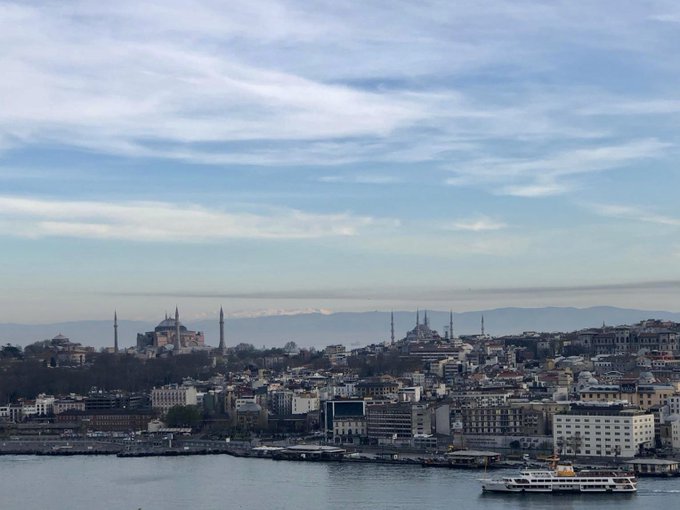
Clear skies over Istanbul with mountains visible.
The Covid-19 pandemic should be a wake up call that some things know no national borders, including climate change.  In addition, travel bans, economic slowdown and greatly reduced use of automobiles has made the impact of human activity on climate obvious as smog and air pollution and water pollution has been reduce to yield clear skies and clear water not seen in some areas in years.  Yet while this stark reminder is before us, the Trump/Pence regime - which so bungled the pandemic response - continues to wage war against clean air and clean water regulations and is loosening offshore oil drilling regulations, refusing to believe in science and pandering to special interest political donors. It's an insane strategy, but then so is the occupant of the White House who unbelievably suggested that humans be injected with (or ingest) lethal disinfectants  to fight the Covid-19 pandemic.  Adding to reasons to fear climate change is the potential release of pathogens long frozen in permafrost and warmer temperatures that will allow some diseases to spread to regions where they have heretofore not been a problem.  A piece in the Washington Post looks at what should be a wake up call but which is being ignored by the Trump regime and many on the lunatic far right.  Here are excerpts:
Travel bans and lockdowns have cleaned the globe, flushing the murk from Venice’s canals, clearing Delhi’s polluted smog, making distant snowy peaks visible for the first time in years from the shores of the Bosporus.

U.S. scientists still predict 2020 will be the hottest year on record, even as experts forecast the largest annual drop in carbon emissions in modern history — a direct consequence of the pandemic’s freeze on human activity, trade and travel. The crisis isn’t uniformly good news for the planet: For example, satellite data shows that deforestation in the Brazilian Amazon is at its fastest pace in years, with environmental officials otherwise sidelined or preoccupied by the outbreak.
The pandemic is not just a reminder of the human impact on the environment, including the significance of man-made emissions on global warming and air pollution. It’s also similar: an imperceptible menace that knows no borders, overwhelms aging infrastructure and bedevils policymakers and politicians who struggle to grapple with the scale of the threat.

“A good way to think about the coronavirus pandemic is that it is like climate change at warp speed. What takes decades and centuries for the climate takes days or weeks for a contagious disease,” New York University climate economist Gernot Wagner wrote last month. “That speed focuses the mind and offers lessons in how to think about risk in an interconnected world.”
In the Boston Globe, former U.S. secretary of state John F. Kerry pointed to evidence suggesting climate change could be a “threat multiplier” for zoonotic and pandemic diseases. He also took aim at President Trump and other politicians who cling to positions outside the scientific consensus and impede collective action.
“Just as in today’s pandemic, progress has been halted by finger-pointing, denial, replacing real science with junk science, misinformation, and flat-out lies, elevating political hacks instead of scientists and experts, refusal to work with allies and even adversaries, and leaving states and cities to fend for themselves,” wrote Kerry.
“The coronavirus pandemic has delivered sharp and painful reminders of our collective vulnerability and the value of paying very close attention to reality,” wrote physicist Mark Buchanan. “If there’s any good to come out of the current tragedy, it may be in helping to persuade a few people to help tip the scales and get our leaders to take the next looming issue much more seriously.” The Trump administration isn’t quite set on tipping the scales. Stimulus money the White House has been empowered to spend in the pandemic’s aftermath may go to U.S. fossil fuel companies that were already in financial trouble before the crisis.
 But away from the White House, others are seeking to take the lead. Under the aegis of the World Economic Forum, major financial firms — including some that may help manage elements of the federal response to the pandemic — have pledged to divest from fossil fuels. Campaigners are calling for government stimulus to fund sustainable development projects that could build the green economy. The World Bank is proposing linking governments’ post-pandemic spending to greener infrastructure projects and future disaster-proofing. “We all breathe the same air and we’re all going to live with the same rising seas,” Michael Chertoff, a former head of the Department of Homeland Security in the George W. Bush administration, told Today’s WorldView during a webinar this week. “And whatever we may disagree about some things, we’re going to need to sit down with them and our like-minded allies and everybody else and figure out what can we do collectively to protect the global commons against either pandemic diseases or disastrous climate change.” But, as Slate’s Joshua Keating noted, the opposite may well be true . . . . some right-wing parties elsewhere in the West have already seized on the threat of climate change not as a call for collective action, but as a justification for limiting migration and unraveling globalization. “It’s not hard to imagine a future U.S. administration, rather than denying the increasingly obvious reality of climate change, using it to argue that the country needs tougher immigration controls and fewer refugees,” wrote Keating. “The alternative, they will argue, is to be overwhelmed by the human invaders and see our own natural resources depleted in the way other countries already have.”


Insanely, limiting immigration will not halt warming temperatures and rising sea levels.  All it does is play to the hate and bigotry that are hallmarks of the political right in today's America.

Friday, February 28, 2020

The Trump Regime's Disturbing Response to the Coronavirus

So far America seems to have dodge a bullet when it comes to the coronavirus.  That said, there is absolutely no assurance that this will continue and, if it does not, the Trump/Pence regime's response is frightening, especially since science denying Mike Pence has been put in charge of the regime's response and has censorship power over legitimate experts.  Just as disturbing, the regime has indicated that whether one can receive needed treatment if the virus spreads will depend upon one's ability to pay since big Pharma cannot be denied the ability to make huge profits.  A piece in the New York Times looks at the disturbing prospects facing America.  Here are highlights:
So, here’s the response of the Trump team and its allies to the coronavirus, at least so far: It’s actually good for America. Also, it’s a hoax perpetrated by the news media and the Democrats. Besides, it’s no big deal, and people should buy stocks. Anyway, we’ll get it all under control under the leadership of a man who doesn’t believe in science.
From the day Donald Trump was elected, some of us worried how his administration would deal with a crisis not of its own making. Remarkably, we’ve gone three years without finding out: Until now, every serious problem facing the Trump administration, from trade wars to confrontation with Iran, has been self-created. But the coronavirus is looking as if it might be the test we’ve been fearing.
The story of the Trump pandemic response actually began several years ago. Almost as soon as he took office, Trump began cutting funding for the Centers for Disease Control and Prevention, leading in turn to an 80 percent cut in the resources the agency devotes to global disease outbreaks. Trump also shut down the entire global-health-security unit of the National Security Council.
Experts warned that these moves were exposing America to severe risks. “We’ll leave the field open to microbes,” declared Tom Frieden, a much-admired former head of the C.D.C., more than two years ago. But the Trump administration has a preconceived notion about where national security threats come from — basically, scary brown people — and is hostile to science in general. So we entered the current crisis in an already weakened condition.
The first reaction of the Trumpers was to see the coronavirus as a Chinese problem — and to see whatever is bad for China as being good for us. Wilbur Ross, the commerce secretary, cheered it on as a development that would “accelerate the return of jobs to North America.”
The story changed once it became clear that the virus was spreading well beyond China. At that point it became a hoax perpetrated by the news media. Rush Limbaugh weighed in: “It looks like the coronavirus is being weaponized as yet another element to bring down Donald Trump.
And in case you’re wondering, no, the coronavirus isn’t like the common cold. In fact, early indications are that the virus may be as lethal as the 1918 Spanish Flu, which killed as many as 50 million people.
 Financial markets evidently don’t agree that the virus is a hoax; by Thursday afternoon the Dow was off more than 3,000 points since last week. Falling markets appear to worry the administration more than the prospect of, you know, people dying.
 At that point the administration appears to have finally realized that it might need to do something beyond insisting that things were great. But according to The Washington Post’s Greg Sargent and Paul Waldman, it initially proposed paying for a virus response by cutting aid to the poor — specifically, low-income heating subsidies. Cruelty in all things.
On Wednesday Trump held a news conference on the virus, much of it devoted to incoherent jabs at Democrats and the media. He did, however, announce the leader of the government response to the threat. Instead of putting a health care professional in charge, however, he handed the job to Vice President Mike Pence, who has an interesting relationship with both health policy and science.
Early in his political career, Pence staked out a distinctive position on public health, declaring that smoking doesn’t kill people. He has also repeatedly insisted that evolution is just a theory. As governor of Indiana, he blocked a needle exchange program that could have prevented a significant H.I.V. outbreak, calling for prayer instead.
And now, according to The Times, government scientists will need to get Pence’s approval before making public statements about the coronavirus.
If the facts don’t make Trump look good, he and his allies attack the messengers, blaming the news media and the Democrats — while trying to prevent scientists from keeping us informed. And in choosing people to deal with a real crisis, Trump prizes loyalty rather than competence.
Maybe Trump — and America — will be lucky, and this won’t be as bad as it might be. But anyone feeling confident right now isn’t paying attention.

Monday, February 10, 2020

The U.S. Government is Buying Your Location Data

Think you have privacy?  Think again. In early January I received an email from Google that laid out everywhere I had been in 2019, covering almost 23,000 miles and three different countries, not to mention several different states and numerous cities. Then, early this month I received something similar for the month of January, 2020.  Did I ask for this? No.  Did I know my phone apps were tracking my every move?  No. But what is more frightening is the the federal government is buying this information without your knowledge.  Do you really want the goons of the Trump/Pence regime knowing your every move? Most of us have nothing to hide, but this level of surveillance is scary and should not be happening as a column in the Washington Post notes.  Here are column highlights:
AMERICANS HAVE lately been learning that the apps they use to check whether they need an umbrella, or follow their favorite sports team, or hurl one animated animal at another for points are sucking up their location data and selling it. Now it turns out that it’s not only advertising companies and other private entities who end up buying this information en masse from brokers. The U.S. government is doing it, too.
The Wall Street Journal wrote last week that federal agencies have purchased access to a virtual trove that charts the movements of millions of citizens’ cellphones from a company called Venntel. The Department of Homeland Security (DHS) and its components are reportedly harnessing this data for immigration enforcement: searching for activity in unexpected places to pin down smuggling rings, or detecting individuals who may have entered the country illegally.
Customs and Border Protection says it accesses only small quantities of the data on a case-by-case basis rather than examining the entire cache in bulk, and that the data is anonymized. But anonymity is a laughable concept when every individual’s day can be turned into a traveling dot that follows a path only they take. A New York Times investigation in 2018 revealed how simple it is to connect a dot to the person it represents — whether that person is a scientist at NASA’s Jet Propulsion Laboratory or an undocumented mother recently arrived from Mexico.
Authorities may hope to preempt some concerns about civil liberties by alleging they’re training their eyes only on suspected non-citizens, but it’s impossible to avoid roping in citizens, too, when information is requisitioned at so massive a volume. It’s also impossible not to imagine what else, and who else, officials might seek to track, once they’ve come up with the legal rationale for doing so. Americans shouldn’t have to rely on the good graces of the bureaucracy to protect them from overreach.
The rationale for warrantless surveillance in this case sidesteps Fourth Amendment law — or tries to. The Supreme Court ruled in Carpenter v. United States that the government couldn’t subpoena geographic data directly from cellphone companies without going through the courts, precisely because of that data’s “depth, breadth, and comprehensive reach.” So the government started buying the exact same data from brokers on the open market instead, arguing that the purchases were fair game because any old company could make them.
This strategy is awfully cynical. Congress has failed to pass a comprehensive privacy statute that shields people from having their every move logged in a database such as the one in question today. Now, this lack of privacy from corporate actors has become an excuse for government to bypass the right to privacy from the state that the Constitution is supposed to enshrine. DHS insists this is legal. But should it be?


Friday, January 31, 2020

Coronavirus: the World Pays for China’s Dictatorship

Dictatorships and authoritarian regimes suffer from two phenomenon which are being showcased by the Coronavirus sweeping China and perhaps gaining a foothold in other nations: (i) inconvenient facts and problems are buried/silence rather than have them reflect badly on the dictator's rule, and (ii) dictators typically find themselves surrounded by ass kissers and sycophants who keep critical information from the ruler rather than upset him.  As a column in the New York Times lays out, China's dictatorship completely botched the handling of the Coronavirus and set the stage for a far worse epidemic seemingly out of a desire to stifle anything that might reflect negatively on the ruling regime.  Now, that regime faces fury from citizens at home and anger from other nations who now find themselves with a possible contagion.  This situation ought to be a wake up call to Americans as the Trump/Pence regime drives scientists and experts from government agencies and replaces them, if at all, with lackeys who will spout the dictated regime story line.  Here are column highlights: 

China’s leaders sometimes seem 10 feet tall, presiding over a political and economic juggernaut that has founded universities at a rate of one a week and that recently used more cement in three years than the United States did in the entire 20th century.
[W]e’re now seeing the dangers of Xi’s authoritarian model, for China and the world.
The first known coronavirus infection in the city of Wuhan presented symptoms beginning on Dec. 1, and by late December there was alarm in Wuhan’s medical circles. That would have been the moment for the authorities to act decisively.
And act decisively they did — not against the virus, but against whistle-blowers who were trying to call attention to the public health threat. A doctor who told a WeChat group about the virus was disciplined by the Communist Party and forced to admit wrongdoing. The police reported giving “education” and “criticism” to eight front-line doctors for “rumormongering” about the epidemic; instead of punishing these doctors, Xi should have listened to them.
China informed the World Health Organization of the virus on Dec. 31 but kept its own citizens in the dark; as other countries reported infections even as China pretended that it had confined the outbreak to Wuhan, Chinese joked grimly about a “patriotic” virus that only struck foreigners.
Wuhan’s mayor said he wasn’t authorized to discuss the virus until late this month. In that time, people traveled to and from Wuhan and didn’t take precautions.
The government finally ordered a lockdown on Jan. 23 that effectively quarantined people in Wuhan. But by then, according to the mayor, five million people had already fled the city.
Partly because the government covered up the epidemic in the early stages, hospitals were not able to gather supplies, and there are now major shortages of testing kits, masks and protective gear.
One reason for the early cover-up is that Xi’s China has systematically gutted institutions like journalism, social media, nongovernmental organizations, the legal profession and others that might provide accountability. These institutions were never very robust in China, but on and off they were tolerated until Xi came along.
I conducted a series of experiments on Chinese blogs over the years beginning in 2003 and was sometimes surprised by what I could get away with — but no longer. Xi has dragged China backward in terms of civil society, crushing almost every wisp of freedom and oversight.
For the same reason that Xi’s increasingly authoritarian China bungled the coronavirus outbreak, it also mishandled a swine flu virus that since 2018 has devastated China’s hog industry and killed almost one-quarter of the world’s pigs.
Dictators often make poor decisions because they don’t get accurate information: When you squelch independent voices you end up getting just flattery and optimism from those around you. Senior Chinese officials have told me that they are routinely lied to on trips to meet local officials and must dispatch their drivers and secretaries to assess the truth and gauge the real mood.
For this or other reasons, Xi has made a series of mistakes. He mishandled and inflamed the political crisis in Hong Kong, he inadvertently assured the re-election of his nemesis as president of Taiwan, and he has presided over worsening relations with the United States and many other countries.
The coronavirus has already reached the Xinjiang region in the Far West of China, and one risk is that it will spread in the internment camps where China is confining about one million Muslims with poor sanitation and limited health care.
[L]et’s get over any misplaced admiration some Americans have for Xi’s authoritarian model.
The Chinese social contract has been that citizens will not get ballots but will live steadily better lives, yet China’s economy is now as weak as it has been in three decades — and the coronavirus will sap growth further. Xi is not living up to his end of the bargain, and this is seen in the anger emerging on Chinese social media despite the best efforts of censors.
I don’t know if Xi is in political trouble for his misrule, but he should be. He’s a preening dictator, and with this outbreak some citizens are paying a price.