Showing posts with label Covid-19 pandemic. Show all posts

Monday, August 24, 2020

Millions Fall Back into Crisis as Stimulus and Safety Nets End

As the Republican convention is poised to begin and display Trump's unmatched narcissism, millions of Americans are back on the brink of desperation as the stimulus payments and safety net of the CARES Act come to an end and the GOP controlled Senate is on recess having passed no extension of relief benefits.  It's a fitting dichotomy given that today's Republican party ceased caring about average Americans years ago, a trend that has only accelerated under Der Trumpenfurher.   America - among the wealthiest nations in the world - may soon see homelessness and hunger not seen since the Great Depression. The GOP convention will likely act as if none of this is happening.  Food banks are attempting to assist, but soon the magnitude of the problem will overwhelm their resources. A piece in the Washington Post looks at the magnitude of the problem.  Here are story highlights:

One of the most successful elements of the government’s response to the coronavirus recession — protecting people on the margins from falling into poverty — is faltering as the safety net shrinks and federal benefits expire.

Major recessions are especially fraught for low-income earners, whose finances can veer from tenuous to dire with one missed paycheck. But as the economy cratered this spring, economists and poverty experts were mildly surprised to discover that the torrent of government support that followed — particularly the $600 a week in expanded unemployment benefits and one-time $1,200 stimulus checks — likely lowered the overall poverty rate.

Now, data show, those gains are eroding as federal inaction deprives Americans on the financial margins of additional support. If the unemployment rate stays around 10 percent and no new stimulus is delivered, “we can expect poverty rates to rise and climb higher than those observed in the Great Recession,” Parolin said.

For the week that ended July 21, the most recent numbers available, roughly 29 million U.S. adults — about 12.1 percent — said their household sometimes or often didn’t have enough to eat the preceding seven days, according to the Center on Budget and Policy Priorities. Nearly 15 million renters said they were behind on rent during the same period.

Code of Vets is used to requests for help with funeral expenses, hospital bills and housing issues. Since the pandemic, the nonprofit says, it has been inundated by veterans who can’t meet their basic needs: groceries, medications, utility bills. Diapers are a chronic concern for those with young children.

In January, a typical month pre-pandemic, it handled 86 cases, . . . . In April, after more than 20 million Americans lost their jobs in the coronavirus recession, Code of Vets had more than 1,300 cases. The scale of need has been consistent, Smith said, even with the federal stimulus.

Karin Smith, 52, of Jupiter, Fla., recently opened the two-bedroom townhouse she shares with her 13-year-old son to a fellow single mom with a daughter. They’re all facing eviction, much like the 22 million other Americans behind on their rent, according to an analysis by the Covid-19 Eviction Defense Project, a Colorado-based community group. Despite the federal moratorium that ended July 24, some landlords are raising rent, issuing late fees and initiating eviction proceedings earlier than the federal deadline, which requires 30 days notice for eviction.

Karin and her son, who has Ehlers-Danlos syndrome, which affects connective tissue, have been living on food stamps and unemployment benefits that did not arrive until May. The state jobless aid started at $125 a week and was recently bumped to $225. She was earning $96,000 a year, but as a single mom with tens of thousands in student loans, health insurance premiums and other expenses, she didn’t have a lot of savings.

Although Karin has a PhD in educational psychology, she hasn’t been able to find a job in her field, and a minimum wage position wouldn’t cover the rent. When Sept. 1 rolls around, she doesn’t know what the four of them — plus two cats and two dogs, most taken in from others who had been evicted — will do.

Diane Yentel, the president and chief executive of the National Low Income Housing Coalition, said the 40 million U.S. households projected for eviction by year’s end — and the lack of legislative action to prevent them — is nothing she’s ever seen. . . . more people are living on the streets, in their cars, crowding into apartments, and living in shelters or encampments, Yentel said. Social distancing, a key defense against the coronavirus, is impossible.

Hunger has hovered near record highs since the beginning of the pandemic, as shuttered school meal programs and vanishing income left many without a way to feed their families. About 22 percent of the population has been food-insecure since the pandemic began, according to an April report by the Hamilton Project, an economic policy project of the Brookings Institution. For mothers with children 12 and younger, the figure is more than 40 percent, according to Lauren Bauer, who wrote the report.

the Trump administration recently decided against extending a food stamps waiver that allowed needy families to bypass certification, such as providing pay stubs. The move will reduce the number of eligible families in the coming months, even as other stimulus measures expire.

Food banks nationwide have struggled to keep up with demand, and surging grocery prices are compounding the strain, said Crystal FitzSimons, the director of school and out-of-school time programs at the Food Research & Action Center.


Tuesday, July 28, 2020

Trump's Latest Medical Quack Warns of Sex with Demons

Trump's medical con-artist, Stella Immanuel.
Trump's Christofascist base of support - and sadly some otherwise decent Republicans I know - are always at the ready to believe whatever insane and far fetched story line that plays to their prejudices and/or ignorance embracing religious beliefs.  This is a reality that Trump has played like a violin as he has sought to grant Christofascists special rights and to exempt them from non-discrimination laws.  It is also why Trump seems to have a constant parade of whacked out "experts" who either support his endless lies or who will play well with the ignorant searching for "experts" to support their exist biases.  Now, Trump has found an unhinged physician who he is offering up as an expert to counter legitimate and sane medical experts.  The Washington Post looks at this loose canon who blames some medical conditions on having sex with demons (A piece in the Daily Beast also looks at her lunacy).  Why this individual still holds any medical license is baffling.  Here are article highlights:

        According to the Mayo Clinic, endometriosis is “an often painful disorder in which tissue similar to the tissue that normally lines the inside of [the] uterus — the endometrium — grows outside [the] uterus.”

    Not so, says Stella Immanuel, a Houston pediatrician and spiritual leader of Fire Power Ministries, a pronouncedly non-orthodox church. Endometriosis and other potentially dangerous gynecological conditions are the residue of sexual intercourse with demons, Immanuel teaches.

        They visit humans in sexy dreams, which aren’t dreams after all but spirit spouses making a booty call. The demons are responsible not only for diseases of the female reproductive system but also for male impotence, most financial troubles, marital discord and spiritual malaise.

        This is not Immanuel’s only diversion from the medical mainstream. She also maintains that alien DNA is a component of some therapeutic drugs and that government scientists are developing a vaccine to prevent religious faith. You can find these and other teachings of hers on YouTube.

        Or you can find Immanuel on President Trump’s Twitter feed, where she testifies to the power of hydroxychloroquine (yep! we’re back to that one) to cure covid-19 and assures the public that masks are not important to fighting the pandemic. More than 10 million Americans heard her advice, thanks in part to the president’s amplifying effect, before Facebook took down her page. In response, Immanuel threatened to have Jesus unplug Facebook’s servers.

        I guess there is no point in expressing my strong view that the president of the United States should not, in the midst of a deadly pandemic, pass along medical advice that undermines public health officials without good reason to believe that it comes from a qualified authority. The president doesn’t care.

        And I suppose it’s pointless to say to my Christian brothers and sisters in Trump’s dwindling camp that a man who raises the profile of a heretical preacher is not a friend of the faith. Many so-called evangelicals who stick with Trump gave up on evangelism — that is, winning people over through selfless acts of love and charity — long ago.

        [L]et me speak to those Republicans cowering in closets and hiding under stairs in Washington and the state capitals, muttering prayers that Trump might somehow calm the flames that threaten to consume them.

        Run away. Close your eyes and duck your heads and sprint as fast as you can away from Trump. Claim amnesia. Say you’ve been hiking the Appalachian Trail. Blame your spirit spouse — whatever. A fury is building in Middle America that has nothing to do with Russia or impeachment or “Access Hollywood.” It’s rising among people who managed to look past all of that to find something they liked about the president. And now he’s repaying them with a stubby middle finger in their faces.

        They understand that covid-19 is not a joke. They have children whose teachers are afraid to be in school with them. They have teenagers reeling from the mental health impacts of isolation and anxiety. They’ve lost their jobs, their businesses, their sense of safety. They’re worried about losing their homes.

        And they see what the president thinks of them and their concerns. Here, you dupes and dopes, Trump says — here’s a video from a woman who believes in demon dream sex. Or here’s one from a washed-up game-show host who says covid-19 is an election ploy. Or how about this idea: Drink some bleach.

        They’re worried and suffering, and their president might as well be saying: I don’t care if you live or die. And it’s coming through loud and clear. The political center is slow to anger. It’s also slow to forget.


Monday, July 27, 2020

Republicans Are Losing with Women Voters

Outside of Republican Women's Clubs - where older women in particular want to bring back the 1950's and perhaps the Jim Crow laws too - women are increasingly fleeing from the GOP.  What had been a growing problem has become a crisis fueled by the always vile Donald Trump whose crudeness, vulgarity and incompetent response to the Covid-19 pandemic is rapidly alienating women voters. If the exodus away from the GOP continues, not only Trump but his enablers within the GOP may face a harsh reckoning come November. A piece at CNN looks at the phenomenon.  Here are highlights: 
The GOP's quest to win back women is not looking promising 100 days before Election Day, a point punctuated by yet another week of sexist missteps -- from a GOP congressman's decision to reportedly call Alexandria Ocasio-Cortez a "f**king bitch" on the steps of the Capitol to President Donald Trump's tweet marshaling "The Suburban Housewives of America."
Though the United States is rightly focused on the coronavirus pandemic, last week's events in Washington underscored that two years after women powered the Democrats' 2018 push to flip the House of Representatives, Trump and some members of his Republican Party have not learned their lesson -- and still cannot seem to show that they will treat women as equals and respect the dignity of their work both at home and in the professional realm. As Trump ramped up his campaign to strike fear in the hearts of White suburban voters by arguing that they will not be safe in Joe Biden's America this week, he tweeted out an opinion column in the New York Post praising his efforts to get rid of an Obama-era fair housing regulation. . . . . the Thursday afternoon tweet that seemed straight out of the 1950s, Trump said "The Suburban Housewives of America must read this article. Biden will destroy your neighborhood and your American Dream. I will preserve it, and make it even better!"
 In another example of his failure to think about the consequences before he speaks, he wished Ghislaine Maxwell "well" during a Tuesday briefing on the coronavirus even though she faces charges for recruiting, grooming and ultimately sexually abusing minors who were as young as 14 as Jeffrey Epstein's alleged accomplice. Trump's tone-deaf tweet about suburban housewives was in keeping with his long record of using demeaning language to describe women and his attempt to win the 2018 midterms for his party by stoking a backlash to the #MeToo movement by calling it a "very scary time" for young men.
Trump has never figured out how to make up lost ground with female voters since 2016 and 2018. And he now stands to lose them by potentially historic margins in the November election.
The President was trailing Vice President Joe Biden by 25 points among women (35% to Biden's 60%) in the recent Washington Post-ABC News poll and by 28 points in the mid-July Quinnipiac poll that showed Biden leading Trump among female voters 59% to 31%. And as CNN's Harry Enten wrote this weekend, this is not an election where the economy -- which Trump has long believed to be his greatest strength — is driving the election. At this moment when the number of coronavirus cases in the US has surpassed 4.1 million and more than 146,000 Americans have died, polls have consistently shown that Americans, particularly women, are more concerned about Covid-19 than any other issue. Voters trust Biden more than Trump to handle the pandemic, and largely because of that, the former vice president has maintained a solid lead in the polls, both nationally and in many of the key battleground states that Trump needs to win reelection. [H]e also undercut his own message by continuing to argue that children must return to school in person -- and falsely claiming that children don't get sick or transmit the virus easily -- even though polls show a majority of parents with school-aged children do not feel safe sending them back for in-person instruction. . . . . Maryland Gov. Larry Hogan said Sunday that Trump's claim that governors have everything they need is not accurate. The gendered language of the week, from Trump's tweet to Florida GOP Rep. Ted Yoho's verbal attack on Ocasio-Cortez -- an incident in which the Florida Republican reportedly called the New York Democrat "disgusting" and a "f**king bitch" within earshot of a reporter from The Hill newspaper -- was a reminder that Trump and many of his allies still don't understand how to talk to women, much less about them. In many interviews with female voters of all political persuasions over the past three years, one of the things many of them said they don't like about Trump is his coarse, sexist language and how he has changed the dialogue in America — convincing his followers and allies that they can say whatever comes to mind, no matter how hurtful or offensive it is. 
For Trump and Republican acolytes like Yoho, there are now too many self-inflicted mistakes to count. They are dragging their own party down with them -- and no one will be surprised if women once again rise up in November and deliver a victory to the Democrats.

America’s Global Standing is at a Low Point


It's ironic that while Donald Trump's campaign theme was to "make America great again,"the reality of his term in office so far is that America's standing in the global community of nations is at a low point even as China's military continues to build, Russia gains ground in the Middle East, and our long-time allies see us as unreliable. Add in America's failed response to the Covid-19 pandemic, about which we are either laughed at or pitied, and America's image is in tatters.  A second irony is that but for Trump's racist, religiously extreme/ignorance embracing base, who think America is the greatest, everyone else can see that its not and that it's decline has been precipitous because of their cult leader.  We cannot take much more of Trump's "winning." An very long article in the Washington Post looks at America's failed stature, most of which tracks to the malignant narcissist in the White House, on the global scene.   Here are excerpts: 

America’s standing in the world is at a low ebb. Once described as the indispensable nation, the United States is now seen as withdrawn and inward-looking, a reluctant and unreliable partner at a dangerous moment for the world. The coronavirus pandemic has only made things worse.
President Trump shattered a 70-year consensus among U.S. presidents of both political parties that was grounded in the principle of robust American leadership in the world through alliances and multilateral institutions. For decades, this approach was seen at home and abroad as good for the world and good for the United States.
In its place, Trump has substituted his America First doctrine and what his critics say is a zero-sum-game sensibility about international relationships. America First has been described variously as nationalistic, populistic, isolationist and unilateralist. [Trump] The president has demeaned allies and emboldened adversaries such as China and Russia.
At home, Trump’s handling of the pandemic has created division and confusion rather than an effective national strategy. The rest of the world sees the United States not as a leader in dealing with the coronavirus but as the country with the highest number of coronavirus infections and covid-19 deaths, and with the disease far from under control. European nations have responded with the unprecedented step of blocking Americans from entering their countries.
Before the pandemic, [Trump] the president took a number of steps that signaled a retreat from collective involvement abroad, pulling out of the Paris climate agreement, the Iran nuclear deal and the Trans-Pacific Partnership trade pact. He raised doubts about the U.S. commitment to NATO. After a long-running quarrel with German Chancellor Angela Merkel, he has called for the withdrawal of more than a quarter of the 34,500 U.S. troops stationed in Germany.
When many world leaders participated in a World Health Organization assembly on the pandemic, the president was absent. Trump’s anger with China over the virus ultimately prompted him to withdraw the United States from the WHO.
“People are stunned about the effect of incapable leadership, or of polarizing leadership, of not being able to unify and get the forces aligned so you can address the problem [of the coronavirus],” said Thomas Kleine-Brockhoff, a vice president of the German Marshall Fund and director of its Berlin office. “And that, of course, results in a nosedive in how you view [the United States]. What you’re seeing is a collapse of soft power of America.”
“I think the U.S. is seen from my perspective as being involved in its own internal reckoning — like the rest of the world doesn’t really exist,”
“It hurts our brand. It hurts the status of our institutions. It’s going to weaken our economy and our economic power and soft power as a consequence,” said Stephen J. Hadley, who was a national security adviser to President George W. Bush. “It’s potentially a real setback.”
This is not the first time the world has held America in low esteem. The U.S. invasion of Iraq cost the country dearly, in lives and in prestige. George W. Bush left office highly unpopular, especially in Europe.
Still, by the numbers, Trump had an immediate and negative impact. A Gallup survey of impressions of world leadership after the first year of Trump’s presidency saw the rating of U.S. leadership plummet by 20 points — lower than Bush’s worst rating.
The following year, approval of U.S. leadership remained similarly low, and disapproval was higher than for the leadership in Germany, China and Russia. “In this climate, China’s leadership has gained a larger advantage in the ‘great power competition,’ and the other player, Russia, is now on a more even level with the U.S.,” the Gallup report said.
The Pew Research Center issued a report in January on international attitudes toward the United States and found 64 percent of people across 32 countries saying they had no confidence in Trump as the U.S. leader, though impressions of the U.S. as a whole remained positive.
President Trump is acting as no administration acted since the 1920s,” said Nicholas Burns, a career Foreign Service officer and former U.S. ambassador to NATO now teaching at Harvard’s Kennedy School. “Those presidents were engaged in the world. President Trump isn’t. He’s almost at war with the world.”
Ivo Daalder, president of the Chicago Council on Global Affairs and U.S. ambassador to NATO during the administration of President Barack Obama, said of Trump, “He doesn’t believe in alliances, open markets, promotion of freedom and human rights — the three pillars of [American] foreign policy. On the essential concept of the United States as the global leader of the international order, Donald Trump has thrown that all out the window.”
“By almost every measure, America’s standing and influence in the world has been damaged over the last three-and-a-half years. . . . You see it during a crisis. This is the first global crisis probably since World War II where the United States has not been in the lead. It’s kind of a stunning thing to see a transnational challenge like this without U.S. leadership.”
“I think this is the most dangerous moment the United States has faced in decades,” said the former Obama adviser Donilon. “We obviously are in the midst of multiple crises. Economic. Health. A serious societal upheaval. We have an election system that is vulnerable to outside interference. . . . We have the lowest point in our relationships with Russia and China in decades. I think democracy is under the most pressure in the world since the ’30s.”
Burns, a foreign policy adviser to the Biden campaign, said he thinks the former vice president, as president, would “quickly return the United States to a position of leadership” and that other governments would respond positively to that. “But I worry that it will take longer with the publics of these countries,” he added. “The memory of Donald Trump will not fade easily.”
[T]he last time this country’s standing was in decline, it was because of fears that the United States would exercise its vast powers excessively and unilaterally. That is not the issue today. Instead, it is a worry that the United States is no longer prepared or willing to use the powers it still has for the good of the world.

Sunday, July 26, 2020

Donald Trump's Suburban Horror Show


I grew up in the Republican Party, and although I lived in the country through high school - going back to my high school reunion last year reminded me of that - I've pretty much lived in the suburbs ever since.  Back when I grew up, the Republican Party was the party of knowledge, science and fiscal responsibility - the latter pretty much went away after Reagan's election and it has been Democrats in the White House that have been the ones reducing the federal deficit. Now, of course, under Donald Trump and the evangelical/Christofascist base of the GOP, the Republican Party has become the party of ignorance, alternate facts, and outright lies. None of these changes in the GOP have been lost on suburban voters who (i) tend to be better educated than rural voters, and (ii) more receptive to racial diversity than red state rural voters.  In addition, suburban voters, are paying attention to Trump's failed leadership in the context of the pandemic and seem to belatedly realized that almost nothing Trump says can be considered true.  The combined result of this is that suburban voters are abandoning Trump - and likely other Republicans - in the suburbs.  The results could be catastrophic - and much deserved - for the GOP.  A piece in Politico looks at Trump's declining prospects in the suburbs.  Here are excerpts:
Donald Trump says Joe Biden wants to abolish the suburbs. But polls show a different truth: The suburbs want to abolish Donald Trump.
If current numbers hold, the Republican Party will suffer its worst defeat in the suburbs in decades — with implications reaching far beyond November.
It was in the suburbs two years ago that Democrats built their House majority, ripping through Republican-held territory across the country, from Minnesota and Texas to Georgia, Virginia and Illinois.
It would be bad enough for the GOP if that had been a temporary setback. But with the prospect of a second straight collapse in the suburbs this year, it is beginning to look like a wholesale retreat.
“We can’t give up more ground in the suburbs nationally without having a real problem for our party,” said Charles Hellwig, a former chair of the Republican Party in Wake County, N.C., describing a landscape in which “every year, every month, every day, we get a little bluer.”
It is the same story in suburbs everywhere. In a Fox News poll last weekend, Trump was trailing Joe Biden, the presumptive Democratic nominee, by 11 percentage points in the suburbs. An ABC News/Washington Post poll had Trump down 9 percentage points there — larger margins in the suburbs than exit polls have recorded since the 1980s, when Republicans were winning there by double digits.
That polling reflects a dramatic swing from 2016, when Trump beat Hillary Clinton in the suburbs by 4 percentage points. Trump’s erosion in the suburbs is a major reason the electoral map this year has expanded for Democrats in recent weeks — with Trump in danger not only of losing, but of taking the Senate down with him. And demographic shifts are only becoming more favorable to Democrats.
“The movement of suburban voters, particularly educated women and millennials being so progressive in their politics, increased voting participating among Latinos, African Americans,” said Bill Carrick, a Democratic strategist who managed Missouri Rep. Dick Gephardt’s 1988 presidential campaign. “That all contributes to this geography: Suddenly, we’ve got Georgia and Texas and Florida and Arizona, Iowa. There’s a lot of places in play.”
Trump’s damage in the suburbs has come primarily, as it has elsewhere, from his handling of the coronavirus pandemic. But Trump’s response to the George Floyd protests also appears to have hurt him in the suburbs . . . .
Trump's intervention in Portland, Ore., has drawn more people into the streets, not fewer — including clashes between not only the Trump administration and antifa, but a “wall of moms.”
Comparing new voter registration in 17 states from immediately before the Floyd protests began to the week after, the Democratic data firm TargetSmart found that young people and people of color were registering at higher rates than before — with years to cast ballots for Democrats still ahead of them.
“Literally every state you’re seeing these increases, which is not something we saw in 2018,” Bonier said. “It’s interesting to see how the demonstrations in cities around the country are playing. … Suburban voters seem to be more sympathetic to those demonstrations than they ever have been in the past.”
When Americans were asked in the ABC News/Washington Post poll who they trusted more to handle issues surrounding crime and safety, they preferred Biden to Trump 50 percent to 41 percent.
There are still more than 100 days before the election, and Trump’s overtures to the suburbs are becoming more explicit.
Last week on the South Lawn, chastising Democrats for their positions on issues ranging from law enforcement to climate change and urban planning, Trump accused Democrats of plotting to “abolish our beautiful and successful suburbs.”
Mike Erlandson, a former chair of the Minnesota Democratic-Farmer-Labor Party, . . . . as the protests — and Trump’s response — have unfolded, he has seen Trump hurt his own standing there.
“The fact that the president is trying to drive a wedge in on things around law enforcement, I think most people find disappointing,” Erlandson said.  The suburbs, he said, "certainly have not turned their back on law enforcement." But at the same time, he said, "they don’t really see leadership coming out of the White House.”

Sunday, July 19, 2020

Millions of Unemployed Americans Face Imminent Catastrophe

I will concede that I have been lucky to date through the economic disaster that has accompanied the Covid-19 pandemic and have worked consistently throughout the nightmare.  While the husband's salon was closed for two months, it is now back open and unless Virginia goes back to so-called Phase One, can continue to operate.  Millions are not so lucky and continue to rely on unemployment payments to survive and literally put food on the table and to keep a roof over their heads.  A sizable chunk of the economic relief that has been keeping them afloat is set to end on or before the end of the month of July and oblivious  - or perhaps uncaring is the better description - Republicans, including Der Trumpenführer, appear only too willing to allow economic catastrophe  overtake millions of unemployed Americans.  A column in the New York Times looks at the impending catastrophe.  Here are highlights:

Some of us knew from the beginning that Donald Trump wasn’t up to the job of being president, that he wouldn’t be able to deal with a crisis that wasn’t of his own making. Still, the magnitude of America’s coronavirus failure has shocked even the cynics.
At this point Florida alone has an average daily death toll roughly equal to that of the whole European Union, which has 20 times its population.
How did this happen? One key element in our deadly debacle has been extreme shortsightedness: At every stage of the crisis Trump and his allies refused to acknowledge or get ahead of disasters everyone paying attention clearly saw coming.
Blithe denials that Covid-19 posed a threat gave way to blithe denials that rapid reopening would lead to a new surge in infections; now that the surge is upon us, Republican governors are responding sluggishly and grudgingly, while the White House is doing nothing at all.
And now another disaster — this time economic rather than epidemiological — is just days away.
To understand the cliff we’re about to plunge over, you need to know that while America’s overall handling of Covid-19 was catastrophically bad, one piece — the economic response — was actually better than many of us expected. The CARES Act, largely devised by Democrats but enacted by a bipartisan majority late in March, had flaws in both design and implementation, yet it did a lot both to alleviate hardship and to limit the economic fallout from the pandemic.
In particular, the act provided vastly increased aid to workers idled by lockdowns imposed to curb the spread of the coronavirus. U.S. unemployment insurance is normally a weak protection against adversity: Many workers aren’t covered, and even those who are usually receive only a small fraction of their previous wages. But the CARES Act both expanded coverage, for example to gig workers, and sharply increased benefits, adding $600 to every recipient’s weekly check.
These enhanced benefits did double duty. They meant that there was far less misery than one might otherwise have expected from a crisis that temporarily eliminated 22 million jobs; by some measures poverty actually declined.
They also helped sustain those parts of the economy that weren’t locked down. Without those emergency benefits, laid-off workers would have been forced to slash spending across the board. This would have generated a whole second round of job loss and economic contraction, as well as creating a huge wave of missed rental payments and evictions.
[T]hat $600 weekly supplement — which accounts for most of the expansion of benefits — applies only to benefit weeks that end “on or before July 31.” July 31 is a Friday. . . . millions of workers will see their incomes plunge 60 percent or more just a few days from now.
Two months have gone by since the House passed a relief measure that would, among other things, extend enhanced benefits through the rest of the year. But neither Senate Republicans nor the White House has shown any sense of urgency about the looming crisis. Why?
Part of the answer is that Trump and his officials are, as always, far behind the coronavirus curve. . . . . they’re apparently oblivious to what everyone else sees — an economy that is stumbling again as the coronavirus surges back.
Delusions about the state of the economic recovery, in turn, allow conservatives to indulge in one of their favorite zombie ideas — that helping the unemployed in a depressed economy hurts job creation, by discouraging people from taking jobs.
Worrying about employment incentives in the midst of a pandemic is even crazier than worrying about those incentives in the aftermath of a financial crisis, but it seems to be at the core of White House thinking (or maybe that’s “thinking”) . . . .
My sense is that Republicans have a delusional view of their own bargaining position. They don’t seem to realize that they, not the Democrats, will be blamed if millions are plunged into penury because relief is delayed; to the extent that they’re willing to act at all, they still imagine that they can extract concessions like a blanket exemption of businesses from pandemic liability.
Maybe the prospect of catastrophe will concentrate Republican minds, but it seems more likely that we’re heading for weeks if not months of extreme financial distress for millions of Americans, distress that will hobble the economy as a whole. This disaster didn’t need to happen; but you can say the same thing about most of what has gone wrong in this country lately.

Saturday, July 18, 2020

The American Political Right Descends into Insanity

Protesters listen during a rally against face
masks being required in schools (Rick Egan/AP).
Once upon a time, certainly while I was growing up and during my period as a Republican city committee member, the Republican Party valued education, respected science and knowledge and was epitomized by "country club Republicans."  Now, it is the party of  ignorance, insane conspiracy theories, and where scientific and medical experts are trashed and undermined if the inconveniently undermine the agenda of far right extremists and, of course, the dangerous buffoon who inhabits the White House.  In the midst of an unprecedented pandemic, this transformation of the GOP is not just disturbing, it is literally life threatening and shows the extremes of the self-centered nature of so-called conservatives who care nothing about those they endanger and may infect with Covid-19. How did this happen?  As I have often stated, in my view, it began with the infiltration of the GOP by evangelicals and other "conservative Christians" - who are anything but true followers of Christ - who deny evolution and claim the earth is less than 10,000 years old and reject any form of science and knowledge that threatens the myths upon which they have based their religion and very small scale world view.  Once these forces grabbed hold of the party base it was only a matter of time before open racists and every kind of crackpot was welcomed into the GOP base.  At the same time, sane, educated people fled the GOP which is why the suburbs have shifted so strongly against the GOP.  A column in the Washington Post looks at the insanity of the GOP and far right.  Here are excerpts:
In 2018, Bob Woodward recounted then-White House chief of staff John Kelly’s view of President Trump. “He’s gone off the rails,” Kelly said. “We’re in Crazytown.”
Two years later, it feels as if the entire country resides in the Greater Crazytown Metropolitan Area.
In Provo, Utah, this week, anti-mask demonstrators, some wearing Trump 2020 paraphernalia, stormed a county commission meeting, forcing its adjournment.
In Tulsa, anti-mask protesters, some in MAGA gear, taunted, threw water and waved money at a black minister reading the Bible through a bullhorn and calling for reparations.
In Georgia, Gov. Brian Kemp (R) sued to stop Atlanta from enforcing mask-wearing to mitigate the spread of the pandemic.
In Florida, longtime Trump adviser Roger Stone, after the president commuted his sentence, said of his and Trump’s opponents: “They’re satanic.”
And here in Washington, Trump surpassed 20,000 falsehoods uttered as president while his administration temporarily took coronavirus data offline, his daughter posed with a can of beans and his trade adviser published an error-laden attack on the government’s top infectious-disease scientist.
The Great American Crackup is underway.
A week ago, I argued that Trump’s conspiracy theories “are spreading faster than covid-19 among his supporters, inducing mass delusion.” So I asked scholars to put this moment into historical and psychological context.
For the first time in our history, a president and a major political party have weaponized paranoia, to destabilizing effect.
Conservatives are inherently no more conspiratorial than liberals; only low education (and, relatedly, income) predict such tendencies. The difference, Uscinski says, is “we have a president who has built a coalition by reaching out to conspiracy-minded people.”
Dartmouth College political scientist Brendan Nyhan finds that “our political elites are amplifying the fringe more than we’ve seen” in modern times, while a president mounts a “grinding attack on factual evidence.” The result, he says, is “conspiracy theories and misinformation become yoked to partisanship in increasingly powerful ways.”
There has always been what the late historian Richard Hofstadter called the “paranoid style” in U.S. politics: witch hunts, Illuminati, Red Scares. William Jennings Bryan promoted conspiracy theories. Richard Nixon believed in them. But Trump is unique in promoting conspiracy thinking from the bully pulpit, and in building a system in which elites — Republican Party leaders — validate the paranoia.
Americans, by nature, are more distrustful of authority than citizens of other advanced democracies. “You always hear Americans say, ‘I know my rights,’ but you never hear an American say, ‘I know my responsibilities and obligations,’ ” Stanford University public-opinion specialist Morris Fiorina observes. The distrust is compounded by polarization of the political system: the collapse of local media (replaced by coastal national media); the growing tendency to live, work and worship among people of similar beliefs; . . . .
An April study by Uscinski and others found Trump’s supporters were the most likely to believe the covid-19 threat was exaggerated — particularly Trump backers who paid the most attention to politics. This, the researchers said, was “likely a consequence of President Trump and other Republican/conservative elites publicly lending credence to this idea.”
And so strong Trump partisans refuse to wear masks. “The science is very clear: People take cues from political leaders,” Nyhan says. Leaders typically rejected conspiracy theories, and the public followed. Now, Trump embraces them, and his followers concur — some out of partisan solidarity, others out of genuine belief.
“Human psychology has not changed,” Nyhan says. What’s changed is we’re discovering that “democratic systems don’t work well when political elites don’t deal in factual information.”
In other words, it’s not us. It’s him.
Be very afraid as Trump tries to now hide accurate information about the pandemic and his followers are increasingly dangerous loose canons. 


Friday, July 17, 2020

The Terrifying Next Phase of the Coronavirus Recession

In relative terms, Virginia continues to do well in fighting the Covid-19 pandemic, although numbers of cases have risen in the Hampton Roads area, likely due to people ignoring mask wearing and social distancing mandates over the 4th of July weekend.  I say relative terms, since Virginia's new cases are a small fraction of what is happening in other states, especially Florida and Texas.  Yet compared to western European countries Virginia's numbers are terrible. Why?  Several causes, the most significant being the lack of any rational, science based federal response to the pandemic. The Trump/Pence regime first punted and left the heavy lifting to individual states and now is undermining medical experts  Further exacerbating the situation,  a number of GOP lead states rushed to reopen prematurely.  Then there are those who refuse to abide by mask requirements and eschew social distancing, caring nothing about those they may be infecting and putting their self-centered  sense of "liberty" over the lives of others.  The current result?  An economy that may be facing a second shutdown, especially in sunbelt states - the governor of Georgia incredibly ban cities and localities from implementing mask mandates.  A piece in The Atlantic looks at America's failure and what may be in store economically if the failed response to the pandemic continues.  Here are highlights:

Failed businesses and lost loved ones, empty theme parks and socially distanced funerals, a struggling economy and an unmitigated public-health disaster: This is the worst-of-both-worlds equilibrium the United States finds itself in.
Since the beginning of the coronavirus pandemic, President Donald Trump has railed against shutdowns and shelter-in-place orders, tweeting in all caps that “we cannot let the cure be worse than the problem itself” and pushing for employees to get back to work and businesses to get back to business. But the country has failed to get the virus under control, through masks, contact tracing, mass testing, or any of the other strategies other countries have tried and found successful. That has kneecapped the nascent recovery, and raised the possibility that the unemployment rate, which eased in May and June after nearly reaching 15 percent in April, could spike again later this year.
The economy seized in unprecedented terms this spring as states and cities mandated lockdowns. Hundreds of thousands of businesses closed, and millions of workers were furloughed or laid off. But instead of setting up a national viral-control strategy during this time, as other rich countries did, the United States did close to nothing. . . .  The Trump administration punted responsibility for public-health management to the states, each tipping into a budgetary crisis. After a springtime peak, caseloads declined only modestly. Outbreaks seeded across the country. States reopened, and counts exploded again.
Now the economy is traveling sideways, as business failures mount and the virus continues to maim and kill. New applications for unemployment insurance, for instance, are leveling off at more than 1 million a week—more than double the highest rate reached during the Great Recession, a sign that more job losses are becoming permanent.
The next, terrifying phase of the coronavirus recession is here: a damaged economy, a virus spreading faster than it was in March. The disease itself continues to take a bloody, direct toll on workers, with more than 60,000 Americans testing positive a day and tens of thousands suffering from extended illness. The statistical value of American lives already lost to the disease is something like $675 billion. The current phase of the pandemic is also taking an enormous secondary toll. States with unmitigated outbreaks have been forced to go back into lockdown, or to pause their reopening, killing weakened businesses and roiling the labor market. Where the virus spreads, the economy stops.
That is not just due to government edicts, either. Some consumers have rushed back to bars and restaurants, and resumed shopping and traveling. Young people, who tend to get less sick from the coronavirus than the elderly, appear to be driving today’s pandemic. But millions more are making it clear that they will not risk their life or the life of others in their community to go out. Avoidance of the virus, more so than shutdown orders, seems to be affecting consumer behavior. Places without official lockdowns have seen similar financial collapses to those with them, and a study by University of Chicago economists showed that decreases in economic activity are closely tied to “fears of infection” and are “highly influenced by the number of COVID deaths reported” in a given county.  
The perception of public transit as unsafe, for example, makes it expensive and tough for commuters to get to their jobs. Schools and day-care centers are struggling to figure out how to reopen safely, meaning millions of parents are facing a fall juggling work and child care. This is a disaster. “The lingering uncertainty about whether in-person education will resume isn’t the result of malfeasance, but utter nonfeasance,” the former Department of Homeland Security official Juliette Kayyem has argued in The Atlantic.
International comparisons are enlightening. Countries that successfully countered the virus seem to have enjoyed better financial recoveries; countries that did not shut down saw major hits to their economy anyway. In Sweden, authorities declined to enact strict public-health measures as the virus took hold. It has seen significantly higher case counts and more deaths than its neighbors, such as Norway, and its economy tanked. Or consider South Korea. With aggressive contact tracing and mass testing, it kept many of its commercial and educational facilities open as it quashed the pandemic. (The country has tallied just 288 deaths from COVID-19, compared with roughly 135,000 in the United States.) The unemployment rate there is 4.2 percent. . . .
In France, one of the hardest-hit countries in Europe, families are back to going on vacation, eating in cafés, and visiting loved ones in hospitals. In the United States, outbreaks are shutting everything down yet again.
The country can still flatten the curve and lower the death toll. Simple, low-cost measures like requiring masks in public would preserve as much as 5 percent of GDP, economists have estimated, as well as preventing thousands from getting sick. The supposed trade-off between public health and the economy doesn’t exist. And right now, the country is choosing not to save either.

Tuesday, July 14, 2020

Is Donald Trump Beginning to Implode?


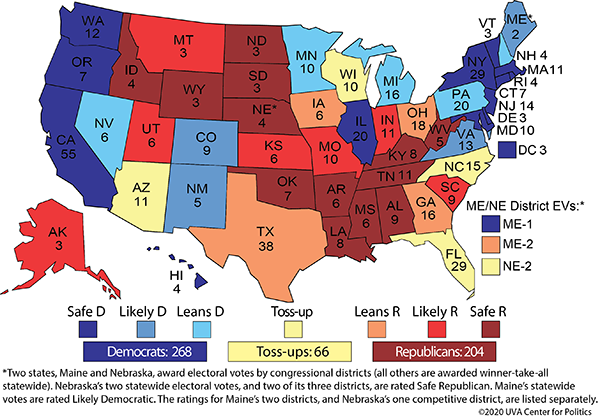
As Donald Trump continues to double down on rhetoric that thrills his core base of racists and Christian extremists in the hope of turning out his base in November, the opposite effect is happening with the rest of the population.  Indeed, the more ugly Trump's rhetoric becomes, the more voters he appears to be driving away.  A piece in Larry Sabato's Crystal Ball even shows Trump's lead in reliably red states dwindling and has caused GOP stalwart states like Alaska, Indiana, Kansas, Missouri, Montana, South Carolina, and Utah from "safe Republican" to "likely Republican."  One can only hope that Trump's hemorrhaging of support continues and that the presidential election becomes a rout with Biden winning by a landslide.  Personally, I want this to happen because it would restore some shred of faith in the American public as a whole and because it would devastate Trump's ego - Trump's pain is my pleasure, if you will.  Here are highlights from the Crystal Ball:

We are now about six weeks into a downturn in Donald Trump’s polling numbers. It’s worth thinking about the ramifications of this change if it endures.
In the RealClearPolitics average of national approval polling, Trump went from about early December to late May without ever dipping below -10 in net approval (approval minus disapproval). He has spent every day since June 1 at or below -10 net approval, and he’s currently at about -15.
Joe Biden’s national polling lead over Trump through May was in the four-to-six-point range. That is a decent lead, but not one that suggested Biden was a towering favorite . . . . But since early June, Biden’s lead has ballooned to the eight-to-10-point range. He has also enjoyed healthy leads in many polls of the most important swing states, like Florida, Michigan, Pennsylvania, and Wisconsin.
The bottom line here is that the nation is in a state of terrible crisis, and the public has, at least for now, judged the president’s responses to both coronavirus and protests of racial inequalities in policing to be lacking.
In an ABC News/Ipsos poll released Friday, 67% of respondents disapproved of Trump’s handling of coronavirus and of race relations. . . . . It is not the kind of year when one wants to be an incumbent running for reelection, and a majority of the public appears to believe that this president is not meeting the moment.
A few weeks into the public health crisis, we explored the possibility of Trump being the second iteration of Jimmy Carter, whose reelection bid fell apart among myriad crises in 1980. Since then, the Trump-as-Carter scenario has grown even more plausible.
There is time for the situation to change — as we wrote a few weeks ago, we want to see where things stand after the conventions, around Labor Day. But Trump is extremely unlikely to win if the polls continue to look the way they do now. And if these numbers represent a new normal, we need to account for the possibility that this election won’t be particularly close, and that new states may come into play. In other words, if the national picture remains bleak for Trump, then the slippage he’s seen from earlier this year wouldn’t just be limited to a handful of swing states.
The very well-sourced New York Times trio of Maggie Haberman, Jonathan Martin, and Alexander Burns recently reported that internal Republican data showed Trump with only a small lead in Montana and trailing in Kansas, two states that Trump carried by about 20 points apiece in 2016 (both have competitive Senate races, too).
Trump’s position is weak enough in mid-July that we have to concede there are some signs of competitiveness in states that were not competitive in 2016. This sort of thing can happen when the overall election is tilted toward one side over the other, which is the state of play at the moment and the advantage Biden currently holds.
[W]e continue to rate states like Colorado, New Mexico, and Virginia as Likely, not Safe, Democratic. That’s despite it being hard to imagine Trump carrying any of them, even if his position dramatically improves.
So we’re moving seven Safe Republican states to Likely Republican: Alaska, Indiana, Kansas, Missouri, Montana, South Carolina, and Utah. . . . In all likelihood, these red states are going to vote for Trump, and not just by a few points.
But could one or more flip if Biden wins decisively in November? Possibly. Let’s remember: A “Likely” rating still means we see one side — in this case, the Republicans — clearly favored in a state. We just don’t feel 100% certain about these states in the event of a lopsided election.
We think we’ll get more clarity about which scenario is more likely following the conventions — whatever the conventions actually look like. Even with 2020’s scaled down, undramatic, and overshadowed conventions, voters and media see them as departure points into the general election. Casting a ballot is no longer just on the distant horizon. It’s a reality that will firm up people’s choices — and our ratings.

Monday, July 13, 2020

America's Stolen Years Thanks to Trump

The Covid-19 pandemic continues to worsen in America even as other parts of the world appear to have contained and defeated the virus.  Yes, there are pockets of positive news - New York is continuing to show huge improvement and while Virginia's numbers have ticked upward they are nothing like those in red states like Florida and Texas.  But overall, some predictions are very grim: it will be summer 2022 before normalcy is achieved across the nation.  Meanwhile, rather than follow the advice of health care experts like countries that have beat the virus, the Trump/Pence regime is attacking medical experts and accusing them - and, of course, the media - being liars. Had America had a science based national response early on, today's grim figures could have been avoided and possibly two lost years could have been saved.  One can only hope that save for Trump cultists, Americans will wake up to the horrific damage done to the nation by Der  Trumpenführer, a/k/a the liar-in-chief.  A column in the New York Times looks at what might have been versus what Trump has wrought on America.  Here are column excerpts:

If you’re lucky enough to live in New Zealand, the coronavirus nightmare has been mostly over since June. After more than two weeks with no new cases, the government lifted almost all restrictions that month. The borders are still shut, but inside the country, normal life returned.
It’s coming back elsewhere too. Taiwan, where most days this month no new cases have been reported, just held the Taipei Film Festival, and a recent baseball game drew 10,000 spectators. Italy was once the epicenter of Europe’s outbreak and remains in a state of emergency, but with just a few hundred new cases a day in the whole country, bars are open and tourists have started returning, though of course Americans remain banned. According to The New York Times’s figures, there were 321 new cases in all of Canada last Friday.
And America? We had 68,241. As of last week, the worst per capita outbreak on the planet was in Arizona, followed by Florida. . . . Lawrence O. Gostin, professor of global health law at Georgetown, told me he doesn’t expect American life to feel truly normal before summer 2022. Two years of our lives, stolen by Donald Trump.
As our country plunges into a black hole of unchecked illness, death and pariahdom, the administration is waging a PR war on its own top disease expert, Anthony Fauci, trying to convince news outlets that he can’t be trusted. “The move to treat Dr. Fauci as if he were a warring political rival comes as he has grown increasingly vocal in his concerns about the national surge in coronavirus cases,” reported The Times.
Trump has also undercut the Centers for Disease Control and Prevention, retweeting the conspiratorial ramblings of the former game show host Chuck Woolery: “The most outrageous lies are the ones about Covid-19. Everyone is lying. The C.D.C., media, Democrats, our doctors, not all but most, that we are told to trust.” There are now so many stories of Trump fans dying after blithely exposing themselves to the virus that they’ve become a macabre cliché.
[T]he coronavirus, he said, has shown us that “health system capacity alone is almost useless unless you have a government that can unleash that capacity promptly and consistently.”  America has long fancied itself a swaggering colossus. It will likely emerge from this calamity humbled and decrepit.
[W]e know that the C.D.C. forecasts total deaths from Covid-19 to rise to as many as 160,000 just by the end of the month. Many times that number will have long-term medical complications, and a record 5.4 million people lost their health insurance between February and May. A generation of American kids will have their educations derailed, and many parents who don’t lose their jobs due to the economic crisis will see their careers ruined by the demands of child care.
The country’s international humiliation is total; historians may argue about when the American century began, but I doubt they’ll disagree about when it ended.
The psychological fallout alone will be incalculable. Even before the coronavirus, researchers spoke of loneliness as its own epidemic in America. A March article in the medical journal JAMA Psychiatry attributed 162,000 deaths a year to the fallout of social isolation.
Yet somehow there’s no drumbeat of calls for [Trump's] the president’s resignation. People seem to feel too helpless. Protesters can make demands of governors and mayors, especially Democratic ones, because at the local level small-d democratic accountability still exists. Nationally such responsiveness is gone; no one expects the president to do his job, or to be held to account when he doesn’t. That’s how you know the country was broken before coronavirus ever arrived.
This suffering, your suffering, wasn’t inevitable. The coronavirus is a natural disaster. The Republican Party’s death-cult fealty to Trump is wholly man-made.
Vote a straigh Democrat ticket in November and punish Trump and the GOP for the harm done to the nation and the thousands of lives needlessly lost.