Showing posts with label suburban voters. Show all posts

Sunday, July 26, 2020

Donald Trump's Suburban Horror Show


I grew up in the Republican Party, and although I lived in the country through high school - going back to my high school reunion last year reminded me of that - I've pretty much lived in the suburbs ever since.  Back when I grew up, the Republican Party was the party of knowledge, science and fiscal responsibility - the latter pretty much went away after Reagan's election and it has been Democrats in the White House that have been the ones reducing the federal deficit. Now, of course, under Donald Trump and the evangelical/Christofascist base of the GOP, the Republican Party has become the party of ignorance, alternate facts, and outright lies. None of these changes in the GOP have been lost on suburban voters who (i) tend to be better educated than rural voters, and (ii) more receptive to racial diversity than red state rural voters.  In addition, suburban voters, are paying attention to Trump's failed leadership in the context of the pandemic and seem to belatedly realized that almost nothing Trump says can be considered true.  The combined result of this is that suburban voters are abandoning Trump - and likely other Republicans - in the suburbs.  The results could be catastrophic - and much deserved - for the GOP.  A piece in Politico looks at Trump's declining prospects in the suburbs.  Here are excerpts:
Donald Trump says Joe Biden wants to abolish the suburbs. But polls show a different truth: The suburbs want to abolish Donald Trump.
If current numbers hold, the Republican Party will suffer its worst defeat in the suburbs in decades — with implications reaching far beyond November.
It was in the suburbs two years ago that Democrats built their House majority, ripping through Republican-held territory across the country, from Minnesota and Texas to Georgia, Virginia and Illinois.
It would be bad enough for the GOP if that had been a temporary setback. But with the prospect of a second straight collapse in the suburbs this year, it is beginning to look like a wholesale retreat.
“We can’t give up more ground in the suburbs nationally without having a real problem for our party,” said Charles Hellwig, a former chair of the Republican Party in Wake County, N.C., describing a landscape in which “every year, every month, every day, we get a little bluer.”
It is the same story in suburbs everywhere. In a Fox News poll last weekend, Trump was trailing Joe Biden, the presumptive Democratic nominee, by 11 percentage points in the suburbs. An ABC News/Washington Post poll had Trump down 9 percentage points there — larger margins in the suburbs than exit polls have recorded since the 1980s, when Republicans were winning there by double digits.
That polling reflects a dramatic swing from 2016, when Trump beat Hillary Clinton in the suburbs by 4 percentage points. Trump’s erosion in the suburbs is a major reason the electoral map this year has expanded for Democrats in recent weeks — with Trump in danger not only of losing, but of taking the Senate down with him. And demographic shifts are only becoming more favorable to Democrats.
“The movement of suburban voters, particularly educated women and millennials being so progressive in their politics, increased voting participating among Latinos, African Americans,” said Bill Carrick, a Democratic strategist who managed Missouri Rep. Dick Gephardt’s 1988 presidential campaign. “That all contributes to this geography: Suddenly, we’ve got Georgia and Texas and Florida and Arizona, Iowa. There’s a lot of places in play.”
Trump’s damage in the suburbs has come primarily, as it has elsewhere, from his handling of the coronavirus pandemic. But Trump’s response to the George Floyd protests also appears to have hurt him in the suburbs . . . .
Trump's intervention in Portland, Ore., has drawn more people into the streets, not fewer — including clashes between not only the Trump administration and antifa, but a “wall of moms.”
Comparing new voter registration in 17 states from immediately before the Floyd protests began to the week after, the Democratic data firm TargetSmart found that young people and people of color were registering at higher rates than before — with years to cast ballots for Democrats still ahead of them.
“Literally every state you’re seeing these increases, which is not something we saw in 2018,” Bonier said. “It’s interesting to see how the demonstrations in cities around the country are playing. … Suburban voters seem to be more sympathetic to those demonstrations than they ever have been in the past.”
When Americans were asked in the ABC News/Washington Post poll who they trusted more to handle issues surrounding crime and safety, they preferred Biden to Trump 50 percent to 41 percent.
There are still more than 100 days before the election, and Trump’s overtures to the suburbs are becoming more explicit.
Last week on the South Lawn, chastising Democrats for their positions on issues ranging from law enforcement to climate change and urban planning, Trump accused Democrats of plotting to “abolish our beautiful and successful suburbs.”
Mike Erlandson, a former chair of the Minnesota Democratic-Farmer-Labor Party, . . . . as the protests — and Trump’s response — have unfolded, he has seen Trump hurt his own standing there.
“The fact that the president is trying to drive a wedge in on things around law enforcement, I think most people find disappointing,” Erlandson said.  The suburbs, he said, "certainly have not turned their back on law enforcement." But at the same time, he said, "they don’t really see leadership coming out of the White House.”

Sunday, July 12, 2020

New Polls: Texas is a Swing State in 2020

With luck historians will write that Donald Trump was one of the worse things to happen to an already moribund Republican Party, a party that placed all of its future on shrinking elements of the US population  - e.g., aging white voters - while going out of its way to alienate growing segments of the national population - e.g., younger voters and the growing numbers of mixed or non-white voters.  Between peddling openly racist dog whistle sound bites and the utter incompetence of the Trump/Pence response to the Covid-19 pandemic, polls increasingly suggest the even red states like Texas and Georgia may end up in Joe Biden's column.  Of course if these polls prove prophetic, the most delicious aspect of it all will be that Trump loses by a landslide and his fragile, self-centered ego is devastated.  May he forever be branded as an incredible loser and the worse president in America's history. A piece at CNN looks at some of the latest polling.  Here are excerpts:
New CBS News/YouGov polls show President Donald Trump is in trouble in three states he won in 2016. He's tied with former Vice President Joe Biden in Arizona (46% to 46%), a state he won by four points in 2016. Trump's down 48% to 42% in Florida, a state he took by a point in 2016.
But it's the third state, Texas, where the eye popping result comes from. It's Trump 46% to Biden's 45%, a result well within any margin of error.
It's pretty clear looking at the data that Texas is a swing state in the 2020 election. The 2020 campaign could be the first time Democrats captured the Lone Star State in a presidential election since 1976. The CBS News/YouGov poll is not an outlier over the last month. There have been eight polls released publicly since the beginning of June. The result is that Biden and Trump are basically tied, with Biden up by a mere 0.3 points in Texas.
Importantly, and unlike in other states, the polls in Texas have not overestimated Democrats over the last few cycles. If anything Democrats actually slightly outperformed their final polls in the 2016 presidential race and 2018 Senate races.
Things may change the closer we get to the election, but Texas really is competitive at this point.
Texas has gotten progressively more competitive during Trump's time as a candidate and officeholder. A big statewide victory has eluded Democrats, though many races have come within single digits for the first time in a generation. In fact, the state seemed, if anything, to move to the left in 2018, as Democrats were able to achieve wins in some key congressional races. A Biden win would be a manifestation of that trend on the statewide level.
 As I noted last year, the reason the Democrats are doing so well in Texas is a shift among college educated white voters. You see this best in the suburbs of Austin, Dallas and Houston, where O'Rourke did disproportionately better than the Democratic Senate did six years prior.
Indeed, Texas' white voter population is very well educated. One calculation by the New York Times' Nate Cohn reveals that a little more than 42% of the 2020 likely white voters in Texas have a college degree. That's 13th highest in the nation and the most of any state Trump carried in 2016.
 I would expect the trend in the college educated areas of Texas to carry over to 2020. Much of Biden's gains over Clinton nationally have occurred among whites with a college degree. In national June polls, Biden was up 22 points among this group compared to Clinton's 12 point lead with them in the final 2016 polls of registered voters.  One problem for Biden is he does seem to be struggling among Hispanic voters nationally, and there are a lot of Hispanic voters in Texas. Although Biden is winning them by around 30 points nationally, he's not putting up the same margins as Clinton did in 2016.
Further, I wouldn't expect Texas to be the tipping state in the electoral college (i.e. state containing the median electoral vote plus one). Biden is certainly in a stronger position in the core six battleground states (Arizona, Florida, Michigan, North Carolina, Pennsylvania and Wisconsin) where the averages have him up anywhere from three to 10 points.
Still, the state has 38 electoral votes and a load of down ballot races that could prove to be alluring for Biden.
 Up to six Republican held House seats could realistically fall to the Democrats in 2020. Many of them are in the aforementioned suburbs.
 Finally, Democrats have a real chance to flip the Texas state House. They need a pickup of less than 10 seats, and race raters give them a decent shot of doing so. If Democrats did flip the chamber, then they'd have a hand in redistricting for the first time since the beginning of the 2000s.
 That's big for state and national politics given that Texas has more House members than any state except California.
 The bottom line is Texas is fertile ground for Democrats in 2020. Biden has to decide whether he truly wants to compete. Either way, he has a real shot of winning, and a chance to rewrite the political map for this year and for the generation to come.
.

Wednesday, July 08, 2020

Trump is - Thankfully - Driving Away Suburban Voters

Across America - Virginia is a perfect example - suburban area voters are rejecting the racism, far right religious extremism, and reactionary policies that now define the Republican Party under Donald Trump.  Neither Trump nor the base of the GOP - white supremacists and Christofascists - seem to have gotten the message.  Hence, the primary defeat in Virginia's 5th congressional district of a Republican likely to have won reelection by an extremist with ties to Liberty University who may well lose to his Democrat opponent in November.  At the national level Trump is doubling down on precisely the things that alienate suburban voters in the effort to retain the loyalty of his knuckle dragging, Klan supporting base.  A piece in the Washington Post looks at the situation which hopefully proves fatal to Trump's reelection hopes.  Here are excerpts:
In 2016, Trump won the overall suburban vote by five percentage points, and those votes were largely responsible for his narrow victory in states such as Michigan, Wisconsin and Pennsylvania. The campaign sent surrogates including Trump’s daughter Ivanka Trump, who became a top aide in his White House, and Kellyanne Conway, counselor to the president, to connect with suburban voters such as white women and working moms who were uncomfortable with Hillary Clinton, his Democratic rival.
But Trump’s responses to several of today’s most significant issues in the past week are making the already unpopular president less popular with these voters.
1. Despite increases in reported coronavirus cases — so severe in some states that their leaders have ordered some shutdowns again — Trump is pressuring schools to reopen this fall.
2. While most Americans believe that monuments honoring Confederate soldiers who fought to keep black people enslaved should be removed, Trump does not — and has even used racist slurs to attack his political opponents on the issue.
3. Days after speaking near Mount Rushmore — a monument to presidents carved on a mountain that some Native American tribes consider sacred — Trump criticized athletic teams that are changing their names and mascots from those deemed racist toward Native Americans.
[Trump’s] eagerness to send students back to school as soon as possible seems more rooted in his desire to give the impression that the pandemic is under control as opposed to data supporting that things are actually improving. That could hurt him with suburban voters — and particularly the women and mothers who supported him in the past.
And while Trump opposes removing Confederate memorials — a position he also took in August 2017 when he defended white nationalists who marched to preserve the monuments — most Americans do not. I previously reported that most voters — 52 percent — support removing Confederate statues from public spaces around the country, according to a June Quinnipiac University poll, a significant increase in support since August 2017, when fewer than 40 percent of voters supported removing such statues.
Among the Americans who feel uncomfortable with Trump’s position on racial issues are suburban voters — and that can have real ramifications for November. Marc Thiessen, a fellow at the American Enterprise Institute, a right-leaning think tank, and the former chief speechwriter for President George W. Bush, wrote in The Washington Post last week:
In the wake of recent racial unrest, Biden, the presumptive Democratic nominee, has opened a commanding 25-point lead over Trump in the suburbs. Two-thirds of Americans say the president has made racial tensions worse since the killing of Floyd in Minneapolis on May 25. Trump’s uncompromising rhetoric and retweets are driving away swing voters who don’t want to be associated with a senior citizen shouting “white power!”
The latest NPR/PBS NewsHour/Marist poll shows the president receiving about a third of the suburban vote — a significant decline from the nearly 50 percent of support he received in 2016. With several months left before the election, that number could drop more, and perhaps is likely to if Trump continues to address these issues in the same way. And all indicators suggest that he will. . . . . it will be very difficult for him to win the election if he continues to take stances on issues that suburban voters oppose.


One can only hope Trump continues to drive away suburban voters.

Friday, July 03, 2020

Trump’s Re-election Message: Inflame White Racism


A column in the New York Times lays out what appears to be Donald Trump's reelection strategy  and in the process explains, in my view, white evangelical support for Trump: white racism.  Of course, evangelicals are not the only ones onboard Trump's racism train although evangelicals are perhaps the ones who are still the most angry over desegregation and an end of the Jim Crow laws. Given the economy's collapse and the seemingly out of control Covid-19 pandemic (especially in GOP led states that followed Trump's demands for "reopening"), Trump has little else to run on and has re-embraced what got him elected in 2016: white grievance and white racial animosity toward non-whites. Congressional Republicans and my Republican "friends" who refuse to admit that they fully realize what Trump's all about are lying to themselves and to others.  One can only hope that this renewed shameless pandering to white supremacists and evangelicals (the two go hand in hand) fails in 2020, especially among suburban voters.  Here are column highlights:

A lot of Republicans are acting puzzled about Donald Trump’s re-election pitch. “He has no message,” one Republican source told Reuters. “He needs to articulate why he wants a second term,” said another. Some have expressed hope that Trump would find a way to become less polarizing, as if polarization were not the raison d’être of his presidency.
It’s hard to know if Republicans like this are truly naïve or if they’re just pretending so they don’t have to admit what a foul enterprise they’re part of. Because Trump does indeed have a re-election message, a stark and obvious one. It is “white power.”
[Trump] The president started this week by tweeting out a video that encapsulates the soul of his movement. In it, a man in The Villages, an affluent Florida retirement community, shouts, “White power!” at protesters from a golf cart bedecked with Trump signs. “Thank you to the great people of The Villages,” wrote Trump. Only after several hours and a panic among White House staffers did the president delete the tweet.
Republicans might act as if they don’t know why Trump’s fans are so unfailingly loyal. Some commentators spent the first year or two of his presidency dancing around the reason he was elected, spending so much time probing the “economic anxiety” of his base that the phrase came to stand for a type of willful political blindness.
But Trump understands that he became a significant political figure by spreading the racist lie that Barack Obama was really born in Kenya. He launched his history-making presidential bid with a speech calling Mexican immigrants rapists and adopted a slogan, “America First,” previously associated with the raging anti-Semite Charles Lindbergh. Throughout the 2016 campaign, he won the invaluable prize of earned media with escalating racist provocations, which his supporters relished and which captivated cable news.
Trump, however, seems to grasp that racism is what put him over the top. It’s what made his campaign seem wild and transgressive and hard to look away from.
Now Trump’s poll numbers are cratering, we have double-digit unemployment and our pandemic-ravaged nation has been rendered an international pariah. America is faring exactly as well under Trump’s leadership as his casinos, airline and scam university did. It’s not surprising that he’s returning to what he knows, and what seemed to work for him before.
In fact, Trump appears to think his problem is that he hasn’t been racist enough. . . . . “He truly believes there is a silent majority out there that’s going to come out in droves in November,” a source told Swan.
And so last week, as if to prod that silent majority, Trump tweeted out videos of Black people assaulting white people. . . . . He said he’d veto a $741 billion defense bill over a provision, written by Senator Elizabeth Warren of Massachusetts, requiring that military bases honoring Confederates be renamed. Apoplectic over New York City’s plans to paint the words “Black Lives Matter” on Fifth Avenue in front of Trump Tower, he called the slogan “a symbol of hate.”
On Tuesday, Trump tweeted that he was considering scrapping an Obama-era housing regulation that required localities to address illegal patterns of residential segregation. . . . . The message to his white supporters seemed clear enough: Trump is going to fight to stop people of color from coming to your neighborhood.
The Times reported on the president’s rationale: “Mr. Trump and his campaign team, already concerned about his weakness in battleground states, have become increasingly alarmed by internal polling showing a softening of support among suburban voters.” Trump sees clearly — more clearly than most of his party — that racism is the main thing he has to offer.
There’s good reason to think that he’s misjudging these suburban voters. Polls show that a growing number of them, particularly women, are repelled by Trump’s race-baiting and divisiveness. But Republicans who complain that the president is undisciplined, that he can’t adhere to a strategy, miss the point: Bigotry has always been the strategy.
The Republicans who support him are yoked to that strategy. Their real frustration isn’t that it’s ugly but that it’s no longer working.

Thursday, July 02, 2020

A Second Blue Wave in the Suburbs?

An exodus of suburban voters from the GOP fueled Democrat wins in 2018 and handed control of the U.S. House of Representatives to Democrats.  As things currently stand, Trump is even more disliked than in 2018 and his botched handling of the Covid-19 pandemic and the battered economy may underscore that dislike.  A piece in Larry Sabato's Crystal Ball looks at possible problems for the congressional Republicans in suburban districts if Trump loses or barely edges out wins far smaller than in 2016.  In deed, Trump may have negative coattails even in states like Texas where the rural/suburban divide is growing rapidly.  In heavy military areas like Hampton Roads, Virginia, the Russian bounties for dead Americans and Trump's claim it is all a hoax could harm Trump and those in the GOP pandering to him even further.  Here are article highlights:

Well-educated suburban districts, particularly ones that also were diverse, were a major part of the Democrats’ victory in the House in 2018. Democrats captured many formerly Republican districts where Donald Trump performed significantly worse in 2016 than Mitt Romney had in 2012. Democratic victories in and around places like Northern Virginia, Philadelphia, Pittsburgh, Detroit, the Twin Cities, Atlanta, Orange County, CA, parts of New Jersey, and elsewhere came in seats that meet this broad definition.
And then there’s Texas. Democrats picked up two districts there, one in the Dallas/Ft. Worth Metroplex (TX-32) and another in suburban Houston (TX-7). But Democrats put scares into several other Republican incumbents, and the closeness of presidential polling in Texas could lead to unexpected opportunities for Democrats there this November.
Tellingly, of 18 Texas polls in the RealClearPolitics database matching Biden against Trump dating back to early last year, Trump has never led by more than seven points — in a state he won by nine in 2016. It seems reasonable to assume that Trump is going to do worse in Texas than four years ago, particularly if his currently gloomy numbers in national surveys and state-level polls elsewhere do not improve.
In an average of the most recent polls, Trump leads by two points in Texas. In 2018, Sen. Ted Cruz (R-TX) won reelection over then-Rep. Beto O’Rourke (D, TX-16) by 2.6 points. If Trump were to win Texas by a similar margin this November, the congressional district-level results probably would look a lot like the Cruz-O’Rourke race.
Cruz won the remaining districts, but several of them were close: TX-2, TX-3, TX-6, TX-21, TX-22, TX-25, and TX-31 all voted for Cruz by margins ranging from 0.1 points (TX-21) to 5.1 (TX-25). These districts all have at least average and often significantly higher-than-average levels of four-year college attainment, and they all are racially diverse.
In other words, these districts share some characteristics of those that have moved toward the Democrats recently, even though they remain right of center.
This is all a long preamble to an alarming possibility for Republicans: If Biden were to actually carry Texas, he might carry many or even all of these districts in the process. In a time when ticket-splitting is less common than in previous eras of American politics (though hardly extinct), that could exert some real pressure on Republicans in these districts.
Trump’s Texas sag in 2016 didn’t immediately imperil any Texas Republican U.S. House members, except for retiring Rep. Will Hurd (R) in the perpetually swingy TX-23; it took the 2018 midterm, when Trump’s unpopularity led to big House losses for Republicans, to make many of these districts much more competitive. So it’s possible that Biden could do really well, but not have strong-enough coattails in these and other similar kinds of districts. We also still like Trump’s chances in Texas, despite the close polls.
However, if that changes — and if Biden wins the state without much ticket-splitting — there could be some unpleasant surprises down the ballot for Republicans in Texas. That could also include control of the Texas state House of Representatives, which might be in play if things get bad enough for Republicans this November.
Redistricting looms for 2021 — at the very least, Republicans who currently control state government in Texas may have to dramatically re-draw the map to shore up incumbents whose safe seats have eroded over the course of the decade while also accommodating a few new House seats because of Texas’ explosive growth. For Republicans, their gerrymander after the last census (albeit blunted a little by judicial intervention) made practical political sense, but demographic changes and coalition shifts pushed 20 of the 36 districts to vote more Democratic than the state in the 2018 Senate race. And if Democrats somehow win the state House, they will have a formal seat at the table in the redistricting process next year.
Overall, our ratings now show 227 House seats at least leaning to the Democrats, 194 at least leaning to the Republicans, and 14 Toss-ups. Splitting the Toss-ups down the middle would mean a 234-201 House, a one-seat GOP improvement on 2018.
That said, as we scan the Leans Republican and Leans Democratic columns, there may be more GOP seats than Democratic ones that are closer to drifting into the Toss-up column. Second-quarter fundraising reports, which will be trickling out over the next couple of weeks, may provide some additional clues as to the state of these competitive races.
All in all, the Democrats’ grip on the House majority remains strong.

Thursday, May 21, 2020

Is Arizona About to Go Blue?

Trump with his sycophant Martha NcSally.
Virginia was once a reliable "red state" but as the suburban population grew and demographic changes steadily took place, it swung from red state to purple and now appears firmly in the "blue state" column with Donald Trump being widely detested. There are signs that Arizona may be headed for a shift and Republican advisers are warning Der Trumpenführer that both he and Republican Sen. Martha McSally are in trouble in Arizona.  Like Virginia, much of the GOP concern is focused on the suburbs where Trump and the GOP are increasingly viewed with misgivings if not revulsion. A piece in Politico looks at Arizona and the increased GOP angst over the warning signs in advance of November.  Personally, I wish Trump and the Republican Party nothing but misfortune and defeat in November.  Here are article highlights: 
Senior political advisers to President Donald Trump warned Senate Majority Leader Mitch McConnell Thursday that Republican Sen. Martha McSally is falling dangerously behind in the critical swing state of Arizona.
Trump’s campaign team was meeting with the president at the White House to discuss the state of play in a handful of battleground states. Toward the end of the meeting, Trump pulled McConnell, who was at the White House to meet with him on another matter, into the Roosevelt Room. The discussion turned to Arizona, where recent polling has shown Trump and McSally trailing.
Trump himself said he was concerned about McSally, according to three people familiar with the discussion. His political advisers told McConnell about recent survey numbers in Arizona and stressed she was losing to Democrat and former astronaut Mark Kelly.
Trump's own standing in the state was also a subject of the conversation.
The discussion comes amid increasing Republican worries about Arizona. An array of recent polls have shown Trump losing to Joe Biden in the state, which Democrats have not won in a presidential election since 1996. Democrats have signaled they intend to make an aggressive play in Arizona.
The Senate race is a particular trouble spot. As Senate Republicans try to protect their majority, McSally has emerged as one of the party’s most vulnerable incumbents. One survey released this week showed McSally trailing Kelly by 13 points.
McSally is also heading into the final six months of the campaign at a substantial fundraising disadvantage. Through the end of March, Kelly had outraised McSally $31 million to $18 million. Kelly, who is the husband of ex-Rep. Gabrielle Giffords, is the most well-funded Senate candidate in the country.
The race is center to Democratic hopes of winning control of the Senate. Along with Colorado, Democrats see Arizona as their best opportunity to flip a GOP-held seat.
Republicans have made protecting McSally, a former congresswoman and ex-Air Force fighter pilot, a top priority. . . . . “It’s a fact that Arizona is a battleground state for both the presidential and U.S. Senate campaigns,” said McSally campaign manager Dylan Lefler. "We are confident that the Republican Party is fully invested in keeping Arizona red in November because control of the White House and the Senate depends on it."
Republicans in the state say the president will need to take it seriously this year. They note the state has grown more liberal in recent years, with four statewide offices flipping to Democrats in 2018. That year, McSally lost to Democrat Kyrsten Sinema. She was later appointed to the seat of the late John McCain.
Republicans are concerned. Biden, they say, will be a tougher opponent than Hillary Clinton was in 2016. They also worry that Trump's troubles in suburban areas could prove costly.
"Trump is his own worst enemy with swing constituencies," said Chuck Couglin, who served as a top adviser to former Republican Arizona Gov. Jan Brewer. "His best shot with those voters is to make his opponent less attractive than he is. He will have a harder time doing that with Biden. He will try though."
Arizona is one of two traditionally conservative states Democrats are trying to put in play. They are also planning to compete in Georgia, which Democrats haven't won in a presidential election since 1992. Trump won the state by 5 percentage points in 2016, though recent surveys have shown a tight race.
Democrats say competing in red states will open up multiple avenues for Biden to reach the 270 electoral vote threshold. The party has been mostly focused on three Rust Belt states — Michigan, Wisconsin, and Pennsylvania — that Trump won by narrow margins in 2016.
A survey released earlier this month showed Biden leading Arizona by 7 percentage points, though Trump advisers insist his numbers in the state are more favorable.
One can hope that Trump remains in denial and ignores his advisers.

Sunday, March 01, 2020

With Buttigieg Out, Who Will Virginia Moderates Back


I'd be lying if I said I was not disappointed that Pete Buttigieg has ended his presidential campaign.  I'd also be lying if I said I did not have any animosity towards black voters - who expect gays to support their rights and vote for black candidates but never see the situation as a two way street - who rejected Buttigieg, most likely because blacks remain the most homophobic of any demographic save white evangelicals. I'm sorry, but I am simply over this constant double standard.  Meanwhile, with Buttigieg's decision, the question becomes who will moderate Virginia suburbanites support if, like me, they find Sanders' far left socialism a non-starter.  I have not decided who I will vote for on Super Tuesday other than it will NOT Be Sanders. First, a piece in the Washington Post looks at Buttigieg's decision to end his campaign.  Here are excerpts:
Pete Buttigieg, the 38-year-old former mayor of South Bend, Ind., who saw a meteoric rise from virtual unknown to top-tier contender and became the first openly gay candidate to make a high-profile presidential run, is ending his campaign.
The development marks an abrupt end to what was briefly an ascendant candidacy, as Buttigieg won the Iowa caucuses and came in second in New Hampshire. But despite attracting enormous attention, significant support and often enthusiastic crowds, there was no clear path forward toward the nomination.
Buttigieg struggled to win support from black voters, a key pillar of the Democratic coalition — a vulnerability that took center stage Saturday in South Carolina, where he finished fourth.
Earlier that day, his campaign held a call with reporters in which senior adviser Michael Halle and deputy campaign manager Hari Sevugan made the case that while Buttigieg likely wouldn’t win any of the 14 states that vote Tuesday, Buttigieg could still accumulate enough delegates to keep Sanders’s lead to a minimum.
“Essentially the reason he is suspending his campaign is the reason he started the campaign: His goal is to defeat the [Trump] President and bring a new kind of politics to our country,” a Buttigieg aide said. “He thought his candidacy would be best vehicle to do that. And when it became clear his candidacy was not the most viable vehicle to do that, he stepped aside to make sure [Democrats] could still achieve those things.” “Pete Buttigieg’s campaign was historic and he showed the world that Americans are ready to accept and embrace qualified LGBTQ public leaders. His candidacy came after decades of LGBTQ Americans fighting to be heard, be visible, and have a place in the American experience,” said gay advocacy group GLAAD’s President Sarah Kate Ellis in a statement. “Pete’s success will no doubt lead to more LGBTQ candidates in political races large and small.”


As for who moderate Virginians will support,  a piece in the New York Times looks at Sanders unpopularity among suburban voters.  Here are excerpts:
VIRGINIA BEACH, Va. — In the Trump era, the suburbs have been Democrats’ surprising superpower.
A revolt by college-educated voters, largely women, in suburbs from Virginia Beach to Oklahoma City, from Houston to Southern California, delivered the House majority to Democrats in 2018. Driven by anxiety over guns, health care and the environment, and recoiling from President Trump’s caustic leadership, suburban voters are widely seen as a critical bloc for any Democratic victory in 2020.
But there are some early signs that the rise of Senator Bernie Sanders, by far the most liberal Democratic front-runner since George McGovern in 1972, is causing stress with the party’s suburban coalition and especially its core of college-educated white women and older voters, many of whom are politically moderate.
And after Saturday night’s big win Joseph R. Biden Jr. in South Carolina, Mr. Sanders will face an invigorated former vice president as well as other moderates, like former Mayor Michael R. Bloomberg, in Tuesday’s primaries in Virginia, Texas, and other states with swaths of suburban voters.
While some women, including many teachers, “are all about Sanders,” Ms. Simonds said, others recoil from his sweeping proposals such as a government takeover of health care. “There are a lot of women who are very protective over health care and the current status quo,” she said.
Suburban women are especially important in battleground states like Virginia, which is seen as essential to any Electoral College majority for the party in 2020. Virginia has turned sharply toward moderate Democratic candidates in recent years; the losses of Republican candidates up and down the ballot in suburbia have produced more political change than arguably any other state.
Mr. Biden’s victory in South Carolina may reset the field going into Super Tuesday on March 3, when 16 states and territories vote.  . . . . In his victory speech on Saturday night, Mr. Biden took aim at Mr. Sanders as a divisive figure.
In a sign of Mr. Sanders’s vulnerability, a plurality of Democrats polled disagreed with some of his key positions: 44 percent said the private insurance system should be kept as it is, and only one in five supported canceling all student debt.
“It’s clear that the path to the majority for us in Virginia in 2017, 2018 and 2019 was Democrats picking candidates in the primary who could talk to independents and bring them to our side in the general election,” said former Gov. Terry McAuliffe, who on Saturday endorsed Mr. Biden after his commanding South Carolina win. “In order to beat Trump, we need a nominee who is inclusive and can build a broad coalition.”
In a head-to-head matchup between Mr. Trump and the top Democrats in a recent Washington Post/ABC News Poll, Mr. Sanders performed the worst with college-educated white women.
There were potential warning signs for Democrats in the poll should Mr. Sanders become the nominee: Nearly one in five suburban Democrats said they would not support him against Mr. Trump in November.
“I don’t think Bernie can win,” said Pat Barner, a retiree here in Virginia Beach, the southern point in a crescent of suburbs running through Richmond to Northern Virginia, which have politically transformed the state. . . . . she feared he could not carry the state. “We’re not that liberal in Virginia,” she said.
A Sanders candidacy might threaten the 2020 prospects of two vulnerable Democratic congresswomen in Virginia who won Republican-held seats in the 2018 midterms: Representative Abigail Spanberger, a former C.I.A. officer who won a suburban district outside Richmond; and Representative Elaine Luria, a retired Navy commander who won in Virginia Beach.
“Both Luria and Spanberger would not be eager to have to be running down-ballot with Bernie,” said Bob Holsworth, a longtime political analyst in the state. “They’re very concerned about the socialist label.”
Hopefully, Virginians will vote to end Sanders' campaign on Tuesday by backing moderate candidates.  I continue to believe that a Sanders nomination guarantees the re-election of Trump.

Sunday, February 23, 2020

Down-Ballot Democrats Distance Themselves from Sanders

With Bernie Sanders' strong showing in Nevada, it seems Democrats are poised to do what Virginia Republicans did for years and which left them completely out of power in Virginia: they nominated candidates that were the darlings of the extremists of the party base but who were viewed as toxic by mainstream voters.  If Bernie Sanders turns out to be the Democrat nominee, I fear that another four years of the nightmare of Donald Trump is virtually guaranteed.  Worse yet, Sanders may drag down many down ballot candidates and cause Democrats to lose seats both in Congress and also in countless state races across the country. While Sanders supporters - who strike me as being just as fanatical as Trump's MAGA supporters  - are blind to this reality, many down-ballot Democrats are seeing the hand writing on the wall and trying to distance themselves from Sanders as vigorously as possible. As for Sanders himself, the man strikes me as just as filled with egomania and a "my way or the highway" mindset as Trump.  He is a catastrophe who will do incalculable damage to the Democrat Party. A piece in the Washington Post looks at these totally justified efforts. Here are article highlights: 
Former astronaut Mark Kelly, the Democratic Party’s hope for flipping a U.S. Senate seat in Arizona, tried to do no harm this month when he was asked about Sen. Bernie Sanders. “I will ultimately support who the nominee is of the Democratic Party,” he said.
That was enough for Kelly’s Republican rival, Sen. Martha McSally (R-Ariz.), who is trailing him in early polls, to go on the attack. The television spot she debuted days later spent nearly as much time talking about plans by the democratic socialist from Vermont to raise taxes and award new benefits to undocumented immigrants as it did about Kelly.
As Sanders builds what could eventually be an insurmountable delegate lead, many Democratic House and Senate candidates are approaching a dramatic shift in their campaigns, as they recalibrate to include praise of capitalism and distance themselves from the national party. Top campaign strategists from both parties view Sanders’s success as a potentially tectonic event, which could narrow the party’s already slim hopes of retaking the Senate majority and fuel GOP dreams of reclaiming the House, which it lost amid a Democratic romp in 2018.
“Donald Trump is going to offer the American people this choice: Do you want to continue building the economy or do you want to lurch toward socialism? And that is a real powerful argument in the Democratic districts that Trump won in 2016.”
With an emphatic victory in Saturday’s Nevada caucuses, Sanders has won two of the first three contests, and lost the third — the Iowa caucuses — in a squeaker.
Because of Democratic rules that give no delegates to candidates who scores less than 15 percent of the vote in a state or congressional district, Sanders could build a delegate lead far greater than his advantage in the popular vote.
If Democrats are awakening to a recognition that Sanders could pull away from the rest of the field, there is far less consensus about whether his nomination will help President Trump win reelection. Sanders’s power to turn out young and blue-collar voters or suburbanites is not fully tested, the ceiling of Trump’s support is poorly defined in a two-way race and the senator from Vermont has not yet been subjected to a negative paid advertising effort.
But there is far less flexibility for candidates in smaller districts. That has prompted Republicans to celebrate as they look to reclaim ground they lost in 2018 when largely affluent suburbs rebelled against the GOP in a protest of Trump.
“The Democrats’ embrace of socialism is going to cost them their majority — I mean, it’s as simple as that,” said Rep. Tom Emmer (R-Minn.), chairman of the National Republican Congressional Committee. “Bernie is about as good a contrast as we could have ever hoped for.” Democrats, particularly those representing swing districts, agree.
“We flipped those seats [in 2018] because of Donald Trump,” said one House Democrat who represents a suburban district, speaking on the condition of anonymity to reflect internal discussions. “And if Democrats want to hand most of those back, put Bernie at the top of the ticket. And that’s how many of us feel.”
The House member added: “Our overarching priority [is] to replace the president, but to do so with someone who is going to be equally divisive does not serve the country’s interests, and I think that’s at the core of what is making so many so uncomfortable.”
Several of Sanders’s rivals have begun to warn about a potential down-ballot rout. They have raised particular concern about Sanders’s support for a Medicare-for-all plan, which would effectively eliminate private health insurance in the United States.
The leading Democratic candidates running for the four most vulnerable Republican Senate seats — in Arizona, North Carolina, Maine and Colorado — have all come out against Sanders’s signature health care plan, as have many House candidates.
“I believe the only way to truly deliver any of the progressive changes we care about is to be a nominee who actually gives a damn about the effect you are having, from the top of the ticket, on those crucial, front-line House and Senate Democrats running to win, who we need to win, to make sure our agenda is more than just words on a page,” former South Bend, Ind., mayor Pete Buttigieg said Saturday in Las Vegas.
The moderate think tank Third Way has urged the presidential candidates to train their fire on Sanders at Tuesday’s South Carolina debate, issuing a memo that cites a recent Gallup survey that found 51 percent of independents would not vote for a self-described socialist for president.
“The suburbs are not looking for a revolution,” said Matt Bennett, co-founder of Third Way. “They want change, for sure. Many of them loathe Trump with a burning passion, but they do not want somebody who is proposing to double the size of the federal government. They do not want somebody who is proposing to take away the health care of 180 million people.”
A Washington Post-ABC News Poll this week found that Sanders had the worst standing against Trump among college-educated white women, the group most responsible for powering Democrats to their 2018 House majority. Sanders had a statistically insignificant two percentage-point edge over Trump among white women voters with college degrees in the poll, compared with Buttigieg, Biden, Bloomberg and Sen. Amy Klobuchar (D-Minn.), who all beat Trump by 10 points or more among that the same group.
Dan Conston, executive director of the Congressional Leadership Fund, the largest GOP super PAC focused on House races, said Sanders’s presence lends instant credibility to the GOP’s long-standing efforts to tie any Democrat to the far left.
“It feels like we are moving to almost a parliamentary system where voters are voting straight ticket,” said Republican pollster Neil Newhouse, who has found in recent polling that Trump is significantly more popular than Sanders in competitive House races. “Sitting back and watching the Democrats and their primary is an extraordinary experience, and I am glad it’s not us.”
I am in horror of what is happening and all I can do is play Cassandra and donate to opposing candidates - something I urge others to do as well starting right now.  Sanders must be stopped if a disaster is to be averted.

Friday, November 08, 2019

The Suburban Backlash Against the GOP Is Growing

I recently wrote about the Virginia Republican Party's slow suicide in Virginia where the population of the urban/suburban areas is surging while the number of rural voters is either stagnant or declining sharply. In statewide races, the Virginia GOP now finds it near impossible to win and losses in redrawn districts will pile up further following the 2021 redistricting which will reflect the population shifts. What the GOP is selling may win the hearts of racists and religious extremist in rural areas, but it is simply repulsive to more and more urban/suburban residents.  As a quote of a former NRCC chair in The Atlantic indicates, the GOP’s transformation from "a party of the country club to the country” does not add up to long-term success.  All indications are that Donald Trump's 2020 campaign effort may accelerate the process across the country and, even if Trump pulls of another Electoral College win while losing the popular vote, the long term trend is clear as urban/suburban populations soar in even states like Texas where sooner or later, the rural vote will not be enough to win statewide elections - or carry states in presidential elections.  Here are some article highlights:

The shift of metro areas away from the Republican Party under President Donald Trump rumbled on in yesterday’s elections, threatening the fundamental calculation of his 2020 reelection plan.
Amid all the various local factors that shaped GOP losses—from Kentucky to Virginia, from suburban Philadelphia to Wichita, Kansas—the clearest pattern was a continuing erosion of the party’s position in the largest metropolitan areas. Across the highest-profile races, Democrats benefited from two trends favoring them in metro areas: high turnout in urban cores that have long been the party’s strongholds, and improved performance in white-collar suburban areas that previously leaned Republican.

“When Trump was elected, there was an initial rejection of him in the suburbs,” says Jesse Ferguson, a Virginia-based Democratic strategist. “We are now seeing a full-on realignment.”
In that way, the GOP’s losses again raised the stakes for Republicans heading into 2020. In both message and agenda, Trump has reoriented the Republican Party toward the priorities and grievances of non-college-educated, evangelical, and nonurban white voters. His campaign has already signaled that it will focus its 2020 efforts primarily on turning out more working-class and rural white voters who did not participate in 2016.
But yesterday’s results again suggested that the costs of that intensely polarizing strategy may exceed the benefits. Republicans again suffered resounding repudiations in urban centers and inner suburbs, which contain many of the nonwhite, young-adult, and white-collar white voters who polls show are most resistant to Trump. If the metropolitan movement away from the Trump-era GOP “is permanent, there’s not much of a path for Republican victories nationally,” former Representative Tom Davis of Virginia, who chaired the National Republican Congressional Committee about two decades ago, told me. Trump’s effort to mobilize his nonurban base around white identity politics is having the offsetting effect of turbocharging Democratic turnout in metropolitan areas, which are growing faster than Trump’s rural strongholds. Unique local conditions contributed to each of yesterday’s most disappointing results for Republicans. . . . . But looming over all these local factors was the consistency of the metropolitan movement away from the GOP. Not only in urban centers, but also in suburban and even some exurban communities, Democrats reaped a double benefit: They increased their share of the vote even as turnout surged. The legislative elections in Virginia show the same pattern of the suburban erosion for the GOP in the Trump era. Democrats overthrew narrow Republican majorities in both chambers of the General Assembly by capturing at least five state House seats (while leading narrowly in a sixth) and two in the state Senate. They included seats in the Washington, D.C., suburbs of Northern Virginia and near the state capital of Richmond. But those new gains were probably less telling than what didn’t change: Democrats didn’t lose any of the previously Republican seats that they captured in suburban areas—particularly Northern Virginia and Richmond—in their landslide win in the state in 2017, which foreshadowed Democrats’ gains in the 2018 midterms. That widening separation between the GOP’s strength outside of metro areas and an intensifying tilt toward Democrats inside of them continues the underlying pattern of geographic polarization that has defined politics in the Trump era. Rather than looking to court urban areas, Trump has more frequently denounced places such as Chicago, San Francisco, and Los Angeles in an attempt to energize his mostly nonurban base. He continues to aim his message preponderantly at culturally conservative whites, and his campaign has signaled that it considers increasing turnout among such voters central to his reelection hopes.
Few in either party dispute that such a strategy could allow Trump to squeeze out another Electoral College victory, even if he loses the popular vote . . . But yesterday’s results underscore how narrow a wire [Trump] the president is walking with that strategy. Even taking into account Bevin’s personal unpopularity, Bitecofer says the Kentucky result should caution Republicans about a plan that accepts metropolitan losses to maximize rural and small-town gains. “If it can’t work in Kentucky … you cannot do it in Wisconsin or Michigan,” she says. Beyond Trump, the urban/nonurban divisions evident in this week’s elections “should scare the ever-loving bejesus” out of 2020 Republican Senate candidates in states with large metropolitan populations, including Arizona, Colorado, and North Carolina. In 2016, the strategist noted, Trump benefited not only because rural and non-college-educated white voters turned out in big numbers, but because turnout was weak among minorities and mediocre among young people. But in 2018—and again last night—large turnout in metropolitan areas swamped strong showings for the GOP in rural communities, the strategist noted. That raises the question of whether even big turnout in nonmetro areas will suffice for Trump if the metropolitan areas moving away from him continue to vote at the elevated levels evident in 2018 and 2019. Davis, the former NRCC chair, likewise believes that the GOP’s transformation from a party of “the country club to the country” does not add up to long-term success. “What’s happening is that the fast-growing areas [are] where the Democrats are doing better,” he told me. “There aren’t enough white rural voters to make up the difference.” Despite the GOP’s recent metropolitan losses, Trump’s approach has generated astonishingly little dissent inside the party. Yesterday’s results are unlikely to break that silence. But Weaver, like other GOP strategists dubious of Trump, says the party cannot indefinitely ignore the implications of prioritizing rural strength at the price of losing ground in the urban centers, which more and more are driving the nation’s economic innovation and its growth in population and jobs.
“Politics is a free-market enterprise. You have to sell a product,” Weaver says. “And Republicans are going to find themselves, by their own decision making, eliminated as an option for many, many voters, many, many demographic groups for generations to come.”

Sunday, November 03, 2019

Virginia on The Brink of Cementing Its Democratic Status

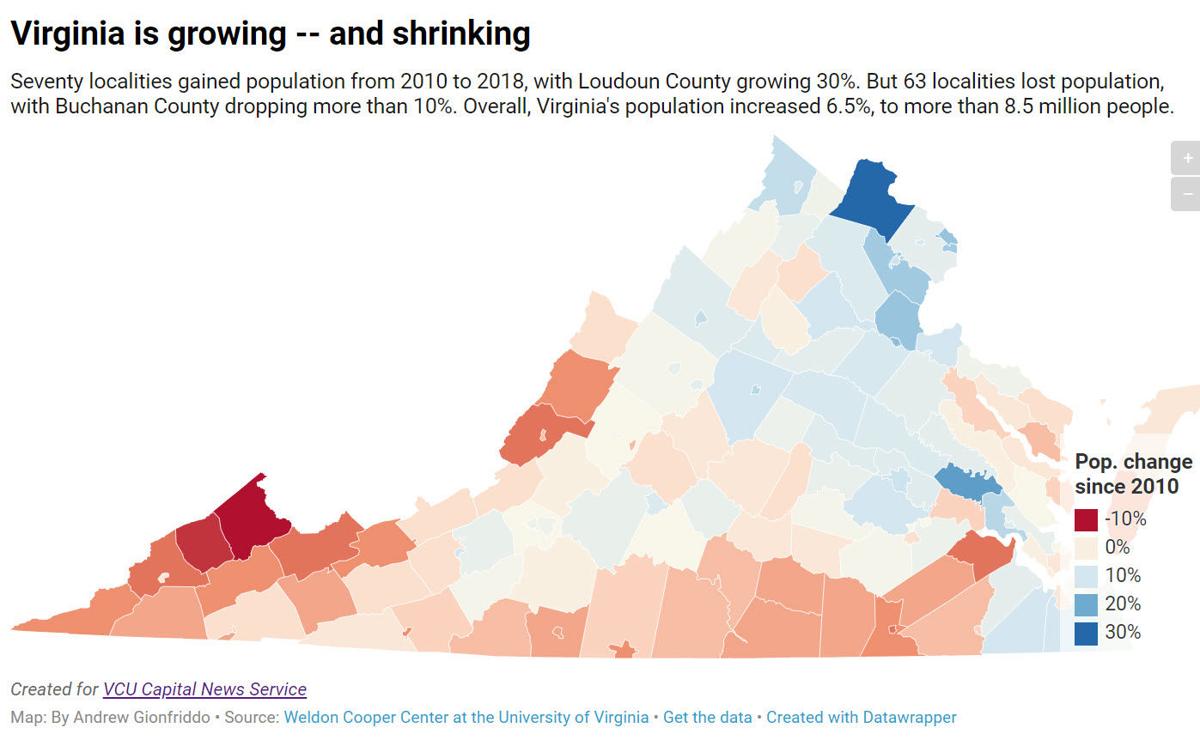
Click image to enlarge: Republican voting strength is increasingly concentrated in the areas
that have stagnated or which are losing population while the Democrat base grows in growing areas.
Virginia's elections on Tuesday, November 5, 2019, are getting a lot of national attention and many hope that the elections will be a reprise of the 2017 bloodbath suffered by the Virginia Republican Party which remains in lock step with Donald Trump, perhaps the most hated politician/demagogue in the Commonwealth - at least outside of knuckle dragging rural areas of the state which continue to see a continued downward spiral because of the backwardness and religious extremism of so many of its inhabitants that modern, progressive businesses find repellent.  A piece in Huffington Post looks at what's at stake on Tuesday - including but not limited to increased minimum wages, LGBT non-discrimination protections, gun control, women's rights, and actions to address climate change -  and and how Virginia appears to be finally seceding from the old Confederacy as states like Alabama descend further into right wing/Christofascist lunacy.  For Virginia to continue to prosper, it is imperative that Republicans lose control of both houses of the General Assembly.  Here are article highlights:
Democratic takeovers in both legislative chambers would have far-reaching implications for the state’s policies and politics. The party, which also controls the governor’s office, would have the chance to pursue a host of liberal priorities like an increase in the state’s minimum wage, laws protecting LGBTQ rights and abortion rights and tougher gun safety regulations.
It would also mark the culmination of Virginia’s years long transformation from a conservative state ― which once was the seat of the Confederacy ― to a progressive one that is not only reliably Democratic in presidential elections, but whose state politics are heavily influenced by a cohort of liberal Democrats that would have been unrecognizable even a decade ago.
“This could be a watershed election for Virginia,” said Quentin Kidd, director of the center for public policy at Christopher Newport University.
And don’t expect the Democrats in Virginia to be moderate quasi-Republicans. The state party has been winning its elections with candidates who are more progressive than the traditional Southern Democrats, touting policies like gun control.
“There will still be [Southern-style] Democrats in Virginia after November 5,” Kidd said, putting Gov. Ralph Northam (D) himself in that category. “But if Democrats win it will because of Democrats who are” more liberal.
Many of the top priorities for Democrats once in power would be the sort of socially liberal reforms for which there is broad support in the increasingly affluent, suburban state.
Tougher gun regulations would almost certainly swiftly become law. In the wake of a mass shooting in Virginia Beach that killed 12 people in May, Northam sought to pass a package of reforms to close background check loopholes for private sales and transfers and forbid the sale of assault rifles, high-capacity magazines and silencers, among other things. The Republican-controlled legislative chambers blocked the measures in a special legislative session in July. 
Legislation aimed at protecting LGBTQ residents from discrimination is also likely to pass very quickly. . . . “LGBTQ rights are on the ballot,” said Lucas Acosta, a spokesman for the Human Rights Campaign, which has contributed over $41,000 to Roem’s reelection and tens of thousands more on other Democrats. “Literally, it will take a flip of two seats and new leadership in the House of Delegates and the state Senate for LGBTQ residents to have the most basic protections.”  
Virginia Democrats would have the chance to adopt more expansive protections for abortion rights and ratify the Equal Rights Amendment to the U.S. Constitution.  
What makes this potential Democratic takeover different from previous legislative wins is that in addition to socially liberal legislation, the party is seriously considering bills that run counter to the state’s mighty business establishment. The clubby, ethically lax and business-friendly consensus in both parties is so ingrained in the state’s political culture, it has its own name: the “Virginia Way.”
But this time, not only have Democrats vowed to raise the state’s minimum wage from $7.25 to $15 an hour, many are also on record in support of repealing the state’s anti-union “right-to-work” law. Virginia was one of the first states in the country to adopt a law barring unions from compelling the workers it represents to contribute dues.
“We’ve been saying since 2008 that Virginia’s been trending purple, trending blue,” he said. “It could very well be the case that Virginia cements itself politically as a mid-Atlantic state after November 5.” 
Another sign of the shifting consensus against big business is a greater appetite among Democrats to take on the state’s twin monopoly electric companies, Dominion Energy and Appalachian Power. 
Forty incumbent Democrats and 47 challengers have pledged not to accept campaign contributions from the two monopolies or own stock in them, according to the progressive nonprofit Clean Virginia, which is seeking to combat their power.
Whether and how much a Democratic legislature is willing to act to combat climate change is likely to depend in particular on lawmakers’ willingness to buck Dominion, long one of the state’s most deep-pocketed campaign donors. 
With the support of Dominion and Appalachian, Northam has proposed a clean energy standard that would make the state 100% carbon-free by 2050. 
But some environmental advocates argue that the deadline for decarbonization is too late. Others worry that climate policies that fail to confront the monopolies’ power will simply extend their dominance into emerging renewable energy sectors, while hurting ratepayers and suppressing the sort of clean energy entrepreneurship that would help Virginia hit its climate targets sooner and more effectively.
“The idea that renewables, which are inevitable and should be mandatory, only come by a utility that has abused its monopoly is a false argument and one that Virginians should reject on the face of it,” said Brennan Gilmore, executive director of Clean Virginia. 
The explosion of the state’s northern suburbs outside Washington brought an influx of highly educated and racially diverse voters more likely to vote Democratic. As a result, Republicans have been losing ground in Virginia for the better part of a decade; their last statewide wins were in 2009.  
The election of President Donald Trump, who lost Virginia by 5 percentage points and repelled many of the educated professionals from the business-friendly wing of the state’s Republican Party, turbocharged that trend. 
The liberal anti-Trump “Resistance” raged as hot in Virginia as any state in the country, sparking a major uptick in candidates for elected office, young voter participation and volunteer door-knocking. What’s more, the exodus of socially liberal, suburban Republicans from the GOP in the Trump era created a vicious cycle wherein the state’s party increasingly catered to a right-wing populist base that further alienated it from swing voters. 
The result was a wave election in November 2017 that was the first real demonstration of Trump’s toxicity in battleground states. . . . . the enthusiasm didn’t let up. In November 2018, Virginia Democrats continued to capitalize on suburban discontent with the president, flipping three Republican-held U.S. House seats.
When Virginia voted for Barack Obama in 2008, it was the first time the state had voted for a Democratic presidential nominee since 1964. 
Some observers characterized that outcome as Virginia’s de facto political secession from the South, Kidd recalled.
Flipping the legislature this year with a more diverse, more progressive group of Democrats, he said, “would be a reaffirmation of that secession from the South ― and it would be on the shoulders of a newer America.”