Showing posts with label Democrat Party base. Show all posts

Sunday, February 23, 2020

Down-Ballot Democrats Distance Themselves from Sanders

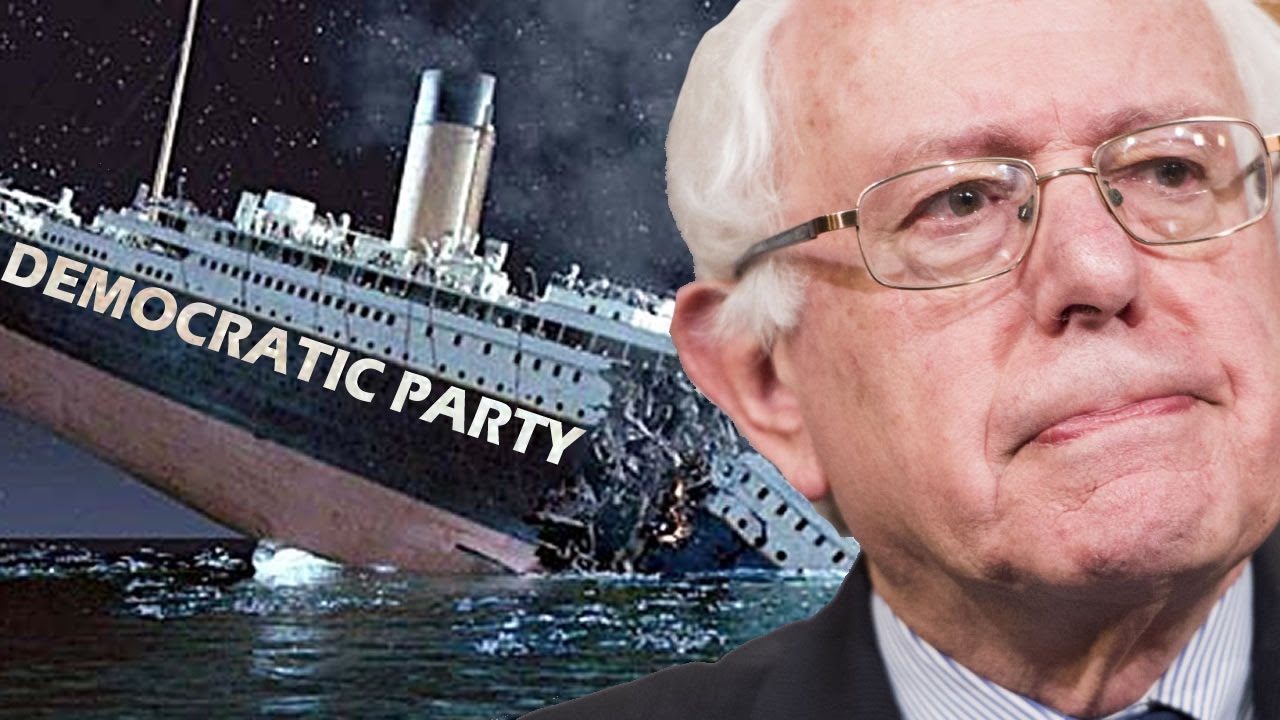
With Bernie Sanders' strong showing in Nevada, it seems Democrats are poised to do what Virginia Republicans did for years and which left them completely out of power in Virginia: they nominated candidates that were the darlings of the extremists of the party base but who were viewed as toxic by mainstream voters.  If Bernie Sanders turns out to be the Democrat nominee, I fear that another four years of the nightmare of Donald Trump is virtually guaranteed.  Worse yet, Sanders may drag down many down ballot candidates and cause Democrats to lose seats both in Congress and also in countless state races across the country. While Sanders supporters - who strike me as being just as fanatical as Trump's MAGA supporters  - are blind to this reality, many down-ballot Democrats are seeing the hand writing on the wall and trying to distance themselves from Sanders as vigorously as possible. As for Sanders himself, the man strikes me as just as filled with egomania and a "my way or the highway" mindset as Trump.  He is a catastrophe who will do incalculable damage to the Democrat Party. A piece in the Washington Post looks at these totally justified efforts. Here are article highlights: 
Former astronaut Mark Kelly, the Democratic Party’s hope for flipping a U.S. Senate seat in Arizona, tried to do no harm this month when he was asked about Sen. Bernie Sanders. “I will ultimately support who the nominee is of the Democratic Party,” he said.
That was enough for Kelly’s Republican rival, Sen. Martha McSally (R-Ariz.), who is trailing him in early polls, to go on the attack. The television spot she debuted days later spent nearly as much time talking about plans by the democratic socialist from Vermont to raise taxes and award new benefits to undocumented immigrants as it did about Kelly.
As Sanders builds what could eventually be an insurmountable delegate lead, many Democratic House and Senate candidates are approaching a dramatic shift in their campaigns, as they recalibrate to include praise of capitalism and distance themselves from the national party. Top campaign strategists from both parties view Sanders’s success as a potentially tectonic event, which could narrow the party’s already slim hopes of retaking the Senate majority and fuel GOP dreams of reclaiming the House, which it lost amid a Democratic romp in 2018.
“Donald Trump is going to offer the American people this choice: Do you want to continue building the economy or do you want to lurch toward socialism? And that is a real powerful argument in the Democratic districts that Trump won in 2016.”
With an emphatic victory in Saturday’s Nevada caucuses, Sanders has won two of the first three contests, and lost the third — the Iowa caucuses — in a squeaker.
Because of Democratic rules that give no delegates to candidates who scores less than 15 percent of the vote in a state or congressional district, Sanders could build a delegate lead far greater than his advantage in the popular vote.
If Democrats are awakening to a recognition that Sanders could pull away from the rest of the field, there is far less consensus about whether his nomination will help President Trump win reelection. Sanders’s power to turn out young and blue-collar voters or suburbanites is not fully tested, the ceiling of Trump’s support is poorly defined in a two-way race and the senator from Vermont has not yet been subjected to a negative paid advertising effort.
But there is far less flexibility for candidates in smaller districts. That has prompted Republicans to celebrate as they look to reclaim ground they lost in 2018 when largely affluent suburbs rebelled against the GOP in a protest of Trump.
“The Democrats’ embrace of socialism is going to cost them their majority — I mean, it’s as simple as that,” said Rep. Tom Emmer (R-Minn.), chairman of the National Republican Congressional Committee. “Bernie is about as good a contrast as we could have ever hoped for.” Democrats, particularly those representing swing districts, agree.
“We flipped those seats [in 2018] because of Donald Trump,” said one House Democrat who represents a suburban district, speaking on the condition of anonymity to reflect internal discussions. “And if Democrats want to hand most of those back, put Bernie at the top of the ticket. And that’s how many of us feel.”
The House member added: “Our overarching priority [is] to replace the president, but to do so with someone who is going to be equally divisive does not serve the country’s interests, and I think that’s at the core of what is making so many so uncomfortable.”
Several of Sanders’s rivals have begun to warn about a potential down-ballot rout. They have raised particular concern about Sanders’s support for a Medicare-for-all plan, which would effectively eliminate private health insurance in the United States.
The leading Democratic candidates running for the four most vulnerable Republican Senate seats — in Arizona, North Carolina, Maine and Colorado — have all come out against Sanders’s signature health care plan, as have many House candidates.
“I believe the only way to truly deliver any of the progressive changes we care about is to be a nominee who actually gives a damn about the effect you are having, from the top of the ticket, on those crucial, front-line House and Senate Democrats running to win, who we need to win, to make sure our agenda is more than just words on a page,” former South Bend, Ind., mayor Pete Buttigieg said Saturday in Las Vegas.
The moderate think tank Third Way has urged the presidential candidates to train their fire on Sanders at Tuesday’s South Carolina debate, issuing a memo that cites a recent Gallup survey that found 51 percent of independents would not vote for a self-described socialist for president.
“The suburbs are not looking for a revolution,” said Matt Bennett, co-founder of Third Way. “They want change, for sure. Many of them loathe Trump with a burning passion, but they do not want somebody who is proposing to double the size of the federal government. They do not want somebody who is proposing to take away the health care of 180 million people.”
A Washington Post-ABC News Poll this week found that Sanders had the worst standing against Trump among college-educated white women, the group most responsible for powering Democrats to their 2018 House majority. Sanders had a statistically insignificant two percentage-point edge over Trump among white women voters with college degrees in the poll, compared with Buttigieg, Biden, Bloomberg and Sen. Amy Klobuchar (D-Minn.), who all beat Trump by 10 points or more among that the same group.
Dan Conston, executive director of the Congressional Leadership Fund, the largest GOP super PAC focused on House races, said Sanders’s presence lends instant credibility to the GOP’s long-standing efforts to tie any Democrat to the far left.
“It feels like we are moving to almost a parliamentary system where voters are voting straight ticket,” said Republican pollster Neil Newhouse, who has found in recent polling that Trump is significantly more popular than Sanders in competitive House races. “Sitting back and watching the Democrats and their primary is an extraordinary experience, and I am glad it’s not us.”
I am in horror of what is happening and all I can do is play Cassandra and donate to opposing candidates - something I urge others to do as well starting right now.  Sanders must be stopped if a disaster is to be averted.

Tuesday, January 14, 2020

Why Trump Has a Huge Advantage With Low-Information Voters

Numerous news stories have reported on how Donald Trump's speeches at rallies and elsewhere are delivered on a 4th grade level of speech and vocabulary. For Trump, this is probably a good thing given the nature of his core base of support: non-college educated whites and evangelicals, the least educated of any Christian denominations in America. Add to this reality the fact that many of Trump's low information voters are easily engaged by racism and/or right wing Christian extremism and otherwise either pay little attention to the news media or rely on the propaganda of Fox News as their sole source of information, distorted as it may be. In short, Trump's tactics - and even his lies - work with his base. Democrats on the other hand have a different problem given the much more diverse nature of that party's base.  On the one hand you have highly educated individuals who follow politics daily (I confess to being a member of this group) and on the other, there are vast numbers of less educated/engaged Democrats, some of whom pay little attention to politics which they view as "confusing" or as not delivering to them.  A piece in Vanity Fair looks at this issue and the challenge Democrat candidates have in motivating and energizing the party' low information.  I definitely feel for candidates that need to find a means to connect with this segment of the party base.Here are story excepts: 

A little over a week ago, after the Trump administration killed Iranian general Qasem Soleimani, the opinion-havers of Twitter were doing what they do best: arguing about something most people don’t care about. The debate at hand involved Elizabeth Warren’s shifting public statements on Soleimani’s killing.. . . . After a whole day of Warren mockery on Twitter, Dave Weigel, a reporter from the Washington Post, threw a brushback pitch at two colleagues from the National Journal and ABC News. “Guys, get out of the beltway for a weekend. Most people had to google Soleimani on Friday,” he wrote.
Weigel, who has spent more time in airports over the last decade than most political journalists, was echoing a critique long held by Avis Preferred press corps against their desk jockey friends in Washington and New York: that the stories and micro-scandals that obsess political and media insiders—often played out in episodic fashion on Twitter—matter little to voters who are too busy and too well-adjusted to follow every nanosecond of the political news cycle. It’s hard to overstate how salient this discontinuity will be in the current election year.
Donald Trump, despite his deep personal insecurities and lust for elite validation—and, indeed, his own use of Twitter—has derived much of his political success by ignoring Washington finger-waggers and connecting with the more primal instincts of his supporters, in whatever televised or digital corner of the media he can, with or without the good graces of the national press and savvy insiders. . . . . . one of the biggest splits in American politics is simply between those who follow politics closely and those who do not.
It’s a split that maps, if not perfectly, onto the gap that emerged between college and non-college educated voters in 2016. The latter set are often low-information voters who view politicians and media with contempt, deciding to sit elections out. Trump has exploited them to powerful effect. [Trump]The president has made politics about culture—not just policy.
None of the above can be said for Democrats, who care habitually about the good graces of the national press, and who don’t see politics as a subspecies of the entertainment business. Democrats happen to believe in facts and institutions—and yes, they would like a cable contract when the campaign is over, thank you very much. But to Trump’s great advantage, the mainstream press is where many of the fights for the Democratic nomination are being waged: on cable news, on Twitter, and in the prestige media.
“In many ways, 2020 is the Cable News Primary. MSNBC and CNN are the biggest pipelines into voters’ living rooms.” The problem for Democrats is that those media spaces are, today more than ever, islands unto themselves. Cable may be a good way to reach highly engaged Democratic primary voters, but the reality is that television news is watched by only a tiny fraction of Americans. During the first five days of the much-hyped impeachment hearings, only about 4% of the American population tuned in to watch some part of the testimony on TV. Twitter, the other opinion-shaper preferred by Democrats, is younger, more educated, and more liberal than the country as a whole, and only 10% of its users create 80% of its content, according to Pew Research.
Topics like wine caves, pay-fors, court packing, white privilege, and Iowa’s role in the nomination process have become topics of profound consequence in the race. The political media blob tumbles forward every day on the assumption that people are aware of these story lines and characters, that voters are tuning in, when many probably can’t tell you what channel this thing is on. The assumption should be that they are not.
Even in Iowa, where caucusgoers have a front-row seat to the race and defeating Trump is top of mind for Democrats, the minutiae of Washington rarely pops up at campaign events. “It’s health care, prescription drug costs, teacher pay, climate change,” said Caroline Cummings, a political reporter for KGAN in Cedar Rapids. . . . Americans might be obsessed with Trump, but they really aren’t obsessed with politics.
Not since Barack Obama have Democrats had a figure compelling enough to overwhelm the informational divides in our culture, to appear on all screens at all times and capture the attention of people who don’t usually follow politics: black people, Hispanics, young people, low-income voters, and people who just think politics sucks. Democrats need them. But at this stage of the race—still early, yes—Democrats aren’t even close to grabbing the hearts and minds or even the eyeballs of the drop-off voters who stayed home on Election Day in 2016. In fact, it’s worse: Many of those voters can’t even tell you who is actually running for president. This doesn’t mean voters are dumb. It means they’re normal—and that Democrats have serious work to do to reach them.
In each of the three low-information groups, Favreau asked voters to say the first word that came to mind when he said “Democratic Party.” Almost everyone repeated a handful of the same names—Barack Obama, Michelle Obama, Hillary Clinton, Joe Biden, Bernie Sanders, Nancy Pelosi, and __Bill Clinton __—along with known Republican Condoleezza Rice for some reason . . . . Most of the voters said they were generally aligned with the Democratic Party on issues—especially the idea of reducing health care costs and expanding access—but that they also associated the Democratic Party with infighting, taxes, socialism, ineptitude, and “too many candidates.” Only Obama’s name elicited warm reactions among everyone.
But even as they universally expressed displeasure with Trump, including the people who voted for him in Milwaukee but flipped in 2018, almost every participant told Favreau they wouldn’t yet commit to voting for the Democratic nominee in 2020. Some said it depends on who the nominee is. Others were open to voting for a third-party candidate instead of the Democrat. “None of them really like Trump, but they don’t have much love for Democratic politicians, Republican politicians, and especially the media, which they don’t trust at all,” Favreau said.
A theme that surfaced again and again, not just about Democrats but about politics generally, was that the whole process is confusing, tedious, and off-putting—and that news organizations and social media do little to make sense of it. “I don’t understand it. I haven’t even watched the news. I just turn it off and go do something else,” said Angela from Philadelphia, a Medicaid-dependent mother of an autistic child who said she was raised Democrat but no longer follows elections closely, despite voting in 2018.
In Philadelphia the voters associated Biden with “crime bill,” “too old,” and “not fired up.” . . . . Sanders, too, was described as “too old” in all three cities, though many of the responses were, if not on message, at least message-adjacent. The Miami group associated Sanders with “crazy hair,” “grinny,” “free college,” and “wants to give away too many things for free.” The Philadelphia group said “your crazy uncle,” “health care,” “questionable health,” and “passionate hand talker.”
Focus groups are not polls, but they do add important texture to the horse race and pressure-test assumptions embedded in the national conversation. The Wilderness focus groups offer a glimpse into the behavior and opinions of those voters you don’t often read about, the self-identified Democrats who “don’t know enough” or have “no opinion” about the candidates. If you scrolled through excited corners of progressive Twitter last week, for instance, you’d think that Julián Castro’s endorsement of Warren was a major moment, giving her a stamp of approval from a former Obama administration official and the lone Hispanic figure in the 2020 race. But an Economist–YouGov poll from December showed that fully 35% of Democrats, and 39% of Hispanics, didn’t even know who Castro was. Another national Quinnipiac poll from December showed that 36% of Democrats didn’t know enough about Buttigieg to have an opinion, and a whopping 49% of Democrats didn’t know enough about Klobuchar. These are names on the tip of every political reporter’s tongue, the marquee actors in America’s national pageant, yet vast swaths of Democrats haven’t given them a passing thought.
[T]he views of these lesser-engaged Democrats are complex and don’t fall neatly into the ideological buckets often discussed in the media. They mostly liked the idea of Medicare for All, but also doubted how the government could possibly pay for it. They brought up a wide variety of issues as their top concerns—poverty, opioids, prison reform, Medicaid, college affordability, guns, LGBTQ rights, drug prices, taxes—but few could say what the federal government had done to help. “No one could remember the last thing the government had actually done to improve their lives, except one woman in Miami who brought up the Affordable Care Act,” Favreau said.
[F]or many of the people in Favreau’s focus groups, politics isn’t real life, either. The eventual Democratic nominee, he said, is duty-bound to fix that. He pointed to an interview with former Georgia gubernatorial nominee Stacey Abrams, also airing on this season of The Wilderness: “What I think we all have to hold to, is that our ambitions have to be met with our capacity to deliver,” Abrams told him. “Because for the people who are the most easily dissuaded from participation, it’s when you promise them the moon and can‘t deliver a single grain of sand.”

Thursday, June 06, 2013

President Obama’s Rapidly Diminishing Credibility


I have noted before that I keep having feeling of deja vue from 2009 in terms of the way in which Barack Obama and the Congressional Democrats  seem to be doing all in their power to upset the Democrat base and to hand the 2013 Virginia statewide elections to the GOP statewide ticket.  Little is being accomplished.  Worse yet, things are being said and done to demoralize the party base and make them feel that the average person is screwed regardless of which party holds the reins of powers.  Hence, why bother to go out in vote on election day.  Here in Virginia, turn out will be crucial in defeating the Christofascist slate of Ken Cuccinelli, E. W. Jackson and Mark Obenshain.  In light of today's disclosures on domestic spying on U. S. citizens, the New York Times editorial board has lost all patience with the Obama administration.  Here are some main page editorial highlights:

Within hours of the disclosure that federal authorities routinely collect data on phone calls Americans make, regardless of whether they have any bearing on a counterterrorism investigation, the Obama administration issued the same platitude it has offered every time President Obama has been caught overreaching in the use of his powers: Terrorists are a real menace and you should just trust us to deal with them because we have internal mechanisms (that we are not going to tell you about) to make sure we do not violate your rights.

Those reassurances have never been persuasive — whether on secret warrants to scoop up a news agency’s phone records or secret orders to kill an American suspected of terrorism — especially coming from a president who once promised transparency and accountability. 

The administration has now lost all credibility on this issue. Mr. Obama is proving the truism that the executive branch will use any power it is given and very likely abuse it. That is one reason we have long argued that the Patriot Act, enacted in the heat of fear after the Sept. 11, 2001, attacks by members of Congress who mostly had not even read it, was reckless in its assignment of unnecessary and overbroad surveillance powers.

Based on an article in The Guardian published Wednesday night, we now know that the Federal Bureau of Investigation and the National Security Agency used the Patriot Act to obtain a secret warrant to compel Verizon’s business services division to turn over data on every single call that went through its system. 

Essentially, the administration is saying that without any individual suspicion of wrongdoing, the government is allowed to know whom Americans are calling every time they make a phone call, for how long they talk and from where. 

This sort of tracking can reveal a lot of personal and intimate information about an individual. To casually permit this surveillance — with the American public having no idea that the executive branch is now exercising this power — fundamentally shifts power between the individual and the state, and it repudiates constitutional principles governing search, seizure and privacy.

It is the very sort of thing against which Mr. Obama once railed, when he said in 2007 that the surveillance policy of the George W. Bush administration “puts forward a false choice between the liberties we cherish and the security we provide.” 

Two Democrats on the Senate Intelligence Committee, Ron Wyden of Oregon and Mark Udall of Colorado, have raised warnings about the government’s overbroad interpretation of its surveillance powers.

On Thursday, Representative Jim Sensenbrenner, Republican of Wisconsin, who introduced the Patriot Act in 2001, said that the National Security Agency overstepped its bounds by obtaining a secret order to collect phone log records from millions of Americans. 

“As the author of the Patriot Act, I am extremely troubled by the F.B.I.’s interpretation of this legislation,” he said in a statement. “While I believe the Patriot Act appropriately balanced national security concerns and civil rights, I have always worried about potential abuses.” He added: “Seizing phone records of millions of innocent people is excessive and un-American.” 

Stunning use of the act shows, once again, why it needs to be sharply curtailed if not repealed.