Showing posts with label Bernie Sanders. Show all posts

Wednesday, March 11, 2020

Sanders Plays the Blame Game for His Decline


As the returns stand currently from "Super Tuesday 2.0" it appears that Joe Biden is going to subject Bernie Sanders to near across the board defeats.  It will be interesting to see if the youth vote and new voter surge that Sanders has continually predicted failed to materialize yet again. As noted in a prior post, Sanders is Trump-like in that his misfortunes are never of his own making and a group of conspirators is supposedly lurking in the shadows to cause his demise. A column in the New York Times (which is a must read) looks at this phenomenon while another Times column looks at how Sanders has missed key aspects of the Nordic economies that he says he would emulate.  Here are excerpts from the first piece:

To Senator Bernie Sanders, there is plenty of blame to go around when it comes to his recent reversal of fortune. For everyone but him and his campaign.
The “corporate media” didn’t pay attention to his agenda.  The Democratic Party establishment aligned to block him from winning its presidential nomination.
And the young voters he counted on to power his campaign didn’t come through for him.
Political candidates are not generally given to self-criticism. And as Mr. Sanders has seen his fortunes slide after a 30-point South Carolina loss to former Vice President Joseph R. Biden Jr., followed by Mr. Biden’s unexpected strength across Super Tuesday, he has cited a number of factors that portray him as an aggrieved outsider.
It comes at a time of particular weakness for Mr. Sanders. Through 18 states, his theory of the election has not proven true. The surge of new voters in the Democratic primaries has featured mostly older people, moderate suburbanites and African-Americans disinclined to support his campaign.
Mr. Sanders, his team and his supporters have come up with explanations for his loss of momentum that deflect the responsibility onto others.
So when Pete Buttigieg and Senator Amy Klobuchar dropped out of the race and endorsed Mr. Biden, to the Sanders camp it wasn’t because they’d won next to no support from black voters and run out of money, it was part of an establishment plot. And Senators Cory Booker and Kamala Harris were simply joining the effort to block Mr. Sanders when they backed Mr. Biden this week.
The 2016 campaign established Mr. Sanders as the Democratic Party’s foremost practitioner of grievance politics. Like Donald Trump in that year’s Republican primary, Mr. Sanders tapped into populist anger to upend a major political party.
Now the Sanders campaign says the policies he’s pitching as a democratic socialist — “Medicare for all,” free public college tuition and other proposals — represent an existential threat to powerful operators that have prompted an unusually coordinated effort to block his rise.
Even among those ideologically inclined to back Mr. Sanders, he has engendered little sympathy in recent days. Adam Jentleson, a close ally of Senator Elizabeth Warren’s campaign — who has not been shy about expressing his own grievances about perceived outside forces that limited her campaign — said Mr. Sanders does himself little good in arguing others are responsible for his shortcomings.
“Blame-shifting is pointless because nobody swoops in and hands you the nomination; you have to win it,” Mr. Jentleson said. “The nominee needs to be the leader of the whole party and Bernie’s job was to convince people he could be that.”
An even more telling column is the second one in the Times that looks at how Sanders' ideology and agenda is not at all in keeping with the economics of Nordic nations like Denmark which are highly capitalistic while having a generous social safety net (paid for by strong capitalism and high taxes).  Here are column highlights:


Bernie Sanders often cites Denmark as the kind of country he would like America to be under his ideology of “democratic socialism.” Well, here’s a news flash: Bernie Sanders, with his hostile attitudes toward free trade, free markets and multinational corporations, probably couldn’t get elected to a municipal council in Denmark today. Ironically, Joe Biden, with his more balanced views on trade, corporations and unions, probably could. And therein lies a column.
I can explain this best by starting with a few questions that I’d love to ask Sanders about his democratic socialism, beginning with the most basic one: Senator Sanders, where do you think jobs come from?
To listen to him (and his surrogates) is to listen to someone who seems to believe that the American economic pie just miraculously appeared and exists on its own. He never discusses where that pie came from, how to bake it or how to enlarge it. His only interest is how to redivide it.
Third, Senator Sanders, do you believe the free enterprise system is the best means for growing jobs, the economy and opportunity — or do you believe in more socialist central planning? I ask because I have often heard you praise Scandinavian countries, like Denmark, as exemplars of democratic socialism. Have you ever been to Denmark? It’s democratic but not socialist.
Denmark is actually a hypercompetitive, wide-open, market economy devoted to free trade and expanding globalization, since trade — exports and imports — makes up roughly half of Denmark’s G.D.P.
Indeed, Denmark’s 5.8 million people have produced some of the most globally competitive multinationals in the world, by the names of A.P. Moller-Maersk, Danske Bank, Novo Nordisk, Carlsberg Group, Vestas, Coloplast, the Lego Group and Novozymes. These are the very giant multinationals Sanders constantly rails against.
The Nordic model is an expanded welfare state, which provides a high level of security for its citizens, but it is also a successful market economy with much freedom to pursue your dreams and live your life as you wish.”
It is through these engines of capitalism, free trade, economic openness and globalization that Denmark has managed to become wealthy enough to afford the social safety net that Sanders rightly admires — as do I: access for all to child care, medical and parental leave from work, tuition-free college, a living stipend, universal health care and generous pensions.
But there is nothing free about these services. According to Investopedia, Denmark’s progressive income tax tops out at 55.8 percent, and the average individual pays 45 percent.
In short, Sanders cherry-picks Denmark. He stresses what he loves — all that the Danish state provides — and then he ignores two things: one obvious and important and one less obvious and even more important.
The obvious and important one is the relentlessly entrepreneurial capitalism that generates Denmark’s prosperity and that is celebrated there. The less obvious, but more important, feature of Denmark’s success is the high-trust social compact among its business community, labor unions, social entrepreneurs and government. That’s the real secret of Denmark’s sauce.
Obviously, in a small, largely homogeneous country of 5.8 million people, it is a lot easier to generate that kind of social trust than in a diverse nation of 327 million. But the point is, no one was demonizing others as “corrupt” by the very fact of who they were — whether labor organizer or corporate titan or someone of wealth.
They understood that it was the balancing of all their interests that made Denmark’s economic growth and generous social safety net possible.
This reality is lost on Sanders and his followers.

Tuesday, March 10, 2020

Sanders Gets More Trump-Like as Never Trump Republicans Back Biden

As Democrats appear to be strongly shifting to support Joe Biden and to be rejecting Bernie Sanders form of populism, Sanders is becoming more Trump-like as he blames "the establishment" and others of conspiring against him rather than admit that just maybe people do not like what Sanders is peddling politically. At the same time, Never Trump Republicans are demonstrating that they are willing to vote for Biden even as they continue to find Sanders toxic and hostile to anyone with differing views and opinions.  A column in the Washington Post looks at Sanders' Trump like behavior.  Here are excerpts:
Populist leaders present themselves as the only authentic voice of the “people.” Therefore, critics in the media are enemies of the people, for to take on the leader is to attack the people. When the leader is rejected at the polls, it cannot be an authentic expression of the people. The system must be rigged; the establishment must be out to get the candidates and, by extension, the people.
We have seen this for the three years President Trump has been in office, and previously in his 2016 campaign. The deep state, the fake news and the elites (not “real” Americans) are out to get him, he says. He insists that all these forces do not respect the people, his followers and the only real Americans.
We are reminded in watching Sen. Bernie Sanders (I-Vt.), as his presidential campaign fizzles, this mind-set is not limited to the right. Sanders had this exchange on ABC’s “This Week”:
SANDERS: Well, one of the things that I was kind of not surprised by is the power of establishment to force Amy Klobuchar, who had worked so hard, Pete Buttigieg, who, you know, really worked extremely hard as well, out of the race. . . . . We’re taking on the political establishment. And what you are seeing now just in the last few weeks is Wall Street, the health-care industry, the billionaire class putting a lot of money into Joe’s campaign.
This is bonkers. Other Democrats got out of the race because voters across the country did not vote for them. Sanders sneers at them as if they are puppets on a string, yanked out of the race by nefarious forces. They actually looked at the facts, saw they could not win and decided Biden had a better chance to unify the country and beat Trump than did a self-proclaimed socialist who cannot resist the urge to pick fights with his own party.
Sanders’s complaint about billionaires giving to Biden’s campaign (they would be limited to $2,800 per person like all other donors) is part of the fixation with attributing opponents’ success to something other than popular opinion.
Sanders keeps insisting he is “winning the support of grass-roots America.” That simply is not so. Biden won 10 of 14 states, driving turnout sky-high in states he won, like Virginia. Sanders’s promised onslaught of new voters has never shown up.
Perhaps he and his snarling online supporters should confront an unpleasant truth: Sanders’s problem is not the establishment or corporate Democrats or billionaires. It is the voters.


Meanwhile, Biden is showing that he can pull in support of independents and Never Trump Republicans - something that might tip the scales in crucial Mid-West states where Sanders' mythical wave of new voters will likely fizzle as it has in state after state.  A piece in the New York Times looks at this phenomenon.  Here are article highlights:
As more data emerge to explain former Vice President Joe Biden’s stunning victory on Super Tuesday, there are two clear demographics that propelled him: African-American voters and suburban voters with college degrees.
It’s a coalition that helped moderate Democrats flip seven governorships, two Senate seats and about 40 House districts (the newly Democratic suburbs alone would have secured a House majority) from red to blue in 2018. African-Americans have long made up a core of the Democratic voting base, but many of Mr. Biden’s college-educated, suburban supporters are right-leaning independents or moderate Republicans who supported candidates like John McCain and Mitt Romney. They don’t want to re-elect Donald Trump. And they’re willing to cross over to vote for a Democrat — a moderate and mainstream Democrat.
These voters might not identify with the “Never Trump” group of conservatives who vociferously oppose the president. But in practice, that’s who they are.
These voters can create winning margins for Democrats in swing states like Michigan, Pennsylvania, Arizona and North Carolina in the general election.
Their numerical strength was on full display on Super Tuesday in the Virginia and Texas suburbs, which saw 74 percent and 87 percent higher voter turnout, respectively, than four years ago.
The responses to our outreach made clear that these voters are looking not for the democratic socialist revolution that Senator Bernie Sanders would offer as the nominee, but simply for a Democrat they could trust to govern responsibly and end the chaos of Mr. Trump’s presidency. For many lapsed and former Republicans, voting for Mr. Biden is the least-bad option. He’s considerably more moderate than Mr. Sanders and doesn’t pose the threats to the rule of law and constitutional norms that Mr. Trump does. He’s a backstop against the political insanity of the right and the left.
College-educated suburban voters often feel politically homeless, trapped between Mr. Trump’s erratic and divisive nature and a fear of Democrats’ leftward march. Mr. Biden may not offer these voters a galvanizing vision for the future. But to those exhausted by the past three years of political upheaval and nastiness, he offers something even better: basic human decency.
Especially in the focus groups in which Trump voters rate his performance as “somewhat bad” or “very bad,” these right-of-center voters are generally open to voting for Mr. Biden — though not for Mr. Sanders.
It has always been a possibility that Mr. Trump could drive a permanent political realignment in which college-educated suburban voters abandon the Republican Party for good. It remains an open question whether that will come to pass in 2020 and beyond, but the warning signs from Super Tuesday are clear.

The goal in 2020 is to defeat Trump - not force a political revolution that a majority of voters do not want.  It's a reality that Sanders seemingly cannot or will not grasp. 

Friday, March 06, 2020

Bernie Sanders Gets a Rude Awakening

Elizabeth Warren has ended her presidential campaign and the question is whether she will endorse Biden or Sanders - or no one - and where her supporters will gravitate.  Some of the most liberal may go to Sanders, but many of the college educated suburbanites may be turned off by Sanders' class warfare agenda and move towards Biden.  Meanwhile, Bernie Sanders has claimed that the youth vote would power him to victory.  Based on analysis so far, the youth vote turned out in smaller percentages for Sanders on Super Tuesday than in 2016 and Sanders captured a small percentage of those who did go to the polls. The situation demonstrated (i) the unreliability of younger voters to actually go and vote, and (ii) the breadth of Sanders' coalition remains too limited to win the nomination.  A piece in The Atlantic looks at Tuesday's outcome and Sanders' need to attract those outside of his base - something I am not sure he is capable of doing given his demeanor and his my way or the highway mindset.  Tuesday, most Democrats chose the highway in the form of Joe Biden.  Here are article excerpts:
Bernie Sanders’s self-proclaimed “political revolution” crashed into a wall of resistance inside the Democratic Party last [Tuesday] night.
After a remarkable 72 hours that saw top party leaders consolidate behind Joe Biden, a panoramic array of key party voting groups coalesced around the former vice president—and against Sanders—in the coast-to-coast competition, according to exit polls conducted in almost all the states that voted. Biden captured at least nine of the 14 states voting, including some—such as Minnesota and Oklahoma—where Sanders won big in 2016.
The surprisingly decisive result left Sanders, a candidate who prides himself on his pile-driver-like consistency, facing a new challenge: finding a second act that can appeal to voters beyond the fervid base he has established. The evening’s clearest message was that while the senator from Vermont has inspired a passionate depth of support, the breadth of his coalition remains too limited to win the nomination. “Sanders has made no effort to reach out beyond his voters, his movement, his revolution,” Greenberg said. “It just has not grown. It is an utterly stable vote that is grounded in the very liberal portion of the Democratic Party, but he’s so disdainful of any outreach beyond that base. He seems content to just keep hitting that drum.”
Last night’s results could cull other candidates in the race sooner than later [Bloomberg has dropped out] . . . . . . Elizabeth Warren [now out as well] , who has pledged to fight on until the convention, lost her home state of Massachusetts and in the exit polls showed only trace levels of support among any group other than her core constituency of college-educated whites.
The results did not ensure a Biden nomination or a Sanders defeat. Sanders still won four states, including a solid-if-not-crushing victory in California, the largest prize on the board. He retained enthusiastic backing from his base: young voters, the most liberal voters, and Latinos, the key group that he has moved in his direction since his first bid in 2016.
But if Biden wins next week in Michigan, one of Sanders’s most significant victories four years ago, the rationale for the senator’s candidacy could quickly become murky.
Last night, Sanders failed on almost every front to enlarge his coalition. He faced a sharp recoil from groups that have long been the most skeptical of him, including African Americans and older voters.  . . . . Outside of Vermont, Sanders faced cavernous deficits among voters 45 and older, who composed a clear majority of the electorate in most states.
Across the country, Sanders also lost ground among white voters up and down the socioeconomic ladder. College-educated white voters, who on the whole had been skeptical of both men until Biden won them in South Carolina, broke decisively for the former vice president in most states. Simultaneously, in most states, Biden reversed Sanders’s previously consistent advantage among white voters without a college degree.
Perhaps the starkest symbol of Sanders’s limitations last night was the resurgence of a problem that severely damaged him in 2016: widespread resistance from primary voters who self-identify as Democrats (as opposed to independents).
The Super Tuesday exit polls showed Biden beating Sanders among self-identified Democrats by about 30 percentage points in both Virginia and North Carolina, about 25 points in Oklahoma, 20 points in Tennessee, and nearly 50 in Alabama. Sanders was more competitive among Democratic partisans in the New England states of Massachusetts and Maine. But the overall pattern was unmistakable.
His collapse among Democratic partisans came after recent full-throated attacks on “the Democratic establishment” in his rallies and media appearances. Sanders has often sounded more as if he believes he’s leading his movement in a hostile takeover of the party than a merger with it.
Biden, for instance, crushed Sanders in the white-collar suburbs of Northern Virginia. That suggests Sanders’s call for political revolution is ringing hollow in the largely prosperous communities outside major cities that helped deliver the House majority to Democrats in 2018, largely out of antipathy toward Trump.
[A]s the race reduces to a binary choice between Biden and Sanders, it’s the Vermont senator who emerged from the biggest night on the primary calendar with the greatest need to change the dynamic in the race.
Frankly, I do not see Sanders trying to enlarge the tent of his supporters.  He is singing the same song he has for decades and appears too old and to closed minded to change.  

Wednesday, March 04, 2020

Bernie Sanders' - and Democrats' - Conundrum

Bernie Sanders has promised a political revolution and claimed that he will bring out massive numbers of new and younger voters.  Yesterday, the majority of Democrats said while they want change, especially in terms of health care - and to see Trump defeated - they do not want Sanders' revolution.  Likewise, while voter turn out was seemingly up, Sanders did not have the major turn out of new/young voters that his campaign has promised.  To be honest, I have qualms about both Sanders and Joe Biden and wish there was a strong moderate/progressive to be the Democrat standard bearer.  At this point, that person doesn't exist and alas as is too often the case in politics, one has to choose the better of two lack luster candidates.  Not voting is not an option as the 2016 stay-at-home vote showed by in effect electing Donald Trump. I do not see Biden engendering high levels of enthusiasm - he can only hope hatred of Trump (which is very real) will be enough to supercharge turnout in November.  If things continue as seemingly now headed, Sanders voters will have to decide whether they want to stay home and reelect Trump - whose agenda is the antithesis of what they claim to support - or hold their nose and vote for Biden if that is what the choice comes down to.  A piece in the Washington Post looks at the situation.  A second in the New York Times looks at the failure of the new/youth vote to materialize at the level Sanders needed.  First, excerpts from the Post
On Super Tuesday, voters across 14 states collectively delivered an emphatic message on the single biggest day of the primary season. They don’t want a revolution. They just want to oust Donald Trump.
In all 12 states where exit polls were conducted, early results showed that majorities said finding a candidate who can beat Trump is more important than having one who agrees with them on major issues. And overwhelmingly they said that man is Biden — by 2 to 1 in some cases.
This hunger to beat Trump led to a remarkable night for Biden and for what Sanders derides as the Democratic “establishment” — and an unexpected reality check for the Sanders revolution.
Democrats on Tuesday rescued themselves from a repeat of what happened to Republicans in 2016, when a populist outsider vanquished a cluttered field and no “establishment” candidate had a clean shot at Trump.
But now they have a different predicament. Democrats find themselves in a bit of a rerun of the Sanders-Clinton race of 2016. Whatever happens in the rest of the primary season, Sanders will have substantial support — and a large number of delegates. If he loses to Biden and doesn’t embrace the Democratic ticket, his supporters might stay home in November, handing victory to Trump.
But while Sanders retains enough power to bring down the party, it’s a lot less clear after Tuesday that he has enough power to lead it. Far from bringing new blood into the Democratic primaries, it appeared that in some places turnout was particularly high in places where he did poorly. As usual, Sanders did well among the very liberal, Biden among moderates. The young voted by a lopsided margin for Sanders, while older voters turned out for Biden.
Those divisions won’t disappear anytime soon, which is all the more reason for Democrats to focus on the one thing they all agree on: beating Trump. The voters just made clear they believe Biden is the one to do that.
As for the younger vote surge that seemingly did not happen, here are highlights from a column in the Times:
[T]he demographics of people who actually vote are almost always different from the demographics of people who can vote. That’s where their analysis raises concerns about Sanders’s chances. According to Broockman and Kalla’s figures, Sanders loses a significant number of swing votes to Trump, but he makes up for them in support from young people who say they won’t vote, or will vote third party, unless Sanders is the nominee. On the surface, these Bernie-or-bust voters might seem like an argument for Sanders. After all, Sanders partisans sometimes insist that Democrats have no choice but to nominate their candidate because they’ll stay home otherwise, a sneering imitation of traditional centrist demands for progressive compromise. But if Broockman and Kalla are right, by nominating Sanders, Democrats would be trading some of the electorate’s most reliable voters for some of its least. To prevail, Democrats would need unheard-of rates of youth turnout. That doesn’t necessarily mean Sanders would be a worse candidate than Joe Biden, given all of Biden’s baggage. It does mean polls might be underestimating how hard it will be for Sanders to beat Trump. About 37 percent of Democrats and independents under 35 voted in 2016. According to Broockman and Kalla’s figures, Sanders would need to get that figure up to 48 percent. By comparison, Broockman told me, in 2008, Barack Obama raised black turnout by about five percentage points. Broockman said that if either Warren or Sanders is on the ballot, more Republicans will likely be motivated to go to the polls in response. “When parties nominate candidates further from the center, it actually inspires the other party to turn out,” he told me.
[T]he 2018 elections saw the highest midterm turnout in over a century, yet most of Democrats’ improved performance “came not from fresh turnout of left-of-center voters, who typically skip midterms, but rather from people who cast votes” in the last two national elections and “switched from Republican in 2016 to Democratic in 2018.”
The primaries have yet to demonstrate that Sanders can generate the hugely expanded turnout his campaign is promising.
Dave Wasserman, an editor at The Cook Political Report, tweeted that most of the Democrats’ turnout bump was attributable to moderate Republicans “crossing over from ’16 G.O.P. primary — not heightened progressive/Sanders base enthusiasm.” South Carolina saw record turnout, but it benefited Biden, not Sanders. College-educated white women, for example, helped flip the House in 2018. They favor Biden over Trump by double digits, but Sanders by only two points. Sanders, however, seems to see little need to reach out to them. Speaking to The Los Angeles Times editorial board in December, Sanders said he didn’t believe the way to win against Trump “is to just speak to Republican women in the suburbs.” Instead, he said, “The key to this election is, can we get millions of young people who have never voted before into the political process, many working people who understand that Trump is a fraud, can we get them voting?” Even if the answer is yes, it probably won’t be enough. If he’s going to be the nominee, the rest of us can only hope his campaign has a Plan B.


Younger voters have the most to gain or lose based on who is elected - Trump is a nightmare for improvement on the issues they care about most - yet the reality is that for reasons I do not comprehend, they continue to fail to vote in the strength needed if they want to further the policies they claim to support. So far, Sanders seems to not have found the magic needed to change their habit of voting in tepid numbers. 

Tuesday, March 03, 2020

Biden Easily wins Virginia Democratic Primary


The exiting of Pete Buttigieg and Amy Klobuchar from the 2020 Democrat primary contest and their pledge of support to Joe Biden in an effort to blunt Bernie Sanders' campaign prospects seems to have worked in Virginia.  While Virginia is moving to solid blue state status, it remains a moderate Democrat state where socialism even when coupled with the term democratic does not hold strong appeal as evidenced by Biden's 20 point lead over Sanders with almost all precincts reporting. Sanders supporters claim that Sanders represents "the majority" yet his winning of only 23% of the vote argues otherwise. Only in Sanders world does 23% trump - no pun intended - the other 67% of the voters.  Sanders' inability to win even half of the Democrat vote in Virginia (even in Northern Virginia) does not bode well for his ability to win in the key Mid-West states that will likely determine who wins the Electoral College in November.  It is a reality that Sanders - who like Trump only sees what he wants to see - and his base refuse to face.  Disturbingly, Sanders will no doubt claim his drubbing in Virginia was due to a conspiracy - imagined in Sanders' mind - of billionaires, the Democrat "establishment" and CEO's.  Anybody but the 67% of voters who voted for someone else. A piece in the Washington Post looks at Biden's win in Virginia.  Here are highlights (note how some Trump supporters voted for Sanders):
RICHMOND — Former vice president Joe Biden easily won Virginia's Democratic primary Tuesday, according to unofficial early returns, with exit polling suggesting that voters mostly chose the candidate they thought had the best chance of defeating President Trump.
With most of the vote counted, Biden was far ahead of Sen. Bernie Sanders (I-Vt.), Sen. Elizabeth Warren (D-Mass.) and former New York Mayor Michael Bloomberg. Biden stands to gain many of the 99 delegates up for grabs in the increasingly blue state, according to unofficial returns.
In interviews with voters around Virginia, Biden emerged as a consensus pick only late in the game. Many said they settled on him after their preferred candidates dropped out. Others didn't decide until they stood in the voting booth.
But most shared one goal: "I want to get Trump out of office by all means necessary," said Josephine Stewart, 66, a cook for Richmond public schools who opted for Biden.
Virginia is still deciding its shade of blue. On Tuesday, that uncertainty followed voters to the polls, which closed at 7 p.m. with official returns expected soon after.
 In early exit polling by Edison Media Research, over half of Virginia Democratic primary voters said they would rather see the party nominate a candidate who can beat Trump, compared with about 4 in 10 who said they’d prefer a candidate who agrees with them on major issues.
About half gave Biden the best chance of winning in November, while roughly 2 in 10 said Sanders is best-positioned to beat Trump.
Across the state, polling places reported turnout slightly higher than usual. Absentee voting was up; Virginians cast nearly 54,700 votes in advance of Tuesday’s primary, up from just over 26,000 in 2016, according to the nonpartisan Virginia Public Access Project. At Yorkshire Elementary School in Manassas, Tim York cheerfully announced that he, too, chose Sanders in the open primary — in hopes of helping Trump get reelected in November.
“He’s the weakest candidate,” York, 39, said of Sanders, predicting that the senator’s calls for Medicare-for-all and free college tuition would turn off moderate voters. “I think the president has a good chance, regardless, but especially against Bernie.”
Concern that Sanders is vulnerable to Trump drove many voters to settle on Biden as the safer bet. In Henrico, Kate Giska, a 39-year-old small business owner and political independent, came to vote with her 7-year-old son. “My son’s name is Bernie, but we don’t think that Bernie is our candidate,” she said, describing Sanders as “just too extreme, just like Trump is a little too extreme. We’re kind of, like, in the middle, just, like, status quo, just get along.”
She voted for Biden, someone she thinks has appeal for “the middle voter, a candidate that can attract the masses.”
Virginia’s establishment Democrats have come out hard for Biden in the past few days. Former governor Terry McAuliffe led the charge, pumping up crowds and rallying other leaders, including Sen. Tim Kaine, Richmond Mayor Levar Stoney and Del. Lamont Bagby (D-Henrico), head of the legislature’s Black Caucus. The question playing out Tuesday was whether that grass-roots enthusiasm is broad enough for Sanders to win.
Quentin Kidd, a political scientist at Christopher Newport University, said he saw a similar phenomenon in Virginia in 2017: In the gubernatorial primary, former congressman Tom Perriello made a hard push for the Democratic nomination over then-Lt. Gov. Ralph Northam. Perriello ran to the left, tapping into a Sanders-like populism that brought him fervent support at rallies throughout the state.
But Northam wound up beating Perriello by a wide margin, with voters seeming to reward the more middle-of-the road, establishment candidate. Northam then easily defeated Republican opponent Ed Gillespie.
“Bernie may have a ceiling in Virginia,” Kidd said, because establishment Democrats still outnumber the young liberals.


My fear is that Sanders has a low ceiling in every moderate state, including the crucial Mid-West states.

Sunday, March 01, 2020

With Buttigieg Out, Who Will Virginia Moderates Back


I'd be lying if I said I was not disappointed that Pete Buttigieg has ended his presidential campaign.  I'd also be lying if I said I did not have any animosity towards black voters - who expect gays to support their rights and vote for black candidates but never see the situation as a two way street - who rejected Buttigieg, most likely because blacks remain the most homophobic of any demographic save white evangelicals. I'm sorry, but I am simply over this constant double standard.  Meanwhile, with Buttigieg's decision, the question becomes who will moderate Virginia suburbanites support if, like me, they find Sanders' far left socialism a non-starter.  I have not decided who I will vote for on Super Tuesday other than it will NOT Be Sanders. First, a piece in the Washington Post looks at Buttigieg's decision to end his campaign.  Here are excerpts:
Pete Buttigieg, the 38-year-old former mayor of South Bend, Ind., who saw a meteoric rise from virtual unknown to top-tier contender and became the first openly gay candidate to make a high-profile presidential run, is ending his campaign.
The development marks an abrupt end to what was briefly an ascendant candidacy, as Buttigieg won the Iowa caucuses and came in second in New Hampshire. But despite attracting enormous attention, significant support and often enthusiastic crowds, there was no clear path forward toward the nomination.
Buttigieg struggled to win support from black voters, a key pillar of the Democratic coalition — a vulnerability that took center stage Saturday in South Carolina, where he finished fourth.
Earlier that day, his campaign held a call with reporters in which senior adviser Michael Halle and deputy campaign manager Hari Sevugan made the case that while Buttigieg likely wouldn’t win any of the 14 states that vote Tuesday, Buttigieg could still accumulate enough delegates to keep Sanders’s lead to a minimum.
“Essentially the reason he is suspending his campaign is the reason he started the campaign: His goal is to defeat the [Trump] President and bring a new kind of politics to our country,” a Buttigieg aide said. “He thought his candidacy would be best vehicle to do that. And when it became clear his candidacy was not the most viable vehicle to do that, he stepped aside to make sure [Democrats] could still achieve those things.” “Pete Buttigieg’s campaign was historic and he showed the world that Americans are ready to accept and embrace qualified LGBTQ public leaders. His candidacy came after decades of LGBTQ Americans fighting to be heard, be visible, and have a place in the American experience,” said gay advocacy group GLAAD’s President Sarah Kate Ellis in a statement. “Pete’s success will no doubt lead to more LGBTQ candidates in political races large and small.”


As for who moderate Virginians will support,  a piece in the New York Times looks at Sanders unpopularity among suburban voters.  Here are excerpts:
VIRGINIA BEACH, Va. — In the Trump era, the suburbs have been Democrats’ surprising superpower.
A revolt by college-educated voters, largely women, in suburbs from Virginia Beach to Oklahoma City, from Houston to Southern California, delivered the House majority to Democrats in 2018. Driven by anxiety over guns, health care and the environment, and recoiling from President Trump’s caustic leadership, suburban voters are widely seen as a critical bloc for any Democratic victory in 2020.
But there are some early signs that the rise of Senator Bernie Sanders, by far the most liberal Democratic front-runner since George McGovern in 1972, is causing stress with the party’s suburban coalition and especially its core of college-educated white women and older voters, many of whom are politically moderate.
And after Saturday night’s big win Joseph R. Biden Jr. in South Carolina, Mr. Sanders will face an invigorated former vice president as well as other moderates, like former Mayor Michael R. Bloomberg, in Tuesday’s primaries in Virginia, Texas, and other states with swaths of suburban voters.
While some women, including many teachers, “are all about Sanders,” Ms. Simonds said, others recoil from his sweeping proposals such as a government takeover of health care. “There are a lot of women who are very protective over health care and the current status quo,” she said.
Suburban women are especially important in battleground states like Virginia, which is seen as essential to any Electoral College majority for the party in 2020. Virginia has turned sharply toward moderate Democratic candidates in recent years; the losses of Republican candidates up and down the ballot in suburbia have produced more political change than arguably any other state.
Mr. Biden’s victory in South Carolina may reset the field going into Super Tuesday on March 3, when 16 states and territories vote.  . . . . In his victory speech on Saturday night, Mr. Biden took aim at Mr. Sanders as a divisive figure.
In a sign of Mr. Sanders’s vulnerability, a plurality of Democrats polled disagreed with some of his key positions: 44 percent said the private insurance system should be kept as it is, and only one in five supported canceling all student debt.
“It’s clear that the path to the majority for us in Virginia in 2017, 2018 and 2019 was Democrats picking candidates in the primary who could talk to independents and bring them to our side in the general election,” said former Gov. Terry McAuliffe, who on Saturday endorsed Mr. Biden after his commanding South Carolina win. “In order to beat Trump, we need a nominee who is inclusive and can build a broad coalition.”
In a head-to-head matchup between Mr. Trump and the top Democrats in a recent Washington Post/ABC News Poll, Mr. Sanders performed the worst with college-educated white women.
There were potential warning signs for Democrats in the poll should Mr. Sanders become the nominee: Nearly one in five suburban Democrats said they would not support him against Mr. Trump in November.
“I don’t think Bernie can win,” said Pat Barner, a retiree here in Virginia Beach, the southern point in a crescent of suburbs running through Richmond to Northern Virginia, which have politically transformed the state. . . . . she feared he could not carry the state. “We’re not that liberal in Virginia,” she said.
A Sanders candidacy might threaten the 2020 prospects of two vulnerable Democratic congresswomen in Virginia who won Republican-held seats in the 2018 midterms: Representative Abigail Spanberger, a former C.I.A. officer who won a suburban district outside Richmond; and Representative Elaine Luria, a retired Navy commander who won in Virginia Beach.
“Both Luria and Spanberger would not be eager to have to be running down-ballot with Bernie,” said Bob Holsworth, a longtime political analyst in the state. “They’re very concerned about the socialist label.”
Hopefully, Virginians will vote to end Sanders' campaign on Tuesday by backing moderate candidates.  I continue to believe that a Sanders nomination guarantees the re-election of Trump.

Thursday, February 27, 2020

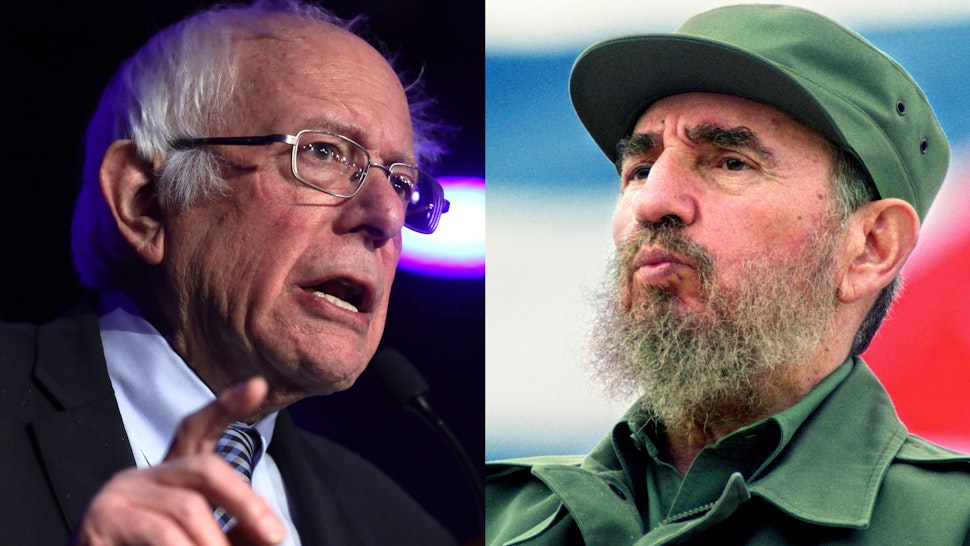
Sanders Reaffirmed His Admiration for the Castro Regime’s Social Policies

Bernie Sanders remains unrepentant for his praise of brutal totalitarian regimes, especially that of Fidel Castro.  Given Sanders' "my way or the highway" mindset, one cannot help but wonder if Sanders doesn't admire forcing change even when the populace doesn't want, particularly if it promotes his left wing ideology.  A piece in the Miami Herald from 2016 looks at the number of Cubans murdered by Castro's brutal regime:
The late and widely respected University of Hawaii historian R. J. Rummel, who made a career out of studying what he termed “democide,” the killing of people by their own government, reported in 1987 that credible estimates of the Castro regime’s death toll ran from 35,000 to 141,000, with a median of 73,000.


This is the regime Sanders has lauded. A column in the Washington Post looks at the myth that Castro's regime greatly reduce illiteracy.  Tell the families of those murdered or forced into exile that a meager increase in literacy was worth the blood bath.  If Sanders is so wrong about the Castro regime - and the Soviet and Sandinista regimes - what else is he wrong about? Democrats are insane if they give Sanders their party nomination.  The only one who benefits is Donald Trump and his horrible regime.  Here are Post column excerpts:
Unfazed by the howls of indignation — honest or feigned — over his recent praise of communist Cuba, Sen. Bernie Sanders (I-Vt.) has reaffirmed his admiration for the Castro regime’s social policies over the past few days. He has done so while simultaneously insisting that he’s “very opposed to the authoritarian nature of Cuba.”
But can the achievements of any monstrous regime ever be praised? Is it really possible to separate the cruelty of any dictatorship from any of its policies? In the case of communist Cuba, a further question arises: Is it possible to believe any of the claims it makes for its own achievements, given that it generates its own statistics and promotes its own version of history?
And anyone who would care to do some fact-checking, as did The Post’s Glenn Kessler a few years ago, will quickly discover that the Sanders version of Cuban history is far from accurate.
First, consider the issue of literacy in Cuba before Castro came along. Was pre-Castro Cuba a nation of illiterates, and Castro’s literacy campaign as great an accomplishment as Sanders avers? Not at all. A Cuban census from 1953 found that 77.9 percent of the island’s total population was already literate, and that in urban areas the literacy rate was 88.9 percent: among the highest in Latin America and higher than in some benighted rural counties in the United States. Seven years later, in 1960, according to data compiled at Oxford University, the literacy rate for the entire island was 79 percent.
So the scope of Castro’s 1961 literacy campaign, much admired by Sanders, is more myth than reality. Moreover, the image of pre-Castro Cuba as a primitive society rescued from poverty and illiteracy by a so-called revolution is a deceitful caricature, one brilliantly conceived by the Castro regime to make its brutality seem less offensive — merely “authoritarian” rather than monstrous.
Second, consider the real purpose of Cuba’s literacy campaign. Can it be totally disassociated from the repression that accompanied it, as Sanders would like you to think? Far from it. At the very same time that it was teaching illiterate Cubans to read, the Castro regime was busy stifling all freedom of expression. It banned any books that displeased it, shut down all newspapers and magazines, and flooded schools with texts that were pure propaganda. It turned each and every school on the island into an indoctrination camp in which no deviation from Marxist orthodoxy was ever allowed.
In other words, the literacy campaign was designed to enhance a totalitarian state’s control of its people. The fact that it lent a falsely benevolent sheen to Castro was an added bonus, but there is no denying that the Maximum Leader taught Cubans to read so that their thinking could be more carefully controlled by his propaganda machine.
Try to imagine Sanders or any other leftist ever insisting that it is “unfair” to deny the Third Reich praise for some of its accomplishments, such as the building of the Autobahn.
The “good” things Sanders finds in communist Cuba should seem immensely disturbing to Americans, even frightening. His vehemence in defending these “good” things, which in truth are hollow victories stained with blood, should also set off alarms, for this peculiar obsession reveals more than some character flaw.
Sanders’s insistence on finding positive things to say about Fidel Castro might be the clearest indication he has yet given American voters of his own sources of inspiration, and of his vision for the future of the United States.


#NeverSanders

Tuesday, February 25, 2020

Sanders' Travels to Totalitarian Regimes Haunt His Campaign

Sanders in Russia.
In addition to, in my view, an over weaning ego, Bernie Sanders shares another trait with Donald Trump: he never admits that he is wrong or that there are other legitimate perspectives. In his recent 60 Minutes interview, Sanders had an opportunity to disavow his past flirtations with and laudatory comments about brutal communist regimes in Russia, Cuba and Nicaragua, but, being Sanders, he did not do so.  Now, his opponents for the Democrat primary are focusing on this aspect of Sanders past that could prove radioactive in a general election - especially in crucial Mid-West states - and which the Trump campaign will laser focus upon.  To me it is yet another reason that a Sanders nomination could see Trump, even hated as he is by so many, being reelected and the nation sliding more and more toward fascism - something Sanders and his base claim to oppose.  A piece in the Washington Post looks at this very damaging baggage that Sanders carries.  Here are article highlights:

The mayor of tiny Burlington, Vt., was back from Nicaragua and eager to share the good news.
The country’s Soviet-backed government — forged via armed rebellion — was cutting infant mortality, reducing illiteracy and redistributing land to peasant farmers. Its Sandinista leaders, branded terrorists by the U.S. government, impressed him with “their intelligence and their sincerity.”
Three years later, Bernie Sanders was fresh off the plane from Moscow, reveling in the beauty of the land and the contentedness of the people.
And a year after that, he returned from Cuba having tapped into a revolutionary spirit “far deeper and more profound than I understood it to be.”
With Sanders now surging to the top of the Democratic presidential field, those three-decade-old impressions introduced a volatile new element in the race Monday as rivals reacted to Sanders’s decision to defend his remarks, not disclaim them.
Asked about his favorable reviews of Fidel Castro’s Cuba in a “60 Minutes” interview that aired on CBS on Sunday night, Sanders said the communist leader deserved criticism for “the authoritarian nature” of his government — as well as praise where it was due, including for “a massive literacy program.”
The comments offered instant fodder for opponents who had already been sharing the old clips and highlighted the risk to a candidate with a track record of sympathy for communist and socialist governments that is unlike any other recent Democratic nominee.
Rivals seized on the brand-new video to portray the senator from Vermont as naive — a possible preview of attack lines in Tuesday night’s debate and of the barrage Sanders is likely to endure in the general election if he makes it that far.
“Fidel Castro left a dark legacy of forced labor camps, religious repression, widespread poverty, firing squads, and the murder of thousands of his own people,” former New York mayor Mike Bloomberg tweeted. “But sure, Bernie, let’s talk about his literacy program.”
Former South Bend, Ind., mayor Pete Buttigieg compared Sanders to President Trump, tweeting that after four years of giving dictators a pass, the United States needs “a president who will be extremely clear in standing against regimes that violate human rights abroad.”
Sanders has promised to remake the party in his far-left image as a “democratic socialist,” and he argues that his vision for a political revolution is best exemplified by thriving democratic, first-world societies like Denmark.
Yet in the 1980s, during the dying days of the Cold War, Sanders indulged a fascination with far more disruptive and divisive strains of a socialist ideology he has embraced throughout his adult life.
Returning home from visits to some of the United States’ most avowed enemies, Sanders offered some criticism but also plenty of praise in Vermont community television recordings.
Now, Sanders’s comments are coming back to life as opponents say his warm feelings toward his hosts decades ago make him vulnerable to attack and reveal a soft spot for left-wing despots.
“If people are going to vote for socialist candidate Bernie Sanders, they need to understand what socialism means historically. And it’s not Scandinavia,” said Marion Smith, executive director of the congressionally authorized Victims of Communism Memorial Foundation.
Smith recently tweeted a clip from a 1988 news conference in which Sanders lauds the Soviet Union for its chandelier-filled transit stations and its “palaces of culture.” Smith demanded an apology for what went unmentioned.
“He turned a blind eye to what was known about the ongoing systematic human rights abuses, the suppression of religious and ethnic minorities, the jailing of dissidents,” Smith said. “He was very clearly joining the ranks of the useful idiots who believed in the propaganda of the Soviet Union and carried it to the West.”
Sanders’s infatuation with revolutionary left-wing movements, particularly those in Latin America, was long-standing, and it became a key feature of his first stint in elected office.
Sanders has recalled feeling “very excited” by Castro’s 1959 revolution, which played out during his teens. “It just seemed right and appropriate that poor people were rising up against rather ugly rich people,” he said in 1986.
Watching the video decades later, Latin America scholar Richard Feinberg said Sanders appeared to have had “a rather simplistic” view of the developing world, as well as an overly rosy assessment of Nicaragua’s leaders. But the reason for Sanders’s attraction, he said, was clear.
“In Nicaragua, he found his equivalents to his view of the United States . . . allegedly a small group of wealthy people at the top versus the struggling, noble poor,” said Feinberg, . . .


Trump and the GOP must be salivating at the prospect of a Sanders nomination.

Monday, February 24, 2020

How Sanders and His Base Alienate Voters

When not upsetting Democrats and aiding GOP talking points with remarks that sound at least partly supportive of Castro's Cuba and and inability to state what his signature "Medicare for All" program would cost, Bernie Sanders- and his more strident supporters -  is also alienating needed voters with what might be described as an arrogant purity test that gives no ground to other views and suggests that those not in agreement are somehow morally deficient.  It's as if one must either fully embrace Sanders' most extreme views and policies or somehow be classified as a right wing Republican in disguise. The result is that many simply do not like the man - I for one do not and see his ego as toxic as Trump's just in a different way - and it could cost Sanders (and Democrats, if he ends up being the nominee) dearly.  It is a dangerous tactic to believe that hatred of Trump alone will be enough to force Democrats, independents and what's left of liberal Republicans to all vote for Sanders if he is the Democrat nominee (even though he is not a Democrat except when convenient). A piece in the New York Times looks at this damaging phenomenon.  Here are column highlights:
The last four presidents — Bill Clinton, George W. Bush, Barack Obama and Donald Trump — are four very different politicians. But they have one crucial similarity: They all tried to appeal to voters who weren’t obvious supporters.
The art of peeling off voters — those in the middle or those who aren’t ideological — may be the most important skill in politics. It doesn’t require a mushy centrist policy agenda, either.
[P]olitics is inescapably performative. Voters respond to signals. They respond to gestures of respect from politicians who are willing to say, in effect: We may not agree on everything, but I see you and understand what matters to you.
The newly energetic American left has largely rejected this approach, choosing instead to believe a comforting myth about swing voters being extinct and turnout being a cure-all. It’s a big mistake.
[T]he left is hurting its own ability to win elections and enact sweeping change, by insisting on an orthodox version of progressivism.
To put it another way: Can you think of one way that Bernie Sanders is signaling respect to voters outside of his base?
Sanders has evidently decided that progressives will no longer accept impurities — or even much tactical vagueness. He, along with Elizabeth Warren, has embraced policies that are popular on the left and nowhere else: a ban on fracking; the decriminalization of border crossings; the provision of federal health benefits to undocumented immigrants; the elimination of private health insurance.
For many progressives, each of these issues has become a moral litmus test. Any restriction of immigration is considered a denial of human rights. Any compromise on guns or health care is an acceptance of preventable deaths.
And I understand the progressive arguments on these issues. But turning every compromise into an existential moral failing is not a smart way to practice politics. It comforts the persuaded while alienating the persuadable.
F.D.R. and Reagan understood this, as did Abraham Lincoln and many great social reformers, including Frederick Douglass, Jane Addams, Martin Luther King Jr. and Cesar Chavez. Strong political movements can accept impurity on individual issues in the service of a larger goal: winning.
But progressives are still a very long way from achieving the changes they seek. Republicans control the Senate, and a conservative majority runs the Supreme Court. Trump has an excellent chance to win re-election and usher in a dark era for American progressivism.
Faced with the potential of either large gains or historic losses, progressives would be wise to stop believing only what they want to believe. Don’t cherry-pick polls to claim that most Americans actually favor a ban on private insurance. Don’t imagine that millions of heretofore silent progressive supporters will materialize on Election Day. In the 2018 midterms, Sanders-style candidates lost swing districts, while candidates demonstrating respect to swing voters won again and again.
Beating Trump in November will be even harder. And uncomfortable compromises will make it more likely.
For Sanders, that may mean walking back his position on fracking, which threatens his chances in must-win Pennsylvania. It could also mean repeating some of his earlier arguments about the need for border security and immigration restrictions. Many working-class voters, including people of color, agree with that.

Sunday, February 23, 2020

Down-Ballot Democrats Distance Themselves from Sanders

With Bernie Sanders' strong showing in Nevada, it seems Democrats are poised to do what Virginia Republicans did for years and which left them completely out of power in Virginia: they nominated candidates that were the darlings of the extremists of the party base but who were viewed as toxic by mainstream voters.  If Bernie Sanders turns out to be the Democrat nominee, I fear that another four years of the nightmare of Donald Trump is virtually guaranteed.  Worse yet, Sanders may drag down many down ballot candidates and cause Democrats to lose seats both in Congress and also in countless state races across the country. While Sanders supporters - who strike me as being just as fanatical as Trump's MAGA supporters  - are blind to this reality, many down-ballot Democrats are seeing the hand writing on the wall and trying to distance themselves from Sanders as vigorously as possible. As for Sanders himself, the man strikes me as just as filled with egomania and a "my way or the highway" mindset as Trump.  He is a catastrophe who will do incalculable damage to the Democrat Party. A piece in the Washington Post looks at these totally justified efforts. Here are article highlights: 
Former astronaut Mark Kelly, the Democratic Party’s hope for flipping a U.S. Senate seat in Arizona, tried to do no harm this month when he was asked about Sen. Bernie Sanders. “I will ultimately support who the nominee is of the Democratic Party,” he said.
That was enough for Kelly’s Republican rival, Sen. Martha McSally (R-Ariz.), who is trailing him in early polls, to go on the attack. The television spot she debuted days later spent nearly as much time talking about plans by the democratic socialist from Vermont to raise taxes and award new benefits to undocumented immigrants as it did about Kelly.
As Sanders builds what could eventually be an insurmountable delegate lead, many Democratic House and Senate candidates are approaching a dramatic shift in their campaigns, as they recalibrate to include praise of capitalism and distance themselves from the national party. Top campaign strategists from both parties view Sanders’s success as a potentially tectonic event, which could narrow the party’s already slim hopes of retaking the Senate majority and fuel GOP dreams of reclaiming the House, which it lost amid a Democratic romp in 2018.
“Donald Trump is going to offer the American people this choice: Do you want to continue building the economy or do you want to lurch toward socialism? And that is a real powerful argument in the Democratic districts that Trump won in 2016.”
With an emphatic victory in Saturday’s Nevada caucuses, Sanders has won two of the first three contests, and lost the third — the Iowa caucuses — in a squeaker.
Because of Democratic rules that give no delegates to candidates who scores less than 15 percent of the vote in a state or congressional district, Sanders could build a delegate lead far greater than his advantage in the popular vote.
If Democrats are awakening to a recognition that Sanders could pull away from the rest of the field, there is far less consensus about whether his nomination will help President Trump win reelection. Sanders’s power to turn out young and blue-collar voters or suburbanites is not fully tested, the ceiling of Trump’s support is poorly defined in a two-way race and the senator from Vermont has not yet been subjected to a negative paid advertising effort.
But there is far less flexibility for candidates in smaller districts. That has prompted Republicans to celebrate as they look to reclaim ground they lost in 2018 when largely affluent suburbs rebelled against the GOP in a protest of Trump.
“The Democrats’ embrace of socialism is going to cost them their majority — I mean, it’s as simple as that,” said Rep. Tom Emmer (R-Minn.), chairman of the National Republican Congressional Committee. “Bernie is about as good a contrast as we could have ever hoped for.” Democrats, particularly those representing swing districts, agree.
“We flipped those seats [in 2018] because of Donald Trump,” said one House Democrat who represents a suburban district, speaking on the condition of anonymity to reflect internal discussions. “And if Democrats want to hand most of those back, put Bernie at the top of the ticket. And that’s how many of us feel.”
The House member added: “Our overarching priority [is] to replace the president, but to do so with someone who is going to be equally divisive does not serve the country’s interests, and I think that’s at the core of what is making so many so uncomfortable.”
Several of Sanders’s rivals have begun to warn about a potential down-ballot rout. They have raised particular concern about Sanders’s support for a Medicare-for-all plan, which would effectively eliminate private health insurance in the United States.
The leading Democratic candidates running for the four most vulnerable Republican Senate seats — in Arizona, North Carolina, Maine and Colorado — have all come out against Sanders’s signature health care plan, as have many House candidates.
“I believe the only way to truly deliver any of the progressive changes we care about is to be a nominee who actually gives a damn about the effect you are having, from the top of the ticket, on those crucial, front-line House and Senate Democrats running to win, who we need to win, to make sure our agenda is more than just words on a page,” former South Bend, Ind., mayor Pete Buttigieg said Saturday in Las Vegas.
The moderate think tank Third Way has urged the presidential candidates to train their fire on Sanders at Tuesday’s South Carolina debate, issuing a memo that cites a recent Gallup survey that found 51 percent of independents would not vote for a self-described socialist for president.
“The suburbs are not looking for a revolution,” said Matt Bennett, co-founder of Third Way. “They want change, for sure. Many of them loathe Trump with a burning passion, but they do not want somebody who is proposing to double the size of the federal government. They do not want somebody who is proposing to take away the health care of 180 million people.”
A Washington Post-ABC News Poll this week found that Sanders had the worst standing against Trump among college-educated white women, the group most responsible for powering Democrats to their 2018 House majority. Sanders had a statistically insignificant two percentage-point edge over Trump among white women voters with college degrees in the poll, compared with Buttigieg, Biden, Bloomberg and Sen. Amy Klobuchar (D-Minn.), who all beat Trump by 10 points or more among that the same group.
Dan Conston, executive director of the Congressional Leadership Fund, the largest GOP super PAC focused on House races, said Sanders’s presence lends instant credibility to the GOP’s long-standing efforts to tie any Democrat to the far left.
“It feels like we are moving to almost a parliamentary system where voters are voting straight ticket,” said Republican pollster Neil Newhouse, who has found in recent polling that Trump is significantly more popular than Sanders in competitive House races. “Sitting back and watching the Democrats and their primary is an extraordinary experience, and I am glad it’s not us.”
I am in horror of what is happening and all I can do is play Cassandra and donate to opposing candidates - something I urge others to do as well starting right now.  Sanders must be stopped if a disaster is to be averted.