Showing posts with label College educated whites. Show all posts

Tuesday, March 10, 2020

Sanders Gets More Trump-Like as Never Trump Republicans Back Biden

As Democrats appear to be strongly shifting to support Joe Biden and to be rejecting Bernie Sanders form of populism, Sanders is becoming more Trump-like as he blames "the establishment" and others of conspiring against him rather than admit that just maybe people do not like what Sanders is peddling politically. At the same time, Never Trump Republicans are demonstrating that they are willing to vote for Biden even as they continue to find Sanders toxic and hostile to anyone with differing views and opinions.  A column in the Washington Post looks at Sanders' Trump like behavior.  Here are excerpts:
Populist leaders present themselves as the only authentic voice of the “people.” Therefore, critics in the media are enemies of the people, for to take on the leader is to attack the people. When the leader is rejected at the polls, it cannot be an authentic expression of the people. The system must be rigged; the establishment must be out to get the candidates and, by extension, the people.
We have seen this for the three years President Trump has been in office, and previously in his 2016 campaign. The deep state, the fake news and the elites (not “real” Americans) are out to get him, he says. He insists that all these forces do not respect the people, his followers and the only real Americans.
We are reminded in watching Sen. Bernie Sanders (I-Vt.), as his presidential campaign fizzles, this mind-set is not limited to the right. Sanders had this exchange on ABC’s “This Week”:
SANDERS: Well, one of the things that I was kind of not surprised by is the power of establishment to force Amy Klobuchar, who had worked so hard, Pete Buttigieg, who, you know, really worked extremely hard as well, out of the race. . . . . We’re taking on the political establishment. And what you are seeing now just in the last few weeks is Wall Street, the health-care industry, the billionaire class putting a lot of money into Joe’s campaign.
This is bonkers. Other Democrats got out of the race because voters across the country did not vote for them. Sanders sneers at them as if they are puppets on a string, yanked out of the race by nefarious forces. They actually looked at the facts, saw they could not win and decided Biden had a better chance to unify the country and beat Trump than did a self-proclaimed socialist who cannot resist the urge to pick fights with his own party.
Sanders’s complaint about billionaires giving to Biden’s campaign (they would be limited to $2,800 per person like all other donors) is part of the fixation with attributing opponents’ success to something other than popular opinion.
Sanders keeps insisting he is “winning the support of grass-roots America.” That simply is not so. Biden won 10 of 14 states, driving turnout sky-high in states he won, like Virginia. Sanders’s promised onslaught of new voters has never shown up.
Perhaps he and his snarling online supporters should confront an unpleasant truth: Sanders’s problem is not the establishment or corporate Democrats or billionaires. It is the voters.


Meanwhile, Biden is showing that he can pull in support of independents and Never Trump Republicans - something that might tip the scales in crucial Mid-West states where Sanders' mythical wave of new voters will likely fizzle as it has in state after state.  A piece in the New York Times looks at this phenomenon.  Here are article highlights:
As more data emerge to explain former Vice President Joe Biden’s stunning victory on Super Tuesday, there are two clear demographics that propelled him: African-American voters and suburban voters with college degrees.
It’s a coalition that helped moderate Democrats flip seven governorships, two Senate seats and about 40 House districts (the newly Democratic suburbs alone would have secured a House majority) from red to blue in 2018. African-Americans have long made up a core of the Democratic voting base, but many of Mr. Biden’s college-educated, suburban supporters are right-leaning independents or moderate Republicans who supported candidates like John McCain and Mitt Romney. They don’t want to re-elect Donald Trump. And they’re willing to cross over to vote for a Democrat — a moderate and mainstream Democrat.
These voters might not identify with the “Never Trump” group of conservatives who vociferously oppose the president. But in practice, that’s who they are.
These voters can create winning margins for Democrats in swing states like Michigan, Pennsylvania, Arizona and North Carolina in the general election.
Their numerical strength was on full display on Super Tuesday in the Virginia and Texas suburbs, which saw 74 percent and 87 percent higher voter turnout, respectively, than four years ago.
The responses to our outreach made clear that these voters are looking not for the democratic socialist revolution that Senator Bernie Sanders would offer as the nominee, but simply for a Democrat they could trust to govern responsibly and end the chaos of Mr. Trump’s presidency. For many lapsed and former Republicans, voting for Mr. Biden is the least-bad option. He’s considerably more moderate than Mr. Sanders and doesn’t pose the threats to the rule of law and constitutional norms that Mr. Trump does. He’s a backstop against the political insanity of the right and the left.
College-educated suburban voters often feel politically homeless, trapped between Mr. Trump’s erratic and divisive nature and a fear of Democrats’ leftward march. Mr. Biden may not offer these voters a galvanizing vision for the future. But to those exhausted by the past three years of political upheaval and nastiness, he offers something even better: basic human decency.
Especially in the focus groups in which Trump voters rate his performance as “somewhat bad” or “very bad,” these right-of-center voters are generally open to voting for Mr. Biden — though not for Mr. Sanders.
It has always been a possibility that Mr. Trump could drive a permanent political realignment in which college-educated suburban voters abandon the Republican Party for good. It remains an open question whether that will come to pass in 2020 and beyond, but the warning signs from Super Tuesday are clear.

The goal in 2020 is to defeat Trump - not force a political revolution that a majority of voters do not want.  It's a reality that Sanders seemingly cannot or will not grasp. 

Friday, March 06, 2020

Bernie Sanders Gets a Rude Awakening

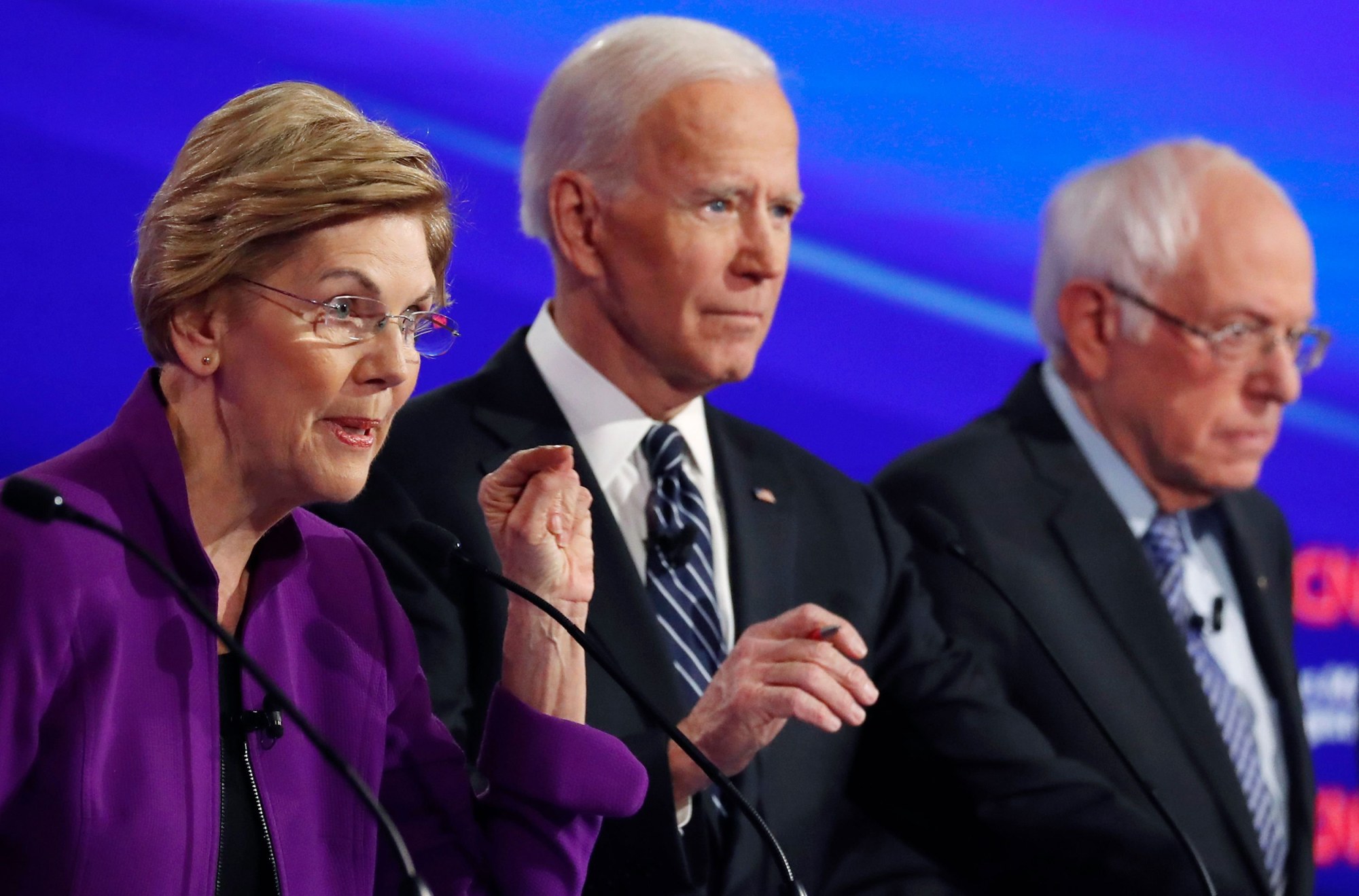
Elizabeth Warren has ended her presidential campaign and the question is whether she will endorse Biden or Sanders - or no one - and where her supporters will gravitate.  Some of the most liberal may go to Sanders, but many of the college educated suburbanites may be turned off by Sanders' class warfare agenda and move towards Biden.  Meanwhile, Bernie Sanders has claimed that the youth vote would power him to victory.  Based on analysis so far, the youth vote turned out in smaller percentages for Sanders on Super Tuesday than in 2016 and Sanders captured a small percentage of those who did go to the polls. The situation demonstrated (i) the unreliability of younger voters to actually go and vote, and (ii) the breadth of Sanders' coalition remains too limited to win the nomination.  A piece in The Atlantic looks at Tuesday's outcome and Sanders' need to attract those outside of his base - something I am not sure he is capable of doing given his demeanor and his my way or the highway mindset.  Tuesday, most Democrats chose the highway in the form of Joe Biden.  Here are article excerpts:
Bernie Sanders’s self-proclaimed “political revolution” crashed into a wall of resistance inside the Democratic Party last [Tuesday] night.
After a remarkable 72 hours that saw top party leaders consolidate behind Joe Biden, a panoramic array of key party voting groups coalesced around the former vice president—and against Sanders—in the coast-to-coast competition, according to exit polls conducted in almost all the states that voted. Biden captured at least nine of the 14 states voting, including some—such as Minnesota and Oklahoma—where Sanders won big in 2016.
The surprisingly decisive result left Sanders, a candidate who prides himself on his pile-driver-like consistency, facing a new challenge: finding a second act that can appeal to voters beyond the fervid base he has established. The evening’s clearest message was that while the senator from Vermont has inspired a passionate depth of support, the breadth of his coalition remains too limited to win the nomination. “Sanders has made no effort to reach out beyond his voters, his movement, his revolution,” Greenberg said. “It just has not grown. It is an utterly stable vote that is grounded in the very liberal portion of the Democratic Party, but he’s so disdainful of any outreach beyond that base. He seems content to just keep hitting that drum.”
Last night’s results could cull other candidates in the race sooner than later [Bloomberg has dropped out] . . . . . . Elizabeth Warren [now out as well] , who has pledged to fight on until the convention, lost her home state of Massachusetts and in the exit polls showed only trace levels of support among any group other than her core constituency of college-educated whites.
The results did not ensure a Biden nomination or a Sanders defeat. Sanders still won four states, including a solid-if-not-crushing victory in California, the largest prize on the board. He retained enthusiastic backing from his base: young voters, the most liberal voters, and Latinos, the key group that he has moved in his direction since his first bid in 2016.
But if Biden wins next week in Michigan, one of Sanders’s most significant victories four years ago, the rationale for the senator’s candidacy could quickly become murky.
Last night, Sanders failed on almost every front to enlarge his coalition. He faced a sharp recoil from groups that have long been the most skeptical of him, including African Americans and older voters.  . . . . Outside of Vermont, Sanders faced cavernous deficits among voters 45 and older, who composed a clear majority of the electorate in most states.
Across the country, Sanders also lost ground among white voters up and down the socioeconomic ladder. College-educated white voters, who on the whole had been skeptical of both men until Biden won them in South Carolina, broke decisively for the former vice president in most states. Simultaneously, in most states, Biden reversed Sanders’s previously consistent advantage among white voters without a college degree.
Perhaps the starkest symbol of Sanders’s limitations last night was the resurgence of a problem that severely damaged him in 2016: widespread resistance from primary voters who self-identify as Democrats (as opposed to independents).
The Super Tuesday exit polls showed Biden beating Sanders among self-identified Democrats by about 30 percentage points in both Virginia and North Carolina, about 25 points in Oklahoma, 20 points in Tennessee, and nearly 50 in Alabama. Sanders was more competitive among Democratic partisans in the New England states of Massachusetts and Maine. But the overall pattern was unmistakable.
His collapse among Democratic partisans came after recent full-throated attacks on “the Democratic establishment” in his rallies and media appearances. Sanders has often sounded more as if he believes he’s leading his movement in a hostile takeover of the party than a merger with it.
Biden, for instance, crushed Sanders in the white-collar suburbs of Northern Virginia. That suggests Sanders’s call for political revolution is ringing hollow in the largely prosperous communities outside major cities that helped deliver the House majority to Democrats in 2018, largely out of antipathy toward Trump.
[A]s the race reduces to a binary choice between Biden and Sanders, it’s the Vermont senator who emerged from the biggest night on the primary calendar with the greatest need to change the dynamic in the race.
Frankly, I do not see Sanders trying to enlarge the tent of his supporters.  He is singing the same song he has for decades and appears too old and to closed minded to change.  

Saturday, February 15, 2020

California Exiles' Revenge on Trump

Virginia has moved into the blue state category due to two principal factors: (i) it has an increasingly college educated population, and (ii) it has seen a large influx of residents from liberal states.  These phenomenon are especially evident in Northern Virginia and the rest of Virginia's urban crescent that stretches south through Richmond and then south east to Hampton Roads. As a piece in the New York Times notes, similar things are happening in other states that are trending blue, often driven by exiles from California who take their more liberal views and support for the environment with them to their new home states. Donald Trump constantly trashes California and its progressive policies, yet that states' former residents are transforming the political landscape in Nevada. Colorado and Arizona - and, in time, perhaps even Texas.  Here are column highlights:
President Trump clearly hates the most populous state in the country he governs. While trashing California with his gutter mouth, the president has used his office to physically trash the home to nearly one in eight Americans — seeking to make its air more polluted, its water less clean, its forests more vulnerable to catastrophic fires.
But now the Golden State is poised to strike back. By moving its presidential primary from June to March 3, California will finally exert a political influence commensurate to its size. Almost 500 delegates, a fourth of the number needed to win the Democratic nomination, are at stake.
Perhaps more consequential — or at least overlooked — is what’s happening among the vast diaspora of more than 7.3 million people who have left California since 2007. They appear to be changing the political makeup of the states they’ve moved to, perhaps enough to alter the Electoral College map in favor of Democrats.
With nearly 40 million people, California is still gaining population — barely. But stratospheric home prices and unbearable rental costs have created a reverse “Grapes of Wrath,” forcing those who are not rich to flee to states with much lower costs of living.
The question is: Are they bringing California values — fierce defense of the environment, tolerance of immigrants and a multiracial society, insistence on universal health care — with them? It could be just demographic churn. But if you look at the changing politics of Nevada, Colorado and Arizona, all fast-growing states packed with new arrivals from California, the answer is yes. Texas may not be far behind.
In Nevada, to which 500,000 Californians moved between 2008 and 2018, Democrats won the governor’s mansion and a second U.S. Senate seat in 2018. There used to be more Republicans, by registration. But Democrats now have a 70,000-voter advantage, and they prevailed there in the last three presidential races.
Colorado, another favorite landing spot for those who can no longer afford California, is now reliably blue. Democrats won majorities there by more than 100,000 votes in the last two presidential elections. The state is likely to flip a Senate seat, bouncing the inept Republican Cory Gardner for a popular former governor, John Hickenlooper.
Arizona could be the next to fall to Democrats. The state known for retirees and tax-averse whites is becoming more diverse and younger and is full of ex-Californians. Between 2001 and 2014, Arizona added about a quarter-million people from its neighboring state to the west.
[I]f the Dems were to win Arizona’s 11 Electoral College votes, as polls show they could, and lose Wisconsin’s 10, while getting back Pennsylvania and Michigan, that would be enough to remove the vile and corrupt man occupying the White House.
Texas, the top state for California exiles, will probably come up short for Democrats this year, though it’s in play. Democrats have a growing advantage in Dallas, Houston, Austin and San Antonio, all seeing heavy U-Haul traffic from California.
Polls in Texas show Trump failing to get above 48 percent in matchups with Democrats. And 45 percent of voters wanted to impeach and remove him from office.
Trump treats these fellow citizens as aliens. He’s going out of his way to gut the state’s clean air standards, to turn the Eden of its public lands over to industrial pillagers and to cast its immigrant strivers as criminals. He has done nothing — rebuffing the state’s plea for additional housing vouchers for the poor — to mitigate the homeless crisis. He’d prefer a dystopia on the Pacific, largely because he lost the Golden State by more than four million votes.
And yet Californians, those who still proudly call it home and those who left their hearts there, could be the force that sends him packing.

Tuesday, October 08, 2019

New Poll: Majority of Americans Endorse Impeachment Inquiry


In the previous post, it was noted that Lindsey Graham called Donald Trump a “nutjob” and a loser,” as well as a “race-baiting, xenophobic, religious bigot.” Moreover, he predicted that if the GOP nominated him, “we will get destroyed … and we will deserve it.”  That, of course, was before Graham and other Congressional Republicans sold their souls and became Trump apologists or worse. Now, a new poll suggests that the GOP's much deserved self-destruction may be closer at hand than boot licking Republicans want to admit.  Indeed, 58% of Americans support the House of Representatives impeachment inquiry and 49% believe Trump should be removed from office - and this is even before the hearings likely expose much more unsavory and improper actions by Trump.  Here are highlights from the Post about the poll findings which must have some in the GOP close to soiling their underwear:
A majority of Americans say they endorse the decision by House Democrats to begin an impeachment inquiry of President Trump, and nearly half of all adults also say the House should take the additional step and recommend that the president be removed from office, according to a Washington Post-Schar School poll.
The findings indicate that public opinion has shifted quickly against [Trump] the president and in favor of impeachment proceedings in recent weeks as information has been released about Trump’s efforts to pressure Ukrainian government officials to undertake an investigation into former vice president Joe Biden, a potential 2020 campaign rival, and Biden’s son Hunter.
The recent revelations appear to have prompted many Americans to rethink their position.
The poll finds that, by a margin of 58 percent to 38 percent, Americans say the House was correct to undertake the inquiry. Among all adults, 49 percent say the House should take the more significant step to impeach [Trump] the president and call for his removal from office. Another 6 percent say they back the start of the inquiry but do not favor removing Trump from office, with the remainder undecided about the president’s ultimate fate. The results among registered voters are almost identical.
The findings highlight the partisan divisions that surround the Trump presidency and any impeachment inquiry, but also the degree to which there are defections among Republicans.
More than 8 in 10 Democrats endorse the inquiry and nearly 8 in 10 favor a vote to recommend that Trump be removed from office. Among Republicans, roughly 7 in 10 do not support the inquiry but almost 3 in 10 do, and almost one-fifth of Republicans say they favor a vote recommending his removal. Among the critical voting bloc of independents, support for the impeachment inquiry hits 57 percent, with 49 percent saying the House should vote to remove Trump from office. . . . there has been movement toward an impeachment inquiry among all three groups, with support for the inquiry rising by 25 points among Democrats, 21 points among Republicans and 20 points among independents.
Two pieces of information triggered the impeachment inquiry and have sparked widespread public concern, according to latest survey . . . . The first was the rough transcript of a July 25 telephone call between Trump and newly elected Ukrainian President Volodymyr Zelensky, during which Trump asked for “a favor” that included requests for the Ukrainians to look into what happened during the 2016 election and to investigate Biden and his son, who sat on the board of a Ukrainian energy company.
Asked about the contents of the telephone call, a clear majority of Americans say Trump’s request to investigate Biden and his son was inappropriate (62 percent to 32 percent who felt it was not).
When it comes to Trump’s overall conduct as president, Americans offer a harsh verdict. Asked whether the president upholds adequate standards for ethics in government, 60 percent of Americans say he does not, while 35 percent say he does.
At this early stage in the impeachment inquiry, whose timing is fraught as the country barrels toward an election year, the public is siding more with congressional Democrats than Republicans when it comes to their responses so far.
Majorities of Americans say Democrats in Congress are making a necessary stand against Trump’s actions (61 percent) and are acting to uphold their constitutional duties (53 percent). Similarly, a majority (55 percent) say Democrats are not overreacting by starting the impeachment inquiry.
The survey finds cracks within the Republican coalition on the question of support for the impeachment inquiry, with younger and more moderate Republicans offering greater support. . . . 40 percent of Republican-leaning adults ages 18-39 endorse the start of the impeachment inquiry, compared with 23 percent of those ages 40-64 and 13 percent of those age 65 and older.
On the question of the appropriateness of Trump’s request to Zelensky to investigate Biden and his son, 45 percent of moderate-to-liberal Republicans and Republicans under age 40 say it was not appropriate.
65 percent of women favoring the impeachment inquiry, compared with 51 percent of men.
A majority (61 percent) of white college graduates favor the inquiry, while whites without college degrees, a mainstay of Trump’s support, are split: 47 percent in favor and 48 percent in opposition.


One can only hoe that support for impeachment - and removal of Trump from office - continues to grow.  He is a cancer that must be removed from the White House at any cost. 

Wednesday, August 28, 2019

Exodus of College-Educated Whites from the GOP

In my youth, Republicans valued education and knowledge. Indeed, many prided themselves on their high level of education and it was Democrats who were viewed as being "working class."  There was a reason for the term country club Republicans, a majority of which were educated professionals.  Nowadays, the demographics of the two party has flipped and college educate whites have migrated to the Democrat party as the less educated has shifted to the GOP.  Evangelical Christians who studies have shown are the least educated of various religious denominations make up the core of the GOP base, a base that, in my view, celebrates ignorance and is motivated by racism and fears of those deemed "other" - a term that applies to anyone who is not a white, conservative Christian (using the term "Christian" loosely, since these conservatives show little Christian behavior).  A lengthy column the New York Times looks at the exodus of educated whites from the GOP.  Here are highlights:  

In less than a decade, from 2010 to 2018, whites without a college degree grew from 50 to 59 percent of all the Republican Party’s voters, while whites with college degrees fell from 40 to 29 percent of the party’s voters. The biggest shift took place from 2016 to 2018, when Trump became the dominant figure in American politics.
This movement of white voters has been evolving over the past 60 years. A paper published earlier this month, “Secular Partisan Realignment in the United States: The Socioeconomic Reconfiguration of White Partisan Support since the New Deal Era,” provides fresh insight into that transformation.
The authors, Herbert Kitschelt and Philipp Rehm, political scientists at Duke and Ohio State, make the argument that the transition from an industrial to a knowledge economy has produced “tectonic shifts” leading to an “education-income partisan realignment” — a profound realignment of voting patterns that has effectively turned the political allegiances of the white sector of the New Deal coalition that dominated the middle decades of the last century upside down.
Driven by what the authors call “first dimension” issues of economic redistribution, on the one hand, and by the newer “second dimension issues of citizenship, race and social governance,” the traditional alliances of New Deal era politics — low-income white voters without college degrees on the Democratic Party side, high-income white voters with degrees on the Republican side — have switched places. According to this analysis, these two constituencies are primarily motivated by “second dimension” issues, often configured around racial attitudes, which frequently correlate with level of education.
[T]he surge of whites into the Republican Party has been led by whites with relatively high incomes — in the top two quintiles of the income distribution — but without college degrees, a constituency that is now decisively committed to the Republican Party.
According to the census, the top two income quintiles in 2017 were made up of those with household incomes above $77,552. More than half of the voters Kitschelt and Rehm describe as high income are middle to upper middle class, from households making from $77,522 to $130,000 — not, by contemporary standards, wealthy.
It’s higher income/low education whites who are currently still doing well, but fear that in the Knowledge Society their life chances are shrinking as high education becomes increasingly the ticket to economic and social success.
Low-income whites without college degrees have moved to the Republican Party, but because they frequently hold liberal economic views — that is, they support redistributionist measures from which they benefit — they are conflicted in their partisan allegiance.
High-income whites without college degrees were swing voters sixty years ago, pursued by both parties; now, they are rock-ribbed Republicans. Their share of the white electorate has fallen, however, from 42.1 to 22.0 percent. In the 1950s, high-income whites with college degrees were the base of the Republican Party — although in 1952 they made up just 6.7 percent of white voters. By 2016, this cohort had moved decisively toward the Democratic Party, as its share of the white electorate had grown to 26.0 percent. The key bloc for both Trump and the Republican Party is made up of white Christian evangelicals. Eight out of ten of these voters cast ballots for Trump, and intensely religious voters make up 40 percent of the Republican electorate. Carney and Enos see race prejudice as setting itself against the broad category of “other.” They have devised an experiment that addresses the tradition of allowing “humanity to be divided into two groups: one that embodies the norm and whose identity is valued, and another whose identity is defined by its faults, devalued and susceptible to discrimination.” The 2020 election will be fought over the current loss of certainty — the absolute lack of consensus — on the issue of “race.” Fear, anger and resentment are rampant. Democrats are convinced of the justness of the liberal, humanistic, enlightenment tradition of expanding rights for racial and ethnic minorities. Republicans, less so. This may well prove to be a base-vs.-base election, but even so the outcome may lie in the hands of the substantial proportion of the electorate that is undecided — 7 percent according to Pew. And if Democrats want to give themselves the best shot of getting Trump out of the White House, it is toward these voters that they must make concerted efforts at pragmatic diplomacy and persuasion — and show a new level of empathy.