Showing posts with label GOP racism. Show all posts

Sunday, July 26, 2020

Donald Trump's Suburban Horror Show


I grew up in the Republican Party, and although I lived in the country through high school - going back to my high school reunion last year reminded me of that - I've pretty much lived in the suburbs ever since.  Back when I grew up, the Republican Party was the party of knowledge, science and fiscal responsibility - the latter pretty much went away after Reagan's election and it has been Democrats in the White House that have been the ones reducing the federal deficit. Now, of course, under Donald Trump and the evangelical/Christofascist base of the GOP, the Republican Party has become the party of ignorance, alternate facts, and outright lies. None of these changes in the GOP have been lost on suburban voters who (i) tend to be better educated than rural voters, and (ii) more receptive to racial diversity than red state rural voters.  In addition, suburban voters, are paying attention to Trump's failed leadership in the context of the pandemic and seem to belatedly realized that almost nothing Trump says can be considered true.  The combined result of this is that suburban voters are abandoning Trump - and likely other Republicans - in the suburbs.  The results could be catastrophic - and much deserved - for the GOP.  A piece in Politico looks at Trump's declining prospects in the suburbs.  Here are excerpts:
Donald Trump says Joe Biden wants to abolish the suburbs. But polls show a different truth: The suburbs want to abolish Donald Trump.
If current numbers hold, the Republican Party will suffer its worst defeat in the suburbs in decades — with implications reaching far beyond November.
It was in the suburbs two years ago that Democrats built their House majority, ripping through Republican-held territory across the country, from Minnesota and Texas to Georgia, Virginia and Illinois.
It would be bad enough for the GOP if that had been a temporary setback. But with the prospect of a second straight collapse in the suburbs this year, it is beginning to look like a wholesale retreat.
“We can’t give up more ground in the suburbs nationally without having a real problem for our party,” said Charles Hellwig, a former chair of the Republican Party in Wake County, N.C., describing a landscape in which “every year, every month, every day, we get a little bluer.”
It is the same story in suburbs everywhere. In a Fox News poll last weekend, Trump was trailing Joe Biden, the presumptive Democratic nominee, by 11 percentage points in the suburbs. An ABC News/Washington Post poll had Trump down 9 percentage points there — larger margins in the suburbs than exit polls have recorded since the 1980s, when Republicans were winning there by double digits.
That polling reflects a dramatic swing from 2016, when Trump beat Hillary Clinton in the suburbs by 4 percentage points. Trump’s erosion in the suburbs is a major reason the electoral map this year has expanded for Democrats in recent weeks — with Trump in danger not only of losing, but of taking the Senate down with him. And demographic shifts are only becoming more favorable to Democrats.
“The movement of suburban voters, particularly educated women and millennials being so progressive in their politics, increased voting participating among Latinos, African Americans,” said Bill Carrick, a Democratic strategist who managed Missouri Rep. Dick Gephardt’s 1988 presidential campaign. “That all contributes to this geography: Suddenly, we’ve got Georgia and Texas and Florida and Arizona, Iowa. There’s a lot of places in play.”
Trump’s damage in the suburbs has come primarily, as it has elsewhere, from his handling of the coronavirus pandemic. But Trump’s response to the George Floyd protests also appears to have hurt him in the suburbs . . . .
Trump's intervention in Portland, Ore., has drawn more people into the streets, not fewer — including clashes between not only the Trump administration and antifa, but a “wall of moms.”
Comparing new voter registration in 17 states from immediately before the Floyd protests began to the week after, the Democratic data firm TargetSmart found that young people and people of color were registering at higher rates than before — with years to cast ballots for Democrats still ahead of them.
“Literally every state you’re seeing these increases, which is not something we saw in 2018,” Bonier said. “It’s interesting to see how the demonstrations in cities around the country are playing. … Suburban voters seem to be more sympathetic to those demonstrations than they ever have been in the past.”
When Americans were asked in the ABC News/Washington Post poll who they trusted more to handle issues surrounding crime and safety, they preferred Biden to Trump 50 percent to 41 percent.
There are still more than 100 days before the election, and Trump’s overtures to the suburbs are becoming more explicit.
Last week on the South Lawn, chastising Democrats for their positions on issues ranging from law enforcement to climate change and urban planning, Trump accused Democrats of plotting to “abolish our beautiful and successful suburbs.”
Mike Erlandson, a former chair of the Minnesota Democratic-Farmer-Labor Party, . . . . as the protests — and Trump’s response — have unfolded, he has seen Trump hurt his own standing there.
“The fact that the president is trying to drive a wedge in on things around law enforcement, I think most people find disappointing,” Erlandson said.  The suburbs, he said, "certainly have not turned their back on law enforcement." But at the same time, he said, "they don’t really see leadership coming out of the White House.”

Tuesday, July 21, 2020

America Needs a Third Reconstruction

A lengthy piece in The Atlantic looks at the post-Civil War efforts and failures at bringing equality to black Americans.  The first Reconstruction more or less collapsed in the late 1870's and Jim Crow laws became the law of the South and even many non-Southern states had bans on interracial marriage, among other things.  What some call the second Reconstruction - the Civil Rights movement of the 1960's - while more promising, never fully delivered on equality and in many ways fizzled as the Vietnam War came to dominate politics and social issues.  Now, with an open racist in the White House and renewed focus on racial inequality, perhaps America can complete the work it has never completed as many whites find themselves forced to look at the ugly reality of the nation's history..  Here are long article excerpts:  
Along the unbroken chain of racism that links America’s past to its present, there have been two points when the federal government—otherwise complicit or complacent—saw the mistreatment of African Americans as intolerable. During these periods, the country had a response: Reconstruction. The Reconstruction efforts were not without their flaws but, without them, the U.S. would not have made what racial progress it has. Today, another Reconstruction is needed to avoid wasting the promise of its predecessors.
The first Reconstruction came in the Civil War’s aftermath. But the concept of reconstruction—that is, what a postwar, reunified America would look like—was being discussed even before the opening shots were fired at Fort Sumter. “If another Union is formed,” one newspaper wrote in 1861, “the slave States can have no part in it except on the principles of entire and perfect equality.”
Not surprisingly, the emphasis of that first Reconstruction was on the South. Ratified shortly after the war, the Thirteenth Amendment abolished slavery, thereby ridding the South of its “slave bonus” in the House of Representatives and the Electoral College. Then, in fairly quick succession, the Fourteenth Amendment bestowed citizenship on the newly freed and Congress forced the South to enfranchise African American men, before the Fifteenth Amendment extended the franchise to men nationwide. The scale of progress ushered in over a decade was so consequential that historians have termed the era “America’s second founding.”
And yet, Reconstruction was an abysmal failure, subverted by policy makers whose acts and omissions made clear that America was giving up on Black people. First off, financial investment in the project was grossly inadequate, all but guaranteeing that formerly enslaved people would remain at the mercy of erstwhile petty tyrants. The Compromise of 1877, moreover, led the federal government to withdraw troops from the South prematurely, which emboldened regional actors to perpetrate campaigns of violence, intimidation, and political domination against African Americans. And the Supreme Court, hellbent on eviscerating the Reconstruction Amendments in the name of states’ rights and constitutional color blindness, issued a series of opinions that failed to vindicate Black liberty. Any aspirations of “entire and perfect equality” were relegated to a footnote in history, and the Fourteenth and Fifteenth Amendments, dead letters.
Jim Crow had taken a sledgehammer to the edifice of a multiracial society and, for decades, the nation stood idle to the destruction—and even wallowed in the detritus.
The sorely needed Second Reconstruction came in the middle of the next century, though its timing is less neatly bounded. Some historians trace its origins to 1948, when President Harry Truman issued the executive order desegregating the military. Others suggest that it began when President Lyndon B. Johnson signed the Civil Rights Act of 1964 into law. Most place its start between those two events, at the Supreme Court’s 1954 decision in Brown v. Board of Education. But all agree that the Second Reconstruction was erected on the foundation of the first. The Fourteenth and Fifteenth Amendments were lifted from abeyance, and soon became the basis for much of the federal government’s equality agenda.
The successes of the Second Reconstruction proved that lawmakers had learned some lessons from the failures of the first. To start, the vote was expanded dramatically—even nationally. Federal measures, most notably the 1965 Voting Rights Act, put the U.S. on a path toward becoming a true democracy. “What occurred in the course of a decade was not only the reenfranchisement of African Americans but the abolition of nearly all remaining limits on the right to vote,” the Harvard historian Alexander Keyssar wrote.
Another distinction between the post–Civil War Reconstruction and that of the mid-20th century is that the latter’s civil-rights agenda was coupled with an economic agenda. To be sure, the Johnson-era domestic policies, known as the Great Society, were not uniquely targeted to Black Americans. But unlike many programs of its forerunner, FDR’s New Deal, the Great Society’s health-care, education, housing, and economic-development initiatives envisioned Black participation.
Finally, in this Second Reconstruction, unlike in the first, the Supreme Court moved alongside advocates for progress—and sometimes ahead. The Warren Court did its share to sustain the momentum of the Second Reconstruction by ruling on the side of equality and upholding federal measures designed to further it. The Court took the lead by outlawing discrimination in schools and transportation hubs, as well as political machinations aimed at submerging Black votes. When pressed by the civil-rights movement, the executive branch racked up some crucial wins in Congress, most notably the 1964 Civil Rights Act and the Voting Rights Act.  And the Court affirmed them.
Even so, the Second Reconstruction soon came to an end. Whereas the Compromise of 1877 marked the swift and dramatic demise of the First Reconstruction, the Second faded away slowly and quietly. Johnson’s War on Poverty morphed into Nixon’s War on Drugs. Federal programs were defunded and disbanded as cities deindustrialized. And color blindness came back with a vengeance, with claims of “reverse discrimination” in the fields of education and employment.
Dog-whistle politics also came to prominence. Because a certain word was not longer acceptable to utter, the mastermind of the “southern strategy” instructed conservatives to code switch. “So you say stuff like, uh, ‘forced busing,’ ‘states’ rights,’” Lee Atwater, a top Reagan and George H. W. Bush adviser, later admitted. “Now, you’re talking about cutting taxes, and all these things you’re talking about are totally economic things, and a by-product of them is blacks get hurt worse than whites.” This approach had its intended effect: Because racism stopped rearing its ugliest faces—the George Wallaces and Bull Connors, and even police dogs—white Americans could psychologically and legally detach themselves from the nation’s racist underpinnings. With no Klan-initiated lynchings to point to, Black people could be hung out to dry.
As the rightward shift in policy continued to clip the wings of the Second Reconstruction, racial inequality soared. Circumstances in the 1990s and the 2000s began to make this painfully clear . . . . The need for Reconstruction pressed upon the country once again.
Then came a herald: President Barack Obama. Obama’s election was both problematic and promising. It was problematic because it allowed the country to applaud itself for being “post-racial” . . . . that opportunity was squandered with the election of Donald Trump, who governs as though we’re in the nadir of a Second Redemption.
This long legacy of racism has salience during the current COVID-19 pandemic: Black Americans have unequal access to health care and housing, while being overrepresented in low-paid, “essential” employment—factors that contribute to their suffering from the virus disproportionately. America’s sharp racial fault lines have proved an all-too-convenient path for the disease to follow. Even after the pandemic subsides, that trail will be littered with signs of the coronavirus’s wreckage. And yet, these dismal times, as the virus rages and historic protests continue in the wake of George Floyd’s slaying, can be the springboard for a Third Reconstruction.
So what is needed for a successful Third Reconstruction? Perhaps it begins with sweeping criminal-justice and voting reforms that could transform the United States from the world’s leading carceral state into a truly multiracial democracy. It might also entail direct investments in Black communities to guarantee stable housing, universal health care, and high-quality education, necessities for achieving a more inclusive economy and greater wealth parity. But whatever its shape, a Third Reconstruction must rekindle the aspiration of a nation molded in the ideal of perfect equality, understanding that thinking big—and going big, too—is the surest way toward “a more perfect Union.” Success also demands that national leaders heed some lessons.
The next period of Reconstruction must contend with the effects of the prior era’s deconstruction. . . . . . In addition, a Third Reconstruction will require many things, three of them vital: truth, reconciliation, and recompense. At no point in American history has there been a major national effort toward achieving any of these things separately, much less collectively. But we have no shortage of models for doing so. Many governments and universities have inquired into their ties to mass atrocities. The United States, too, should establish formal means to unearth and understand the enormity of state-sanctioned repression, dispossession, exploitation, and violence toward Black Americans, as well as the extent to which the remnants of those ills persists in our economic, political, and legal systems today.
Viruses may not discriminate but, unfortunately, U.S. policy does. The destruction from COVID-19, as Martin Luther King Jr. might have said, “is exposing evils that are rooted deeply in the whole structure of our society. It reveals systemic rather than superficial flaws and suggests that radical reconstruction of society itself is the real issue to be faced.” It has been said that life has no do-overs. When it comes to reconstruction, we can only hope that’s wrong. And if it is, we will have to undertake deep self-examination, be prepared to confront some hard truths, and remain open to substantial remedial action. The country cannot afford to lose a third chance to get things right.

Sunday, July 05, 2020

Vichy Republicans Fear the Consequences of Self-Prostitution to Trump

The Republican Party I grew up in and once supported is dead and gone.  In its place is a party that rejects science and education, embraces white supremacy and has completely prostituted itself to Donald Trump and the ugliest elements of his base of support, namely openly racist whites and white evangelicals (although at times it is difficult to differentiate the latter the former).  Now with Trump's support seemingly eroding and a majority of Americans tiring of Trump's non-stop racism,  congressional Republicans, especially those in the Senate fear that they may be in for a much deserved reckoning come November.  As a former Republican I have zero sympathy for today's Republicans who now disingenuously seek to pretend they find Trump's white nationalism distastefully.  They are little better than the Vichy French who collaborated with the Nazi's in occupied France. Like the Vichy French, these Republicans sold their souls for short term power and need to pay a high price.  A long piece in the Washington Post looks at this self-made crisis for Republicans.  Here are highlights:

President Trump’s unyielding push to preserve Confederate symbols and the legacy of white domination, crystallized by his harsh denunciation of the racial justice movement Friday night at Mount Rushmore, has unnerved Republicans who have long enabled him but now fear losing power and forever associating their party with his racial animus.
Although amplifying racism and stoking culture wars have been mainstays of Trump’s public identity for decades, they have been particularly pronounced this summer as [Trump] the president has reacted to the national reckoning over systemic discrimination by seeking to weaponize the anger and resentment of some white Americans for his own political gain.
Trump has left little doubt through his utterances the past few weeks that he sees himself not only as the Republican standard-bearer but as leader of a modern grievance movement animated by civic strife and marked by calls for “white power,” . . . . Trump put his strategy to resuscitate his troubled reelection campaign by galvanizing white supporters on display Friday night under the chiseled granite gaze of four past presidents memorialized in the Black Hills of South Dakota. He celebrated Independence Day with a dystopian speech in which he excoriated racial justice protesters as “evil” representatives of a “new far-left fascism” whose ultimate goal is “the end of America.”
Over the years, some Republicans have struggled to navigate Trump’s race baiting and, at times, outright racism, while others have rallied behind him. Bursts of indignation and frustration come and go but have never resulted in a complete GOP break with the president. Trump’s recent moves are again putting Republican officeholders onto risky political terrain.
On Friday night at Mount Rushmore, Sen. John Thune (R-S.D.), a member of the party’s leadership, and other top Republicans were seen applauding as Trump spoke.
Trump’s repeated championing of monuments, memorials and military bases honoring Confederate leaders has run up against the tide of modernity and a weary electorate that polls show overwhelmingly support the Black Lives Matter movement — a slogan that Trump said would be “a symbol of hate” if painted on Fifth Avenue in New York.
On Capitol Hill, some Republicans fret — mostly privately, to avoid his [Trump's] wrath — that Trump’s fixation on racial and other cultural issues leaves their party running against the currents of change. Coupled with the coronavirus pandemic and related economic crisis, these Republicans fear he is not only seriously impairing his reelection chances but also jeopardizing the GOP Senate majority and its strength in the House. . . .  “The problem is this is no longer just Trump’s Twitter feed. It’s expanded to the podium, and that makes it more and more difficult for these campaigns.”
Racial animus and toxicity were woven throughout Trump’s 2016 campaign. Patrick Gaspard, a former Obama White House political director who is now president of the Open Society Foundations, credited Trump with understanding “that there is a constituency — a deep constituency, a solid constituency, a resolute constituency — in the electorate for these views.”
The difference now, four years later, Gaspard argued, is that the sentiments of many Americans about justice and disparity appear to have evolved.
Former Ohio governor John Kasich, a Republican who ran against Trump in 2016, said the GOP’s muted and scattered response to the president on race this week underscores how the party is “in decline” and has become a vessel for Trumpism — even as polls show Trump losing ground among seniors and white evangelicals and trailing Biden in every key battleground state. 
“They coddled this guy the whole time and now it’s like some rats are jumping off of the sinking ship. It’s just a little late,” Kasich said. “It’s left this nation with a crescendo of hate not only between politicians but between citizens. . . . It started with Charlottesville and people remained silent then, and we find ourselves in this position now.”
Kasich added, “I’m glad to see some of these Republicans moving the other way but it reminds me of Vichy France where they said, ‘Well, I never had anything to do with that,’ ” a reference to the French government that continued during Nazi occupation in the 1940s. 
“Trump is pretty predictable with his racism and his racialized take on things,” Wright Rigueur said. “Every once in a while the Trump administration and campaign have flashes of what look like sincere outreach efforts to various racial communities. . . . But that’s the part that’s insincere, and he always circles back to his core, and it renders all of this other stuff around the economy and criminal justice reform completely invalid because there’s no way of ignoring the central component of his campaign.”
Dianne Pinderhughes, a professor at the University of Notre Dame who focuses on race and politics, said Trump’s latest outbursts are the culmination of his nearly decade-long effort to remake the GOP in his own image, going back to his racist “birther” attacks on Obama’s credentials and love of country.
Trump’s racism, she said, “is not subtle at all. Every step he takes, every comment about human beings, murders or killings, he can’t hold back. Even as Mississippi and other parts of the country remove Confederate symbols, he goes in the opposite direction as hard as he can.”
Some senators and their advisers believe they must expand their vote share beyond Trump’s base to win reelection.
“[Trump's] The president’s base is locked in. They love him, they’re going to turn out and they’re going to vote for him,” GOP pollster Whit Ayres said. “The problem is that the base is not enough to win. You can make a case that protecting Confederate monuments is very popular among at least a portion of his base, but it does nothing to expand the coalition, and that’s the imperative at the moment and will be going forward if the party hopes to govern.”
Trump has not made it easy for embattled Republicans to duck him. He reaffirmed Tuesday that he would veto this year’s proposed $740 billion annual defense bill if an amendment is included that would require the Pentagon to change the names of bases named for Confederate military leaders — an amendment that has bipartisan support. 
Trump’s approach has deep roots in Republican politics. Beginning with the violent opposition among some white voters to the Civil Rights Act of 1964, Richard Nixon and other Republican politicians appealed to white voters — especially in the South — with calls for “law and order” and vows to defend states’ rights as the federal government enforced the new laws.
Most congressional Republicans in challenging races this year have long been mute on Trump’s racist comments, or they have cast them as unhelpful or combative but not racist — a method that has largely helped them avoid Trump’s anger.
Cornell Belcher, a Democratic pollster who has done extensive research on racial divisions, argued that Trump is likely to continue to play to “white resentment politics” because it is the only strategy that could stave off further erosion of his support.
“Without white resentment, there is no rationale for Donald Trump,” Belcher said. “Without that, what reason do his supporters have to be with Donald Trump if he’s not going to be your tribal strong man? He started there and will end there.”


Saturday, June 20, 2020

Why Is the GOP Fighting to Preserve Monuments to Traitors?

When goes to France, one does not see statutes of those who held positions in the Vichy government.  Across the former Soviet block one sees few monuments to communist leaders and even in Russia, there has been a resurgence of recognition of the tsarist era which in retrospect was no where near as repressive and murderous as the communist era ushered in by Lenin and the Bolsheviks. Brutal regimes and the losers in the stage of history are not typically honored by statutes and monuments once the regimes have fallen.  Except in the American South where a battle now rages over the statutes to the Confederacy - most erected during the Jim Crow era, not the immediate aftermath of the Civil War.  On the side of honoring those who in effect were traitors to the United States is the Republican Party, the descendant party of the one that fought the Civil War to end slavery and defeat those honored by monuments and statutes such as those on Monument Avenue in Richmond, Virginia, a truly beautiful street and grand residential area. An editorial in the New York Times asks the question of why.  My own short hand answer is that today's GOP is the party of white supremacy lead by the racist-in-chief, Donald Trump.  Here editorial highlights:
Confederate statues are being pulled down across the South — from Birmingham, Ala., to Decatur, Ga., to Richmond, Va., the Confederacy’s former capital. The U.S. Navy and the Marines have banned public displays of the Confederate battle flag — as has NASCAR.
Now, Congress is taking its own halting steps forward. On Thursday, the House speaker, Nancy Pelosi, announced that portraits of four former House speakers who also served the Confederacy would be removed from display in the Capitol in observance of the Juneteenth holiday.
The portraits are of Robert M.T. Hunter of Virginia, who was speaker from 1839 to 1841 before serving in various high positions in the Confederacy, including secretary of state; Howell Cobb of Georgia, who was speaker from 1849 to 1851 and later served as a Confederate Army officer; James L. Orr of South Carolina, speaker from 1857 to 1859, who went on to serve in the Confederate Army and in the Confederate Senate; and Charles F. Crisp of Georgia, the House speaker from 1891 to 1895, who served in the Confederate Army as a young man.
“As I have said before, the halls of Congress are the very heart of our democracy,” Ms. Pelosi wrote to the clerk of the House, requesting the removal. “There is no room in the hallowed halls of Congress or in any place of honor for memorializing men who embody the violent bigotry and grotesque racism of the Confederacy.”
Over in the Senate, Cory Booker, Democrat of New Jersey, tried to nudge his chamber forward as well. He and the Democratic leader, Chuck Schumer, moved Thursday to pass a bill by unanimous consent that would remove 11 monuments to Confederates from the National Statuary Hall Collection displayed in the Capitol.
Not all of Mr. Booker’s colleagues agreed. Senator Roy Blunt, Republican of Missouri, blocked the move. . . . The Senate majority leader, Mitch McConnell of Kentucky, was more outspoken in his opposition. On Tuesday, he derided brewing efforts to “airbrush the Capitol and scrub out everybody from years ago who had any connection to slavery” as “nonsense” and “a bridge too far.” He even felt moved to list for reporters some of the early presidents who owned slaves.
None of those presidents, it should be noted, went to war against the United States to defend slavery. Nor are all the 11 statues of peripheral figures who had just “any connection” to the war for chattel slavery. The statues include one of Jefferson Davis, the president of the Confederate States of America; Alexander Hamilton Stephens, the vice president; and its most famous general, Robert E. Lee. There are other statues of men less central to the rebel cause. But given that states can select any person of note from their state, surely there are many other men or women who don’t have the Confederacy on their résumés.
Is this really the hill that the Party of Lincoln wants to fight on in 2020? What an ignoble, lost cause.
Once again, America is showing itself to be exceptional, but not in a good way.

Sunday, June 14, 2020

The Wedding That Started a Republican Civil War

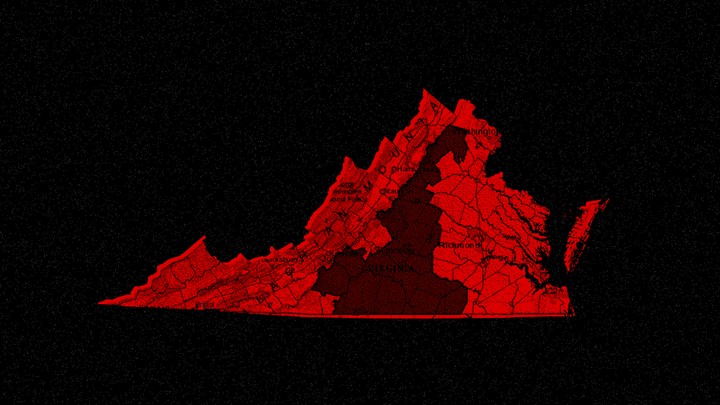
Virginia's gerrymandered 5th Congressional District.
Virginia is rapidly becoming a blue state despite the efforts of the majority of Republicans, particularly those from rural, economically moribund areas of the state.  A minority of Republicans recognize that the either the Virginia GOP changes or the state will have a Democrat majority for the foreseeable future (Republicans last won statewide office in 2009). In a nod to change, 5th Congressional District congressman Denver Riggleman officiated at the wedding of a same sex, mixed race couple, Alex Pisciarino and Anthony “Rek” LeCounte.  Little did Riggleman realize that this simple action would ignite a civil war within the Virginia GOP with the forces of reaction seeking Riggleman's expulsion from the party and primary defeat to replace Riggleman with a knuckle-dragging candidate with past ties to the religiously extreme Liberty University in Lynchburg, Virginia.  As a piece in Politico reports, the forces of reaction won and Riggleman ousted - likely to the delight of Democrats.  Here are highlights:
Rep. Denver Riggleman (R-Va.), who became a target of conservatives after officiating a same-sex wedding last year, was ousted Saturday by GOP voters in a drive-thru district convention. 
Good’s victory came after a day-long convention held in the parking lot of a central Virginia church. He ran as a staunch social conservative, campaigning on a traditional view of marriage, his support to make English the official language of the U.S. and to end birthright citizenship.
A piece in The Atlantic looks at the effort behind Riggleman's ouster and the push to drag the Virginia GOP even further rightward and homophobic and racist.  Here are excerpts:
Virginia Republicans have spent the past decade getting routed in elections. They lost three U.S. congressional seats and control of both chambers of the state legislature in 2018 [and 2019] alone. Yet today, with another tough election less than five months away, Republicans in Virginia’s Fifth District will gather in a church parking lot to decide whether to boot their incumbent congressman, Denver Riggleman, largely because he officiated a same-sex wedding last summer. The unconventional convention will earn the grooms, Alex Pisciarino and Anthony “Rek” LeCounte, a distinction in their first year of marriage that most people never achieve in a lifetime: They started a Republican civil war.
Virginia’s Fifth is a district where Bible Belt activists, suburban moderates, and college-town free-market types mix together in one massively gerrymandered area larger than New Jersey, stretching from the state’s southern border almost all the way to D.C. Riggleman, who owns a distillery outside Charlottesville, was one of the few rookie Virginia Republicans to win a competitive district amid the Democrats’ 2018 wave. But Riggleman’s success, and even an endorsement from President Donald Trump, may not save his job: The idiosyncrasies of Virginia election law mean there is a real risk he will be ousted by his own party. As Virginia turns blue, the question is whether the GOP can stay close enough to the center to hold competitive seats—or whether it will become more extreme as it shrinks.
“We don’t want a party so small that it just fits in the bedroom,” says Riggleman, an Air Force veteran with libertarian leanings on marijuana legalization, social issues, and small-business regulations. His opponent, Bob Good, who declined to speak with me, is a former athletics director at the evangelical Liberty University who has described himself in interviews as a “strong, bright-red,” “biblical,” and “constitutional conservative.” After Good was elected to the Campbell County Board of Supervisors in 2015, one of his first acts was signing onto a resolution declaring the U.S. Supreme Court “lawless” for legalizing same-sex marriage in Obergefell v. Hodges, comparing the decision to the Dred Scott case.
“We’ve played the ‘Who’s the bigger Christian?’ game in the Republican Party for a long time,” says Matt Hall, a conservative commentator who writes for Bearing Drift, a website focused on Virginia politics. “Bob comes from that minority—that small group of people that says you have to be this way or that way to be a Republican.” Riggleman’s liability, at least in this district, is that he is unwilling to conform to a culture-wars strategy. “Bob Good doesn’t get to define what’s Christian and what’s not Christian,” he told me. “You can say you’re a Christian conservative all day long. What I’m going to say is that I’m going to protect your right to be a Christian conservative. But I’m also going to protect your right to follow any religion that you want to.”
When Pisciarino and LeCounte moved to Charlottesville for graduate school in the summer of 2018, they wanted to get involved in local politics. Pisciarino, who is white, and LeCounte, who is black, were impressed by Riggleman’s record on LGBTQ issues. After Riggleman won, they figured it would be fun to ask him to officiate their wedding, a way of “celebrating the fact that we had a congressman we liked and wanted to elect,” LeCounte told me. . . . . Although they expected that local papers might write a story or two about the congressman’s involvement in their ceremony, LeCounte said, “We were not remotely expecting it to become the kind of story where we’re giving interviews about it almost a year later.”
The backlash was immediate. Melvin Adams, the district committee chair, wrote a post on the district’s website about “inclusiveness,” emphasizing that the Republican Party is committed to recognizing marriage “as the union of one man and one woman.” One Republican group after another in the Fifth District voted to censure or condemn Riggleman: in Cumberland County, then in Rappahannock. “The sanctity of marriage does not need to be redefined because it has been defined for thousands of years as one man and one woman. That’s a standard that I don’t think you can change, because that’s the standard that I believe the God of Creation established in the very first chapters of the Book of Genesis,” Travis Witt, a Bob Good supporter and pastor who serves on the Fifth District committee and the Republican Party of Virginia’s state central committee, told me.
Riggleman may have had an easier time securing his seat in a primary election; he has pitched his campaign as one of broad, conservative-coalition appeal. But the GOP’s Fifth District congressional candidate is about to be chosen by the party’s most ardent activists. Virginia election law allows districts to hold nominating conventions rather than primaries. Out of the roughly 3,500 people preregistered as delegates, some will have to drive several hours to cast their ballot on Saturday morning in the parking lot of Tree of Life Ministries in Lynchburg—Good’s home turf—remaining in their cars to prevent the spread of COVID-19. The whole process is set up to encourage participation from the people with the strongest views.
All of this may end up putting a relatively safe Republican seat in jeopardy. . . . . Choosing the more socially conservative candidate may end being an expensive form of purity: “It will cost the party a lot of money to defend a seat, and possibly lose a seat, that otherwise they’d walk into,” Davis said.
When Bob Good came to Charlottesville, Pisciarino and LeCounte attended one of his campaign events. They wanted to hear for themselves how their wedding had become part of his stump speech. Good moved through that section quickly, presumably because they were there, LeCounte said, but the experience was surreal: “It’s extremely bizarre to watch people argue about what they consider an abstract issue, which is our lives.” Pisciarino and LeCounte haven’t particularly enjoyed receiving calls from reporters to talk about the wedding that might unseat their friend and congressman. But they wanted “to take control of a narrative that was going to include us, one way or another,” LeCounte said. When the couple load up their blue sedan, with its Riggleman and UVA bumper stickers, and drive to Lynchburg today, they won’t just be voting for Riggleman. They’re voting for a different kind of Republican Party.
Sadly, there will not be a different kind of Republican Party in Virginia.  Only more and more electoral defeats will finally force change or see the much deserved death of today Virginia GOP..

Friday, June 12, 2020

GOP to Retain It's Anti-Gay, Anti-Woman, and Anti-Immigrant Party Platform


In yet another clear sign that the Republican Party remains the party of exclusion dominated by "Christian" extremists and white supremacists, the RNC has voted to retain the 2016 party platform in its entirety with no changes that might expand the the GOP's mythical and non-existent "big tent."  The "social issues" portion of the platform was largely written by Tony Perkins of Family Research Counsel, a certified hate group that is vitriolically anti-gay and seeks a total end to abortion in all cases.  On racial issues, Perkins has documented ties to white supremacy groups and retention of the 2016 platform - combined with Trump's objections to NASCAR ban of the confederate flag and changing the names of military bases bearing the names of Confederate generals - signals that the GOP will play the race card again in 2020.  Much of the opposition to any streamlining and toning down of the party platform has come from Christofascists to whom Trump continues to pander.  A piece Politico looks at the situation and a platform that hopefully harms down ballot candidates who may try to pretend they are moderates.  Here are highlights:
A vote by the Republican National Committee to leave the party’s 2016 party platform unchanged ahead of the November election has infuriated grassroots activists — including moderates who wanted to streamline its message and social conservatives who sought added language on emerging hot-button topics.
The decision by the party’s executive panel Wednesday means the GOP will maintain positions in the 4-year-old policy blueprint — including opposition to same-sex marriage and a nod to gay conversion therapy — and decline to stake out new positions on topics such as police reform, gender identity and third-trimester abortions. Party officials and senior Trump campaign aides had previously discussed ways to pare down the 58-page document to a single note card or abbreviated list of principles, but the effort broke down after several conservative groups registered complaints with the White House.
“America has changed incredibly since 2016 and not updating our platform to reflect that is an unforced error. The RNC should reconsider this terrible decision,” said Terry Schilling, executive director of the American Principles Project and a proponent of updating the platform to oppose efforts to defund law enforcement or permit transgender minors to undergo gender reassignment treatments.
“We can’t go into 2020 with the same platform we had in 2016, and by limiting the ability to make changes you run the risk of having a stale platform. It will be tone deaf,” Schilling added.
At the other end of the GOP spectrum, Jerri Ann Henry, former executive director of Log Cabin Republicans, said the decision effectively upholds “one of the worst platforms in terms of LGBT issues.” Henry, who has spent years fighting for marriage equality within the Republican Party, was supportive of a condensed platform that “harkens back to the party’s big principles and not the minute detail of every microscopic policy.”
But when plans to shrink the bloated platform fell through, the only suitable alternative in her view was to proceed with platform deliberations, which typically occur in the week or two prior to the party’s nominating convention.
The widespread disappointment in the decision to leave the platform unchanged illuminates one of President Donald Trump’s major hurdles as he campaigns for reelection. The same traditional conservative groups that objected to condensing the platform in a way that would have eliminated controversial planks on abortion, parental rights and LGBT issues are now annoyed they can’t change the platform to strengthen its language on some of those same issues and others.
At the same time, positions contained in the 2016 platform on abortion, education, marriage, LGBT rights and family structure could further alienate suburban voters and women. Those demographics abandoned the GOP in droves during the 2018 midterms and the Trump campaign has invested significant resources to try to win them back.
Grassroots conservatives [think Christofascists] view the platform as a mechanism for accountability and worried that eliminating its explicit language on social issues would open the door for Republican candidates to be deliberately vague on key issues. Among their concerns was that mentions of abortion — which comes up 35 times in the 2016 version — would be reduced.
“The full platform is still essential for guiding policy, holding legislators accountable, and for distinguishing policy differences between Republicans and Democrats,” the Eagle Forum had written in its Monday letter to Trump and McDaniels. “We respectfully request that all efforts to streamline the overall platform, which has been forged over more than a century of committed grassroots activism, be resisted.”
With the Platform Committee scrapped, the only official business that is likely to take place next month in Charlotte, N.C. — the original location of the 2020 GOP convention — is the selection of Trump as the party’s nominee. [Trump's] The president’s acceptance speech is expected to take place at a separate facility in Jacksonville, Fla., though the Trump campaign and RNC were still finalizing those details this week.

Tuesday, April 07, 2020

Coronavirus Is Forcing the GOP to Admit Its Ideology Is Delusional

The Republican Party discarded a belief in facts, logic and knowledge over two decades ago, first when it welcomed Christofascists into the party and, worse yet foolishly voted many of them onto local city and county committees, a move that forced many moderates to flee the party and its new members who embraced ignorance. Then, of course, there was the rise of the so-called Tea Party crowd which (i) overlapped significantly with the Christofascist set, and (ii) sought to gut the federal government.  Lastly, especially under Donald Trump, the Party embraced unabashed racists and white supremacists who sought to take the nation back to the days of segregation and white privilege writ large.  The ideology that emerged stressed (A) a hatred of foreigners, especially non-whites, (B) a mindset where the federal government needed to shrink and agencies needed to be dissolved, and (C) that the free-market should reign supreme. Now, as a lengthy piece in New York Magazine looks at how the coronavirus and the economic collapse it is triggering shows the delusional nature of the GOP agenda when confronted with a unrivaled crisis and inconvenient objective facts.  Here are article highlights:

As the coronavirus pandemic shutters America’s storefronts and fills its ICUs, the GOP is camouflaging a whispered confession beneath a cough. . . . But listen carefully to recent directives from the Trump administration and its allies and you’ll hear unmistakably: Our theory of governance is a lie.
The modern conservative movement holds these truths to be self-evident:
1. Undocumented immigrants are a scourge of American society, a nefarious invading army that’s depriving native-born workers of precious jobs, filling our cities with crime, and leeching off our welfare programs.
2. Uncle Sam has grown badly bloated and could govern more effectively if a wide swath of federal agencies were gutted.
3. The market is (a largely) apolitical sphere ruled by the impartial dictates of an invisible hand. Thus the superrich do not owe their astronomical market incomes to any set of politically ordained laws or institutions; rather, they earn their gains in a fundamental, metaphysical sense, and the state must therefore meet a heavy burden before it can justify coercively redistributing the wealth that billionaires have rightly earned. By the same token, the working poor cannot blame their low pay on political powerlessness but the objectively low value of their contributions to society.
Before the onset of the COVID-19 pandemic, Donald Trump made a halfway-convincing show of governing as though these claims had some correspondence with reality. . . . . Trump downsized the federal bureaucracies — first by neglecting to fill vacant positions, then by purging the “deep state” of experts who would privilege their official duties over personal loyalty to the commander-in-chief. Finally, the White House has affirmed the moral premises of laissez-faire by prioritizing tax cuts, inveighing against socialism, opposing an increase to the federal minimum wage, and slashing regulations that attempt to price the social costs of economic activity that market signals fail to capture.
A theory of government assembled out of the self-affirming delusions of the reactionary rich — and seething, amnesia-laden nostalgia of white cultural traditionalists — is bound to be a poor compass for guiding the ship of state. This was true before the coronavirus reached our shores. But the pandemic has brought the tension between the verities of CPAC and exigencies of governance to such vertiginous heights Republicans have been forced to (tacitly, quietly) make three startling admissions:
1. Undocumented immigrants are among the most indispensable contributors to the American economy.
The COVID-19 pandemic has forced the U.S. to determine whose labor it can and cannot live without. In much of the country, nonessential businesses have been forced to shut their doors . . . Unfortunately for Trumpism, undocumented agricultural workers are among our economy’s most valuable players.  . . .  his [Trump’s] administration has never before formally acknowledged the fact that undocumented workers are essential for keeping America fed.
By some estimates, roughly three-quarters of all crop hands in the U.S. do not have a legal right to be in this country. This is no accident. Since the early 1920s, when nativists enacted ethnic quotas restricting the inflow of Asian and European immigrants, America’s large growers have relied on Mexican migrants to provide the cheap, physically grueling seasonal labor that their business models demand.
There is little evidence that these workers are taking jobs from native-born Americans. When the Trump administration and the Federal Reserve implemented full-employment fiscal and monetary policies before the pandemic, the unemployment rate went to historic lows even as the undocumented population remained millions strong. Rather, undocumented farmworkers are mostly just aiding U.S. consumers by accepting the low wages that keep food prices down and subsidizing Social Security recipients by paying into that program despite their own ineligibility for benefits.
2. The administrative state needs to be reconstructed.
For the White House, this confession has been more tacit than explicit. But the pandemic has forced the Trump administration to confront the fact that much of America’s “administrative state” is less bloated than it is emaciated. In part, this is a mess of Trump’s own making; the president dissolved the National Security Council’s pandemic task force and pushed for cuts to the CDC and NIH budgets that plausibly undermined the initial response to the COVID-19 pandemic. Similarly, Trump’s understaffing of the Treasury Department has undermined the administration’s management of the present economic crisis. But other difficulties besetting the White House are more damning for the conservative movement ideologically than the president personally.
Unlike many less-wealthy nations, the U.S. lacks the state capacity necessary to rapidly deposit cash relief into citizens’ bank accounts or cover the wage bills of struggling firms. As a result, the Trump administration was forced to structure its small-business bailout as a forgivable-loan program implemented through private banks, rather than a grant program implemented by the federal government. This has vastly increased the logistical difficulty of getting public funds into small-business owners’ hands. Similarly, our underfunded IRS (and large unbanked population) has made getting cash-relief checks to all working-class Americans a months-long endeavor. Meanwhile, our nation’s sclerotic unemployment-insurance systems have been failing to process the tidal wave of new jobless claims, preventing laid-off workers from accessing their new enhanced benefits.
The White House’s allies defended its efforts to the Post by citing the “daunting set of tasks” that the pandemic has created for the White House. But what makes those tasks so daunting is precisely that wide swathes of America’s administrative state are in sorry need of reconstruction.
In Florida, the GOP has confessed this point more forthrightly. As the Sunshine State’s deliberately underfunded unemployment-insurance system crashed last week, an adviser to Republican governor Ron DeSantis described the government office as a “shit sandwich.”
3. The “free market” is a big government program.
Markets, money, and corporations are all creations of the state. The distribution of income is not determined by an invisible hand’s objective appraisal of each worker and investor’s marginal utility but by the politically constructed laws and institutions that structure economic activity in a given society. These are plain facts. But they are inconvenient ones for a party that exists to oppose the progressive redistribution of economic power in a heinously unequal society. If Republicans were to concede that there is nothing natural or inherently just about the market distribution of income, then they would have to affirmatively defend deliberately increasing the superrich’s share of GDP growth at a time when the top 0.1 percent of households own as much wealth as the bottom 90 percent combined.
And yet, even as some congressional Republicans flail to uphold the fiction of an apolitical marketplace, the Trump administration’s bailout policies have torn it to shreds. With Treasury Secretary Mnuchin’s eager approval, the Federal Reserve has set about directly financing U.S. corporations for the first time in its history. Which is to say: A government institution is deciding which firms to keep alive with cheap credit and which to let die. Meanwhile, the federal government is (however haphazardly) attempting to compensate firms and workers for their losses as it demonstrates its capacity to prioritize human welfare over economic growth.
The GOP’s tacit confessions of ideological obsolescence have been hushed, limited, and inconsistent. A reflexive aversion to contravening the prerogatives of capital is still undermining the White House’s response to the pandemic and recession. The Trump administration has stubbornly honored the conservative principle that the federal government must never coerce private industry into manufacturing public goods unless those goods can be used to kill foreigners.
Nevertheless, COVID-19 has called many of the conservative movement’s biggest bluffs. Perhaps the GOP will therefore emerge from this crisis an ideologically revitalized center-right party that’s committed to an evidence-based conservatism that would favor deregulation where appropriate (such as, say, for physician’s licensing requirements), heightened state capacity where needed, and respect for all hard-working Americans.
But it seems infinitely more likely that the same affinity for self-affirming delusions and memory-obliterating nostalgia that birthed movement conservatism will ensure that it remains a plague on our body politic long after we’ve kicked COVID-19.

Wednesday, February 26, 2020

The Issue of Race Continues to Haunt American Politics

Donald Trump uses perhaps the most openly racist calls to racial bigotry seen since the days of the segregationists in the late 1950's and 1960's.  He has been aided in his racist propaganda by white supremacists and white evangelical Christians - a group that hates everyone other than themselves - lead by charlatans and scamvangelists who have used racial resentment and manufactured dangers to gain political power for themselves and, just as importantly, to line their own pockets with money.  The question for Democrats and truly moral people is how to counter hate and racism and persuade a large segment of voters that racism and Trump's divide and conquer agenda does not truly further their interests or well-being.  A lengthy column in the New York Times looks at this difficult issue and the difficulty in finding a counter argument that will convince the "presuadables" that toxic racism is bad for America.  Here are highlights:

Stung by the success of Trump’s anti-immigrant, racist campaign themes in 2016, left-of-center advocacy groups — think tanks, unions, progressive academics and Democratic consultants — are developing tools this year to counter the continuing Republican assault on liberal values, based on the optimistic assumption that the reservoir of white animosity is not so deep that Trump is assured re-election.
These efforts on the left challenge the long history of Republican success in exploiting race . . . . That history points to the relentless power of racial resentment in American politics. Despite polling that shows greater acceptance of racial equality, this issue is as potent a source of political strength for Trump today as it was for Nixon a half century ago.
There are myriad studies, as I have noted (along with many others) that show the continuing effectiveness of race and immigration as wedge issues. These studies continue to appear at an alarming rate.
Take “The Trump Effect: An Experimental Investigation of the Emboldening Effect of Racially Inflammatory Elite Communication” published earlier this month by four political scientists:
We find that exposure to racially inflammatory statements by Trump caused those with high levels of prejudice to be more likely to perceive engagement in prejudiced behavior as socially acceptable.
In other words, if the president of the United States denigrates Muslims, or Hispanics, or African-Americans, then anyone can.
A forthcoming paper by Desmond King and Rogers M. Smith, political scientists at Oxford and the University of Pennsylvania, “White Protectionism in America,” makes a strong case that Trump, unlike his Republican predecessors in the White House, has gone far beyond rhetoric and token gestures to substantively address the concerns of his anti-immigrant and socially conservative supporters.
Now let’s look at some of the Democratic and liberal thinking focused on undermining Trump’s divide-and-conquer strategy.
The authors, Simon Greer, founder of Cambridge Health Ventures, and Richard D. Kahlenberg, a senior fellow at the foundation, note that
Working-class Americans do not want to be lectured about what their motivations are, and ascribing misogyny or racial animus to any group of potential voters is not a winning strategy for building a coalition.
One of the authors’ central arguments is that liberals have ceded to conservatives a monopoly on such themes and values as faith, family, country and law and order. They have done so because Republicans have “added a meanspirited twist to these mainstream values” as a way of attacking women’s and gay rights, blacks, antiwar protesters and single mothers.
[A] paper that was published last year, that voters are less concerned with candidates’ specific policies than with the values they espouse:
We found that a presidential candidate who framed his progressive economic platform to be consistent with more conservative value concerns like patriotism, family, and respect for tradition — as opposed to more liberal value concerns like equality and social justice — was supported significantly more by conservatives and, unexpectedly, by moderates as well.
Voelkel and Willer conclude by citing the “progressive paradox,” that Americans “support many core progressive economic policies at high levels, yet rarely elect progressive candidates, a paradox widely discussed in academic and popular literature.”
The Race-Class project . . . . . according to the report, these middle ground voters “have concerns about ‘reverse racism’ and discrimination against whites;” a sizable majority agree “focusing on race doesn’t fix anything and may even make things worse;” and “persuadable adults believe that people of color who cannot get ahead are mostly responsible for their own condition.”
In other words, these persuadable voters provide fertile ground for conservative appeals to racial resentment.
The most effective liberal-Democratic message read:
America’s strength comes from our ability to work together — to knit together a landscape of people from different places and of different races into one nation. For this to be a place of freedom for all, we cannot let the greedy few and the politicians they pay for turn what you look like, where you come from or how much money you have into reasons some of us matter and others don’t. It’s time to stand up for each other and come together. It is time for us to pick leaders who reflect the very best of every kind of American. Together, we can make this a place where freedom is for everyone, no exceptions.
For the Democratic Party, race and immigration remain crucially important in terms of both values and policy. The key question is whether the party is structurally capable — under an extraordinary barrage of hostility directed by Republicans at African-Americans and immigrants — of finding politically effective ways of addressing race and immigration. Has the left wing of the party become so discouraged, so defensive — and so embattled — that it now perceives a critical mass of whites as intractably hardened and unswervingly opposed to minority interests? If moderates and progressives are locked in on either side of such a chasm, what will it take to make peace?
Sadly, Bernie Sanders' "my way or the highway" message does not telegraph the most effective liberal messaging. In a different manner, he is almost as divisive as Trump. 

Saturday, December 21, 2019

The Tyranny of the Republican Minority

The sad reality is that Donald Trump is a racist misogynist who, as Christianity Today noted in an editorial Thursday, is morally unfit and who needs to be removed from office. Yet his base, especially evangelicals, who comprise a minority of voters,  continue to support him with an almost cult-like fervor.  Despite all the denials and excuses by members of his base, the take away is that members of his base are as depraved as Trump himself and/or outright racists who cannot countenance the demographic changes occur in the country or the reality that the 63 million voters Republicans whine about did NOT and do NOT represent a majority of voters.  Thus, the 2016 vote in no way granted Trump and/or Republicans a mandate.  Indeed, but for the highly flawed and outdated Electoral College, Trump would not and should not have been elected. A column in the New York Times looks at the disingenuous effort by Republicans to depict Trump's impeachment as an effort to overturn majority rule. Here are highlights:

[T]his constant trumpeting of a vote total that is more than two million less than the total received by Trump’s opponent, Hillary Clinton. Trump didn’t just lose the popular vote — he lost it by a greater margin than any successful presidential candidate in American history. The right’s bombastic repetition of Trump’s 63 million could be just a propaganda trick meant to bully America’s anti-Trump majority into seeing itself as marginal, despite the more than 65 million votes Clinton received. But as I watched impeachment unfold, it seemed like something more than that — an assertion of whom Republicans think this country belongs to.
Over the last three years, a political narrative has developed that Republicans in Congress secretly dislike Trump but overlook his personal degeneracy in the interest of enacting their agenda. Wednesday should explode that fiction forever.
The Republican identification with Trump is total. Again and again, histrionic Republican congressmen equated hatred of the president with hatred of themselves and hatred of the sacred 63 million. They spoke of Trump with an awe and a maudlin devotion bordering on religious; Barry Loudermilk, a Georgia Republican, declared that Trump had been given less due process than Jesus Christ himself.
All day, Republican speeches delivered by old white men alternated with Democratic speeches from women, people of color and young people. White men make up 90 percent of the Republican caucus and 38 percent of the Democratic one, and the day dramatized the representational gulf in the starkest visual terms.
We face the horror of Trump because the structure of American democracy gives disproportionate power to a declining demographic group passionately convinced of its right to rule. Trump, with his braying entitlement, his boastful ignorance, his sneering contempt for pluralism, is an avatar of a Republican Party desperate to return to the 1980s, or the 1950s, or maybe the 1910s. He can’t betray America if, to those who fetishize the 63 million, he embodies it.
At the start of this administration, many who are horrified by Trump, me included, thought that at some point the Republican fever might break, leading conservatives in Congress to check a dictator-worshiping buffoon for the sake of the Constitution they claim to revere. I’ve become ashamed of my naïveté in imagining any overlap between my ideas about what is valuable in this country, and theirs.
“There’s been a lot of talk about the 63 million people who voted for Mr. Trump,” the House majority leader, Steny Hoyer, said in his surprisingly moving speech on Wednesday. “Little talk about the 65 million people who voted for Hillary Clinton.” With the House’s impeachment vote, the America outside of Trump’s ruling faction finally mattered.
Democrats didn’t want to impeach, but once they decided to, Trump’s insistence that his Electoral College victory grants him impunity didn’t work. For one night, democracy asserted itself.
In the end, Trump’s impeachment passed with more House votes than Bill Clinton’s. All but one of the Democrats first elected in last year’s blue wave voted for impeachment, some at real political risk, given the conservative lean of their districts.
“Today, especially today, I reflect on the founding documents that have set us apart in the world, leading people across generations and across the world to risk everything because of their belief in our great nation,” said the Virginia Democrat Abigail Spanberger, a Constitution scarf around her neck, her voice charged with emotion.
Women and people of color, of course, were originally outside the protection of those founding documents. But on Wednesday, the most diverse Congress in history declared that even the most powerful white man in the world should be bound by them. When Republicans act as if that’s a sacrilege, they show us what they worship.