Showing posts with label U. S. House of Representatives. Show all posts

Saturday, June 20, 2020

Why Is the GOP Fighting to Preserve Monuments to Traitors?

When goes to France, one does not see statutes of those who held positions in the Vichy government.  Across the former Soviet block one sees few monuments to communist leaders and even in Russia, there has been a resurgence of recognition of the tsarist era which in retrospect was no where near as repressive and murderous as the communist era ushered in by Lenin and the Bolsheviks. Brutal regimes and the losers in the stage of history are not typically honored by statutes and monuments once the regimes have fallen.  Except in the American South where a battle now rages over the statutes to the Confederacy - most erected during the Jim Crow era, not the immediate aftermath of the Civil War.  On the side of honoring those who in effect were traitors to the United States is the Republican Party, the descendant party of the one that fought the Civil War to end slavery and defeat those honored by monuments and statutes such as those on Monument Avenue in Richmond, Virginia, a truly beautiful street and grand residential area. An editorial in the New York Times asks the question of why.  My own short hand answer is that today's GOP is the party of white supremacy lead by the racist-in-chief, Donald Trump.  Here editorial highlights:
Confederate statues are being pulled down across the South — from Birmingham, Ala., to Decatur, Ga., to Richmond, Va., the Confederacy’s former capital. The U.S. Navy and the Marines have banned public displays of the Confederate battle flag — as has NASCAR.
Now, Congress is taking its own halting steps forward. On Thursday, the House speaker, Nancy Pelosi, announced that portraits of four former House speakers who also served the Confederacy would be removed from display in the Capitol in observance of the Juneteenth holiday.
The portraits are of Robert M.T. Hunter of Virginia, who was speaker from 1839 to 1841 before serving in various high positions in the Confederacy, including secretary of state; Howell Cobb of Georgia, who was speaker from 1849 to 1851 and later served as a Confederate Army officer; James L. Orr of South Carolina, speaker from 1857 to 1859, who went on to serve in the Confederate Army and in the Confederate Senate; and Charles F. Crisp of Georgia, the House speaker from 1891 to 1895, who served in the Confederate Army as a young man.
“As I have said before, the halls of Congress are the very heart of our democracy,” Ms. Pelosi wrote to the clerk of the House, requesting the removal. “There is no room in the hallowed halls of Congress or in any place of honor for memorializing men who embody the violent bigotry and grotesque racism of the Confederacy.”
Over in the Senate, Cory Booker, Democrat of New Jersey, tried to nudge his chamber forward as well. He and the Democratic leader, Chuck Schumer, moved Thursday to pass a bill by unanimous consent that would remove 11 monuments to Confederates from the National Statuary Hall Collection displayed in the Capitol.
Not all of Mr. Booker’s colleagues agreed. Senator Roy Blunt, Republican of Missouri, blocked the move. . . . The Senate majority leader, Mitch McConnell of Kentucky, was more outspoken in his opposition. On Tuesday, he derided brewing efforts to “airbrush the Capitol and scrub out everybody from years ago who had any connection to slavery” as “nonsense” and “a bridge too far.” He even felt moved to list for reporters some of the early presidents who owned slaves.
None of those presidents, it should be noted, went to war against the United States to defend slavery. Nor are all the 11 statues of peripheral figures who had just “any connection” to the war for chattel slavery. The statues include one of Jefferson Davis, the president of the Confederate States of America; Alexander Hamilton Stephens, the vice president; and its most famous general, Robert E. Lee. There are other statues of men less central to the rebel cause. But given that states can select any person of note from their state, surely there are many other men or women who don’t have the Confederacy on their résumés.
Is this really the hill that the Party of Lincoln wants to fight on in 2020? What an ignoble, lost cause.
Once again, America is showing itself to be exceptional, but not in a good way.

Saturday, March 28, 2020

Rep. Thomas Massie Typifies the Ugliness of Today's Republicans

GOP Rep. Thomas Massie - a monster of the GOP's creation.
Anyone following the $2.2 trillion coronavirus stimulus package knows that Rep. Thomas Massie (R-Ky.) opposed the legislation and forced members of the House to physically travel to Washington, D.C. for a roll call vote.  The action was typical of the far right in the GOP that seeks to do nothing but obstruct bipartisan action and to revel in every lunatic conspiracy theory about the mythical "deep state" that purportedly opposes Donald Trump and the GOP's reverse Robin Hood agenda.   The GOP has become unrecognizable from the the party in which I once was an activist and City Committee member - while moving I came across the "Patrick Henry" award I had received from Virginia Governor Jim Gilmore for my support of principled and responsible government - and in which I had been raised. The party's transformation was allowed by party leaders and, in my view, tracks directly to the decision to allow Christofascists to gain seats in city and county committees across America, forcing out sane moderates in the process.  A column in the  Washington Post looks at how the GOP made extremists like Massie main stream in the GOP.  Here are column excerpts:
Republicans were aghast that one of their own had committed such a monstrously selfish act.
Rep. Thomas Massie (R-Ky.), in purely symbolic opposition to the $2.2 trillion emergency coronavirus legislation, forced hundreds of his colleagues to risk their lives — literally — by flying back to Washington. So what if many of the lawmakers are elderly and at high risk?
To thwart Massie’s pointless protest, an attempt to force a roll-call vote instead of a simple voice vote, leaders had to summon 216 members to fill the chamber, eerily separated on the floor and in the gallery above to limit infection. This fruitless, immoral gesture by the 49-year-old legislator was in service of another: to thwart a nearly unanimous Congress from dispensing aid to the sick and suffering in the middle of a pandemic.
But if Republicans are disturbed by Massie, they might pause for self-reflection. Massie is the epitome of the anti-government culture they have nurtured and encouraged. He embodies the drain-the-swamp political philosophy they have embraced.
Unanimous consent doesn’t kill the Republic. Unanimity, or at least consensus, is what we need in Washington, and what we have lost. Massie and scores like him in the congressional GOP exist to break up consensus, to throw sand in the gears, to hobble government. Maybe Massie’s antics in this moment of national crisis will help Republicans remember that the government they’ve been demonizing is the only thing they have to save a collapsing national economy and stop a deadly disease.
Massie, a believer in the “deep state” conspiracy, is a product of the tea party, a protege of Sen. Rand Paul (R-Ky.) and a collaborator with outgoing Rep. Mark Meadows (R-N.C.), who is becoming Trump’s chief of staff, when they tried to oust then-Speaker John Boehner. “I’m ready to be unpopular,” Massie said after his 2012 election, and he has opposed even anti-lynching and human rights legislation — and celebrated when he uses “the process” so that “things die.”
He is emblematic of the newer Republicans who congressional scholars Norman Ornstein and Thomas Mann say have turned the GOP into an “insurgent outlier," rewarding bomb-throwers and making compromise with Democrats all but impossible.
Massie, he said, “is a monster created by their deliberate attempt to get people to have contempt for government and institutions that are part of government.” That contempt gave rise to Trump, but it also remade the Republican caucus in Congress.
Massie boasts that Trump named him a co-chair of his reelection campaign in Kentucky, and Trump has retweeted Massie and said that Massie is “doing a great job” and is “so good.”
No longer. Some on both sides complained about flaws in the legislation during Friday’s debate. And there’s much in the bill to dislike; particularly outrageous is the decision to give the District of Columbia only about $500 million, while less populous and less affected states each get $1.2 billion. But the alternative to the hard-fought compromise — doing nothing — was unthinkable. Massie’s protest served only to turn the House chamber into a petri dish.
Republicans may be spared the question of what to do with Massie, who has a serious primary challenger. But what about all the other Massies in their ranks?
With luck, Massie’s ugly spectacle, and the exploding public health and economic crises, will cause Republicans to see the limits of their corrosive message that government is the enemy.


Sadly, I doubt that Massie's stunt will cause any Republicans to rethink their toxic, obstructionist agenda.

Wednesday, November 20, 2019

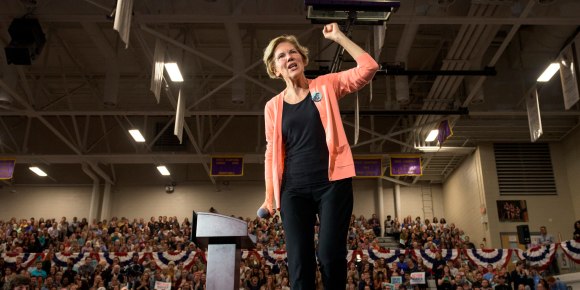
Elizabeth Warren Could Jeopardize Democrats in the House and the Senate

Selecting candidates for general elections is about picking a candidate that can both win and not wreak havoc on down ticket candidates. A long and well reasoned and researched column in the New York Times makes the case that Elizabeth Warren as the Democrat standard bearer could (i) result in Trump's re-election, and (ii) significant loses by Democrats in the House and Senate.  The same reasoning applies to Bernie Sanders and, to me, makes it clear that neither Warren or Sanders should be the nominee.   Their respective supporters, who the article points out tend to be the whitest and most affluent, simply are out of touch with what sells in Middle America, including among many more traditional and moderate Democrats. This is especially true in the half dozen swing states in the Mid-West that will likely decide who wins the Electoral College contest.  Running up huge vote leads in say California or New York means nothing in the Electoral College math calculation.  Here are lengthy column highlights which thinking Democrats need to read in full:

Under pressure, Elizabeth Warren has retreated from the idea of immediate implementation of Medicare for All, but she remains committed to the progressive core of her candidacy.
As she put it in a speech to Iowa Democrats on Nov. 1:
If we’re going to meet the challenges of our time, we need big ideas. Big ideas to inspire people and get them out to caucus and get them out to vote. Big ideas to be the lifeblood of our party and show the world who and what Democrats will fight for.
In rhetoric that drew enthusiastic applause from her supporters at the Liberty and Justice Dinner in Des Moines, Warren declared that the nation is at “a time of crisis, and media pundits, Washington insiders, even some people in our own party don’t want to admit it. They think that running some vague campaign that nibbles around the edges is somehow safe.”
Democrats will win, she continued, “when we offer solutions big enough to touch the problems that are in people’s lives. Fear and complacency does not win elections; hope and courage wins elections.”
There is evidence, however, that Warren’s strategy could generate a backlash leading to the re-election of Donald Trump.
Andrew Hall and Daniel Thompson, political scientists at Stanford, examined “the link between the ideology of congressional candidates and the turnout of their parties’ bases in US House races, 2006—2014” in their 2018 paper “Who Punishes Extremist Nominees? Candidate Ideology and Turning Out the Base in US Elections.”
In contrast to moderate candidates, Hall and Thompson found: Extremist candidates do worse, because, contrary to rhetoric, they fail to galvanize their own base and instead encourage the opposing party’s base to turn out more, on average.
In other words, polarizing candidates diminish turnout in their own party while boosting turnout among opposing partisans.
Alan Abramowitz, a political scientist at Emory, analyzed the pattern of Democratic victories in 2018 House races and found that “those who supported Medicare for All performed worse than those who did not, even when controlling for other factors.”
The analyses by Hall, Thompson and Abramowitz do not preclude the possibility that Warren could beat Trump in 2020. Whoever the Democratic nominee is will be able to capitalize on widespread hostility to Trump, a motivated Democratic electorate and the party’s continuing gains in formerly Republican suburbs across the nation.
An underlying premise of the campaigns of both Warren and Bernie Sanders is that taking radically progressive stands will motivate, enlarge and turn out the Democratic base, including minorities, the young and the poor; and that such positions are necessary to restore Democratic support among those who voted for third party candidates in 2016.
As much as the Warren program has mobilized many Democratic primary voters, polls show that significant numbers of swing voters — wavering Republicans repelled by President Trump and moderate to conservative Democrats — do not share Warren’s appetite for major structural change, preferring incremental change and the repair of existing programs, like Obamacare.
Strategically, if Warren wins the Democratic nomination, the election would become not only a referendum on Trump — favorable terrain for Democrats — but also a referendum on Warren’s program, a far less certain proposition.
“Many of Senator Warren’s proposals are indeed radical and could have unintended consequences,” Jeffrey Frankel, an economist at Harvard’s Kennedy School and a member of the Council of Economic Advisers during the Clinton administration, wrote by email. He added: “I fear that by far the worst of the unintended consequences of making these proposals during the campaign is to get Donald Trump re-elected.”
Larry Summers is a former secretary of the Treasury, director of the national economic council and president of Harvard. The Warren program, Summers wrote by email, “dwarfs the errors, economic and political, of George McGovern.”
Last week, in an effort to mute criticism that her agenda would be not only difficult to enact in toto but also highly disruptive if it became law, Warren announced a significant modification of her version of Medicare for All. Instead of trying to immediately pass a complete government takeover of health care that would eliminate private insurance plans, she proposed “a true Medicare for All option,” or what has generally been described as a public option — and that has strong support among voters of all stripes.
Warren’s new stance appears to be an acknowledgment of the fact that her proposal to replace all health private coverage with Medicare for All does not carry majority support even among Democratic primary voters, a liberal constituency, much less the general electorate.
While liberal economists have mixed views of Warren’s agenda, a number of political observers warn that candidates for the House and Senate would face a steeper climb to victory with Warren at the top of the ticket.
“It would be tough to run under Elizabeth Warren,” David Wasserman, who studies House races for the Cook Report, said in an interview. “As of now, she runs the weakest against Trump in battleground areas and her proposals are not broadly popular.”
The worst case scenario, Wasserman argued, “would be to have Elizabeth Warren at the top of ticket with a plausible chance to win.” He argued that swing voters worried about a Warren presidency would vote in support of a Republican Congress to act as a check on her.
“Anyone at the top of the ticket who repels these Republicans will make it more difficult to win the key House and Senate seats Democrats have targeted,” Trippi said.
Whit Ayres, president of North Star Opinion Research, was outspoken: “Elizabeth Warren is God’s gift to Donald Trump and Republican candidates.”
“Well-educated suburban voters, especially women,” Ayres continued, “are uncomfortable with President Trump,” but, he added, they are not going to vote for a candidate who wants to take away their private health insurance, decriminalize the border, increase government spending by 50 percent, and ban fracking, especially in Pennsylvania, Ohio and Colorado.
Wariness toward the kind of disruptive structural change Warren is calling for can be seen among Democratic voters in six battleground states — Michigan, Wisconsin, Pennsylvania, North Carolina, Arizona and Florida — as a New York Times/Siena College survey conducted Oct. 13-26 demonstrated.
By 62 to 33, these Democrats said they would prefer a candidates who promises “to find common ground with Republicans” to one who promises “to fight for a bold progressive agenda;” by 55 to 36 a candidate who is more “moderate than most Democrats” to one who is “more liberal than most Democrats;” and by 49 to 45 a candidate who promises “to bring politics in Washington back to normal” to a candidate who promises “to bring fundamental, systematic change to American society.”
The same Times/Siena College survey identified 596 undecided or “persuadable” voters in these six states . . . They are fairly clear about what they would like from a Democrat. They prefer, by 82 percent to 11 percent, one who promises to find common ground over one who promises to fight for a progressive agenda; and they prefer a moderate over a liberal, 75 percent to 19 percent.
Patterson’s analysis points to the larger question that looms constantly over the nomination fight: Is the progressive wing of the Democratic primary electorate, and its demand that the nominee take stands on health care, energy and immigration well to the left of the electorate at large, the main obstacle to Democratic victory in 2020?

Tuesday, October 29, 2019

Trump's Ludicrous Claim That Impeachment is Unconstitutional

At times it seems there is no limit to the lies and disinformation that Trump's cult followers and much of the GOP base will willingly swallow.  Just as they reject modern knowledge on a range of issues that varies from climate change to the immutability of sexual orientation, so too, they reject even a semblance of a knowledge of accurate history.  How else to explain their embrace of Trump's claim that impeachment is "unconstitutional" despite the fact that it derives directly from the provisions of the U. S. Constitution. As a column in the New York Times lays out, the same falsity applies to Trump's claim that his impeachment and removal from office would "reverse the 2016 election."  If Trump is removed, Mike Pence, a Republican, would rise to the office of president - unless, of course, Pence is shown to have engaged in "high crimes and misdemeanors" like Trump. The column looks at how we got to today's presidential elections and the dishonesty of Trump's claims - ditto for his bootlickers like Lindsey Graham. Here are column excerpts:

As House Democrats ramp up their impeachment investigation into President Trump, an increasingly vocal charge from the president’s supporters (and the White House) is that the House is attempting to “overturn” the results of the 2016 election.
The charge is that impeaching and removing an elected president is illegitimate because it is anti-democratic — because the person the voters (or, at least in this case, the Electoral College) chose ends up out of office. This argument is silly — impeachment is in the Constitution as a way of dealing with the abuse of executive power.
But to fully understand why the charge is ludicrous, it may help to go back 219 years — to the origins of a constitutional provision that receives virtually no attention in contemporary discourse, the 12th Amendment.
Congress responded with the 12th Amendment, proposed in December 1803 and ratified by the states, by the standards of constitutional amendments, practically overnight. That provision gave us the presidential elections we have today, in which electors cast one vote apiece for president and vice president. And so long as the current two-party system prevails, the 12th Amendment thereby all but guarantees that an elected vice president will be, if not from the same party as the elected president, at least the nominee of the same party.
[E]ven if the House ultimately impeaches Mr. Trump and the Senate removes him, the result would simply be to elevate to the presidency Mr. Trump’s own handpicked running mate, Vice President Mike Pence — who could then nominate his own vice president under the 25th Amendment.
Against that backdrop, it’s difficult to see how removing Mr. Trump would “overturn” the results of the election, since the same party that won would remain in control of the White House. But there’s a deeper and more important point here: The founders wrote the impeachment and removal power into the Constitution at a time when that wasn’t true — when there was no 12th Amendment, and so it was entirely possible that removing the president from office would hand power over to one of his rivals.
That’s exactly what would have happened, for instance, if the Democratic-Republicans had taken over Congress in the 1798 midterm elections instead of in 1800, and then removed Adams in favor of Jefferson. But even in the face of that possibility, the founders still gave the House the power to impeach and the Senate the power to remove — because it was more important that the legislature should have a check on the executive.
Checks and balances run in both directions. To that end, the Constitution’s drafters took away the vice president’s power to preside over presidential removal trials in the Senate (and gave it to the chief justice). And although a bare majority of the House has the power to impeach, the founders required a two-thirds vote of the Senate for removal — to ensure that a geographically representative supermajority agreed with the House’s determination that the president had engaged in misconduct that should disqualify him from office.
This is why impeachment and removal remain extraordinary remedies for extraordinary misconduct by the president of the United States. But the founders would have been appalled at the suggestion that such measures are illegitimate solely because their result would be that the president is no longer the president. If that didn’t faze them even when the result could have been to hand the presidency to the president’s rival, it certainly wouldn’t faze them today, when it would hand the presidency to the president’s own handpicked running mate.
Just as science is the enemy of today's GOP base, so too is an accurate knowledge of history and the nation's founding documents.  This deliberate embrace of ignorance sets the state for demagogues and would be authoritarians. 

Wednesday, October 02, 2019

Trump Implicates Pence in Ukraine Impeachment Scandal.

Pence is lying about his role in the Ukraine scandal.

So far during his term as Donald Trump's sycophant-in-chief, Mike Pence has worked hard to engage in a "Sergeant Schultz" routine of claiming he saw nothing, heard nothing and knew nothing about Trump's various misdeeds and abuses of his office.  Indeed, some have remarked that it defies belief that Pence is as out of the loop and as uninformed as he would have the American public believe. Now, with the House of Representatives impeachment heating up, Trump is not only spouting insane nonsense, but he is also implicating Pence, Pompeo and others as having been on the threat/intimidation call to the president of Ukraine and, it would seem, part of the conspiracy to cover up the details of the call and Trump's call for a quid pro quo from Ukraine in exchange for much needed military aid. A piece in the Washington Post looks at Trump's implication of Pence in the entire effort that now threatens Trump - and by extension, Pence - with impeachment.  The overall take away is that of a criminal operation by a mobster and his lieutenants and henchmen.  Here are article excerpts:

President Trump repeatedly involved Vice President Pence in efforts to exert pressure on the leader of Ukraine at a time when the president was using other channels to solicit information that he hoped would be damaging to a Democratic rival, current and former U.S. officials said.
Trump instructed Pence not to attend the inauguration of Ukrainian President Volodymyr Zelensky in May — an event White House officials had pushed to put on the vice president’s calendar — when Ukraine’s new leader was seeking recognition and support from Washington, the officials said.
Months later, [Trump] the president used Pence to tell Zelensky that U.S. aid was still being withheld while demanding more aggressive action on corruption, officials said. At that time — following Trump’s July 25 phone call with Zelenksy — the Ukrainians probably understood action on corruption to include the investigation of former vice president Joe Biden and his son Hunter Biden.
Officials close to Pence insist that he was unaware of Trump’s efforts to press Zelensky for damaging information about Biden and his son
Pence’s activities occurred amid several indications of the president’s hidden agenda. Among them were the abrupt removal of the U.S. ambassador to Kiev; the visible efforts by the president’s lawyer, Rudolph W. Giuliani, to insert himself in the U.S.-Ukraine relationship; as well as alarms being raised inside the White House even before the emergence of an extraordinary whistleblower complaint about Trump’s conduct.
Perhaps most significantly, one of Pence’s top advisers was on the July 25 call and the vice president should have had access to the transcript within hours, officials said.
Trump’s deployment of Pence is part of a broader pattern of using both executive authority and high-ranking officials in his administration to advance his personal or political interests — even in cases when those subordinates appear not to know that another agenda is in play.
White House officials said that Pence likely would have received the detailed notes of the president’s call in his briefing book on July 26.The five-page document also should have been part of the briefing materials he took with him to Warsaw to prepare for the meeting, according to the officials who spoke on the condition of anonymity to discuss internal matters.
In his meeting with Zelensky, Pence conveyed the news that hundreds of millions of dollars in U.S. aid to Ukraine was not going to be released amid concerns about the country’s lagging efforts to combat corruption. He also emphasized Trump’s frustration that he thought the European Union was not doing a sufficient job in helping to provide aid.
[F]ormer officials said that Pence’s emphasis on corruption probably would have been interpreted by Zelensky as “code” for that issue [i.e. finding dirt on Biden], whether the vice president intended it or not. . . . A top Pence staffer rejected the charge that the vice president was conveying an inappropriate — or coded — message from the president.  


A piece in New York Magazine looks further into Pence's extensive role that suggests that either his Sergeant Schultz routine is a big lie or that he is so stupid and incompetent that he needs to resign his office.  Here are highlights:
Vice-President Mike Pence is knee-deep in the Ukraine scandal. He is floating the absurd defense that, while he did participate in Trump’s plan to extort Ukraine into investigating Joe Biden, he was completely ignorant of what he was doing.

Although President Trump “used Pence to tell [Ukrainian president Volodymyr] Zelensky that U.S. aid was still being withheld,” the Washington Post reports, Pence’s aides insist he had no idea what he was actually being used for.
Pence’s involvement in the plot was extensive. White House officials had him cancel a planned trip to Zelensky’s inauguration. One of Pence’s top advisers was on the July 25 call when Trump made clear his demand that Zelensky open investigations into various Democratic officials, including Biden, whom Trump named on the call. Pence was given the transcript of the call before his September 1 meeting with Zelensky, when he reiterated Trump’s threat.
Pence’s defense is that, even though the readout of Trump’s call with Zelensky was in his briefing materials on his trip to Europe, he did not bother to read it before the meeting.
So Pence didn’t read or understand the vital background information he needed before this important national-security meeting. He didn’t hear the widespread alarm rippling through the administration that Trump was acting improperly. He somehow failed to pick up on Rudy Giuliani’s repeated public boasts — in the New York Times, on Fox News, on Twitter, and in any media he could find — that he was pressuring Ukraine to investigate the Bidens in his personal capacity as Trump’s lawyer. Most amazing, Pence’s defense is that when he delivered Trump’s threat in the meeting with Zelensky, Pence had no idea that “corruption” was code for ordering up investigations of Trump’s domestic enemies. If Pence is so ignorant that he could be pulled into an extortion plot without having any idea what he was doing, while missing numerous public and private signs that would have spelled it out, he is too dumb to serve as vice-president or even to be allowed to use metal cutlery. There is no way Pence is quite that stupid.
Pence was asked whether the aid was being held up over the Biden probes, and he answered by reciting the “corruption” party line. Pence knew exactly what he was doing.


If one needs further proof that Pence is lying, consider this: in all my years in politics - and life in general - absolutely no one lies more than evangelical Christians, a group that Pence claims to belong to. 

Sunday, September 08, 2019

Congressional Republicans Are Dropping Like Flies

Ben Wiseman.
While today's Republican Party has become a moral cesspool as noted in a prior post, there are seemingly some positive signs: congressional Republicans are opting to not seek re-election at a rate on pace to equal or exceed the number who chose to leave office in the run up to the 2018 midterm elections. Some electing to retire seem disgusted with what the party has become, others fear electoral defeat in the face of changing demographics, and others simply do not want to serve in what they expect will remain the minority party in the House of Representatives after the 2020 elections.  Whether or not these exits from office are an indication of Trump's chances in 2020 remain to be seen, but at lease bode well if the House remains in Democrat control. A column in the New York Times looks at the phenomenon.  Here are excerpts:

There was no home for Representative Will Hurd in Donald Trump’s Republican Party.
For a while he tried to make one. For a while he succeeded, if success means preserving some of your dignity while steering clear of Trump’s wrath and surviving politically. Although Hurd’s Texas congressional district voted narrowly for Hillary Clinton in 2016, he held on to his seat that year and again in 2018, but by slim margins. It was anyone’s guess how he’d fare in 2020, and now no one will know. Hurd, 42, isn’t seeking re-election — he and a big, expanding bunch of his Republican colleagues in the House.
We talk and write all the time about the Never Trumpers: . . . . But they’re not the best gauges of his and the party’s political fortunes. Their estrangement and emotional pitch have been changeless. The more interesting and maybe predictive group are the Republicans who, to varying degrees, tried to make do with Trump, found ways to rationalize him and still won’t acknowledge how offensive he is but have fled or are fleeing government nonetheless. He made their participation in political life joyless. He so thoroughly befouled their party’s image that they reek by association. And, thanks largely if not entirely to him, many of them faced or face punishment at the polls. In the cause of figuring out whether, in November 2020, Trump will be rewarded with a second term, many numbers and dynamics get tossed around: the unemployment figures, the Dow Jones, the trade war, the advantages of incumbency, the peculiarities of the Electoral College and Trump’s approval ratings, consistently low but not entirely static. 
But at least one constituency is unconvinced of that: Republicans in Congress, especially in the House. They’re making their predictions with their feet, and they’re heading for the exit.
To recap: Before the 2018 midterms, 46 Republicans but only 20 Democrats decided not to seek re-election to their offices in Congress, and among those, 32 Republicans and 11 Democrats weren’t doing that in order to run for some higher, different post. They were just bolting. The discrepancy between the Republican and Democratic numbers amounted to a weather forecast — and an accurate one at that.
Heading into the 2020 election, 19 Republicans in Congress have already announced that they won’t seek another term in their current office, a number higher than at the same point two years ago. Of the 19, 17 aren’t retiring from Congress to pursue some kind of political promotion. Meanwhile, only four Democrats in all are retiring from Congress. Maybe Trump’s fortunes are untethered from his party’s. . . . His campaign associates go to jail; he goes to the Group of 7. The most principled Republicans are driven from the fold; he reigns without principle over a party that has largely bent to his wishes rather than stand up for what it purported to believe. The departures this time around speak volumes about looming threats to the Republican Party. Five of the House Republicans who aren’t running again, including Hurd, are from Texas, a red state whose demographic composition fills Democrats with more and more hope. Two of only 13 Republican women in the House are stepping down. Hurd is the only black Republican in the House — a detail that he underlined in a sort of farewell note that he wrote and posted on his website. Hurd announced his decision not to run again shortly after Trump attacked “the squad” of four congresswomen of color by tweeting that they should “go back” to where they came from. He was one of only four House Republicans who voted to condemn those remarks, which he told CNN’s Christiane Amanpour were “racist and xenophobic.” But he’s in a much larger crowd of House Republicans who, for all their usual silence, privately bristle or gasp at Trump’s behavior. [Representative Paul] Mitchell has at this point apparently had enough. He announced in late July that he’d leave the House at the end of this term, which is only his second. He cited the “rhetoric and vitriol” that dominate our politics now. Make no mistake: Those are synonyms for President Trump.

Thursday, August 01, 2019

The Republican Exodus From Congress

Sabato's Crystal Ball notes that one forecasting model based on postwar electoral history along with the president’s approval rating and the House generic ballot - which shows an 11 point advantage for Democrats - points to Democratic gains in 2020. Add to that Donald Trump's ongoing efforts to alienate everyone outside of his racist and religiously extreme base and it is perhaps little wonder that a number of Republican House members are announcing their retirement from Congress. Some believe there will be many more retirements which, in competitive districts offers Democrats potential seat pickups. A piece in the New York Times looks at what will hopefully be a worsen problem for Republicans - assuming, of course, Democrats do not seize defeat from the jaws of victory, always a big if.  Here are highlights from the New York Times

On Wednesday afternoon, Representative Mike Conaway, Republican of Texas, announced that he would not run for re-election next year. At a news conference in Midland, Mr. Conaway expressed distress at the partisan dysfunction in Congress, nodded to the term limits that his party places on committee leadership positions and said he’d been pondering retirement for a year or so. He said he wanted to leave on his “own terms.”
After eight terms in the House, the 71-year-old Mr. Conaway is entitled to a new adventure. But as the fifth congressional Republican to issue a retirement announcement in the past two weeks — and the eighth this year — his decision is being received as more than a personal choice. It’s being seen as evidence that Republican lawmakers are not feeling upbeat about retaking control of the House in 2020. Some party strategists have said they expect the trend to accelerate, with another round of announcements after members return from the August recess.
Besides Mr. Conaway, Utah’s Rob Bishop confirmed his retirement on Monday, and Alabama’s Martha Roby announced hers on Friday, one day after the announcement by Pete Olson of Texas, which came one day after the announcement by Paul Mitchell of Michigan. Indiana’s Susan Brooks announced her retirement in June. Georgia’s Rob Woodall did the same in February. And in January, just two weeks after being sworn in, Pennsylvania’s Tom Marino resigned. And let’s not forget Justin Amash of Michigan, who switched from Republican to Independent in disgust on July 4. [L]awmakers often start eyeing the exits with special longing when stuck in the minority with little hope of escape. Unlike in the Senate, where every lawmaker has some ability to influence — or at least disrupt — operations, life in the House minority tends to be a soul-crushing experience. Add to this the strain of endlessly being asked to defend the rantings of a volatile president who prides himself on being offensive. While some Republican lawmakers seem to thrive in the role of Trump apologist, others find it “exhausting and often embarrassing,” as one confided to The Hill this week. “Serving in the Trump era has few rewards,” said the member.
In terms of electoral impact, not all retirements are created equal. Ms. Roby and Mr. Conaway hail from blood-red districts that the party is expected to hold. But Ms. Brooks’s district is more competitive, and Mr. Woodall’s and Mr. Olson’s are considered tossups.
Some of the departures are problematic for the party’s overall brand. Ms. Brooks and Ms. Roby are two of only 13 women in a Republican conference with 197 members. (Eighty-nine of the House’s 235 Democrats are women.)
[T]he 2020 fight promises to be bloody. Republican leaders may want to be extra nice to their team. Who knows how many other members might decide to leave on their own terms?

Saturday, May 04, 2019

Cracks Are Developing in Trump's Stonewalling

Lies and obstruction are the hallmarks of Trump's occupancy of the White House - I will never afford him the title "president" - with an overall goal of keeping the American public from learning all of the dirty business deals, money laundering, self-enrichment, and violations of U.S. Constitution provisions such as the emoluments clause that define the Trump regime.  Now, as a piece in The Atlantic notes, cracks may be developing in the wall of obstruction and obfuscation that Trump has spun for the last four years. One can only hope that Democrats in the House of Representatives and the courts will hold Trump to account and expose Trump's crime syndicate like business scheme.  Here are article highlights:

To date, the cover-up has worked about as well as President Donald Trump could have hoped.
Almost four years after Trump declared his campaign for the presidency, and more than 30 months since he won that office, he has successfully kept secret almost all the things he wished to keep secret. How much debt does he owe, and to whom? How much of his income derives from people who do business with the U.S. government? How much of his income derives from foreign sources? Who are his business partners, and do any of them present ethical or national-security concerns? These basics of post-Watergate official disclosure have all been suppressed.
If Trump has his way, the secrecy will continue for a lot longer. In the past few days, he’s filed suit to prevent his bankers from complying with a congressional subpoena. His secretary of the Treasury has defied a never-before-questioned law and refused to surrender the president’s tax returns to the House Ways and Means Committee. His attorney general mischaracterized the Mueller report, as Mueller complained in writing, and now has operational control over the ongoing criminal prosecutions bequeathed to the Justice Department by Mueller. Trump’s trouble is that the dike is sprouting more leaks than he has fingers with which to plug the expanding trickles. Two federal judges, one in Maryland and one in the District of Columbia, have approved lawsuits based on the U.S. Constitution’s emoluments clause demanding information about Trump’s revenues from foreign-government entities. Those lawsuits—one filed by congressional Democrats, the other by attorneys general for the state of Maryland and the District of Columbia—now proceed to two different appellate courts, the Fourth Circuit and the D.C. Circuit. At this rate, an emoluments case could reach the Supreme Court before the 2020 election. The dispute over the president’s tax returns has not yet triggered a judicial process. . . . If the tax-return demand ends up in court, we’ll witness the unusual spectacle of a Republican administration inviting judges to reverse decades of conservative legal theory and to defy the clear letter of the law in favor of nebulous concepts of privacy. The law very much favors Congress in the subpoena of Trump’s bankers. Congressional subpoena power extends to any subject on which Congress can constitutionally legislate, among other realms, as the Supreme Court has affirmed again and again. It’s not necessary that Congress actually have any legislation in mind, so long as it potentially could. . . . To be a valid legislative inquiry there need be no predictable end result.”
Meanwhile, Attorney General William Barr has just advanced a likely doomed new legal theory that a president is entitled to shut down any investigation that he feels is unfair to him: “The president does not have to sit there constitutionally and allow [a special-counsel investigation] to run its course. . . . . It’s an argument for total impunity based purely on political power—and for that reason will gain no favor from either Congress or courts.
Perhaps the Trump administration hopes that it can run out the clock on the bank subpoenas and the other matters, too. But so many clocks are ticking over so many inquiries into so many areas of potential scandal. Can they all be postponed and postponed past 2020? For a president with many guilty secrets, everything turns on the ability to insert delay after delay before ultimate legal defeat. It’s not a great plan. It’s liable to go wrong, maybe catastrophically wrong. At this point, though, it’s all he’s got.

Thursday, March 21, 2019

New Zealand To Ban Military-Style Semiautomatic Weapons

New Zealand's prime minister.

In a stunning display of what can happen when politicians are not bought and owned by the gun lobby, less than a week after it experienced a horrific mass shooting, New Zealand is moving to ban military-style semiautomatic weapons.  Meanwhile, in the USA where mass shootings are all too prevalent, Congress continues to fail to pass common sense gun control legislation.  While the Democrat controlled House of Representatives will try to change this sad reality, the political whores of the NRA and gun manufacturers in the Senate will likely kill any such legislation.  Huffington Post looks at the quick and dramatic action underway in New Zealand.  Here are article highlights (note the stiff fines and possible prison time for offenders):

New Zealand Prime Minister Jacinda Ardern said Thursday that the country will ban military-style semiautomatic weapons in an announcement that comes just six days after shootings at two mosques in Christchurch killed 50 people.
“Every semiautomatic weapon used in the terrorist attack on Friday will be banned,” Ardern said at a news conference.
Ardern said Thursday that the shooter used two legally purchased semiautomatic rifles that were modified with high-capacity magazines, “turning them into military-style semiautomatic weapons.” A suspect in the massacre, a white supremacist extremist, has been arrested.
A day after the shootings, Ardern pledged to change New Zealand’s gun laws and said she would announce plans within 10 days.
The ban includes military-style assault rifles, high-capacity magazines and tools to modify firearms, and the arms “will be categorized as weapons with an E-class endorsement” until legislation formally passes, according to Ardern. Most people in New Zealand likely do not have a license for that class of firearm, meaning an owner of such weapons would be breaking the law with the new categorization. Once legislation on the ban passes, which is expected, possessing such firearms will result in a $4,000 fine or three years in prison.
The ban is also supported by the opposition party in New Zealand, according to its leader. Parliament is hoping to create a buyback scheme in which gun owners will be compensated for returning their weapons. Ardern said weapon sales “should now cease” and expects stores to return their firearms stock to suppliers.
Police Minister Stuart Nash said Thursday that “owning a firearm is a privilege and not a right in New Zealand.”  Nash also said the full ban will go into effect in three weeks and that anyone who applies to buy a gun during that period is wasting their time.
The prime minister said her Cabinet will meet Monday to consider more changes to gun laws, saying there are still loopholes.


How inspiring to see politicians who put the safety of the public first rather than lining their pockets with campaign donations from the gun lobby. 

Friday, January 18, 2019

The Case for Impeaching Donald Trump

I have always viewed Donald Trump as unfit for office both due to his total immorality and his greed and never ending quest for self-enrichment.  It's telling that New Yorkers who knew him best and had most closely witnessed his skirting of the law and questionable business practices overwhelming voted against him.  Indeed, Trump embodies the personification of the type of individual the Founding Fathers feared and caused them to build in two safeguards for the nation.  The first was the Electoral College which was empowered to overturn the election of a dangerous and immoral demagogue to protect the nation.  Sadly, in the wake of the 2016 presidential election, the electors failed to uphold their constitutional duty and instead rubber stamped the Trump victory even though he had lost the popular vote by 3 million votes and had already displayed his unfitness for office throughout the campaign.  The second mechanism to protect the nation was impeachment whereby an unfit and dangerous occupant of the White House could be removed from office. Given the failure of the Electors to do their duty, a very lengthy piece in The Atlantic makes the case for beginning impeachment proceedings now against Donald Trump.  It's very long and deserves a full read.  Here are substantial highlights: 

On January 20, 2017, Donald Trump stood on the steps of the Capitol, raised his right hand, and solemnly swore to faithfully execute the office of president of the United States and, to the best of his ability, to preserve, protect, and defend the Constitution of the United States. He has not kept that promise.
Instead, he has mounted a concerted challenge to the separation of powers, to the rule of law, and to the civil liberties enshrined in our founding documents. He has purposefully inflamed America’s divisions. He has set himself against the American idea, the principle that all of us—of every race, gender, and creed—are created equal.
This is not a partisan judgment. Many of the president’s fiercest critics have emerged from within his own party. Even officials and observers who support his policies are appalled by his pronouncements, and those who have the most firsthand experience of governance are also the most alarmed by how Trump is governing.
“The damage inflicted by President Trump’s naïveté, egotism, false equivalence, and sympathy for autocrats is difficult to calculate,” the late senator and former Republican presidential nominee John McCain lamented last summer. “The president has not risen to the mantle of the office,” the GOP’s other recent nominee, the former governor and now senator Mitt Romney, wrote in January.
The oath of office is a president’s promise to subordinate his private desires to the public interest, to serve the nation as a whole rather than any faction within it. Trump displays no evidence that he understands these obligations. To the contrary, he has routinely privileged his self-interest above the responsibilities of the presidency.
More troubling still, Trump has demanded that public officials put their loyalty to him ahead of their duty to the public. On his first full day in office, he ordered his press secretary to lie about the size of his inaugural crowd. He never forgave his first attorney general for failing to shut down investigations into possible collusion between the Trump campaign and Russia, and ultimately forced his resignation. “I need loyalty. I expect loyalty,” Trump told his first FBI director, and then fired him when he refused to pledge it. . . . His efforts to mislead, impede, and shut down Mueller’s investigation have now led the special counsel to consider whether the president obstructed justice.
As for the liberties guaranteed by the Constitution, Trump has repeatedly trampled upon them. He pledged to ban entry to the United States on the basis of religion, and did his best to follow through. He has attacked the press as the “enemy of the people” and barred critical outlets and reporters from attending his events. He has assailed black protesters. He has called for his critics in private industry to be fired from their jobs. He has falsely alleged that America’s electoral system is subject to massive fraud, impugning election results with which he disagrees as irredeemably tainted.
[T]he Framers were concerned that a president could abuse his authority in ways that would undermine the democratic process and that could not wait to be addressed. So they created a mechanism for considering whether a president is subverting the rule of law or pursuing his own self-interest at the expense of the general welfare—in short, whether his continued tenure in office poses a threat to the republic. This mechanism is impeachment.
Trump’s actions during his first two years in office clearly meet, and exceed, the criteria to trigger this fail-safe. But the United States has grown wary of impeachment. The history of its application is widely misunderstood, leading Americans to mistake it for a dangerous threat to the constitutional order.
That is precisely backwards. . . . . Impeachment, in fact, is a vital protection against the dangers a president like Trump poses. And, crucially, many of its benefits—to the political health of the country, to the stability of the constitutional system—accrue irrespective of its ultimate result. Impeachment is a process, not an outcome, a rule-bound procedure for investigating a president, considering evidence, formulating charges, and deciding whether to continue on to trial.
The fight over whether Trump should be removed from office is already raging, and distorting everything it touches. . . . . By denying the debate its proper outlet, Congress has succeeded only in intensifying its pressures. And by declining to tackle the question head-on, it has deprived itself of its primary means of reining in the chief executive.
With a newly seated Democratic majority, the House of Representatives can no longer dodge its constitutional duty. It must immediately open a formal impeachment inquiry into President Trump, and bring the debate out of the court of public opinion and into Congress, where it belongs.
In no small part, this trepidation is due to the fact that the last effort to remove an American president from office ended in political fiasco. When the House impeached Bill Clinton, in 1998, his popularity soared; in the Senate, even some Republicans voted against convicting him of the charges.
Pelosi and her antediluvian leadership team served in Congress during those fights two decades ago, and they seem determined not to repeat their rivals’ mistakes. . . . . To move against Trump now, Democrats seem to believe, would only strengthen the president’s hand. Better to wait for public opinion to turn decisively against him and then use impeachment to ratify that view. This is the received wisdom on impeachment, the overlearned lesson of the Clinton years: House Republicans got out ahead of public opinion, and turned a president beset by scandal into a sympathetic figure.
Congress can’t outsource its responsibilities to federal prosecutors. No one knows when Mueller’s report will arrive, what form it will take, or what it will say. Even if Mueller alleges criminal misconduct on the part of the president, under Justice Department guidelines, a sitting president cannot be indicted. Nor will the host of congressional hearings fulfill that branch’s obligations. . . . . Only by authorizing a dedicated impeachment inquiry can the House begin to assemble disparate allegations into a coherent picture, forcing lawmakers to consider both whether specific charges are true and whether the president’s abuses of his power justify his removal.
Waiting also presents dangers. With every passing day, Trump further undermines our national commitment to America’s ideals. And impeachment is a long process. . . . By delaying the start of the process, in the hope that even clearer evidence will be produced by Mueller or some other source, lawmakers are delaying its eventual conclusion. Better to forge ahead, weighing what is already known and incorporating additional material as it becomes available.
Democrats’ fear—that impeachment will backfire on them—is likewise unfounded. The mistake Republicans made in impeaching Bill Clinton wasn’t a matter of timing. They identified real and troubling misconduct—then applied the wrong remedy to fix it. Clinton’s acts disgraced the presidency, and his lies under oath and efforts to obstruct the investigation may well have been crimes. The question that determines whether an act is impeachable, though, is whether it endangers American democracy.
Trump’s bipartisan critics are not merely arguing that he has lied or dishonored the presidency. The most serious allegations against him ultimately rest on the charge that he is attacking the bedrock of American democracy. That is the situation impeachment was devised to address.
The process of impeachment itself is likely to shift public opinion, both by highlighting what’s already known and by bringing new evidence to light. If Trump’s support among Republican voters erodes, his support in the Senate may do the same. One lesson of Richard Nixon’s impeachment is that when legislators conclude a presidency is doomed, they can switch allegiances in the blink of an eye.
[T]his sort of vote-counting, in any case, misunderstands the point of impeachment. The question of whether impeachment is justified should not be confused with the question of whether it is likely to succeed in removing a president from office. The country will benefit greatly regardless of how the Senate ultimately votes. . . . The protections of the process alone are formidable. They come in five distinct forms.
The first is that once an impeachment inquiry begins, the president loses control of the public conversation. Andrew Johnson, Richard Nixon, and Bill Clinton each discovered this, much to their chagrin. . . . . Trump is easily the most pugilistic president since Johnson; he’s never going to behave with decorous restraint. But if impeachment proceedings begin, his staff will surely redouble its efforts to curtail his tweeting, his lawyers will counsel silence, and his allies on Capitol Hill will beg for whatever civility he can muster. His ability to sidestep scandal by changing the subject—perhaps his greatest political skill—will diminish.
As Trump fights for his political survival, that struggle will overwhelm other concerns. This is the second benefit of impeachment: It paralyzes a wayward president’s ability to advance the undemocratic elements of his agenda. . . . It is, rather, the extraordinary elements of Trump’s presidency that merit the use of impeachment to forestall their success: his subversion of the rule of law, attacks on constitutional liberties, and advancement of his own interests at the public’s expense.
The most a president generally has to fear from congressional hearings is embarrassment; there is always an aide to take the fall. Impeachment puts his own job on the line, and demands every hour of his day. . . . . There may be no more effective way to run out the clock on an administration than to tie it up with impeachment hearings.
But the advantages of impeachment are not merely tactical. The third benefit is its utility as a tool of discovery and discernment. . . . The process of impeachment can also surface evidence. . . . . The evidence that drove Nixon from office thus emerged as a consequence of the impeachment hearings; it did not spark them. The only way for the House to find out what Trump has actually done, and whether his conduct warrants removal, is to start asking.
Hosting that debate in Congress yields a fourth benefit: defusing the potential for an explosion of political violence. . . . . A system without a mechanism for removing the chief executive, he [Benjamin Franklin] argued, offered an invitation to violence. Just as the courts took the impulse toward vigilante justice and safely channeled it into the protections of the legal system, impeachment took the impulse toward political violence and safely channeled it into Congress.
[T]he overwhelming majority of political violence is committed by the far right, albeit on a considerably smaller scale than in the Nixon era. Trump himself has warned that “the people would revolt” if he were impeached, a warning that echoes earlier eras.
The predictions were wrong then, as Trump’s are likely wrong now. The public understood that once the impeachment process began, the real action would take place in Congress, and not in the streets. Johnson knew that inciting his supporters to violence would erode congressional support just when he needed it most. That seems the most probable outcome today as well. If impeached, Trump would lose the luxury of venting his resentments before friendly crowds, stirring their anger. His audience, by political necessity, would become a few dozen senators in Washington.
And what if the Senate does not convict Trump? The fifth benefit of impeachment is that, even when it fails to remove a president, it severely damages his political prospects. Johnson, abandoned by Republicans and rejected by Democrats, did not run for a second term.  . . . . If Congress were to impeach Trump, whatever short-term surge he might enjoy as supporters rallied to his defense, his long-term political fate would likely be sealed.
Today, the United States once more confronts a president who seems to care for only some of the people he represents, who promises his supporters that he can roll back the tide of diversity, who challenges the rule of law, and who regards constitutional rights and liberties as disposable. Congress must again decide whether the greater risk lies in executing the Constitution as it was written, or in deferring to voters to do what it cannot muster the courage to do itself. The gravest danger facing the country is not a Congress that seeks to measure the president against his oath—it is a president who fails to measure up to that solemn promise.