Showing posts with label changing demographics. Show all posts

Saturday, February 15, 2020

California Exiles' Revenge on Trump

Virginia has moved into the blue state category due to two principal factors: (i) it has an increasingly college educated population, and (ii) it has seen a large influx of residents from liberal states.  These phenomenon are especially evident in Northern Virginia and the rest of Virginia's urban crescent that stretches south through Richmond and then south east to Hampton Roads. As a piece in the New York Times notes, similar things are happening in other states that are trending blue, often driven by exiles from California who take their more liberal views and support for the environment with them to their new home states. Donald Trump constantly trashes California and its progressive policies, yet that states' former residents are transforming the political landscape in Nevada. Colorado and Arizona - and, in time, perhaps even Texas.  Here are column highlights:
President Trump clearly hates the most populous state in the country he governs. While trashing California with his gutter mouth, the president has used his office to physically trash the home to nearly one in eight Americans — seeking to make its air more polluted, its water less clean, its forests more vulnerable to catastrophic fires.
But now the Golden State is poised to strike back. By moving its presidential primary from June to March 3, California will finally exert a political influence commensurate to its size. Almost 500 delegates, a fourth of the number needed to win the Democratic nomination, are at stake.
Perhaps more consequential — or at least overlooked — is what’s happening among the vast diaspora of more than 7.3 million people who have left California since 2007. They appear to be changing the political makeup of the states they’ve moved to, perhaps enough to alter the Electoral College map in favor of Democrats.
With nearly 40 million people, California is still gaining population — barely. But stratospheric home prices and unbearable rental costs have created a reverse “Grapes of Wrath,” forcing those who are not rich to flee to states with much lower costs of living.
The question is: Are they bringing California values — fierce defense of the environment, tolerance of immigrants and a multiracial society, insistence on universal health care — with them? It could be just demographic churn. But if you look at the changing politics of Nevada, Colorado and Arizona, all fast-growing states packed with new arrivals from California, the answer is yes. Texas may not be far behind.
In Nevada, to which 500,000 Californians moved between 2008 and 2018, Democrats won the governor’s mansion and a second U.S. Senate seat in 2018. There used to be more Republicans, by registration. But Democrats now have a 70,000-voter advantage, and they prevailed there in the last three presidential races.
Colorado, another favorite landing spot for those who can no longer afford California, is now reliably blue. Democrats won majorities there by more than 100,000 votes in the last two presidential elections. The state is likely to flip a Senate seat, bouncing the inept Republican Cory Gardner for a popular former governor, John Hickenlooper.
Arizona could be the next to fall to Democrats. The state known for retirees and tax-averse whites is becoming more diverse and younger and is full of ex-Californians. Between 2001 and 2014, Arizona added about a quarter-million people from its neighboring state to the west.
[I]f the Dems were to win Arizona’s 11 Electoral College votes, as polls show they could, and lose Wisconsin’s 10, while getting back Pennsylvania and Michigan, that would be enough to remove the vile and corrupt man occupying the White House.
Texas, the top state for California exiles, will probably come up short for Democrats this year, though it’s in play. Democrats have a growing advantage in Dallas, Houston, Austin and San Antonio, all seeing heavy U-Haul traffic from California.
Polls in Texas show Trump failing to get above 48 percent in matchups with Democrats. And 45 percent of voters wanted to impeach and remove him from office.
Trump treats these fellow citizens as aliens. He’s going out of his way to gut the state’s clean air standards, to turn the Eden of its public lands over to industrial pillagers and to cast its immigrant strivers as criminals. He has done nothing — rebuffing the state’s plea for additional housing vouchers for the poor — to mitigate the homeless crisis. He’d prefer a dystopia on the Pacific, largely because he lost the Golden State by more than four million votes.
And yet Californians, those who still proudly call it home and those who left their hearts there, could be the force that sends him packing.

Sunday, January 26, 2020

When Will Republicans Realize Trump is Hurting Them?

For years now, the Republican Party has never focused on the future and the irreversible demographic changes coming to America.  Rather than broaden its appeal, it has concentrated its efforts on a shrinking, aging white demographic with undo reliance on Christian extremist voters even as the younger generations are leaving religion in droves.  Now, after Donald Trump won the presidency in what some see as a fluke, Republicans - mostly out of fear of their base - have made the conscious decision to tie themselves to Trump despite the losses the party has suffered since Trump's election and, arguably because of Trump's toxic policies and personality.  A piece in Newsweek looks at these Republican loses and the reckoning that may be awaiting Republicans in 2020 and beyond. Here are excerpts:

Like many things with Trump, his rhetoric bears no resemblance to the truth.
After losing the popular vote by nearly 3 million votes, Trump won the Electoral College and, therefore, the White House in 2016 by 77,744 votes spread across three states. Put another way, Trump won the White House with fewer people than fit in many college football stadiums on Saturday afternoons.
And since that narrow victory, Republicans in the era of Trump have gone on to lose nearly every Election Day since. In 2017, Republicans lost the special election in deep-red Alabama, sending the first Democratic senator from the state in 25 years to Washington. Republicans lost the 2018 election, as Democrats had their biggest gain of seats in the House of Representatives since Watergate. And in 2019, Republicans lost again as Democrats flipped the governorship in Kentucky and won the governor's race in Louisiana—states Trump had won in 2016 by about 30 percent and 20 percent, respectively.
When you dig a little deeper, the numbers get much worse for Republicans. When Trump took office, Republicans controlled the House of Representatives 241-194; today, the Democratic majority is 232-197. When Trump took office, Republicans held the advantage in governors' seats 33-16; today, it is nearly even, at 26-24. And when Trump took office, Republicans had a 15 percent advantage in nationwide state legislative seats they held; today, that lead is down to only 5 percent.
I bet Republicans have a headache. But it is not from winning so much.
And all of that losing was before Trump was caught seeking foreign interference in our elections and the House impeached him.
This week, attention turns to the U.S. Senate and the impeachment trial that will start in earnest. Between the dizzying pace of bombshell revelations and the efforts of Trump and his allies in Congress and in conservative media to muddy the waters, the basic contours of this case easily get lost or blurred. But the facts are actually crystal clear: Trump used the powers of the presidency to solicit a foreign government to interfere in our election for his own political benefit. He then orchestrated a cover-up of his actions. And, finally, when he was caught, he obstructed the investigation.
Despite the mountain of evidence that proves the case, it is widely expected that a majority of Republicans in the Senate will join all their colleagues in the House in deciding not to hold Trump accountable for his abuses.
No matter what happens in the Senate, Trump will always be the third president in our nation's history to be impeached. But, by normalizing his abuses and his debasing of the office, Republicans are telling voters there is no action, including undermining free and fair elections in our country, that Trump could take for which they would hold him accountable.
While Republicans in Congress may fail to do their job, there are strong indications that voters will not fail to do theirs. And yet again, the Republican calculation that their loyalty to Trump will pay off in the next election will be exposed as deeply flawed, just as it has been in every election since 2016.
According to an ABC News/Ipsos poll, 70 percent of Americans think Trump's request to a foreign leader to investigate a political rival, the argument at the heart of the impeachment articles, was wrong. That is a remarkably high number. In today's highly polarized political environment, you probably can't get 70 percent of Americans to agree the sky is blue. Yet 70 percent agree that Trump's actions were wrong.
On top of that, support for impeachment and removal from office remains historically high. Fifty-two percent of Americans support removing Trump from office, according to a recent Politico/Morning Consult poll. 
Lastly, enter into this equation that Trump is a historically unpopular president and is the first president in modern polling to never poll above 50 percent approval.
Add it all up, and you have a historically unpopular president who has headed up historic losses for his party entering into a historically popular impeachment trial.
That is not a winning equation for Republicans.
The battle for control of the Senate this year will be fought in Maine, North Carolina, Arizona and Colorado. Since Trump took office, his net approval ratings decreased substantially in each of those states, according to Morning Consult. His approval is down by 14 percent in Maine, 18 percent in North Carolina, 23 percent in Arizona, and 19 percent in Colorado. As we enter the election year, Trump remains underwater in each of those states. Donald Trump entered the White House with virtually no ability to help down-ballot Republicans, and three years and three Election Day losses later, he has even less today.
So, as senators will sit in judgment of Trump during this trial, voters will sit in judgment of them. Republicans in the House have had their say. Soon, Republicans in the Senate will have theirs. But ultimately, it will be voters who will have the final say come November.
If Republicans fail to hold Trump accountable, voters will hold them accountable.

Sunday, November 03, 2019

Virginia on The Brink of Cementing Its Democratic Status

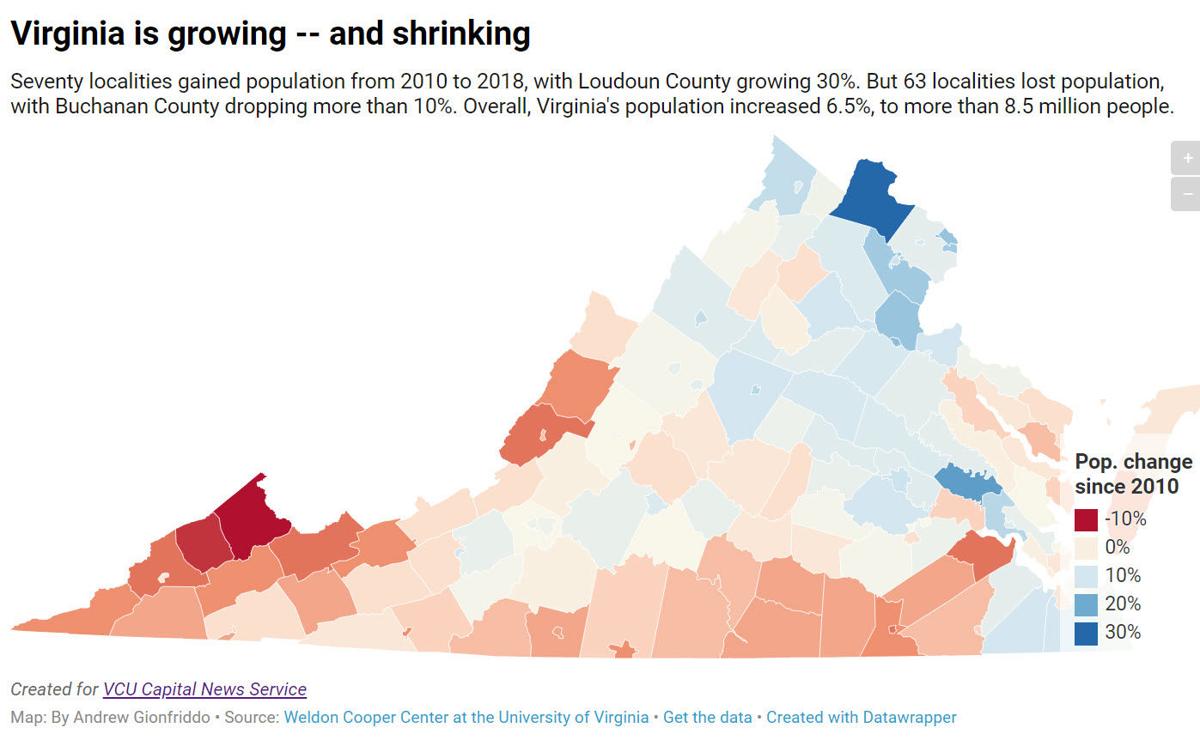
Click image to enlarge: Republican voting strength is increasingly concentrated in the areas
that have stagnated or which are losing population while the Democrat base grows in growing areas.
Virginia's elections on Tuesday, November 5, 2019, are getting a lot of national attention and many hope that the elections will be a reprise of the 2017 bloodbath suffered by the Virginia Republican Party which remains in lock step with Donald Trump, perhaps the most hated politician/demagogue in the Commonwealth - at least outside of knuckle dragging rural areas of the state which continue to see a continued downward spiral because of the backwardness and religious extremism of so many of its inhabitants that modern, progressive businesses find repellent.  A piece in Huffington Post looks at what's at stake on Tuesday - including but not limited to increased minimum wages, LGBT non-discrimination protections, gun control, women's rights, and actions to address climate change -  and and how Virginia appears to be finally seceding from the old Confederacy as states like Alabama descend further into right wing/Christofascist lunacy.  For Virginia to continue to prosper, it is imperative that Republicans lose control of both houses of the General Assembly.  Here are article highlights:
Democratic takeovers in both legislative chambers would have far-reaching implications for the state’s policies and politics. The party, which also controls the governor’s office, would have the chance to pursue a host of liberal priorities like an increase in the state’s minimum wage, laws protecting LGBTQ rights and abortion rights and tougher gun safety regulations.
It would also mark the culmination of Virginia’s years long transformation from a conservative state ― which once was the seat of the Confederacy ― to a progressive one that is not only reliably Democratic in presidential elections, but whose state politics are heavily influenced by a cohort of liberal Democrats that would have been unrecognizable even a decade ago.
“This could be a watershed election for Virginia,” said Quentin Kidd, director of the center for public policy at Christopher Newport University.
And don’t expect the Democrats in Virginia to be moderate quasi-Republicans. The state party has been winning its elections with candidates who are more progressive than the traditional Southern Democrats, touting policies like gun control.
“There will still be [Southern-style] Democrats in Virginia after November 5,” Kidd said, putting Gov. Ralph Northam (D) himself in that category. “But if Democrats win it will because of Democrats who are” more liberal.
Many of the top priorities for Democrats once in power would be the sort of socially liberal reforms for which there is broad support in the increasingly affluent, suburban state.
Tougher gun regulations would almost certainly swiftly become law. In the wake of a mass shooting in Virginia Beach that killed 12 people in May, Northam sought to pass a package of reforms to close background check loopholes for private sales and transfers and forbid the sale of assault rifles, high-capacity magazines and silencers, among other things. The Republican-controlled legislative chambers blocked the measures in a special legislative session in July. 
Legislation aimed at protecting LGBTQ residents from discrimination is also likely to pass very quickly. . . . “LGBTQ rights are on the ballot,” said Lucas Acosta, a spokesman for the Human Rights Campaign, which has contributed over $41,000 to Roem’s reelection and tens of thousands more on other Democrats. “Literally, it will take a flip of two seats and new leadership in the House of Delegates and the state Senate for LGBTQ residents to have the most basic protections.”  
Virginia Democrats would have the chance to adopt more expansive protections for abortion rights and ratify the Equal Rights Amendment to the U.S. Constitution.  
What makes this potential Democratic takeover different from previous legislative wins is that in addition to socially liberal legislation, the party is seriously considering bills that run counter to the state’s mighty business establishment. The clubby, ethically lax and business-friendly consensus in both parties is so ingrained in the state’s political culture, it has its own name: the “Virginia Way.”
But this time, not only have Democrats vowed to raise the state’s minimum wage from $7.25 to $15 an hour, many are also on record in support of repealing the state’s anti-union “right-to-work” law. Virginia was one of the first states in the country to adopt a law barring unions from compelling the workers it represents to contribute dues.
“We’ve been saying since 2008 that Virginia’s been trending purple, trending blue,” he said. “It could very well be the case that Virginia cements itself politically as a mid-Atlantic state after November 5.” 
Another sign of the shifting consensus against big business is a greater appetite among Democrats to take on the state’s twin monopoly electric companies, Dominion Energy and Appalachian Power. 
Forty incumbent Democrats and 47 challengers have pledged not to accept campaign contributions from the two monopolies or own stock in them, according to the progressive nonprofit Clean Virginia, which is seeking to combat their power.
Whether and how much a Democratic legislature is willing to act to combat climate change is likely to depend in particular on lawmakers’ willingness to buck Dominion, long one of the state’s most deep-pocketed campaign donors. 
With the support of Dominion and Appalachian, Northam has proposed a clean energy standard that would make the state 100% carbon-free by 2050
But some environmental advocates argue that the deadline for decarbonization is too late. Others worry that climate policies that fail to confront the monopolies’ power will simply extend their dominance into emerging renewable energy sectors, while hurting ratepayers and suppressing the sort of clean energy entrepreneurship that would help Virginia hit its climate targets sooner and more effectively.
“The idea that renewables, which are inevitable and should be mandatory, only come by a utility that has abused its monopoly is a false argument and one that Virginians should reject on the face of it,” said Brennan Gilmore, executive director of Clean Virginia. 
The explosion of the state’s northern suburbs outside Washington brought an influx of highly educated and racially diverse voters more likely to vote Democratic. As a result, Republicans have been losing ground in Virginia for the better part of a decade; their last statewide wins were in 2009.  
The election of President Donald Trump, who lost Virginia by 5 percentage points and repelled many of the educated professionals from the business-friendly wing of the state’s Republican Party, turbocharged that trend. 
The liberal anti-Trump “Resistance” raged as hot in Virginia as any state in the country, sparking a major uptick in candidates for elected office, young voter participation and volunteer door-knocking. What’s more, the exodus of socially liberal, suburban Republicans from the GOP in the Trump era created a vicious cycle wherein the state’s party increasingly catered to a right-wing populist base that further alienated it from swing voters. 
The result was a wave election in November 2017 that was the first real demonstration of Trump’s toxicity in battleground states. . . . . the enthusiasm didn’t let up. In November 2018, Virginia Democrats continued to capitalize on suburban discontent with the president, flipping three Republican-held U.S. House seats.
When Virginia voted for Barack Obama in 2008, it was the first time the state had voted for a Democratic presidential nominee since 1964. 
Some observers characterized that outcome as Virginia’s de facto political secession from the South, Kidd recalled.
Flipping the legislature this year with a more diverse, more progressive group of Democrats, he said, “would be a reaffirmation of that secession from the South ― and it would be on the shoulders of a newer America.”

Sunday, September 22, 2019

Why Republicans Fear Democracy

Over the last two decades, Republicans have increasingly resorted to dirty tricks ranging from voter ID laws to disenfranchise voters unlikely to support them to drawing computer gerrymandered districts to make it more difficult for Democrat candidates win - something Virginia certainly witnessed until the federal courts intervened.  Why resort to such tactics?  The answer is easy.  Increasingly, the majority of Americans reject what the GOP is peddling and, without cheating, Republicans fear they are destined to become a permanent minority party.  There simply are not enough racist and religiously extreme voters to assure the GOP's survival.  Thus, the efforts to thwart democracy and limit who can vote.  The only thing the GOP will not do is reject its toxic policies and evolve with the times and the changing demographics of the nation.  A column in the New York Times looks at the phenomenon.  Here are highlights:
The greatest threat to our democracy today is a Republican Party that plays dirty to win.
The party’s abandonment of fair play was showcased spectacularly in 2016, when the United States Senate refused to allow President Barack Obama to fill the Supreme Court vacancy created by Justice Antonin Scalia’s death in February. While technically constitutional, the act — in effect, stealing a court seat — hadn’t been tried since the 19th century. It would be bad enough on its own, but the Merrick Garland affair is part of a broader pattern.
Republicans across the country seem to have embraced an “any means necessary” strategy to preserve their power. After losing the governorship in North Carolina in 2016 and Wisconsin in 2018, Republicans used lame-duck legislative sessions to push through a flurry of bills stripping power from incoming Democratic governors. Last year, when the Pennsylvania Supreme Court struck down a Republican gerrymandering initiative, conservative legislators attempted to impeach the justices.
Constitutional hardball has accelerated under the Trump administration. President Trump’s declaration of a “national emergency” to divert public money toward a border wall — openly flouting Congress, which voted against building a wall — is a clear example. And the Supreme Court’s conservative majority, manufactured by an earlier act of hardball, may uphold the constitutionality of [Trump's] the president’s autocratic behavior.
Constitutional hardball can damage and even destroy a democracy. Democratic institutions function only when power is exercised with restraint. When parties abandon the spirit of the law and seek to win by any means necessary, politics often descends into institutional warfare.
As the collapse of democracy in Germany and Spain in the 1930s and Chile in the 1970s makes clear, these escalating conflicts can end in tragedy. Why is the Republican Party playing dirty? Republican leaders are not driven by an intrinsic or ideological contempt for democracy. They are driven by fear.
Democracy requires that parties know how to lose. Politicians who fail to win elections must be willing to accept defeat, go home, and get ready to play again the next day. This norm of gracious losing is essential to a healthy democracy.
But for parties to accept losing, two conditions must hold. First, they must feel secure that losing today will not bring ruinous consequences; and second, they must believe they have a reasonable chance of winning again in the future. When party leaders fear that they cannot win future elections, or that defeat poses an existential threat to themselves or their constituents, the stakes rise. . . . In short, desperation leads politicians to play dirty.
Take German conservatives before World War I. They were haunted by the prospect of extending equal voting rights to the working class. They viewed equal (male) suffrage as a menace not only to their own electoral prospects but also to the survival of the aristocratic order. . . . . So German conservatives played dirty, engaging in rampant election manipulation and outright repression in the late 19th and early 20th centuries.
In the United States, Southern Democrats reacted in a similar manner to the Reconstruction-era enfranchisement of African-Americans. Mandated by the 15th Amendment, which was ratified in 1870, black suffrage not only imperiled Southern Democrats’ political dominance but also challenged longstanding patterns of white supremacy. Since African-Americans represented a majority or near majority in many of the post-Confederate states, Southern Democrats viewed their enfranchisement as an existential threat. So they, too, played dirty.
Between 1885 and 1908, all 11 post-Confederate states passed laws establishing poll taxes, literacy tests, property and residency requirements and other measures aimed at stripping African-Americans of their voting rights . . . . These measures, building on a monstrous campaign of anti-black violence, did precisely what they were intended to do: Black turnout in the South fell to 2 percent in 1912 from 61 percent in 1880. Unwilling to lose, Southern Democrats stripped the right to vote from millions of people, ushering in nearly a century of authoritarian rule in the South.
Republicans appear to be in the grip of a similar panic today. Their medium-term electoral prospects are dim. For one, they remain an overwhelmingly white Christian party in an increasingly diverse society.
Republicans also face a generational challenge: Younger voters are deserting them. In 2018, 18- to 29-year-olds voted for Democrats by more than 2 to 1, and 30-somethings voted nearly 60 percent for Democrats.
Demography is not destiny, but as California Republicans have discovered, it often punishes parties that fail to adapt to changing societies. The growing diversity of the American electorate is making it harder for the Republican Party to win national majorities. Republicans have won the popular vote in presidential elections just once in the last 30 years.
The problem runs deeper than electoral math, however. Much of the Republican base views defeat as catastrophic. White Christians are losing more than an electoral majority; their once-dominant status in American society is eroding. . . . . Many rank-and-file Republicans believe that the country they grew up in is being taken away from them. Slogans like “take our country back” and “make America great again” reflect this sense of peril.
So like the old Southern Democrats, modern-day Republicans have responded to darkening electoral horizons and rank-and-file perceptions of existential threat with a win-at-any-cost mentality. Most reminiscent of the Jim Crow South are Republican efforts to tilt the electoral playing field. Since 2010, a dozen Republican-led states have adopted new laws making it more difficult to register or vote. Republican state and local governments have closed polling places in predominantly African-American neighborhoods, purged voter rolls and created new obstacles to registration and voting.
Although these abuses are certainly less egregious than those committed by post-bellum Southern Democrats, the underlying logic is similar: Parties representing fearful, declining majorities turn, in desperation, to minority rule.
The only way out of this situation is for the Republican Party to become more diverse. A stunning 90 percent of House Republicans are white men, even though white men are a third of the electorate. Only when Republicans can compete seriously for younger, urban and nonwhite voters will their fear of losing — and of a multiracial America — subside.
American democracy faces a Catch-22: Republicans won’t abandon their white identity bunker strategy until they lose, but at the same time that strategy has made them so averse to losing they are willing to bend the rules to avoid this fate. There is no easy exit.
Republican leaders must either stand up to their base and broaden their appeal or they must suffer an electoral thrashing so severe that they are compelled to do so. . . . Until Republicans learn to compete fairly in a diverse society, our democratic institutions will be imperiled.

Monday, June 03, 2019

The Coming GOP Apocalypse


As long time readers of this blog know, I have long predicted that the GOP is headed towards potential long term extinction if it does not adapt to the changing demographics of America and the views of younger voters who will eventually replace the elderly white voters on whom the GOP has staked its existence. In the past many Republicans mocked this point of view and continued to act as apologist for the worse policies of the GOP and even the open racism of the current Trump/Pence regime.  Once such individual was New York Times columnist David Brooks who in his own way helped pave the way for the rise of Trump.  Now, apparently Brooks has belatedly pulled his head out of his ass and sees the coming apocalypse ahead for the GOP if it doesn't change course radically (unless, of course, Trump. Pence and McConnell overthrow the U.S. Constitution).  Brooks' columnist is on pointy and, I believe, accurately predicts what is coming.  Too bad he didn't open his eyes years ago.  Here are column highlights:
Much of the 20th century, young and old people voted pretty similarly. The defining gaps in our recent politics have been the gender gap (women preferring Democrats) and the education gap. But now the generation gap is back, with a vengeance.
This is most immediately evident in the way Democrats are sorting themselves in their early primary preferences. A Democratic voter’s race, sex or education level doesn’t predict which candidate he or she is leaning toward, but age does.
In one early New Hampshire poll, Joe Biden won 39 percent of the vote of those over 55, but just 22 percent of those under 35, trailing Bernie Sanders. Similarly, in an early Iowa poll, Biden won 41 percent of the oldster vote, but just 17 percent of the young adult vote, placing third, behind Sanders and Elizabeth Warren.
The generation gap is even more powerful when it comes to Republicans. To put it bluntly, young adults hate them.
In 2018, voters under 30 supported Democratic House candidates over Republican ones by an astounding 67 percent to 32 percent. A 2018 Pew survey found that 59 percent of millennial voters identify as Democrats or lean Democratic, while only 32 percent identify as Republicans or lean Republican.
The difference is ideological. According to Pew, 57 percent of millennials call themselves consistently liberal or mostly liberal. Only 12 percent call themselves consistently conservative or mostly conservative. This is the most important statistic in American politics right now.
Recent surveys of Generation Z voters (those born after 1996) find that, if anything, they are even more liberal than millennials.
In 2002, John B. Judis and Ruy Teixeira wrote a book called “The Emerging Democratic Majority,” which predicted electoral doom for the G.O.P. based on demographic data. That prediction turned out to be wrong, or at least wildly premature.
But it’s hard to look at the generational data and not see long-term disaster for Republicans. Some people think generations get more conservative as they age, but that is not borne out by the evidence. Moreover, today’s generation gap is not based just on temporary intellectual postures. It is based on concrete, lived experience that is never going to go away.
[M]illennials and Gen Z voters live with difference every single day. Only 16 percent of the Silent Generation is minority, but 44 percent of the millennial generation is. If you are a millennial in California, Texas, Florida, Arizona or New Jersey, ethnic minorities make up more than half of your age cohort. In just over two decades, America will be a majority-minority country.
Young voters approve of these trends. Seventy-nine percent of millennials think immigration is good for America. Sixty-one percent think racial diversity is good for America.
They are much more sympathetic to those who identify as transgender. They are much more likely than other groups to say that racial discrimination is the main barrier to black progress. They are much less likely to say the U.S. is the best country in the world.
These days the Republican Party looks like a direct reaction against this ethos — against immigration, against diversity, against pluralism. Moreover, conservative thought seems to be getting less relevant to the America that is coming into being.
The most burning question for conservatives should be: What do we have to say to young adults and about the diverse world they are living in? Instead, conservative intellectuals seem hellbent on taking their 12 percent share among the young and turning it to 3.
There is a conservative way to embrace pluralism and diversity. . . . . A better multiculturalism would be optimistic: We can communicate across difference; the American creed is the right recipe for a thick and respectful pluralism; American structures are basically sound and can be realistically reformed.
So far that’s not visible. My mentor William F. Buckley vowed to stand athwart history yelling “Stop!” Today’s Republicans don’t even seem to see the train that is running them over.
Trump - and Pence - are the embodiment of what these younger generations detest. Yet, the entire GOP has turned into a group of Trump ass kissers only too happy to perform political fellatio to the horrible individual occupying the White House. 

Monday, October 01, 2018

Trump/the GOP Can’t Win the War on Demography


I for one hope that 2016 and the nightmare election of Der Trumpenführer will prove to be the last gasp of aging right wing/Christofascist whites in their attempt to turn back time and magically stop the demographic changes sweeping the nation.  True, wherever possible, Republicans will strive to disenfranchise non-whites and the young, but those efforts will sooner or later fail to stop the wave of demographic change that will make both whites and traditional Christians a minority in America.  Candidly, in my view, that ultimate defeat of the GOP and Trump voters cannot come soon enough.  Perhaps being gay - a hated minority to many - makes one open their eyes to the failings and ugliness of the majority as well as the common humanity of other minorities.  Whatever the cause, I simple cannot understand the hysterical fear of those who are different. A column in the New York Times looks at the unwinnable war Trump and the racist GOP are fighting.  It also looks at the distortions in policies and funding that the quest to maintain "whiteness" will have on the country.  Here are column highlights:

Since the early days of his campaign, from his proposal to build a wall along the Mexican border to his discredited committee on voter fraud, President Trump has declared war on America’s changing demography. His administration has followed through on that strategy with a proposal to add a question to the 2020 census asking about citizenship.
If it is added to the census form, the citizenship question will distort our understanding of who resides in the country. What this selective underenumeration will not do is make America’s growing racial minority populations disappear. The losers from this undercount include members of Mr. Trump’s older white base, who will suffer from lost investments in a younger generation, whose successes and contributions to the economy will be necessary to keep America great.
The demographic trends make this plain. America’s white population is growing tepidly because of substantial declines among younger whites. Since 2000, the white population under the age of 18 has shrunk by seven million, and declines are projected among white 20-somethings and 30-somethings over the next two decades and beyond. This is a result of both low fertility rates among young whites and modest white immigration — a trend that is not likely to change despite Mr. Trump’s wish for more immigrants from Norway.
The likely source of future gains among the nation’s population of children, teenagers and young working adults is minorities — Hispanics, Asians, blacks and others — most of whom are born in the United States.
Indeed, the only part of the white population that is growing appreciably is older people, the same group to whom Mr. Trump is appealing. Thanks to aging baby boomers, the older retirement-age white population will grow by one-third over the next 15 years and, with it, the need for the government to support Social Security, Medicare, hospitals and the like. Revenue for these programs will have to come from the younger minority population.
Although the slowly growing, rapidly aging white population will be accurately counted, the fast-growing minority school-age and young adult populations that represent the nation’s future will not get their due — demographically, politically or economically.
An in-house Census Bureau analysis based on 2010 survey data found that the inclusion of a citizenship question reduced the response rate among households that have at least one noncitizen individual. While 7 percent of United States residents are themselves noncitizens, 14 percent live in households that include one or more noncitizens. The latter figure rises to 46 percent among all Hispanics and to 45 percent among Asian-Americans, compared with just 8 percent among blacks and 3 percent among whites.
Let’s assume that one in three people in Hispanic and Asian noncitizen households refuses to answer the census. If that’s the case, the Hispanic share of the United States population would drop by 2.1 percentage points (from 17.3 to 15.2 percent) and the total white population share would rise by 2.2 percentage points (from 62 to 64.2 percent).
This imbalance would influence congressional reapportionment, hurting large, immigrant-heavy states. It will also shape how congressional and state legislative districts are drawn, favoring rural and small areas at the expense of large metropolitan areas, since noncitizen households are far more prevalent in the latter.
The underenumeration of racial minorities would also misallocate billions of dollars in state and federal funds for housing assistance, job training, community development and a variety of social services that should be distributed on the basis of census counts. It would provide a faulty framework for surveys that will inform thousands of policy and business decisions, such as where to locate schools, hospitals, employment sites or retail establishments catering to different population groups, over the next decade.
Through his rhetoric and actions, Mr. Trump stands for keeping America white, appealing to his base by implicitly promising to preserve the racial status quo. But Mr. Trump’s supporters, and the country in general, must not ignore the generational dependency between older whites and younger minorities. Forcing an inaccurate accounting of who resides in the nation will have long-term negative consequences for everyone.
For the record, both the husband and I have extended family members who are of mixed race..  Some are half Asian and others are part black.  All are decent and responsible individuals - far more decent than Trump's bigoted and hypocrisy-filled base.

Sunday, September 09, 2018

Top Republicans: "Unlikable" Ted Cruz Might Lose


Personally, I hope that Republicans who keep claiming that their "organization" and fundraising advantage will allow them to hold control of Congress after the 2018 midterm elections will prove to be little more than a group of delusional misogynist rearranging the deck chairs on the Titanic.  While Trump lies and says his approval ratings are soaring even as new polls show him with a 36% approval level, some Republicans seemingly are realizing that Trump poses a huge problem for the GOP.  He may be welcomed at rallies in red states, but his vitriol may well be turning alienation voters from the GOP and motivating even larger numbers of voters to turn out in November to vote against Republicans as the sole means to contain Trump.  A piece in the New York  Times based on audio from a GOP confab looks at the hopefully worsening prospects for the GOP and Ted Cruz.  Here are article excerpts:

A pair of top Republicans acknowledged in a private meeting on Saturday that the party was battling serious vulnerabilities in the midterm elections, including what one described as widespread “hate” for President Trump, and raised the prospect that Senator Ted Cruz of Texas could lose his bid for re-election because he is not seen as “likable” enough.
The two Republican leaders, Mick Mulvaney, the federal budget director, and Ronna McDaniel, the Republican National Committee chairwoman, . . . . But Mr. Mulvaney and Ms. McDaniel also offered an unusually raw assessment of their own party’s strengths and weaknesses in the midterm elections. They pointed to the burning energy among Democratic voters and the dozens of open House seats, where Republican incumbents decided not to seek re-election, as fearsome obstacles to retaining control of Congress. And Mr. Mulvaney suggested Republicans would fare better if they could “subtract” [Trump] the president’s divisive persona from voters’ minds, and stress instead that the country is in a “pretty good” condition.
Their comments were captured in an audio recording that was obtained by The New York Times from a person who attended the party meeting.
Even as Mr. Mulvaney conceded that Mr. Trump’s personal unpopularity was a problem for the party, he predicted it would not ultimately be a decisive factor for most voters. He also alluded to Mr. Cruz, without mentioning his name, as a lawmaker who might lack the charm to win a contested race this year.
Mr. Mulvaney said, Democrats were putting forward a “movement of hate,” and asked rhetorically: “What is the signature piece of legislation they’re against? The tax bill?”
Ms. McDaniel, a former chairwoman of the Michigan Republican Party, alluded more delicately in her remarks to the explosive Democratic turnout in the midterm primary elections that Mr. Trump had helped stir, telling the meeting, which included many major donors, that Republicans were spending money aggressively to build a voter-turnout machine to block a Democratic takeover.
She framed the election as an asymmetrical contest — Republican organizing prowess and financial supremacy versus raw Democratic energy.
Spokesmen for the R.N.C. and Mr. Mulvaney declined to comment.
The suggestion, by Mr. Mulvaney, that Republicans might fare better without Mr. Trump as the dominant factor in voters’ minds is a far cry from [Trump's] the president’s personal approach to the campaign. He has held rallies across the country in recent days, focusing on red states where Democratic senators are seeking re-election, and warning conservative voters in intensely personal terms that a victorious Democratic Party would try to hound him from office.
And Mr. Mulvaney’s comments came at the end of a week that dramatized just how difficult it might be to nudge any particular issue, aside from Mr. Trump, to the center of the campaign.
The budget chief, who has been seen at points as a potential White House chief of staff, acknowledged that Republicans had nominated poor candidates in some important races and might struggle to defend a huge number of open seats in the House, where dozens of Republican lawmakers decided not to run for re-election.
Democrats must gain 23 seats in the House to take control of the chamber. Senior Republican strategists have grown sharply concerned about a collection of open seats where they have put forward flawed nominees, including in Pennsylvania, New Jersey and North Carolina. Mirroring in some respects the Republican campaigns of 2010, Democratic candidates have been running on a message of blocking Republican health care and economic policies, and reining in an unpopular White House.
The Senate appears more secure for Republicans at this point. Even though they hold only a slim, 51-seat majority, Democrats are defending far more seats than Republicans, and many of the Democratic incumbents up for re-election are running in conservative states.
Still, there is a path for Democrats to capture the Senate, and Mr. Mulvaney pointed to crucial Senate races in Texas and Florida as places where candidate quality could be decisive.
“There’s a very real possibility we will win a race for Senate in Florida and lose a race in Texas for Senate, O.K.?” Mr. Mulvaney said. “I don’t think it’s likely, but it’s a possibility. How likable is a candidate? That still counts.”
Mr. Mulvaney’s comments about the Texas Senate race represent perhaps the most candid admission by a senior Republican that Mr. Cruz, a first-term lawmaker who battled Mr. Trump for the presidential nomination in 2016, is actually facing a fight for his political life. He is being challenged by Representative Beto O’Rourke, a maverick Democrat who has raised enormous sums of money online.At the same conclave of Republicans on Saturday, one of the party’s key Senate candidates, Mike Braun, a wealthy former Indiana state legislator who is running against Senator Joe Donnelly, a Democrat, framed the stakes of the election in grimmer terms.

At a forum for Senate candidates, Mr. Braun pleaded with party donors to put up the money needed for Republicans to defend their control of the Senate, warning that if the party did not govern successfully under Mr. Trump it could face a long political winter.
“We’ve got four to six years to get this right, and if we don’t, it’ll go the other direction, demographically and all those other things that point negatively for us,” Mr. Braun said, in comments captured on a second recording. “We’ll be miserable for 15 to 20 years.”
It is actually shocking that Braun admitted that the GOP is committing political suicide by its alienation of all but white Christian extremists and white supremacists. 

Thursday, August 30, 2018

Cruz Allies Sound Alarm About Texas Senate Race

Grandpa Munster look-a-like Ted Cruz and Beto O'Rourke.

As politicians go, GOP Texas Senator Ted Cruz has got to rank very high on the list of the most foul and most lacking in basic honesty and morality - Trump and Pence are in a league of their own - and, therefore, it would be a true delight to see him defeated in November, 2018. For a long time many thought that Cruz going down to defeat was near impossible given the reactionary nature of Texas, but Beto O'Rourke has surged in the polls and by some polls is even in a statistical dead heat with Cruz.  While not yet to the point where Virginia is in terms of urban areas being able to out vote the backward, knuckle dragging areas of the state, Texas' cities are moving in that direction.  Add to that a Hispanic population that, if it has any sense of self-preservation, should vote for any Democrat against any Republican.  Now, Cruz allies are panicking and the insidious and misnamed Club for Growth - which wants even more tax cuts for the wealthy and large corporations - has announced that it will launch an attack ad campaign against O'Rourke.  Politico looks at this high profile contest.  Here are excerpts:

Republicans are sounding the alarm about Texas Sen. Ted Cruz’s closer-than-expected reelection contest, with an influential conservative group racing to his aid.
The Club for Growth, a Washington-based anti-tax group, is drawing up plans for a major TV ad campaign boosting Cruz — the first such intervention by a Republican outside group in this race. The move comes as Democratic Rep. Beto O’Rourke, an online fundraising behemoth who has attracted national support, continues to narrow the gap in polling.
David McIntosh, the Club for Growth’s president, said on Tuesday the organization is planning a seven-figure-plus offensive targeting O’Rourke. McIntosh was speaking from Texas, where he is meeting with pro-Cruz donors who could help fund the effort.  “In the last five weeks, it’s become clear that the race has tightened,” said McIntosh.
Republican officials once saw Cruz, a failed 2016 presidential candidate, as safe given Texas’ conservative tilt, and in public, they have largely derided O’Rourke’s candidacy and public polls showing a close race. But, privately, they have grown increasingly concerned. An NBC News/Marist poll conducted earlier this month showed Cruz leading O’Rourke by a narrow 49 percent to 45 percent margin.
O’Rourke has emerged as a national liberal cause célébre. An online video of O’Rourke defending the right of NFL players to kneel during the national anthem has gone viral in recent days, and it was announced on Tuesday that O’Rourke would appear on “The Ellen DeGeneres Show” in September.
The extent of the rescue effort remains an open question. While a pro-Cruz super PAC, Texans Are, has been established, other conservative outside groups have remained focused on other Senate contests.
The White House, meanwhile, has been monitoring the contest. Two senior Republicans said they expected President Donald Trump, who fought bitterly with Cruz during in the 2016 presidential race, to hit the trail for the Texas Republican ahead of the November election.
McIntosh said it had not been determined when the Club’s campaign would begin. But he said it would focus heavily on casting O’Rourke as an establishment figure who, contrary to the nonpolitical and outsider persona he has cultivated, is eager to climb the ranks of political power.
To some Cruz backers, the help cannot come soon enough, and many of them are eager to see Cruz’s donor network, which he forged during his 2016 presidential bid, activated for his reelection.
“I don’t think you can count anybody out at any point. This world is changing so rapidly. It’s pretty unbelievable,” said Lee Roy Mitchell, a Dallas-based Cruz donor and founder of the Cinemark movie theater chain.
“We’re solidly behind the senator, and I would like to think most Texans are. I believe they are,” said Mitchell, who with his wife Tandy has donated a combined $1 million to the pro-Cruz super PAC. “But there’s a tremendous amount of money being poured in here to change people’s opinions.”
One can only hope that Trump campaigning in Texas for Cruz will only further energize the Democrat base and convince the must go to the polls and vote Democrat as a means to strike back and the racist Trump. 

Tuesday, May 29, 2018

Will Arizona Swing Blue in 2018?

Trump and anti-immigrant extremist Arpaio.
One of the big questions for 2018 is whether or not Hispanics and Millennials will turn out in force at the polls come November.  If they do, the 2018 midterms and other elections could be brutal for Republicans. Hopefully, Democrats across the country are replicating the ground game and get out the vote effort Virginia Democrats under Ralph Northam mounted in 2017.  One state that many pundits and party operatives are watching is Arizona, which among other things, has an open U.S.Senate seat.  Two of the would be GOP nominees are trying to out-Trump Der Trumpenführer when it comes to Hispanic bashing.  The other is swinging to the hard right to court the racist GOP base.  With luck, this primary will motivate Hispanics and Millennials to seek revenge in the November general election.  A piece in The Guardian looks at the dynamics in play in Arizona.  Here are excerpts:

With its growing population of young Hispanic voters, Arizona has long seemed a tempting prize for Democrats. Year after year, electoral success has eluded them. As the 2018 midterms approach, with Arizona one of the biggest political battlegrounds, Democrats are indefatigably optimistic.
Issues that animate liberals across the country – immigration, healthcare, education – are raging in Arizona. Last month, public school teachers walked out of their classrooms – and won salary increases and more funding for schools. The state is also at the center of the roiling debate over illegal immigration and border enforcement. It is home to Hispanics, 31% of the population, and suburban white voters who strongly disagree with Trump’s hardline politics.
Republicans outnumber Democrats in the state and have nearly twice as many precinct committee officials. But Democrats say their numbers have jumped since 2016 and the combined total of unaffiliated and third-party voters is greater than those for either party. Accordingly, the state Democratic party has launched a 15-county strategy to reach new voters across the states and especially independents.
Democrats say they are optimistic they can pick up at least one, possibly two congressional seats. They are also excited about the possibility of winning control of the state senate and insist they have a chance of unseating the Republican governor, Doug Ducey. The biggest prize of all is an open Senate seat that could determine control of the chamber. Republicans, of course, push back.
 Chuck Coughlin, a veteran Republican strategist, was less emphatic. Though he said too many Democrats were running as progressives in a state that is still conservative and waved off the chance of a defeat for Ducey, who negotiated the pay rise for teachers, he said the Senate seat, held by a conservative Republican since 1995, “clearly leans blue”.
 Immigration has already emerged as a defining issue of the battle for Arizona’s seat. The three Republican candidates have largely embraced Trump’s agenda – policies several party strategists quietly worry are too far right for the general election.
The Republican primary is a three-way contest between US congresswoman Martha McSally, a decorated air force veteran and party favorite; Kelli Ward, a former state senator and far-right conservative; and Arpaio, whom Trump pardoned after he was convicted of contempt of court for refusing to stop racially profiling Hispanics.
Democrats hope a nasty Republican primary will open the door to a first Democratic senator in a generation. US congresswoman Kyrsten Sinema, a “Blue Dog” centrist and the presumptive nominee, has positioned herself as an “independent voice” and consensus builder, willing to work across the aisle. While the Republicans vie to be seen as the most conservative, Coughlin said, Sinema is honing a positive, general-election message, in English and Spanish.
 McCain, the six-term Arizona senator who is fighting brain cancer at his ranch in Sedona, warns that Republicans are “on the wrong side” of the immigration debate and risk losing Latino voters for a generation.
“Most Arizona high school seniors are Hispanic,” McCain writes. “Do you think most of them would consider voting for the party that pulled their friends out of school, took them away from their teams and clubs and neighborhoods and put them on buses to Mexico?”
Joseph Garcia, director of the Morrison Institute Latino Public Policy Center at Arizona State University, said Latinos made up more than a fifth of the Arizona electorate in 2016 election but their influence was limited by low voter turnout.
 A study he worked on, however, found that by 2030 Arizona could become a “blue, progressive state”, in large part because of the Latino vote.
“The die is cast as far as changing demographics [go],” Garcia said. “It’s not hard to predict the future when you have the numbers.”

Wednesday, March 07, 2018

Is Texas Poised to Begin the Shift to Purple?

The always foul Sen. Ted Cruz (R) faces a strong challenge from Rep. Beto O'Rourke (D).

years Virginia was a reliable Republican leaning state.  The two things happened: the Christofascists and white supremacists hijacked the Virginia GOP and the party base basically became something akin to a rabid dog.  The second thing that happened was that the voters in the growing urban areas finally decided that they were over the insanity of the GOP and its efforts to drag Virginia backwards in time.  The 2017 Virginia elections underscored the results of these two factors when Republicans lost the gubernatorial election by 9 points and 15 Republicans lost their seats in the House of Delegates.  Now, some believe - or at least hope - that Texas may be on the verge of a similar shift towards Democrats and modernity in general fueled by the growth of that state's urban areas and growing minority population.  The turn out in the Texas primaries today suggest a surge in Democrat voters - more, in fact than the Republican turnout. Here are highlights from a piece in the Washington Post:  
Texas polls have closed and the vote counting has begun in the first statewide primary of the 2018 election season, a major test of the elevated enthusiasm of Democratic voters in a Republican-dominated state.
According to figures published over the weekend by the Texas secretary of state’s office, of the 885,574 ballots already cast in the state’s 15 largest counties, more than 52 percent were for Democrats — a major jump from the last midterm primary.
In 2014, only 592,153 early ballots were cast in those counties, with Republican voters accounting for nearly 62 percent of the votes.
Tuesday’s voting stands to give a fuller picture of whether Democratic turnout in the state is truly outsized or whether Republicans simply waited till Election Day to cast ballots. Texas has routinely elected GOP officials in statewide races for a generation, though recently with declining margins. President Trump won the state by nine points four years after GOP nominee Mitt Romney beat President Barack Obama by 16 points.
Democratic turnout has been surging for months in elections around the country. Democrat Ralph Northam handily won the Virginia governor’s race in November, even though the Republican candidate, Ed Gillespie, received more votes than any GOP candidate in the state’s history.
Democrats have also been winning special state legislative elections around the country, including seats in states like Florida, Wisconsin and Kentucky that were once considered safe for Republicans. “WAKE UP CALL,” tweeted Wisconsin Gov. Scott Walker (R) in January, after a Democrat handily won a state legislative race in his state that Republicans won by 27 points in 2016.
The trend was set to continue Tuesday.
“There’s something different going on in Texas this cycle,” said David Wasserman, who analyzes House races for the nonpartisan Cook Political Report. “It’s a uniquely anti-Trump state, because it has a rare combination of diversity and a suburban professional class. And, in that sense, it’s becoming a little bit more like California every year.”
Top Republicans are taking notice of the trend, with Sen. Ted Cruz (R) telling state reporters even before polls closed that the new enthusiasm among Democrats, including his opponent Rep. Beto O’Rourke (D), had limited potential. “Congressman O’Rourke’s campaign is benefiting from left-wing rage,” Cruz said. “Left-wing rage may raise a bunch of money from people online, but I don’t believe it reflects the views of a majority of Texans.”
Others were more cautious about the coming danger.
“I think it would be malpractice if we didn’t pay attention and respond accordingly,” Sen. John Cornyn (R-Tex.) said Monday of the early voting results, suggesting that “we need to encourage the president” to email his supporters “and encourage them to vote in November.”
What Tuesday’s voting is unlikely to do is pick nominees in the most closely watched House races, many of which feature jam-packed fields where even the best-financed and best-known candidates will struggle to win an outright majority and avoid a May 22 runoff.
Rep. Joaquín Castro (D-Tex.) predicted Tuesday that the elections will reflect a rising wave of discontent in his home state not just with Trump, but also with state Republican leaders who have governed from the hard right.
Few things would give me more joy than to see Ted Cruz defeated in November.  I hope Democrats continue to push and organize their ground game.  I remain convinced that the Northam/Democrat ground game in Virginia provides a wonderful template for implementation nationwide.