Showing posts with label shrinking GOP base. Show all posts

Sunday, July 12, 2020

New Polls: Texas is a Swing State in 2020

With luck historians will write that Donald Trump was one of the worse things to happen to an already moribund Republican Party, a party that placed all of its future on shrinking elements of the US population  - e.g., aging white voters - while going out of its way to alienate growing segments of the national population - e.g., younger voters and the growing numbers of mixed or non-white voters.  Between peddling openly racist dog whistle sound bites and the utter incompetence of the Trump/Pence response to the Covid-19 pandemic, polls increasingly suggest the even red states like Texas and Georgia may end up in Joe Biden's column.  Of course if these polls prove prophetic, the most delicious aspect of it all will be that Trump loses by a landslide and his fragile, self-centered ego is devastated.  May he forever be branded as an incredible loser and the worse president in America's history. A piece at CNN looks at some of the latest polling.  Here are excerpts:
New CBS News/YouGov polls show President Donald Trump is in trouble in three states he won in 2016. He's tied with former Vice President Joe Biden in Arizona (46% to 46%), a state he won by four points in 2016. Trump's down 48% to 42% in Florida, a state he took by a point in 2016.
But it's the third state, Texas, where the eye popping result comes from. It's Trump 46% to Biden's 45%, a result well within any margin of error.
It's pretty clear looking at the data that Texas is a swing state in the 2020 election. The 2020 campaign could be the first time Democrats captured the Lone Star State in a presidential election since 1976. The CBS News/YouGov poll is not an outlier over the last month. There have been eight polls released publicly since the beginning of June. The result is that Biden and Trump are basically tied, with Biden up by a mere 0.3 points in Texas.
Importantly, and unlike in other states, the polls in Texas have not overestimated Democrats over the last few cycles. If anything Democrats actually slightly outperformed their final polls in the 2016 presidential race and 2018 Senate races.
Things may change the closer we get to the election, but Texas really is competitive at this point.
Texas has gotten progressively more competitive during Trump's time as a candidate and officeholder. A big statewide victory has eluded Democrats, though many races have come within single digits for the first time in a generation. In fact, the state seemed, if anything, to move to the left in 2018, as Democrats were able to achieve wins in some key congressional races. A Biden win would be a manifestation of that trend on the statewide level.
 As I noted last year, the reason the Democrats are doing so well in Texas is a shift among college educated white voters. You see this best in the suburbs of Austin, Dallas and Houston, where O'Rourke did disproportionately better than the Democratic Senate did six years prior.
Indeed, Texas' white voter population is very well educated. One calculation by the New York Times' Nate Cohn reveals that a little more than 42% of the 2020 likely white voters in Texas have a college degree. That's 13th highest in the nation and the most of any state Trump carried in 2016.
 I would expect the trend in the college educated areas of Texas to carry over to 2020. Much of Biden's gains over Clinton nationally have occurred among whites with a college degree. In national June polls, Biden was up 22 points among this group compared to Clinton's 12 point lead with them in the final 2016 polls of registered voters.  One problem for Biden is he does seem to be struggling among Hispanic voters nationally, and there are a lot of Hispanic voters in Texas. Although Biden is winning them by around 30 points nationally, he's not putting up the same margins as Clinton did in 2016.
Further, I wouldn't expect Texas to be the tipping state in the electoral college (i.e. state containing the median electoral vote plus one). Biden is certainly in a stronger position in the core six battleground states (Arizona, Florida, Michigan, North Carolina, Pennsylvania and Wisconsin) where the averages have him up anywhere from three to 10 points.
Still, the state has 38 electoral votes and a load of down ballot races that could prove to be alluring for Biden.
 Up to six Republican held House seats could realistically fall to the Democrats in 2020. Many of them are in the aforementioned suburbs.
 Finally, Democrats have a real chance to flip the Texas state House. They need a pickup of less than 10 seats, and race raters give them a decent shot of doing so. If Democrats did flip the chamber, then they'd have a hand in redistricting for the first time since the beginning of the 2000s.
 That's big for state and national politics given that Texas has more House members than any state except California.
 The bottom line is Texas is fertile ground for Democrats in 2020. Biden has to decide whether he truly wants to compete. Either way, he has a real shot of winning, and a chance to rewrite the political map for this year and for the generation to come.
.

Saturday, July 04, 2020

Revulsion Towards Trump’s Racist Politics is Building

Donald Trump is the antithesis to decency and morality and, as previous posts have focused upon, his sole reelection plan is to double down on racism and hatred in the hope of turning out more of the GOP's shrinking base to the polls come November.   Almost everything the GOP once stood for - fiscal responsibility, support for science and education, and true basic morality (as opposed to Christofascist false piety and hypocrisy) - has been jettisoned as the Party has sold its soul to Trump and the white supremacists and religious extremist who now make up the core party base.  Meanwhile, younger voters who see both Trump and Christofascists as repulsive and educated suburban voters are fleeing the GOP.  As a column in the Washington Post notes, support for the GOP now boils down to racism more than any other factor. The party once identified with so-called country club Republicans now finds its image tied to red neck racists. Some surveys suggest that a wave is building against Trump and the soulless GOP.  Here are column highlights:
Four years ago, Christopher Parker, an African American political scientist at the University of Washington, made the provocative argument that Donald Trump’s candidacy could “do more to advance racial understanding than the election of Barack Obama.”
“Trump’s clear bigotry,” Parker wrote in the American Prospect, a liberal journal, “makes it impossible for whites to deny the existence of racism in America. . . . His success clashes with many white Americans’ vision of the United States as a fair and just place.”
Those words seem prescient today, after four years of President Trump’s racism, from the “very fine people” marching with neo-Nazis in Charlottesville to, in just the past week, a “white power” retweet and a threat to veto defense spending to protect the names of Confederate generals; after a pandemic disproportionately ravaged African American communities while an indifferent president tried to move on; after Trump-allied demonstrators, some carrying firearms and Confederate flags, tried to “liberate” themselves from public health restrictions; after the video of George Floyd’s killing showed the world blatant police brutality; after Trump used federal firepower against peaceful civil rights demonstrators of all colors.
The reckoning Parker foresaw is now upon us. White women, disgusted by Trump’s cruelty, are abandoning him in large number. White liberals, stunned by the brazen racism, have taken to the streets. And signs point to African American turnout in November that will rival the record level of 2012, when Obama was on the ballot. This, by itself, would flip Michigan, North Carolina, Pennsylvania and Wisconsin to Democrats, an analysis by the liberal Center for American Progress shows.
Surprisingly high Democratic turnout in recent contests in Wisconsin, Georgia, Kentucky and Colorado points to the possibility of a building wave. The various measures of Democratic enthusiasm suggest “turnout beyond anything we’ve seen since 1960,” University of North Carolina political scientist Marc Hetherington predicts. If so, that would mean a historic repudiation of Trump, who knows his hope of reelection depends on low turnout. He has warned that mail-in ballots and other attempts to encourage more voting would mean “you’d never have a Republican elected in this country again.”
That may not be wrong. Trump has accelerated a decades-old trend toward parties redefining themselves by race and racial attitudes. Racial resentment is now the single most important factor driving Republicans and Republican-leaning movers, according to extensive research, most recently by Nicholas Valentino and Kirill Zhirkov at the University of Michigan — more than religion, culture, class or ideology. An ongoing study by University of North Carolina researchers finds that racial resentment even drives hostility toward mask-wearing and social distancing. Conversely, racial liberalism now drives Democrats of all colors more than any other factor.
Consider just one yardstick, a standard question of racial attitudes in which people are asked to agree or disagree with this statement: “It’s really a matter of some people not trying hard enough; if blacks would only try harder they could be just as well off as whites.”
In 2012, 56 percent of white Republicans agreed with that statement, according to the American National Election Studies. The number grew in 2016 with Trump’s rise, to 59 percent. Last month, an astonishing 71 percent of white Republicans agreed, according to a YouGov poll written by Parker and conducted by GQR (where my wife is a partner).
The opposite movement among white Democrats is even more striking. In 2012, 38 percent agreed that African Americans didn’t try hard enough. In 2016, that dropped to 27 percent. And now? Just 13 percent.
To the extent Trump’s racist provocation is a strategy (rather than simply an instinct), it is a miscalculation. The electorate was more than 90 percent white when Richard Nixon deployed his Southern strategy; the proportion is now 70 percent white and shrinking. But more than that, Trump’s racism has alienated a large number of white people.
“For many white Americans, the things Trump is saying and getting away with, they just didn’t think they lived in a world where that could happen,” says Vincent Hutchings, a political scientist specializing in public opinion at the University of Michigan. Racist appeals in particular alienate white, college-educated women, and even some women without college degrees, he has found: “One of the best ways to exacerbate the gender gap isn’t to talk about gender but to talk about race.”
This is what Parker had in mind when he wrote in 2016 that Trump could be “good for the United States.” The backlash Trump provoked among whites and nonwhites alike “could kick off a second Reconstruction,” Parker now thinks. “I know it sounds crazy, especially coming from a black man,” he says, but “I think Trump actually is one of the best things that’s happened in this country.”

Friday, November 08, 2019

The Suburban Backlash Against the GOP Is Growing

I recently wrote about the Virginia Republican Party's slow suicide in Virginia where the population of the urban/suburban areas is surging while the number of rural voters is either stagnant or declining sharply. In statewide races, the Virginia GOP now finds it near impossible to win and losses in redrawn districts will pile up further following the 2021 redistricting which will reflect the population shifts. What the GOP is selling may win the hearts of racists and religious extremist in rural areas, but it is simply repulsive to more and more urban/suburban residents.  As a quote of a former NRCC chair in The Atlantic indicates, the GOP’s transformation from "a party of the country club to the country” does not add up to long-term success.  All indications are that Donald Trump's 2020 campaign effort may accelerate the process across the country and, even if Trump pulls of another Electoral College win while losing the popular vote, the long term trend is clear as urban/suburban populations soar in even states like Texas where sooner or later, the rural vote will not be enough to win statewide elections - or carry states in presidential elections.  Here are some article highlights:

The shift of metro areas away from the Republican Party under President Donald Trump rumbled on in yesterday’s elections, threatening the fundamental calculation of his 2020 reelection plan.
Amid all the various local factors that shaped GOP losses—from Kentucky to Virginia, from suburban Philadelphia to Wichita, Kansas—the clearest pattern was a continuing erosion of the party’s position in the largest metropolitan areas. Across the highest-profile races, Democrats benefited from two trends favoring them in metro areas: high turnout in urban cores that have long been the party’s strongholds, and improved performance in white-collar suburban areas that previously leaned Republican.

“When Trump was elected, there was an initial rejection of him in the suburbs,” says Jesse Ferguson, a Virginia-based Democratic strategist. “We are now seeing a full-on realignment.”
In that way, the GOP’s losses again raised the stakes for Republicans heading into 2020. In both message and agenda, Trump has reoriented the Republican Party toward the priorities and grievances of non-college-educated, evangelical, and nonurban white voters. His campaign has already signaled that it will focus its 2020 efforts primarily on turning out more working-class and rural white voters who did not participate in 2016.
But yesterday’s results again suggested that the costs of that intensely polarizing strategy may exceed the benefits. Republicans again suffered resounding repudiations in urban centers and inner suburbs, which contain many of the nonwhite, young-adult, and white-collar white voters who polls show are most resistant to Trump. If the metropolitan movement away from the Trump-era GOP “is permanent, there’s not much of a path for Republican victories nationally,” former Representative Tom Davis of Virginia, who chaired the National Republican Congressional Committee about two decades ago, told me. Trump’s effort to mobilize his nonurban base around white identity politics is having the offsetting effect of turbocharging Democratic turnout in metropolitan areas, which are growing faster than Trump’s rural strongholds. Unique local conditions contributed to each of yesterday’s most disappointing results for Republicans. . . . . But looming over all these local factors was the consistency of the metropolitan movement away from the GOP. Not only in urban centers, but also in suburban and even some exurban communities, Democrats reaped a double benefit: They increased their share of the vote even as turnout surged. The legislative elections in Virginia show the same pattern of the suburban erosion for the GOP in the Trump era. Democrats overthrew narrow Republican majorities in both chambers of the General Assembly by capturing at least five state House seats (while leading narrowly in a sixth) and two in the state Senate. They included seats in the Washington, D.C., suburbs of Northern Virginia and near the state capital of Richmond. But those new gains were probably less telling than what didn’t change: Democrats didn’t lose any of the previously Republican seats that they captured in suburban areas—particularly Northern Virginia and Richmond—in their landslide win in the state in 2017, which foreshadowed Democrats’ gains in the 2018 midterms. That widening separation between the GOP’s strength outside of metro areas and an intensifying tilt toward Democrats inside of them continues the underlying pattern of geographic polarization that has defined politics in the Trump era. Rather than looking to court urban areas, Trump has more frequently denounced places such as Chicago, San Francisco, and Los Angeles in an attempt to energize his mostly nonurban base. He continues to aim his message preponderantly at culturally conservative whites, and his campaign has signaled that it considers increasing turnout among such voters central to his reelection hopes.
Few in either party dispute that such a strategy could allow Trump to squeeze out another Electoral College victory, even if he loses the popular vote . . . But yesterday’s results underscore how narrow a wire [Trump] the president is walking with that strategy. Even taking into account Bevin’s personal unpopularity, Bitecofer says the Kentucky result should caution Republicans about a plan that accepts metropolitan losses to maximize rural and small-town gains. “If it can’t work in Kentucky … you cannot do it in Wisconsin or Michigan,” she says. Beyond Trump, the urban/nonurban divisions evident in this week’s elections “should scare the ever-loving bejesus” out of 2020 Republican Senate candidates in states with large metropolitan populations, including Arizona, Colorado, and North Carolina. In 2016, the strategist noted, Trump benefited not only because rural and non-college-educated white voters turned out in big numbers, but because turnout was weak among minorities and mediocre among young people. But in 2018—and again last night—large turnout in metropolitan areas swamped strong showings for the GOP in rural communities, the strategist noted. That raises the question of whether even big turnout in nonmetro areas will suffice for Trump if the metropolitan areas moving away from him continue to vote at the elevated levels evident in 2018 and 2019. Davis, the former NRCC chair, likewise believes that the GOP’s transformation from a party of “the country club to the country” does not add up to long-term success. “What’s happening is that the fast-growing areas [are] where the Democrats are doing better,” he told me. “There aren’t enough white rural voters to make up the difference.” Despite the GOP’s recent metropolitan losses, Trump’s approach has generated astonishingly little dissent inside the party. Yesterday’s results are unlikely to break that silence. But Weaver, like other GOP strategists dubious of Trump, says the party cannot indefinitely ignore the implications of prioritizing rural strength at the price of losing ground in the urban centers, which more and more are driving the nation’s economic innovation and its growth in population and jobs.
“Politics is a free-market enterprise. You have to sell a product,” Weaver says. “And Republicans are going to find themselves, by their own decision making, eliminated as an option for many, many voters, many, many demographic groups for generations to come.”

Sunday, November 03, 2019

Virginia on The Brink of Cementing Its Democratic Status

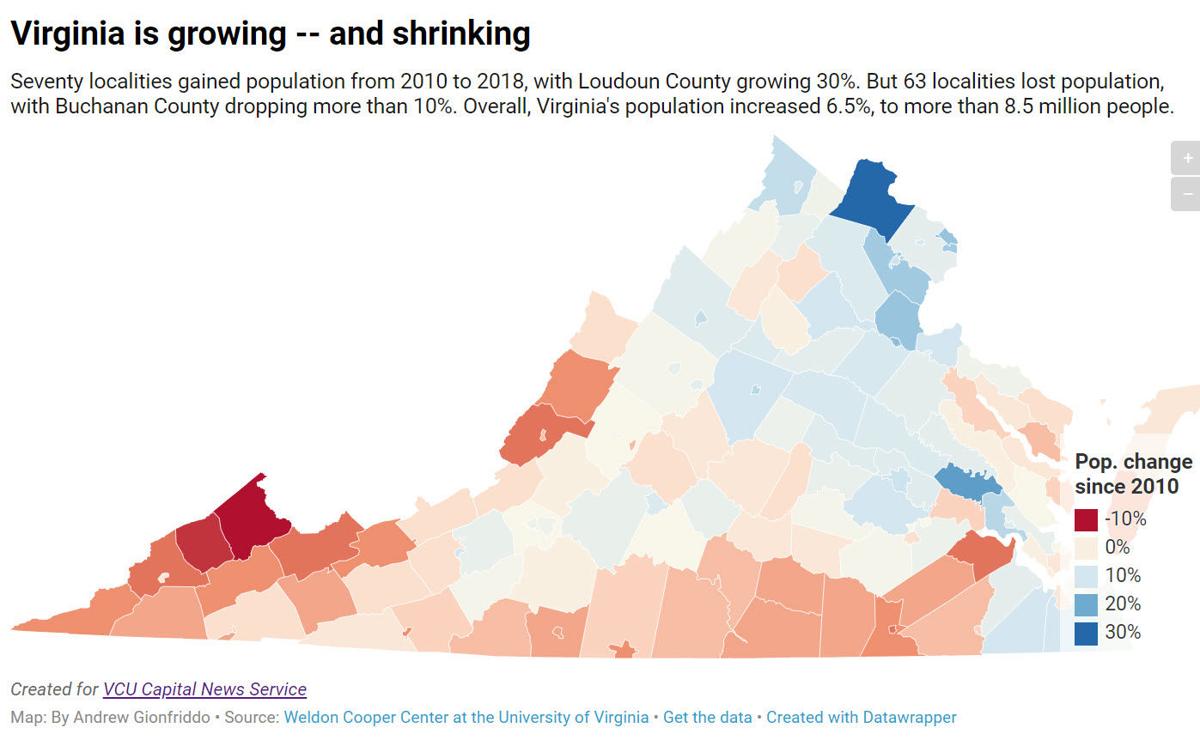
Click image to enlarge: Republican voting strength is increasingly concentrated in the areas
that have stagnated or which are losing population while the Democrat base grows in growing areas.
Virginia's elections on Tuesday, November 5, 2019, are getting a lot of national attention and many hope that the elections will be a reprise of the 2017 bloodbath suffered by the Virginia Republican Party which remains in lock step with Donald Trump, perhaps the most hated politician/demagogue in the Commonwealth - at least outside of knuckle dragging rural areas of the state which continue to see a continued downward spiral because of the backwardness and religious extremism of so many of its inhabitants that modern, progressive businesses find repellent.  A piece in Huffington Post looks at what's at stake on Tuesday - including but not limited to increased minimum wages, LGBT non-discrimination protections, gun control, women's rights, and actions to address climate change -  and and how Virginia appears to be finally seceding from the old Confederacy as states like Alabama descend further into right wing/Christofascist lunacy.  For Virginia to continue to prosper, it is imperative that Republicans lose control of both houses of the General Assembly.  Here are article highlights:
Democratic takeovers in both legislative chambers would have far-reaching implications for the state’s policies and politics. The party, which also controls the governor’s office, would have the chance to pursue a host of liberal priorities like an increase in the state’s minimum wage, laws protecting LGBTQ rights and abortion rights and tougher gun safety regulations.
It would also mark the culmination of Virginia’s years long transformation from a conservative state ― which once was the seat of the Confederacy ― to a progressive one that is not only reliably Democratic in presidential elections, but whose state politics are heavily influenced by a cohort of liberal Democrats that would have been unrecognizable even a decade ago.
“This could be a watershed election for Virginia,” said Quentin Kidd, director of the center for public policy at Christopher Newport University.
And don’t expect the Democrats in Virginia to be moderate quasi-Republicans. The state party has been winning its elections with candidates who are more progressive than the traditional Southern Democrats, touting policies like gun control.
“There will still be [Southern-style] Democrats in Virginia after November 5,” Kidd said, putting Gov. Ralph Northam (D) himself in that category. “But if Democrats win it will because of Democrats who are” more liberal.
Many of the top priorities for Democrats once in power would be the sort of socially liberal reforms for which there is broad support in the increasingly affluent, suburban state.
Tougher gun regulations would almost certainly swiftly become law. In the wake of a mass shooting in Virginia Beach that killed 12 people in May, Northam sought to pass a package of reforms to close background check loopholes for private sales and transfers and forbid the sale of assault rifles, high-capacity magazines and silencers, among other things. The Republican-controlled legislative chambers blocked the measures in a special legislative session in July. 
Legislation aimed at protecting LGBTQ residents from discrimination is also likely to pass very quickly. . . . “LGBTQ rights are on the ballot,” said Lucas Acosta, a spokesman for the Human Rights Campaign, which has contributed over $41,000 to Roem’s reelection and tens of thousands more on other Democrats. “Literally, it will take a flip of two seats and new leadership in the House of Delegates and the state Senate for LGBTQ residents to have the most basic protections.”  
Virginia Democrats would have the chance to adopt more expansive protections for abortion rights and ratify the Equal Rights Amendment to the U.S. Constitution.  
What makes this potential Democratic takeover different from previous legislative wins is that in addition to socially liberal legislation, the party is seriously considering bills that run counter to the state’s mighty business establishment. The clubby, ethically lax and business-friendly consensus in both parties is so ingrained in the state’s political culture, it has its own name: the “Virginia Way.”
But this time, not only have Democrats vowed to raise the state’s minimum wage from $7.25 to $15 an hour, many are also on record in support of repealing the state’s anti-union “right-to-work” law. Virginia was one of the first states in the country to adopt a law barring unions from compelling the workers it represents to contribute dues.
“We’ve been saying since 2008 that Virginia’s been trending purple, trending blue,” he said. “It could very well be the case that Virginia cements itself politically as a mid-Atlantic state after November 5.” 
Another sign of the shifting consensus against big business is a greater appetite among Democrats to take on the state’s twin monopoly electric companies, Dominion Energy and Appalachian Power. 
Forty incumbent Democrats and 47 challengers have pledged not to accept campaign contributions from the two monopolies or own stock in them, according to the progressive nonprofit Clean Virginia, which is seeking to combat their power.
Whether and how much a Democratic legislature is willing to act to combat climate change is likely to depend in particular on lawmakers’ willingness to buck Dominion, long one of the state’s most deep-pocketed campaign donors. 
With the support of Dominion and Appalachian, Northam has proposed a clean energy standard that would make the state 100% carbon-free by 2050
But some environmental advocates argue that the deadline for decarbonization is too late. Others worry that climate policies that fail to confront the monopolies’ power will simply extend their dominance into emerging renewable energy sectors, while hurting ratepayers and suppressing the sort of clean energy entrepreneurship that would help Virginia hit its climate targets sooner and more effectively.
“The idea that renewables, which are inevitable and should be mandatory, only come by a utility that has abused its monopoly is a false argument and one that Virginians should reject on the face of it,” said Brennan Gilmore, executive director of Clean Virginia. 
The explosion of the state’s northern suburbs outside Washington brought an influx of highly educated and racially diverse voters more likely to vote Democratic. As a result, Republicans have been losing ground in Virginia for the better part of a decade; their last statewide wins were in 2009.  
The election of President Donald Trump, who lost Virginia by 5 percentage points and repelled many of the educated professionals from the business-friendly wing of the state’s Republican Party, turbocharged that trend. 
The liberal anti-Trump “Resistance” raged as hot in Virginia as any state in the country, sparking a major uptick in candidates for elected office, young voter participation and volunteer door-knocking. What’s more, the exodus of socially liberal, suburban Republicans from the GOP in the Trump era created a vicious cycle wherein the state’s party increasingly catered to a right-wing populist base that further alienated it from swing voters. 
The result was a wave election in November 2017 that was the first real demonstration of Trump’s toxicity in battleground states. . . . . the enthusiasm didn’t let up. In November 2018, Virginia Democrats continued to capitalize on suburban discontent with the president, flipping three Republican-held U.S. House seats.
When Virginia voted for Barack Obama in 2008, it was the first time the state had voted for a Democratic presidential nominee since 1964. 
Some observers characterized that outcome as Virginia’s de facto political secession from the South, Kidd recalled.
Flipping the legislature this year with a more diverse, more progressive group of Democrats, he said, “would be a reaffirmation of that secession from the South ― and it would be on the shoulders of a newer America.”

Sunday, October 20, 2019

"Texodus" Bodes Badly for Republicans

Like many Republicans who ultimately became "Never Trumpers," for years George Will served as an apologist for many of the forces within the GOP base - e.g., Christofascists and others who would use religion and a perverted version of "religious freedom" as a basis to harm others while grabbing special rights for themselves.  Then, of course, there were the dog whistle racists who paved the way for the outright white supremacists who now comprise a significant portion of the party base. Both of these factions of the GOP base helped hand Trump the nomination and helped him eek out an Electoral College win despite losing the popular vote by 3,000,000 votes. Belatedly, in my view, Will is playing Cassandra for the Texas Republican Party that has grown increasingly extreme and shamelessly panders to racists and the ugliest and often most ignorant elements of the evangelicals in Texas. The problem the Texas GOP faces is what has already happened in Virginia: the population has changed racially, become increasingly suburban, and finds the GOP's racism and religious zealotry disgusting and loathsome.  In a column in the Washington Post, Will warns the Texas GOP to learn the new reality before it is too late.  Here are excerpts:
I am a classically trained engineer,” says Rep. Will Hurd, a Texas Republican . . . . And he sees portents that his blinkered party would be prudent to notice.
Hurd is one of six Texas Republican congressman who have decided not to seek reelection next year. Until this year, none of them had, since 2011, experienced the purgatory of being in the House minority. In the 2018 “Texodus,” five Texas Republican representatives retired (a sixth resigned) and two were defeated. Of the 241 Republicans in the House when President Trump was inaugurated, almost 40 percent are gone or going. See a trend?
His district, which includes 23 percent of Texas’s land and extends from San Antonio’s fringe to New Mexico’s border, is the state’s largest, encompassing all or parts of 29 counties and 820 miles of the U.S.-Mexico border. It is 58,000 square milesalmost as big as Georgia and larger than Illinois and 25 other states. It is 69 percent Hispanic and just 4 percent African American.
Hurd, an articulate, assertive 6-foot-4 former CIA operative and the only African American Republican in the House, thinks voting trends “are moving so fast” that 2020 “has nothing to do with 2016.” Just as “U.S. economic and military dominance are no longer guaranteed,” neither is Republican dominance in Texas, a state that is hardly immune to national trends.
In the 2016 House of Representatives elections, no Republican incumbent from Texas lost . . . In 2018, there were eight losses, and 16 won with less than 55 percent. . . . Nationally, Republicans are decreasingly strong where two generations ago they were especially robust — in suburbs. Texas ranks high among the states in terms of the percentage of the population that is suburban. And statewide, whites are a minority.
In Texas’s most important 2018 contest for a federal office, incumbent Republican Sen. Ted Cruz won by just three. See a trend?
If the Democratic Party can collect Texas’s electoral votes — 38 today, perhaps 41 after the 2020 Census — as well as California’s 55, it will reap 35.5 percent of a winning 270 from just two states. Then the GOP will have almost no plausible path to 270. . . .
And Hurd will repeat what he says today: Texas is “already purple.” Republicans “have to get out of our own way” because “if the Republican Party in Texas does not start looking like Texas, there will not be a Republican Party in Texas.”


Sunday, February 17, 2019

Trump Is Driving Out Republican Voters


A piece in the New York Times looks at an issue that I have long argued ought to be terrifying the Republican Party both nationally and here in Virginia: the GOP is driving away younger, non-rural voters at an alarming rate and putting the party's long term viability at risk. The GOP base is aging and literally dying off and in states like Virginia, the rural vote can no longer outweigh the collective vote of the urban voters, which is precisely why GOP operatives sought to create chaos in the Virginia Democrat Party with its orchestrated attacks on Ralph Northam, Justin Fairfax and, to a lesser extent Mark Herring (a piece in the Washington Post suggests the GOP strategy is not working with the Democrat donor class).  The majority of voters increasingly do not want what the GOP is selling.  And Donald Trump is exacerbating the problem, especially with younger voters who over time will replace the GOP's steadily dying base.  Personally, the death of the GOP and everything it has come to stand for cannot come soon enough, but one would think alarm bells would be going off somewhere with the GOP leadership.  Here are article highlights:
Ever since Donald Trump’s upset victory over Hillary Clinton in 2016, much of the media attention has been on how Democrats need to reconsider their strategy for winning voters in future elections, particularly Obama-to-Trump voters. But the results of the 2018 midterm elections suggest that Republicans have some soul-searching to do as well.
They lost the popular vote in six of the last seven presidential elections and suffered battering losses in the House in 2018. Republican strategists must grapple with how to keep their party viable nationally, and our data suggests that Trumpism may continue to hurt them in the future.
It has flown under the radar a bit, masked perhaps by the switch of millions of Barack Obama’s voters into Mr. Trump’s column, but in 2016 Mr. Trump did not receive support from a large segment of voters who pulled the lever for Mitt Romney in 2012. In fact, our data shows that 5 percent of Romney 2012 voters stayed home in 2016, while another 5 percent voted for Mrs. Clinton. These voters tended to be female, nonwhite, younger and more highly educated — the very voters Republicans feared would be alienated by a Trump victory when he was seeking the party’s nomination.
Most strikingly, one-third of 2012 Romney voters who were under 40 in 2016 did not vote for Mr. Trump, but rather stayed home, voted for Mrs. Clinton or voted for a third-party candidate. Among the under-40 Romney voters who supported Mr. Trump in 2016, 16 percent appear to have defected from the party to vote for a Democratic House candidate in 2018. Of course, we don’t know how they will vote in 2020, but what this means is that in the past two elections Republicans may have lost more than 40 percent of Romney voters born after 1976.
Republican House candidates performed worse among 18- to 39-year-olds than they have in decades. The voters Mr. Trump and his party lost in 2016 and 2018 represent the future of American politics.
Defectors were disproportionately women; 63 percent of Romney-to-Clinton voters were female compared with 46 percent of Romney-to-Trump voters. Romney-to-nonvoters were 54 percent female.
Perhaps unsurprisingly, given Mr. Trump’s rhetoric, Mr. Trump shed a large share of 2012 Romney voters of color — precisely the type of voters that Republicans have been struggling to attract for some time.
Trump also lost support from Romney-supporting college-educated voters. While only one in four Romney-to-Trump voters had a college degree, 39 percent of Romney-to-Clinton voters did, and 31 percent of Romney-to-nonvoters were college-educated.
Crucially, the Trump campaign alienated a lot of younger-to-middle-aged voters who had turned out for Mr. Romney in 2012. Four percent of Romney-to-Trump voters were under 30 years old in 2016. In contrast, 18 percent of Romney-to-Clinton voters were under 30, as were 21 percent of Romney-to-nonvoters. Each of these patterns should raise red flags for Republicans, even more so after 18- to 29-year-olds went from supporting Mrs. Clinton by a 25-point margin in 2016 to supporting House Democrats by a 44-point margin in 2018. . . .
But it is the graying of the Republican coalition that is arguably the biggest threat to the party’s prospects. It is true that on average, older people are more reliable voters than younger people. But the partisan identities and voting behaviors that people adopt early in the life cycle tend to stick, becoming routines that people carry on for the remainder of their lives.
Can Republicans solve their demographic problem? A look at issue preferences indicates wooing back defectors will be difficult. On crucial issues facing the country, Romney-to-Clinton voters, Romney-to-nonvoters and Americans over all hold positions that are relatively far from Romney-to-Trump voters.
Trump may have won the White House with a thin margin built on winning over just enough Obama voters in the right places. But this victory may ultimately have come at the expense of the Republican Party’s long-term electoral prospects. To win some of the Romney coalition back, Republicans would need to moderate their stances on some key issues, like immigration and trade, and, of course, exactly the opposite is happening.
Again, let's hope the exodus of GOP voters accelerates!

Saturday, December 29, 2018

Trump's Fixation on Pleasing His Base May Torpedo 2020 Chances

As a former Republican I have been complaining for years that the GOP seemingly has no long term plan for survival as it increasingly focuses on the hatreds and bigotries of a shrinking base of aging, religiously extreme, low education whites. Donald Trump, a/k/a Der Trumpenführer, is taking this losing approach no new levels as he ignores the House results in the 2018 midterm elections, his toxicity among Millennials and the increasing revulsion with which he is viewed by the college educated and suburbanites.  And that doesn't even consider the Midwest voters who are now facing a collapse in the soybean market or workers losing their jobs due to steel and aluminum tariffs and might not give Trump his 70,000 vote margin spread over three rust belt states that gave him his Electoral College win (the failure of the Electors to do their duty as envisioned by the Founding Fathers and reject Trump is a topic for another post).   A piece in the Washington Post looks at Trump's hopefully failing focus.  Here are highlights:

President Trump’s headstrong refusal to reopen the federal government without new border wall funding has set him on a risky and defiant path for 2019, relying on brazen brinkmanship to shore up his base support and protect him ahead of a challenging year for his administration.
The latest overtures in the wake of the midterm elections, which brought about sweeping Democratic gains and the end of GOP control of Congress, stand in stark contrast to the historical behavior of modern presidents, who have moved at least briefly toward the political center after being humbled at the ballot box.
But Trump — counseled by a cadre of hard-line lawmakers and sensitive to criticism from his allies in the conservative media — has instead focused on reassuring his most ardent supporters of his commitment to the signature border pledge that electrified his followers during his 2016 presidential run even though it is opposed by a majority of voters.
Trump’s fervent appeals to his supporters — not just on the wall but in his sharpening criticism of Federal Reserve Board Chairman Jerome H. Powell, special counsel Robert S. Mueller III and Democrats — leave him both emboldened and hamstrung heading into the new year, according to top Republicans and Democrats. While he is galvanizing his base amid political and economic uncertainty, he is also making it difficult to work with Democrats or recast his own presidency.
Republican critics, such as veteran strategist Mike Murphy, say Trump is threatening the GOP by “learning nothing from November and playing to the third of the country that he already has.”
“He’s trapped,” Murphy said. “He’s playing poker holding two threes and suddenly putting all of his chips in. It’s pure emotion, the mark of a panicking amateur.”
Democrats see a president unready for the siege coming in the new year from empowered House Democrats and developments in the special counsel probe of Russia’s role in the 2016 election — and flailing as the financial markets endure a roller-coaster of highs and lows.
Democrats have also pointed to another recent online poll by Morning Consult showing a six-point decrease in Trump’s approval rating since mid-November as evidence that their position remains strong even as the effects of the shutdown become more severe. . . . . “Talking only to your base while alienating the rest of the entire country is not a recipe for success.”
Pelosi, in a recent interview with USA Today, mocked Trump’s ultimatum as the battle cry of a weakened executive searching for a legislative fig leaf: “Now he’s down to, I think, a beaded curtain or something, I’m not sure where he is.”
Some Republican pollsters have also been watching the president’s tactics with concern, noting that there is little evidence he has grown his electoral coalition after the 2016 election, when he won the White House despite losing the popular vote.
“The problem is that the base is nowhere close to a majority of the nation,” GOP pollster Whit Ayres said. “In a government of the people, for the people and by the people, it sure helps to have a majority of the people behind what you are trying to do.”
As Trump has rallied [while at al-Asad Air Base in Iraq], House Democrats say they believe their leverage has only increased. They have repeatedly highlighted Trump’s claim this month that he would be “proud to shut down the government for border security,” which was made in a televised meeting with congressional leaders where Trump expressed dismay with Democrats by acting as an avatar for his base voters.
One longtime Trump adviser, who requested anonymity to speak candidly, said Trump has been “spooked” not by the midterms but by a brewing rebellion on the right earlier this month when he was considering accepting a deal from Democrats to fund the government through early February.
“He’s spooked by what the world would be like for him if the base wasn’t there” for whatever comes from the Mueller probe or House investigations, the Trump adviser said, adding that the volatility of Wall Street has increased Trump’s private frustrations to include not just Democrats and the media but the Federal Reserve.
Trump’s current border stance has polled poorly. A Quinnipiac University poll in mid-December found that 62 percent of the country, including 65 percent of self-identified independents and one in three Republicans, oppose shutting down the government over wall funding. The same poll found that Americans oppose building a wall on the Mexican border by a margin of 54 to 43 percent.
Trump’s 2016 victory was dependent on winning over white voters in the Midwest who did not attend college by using populist and nativist pitches, and some officials and allies continue to believe he can repeat the same success.
In a 2018 study of the nation’s changing demographics, Brookings Institution political scientist Ruy Teixeira concluded with his colleagues that increasing margins and maintaining turnout among this group provided Republicans the greatest opportunity to continue to win the White House. . . . “It’s the way to finesse the structure of the electoral college,” Teixeira said. “White non-college, in the center of the country.”


If Trump ends up causing a recession in the middle of the country, all bets will be off.  And that assumes he doesn't get indicted or impeached. 

Monday, October 01, 2018

Trump/the GOP Can’t Win the War on Demography


I for one hope that 2016 and the nightmare election of Der Trumpenführer will prove to be the last gasp of aging right wing/Christofascist whites in their attempt to turn back time and magically stop the demographic changes sweeping the nation.  True, wherever possible, Republicans will strive to disenfranchise non-whites and the young, but those efforts will sooner or later fail to stop the wave of demographic change that will make both whites and traditional Christians a minority in America.  Candidly, in my view, that ultimate defeat of the GOP and Trump voters cannot come soon enough.  Perhaps being gay - a hated minority to many - makes one open their eyes to the failings and ugliness of the majority as well as the common humanity of other minorities.  Whatever the cause, I simple cannot understand the hysterical fear of those who are different. A column in the New York Times looks at the unwinnable war Trump and the racist GOP are fighting.  It also looks at the distortions in policies and funding that the quest to maintain "whiteness" will have on the country.  Here are column highlights:

Since the early days of his campaign, from his proposal to build a wall along the Mexican border to his discredited committee on voter fraud, President Trump has declared war on America’s changing demography. His administration has followed through on that strategy with a proposal to add a question to the 2020 census asking about citizenship.
If it is added to the census form, the citizenship question will distort our understanding of who resides in the country. What this selective underenumeration will not do is make America’s growing racial minority populations disappear. The losers from this undercount include members of Mr. Trump’s older white base, who will suffer from lost investments in a younger generation, whose successes and contributions to the economy will be necessary to keep America great.
The demographic trends make this plain. America’s white population is growing tepidly because of substantial declines among younger whites. Since 2000, the white population under the age of 18 has shrunk by seven million, and declines are projected among white 20-somethings and 30-somethings over the next two decades and beyond. This is a result of both low fertility rates among young whites and modest white immigration — a trend that is not likely to change despite Mr. Trump’s wish for more immigrants from Norway.
The likely source of future gains among the nation’s population of children, teenagers and young working adults is minorities — Hispanics, Asians, blacks and others — most of whom are born in the United States.
Indeed, the only part of the white population that is growing appreciably is older people, the same group to whom Mr. Trump is appealing. Thanks to aging baby boomers, the older retirement-age white population will grow by one-third over the next 15 years and, with it, the need for the government to support Social Security, Medicare, hospitals and the like. Revenue for these programs will have to come from the younger minority population.
Although the slowly growing, rapidly aging white population will be accurately counted, the fast-growing minority school-age and young adult populations that represent the nation’s future will not get their due — demographically, politically or economically.
An in-house Census Bureau analysis based on 2010 survey data found that the inclusion of a citizenship question reduced the response rate among households that have at least one noncitizen individual. While 7 percent of United States residents are themselves noncitizens, 14 percent live in households that include one or more noncitizens. The latter figure rises to 46 percent among all Hispanics and to 45 percent among Asian-Americans, compared with just 8 percent among blacks and 3 percent among whites.
Let’s assume that one in three people in Hispanic and Asian noncitizen households refuses to answer the census. If that’s the case, the Hispanic share of the United States population would drop by 2.1 percentage points (from 17.3 to 15.2 percent) and the total white population share would rise by 2.2 percentage points (from 62 to 64.2 percent).
This imbalance would influence congressional reapportionment, hurting large, immigrant-heavy states. It will also shape how congressional and state legislative districts are drawn, favoring rural and small areas at the expense of large metropolitan areas, since noncitizen households are far more prevalent in the latter.
The underenumeration of racial minorities would also misallocate billions of dollars in state and federal funds for housing assistance, job training, community development and a variety of social services that should be distributed on the basis of census counts. It would provide a faulty framework for surveys that will inform thousands of policy and business decisions, such as where to locate schools, hospitals, employment sites or retail establishments catering to different population groups, over the next decade.
Through his rhetoric and actions, Mr. Trump stands for keeping America white, appealing to his base by implicitly promising to preserve the racial status quo. But Mr. Trump’s supporters, and the country in general, must not ignore the generational dependency between older whites and younger minorities. Forcing an inaccurate accounting of who resides in the nation will have long-term negative consequences for everyone.
For the record, both the husband and I have extended family members who are of mixed race..  Some are half Asian and others are part black.  All are decent and responsible individuals - far more decent than Trump's bigoted and hypocrisy-filled base.

Sunday, September 09, 2018

Top Republicans: "Unlikable" Ted Cruz Might Lose


Personally, I hope that Republicans who keep claiming that their "organization" and fundraising advantage will allow them to hold control of Congress after the 2018 midterm elections will prove to be little more than a group of delusional misogynist rearranging the deck chairs on the Titanic.  While Trump lies and says his approval ratings are soaring even as new polls show him with a 36% approval level, some Republicans seemingly are realizing that Trump poses a huge problem for the GOP.  He may be welcomed at rallies in red states, but his vitriol may well be turning alienation voters from the GOP and motivating even larger numbers of voters to turn out in November to vote against Republicans as the sole means to contain Trump.  A piece in the New York  Times based on audio from a GOP confab looks at the hopefully worsening prospects for the GOP and Ted Cruz.  Here are article excerpts:

A pair of top Republicans acknowledged in a private meeting on Saturday that the party was battling serious vulnerabilities in the midterm elections, including what one described as widespread “hate” for President Trump, and raised the prospect that Senator Ted Cruz of Texas could lose his bid for re-election because he is not seen as “likable” enough.
The two Republican leaders, Mick Mulvaney, the federal budget director, and Ronna McDaniel, the Republican National Committee chairwoman, . . . . But Mr. Mulvaney and Ms. McDaniel also offered an unusually raw assessment of their own party’s strengths and weaknesses in the midterm elections. They pointed to the burning energy among Democratic voters and the dozens of open House seats, where Republican incumbents decided not to seek re-election, as fearsome obstacles to retaining control of Congress. And Mr. Mulvaney suggested Republicans would fare better if they could “subtract” [Trump] the president’s divisive persona from voters’ minds, and stress instead that the country is in a “pretty good” condition.
Their comments were captured in an audio recording that was obtained by The New York Times from a person who attended the party meeting.
Even as Mr. Mulvaney conceded that Mr. Trump’s personal unpopularity was a problem for the party, he predicted it would not ultimately be a decisive factor for most voters. He also alluded to Mr. Cruz, without mentioning his name, as a lawmaker who might lack the charm to win a contested race this year.
Mr. Mulvaney said, Democrats were putting forward a “movement of hate,” and asked rhetorically: “What is the signature piece of legislation they’re against? The tax bill?”
Ms. McDaniel, a former chairwoman of the Michigan Republican Party, alluded more delicately in her remarks to the explosive Democratic turnout in the midterm primary elections that Mr. Trump had helped stir, telling the meeting, which included many major donors, that Republicans were spending money aggressively to build a voter-turnout machine to block a Democratic takeover.
She framed the election as an asymmetrical contest — Republican organizing prowess and financial supremacy versus raw Democratic energy.
Spokesmen for the R.N.C. and Mr. Mulvaney declined to comment.
The suggestion, by Mr. Mulvaney, that Republicans might fare better without Mr. Trump as the dominant factor in voters’ minds is a far cry from [Trump's] the president’s personal approach to the campaign. He has held rallies across the country in recent days, focusing on red states where Democratic senators are seeking re-election, and warning conservative voters in intensely personal terms that a victorious Democratic Party would try to hound him from office.
And Mr. Mulvaney’s comments came at the end of a week that dramatized just how difficult it might be to nudge any particular issue, aside from Mr. Trump, to the center of the campaign.
The budget chief, who has been seen at points as a potential White House chief of staff, acknowledged that Republicans had nominated poor candidates in some important races and might struggle to defend a huge number of open seats in the House, where dozens of Republican lawmakers decided not to run for re-election.
Democrats must gain 23 seats in the House to take control of the chamber. Senior Republican strategists have grown sharply concerned about a collection of open seats where they have put forward flawed nominees, including in Pennsylvania, New Jersey and North Carolina. Mirroring in some respects the Republican campaigns of 2010, Democratic candidates have been running on a message of blocking Republican health care and economic policies, and reining in an unpopular White House.
The Senate appears more secure for Republicans at this point. Even though they hold only a slim, 51-seat majority, Democrats are defending far more seats than Republicans, and many of the Democratic incumbents up for re-election are running in conservative states.
Still, there is a path for Democrats to capture the Senate, and Mr. Mulvaney pointed to crucial Senate races in Texas and Florida as places where candidate quality could be decisive.
“There’s a very real possibility we will win a race for Senate in Florida and lose a race in Texas for Senate, O.K.?” Mr. Mulvaney said. “I don’t think it’s likely, but it’s a possibility. How likable is a candidate? That still counts.”
Mr. Mulvaney’s comments about the Texas Senate race represent perhaps the most candid admission by a senior Republican that Mr. Cruz, a first-term lawmaker who battled Mr. Trump for the presidential nomination in 2016, is actually facing a fight for his political life. He is being challenged by Representative Beto O’Rourke, a maverick Democrat who has raised enormous sums of money online.At the same conclave of Republicans on Saturday, one of the party’s key Senate candidates, Mike Braun, a wealthy former Indiana state legislator who is running against Senator Joe Donnelly, a Democrat, framed the stakes of the election in grimmer terms.

At a forum for Senate candidates, Mr. Braun pleaded with party donors to put up the money needed for Republicans to defend their control of the Senate, warning that if the party did not govern successfully under Mr. Trump it could face a long political winter.
“We’ve got four to six years to get this right, and if we don’t, it’ll go the other direction, demographically and all those other things that point negatively for us,” Mr. Braun said, in comments captured on a second recording. “We’ll be miserable for 15 to 20 years.”
It is actually shocking that Braun admitted that the GOP is committing political suicide by its alienation of all but white Christian extremists and white supremacists. 

Saturday, March 24, 2018

Women, Millennials, College Graduates Increasingly Align with Democratic Party


As the 2018 midterm elections approach, a new Pew Research Center survey reveals data that ought to make the Republican Party very fearful especially in the long term.   The GOP base is increasingly less educated, rural, aging and more religiously extreme.  The Democrat base in contrast is urban, better educated, younger and non-religiously affiliated, with Millennials being sharply more aligned with the Democrat Party.   One take away is that if Democrats can get Millennials - now the largest generation - to the polls, GOP prospects dim significantly.  Ironically, leading Christofascists (hate group leader and pathological liar Tony Perkins has a rant here) who drive the GOP's anti-woman, anti-knowledge, racist and religiously intolerant agenda blame the phenomenon on "indoctrination" by public schools and "liberal colleges" rather than looking at themselves in the mirror and realizing that they themselves are one of the largest problems for the GOP going forward and that they have been key in driving Millennials from religion in general.  Here are highlights from Pew's long article:
As the 2018 midterm elections approach, women and especially college graduates have moved toward the Democratic Party. By contrast, the Republican Party’s advantage in leaned party identification among white voters without a college degree has never been greater, dating back more than two decades. 
A new analysis of party identification, based on more than 10,000 interviews of registered voters conducted by Pew Research Center in 2017, finds that 37% of registered voters identify as independents, 33% are Democrats and 26% are Republicans. Since 2014, the last midterm election year, there have been notable changes in party identification among several groups of voters. And as we noted in our 2016 report on party affiliation, the composition of the Republican and Democratic electorates are less alike than at any point in the past quarter-century.
Persistent gender gap. For decades, women have been more likely than men to identify as Democrats or lean Democratic. But today, a 56% majority of women identify as Democrats or lean Democratic, while 37% affiliate with or lean toward the GOP. The share of women identifying as Democrats or leaning Democratic is up 4 percentage points since 2015 and is at one of its highest points since 1992.
Record share of college graduates align with Democrats. Voters who have completed college make up a third of all registered voters. And a majority of all voters with at least a four-year college degree (58%) now identify as Democrats or lean Democratic, the highest share dating back to 1992. Just 36% affiliate with the Republican Party or lean toward the GOP.
Continued racial divisions in partisan identification. . . . . African American voters continue to affiliate with the Democratic Party or lean Democratic by an overwhelming margin (84% Democrat to 8% Republican). Hispanic voters align with the Democrats by greater than two-to-one (63% to 28%), while Asian American voters also largely identify as Democrats or lean Democratic (65% Democrat, 27% Republican).
Millennials, especially Millennial women, tilt more Democratic. As noted in our recent report on generations and politics, Millennial voters are more likely than older generations to affiliate with the Democratic Party or lean Democratic. Nearly six-in-ten Millennials (59%) affiliate with the Democratic Party or lean Democratic, compared with about half of Gen Xers and Boomers (48% each) and 43% of voters in the Silent Generation. A growing majority of Millennial women (70%) affiliate with the Democratic Party or lean Democratic; four years ago, 56% of Millennial women did so.
Education Gap. When race and education are taken into account, white voters who do to not have a college degree make up a diminished share of Democratic registered voters. White voters who do not have a four-year degree now constitute just a third of Democratic voters, down from 56% two decades ago. By contrast, non-college white voters continue to make up a majority of Republican and Republican-leaning registered voters (59% now, 66% in 1997).
Millennials. Millennial voters (born 1981 to 1996) have had a Democratic tilt since they first entered adulthood; this advantage has only grown as they have aged. Democrats enjoy a 27-percentage-point advantage among Millennial voters (59% are Democrats or lean Democratic, 32% are Republican or lean Republican).
Religious Affiliation. White evangelical Protestants remain one of the most reliably Republican groups of voters, and the GOP’s advantage among this segment of the population has continued to grow in recent years: 77% of white evangelical voters lean toward or identify with the Republican Party, while just 18% have a Democratic orientation. . . . . The religiously unaffiliated, a growing share of the population, have shown steady movement in orientation toward the Democratic Party. In 1994, about half (52%) of religiously unaffiliated voters leaned toward or identified with the Democratic Party. Today nearly seven-in-ten (68%) do so.
Urban versus Rural. Voters in urban counties have long aligned more with the Democratic Party than the Republican Party, and this Democratic advantage has grown over time. Today, twice as many urban voters identify as Democrats or lean Democratic (62%) as affiliate with the GOP or lean Republican.