Showing posts with label Virginia 2019 Elections. Show all posts

Wednesday, January 01, 2020

VA Democrats Make LGBT Nondiscrimination a Top 2020 Priority

Speaking with Governor Ralph Northam last month in Richmond following the Virginia 2019 elections that saw Democrats retake control of both houses of the Virginia General Assembly, he said he wanted Democrats to "be bold" on the issue of LGBT rights.  Democrats now in control of the House of Delegates and Virginia Senate appear to be doing just that and are making the passage of LGBT non-discrimination laws a priority for the 202 legislative session ( no doubt to the horror of the hate merchants at The Family Foundation).  A ban on conversion therapy is also apparently in the works. All of which underscores the reality that elections do matter and that every vote is critical - ask Nancy Guy who beat a Republican by a little more than two dozen votes.  While vacationing last week, I came across a piece that looks at the Democrat agenda on finally enacting LGBT protections long blocked by Republicans.  Here are highlights:

Virginia House of Delegates Speaker-designate Eileen Filler-Corn (D-Fairfax County) on Thursday said passage of a comprehensive LGBT nondiscrimination bill is a top legislative priority in 2020.
“Virginia needs comprehensive protections for our LGBT brothers, sisters, friends, co-workers,” said Filler-Corn during a press conference at the Pocahontas State Office Building near the Virginia Capitol in Richmond. “And in 2020 I’m here to tell you we will deliver them.”
State Dels. Danica Roem (D-Manassas) and Dawn Adams (D-Richmond) are among those who stood alongside Filler-Corn at the press conference the Virginia Values Coalition organized. State Sen. Adam Ebbin (D-Alexandria), outgoing Equality Virginia Executive Director James Parrish, Nationz Foundation founder Zakia McKensey, American Civil Liberties Union of Virginia Executive Director Claire G. GastaƱaga, Human Rights Campaign President Alphonso David, National Center for Transgender Equality Executive Director Mara Keisling and Hannah Willard of Freedom for All Americans spoke.
The bill about which Filler-Corn and others at the press conference spoke would ban discrimination based on sexual orientation and gender identity in employment, housing and public accomodation. Filler-Corn noted Virginia is one of 30 states “where members of the LGBTQ community are not explicitly protected from discrimination.”
“We’re long overdue in protecting Virginia’s LGBT community,” she said. “It is unacceptable to me, to others and clearly the voters that in 2019 a Virginian can be fired or evicted or denied service at a restaurant because of who they are and who they love.”
Roem after she defeated Republican challenger Kelly McGinn on Election Day told the Washington Blade “its time for us to pass a Virginia version of the Equality Act.”


This is wonderful news!! May the legislation pass quickly and go to Northam's office for signing.

Friday, November 08, 2019

The Suburban Backlash Against the GOP Is Growing

I recently wrote about the Virginia Republican Party's slow suicide in Virginia where the population of the urban/suburban areas is surging while the number of rural voters is either stagnant or declining sharply. In statewide races, the Virginia GOP now finds it near impossible to win and losses in redrawn districts will pile up further following the 2021 redistricting which will reflect the population shifts. What the GOP is selling may win the hearts of racists and religious extremist in rural areas, but it is simply repulsive to more and more urban/suburban residents.  As a quote of a former NRCC chair in The Atlantic indicates, the GOP’s transformation from "a party of the country club to the country” does not add up to long-term success.  All indications are that Donald Trump's 2020 campaign effort may accelerate the process across the country and, even if Trump pulls of another Electoral College win while losing the popular vote, the long term trend is clear as urban/suburban populations soar in even states like Texas where sooner or later, the rural vote will not be enough to win statewide elections - or carry states in presidential elections.  Here are some article highlights:

The shift of metro areas away from the Republican Party under President Donald Trump rumbled on in yesterday’s elections, threatening the fundamental calculation of his 2020 reelection plan.
Amid all the various local factors that shaped GOP losses—from Kentucky to Virginia, from suburban Philadelphia to Wichita, Kansas—the clearest pattern was a continuing erosion of the party’s position in the largest metropolitan areas. Across the highest-profile races, Democrats benefited from two trends favoring them in metro areas: high turnout in urban cores that have long been the party’s strongholds, and improved performance in white-collar suburban areas that previously leaned Republican.

“When Trump was elected, there was an initial rejection of him in the suburbs,” says Jesse Ferguson, a Virginia-based Democratic strategist. “We are now seeing a full-on realignment.”
In that way, the GOP’s losses again raised the stakes for Republicans heading into 2020. In both message and agenda, Trump has reoriented the Republican Party toward the priorities and grievances of non-college-educated, evangelical, and nonurban white voters. His campaign has already signaled that it will focus its 2020 efforts primarily on turning out more working-class and rural white voters who did not participate in 2016.
But yesterday’s results again suggested that the costs of that intensely polarizing strategy may exceed the benefits. Republicans again suffered resounding repudiations in urban centers and inner suburbs, which contain many of the nonwhite, young-adult, and white-collar white voters who polls show are most resistant to Trump. If the metropolitan movement away from the Trump-era GOP “is permanent, there’s not much of a path for Republican victories nationally,” former Representative Tom Davis of Virginia, who chaired the National Republican Congressional Committee about two decades ago, told me. Trump’s effort to mobilize his nonurban base around white identity politics is having the offsetting effect of turbocharging Democratic turnout in metropolitan areas, which are growing faster than Trump’s rural strongholds. Unique local conditions contributed to each of yesterday’s most disappointing results for Republicans. . . . . But looming over all these local factors was the consistency of the metropolitan movement away from the GOP. Not only in urban centers, but also in suburban and even some exurban communities, Democrats reaped a double benefit: They increased their share of the vote even as turnout surged. The legislative elections in Virginia show the same pattern of the suburban erosion for the GOP in the Trump era. Democrats overthrew narrow Republican majorities in both chambers of the General Assembly by capturing at least five state House seats (while leading narrowly in a sixth) and two in the state Senate. They included seats in the Washington, D.C., suburbs of Northern Virginia and near the state capital of Richmond. But those new gains were probably less telling than what didn’t change: Democrats didn’t lose any of the previously Republican seats that they captured in suburban areas—particularly Northern Virginia and Richmond—in their landslide win in the state in 2017, which foreshadowed Democrats’ gains in the 2018 midterms. That widening separation between the GOP’s strength outside of metro areas and an intensifying tilt toward Democrats inside of them continues the underlying pattern of geographic polarization that has defined politics in the Trump era. Rather than looking to court urban areas, Trump has more frequently denounced places such as Chicago, San Francisco, and Los Angeles in an attempt to energize his mostly nonurban base. He continues to aim his message preponderantly at culturally conservative whites, and his campaign has signaled that it considers increasing turnout among such voters central to his reelection hopes.
Few in either party dispute that such a strategy could allow Trump to squeeze out another Electoral College victory, even if he loses the popular vote . . . But yesterday’s results underscore how narrow a wire [Trump] the president is walking with that strategy. Even taking into account Bevin’s personal unpopularity, Bitecofer says the Kentucky result should caution Republicans about a plan that accepts metropolitan losses to maximize rural and small-town gains. “If it can’t work in Kentucky … you cannot do it in Wisconsin or Michigan,” she says. Beyond Trump, the urban/nonurban divisions evident in this week’s elections “should scare the ever-loving bejesus” out of 2020 Republican Senate candidates in states with large metropolitan populations, including Arizona, Colorado, and North Carolina. In 2016, the strategist noted, Trump benefited not only because rural and non-college-educated white voters turned out in big numbers, but because turnout was weak among minorities and mediocre among young people. But in 2018—and again last night—large turnout in metropolitan areas swamped strong showings for the GOP in rural communities, the strategist noted. That raises the question of whether even big turnout in nonmetro areas will suffice for Trump if the metropolitan areas moving away from him continue to vote at the elevated levels evident in 2018 and 2019. Davis, the former NRCC chair, likewise believes that the GOP’s transformation from a party of “the country club to the country” does not add up to long-term success. “What’s happening is that the fast-growing areas [are] where the Democrats are doing better,” he told me. “There aren’t enough white rural voters to make up the difference.” Despite the GOP’s recent metropolitan losses, Trump’s approach has generated astonishingly little dissent inside the party. Yesterday’s results are unlikely to break that silence. But Weaver, like other GOP strategists dubious of Trump, says the party cannot indefinitely ignore the implications of prioritizing rural strength at the price of losing ground in the urban centers, which more and more are driving the nation’s economic innovation and its growth in population and jobs.
“Politics is a free-market enterprise. You have to sell a product,” Weaver says. “And Republicans are going to find themselves, by their own decision making, eliminated as an option for many, many voters, many, many demographic groups for generations to come.”

Thursday, November 07, 2019

The Virginia GOP's Slow Suicide

As a former Republican and Republican activist - I held a City Committee seat in Virginia Beach for eight years roughly two decades ago - watching the Virginia GOP's slide from power has been watching a form of slow moving suicide, a process which, as I have said before, began when Republicans foolishly began embracing far right Christians and, worse yet, voting them onto city and county committees. To my mind, that move that focused on short term advantage set the stage for the exodus of moderates and educated suburban voters from a party that became increasingly defined by an embrace of ignorance, rejection of science and knowledge and hatred to anyone deemed "other" - a category that includes basically anyone who is not a white right wing Christian.  The move also ushered in the beginning of the GOP's embrace of white supremacy since so may evangelicals in my experience are racist as exemplified by The Family Foundation which traces its roots to supporters of "Massive Resistance" when confronted with school desegregation.  As Virginia's urban and suburban areas have grown, a critical mass was reached where these regions can out vote the racist, knuckle dragging rural regions.  This new reality is not going to change and unless the Virginia GOP can reform itself - something not likely in my view given the grip the Christofascists have on the party even as Millennials exit religion entirely - Virginia will be a "blue state" for the foreseeable future (a view confirmed by Larry Sabato's Crystal Ball).  A Washington Post editorial looks at this new reality.  Here are highlights: 
IN POLITICAL terms, Virginia is no longer a Southern state; it’s an Eastern one that tilts heavily Democratic. That transformation, affirmed in Tuesday’s watershed elections that flipped both state legislative chambers to the Democrats’ control, was long in the making and helped by Republicans who fell radically out of step with the increasingly diverse voters who populate the state’s booming suburbs.
Long before anyone imagined Donald Trump in the White House, Republicans such as Corey A. Stewart, last year’s failed GOP candidate for the U.S. Senate and the soon-to-be-former top official in Prince William County, rose to prominence as right-wing culture warriors. Mr. Stewart, assessing this week’s Democratic gains, said Republicans would be “toast” in Virginia for 10 years. That may be right; if it is, Mr. Stewart himself was a prominent toaster.
Mr. Stewart’s brand of Republicanism — immigrant-bashing, Confederate-monument-revering, gun-loving, abortion-blocking, trash-talking and, lately, Trump-lionizing — has been ascendant in Richmond and elsewhere. It has methodically alienated moderate and swing voters, especially in the vote-rich suburbs of Northern Virginia, Richmond and Hampton Roads. In a state that won the competition for Amazon’s second corporate headquarters partly on the strength of a well-educated, multicultural workforce, Republicans who threw red meat to their base by attacking undocumented immigrants found their appeal waning.
[T]he GOP’s problems have deep roots. No Virginia Republican has won a statewide election in a decade. And in Fairfax, Prince William and Loudoun counties — Washington suburban localities that together comprise nearly a quarter of Virginia’s population of 8.5 million — elected Republicans at any level are now an all-but-vanished breed.
The party’s enfeeblement was accelerated by its rejection of moderate, substantive GOP officeholders such as former lieutenant governor Bill Bolling and former congressman Thomas M. Davis III. And it signed its political death warrant by blowing up the summer’s special legislative session on gun safety after just 90 minutes, without considering a single bill. That act of cluelessness and arrogance came weeks after a mass shooting in Virginia Beach left 12 people dead.
Virginia Republicans are at a defining moment. If they reverse course and tack to the center, they may again become a force in a state that would benefit from a vibrant two-party competition. If not — if they double down by continuing down the Trumpian path blazed by Mr. Stewart and his like — they might become “toast” not for a decade but for a generation.


Monday, November 04, 2019

Virginia Votes: What is at Stake on November 5, 2019

It is not an exaggeration to state that tomorrow's state elections in Virginia are the most consequential in a generation or more given that control of the Virginia General Assembly is the ultimate prize.  If Republicans retain control of the Senate and/or House of Delegates (in part due to gerrymandering), it will mean at least two more years of Republicans obstructing and sabotaging policies and programs that a significant majority of Virginians want. If the Democrats win control, Virginia will move significantly forward into the 21st century and finally throw off the remnants of its ugly history as a part of the Confederacy and an architect of the Jim Crow laws.  Democrat control will mean the passage of common sense gun control, laws to address climate change and repair holes in the Paris climate accord being torn open by Trump/Pence, an increase in the minimum wage, stronger health care policies, enhanced non-discrimination laws, and redistricting in 2020 that could end GOP gerrymandering.  In short, so much is at stake and it is critical that voters go to the polls and vote out Republicans who have engaged in a campaign of lies since summer wherein they pretend to be moderates - they are NOT - and lying about their own voting records (Suffolk's Chris Jones has been among the most shameless liars - and one of his ads has an older white woman saying he is "one of us," a not so subtle dog whistle against Jones' black opponent).  Here are highlights from a piece in the Washington Post that looks ate the importance of tomorrow's elections:
Voters go to the polls Tuesday for Virginia’s most consequential legislative elections in a generation, with control of state government at stake and the results marking an early skirmish in next year’s presidential contest.
An unprecedented flood of money has boosted many General Assembly races to the spending level of congressional contests. Virginia is the only state where this fall’s elections will determine the balance of power in the legislature, and both national parties regard it as a proxy war over President Trump and his political future.
All 140 seats in the General Assembly are on the ballot, but much of the battle has focused on suburban districts in Northern Virginia, Richmond and Hampton Roads, where voters can swing left or right.
Trump is deeply unpopular in Virginia, and he made no visits there to boost GOP candidates. When Vice President Pence attended a campaign rally in Virginia Beach on Sunday, the Democratic Party of Virginia promoted the appearance.
Republicans are defending thin majorities of 20 to 19 in the Senate and 51 to 48 in the House of Delegates, with one vacancy in each chamber. If Democrats can take control, they could consolidate power for the first time in 26 years and work with [Governor] Northam to enact legislation long blocked by Republicans.
Those include gun control, protections against discrimination based on sexual orientation, a higher minimum wage and passage of the Equal Rights Amendment. As the only former Confederate state that went for Hillary Clinton in 2016, and with its urban and suburban areas becoming increasingly diverse, Virginia is seen by Democrats as an important place to plant the flag against Trump’s Republican Party.
Whoever controls the General Assembly will oversee redistricting after next year’s census — influencing politics for a decade to come.
GOP candidates warn that new liberal Democrats are out of step with traditional Virginia values and will ruin the state’s business-friendly climate. Many suburban Republican candidates have attempted a difficult balancing act, posing almost like centrist Democrats for much of the summer — including blue campaign signs and literature that emphasized gun safety and health care without mentioning party affiliation — but lashing out against “socialists” and abortionists in the final weeks. . . . Republicans aimed to depict Democrats as chaotic, scandal-ridden baby killers, and themselves as pragmatic centrists.
On May 31, though, tragedy disrupted state politics when a gunman killed 12 in Virginia Beach. Amid a public outcry for action, Democrats rallied around Northam, who summoned the General Assembly to a special legislative session in July to consider gun restrictions.
Republicans who control the legislature accused Democrats of cynical politics and adjourned the session after 90 minutes without debating a single bill. Instead, they referred all legislation to a state crime commission.
That was a risky move for Republicans — a recent Washington Post-Schar School poll found that gun policy is the top issue for a majority of Virginia voters. While those voters split evenly among Democrats and Republicans, even bigger majorities said they favor some form of gun control legislation.
Polls also consistently showed that most Virginians are happy with the job Northam is doing, defusing the scandal issue for Republicans.
Turnout is the most crucial factor Tuesday. . . . . Democrats are hoping that anti-Trump fervor will get their numbers up, as it has done since 2016, and they have cranked up celebrity endorsements for good measure, including visits from actors Alec Baldwin and Kerry Washington.
Republicans, meanwhile, focused on unseating several Prince William delegates swept into office two years ago on an anti-Trump wave, including the state’s first two Latina legislators, Hala Ayala and Elizabeth Guzman, and Danica Roem, Virginia’s first transgender elected official. But fundraising in those races has heavily favored Democrats.
In Hampton Roads, the most-watched race is a rerun: Del. David E. Yancey (R-Newport News) faces Democrat Shelly Simonds (D) two years after their 2017 contest resulted in a tie, which was decided by a random drawing live on national television.
Del. Chris Jones (R-Suffolk), chairman of the powerful House Appropriations Committee, is trying to fend off Clinton Jenkins in a redrawn district that heavily favors Democrats.
Several Virginia Beach races could be pivotal in determining the balance of power and will test the potency of the gun control issue. Freshman Del. Kelly K. Convirs-Fowler (D-Virginia Beach) is in a tight race in a heavily military district against Republican challenger Shannon Kane; Del. Glenn R. Davis Jr. (R-Virginia Beach) faces Democrat Karen Mallard; and Del. Christopher P. Stolle (R-Virginia Beach) is running against Democrat Nancy Guy.
That area’s two Senate seats are also competitive. Del. Cheryl B. Turpin (D-Virginia Beach) faces Republican Jen Kiggins for an open seat vacated by retired senator Frank Wagner (R-Virginia Beach), and Sen. William R. DeSteph Jr. (R-Virginia Beach) is trying to turn back a well-funded challenge by Democrat Missy Cotter Smasal.
Vote Democrat tomorrow to move Virginia forward - and to symbolically give a huge middle finger to Donald Trump and national Republicans such as Moscow Mitch McConnell, Leningrad Lindsey Graham and the white supremacists and religious extremist who support them.

If you live on the Peninsula, vote for Martha Mugler or Shelly Simonds if you are in their respective districts.

Tuesday, October 01, 2019

The True Face of Virginia Republicans

Gun carrying Amanda Chase - the true face of the GOP.
Watching political ads for the coming Virginia elections in November, 2019, one thing is striking: most Republicans are running ads that (i) would have one think they were Democrats, (ii) totally misrepresent their actual voting records - e.g., Chris Jones who voted against Medicaid expansion four times - or  (iii) avoid indicating that they are Republicans.  Besides Jones, among other local Republicans who are seeking to appear deceptively moderate is 91st district GOP candidate Colleen Holcomb who, despite her brazenly false campaign web page is a far right Christofascist extremist.  The big question will, of course be how many voters are fooled by the deceptive depictions of what GOP candidates really stand for even as most work strenuously to sell themselves as something that they are not.  An exception to this phenomenon is Republican Virginia state Sen. Amanda F. Chase of Chesterfield County who flat out reveals what the Virginia GOP is really all about: supporting Trump, anti-gay, anti-women's rights, pro-guns, and largely anti-modernity.  A piece in the Washington Post looks at Chase and the consternation she is causing among many Virginia Republicans who do not want voters to know their real agenda.  Here are article highlights (take a good look at Chase, because if the GOP retains control of the General Assembly, she embodies the true GOP agenda): 
In a state where Trump’s approval rating is in the basement, Chase is the rare suburban Republican who is embracing [Trump] the president as she seeks a second term in a pivotal election this November.
All 140 seats in the state legislature will be on the ballot and Republicans are defending razor-thin majorities: the GOP has a 51-48 edge in the House and a 20-19 advantage in the Senate, with one vacancy in each chamber. If Democrats flip both chambers, they would have full control of state government for the first time in a generation.
Democrats are banking on ­anti-Trump sentiment to help them in suburban districts. Many Republicans, meanwhile, are trying to avoid talking about the president or divisive issues such as guns and abortion.
Not Chase. . . . “I won’t be quiet. I won’t be silenced,” she declared to about 40 donors at the country club. “I’m going to continue to boldly represent our family values and those values which make Virginia, Virginia. We are not California. We are not New York. And we will not be, as long as I’m serving in the General Assembly.”
The 49-year-old freshman lawmaker says Democrats and ­RINOs — Republicans in name only — are aligned against her because she is a conservative truth-teller. At a time when the GOP can’t afford to lose a single seat, some Senate Republicans fret that the drama swirling around “Senator Annie Oakley Chase,” as some call her, threatens to put her reliably red district in play.
“What she does, we all pay a price for,” said one frustrated GOP senator who spoke on the condition of anonymity to be candid.
Chesterfield County Sheriff Karl Leonard, a Republican who withdrew his support this spring because Chase would not apologize to the police officer, has been in the senator’s sights ever since. She threatened to hurt his fundraising — “I’ll let my Republican donors know,” she texted — and has been campaigning with his challenger, an independent. On Friday, she accused Leonard of making Chesterfield a “sanctuary city.” That was news to the sheriff, who last year backed Rep. Dave Brat (R-Va.), an immigration hard-liner.
On Monday, the Chesterfield County GOP ousted Chase for attacking Leonard and promoting the independent challenging him.
Senate Minority Leader Richard L. Saslaw (D-Fairfax), who saddled Chase with the Annie Oakley nickname, said she also reminds him of the president. “She’s a replica of Trump,” Saslaw said. “His conduct is bizarre, and so is hers.” Chase supporters compare her to Trump, too, but favorably.
During a special legislative session in July, a gun-control group wielding a video camera put Republicans on the spot as they passed through the Capitol’s marble hallways. As the video crew lobbed questions about expanding background checks, a pair of suburban Republicans scattered. Chase didn’t run; she said flatly that she wouldn’t support anything that infringes on gun rights. Chase’s Democratic challenger — another Amanda, Amanda Pohl — has used some of Chase’s headlines to raise money. After the El Paso mass shooting in August, Chase put out a video calling for an end to “gun-free zones that are creating safe havens for criminals who don’t follow the law.” Pohl, a social worker and former hospital chaplain who favors expanded background checks, promoted the video, too — calling Chase’s response “outrageous and dangerous. She is out of touch with our district and with reality.”
Pohl has outraised Chase so far this year, $252,000 to $189,000, and had more cash on hand heading into September.
Emotions were high last year as a handful of Senate Republicans were about to break ranks and vote to expand Medicaid — something the GOP had fiercely opposed for years. House Republicans had done an about-face after an anti-Trump wave in 2017 all but wiped out their 2-to-1 majority. Now Senate Republicans were crumbling.
In a closed caucus meeting ahead of the vote, Chase warned the four defectors that she would see to it that they all got primary challengers, according to wit­nesses.
Do NOT be fooled by Republican candidates' deceptive campaign websites and/or ads that depict them as moderates.  They are not moderates and hope voters fail to understand their true agenda.  Vote Democrat to move Virginia forward.

Monday, September 09, 2019

Poll: Americans Overwhelmingly Support Major Gun Control Measures

Click image to enlarge.
The NRA and the gun manufacturer lobby continues to be successful in buying Republican politicians, but a new Washington Post - ABC News poll indicates that the malevolent forces are losing the battle to win support from average Americans.  Indeed, the vast majority of Americans support laws that are anathema to the gun lobby: universal background checks and red flag laws.  Solid majorities support a ban on high capacity magazines and assault rifles and even a mandatory buy back of assault rifles.  The obstacle to such common sense reforms?  Republicans in Congress and state legislatures across the country. If the overwhelming majority of Americans want these gun control measures, there are simple steps they can take, the most important one being to vote a straight Democrat ticket in every election and let Republicans know why they are doing so.  This process can start here in Virginia in less than two months where Virginia Republicans can be paid back for the arrogance and slavish self-prostitution to the gun industry.  Here are highlights from the Washington Post on the poll findings:
Americans across party and demographic lines overwhelmingly support expanded background checks for gun buyers and allowing law enforcement to temporarily seize weapons from troubled individuals, according to a Washington Post-ABC News poll, as President Trump and Republicans face fresh pressure to act.
Although the poll finds a continued partisan divide on more far-reaching gun-control proposals, public opinion is firmly behind Democrats’ push for action as Congress returns to Washington on Monday. More Americans say they trust congressional Democrats over Trump to handle the nation’s gun laws, 51 percent to 36 percent, with independents siding with Democrats by a 17-point margin — a divide that could have political ramifications for the 2020 presidential and congressional elections.
The Post-ABC poll finds 86 percent of Americans support implementing “red-flag” provisions, which allow guns to be taken from people judged to be a danger to themselves or others. And 89 percent support expanding federal background checks to cover private sales and gun-show transactions. Both measures are supported by at least 8 in 10 Republicans, white evangelical Christians, members of gun-owning households and other traditionally conservative groups.
More far-reaching restrictions also have majority support, the survey finds, albeit by more modest margins. Six in 10 support a federal ban on gun magazines holding more than 10 rounds of ammunition.
A 56 percent majority supports a new federal ban on sales of military-style assault weapons, and nearly all who support such a ban also back a mandatory federal buyback program for those weapons . . . .
Late last month, Trump backed away from tougher restrictions, telling NRA chief executive Wayne LaPierre that universal background checks were off the table.
 “This is a pattern,” said Rep. David N. Cicilline (D-R.I.), a leader of gun-control efforts in the House. “They sort of hope time passes and people forget about it. The good news is, the American people are not going to let them forget about it. They’re going to demand that Congress and the Senate do something to reduce gun violence in this country.”
The poll finds a stark gender divide on the gun issue. More than two-thirds of women say they are worried about a mass shooting in their community, compared with just more than half of men. Women are also 20 points more likely to be confident than men that passing stricter gun-control laws would reduce mass shootings.
Women are more than twice as likely to trust Democrats in Congress than Trump to handle gun laws, 59 percent to 28 percent.
A majority of Democrats (87 percent) and independents (55 percent) are confident new gun restrictions would have that effect, while a minority of Republicans agree (34 percent).
Americans’ anxiety about a mass shooting happening in their own community has ticked up, with 6 in 10 saying they are greatly or somewhat worried about that possibility. A partisan divide on that question has widened: Democrats and independents are more worried now than they were in 2013, while Republicans are less worried.
Besides the red flag bill, the House Judiciary Committee is expected to advance a proposed federal ban on high-capacity magazines and a third bill that would bar people convicted of misdemeanor hate crimes from being eligible to purchase firearms — measures that go beyond the party’s previous comfort zone.
The obstacles continue to be Republicans who argue that the Democratic bills would infringe on law-abiding gun owners’ constitutional rights while doing little to prevent the actual causes of mass shootings. That is a perspective shared with a highly motivated slice of the party’s conservative base and promoted by its most aggressive advocacy group, the NRA. 
But there is a rising concern in the GOP that the party is putting itself at risk if it doesn’t take some kind of action to address the epidemic of mass bloodshed.


Again, if you want gun control, vote Republicans out of office.  It is really that simple.

Thursday, September 05, 2019

Democrats Poised to Dominate Next Round of Redistricting

Terry McAuliffe who is working to win Democrat control
of the Virginia General Assembly.
One can be hopefully optimistic that Democrats have finally awakened to the reality that state level elections matter just as much as presidential elections.  It is maddening that Democrat voter turnout soars in presidential election years yet historically stayed home and given away the farm the the Republican Party fueled by extremists and zealots. A piece in Politico looks at how Democrats may be poised to do unto Republicans what the GOP did in 2010.  Ultimately, it is STATE elections that determine congressional district maps, so every state house seat matters.  Now, with its off year elections, Virginia is garnering lots of attention and money to push the Democrat effort to take control of the Virginia General Assembly to not only control redistricting but to also pass common sense, progressive legislation that has been killed by Republicans, particularly in the House of Delegates.  Here are highlights from Politico:

Democrats were caught napping in the 2010 election ahead of the last round of redistricting — and it cost them control of Congress for nearly a decade.
Now Republicans are warning the same thing could happen to them.
Senior Republicans concede they’re at risk of losing dozens of state-level elections that will determine who wields power over the post-2020 congressional map — and potentially which party controls the chamber for the following 10 years. While Republicans are establishing a massive national infrastructure devoted to reelecting President Donald Trump and winning congressional majorities, party officials say the state legislative races are being overlooked. The trepidation comes as an array of well-funded Democratic groups — including one with the backing of former President Barack Obama and ex-Attorney General Eric Holder — are flooding cash into Virginia, a key redistricting battleground that's holding state legislative elections this fall.
The GOP's redistricting troubles represent a complete turnabout for the party. In the run-up to the 2010 election, Chambers’ group outspent its Democratic counterpart nearly 3-to-1, helping Republicans net nearly 700 seats and flip control of 20 legislative bodies. The party that year benefited from a broad backlash against Obama's first years in office, particularly his health care overhaul.
Republicans used their control of line-drawing to solidify and protect their newly won House majority, which remained intact through 2018.
This time around, it’s Democrats who are playing big. The Democratic Legislative Campaign Committee outraised the RSLC during the first half of 2019. And unlike a decade ago, Democrats are getting help from a galaxy of outside groups and allies, especially Obama.
Others warn that overlooking statehouse elections could have long-lasting implications for the party, which was wiped out in 2018 legislative elections.
The Democratic deluge is being felt most immediately in Virginia, where Republicans are trying to defend one-seat majorities in both legislative chambers. Democrats out-raised Republicans during the second fundraising quarter, and a handful of outside liberal groups, including the Michael Bloomberg-backed Everytown for Gun Safety Action Fund and the Tom Steyer-funded NextGen America, have pledged to spend more than $5.5 million combined ahead of the November contests.
Other Democratic heavyweights are getting involved, too. Former Virginia Gov. Terry McAuliffe, a former national party chairman and a fundraising powerhouse, has steered $400,000 to Virginia candidates through his political action committee.
Some Democrats say the attention to down-ballot races reflects lessons the party learned after two devastating losses: In 2016, when it became clear it isn’t enough to just play in presidential elections, and in 2010, when they were devastated in state-level races.


Personally, I hope it is the GOP that suffers devastating losses both in November, 2019, and in November, 2020. 

Wednesday, September 04, 2019

Democrats Bet Big on Health Care to Win Virginia Statehouse

Virginia Capitol.

Election day in Virginia's elections that will determine which party controls the Virginia General Assembly is two months from tomorrow and Democrats are stressing that they are the protectors of health care in Virginia as part of their campaign to win control of the House of Delegates and the Virginia Senate.  Meanwhile, many Republicans (Think Del. Chris Jones -R) are lying about their true voting record on Medicaid expansion and are hoping voters have amnesia.  Jones voted four (4) times against Medicaid expansion and only voted for expansion after the Democrat wave in 2017 (you'd never know this from his TV ads that claim he was a "champion" for expansion - he's about as big of a liar as Trump, in my opinion).  The other issue that Democrats will likely stress is the GOP self-prostitution to the gun industry.  A piece in Politico looks at the growing intensity of the lead up to ballots being cast on November 5, 2019.  Here are article highlights:
Virginia Democrats are betting health care will help them take control of the state legislature in November, following their rout of Republicans two years ago that nearly eliminated the GOP’s hold on the Virginia statehouse.
Democrats are already pouring tens of thousands of dollars into ads targeting the health care records of GOP incumbents in newly competitive races, hoping to capitalize on recently redrawn legislative districts seen as more favorable to Democrats. And new polling data says health care ranks high for potential voters.
State lawmakers will face voters for the first time since Virginia adopted Obamacare’s Medicaid expansion in an election that will test whether some of the same pro-Obamacare messaging can work again. The off-year election will be watched closely as a harbinger for 2020, after Virginia’s last statewide elections forecast the mid-term blue wave . . . . Another health care-fueled Democratic victory in Virginia this fall could be a worrying sign for President Donald Trump, who has sought to seize an advantage on health care since failing to replace Obamacare.
Both of Virginia's legislative chambers are up for grabs this fall, with Republicans holding just a razor-thin majority in each chamber. A full Democratic takeover could usher in the most liberal government in Virginia history and empower the party to redraw electoral maps for the state legislature and congressional seats in 2021.
[A] Roanoke College poll last week showed health care ranked as a top issue for potential voters, narrowly behind education and the economy. The poll also showed that Democrats had a slight advantage over Republicans on a generic ballot. The fight for Medicaid expansion, as well as backlash to Trump amid the state’s leftward shift, drove Gov. Ralph Northam’s successful 2017 campaign and helped Democrats nearly retake control of the Virginia House of Delegates. In a replay of that strategy, Democrats are reminding voters that Virginia Republicans, including Cox and Jones, had long opposed Medicaid expansion, which has covered more than 300,000 low-income Virginians since enrollment started last November, and they contend only Democrats can be trusted to preserve the program. In Virginia, though, health care will compete for attention with other high-profile issues Democrats and outside groups will lean on heavily to drive turnout in an off-year election. That includes a push for stricter gun laws after 12 people were killed during an attack in Virginia Beach this May. Rachel Bitecofer, a political scientist at Christopher Newport University, said guns and health care are the two biggest issues for voters in competitive districts Virginia Democrats are trying to flip in November.


A Democrat takeover would mean that Virginia finally moves into the 21st century and that legislation long blocked by the Virginia GOP will see likely passage.  If you live in Virginia, make sure you are registered to vote and go out and vote a straight Democrat ticket in November. 

Sunday, September 01, 2019

Extremist Group Endorses GOP Candidates in 13th and 91st House Districts


It's Labor Day weekend and the traditional kickoff of the home stretch for political campaigns in Virginia.  As previously noted, with the entire Virginia General Assembly up for re-election, one would think at first blush that the Republican Party of Virginia would have worked diligently to field sane, somewhat mainstream candidates in order to improve its chance of clinging to control of House of Delegates and the Virginia Senate.  Yet at least two of the GOP's candidates are ultra-far right despite their campaign websites' efforts to depict them as moderates.  Indeed, they have both been endorsed by Eagle Forum - a far right group that is anything but mainstream. One of these candidates, Colleen Holcomb is running for the 91st District (i.e., parts of Hampton, Poquoson and York County), continues to be a part of Eagle Forum's Washington D.C., office. The other is Kelly McGinn who is running for the gerrymandered 13th District in the Prince William/Manassas area. 

I have followed Eagle Forum for over twenty years.  The organization is very extreme, and is pro-gun, anti-abortion, anti-gay, anti-public education, pro-unregulated home schooling, and would siphon money from public schools to private religious schools, and opposes publicly funded day care and pre-kindergarten programs. Just as disturbing are Eagle Forum's opposition to immigration, support for restrictive voter ID laws, white supremacist overtones, an proposals to restrict the jurisdiction of the federal courts on civil rights issues, and support for a radical definition of "religious freedom" that would allow right wing Christians to exempt themselves from non-discrimination and public accommodation laws.  

Extremist endorsed Kelly McGinn. 
McGinn is an at home mother (not an issue in and of itself), but previously her work experience is quite troubling.  McGinn was on the staff of former U.S. Senator Sam Brownback – a far right extremist – whose subsequent policies as governor of Kansas slashed education spending and wreaked havoc on Kansas’ economy.  Brownback’s policies were in fact so destructive to Kansas, including its public schools and universities, that Kansas, a deep red state, elected Laura Kelly, a Democrat as governor in 2018.  Virginia does not need an extremist back individual who likely shares Brownback’s damaging views in the Virginia House of Delegates.

Extremist activist Colleen Holcomb.
As for Holcomb, she espouses Eagle Form's agenda everywhere except on her campaign website which seeks to dupe voters into falsely believing she is a moderate.  Not only is Holcomb tied to Eagle Forum, but she is a registered to lobbyist in Virginia for the anti-gay, anti-reproductive choice, anti-public education Family Foundation, which among other extreme positions supports requiring women to be given a forced ultrasound prior to having an abortion.  The Family Foundation also supports the “Education Improvement Scholarship Tax Credit,” which is essentially a voucher program to divert moneys from public schools. 

Back to Holcomb's Eagle Forum ties, Eagle Forum thinks “restricting gun laws devalues our freedoms.” It thinks people on the No Fly List should be allowed to buy guns and teachers should be allowed “to arm themselves while at school.”  Also of note is the fact that two months after failed GOP Senate candidate Todd Akin claimed “in a TV interview …that victims of ‘legitimate rape’ very rarely get pregnant because their bodies prevent them from doing so,” Holcomb campaigned for him.

Eagle Forum supports anti-vaccine extremists.  It is realistic to believe that both McGinn and Holcomb also support this dangerous agenda. 


I urge readers in Virginia to carefully research the candidates running in their districts.  Do not allow yourself to be fooled by disingenuous campaign websites and candidates' hidden agendas. . If you live in the 13th District, vote for McGinn's opponent Danica Roem.  If you live in the 91st District, vote for Martha Mugler.  If your House and Senate districts are not competitive, consider making donations to or volunteering for Democrat candidates in competitive districts.  Virginia does not need more far right extremists in the General Assembly. 

Monday, August 19, 2019

The Unfinished Struggle for Gay Rights

Here in Virginia LGBT citizens can be fired for being LGBT and can face fully legal discrimination in housing.  Meanwhile, poll after poll reveals - both in Virginia and across America - most Americans believe that anti-LGBT discrimination is illegal even as the Trump/Pence regimes works to convince a rightward leaning U.S. Supreme Court that anti-LGBT discrimination should be fully legal and outside the protections of existing civil rights laws. In Virginia in November, 2019, the state of affairs can change if control of the Virginia General Assembly shifts to Democrats and Republicans are voted out of a majority in the Virginia Senate and House of Delegates.  In 2020, the same opportunity for change exists if (i) Trump is not re-elected, and (ii) Republicans lose control of the U.S. Senate. A piece in The Atlantic looks at the unfinished work to be done in the area of LGBT rights and the mess that exists in a majority of states where gays can marry on the weekend and be fired on Monday for being gay.  

To me, the ultimate irony is that civil rights laws are supposed to protect against immutable characteristics such as skin color, country of one's birth, age, sex.  Medical and medical health knowledge tells us that sexual orientation cannot be changed - despite the lies disseminated by Christofascist proponents of "conversion therapy."  Indeed, of currently protected categories, only one is NOT immutable: religion.  People can and do change religious affiliation all the time while others leave it entirely based on things ranging from Christian hypocrisy to the reality that neither science nor historical evidence confirm the gospel narratives.  If any category deserves not non-discrimination protection, it is religion. embracing myths and ignorance is a choice. One's sexual orientation is not. The Equality Act passed by the House of Representatives which contains no religious exemptions recognizes this simple reality. Here are article highlights:
Roughly half of Americans think federal law bans discrimination on the basis of sexual orientation. Despite four years of nationwide same-sex marriage, despite rapidly growing cultural acceptance for LGBTQ people, despite extensive annual Pride celebrations—these Americans are wrong. Now that all of this summer’s glitter floats have been dismantled and the rainbow confetti has been cleared, lawyers, legislators, and judges have turned back to the ongoing fight over whether federal law does, and should, specifically protect LGBTQ people from being fired, denied a rental lease, or refused service because of their sexual orientation or gender identity.
 This year will mark several important milestones in the battle over LGBTQ discrimination. In the spring, the House of Representatives passed the Equality Act, a sweeping bill that would prohibit anti-LGBTQ discrimination in all aspects of public and commercial life, without any religious exemptions. While the bill has basically no chance of gaining traction in this Senate, if Democrats sweep Congress in 2020, it will likely be high on the party’s priority list. In the fall, the Supreme Court will hear arguments in the case R. G. & G. R. Harris Funeral Homes v. EEOC & Aimee Stephens, about a former funeral director who was fired after coming out to her employer as transgender. The justices will consider whether existing workplace protections in Title VII of the Civil Rights Act of 1964 already cover discrimination on the basis of gender identity.
And yet, the legal status of LGBTQ rights remains murky. As the movement has gained cultural momentum, activists have largely moved away from a posture of compromise—they believe they can win full protections for LGBTQ people in any context, without exceptions. A small but significant group of conservative religious leaders has been working the middle ground, trying to build support for a bill that would protect LGBTQ people but leave space for institutions, such as Christian colleges and Catholic hospitals, to operate according to their religious teachings. But they’ve faced resistance from their right, with prominent pastors and conservative legal groups opposed to any kind of bill that would mark sexual orientation and gender identity as special legal categories.
As America has largely moved on from its gay-rights moment, with many Americans believing everything got taken care of with same-sex marriage, legal advocates on both sides have been left with bitter disagreements about where the country should go next—and the possibility that the status quo will perpetually remain in place.
[Lying and dishonest] Conservative advocates argue that LGBTQ people face little to no discrimination, and that their identities have been normalized . . . . Ask LGBTQ people themselves, however, and they consistently see discrimination in their daily lives: A recent study from the Williams Institute at UCLA found that lesbian, gay, and bisexual people reported much higher rates of being bullied, fired, or denied a job, promotion, or lease compared with heterosexual people. Still, these experiences can be subtle or hard to document. And the incentives for bringing a formal, legal complaint vary wildly, depending on where someone lives: 20 states fully prohibit discrimination based on sexual orientation and gender identity, while 28 states don’t. “Because it doesn’t look just like Jim Crow,” said Doug NeJaime, a law professor at Yale University who focuses on LGBTQ legal issues, conservatives argue that “it then doesn’t merit attention.” But, he said, “there’s lots of reasons why discrimination against LGBT people looks different than other forms of discrimination … [That] doesn’t mean it’s not discrimination that needs to be remedied.”
In the past 30 years, the Supreme Court has ruled sex stereotyping illegal; declared sodomy bans unconstitutional; struck down state measures blocking civil-rights protections for gays, lesbians, and bisexuals; and, of course, legalized same-sex marriage in all 50 states. But even as the inevitability of legalized gay marriage was becoming clear in the early 2010s, “the narrative really began to take hold that you could be married on Sunday and fired on Monday and lose your housing on Tuesday,”. . . . This question has been particularly fraught for transgender people, such as the plaintiff who will go before the Supreme Court this fall. Ironically, as LGBTQ rights have expanded, it has become harder for advocates to make their case to the public. Before the Supreme Court legalized gay marriage, “people could see very clearly the fact that same-sex couples couldn’t get married,” McBride said. “People have a more difficult time understanding the way civil rights work in our country, the absence of protections.” The movement has also developed powerful allies from Wall Street to Hollywood, and those alliances have been used against advocates. . . . “The irony about antidiscrimination laws is: Vulnerable groups don’t get protected until they’re actually … [able to] muster the political power to gain momentum.”
Still, that momentum has redoubled the resolve of LGBTQ activists. Maybe they won’t win at the Supreme Court this time, or get nondiscrimination legislation passed through this Congress. But, they believe, theirs is a cause of progress. They will eventually win it all.
And that has left a number of their opponents very, very nervous.
When the Equality Act passed in the U.S. House of Representatives this spring, there were no amendments on the floor—it was just an up or down vote. . . . The legislation won the vote of every Democrat in the House who participated in the roll call, along with eight Republicans—a clear sign of its broad support. The bill also sent another message: The days of compromise are over.
In recent years, claims of LGBTQ rights have been repeatedly brought into direct conflict with claims of religious conscience. Just this week, the Trump administration proposed a new rule that would allow federal contractors to make hiring and firing decisions based on their religious beliefs and practices; progressive advocates believe the rule will be used to target LGBTQ people.
The Equality Act specifically bars any group from using the Religious Freedom Restoration Act, known as RFRA, to try to opt out of the bill’s protections.
For religious groups and institutions that teach that homosexuality is a sin, and that men and women were created as such by God, the prospect of this kind of legislation is worrying. “It would be years of litigation . . . Hoogstra has been part of a coalition pushing an alternative to the Equality Act called Fairness for All. Her organization, along with groups such as the Church of Jesus Christ of Latter-day Saints and the Seventh-day Adventists, believes federal LGBTQ discrimination protections are inevitable—the Equality Act’s passage “was a proof point,” Hoogstra said. They want the final law, whenever it passes, to reflect their needs. . . much like exceptions that were written into parts of the original Civil Rights Act of 1964, which outlawed discrimination based on race, color, religion, sex, or national origin.
When the evangelical World Magazine broke the news that the CCCU and the National Association of Evangelicals (NAE), which claims to represent roughly 45,000 churches, had voted to support the Fairness for All effort, a prominent group of conservative religious leaders signed a letter of condemnation. . . . The signers included Franklin Graham, the evangelist Billy Graham’s son, who has been known to make inflammatory comments about homosexuality; but also Russell Moore, the head of the Southern Baptist Convention’s political arm, who is often seen as a moderating voice in the evangelical world.
If the Democrats make a full electoral sweep in 2020, holding on to the House, taking back the Senate, and winning the White House, it seems likely that the Equality Act will be on their agenda—and it’s unlikely the party’s leadership will be open to finding a middle ground. Meanwhile, the groups totally opposed to this kind of legislation are preparing for legal war.
The story of the LGBTQ movement has lately been one of triumph, but it’s not clear whether that will continue. Graham, of Georgia Equality, told me he believes some kind of federal legislation will eventually protect LGBTQ people from discrimination, “but I’m not optimistic that it will happen quickly,” he added. In this political environment, the possibility of moderation and dialogue seems almost antiquated. “It really feels,” he said, “like everything is a battle for the soul of the nation.”
My take away?  If one is LGBT or has family members or friends who are LGBT allies, the course of action is simple: vote a straight Democrat ticket in Virginia in 2019 and in the 2020 federal elections.  Religious based bigotry and ignorance has harmed lives for centuries.  It's time to make it illegal. 

Wednesday, August 14, 2019

Trump’s State-by-State Approval Ratings Look Good for Democrats

click image to enlarge.

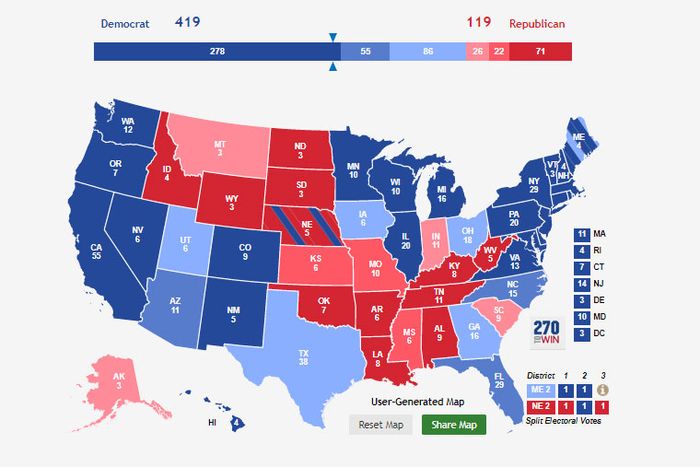
Donald Trump's campaign strategy for 2020 of fanning hate and division, especial racial hate, in the hopes of mobilizing rural voters and non-college educated whites may not be playing out as planned based on new analysis of his state-by-state approval ratings. The picture looks very positive for Democrats and, if Trump were to fair as poorly as these analyses suggest, he could pull down with him many other Republican candidates. Here in Virginia, many hope the widespread anti-Trump feelings may be the added edge Democrats need to flip control of the Virginia General Assembly and thus flip the middle finger to Der Trumpenführer.  A piece in New York Magazine looks at the survey findings.  Here are highlights:
There has been a lot of discussion in political circles about Donald Trump’s job-approval ratings, what they portend, and Trump’s Electoral College strategy for 2020, which doesn’t necessarily require a popular-vote plurality. But in the end, of course, the conjunction of the Electoral College with Trump’s state-by-state popularity is where the deal will go down.
The online polling firm Civiqs has published a new set of state-by-state job-approval ratings for Trump as of August 11, and it shows how the president’s overall standing (a 43 percent approval rating nationally, which happens to match the current RealClearPolitics polling average) might translate into electorate votes. It’s not a pretty picture for the president, to put it mildly.
Civiqs shows [Trump's] the president’s net approval ratios being underwater (i.e., negative) in 10 states he carried in 2016: Arizona, Florida, Georgia, Iowa, Michigan, North Carolina, Ohio, Pennsylvania, Texas, and Wisconsin. If that were to represent how the 2020 elections turn out, Trump would have a booming 119 electoral votes.
He’s underwater by 12 points in Pennsylvania, 11 in Michigan, and nine in Arizona, North Carolina, and Wisconsin. And there’s virtually no indication that states that narrowly went for Clinton in 2016 are trending in Trump’s direction: His approval ratios are minus 18 in Colorado, minus 15 in Minnesota, minus 12 in Nevada, and minus 27 in New Hampshire. These are, by the way, polls of registered voters, not just “adults,” so they should be a relatively sound reflection of the views of the electorate.
[T]he other publicly available survey of state-by-state presidential job approval is from Morning Consult, and its latest numbers (as of July) are pretty similar. They show Georgia and Texas as positive for Trump, and North Carolina as very close. But all the other “battleground states” are quite the reach for the incumbent.
If you credit these polls at all, Trump’s reelection will require (1) a big late improvement in his approval ratings, which is possible but unlikely based on long-standing patterns during his polarizing presidency; (2) a campaign that succeeds in making the election turn on theoretical fears about his opponent rather than actual fears about a second Trump term, which won’t be easy either; (3) a big Republican turnout advantage, which is less likely among the larger presidential electorate than it was in 2018; or (4) some diabolical ability to thread the needle despite every contra
If anything, there’s evidence that he is likely to undershoot rather than overshoot his approval ratings as the sitting president of a country whose direction lacks any kind of public confidence. Beyond that, even those who succeed by selling their souls to the devil don’t have the collateral to pull that off twice.
One can only hope that these surveys prove accurate and that things only get worse for Trump and his fellow Republicans.