Showing posts with label LGBT non-discrimination protections. Show all posts

Sunday, June 21, 2020

The Best and Worse States to Live if You are LGBT

Last weeks ruling in Bostock v. Clayton County granted federal employment non-discrimination protections to LGBT Americans nationwide and some have suggested perhaps the gay rights movement has finished its work and accomplished its goals. My response to this ludicrous suggestion is "hell no" since there remains huge amounts of work to be done at the state level and even with the newly granted federal protections, I suspect in many red states and even rural areas of some blue states being LGBT will continue to be a potentially life threatening situation.  Thus, the questions becomes what states should one consider moving to or visiting on vacations if you are LGBT and want to have some sense of safety and legal protections.  USA Today is reporting the results of a national survey of states ranking the states from worse to best places for LGBT citizens.  The rankings include laws protection LGBT citizens and is slightly out of date because it uses 2019 laws  which, as a result does not include the panoply of laws enacted in Virginia this spring.  As a result, per the survey, Virginia earns a 35th place ranking (hopefully, this ranking will move up markedly next year.  Not surprisingly, Alabama wins the worse place ranking and surprisingly, Mississippi ranks a number of rungs higher, thereby depriving Alabamians the often cited saying "thank god for Mississippi" for saving them from last place.  Below are the rankings of several states.  Take the time to read the entire piece, especially if you are thinking of relocating - both individually or moving a business - or traveling domestically during the coming year.  Here are article excerpts:

Across the United States, Americans have increasingly embraced equal treatment and access for lesbian, gay, bisexual, transgender, and queer (LGBTQ) Americans over the last decade. According to a Gallup poll in 2019, 63% of Americans supported same-sex marriage, compared with about 44% in 2010.  Some cities are more welcoming to the LGBTQ community than their respective states – Austin, Texas, is one example – but, in general, entire states (rather than just cities within them) are moving toward  protecting and empowering their LGBTQ residents.
In acknowledgement of Pride month, 24/7 Wall St. reviewed the states most and least welcoming to the LGBTQ community. We created an index of three measures – hate crimes motivated by gender and sexual orientation reported per 100,000 people, laws protecting the LGTBQ community, and the percentage of each state's population who identifies as LGTBQ – to identify the best and worst states for LGBTQ people.
While there has been no doubt progress toward equality, anti-equality activists and politicians still have a lot of influence – in some states more than others. In Texas alone, 19 anti-LGBTQ bills were filed in 2019. In Iowa, transgender health care benefits were removed from the state’s medical plan. Across the country, 102 anti-LGBTQ bills were introduced, and seven became laws. 
Even though the U.S. – and the world – is slowly becoming a more welcoming place for LGBTQ people, there are still many places where same-sex relationships are considered criminal behavior. 
50. AlabamaBased on its relatively small LGBTQ population and lack of progress passing laws that protect LGBTQ communities, Alabama is the worst state in the nation for LGBTQ Americans. Unlike the vast majority of states, which have mandatory hate crime reporting laws, Alabama police jurisdictions do not participate in reporting of hate crimes motivated by gender or sexual orientation.
In fact, the state has very few laws that positively affect LGTBQ residents, and plenty of rules that negatively affect LGBTQ communities. For example, in 2017, Gov. Kay Ivey signed legislation that would permit religious agencies to deny placing an adopted child in LGBTQ families. Alabama also restricts inclusion of LGBTQ topics in schools, and the state is one of 26 states that criminalize behaviors that carry low or negligible risk of HIV transmission (such as anti-sodomy laws). Such laws are considered archaic and frequently lead to abuse and discrimination against HIV-positive individuals and harms public health efforts.
49. WyomingJust 3.3% of Wyoming's population identifies as LGBTQ, the ninth lowest such share of any state. Relatively low numbers of LGBTQ state residents could reflect lower likelihood of identifying as LGBTQ and a generally less hospitable state for the community.
Wyoming is the state where Matthew Shepard, a gay college student, was beaten and left to die in the town of Laramie in 1998, in an incident that shocked the nation. There have been other incidents against gay people in recent years, and a gay man who was bullied committed suicide in 2016. Tragic incidents such as these are unfortunately common across the country, but considering the general inhospitable environment in the state, including lacking laws that would protect basic LGBTQ civil rights, these incidents take perhaps additional meaning in Wyoming. Still, there are people in Wyoming who continue to struggle for equal rights under the law. The cities of Casper and Cheyenne held their first pride marches in 2017.
35. VirginiaUntil very recently, Virginia was not making progress toward equality for the LGBTQ community. In April 2020, a few months after the HRC latest report was published, the state passed several laws that provided anti-discrimination protections to the LGBTQ community, making Virginia the first state in the South to do so. The state made it easier for people to update the gender marker on their birth certificate. The laws will take effect July 1.
While progress has been made, LGBTQ residents still face challenges that non-LGBTQ residents do not. Virginia has legal provisions that allow adoption and foster care agencies to turn away prospective LGBTQ parents on the grounds of religious freedom. The state does not have laws protecting students from discrimination in schools based on their sexual orientation or gender identity.
3. New YorkNew York has special significance to the LGBTQ community, as the Stonewall riots of 1969 in New York City helped spark massive changes in the nation's understanding of LGBTQ issues and paved the way for more equality to the LGBTQ community.
Today, New York ranks as one of the best states for LGBTQ people. In the last decade, the state legislature has passed 30 laws protecting the rights and safety of its LGBTQ residents. The state has some of the most comprehensive non discrimination laws of any state.
2. VermontVermont ranks as one of the best states for LGBTQ people. It provides better access to CenterLink pride centers than any other state. Vermont has an estimated 26,000 LGBTQ people and three pride centers.
The state also has some of the most comprehensive health and safety laws for LGBTQ residents among all states. It ensures that transgender people cannot be excluded from health care. Vermont also collects data on the health and well being of LGBTQ youth and adults. It also has extensive nondiscrimination laws.
1. NevadaNevada ranks as the best state in America for LGBTQ people. It has a relatively low share of hate crimes motivated by gender identity or sexual orientation. It also has nearly all laws suggested by the HRC for LGBTQ rights, including nondiscrimination laws, parenting laws, statutes against hate crimes, and those ensuring protections for health care access.
Nevada passed 34 laws protecting the rights and safety of its LGBTQ residents from 2009 to 2019. The state also has no laws considered infringing on these protections, according to the HRC.
To identify the best and worst states for LGBTQ people, 24/7 Wall St. created an index of three measures: hate crimes reported per 100,000 people, laws protecting LGTBQ communities, and the percentage of each state's population who identify as LGTBQ. Each of these three measures were weighted equally in the index.
State laws affecting LGBTQ communities came from the Human Rights Campaign’s 2019 State Equality Index, which defined such laws as positive or negative to LGBTQ Americans. The Equality Index classified each state into one of four categories: “high priority for basic equality,” "building equality," "solidifying equality," “working toward innovative equality.” 24/7 Wall St. assigned scores to each of the categories that could be normalized for the index. States that were labeled a “high priority for basic equality” received the lowest score, while states that were “working toward innovative equality” were ranked higher on our list.

Sunday, April 12, 2020

Northam Signs LGBT Nondiscrimination Bill into Law


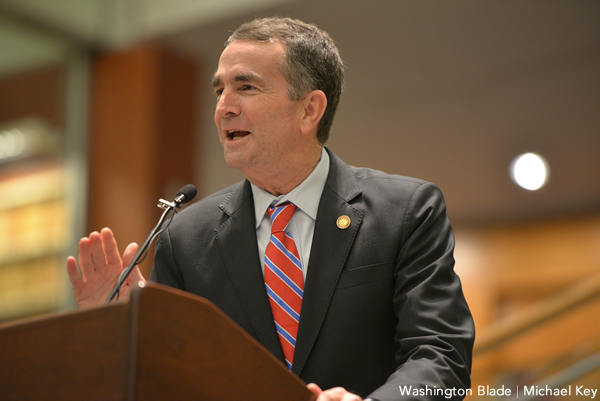
When I first came out, same sex relations could land one with a felony conviction. Thankfully, that situation ended with the Supreme Court ruling in Lawrence v. Texas.  Yet over the intervening years while finally afforded the right to may, LGBT Virginians were fair game for being fired from their jobs of their sexual orientation - something that happened to me - and could be denied housing or even public accommodations. The Virginia elections in 2019 which handed Democrats control of both the General Assembly and the Governor's mansion set the stage for passage of non-discrimination protections - long blocked by Republicans prostituting themselves to Christofascists and hate merchants such as those at The Family Foundation, Virginia's leading hate group to be passed into law.  Yesterday, these protections became a reality as Governor Northam, a good friend, signed the Virginia Values Act into law.  This Act  prohibits discrimination on the basis of sexual orientation and gender identity in housing, public or private employment, public spaces and credit transactions.  Moreover, it gives LGBT individuals a right to sue those who violate the Act and in some cases, grants the attorney general to prosecute offenders.   The Washington Blade looks at this legislation which will make Virginia a more welcoming state and remove an obstacle to companies recruiting the best talent.  Here are highlights:
Virginia Gov. Ralph Northam on Saturday signed a bill that adds sexual orientation and gender identity to the state’s nondiscrimination law.
“This legislation sends a strong, clear message — Virginia is a place where all people are welcome to live, work, visit, and raise a family,” said Northam in a statement. “We are building an inclusive commonwealth where there is opportunity for everyone, and everyone is treated fairly. No longer will LGBTQ Virginians have to fear being fired, evicted, or denied service in public places because of who they are.”
The General Assembly approved the Virginia Values Act earlier this year. Republicans, who lost control of the General Assembly last November, previously blocked efforts to ban anti-LGBTQ discrimination in Virginia.
“With the governor’s signing of the Virginia Values Act, we have made discrimination against our gay, lesbian and transgender friends, family, neighbors and co-workers in employment, housing and public accommodation illegal in the commonwealth of Virginia,” said House Speaker Eileen Filler-Corn (D-Fairfax County) in the statement Northam’s office issued. “It is now the law of the land [in Virginia] that every Virginian can work hard, earn a living wage, and live their lives without fear of discrimination based on who they are or who they love. A tremendous victory.”
Advocacy groups also applauded Northam. . . . The Virginia Values Act will take effect on July 1, 2020.
Virginia will join 20 other states, D.C. and Puerto Rico that explicitly ban discrimination based on sexual orientation and gender identity. Virginia is the first Southern state to enact these protections.
As a piece in the Virginia Pilot notes, Christofascist who use the smoke screen of "religious liberty" to inflict harm on others -typically so they can feel superior - vigorously opposed the legislation and can be expected to act as if the sky is falling. 

Thursday, February 06, 2020

Virginia to Become First Southern State Banning LGBT Discrimination

For the 26 years that it held control of the Virginia General Assembly, the Republican Party of Virginia ("RPV") sought to make life hell for LGBT Virginians.  When not pushing anti-gay policies such as the 2006 constitutional amendment to ban same sex marriage, to curry favor with its masters at The Family Foundation, Virginia's most prominent hate group, the RVP sought to block any and all bills that might have protected LGBT citizens.  This intransigence and arrogance was in spite of the fact that large majorities of Virginians favored non-discrimination protections - just as they favor common sense gun control and other progressive measures blocked by the RVP.  In November, 2019, Virginian's finally said "enough" and handed control of the Virginia General Assembly to Democrats.  Now, Virginia is poised to be the first state in the South to enact sweeping LGBT non-discrimination and public accommodation protections. Shortly after last November's sea change election, Governor Northam told the husband and I during a private visit to the Executive Mansion that he wanted "bold" action on LGBT rights.  He and the Democrat controlled legislature are about to deliver.  Here are highlights from the Washington Post's coverage:  
RICHMOND — Sweeping LGBT rights legislation that bans discrimination in employment, housing and public accommodations sailed out of the Virginia Senate and House on bipartisan votes Thursday.
Virginia would become the first Southern state to adopt such protections if the measures become law as expected. The bills also would for the first time apply Virginia’s civil rights protections to public accommodations such as restaurants and stores — not just for the LGBT community but also for racial minorities, women and religious groups.
The Senate and House bills have to cross over to the opposite chamber and win passage again before Gov. Ralph Northam (D), who requested the legislation, can sign them into law.
But those steps were seen as technicalities by advocates cheering what they regard as landmark human rights legislation.
“Its sends a message that the commonwealth is a safe and welcoming place for all people,” said Sen. Adam P. Ebbin (D-Alexandria), who was Virginia’s first openly gay legislator when he joined the House of Delegates in 2004.
Previously, Republican House leaders always killed those measures in committee.
Both chambers are under Democratic control this year for the first time in decades. The LGBT rights measures are part of a flood of Democratic priorities advancing this year, including bills to limit access to firearms, boost the minimum wage and loosen voting rules.
The legislation that advanced Thursday would prohibit discrimination against LGBT people in employment, housing or public accommodations such as restaurants. It applies to public and private entities alike.
Alphonso David, president of the Human Rights Campaign, a national group that invested in Virginia legislative campaigns last year, said there are 30 U.S. states where “gay, lesbian, bisexual and transgender people can be fired from their jobs and discriminated against in housing. Today we take Virginia off that list.
The public accommodations portion of the bill was especially notable because Virginia — the former capital of the Confederacy, which bitterly resisted racial desegregation — is one of just five states with no public accommodations law of any kind.
So the bills would not simply add LGBT people to an existing list of protected classes that cannot be denied service. Instead they would create an entirely new public accommodations provision, making it unlawful to deny services to individuals “on the basis of race, color, religion, national origin, sex, pregnancy, childbirth or related medical conditions, age, sexual orientation, gender identity, marital status, disability, or status as a veteran.”
The Senate’s bill passed 30 to 9, with nine of the chamber’s 19 Republicans voting in favor. Nine were against, and one GOP senator was off the floor when voting took place.
In January, the Senate voted to ban conversion therapy on children, repeal the state’s now-defunct ban on same-sex marriage and establish statewide policies for the treatment of transgender students.
The chamber also voted to replace “husband and wife” with gender-neutral “parties to the marriage” language in divorce law and make it easier for transgender people to change how their sex is listed on their birth certificates.


It is a new day in Virginia.  It is also ironic that in Northam, whom a number of LGBT organizations stupidly called upon to resign, LGBT Virginians have found their strongest ally and advocate - something the husband and I have long known.

Gov. Northam at a 2019 Pride reception at the Executive Mansion.

Tuesday, January 28, 2020

Virginia's Largest Employers Urge Passage of LGBT Non-Discrimination Bills

For years Virginia Republicans claimed they were the "pro-business" party yet for decades made Virginia businesses less competitive in their ability to recruit top talent and employees by pandering to anti-gay hate groups like The Family Foundation and "Christian" extremists.  Now, with the change of control of the Virginia General Assembly to the Democrats, LGBT appear poised to gain long over due non-discrimination protections.  In a recent letter, 30 of Virginia's largest employers (locally, that includes Newport News Shipbuilding) have urged passage of the Virginia Values Act that would end anti-LGBT discrimination in employment, housing, public accommodation and health care access.  The letter can be found hereVirginia Business Magazine looks at the development.  Here area article excerpts:
More than 30 Virginia employers — including Altria Group Inc., Amazon.com Inc., Capital One Financial Corp. and Dominion Energy — on Monday sent a letter to Virginia lawmakers asking for comprehensive lesbian, gay, bisexual, transgender and queer (LGBTQ) nondiscrimination protections.
The letter addressed to House Speaker Eileen Filler-Corn, D-Fairfax, and Senate Majority Leader Richard Saslaw, D-Falls Church, states that employees, their families and customers deserve equal opportunities at work and in daily life.
“Because many LGBTQ and non-LGBTQ workers prefer to live and work in communities with nondiscrimination protections, such a law will give Virginia’s employers tangible advantages in recruitment and retention,” reads the letter released by the Virginia Values Coalition, a statewide group pushing for passage of the Virginia Values Act, which would prohibit LGBTQ discrimination in Virginia.
“Business leaders know that a welcoming Virginia is crucial to their economic competitiveness,” said Kasey Suffredini, Freedom for All Americans CEO and national campaign director. “Nondiscrimination protections for LGBTQ Virginians and visitors will make it easier for businesses to recruit talented workers, to expand investments in the state, and to attract tourism business.” The crossover companies (companies that both signed the letter and were recognized as a best place to work for LGBTQ equality) included Altria, Capital One, Dominion Energy, Hilton and Nestlé USA Inc. “Virginians and businesses agree — it is past time for LGBTQ people in the commonwealth to have comprehensive nondiscrimination protections,” HRC President Alphonso David said in a statement. “These protections are good for business, good for tourism, good for the economy, and most importantly, vital for the 250,000+ LGBTQ adults living in Virginia. It’s heartening to see so many Virginia businesses publicly support these protections and push for equality for all.”

Wednesday, January 01, 2020

VA Democrats Make LGBT Nondiscrimination a Top 2020 Priority

Speaking with Governor Ralph Northam last month in Richmond following the Virginia 2019 elections that saw Democrats retake control of both houses of the Virginia General Assembly, he said he wanted Democrats to "be bold" on the issue of LGBT rights.  Democrats now in control of the House of Delegates and Virginia Senate appear to be doing just that and are making the passage of LGBT non-discrimination laws a priority for the 202 legislative session ( no doubt to the horror of the hate merchants at The Family Foundation).  A ban on conversion therapy is also apparently in the works. All of which underscores the reality that elections do matter and that every vote is critical - ask Nancy Guy who beat a Republican by a little more than two dozen votes.  While vacationing last week, I came across a piece that looks at the Democrat agenda on finally enacting LGBT protections long blocked by Republicans.  Here are highlights:

Virginia House of Delegates Speaker-designate Eileen Filler-Corn (D-Fairfax County) on Thursday said passage of a comprehensive LGBT nondiscrimination bill is a top legislative priority in 2020.
“Virginia needs comprehensive protections for our LGBT brothers, sisters, friends, co-workers,” said Filler-Corn during a press conference at the Pocahontas State Office Building near the Virginia Capitol in Richmond. “And in 2020 I’m here to tell you we will deliver them.”
State Dels. Danica Roem (D-Manassas) and Dawn Adams (D-Richmond) are among those who stood alongside Filler-Corn at the press conference the Virginia Values Coalition organized. State Sen. Adam Ebbin (D-Alexandria), outgoing Equality Virginia Executive Director James Parrish, Nationz Foundation founder Zakia McKensey, American Civil Liberties Union of Virginia Executive Director Claire G. Gastañaga, Human Rights Campaign President Alphonso David, National Center for Transgender Equality Executive Director Mara Keisling and Hannah Willard of Freedom for All Americans spoke.
The bill about which Filler-Corn and others at the press conference spoke would ban discrimination based on sexual orientation and gender identity in employment, housing and public accomodation. Filler-Corn noted Virginia is one of 30 states “where members of the LGBTQ community are not explicitly protected from discrimination.”
“We’re long overdue in protecting Virginia’s LGBT community,” she said. “It is unacceptable to me, to others and clearly the voters that in 2019 a Virginian can be fired or evicted or denied service at a restaurant because of who they are and who they love.”
Roem after she defeated Republican challenger Kelly McGinn on Election Day told the Washington Blade “its time for us to pass a Virginia version of the Equality Act.”


This is wonderful news!! May the legislation pass quickly and go to Northam's office for signing.

Sunday, April 29, 2018

The Extinction of Gay Identity

I will be sailing today at the Hampton Yacht Club where I am a member. 
I "came out" about 16 and a half years ago in mid-life (hence the name of this blog).  During that period the world has changed much for the better:  the nation's remaining sodomy laws, including Virginia's were struck down in 2003, thereby removing would be felon status for even otherwise law abiding gays, public acceptance of LGBT individuals has soared - even in relatively conservative Tidewater Virginia gay couples are now welcomed as members of yacht clubs and country clubs - and in 2015 sames sex couples finally won the right to be married.  In Norfolk, where gays were once treated as somewhat radioactive and the pride event was a small event hidden in the back of a city park, Pride Fest is now the second largest festival of the year and the City of Norfolk provides significant funding and support because of the tourism and spending the event brings with it.  (Sadly, thanks to Republicans in Richmond all too willing to prostitute themselves to Christofascists, LGBT Virginians lack employment and housing non-discrimination protections).

Along the way, however, some things were lost.  At least half of the gay bars have closed and younger LGBT residents mix freely with their straight friends with no need to seek refuge in a gay bar where they can feel safe. On a Friday night now, the husband and I are more likely to dine with friends at the Hampton Yacht Club than go to one of the remaining gays bars with restaurant facilities.  In many ways - at least in Virginia's urban crescent - gays and lesbians have become mainstream.  All of this is a positive, yet a one time sense of belonging to a special tribe is gone.  When I first came out, I felt a certain level of safety walking into "The Wave" in Norfolk on a Saturday night.  I knew I could simply be myself.  Last night, the husband and I attended a wonderful wedding at the Ford's Colony country club and not a soul batted an eye at a gay couple in attendance.   
A column in the New York Times looks at this sense of lost that at times I suspect that many of us in the LGBT community nonetheless feel.  Here are column highlights:

Mart Crowley, the author of the groundbreaking gay play “The Boys in the Band,” lives in a Manhattan apartment building that he used to visit frequently, for parties, in the late 1960s, when “Boys” had its theatrical debut. It’s on East 54th Street, No. 405, and its nickname, he told me, used to be “four of five,” because that was supposedly the ratio of gay residents.
That is not the ratio now. “It’s all yuppies and kids in strollers and all of that — and a few old codgers,” Crowley, 82, said over a recent lunch. The gays have scattered, not just from that building but from others, and we’ve distributed ourselves throughout the city — and throughout society. Gay sanctuaries are vanishing.
Is that true of gay culture and gay identity, too? I increasingly get the sense that gayness itself has scattered, becoming something more various and harder to define. “Gay” tells you about a person’s lusts and loves, but it used to tell you more — about his or her boldness, irreverence, independence. It connoted a particular journey and pronounced struggle, and had its own soundtrack, sartorial flourishes and short list of celebrity icons. Not so anymore. These thoughts came to mind as “Boys” comes back into view. For its 50th anniversary, it’s getting its first-ever Broadway production, with an all-gay, all-star cast including Jim Parsons, Matt Bomer and Zachary Quinto. The play is a postcard from an era that we have thankfully moved past, a point of reference for our hard-won success over the last half-century and our arrival in an infinitely better place. But it’s also a reminder of a glue that has gone missing among many gay men. Among many lesbians, too, . . . . We were tribes in a way that we no longer are, with rituals that we no longer have, and with a shared story. [T]he gay theatrical canon — or, rather, the gay male theatrical canon — ends in 1993, with Tony Kushner’s “Angels in America.” That play followed “The Normal Heart,” “Torch Song Trilogy” and, decades earlier, “Boys.” All were born of the bigotry that gays endured and the grace that they forged in the face of it. . . . . Sometimes, to judge from what’s onstage, I have to conclude that Crate & Barrel is sponsoring the new gay agenda,” Green writes . . . . "Boys"  . . . captures the flair for melodrama, appetite for mischief and exaggerated sense of humor — alternately self-lacerating and self-lionizing — that constituted a gay armor, worn because we lived in a sort of exile. I donned it myself in the 1980s, from my late teens through my mid-20s, as I took the temperature of the country around me, wondering exactly how cold to me it would be. Crowley said that if someone had told him then that the United States Supreme Court would someday legalize same-sex marriage, he would have responded, “That’s rather insane.” It happened in 2015. But there had been enough progress toward the acceptance and integration of gays by 2005 that Andrew Sullivan wrote an essay in The New Republic titled “The End of Gay Culture,” which he imagined would “expand into such a diverse set of subcultures that ‘gayness’ alone will cease to tell you very much about any individual.” We’re there.
Gays aren’t yet on an equal legal footing with straight people. We’re frequently derided (I’m looking at you, Mike Pompeo) and assaulted. How gay, lesbian, bisexual or transgender people are treated hinges on where we live, what color we are, how much money we have and whom we work for.
I’m 53, I came out a few years later than she did, and I remember that simply telling someone that I was gay made me interesting at a time when most gay people weren’t forthcoming about that. I remember that visiting a gay bar or resort had an electric charge, because I was traversing forbidden ground. No matter how open I was about it, being gay felt a bit like belonging to a secret society.
“Everything costs something,” Crowley told me. “Gay culture is so diffuse now, where it was once so cloistered and clandestine. It was like our own world — the world was inside out.”
“I wouldn’t trade any of the progress,” I said to him. “And yet.”  “And yet,” he agreed. But, he added, with no equivocation, “You wouldn’t want that world back.”
“Boys in the Band” makes that clear, while also making sure that a lost world is remembered.
All of this said, I am thrilled that things have changed for the better.  Growing up in the closet and desperately suppressing who I was, I could never have dreamed of the life I can now live.  It's wonderful that young gays can grow up knowing that they can marry, have families, and not be haunted by a sense of being "other."  Hopefully, the Trump/Pence regime does not take that away. 

Wednesday, January 17, 2018

Virginia Republicans Kill LGBT Non-Discrimination Law

Anti-gay Republican Tommy Norment 
One would have thought that after their severe drubbing last November, Virginia Republicans might have gotten the message that their discriminatory - and at times racist - policies are not acceptable to Virginia voters.  Apparently nine Republicans - Senators Obenshain, Norment, McDougle, Stuart, Stanley, Reeves, Chafin, Sturtevant, and Peake - missed the message from voters and started off the 2018 Virginia General Assembly session by killing a bill that would have protected LGBT Virginians from discrimination and provided civil remedies.  All of the Democrats on the Courts of Justice Committee - Senators Saslaw, Howell, Lucas, Edwards, Deeds, Petersen - voted for the bill.  Sadly, these events are in keeping with past Republican tactics of killing pro-LGBT bills in committee rather than allow them a full vote where they might pass.  Here are details on this bigoted situation:  
The bill was stopped in the Senate Courts of Justice Committee by a 9-6 vote, according to PinkNews. The nine dissenting votes all came from Republican committee members, while the other six came from Democrats.
“Adds disability, gender, gender identity, and sexual orientation to the categories of victims whose intentional selection for a hate crime involving assault, assault and battery, or trespass for the purpose of damaging another's property results in a higher criminal penalty for the offense,” the bill reads.
The bill would have required crimes against LGBT and disabled persons to be reported to the Virginia State Police database. lt would have also allowed people with vandalized homes to bring civil charges about to recover damages if the vandalization was because of their gender or sexual identity.
Currently, Virginia is one of 20 states without protections for LGBT individuals, according to PinkNews.
In states without protections, the Matthew Shepard and James Byrd Jr. Hate Crimes Prevention Act allows the federal government to pursue charges in states with no LGBT hate crime laws. The 2009 bill signed into effect by former President Barack Obama expanded the 1969 federal hate crimes law to include LGBT protections, . . . 
When LGBT Virginians and pro-LGBT businesses are selecting legal counsel, they might want to avoid Mr. Norment and his law firm, Kaufman & Canoles in favor of firms that have a pro-LGBT record. 

Saturday, January 13, 2018

Pro-LGBT Bills Mark Start of Virginia General Assembly


The husband and I are in Richmond, Virginia for the inauguration of Ralph Northam as Governor, Mark Herring as Attorney General, and Justin Fairfax as Lt. Governor. Meanwhile, the General Assembly has begun and this is a stark change from prior years: no anti-LGBT bills have been introduced while numerous pro-LGBT bill have been filed.  Perhaps the near evenly split House of Delegates and the savaging Republicans experienced at the polls last November have changed some attitudes.  A piece in GayRVA looks at the welcomed phenomenon which will hopefully be the prelude to passage of long lacking non-discrimination protections.  Here are excerpts (it's a lengthy piece that deserves a full read.):
It’s General Assembly time, traditionally a busy season for GayRVA. However, searches through Virginia’s Legislative Information System (LIS) have revealed a curious thing; unlike previous years, including this past year — which brought us bills attempting to deny transgender people the right to use the bathroom in public and allow faith-based organizations to discriminate against married same-sex couples — this year’s crop of bills and resolutions dealing with LGBTQ issues are all on the right side of issues that affect our community.
[R]ight now it appears that 27 bills and resolutions relating to LGBTQ issues have been filed in the Senate and House Of Delegates. These mainly fall into three categories.
Adding sexual orientation and gender identity to current hate crime statutes. There are four bills that have been introduced in the House (HB 10, 32, 266, and 718) and one in the Senate (SB 112) that add sexual orientation and gender identity, as well as gender and disability in most cases, to the categories of victims whose intentional targeting in a crime will result in a higher sentence for the perpetrator.
Prohibiting discrimination on the basis of sexual orientation and gender identity. This is a big one. Virginia is one of six states in which state employees are the only people in the state protected from being fired on the basis of their sexual orientation or gender identity. Of course, in that respect, we are still doing better than the 16 states with no employment-based protections at all for LGBTQ workers. But that’s thin comfort for a trans woman who can’t get a job at KFC due to her gender identity. There are other ways in which discrimination on basis of sexual orientation and gender identity is also currently permitted under the law — for example, as it stands, those who are denied housing on the basis of their sexual orientation or gender identity have no legal recourse.
Del. Mark Levine’s HB 401 is the big one here — it prohibits “discrimination in employment, public accommodation, public contracting, apprenticeship programs, housing, banking, and insurance on the basis of sexual orientation or gender identity.” This is a broad, sweeping piece of legislation that tackles all facets of a problem that some other bills only address small parts of.
Removal of sex-based classifications in laws relating to marriage and parenting. Several bills have been introduced that will amend with gender-neutral terms a variety of laws that currently describe couples as being made up of one man and one woman. These are basically procedural in nature; they simply recognize in legal language the reality that already exists in our state. However, their passage is important in making clear Virginia’s commitment to recognizing and welcoming same-sex couples. Situations these bills deal with include the property rights of married, ahem, people (HB 410), assisted conception (HB 411), adoption (HB 413), and even marriage-related criminal laws (HB 412), which, yes, have to be made applicable to same-sex couples too.
There are a few other noteworthy issues our legislators have chosen to focus on this year. Bills to ban conversion therapy, aka “ex-gay” therapy, have been introduced in both the House and Senate. 47th District Delegate Patrick A. Hope’s HB 363 prohibits health care providers and counselors from engaging in what the bill calls “sexual orientation change efforts” with anyone under the age of 18.
Bills and resolutions proposing the repeal of the Marshall-Newman Amendment, the 2006 state Constitutional amendment defining marriage as “only a union between one man and one woman,” have been introduced in both the House and Senate. HB 414, introduced by 53rd District Delegate Marcus Simon, and SB 603, introduced by 30th District Senator Adam Ebbin, both seek to repeal prohibitions against same-sex marriages that still remain encoded into law, despite the fact that the Supreme Court’s 2015 decision in Obergefell v. Hodges made such prohibitions invalid.

Monday, July 10, 2017

LGBTQ Rights Are In Danger Of Being Rolled Back


My relationships with a number of "friends" who voted for Donald Trump remained strained as some of my worse fears of a Trump/GOP victory continue to be realized.  Why?  The answer is simple: such people have set in motion what may prove to be extremely harmful to me personally and virtually every LGBT American.  Already, Trump and his regime have rolled back a number of LGBT non-discrimination protections.  Sadly, I suspect that the worst is still to come and I believe that many in the LGBT community and among our straight allies underestimate the harm that Der  Trumpenführer and his Christofascist and evangelical Christian seek to inflict.  It is worth remembering that while anti-Semiticism was common in pre-Nazi Germany, few Germans would have dreamed that Hitler and his regime would murder millions of Jews.  Then, like now, it was believed that public opinion would prevent such a wholesale murder of millions.  Justice Neil Gorsuch has shown himself to be an extreme enemy of LGBT equality.  Here in Virginia GOP attorney general candidate, John Adams, is equally hostile towards LGBT citizens. Can LGBT Americans safely rely on growing public acceptance to protect them?  A piece in HuffPost, which I sadly agree with, argues that we cannot.  Here are column highlights:
I’ve many times discussed “victory blindness,” brought on by the seduction of big wins for civil rights and which has had many gay, lesbian, bisexual and transgender people believing they’ve “arrived” ― that LGBTQ rights are secured ― while not seeing the perils ahead.
From as far back as 2014, watching the way that anti-LGBTQ forces were organizing for the future, I was worried about how the LGBTQ community would get too caught up in the anticipated win at the Supreme Court on marriage equality that was coming down the pike in 2015.
The onset of the Trump administration has certainly been a clarion call to snap out of it. And so many queer people have seen the threat and joined the Resistance.
But some recent exchanges and interactions I’ve had lead me to believe that many people, queer and straight, still believe that LGBTQ rights are secure and advancing. They point to public opinion polls, to cultural changes and to progress even in the most conservative corners of the country.
One person, educated in the history of the LGBTQ movement, told me that he couldn’t believe that the Supreme Court would undo something that the majority of Americans now supported ― marriage equality ― and implied a lot of the sounding of the alarm was for the conspiracy-minded.
I find this thinking to be naive and enormously dangerous.
It often doesn’t matter what the majority of Americans believe ― over 90 percent support universal background checks on gun purchases, after all, but we can’t get the legislation passed. The Supreme Court has handed down ruling after ruling that reversed precedents and defied the majority of Americans’ beliefs on voting rights, corporate money in politics, immigration and so many other issues. What is happening in our country right now is clear: a powerful minority is in control and is trying to get the fix in so that it can rule from the minority for a long time to come. 
Let’s look at the facts:
Donald Trump’s Supreme Court pick Neil Gorsuch  wrote a dissenting opinion two weeks ago regarding Arkansas and birth certificates for children of same-sex couples, defining himself as the new hardline leader on the court for religious conservatives and inviting lower courts to view the Obergefell marriage equality decision not as settled law, but as open to interpretation, possibly allowing for religious or other exemptions for those opposed to marriage equality.
Days later the Texas Supreme Court refused to see Obergefell as settled, sending a case back to a trial court. Slate legal writer Mark Joseph Stern, in a piece headlined, “Marriage Equality Could be in Peril,” laid out the case last week for the how marriage equality, with Gorsuch in the lead and Justice Kennedy perhaps retiring at any time and replaced by another anti-LGBTQ conservative, could be overturned.
Mississippi last year passed the most far-reaching anti-LGBTQ law we have seen and just a few weeks ago a federal appeals court ruled that the law should be allowed to take effect. The law allows for businesses and government employees to decline service to LGBTQ people, and that includes bakers, florists, county clerks and and other government employees, based on religious beliefs. It allows for discrimination in housing and employment against same-sex couples or any individual within a same-sex couple.  . . . The law allows mental health professionals and doctors, nurses and clinics to turn away LGBTQ individuals. It also allows state-funded adoption agencies to turn away LGBTQ couples. With several of the Supreme Court’s conservatives seeming to welcome these exemptions, expect other states to move in the same direction and, again, with Gorsuch on the court and Kennedy perhaps retiring at any time soon, it’s frightening to think what the court might decide about such exemptions.
Texas joined Michigan, South Dakota and Mississippi in allowing bans on adoption to same-sex couples by state-funded adoption agencies. In the cases of both Texas and South Dakota, the laws were passed this year and seemed to fly under the radar of all the attention on Donald Trump. But they, too, get at that same issue of allowing exemptions to same sex-marriage, turning same-sex marriage into second-class marriage. Again, look for more states to follow this lead.
The Trump administration has thrown transgender students overboard, withdrawing guidelines on protecting trans students that were put in place by the Obama administration for schools nationwide. And the Education Secretary, Betsy DeVos, sees no problem with giving federal dollars to schools that discriminate against gay, lesbian, bisexual or transgender students. 
Trump’s cabinet and undersecretaries include some of the most ardent foes of LGBT rights, from Housing Secretary Ben Carson and Attorney General Jeff Sessions to Health and Human Services (HHS) Secretary Tom Price and his director of the Office of Civil Rights at HHS, Roger Severino . . . .
Trump has essentially made LGBTQ people invisible. There was no presidential Pride proclamation in June, let alone a White House reception. Two surveys by HHS about older Americans and disabled people have removed questions about sexual orientation, refusing to collect vital data. And the Census Bureau dumped plans to finally include information about sexual orientation and gender identity in the 2020 census. 
This is a vigorous attempt at a full-scale rollback by religious conservatives who’ve been part of Trump’s and the GOP’s base, and it’s already had some success. There is no denying it. Many are woke to it. But I’m afraid far too many LGBTQ people are not, still wanting to revel in victories, pointing to polls and to progress globally.
The United States, however, is right now led by an authoritarian whose party ― always hostile to LGBTQ rights ― has so far given him free rein to engage in destructive behavior against anyone and everyone.
None of us can believe any of the rights we’ve fought for are safe. But more importantly, we need to wake up and see that they are already being stripped away right before our eyes.
When Trump won the 2016 presidential election as a result of the Electoral College's failure to do its duty as envisioned by the Founding Fathers, I noted that emigrating from America might be an option that the husband and I might end up pursuing.  We have taken no action on this as yet, although we are remodeling our master bathroom - doing much of the work ourselves - to make the house more salable if things should come to needing to move.  We have no intention of making the same mistakes made by 1930's German Jews who failed to flee Germany while they had the opportunity. We will watch and wait, but have no intention odf sticking our heads in the sand as to what is happening - right before our eyes.