Showing posts with label 2019 Virginia elections. Show all posts

Sunday, April 12, 2020

Northam Signs LGBT Nondiscrimination Bill into Law


When I first came out, same sex relations could land one with a felony conviction. Thankfully, that situation ended with the Supreme Court ruling in Lawrence v. Texas.  Yet over the intervening years while finally afforded the right to may, LGBT Virginians were fair game for being fired from their jobs of their sexual orientation - something that happened to me - and could be denied housing or even public accommodations. The Virginia elections in 2019 which handed Democrats control of both the General Assembly and the Governor's mansion set the stage for passage of non-discrimination protections - long blocked by Republicans prostituting themselves to Christofascists and hate merchants such as those at The Family Foundation, Virginia's leading hate group to be passed into law.  Yesterday, these protections became a reality as Governor Northam, a good friend, signed the Virginia Values Act into law.  This Act  prohibits discrimination on the basis of sexual orientation and gender identity in housing, public or private employment, public spaces and credit transactions.  Moreover, it gives LGBT individuals a right to sue those who violate the Act and in some cases, grants the attorney general to prosecute offenders.   The Washington Blade looks at this legislation which will make Virginia a more welcoming state and remove an obstacle to companies recruiting the best talent.  Here are highlights:
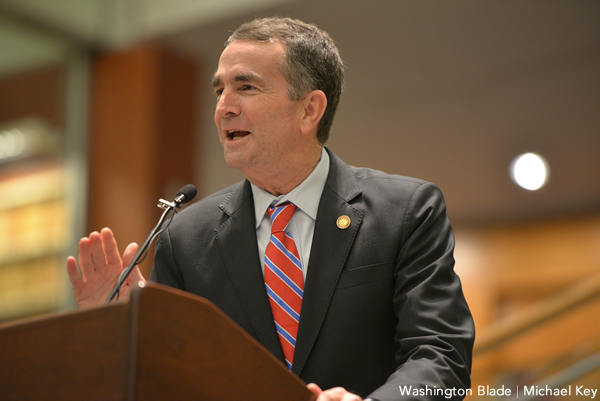
Virginia Gov. Ralph Northam on Saturday signed a bill that adds sexual orientation and gender identity to the state’s nondiscrimination law.
“This legislation sends a strong, clear message — Virginia is a place where all people are welcome to live, work, visit, and raise a family,” said Northam in a statement. “We are building an inclusive commonwealth where there is opportunity for everyone, and everyone is treated fairly. No longer will LGBTQ Virginians have to fear being fired, evicted, or denied service in public places because of who they are.”
The General Assembly approved the Virginia Values Act earlier this year. Republicans, who lost control of the General Assembly last November, previously blocked efforts to ban anti-LGBTQ discrimination in Virginia.
“With the governor’s signing of the Virginia Values Act, we have made discrimination against our gay, lesbian and transgender friends, family, neighbors and co-workers in employment, housing and public accommodation illegal in the commonwealth of Virginia,” said House Speaker Eileen Filler-Corn (D-Fairfax County) in the statement Northam’s office issued. “It is now the law of the land [in Virginia] that every Virginian can work hard, earn a living wage, and live their lives without fear of discrimination based on who they are or who they love. A tremendous victory.”
Advocacy groups also applauded Northam. . . . The Virginia Values Act will take effect on July 1, 2020.
Virginia will join 20 other states, D.C. and Puerto Rico that explicitly ban discrimination based on sexual orientation and gender identity. Virginia is the first Southern state to enact these protections.
As a piece in the Virginia Pilot notes, Christofascist who use the smoke screen of "religious liberty" to inflict harm on others -typically so they can feel superior - vigorously opposed the legislation and can be expected to act as if the sky is falling. 

Saturday, February 08, 2020

Ban on Sales of Assault Weapons Advances in Virginia

For 26 years Virginia Republicans put the profits of gun manufacturers and the wants of gun rights extremists over the safety and desires of the majority of Virginians.  After the gun massacre in Virginia Beach last May, Governor Northam called a special session of the General Assembly to consider gun control legislation.  The Republican majority arrogantly ended the session in less than 90 minutes with no discussion of proposals.  Democrats campaigned for the 2019 Virginia elections on a promise to pass the gun control legislation that most Virginians want and the voters handed them control of the legislature.  Now, Democrats are delivering on that mandate despite the shrill screams of the NRA, a front organization for gun manufacturers with a history of accepting Russian money to interfere in American elections, and white supremacist "militia" groups. The Washington Post looks at the advancement of a ban on assault weapons.  Here are excerpts:
RICHMOND — A bill banning the sale of assault-style weapons and possession of high-capacity magazines cleared a House committee Friday, drawing such an angry reaction from gun rights activists that the panel’s chairman had Capitol Police clear the room.
Sponsored by Del. Mark H. Levine (D-Alexandria), the measure would prohibit the sale or transfer of those firearms beginning July 1, and outlaw possession of the magazines six months later, on Jan. 1, 2021.
The legislation initially would have banned all possession of assault weapons, forcing owners to give them up. But the House Public Safety Committee modified it to prohibit only sales and transfers. Anyone who legally owned those guns before the law took effect would be allowed to keep them.
The measure takes a harder line on magazines that hold more than 12 rounds and on bump stocks, banning their sale and possession.
 The bill is perhaps the most controversial part of an eight-bill package of gun-control legislation that Gov. Ralph Northam (D) backed after a shooter killed 12 people in a Virginia Beach municipal building on May 31.
 “As an army doctor, Governor Northam has seen firsthand what weapons of war do to a human body,” his spokeswoman, Alena Yarmosky, said in a statement. “This bill will save lives in Virginia, and the Governor is glad to see it advance.”
 Democrats won their majorities on a promise to enact sweeping gun control, including universal background checks and a purchase limit of one handgun a month.
 While most of the gun-control measures backed by Northam are sailing through the legislature on party-line votes, the fate of the assault weapons bill in the full House is uncertain; at least a few Democratic delegates voiced concern about the original version earlier this year.
 The measure would also have to clear the Senate, where Majority Leader Richard L. Saslaw (D-Fairfax) last month scrapped his own assault weapons bill, which was not part of Northam’s package and would have banned possession of those firearms.
 Brian Moran, Northam’s secretary of public safety and homeland security, urged the committee to back the bill.  “Assault weapons are not protected by the Second Amendment because they’re weapons of war. . . . They’re not protected, just like machine guns before them,” he said. “The court will uphold this legislation. You just need to pass it.”
The House has approved the governor’s other seven gun-control bills, which would:
●Enact universal background checks on private gun sales.
●Require an owner to report the loss or theft of a firearm within 24 hours.
●Give local governments the authority to enact gun laws of their own, such as banning weapons in public buildings.
●Create a “red flag” law, or extreme risk protective order, under which authorities can temporarily seize firearms from someone deemed a threat to themselves or others.
●Limit handgun purchases to one per month, a policy that was in effect in Virginia until 2012.
●Tighten the law prohibiting access to firearms for someone subject to a protective order.
●Make it a felony to “recklessly” leave a firearm within reach of anyone age 18 or younger, up from the current age of 14, a measure known as “child access prevention.”


Thursday, February 06, 2020

Virginia to Become First Southern State Banning LGBT Discrimination

For the 26 years that it held control of the Virginia General Assembly, the Republican Party of Virginia ("RPV") sought to make life hell for LGBT Virginians.  When not pushing anti-gay policies such as the 2006 constitutional amendment to ban same sex marriage, to curry favor with its masters at The Family Foundation, Virginia's most prominent hate group, the RVP sought to block any and all bills that might have protected LGBT citizens.  This intransigence and arrogance was in spite of the fact that large majorities of Virginians favored non-discrimination protections - just as they favor common sense gun control and other progressive measures blocked by the RVP.  In November, 2019, Virginian's finally said "enough" and handed control of the Virginia General Assembly to Democrats.  Now, Virginia is poised to be the first state in the South to enact sweeping LGBT non-discrimination and public accommodation protections. Shortly after last November's sea change election, Governor Northam told the husband and I during a private visit to the Executive Mansion that he wanted "bold" action on LGBT rights.  He and the Democrat controlled legislature are about to deliver.  Here are highlights from the Washington Post's coverage:  
RICHMOND — Sweeping LGBT rights legislation that bans discrimination in employment, housing and public accommodations sailed out of the Virginia Senate and House on bipartisan votes Thursday.
Virginia would become the first Southern state to adopt such protections if the measures become law as expected. The bills also would for the first time apply Virginia’s civil rights protections to public accommodations such as restaurants and stores — not just for the LGBT community but also for racial minorities, women and religious groups.
The Senate and House bills have to cross over to the opposite chamber and win passage again before Gov. Ralph Northam (D), who requested the legislation, can sign them into law.
But those steps were seen as technicalities by advocates cheering what they regard as landmark human rights legislation.
“Its sends a message that the commonwealth is a safe and welcoming place for all people,” said Sen. Adam P. Ebbin (D-Alexandria), who was Virginia’s first openly gay legislator when he joined the House of Delegates in 2004.
Previously, Republican House leaders always killed those measures in committee.
Both chambers are under Democratic control this year for the first time in decades. The LGBT rights measures are part of a flood of Democratic priorities advancing this year, including bills to limit access to firearms, boost the minimum wage and loosen voting rules.
The legislation that advanced Thursday would prohibit discrimination against LGBT people in employment, housing or public accommodations such as restaurants. It applies to public and private entities alike.
Alphonso David, president of the Human Rights Campaign, a national group that invested in Virginia legislative campaigns last year, said there are 30 U.S. states where “gay, lesbian, bisexual and transgender people can be fired from their jobs and discriminated against in housing. Today we take Virginia off that list.
The public accommodations portion of the bill was especially notable because Virginia — the former capital of the Confederacy, which bitterly resisted racial desegregation — is one of just five states with no public accommodations law of any kind.
So the bills would not simply add LGBT people to an existing list of protected classes that cannot be denied service. Instead they would create an entirely new public accommodations provision, making it unlawful to deny services to individuals “on the basis of race, color, religion, national origin, sex, pregnancy, childbirth or related medical conditions, age, sexual orientation, gender identity, marital status, disability, or status as a veteran.”
The Senate’s bill passed 30 to 9, with nine of the chamber’s 19 Republicans voting in favor. Nine were against, and one GOP senator was off the floor when voting took place.
In January, the Senate voted to ban conversion therapy on children, repeal the state’s now-defunct ban on same-sex marriage and establish statewide policies for the treatment of transgender students.
The chamber also voted to replace “husband and wife” with gender-neutral “parties to the marriage” language in divorce law and make it easier for transgender people to change how their sex is listed on their birth certificates.


It is a new day in Virginia.  It is also ironic that in Northam, whom a number of LGBT organizations stupidly called upon to resign, LGBT Virginians have found their strongest ally and advocate - something the husband and I have long known.

Gov. Northam at a 2019 Pride reception at the Executive Mansion.

Sunday, February 02, 2020

A Year After Republicans Tried to Blow Up the Virginia Democrat Party

What a difference a year makes.  A year ago the Virginia Democrat Party was in crisis after a far right organization with ties to the Trump White House skillfully played for fools senior Virginia Democrats, most particularly Mark Warner (who in face to face encounters has never admitted he was played), and a number of LGBT organizations by the calculated release of racist photos from Governor Northam's medical school year book, allegations of sexual assault against Lt. Governor Fairfax and a forced confession from Attorney General Herring of having worn black face as a college student. The right wing/Republican goal was to destroy unity in the Democrat party in a desperate attempt to stave off loss of Republican control of the Virginia General Assembly,  At first, the fact that it was NOT Northam in the photos - they DO know who the individuals are despite EVMS's faux investigation and claims to the contrary- did not matter as the press and the black caucus went into a feeding frenzy.  Fortunately, none of the three targeted officials resigned and Democrats achieved their takeover of Richmond and a new progressive era in Virginia has begun.  A piece in the Virginian Pilot looks at how Northam and the others have prevailed. Here are highlights:
During his State of the Commonwealth address earlier this month, Gov. Ralph Northam spoke to Virginia lawmakers about taking an “honest look” at the state’s past.
After congratulating the new Democratic majority on their gains in the General Assembly, he listed the priorities of his “fair and equitable” legislative agenda.
Sitting behind him was Lt. Gov. Justin Fairfax, who would soon preside over a Senate that would pass the Equal Rights Amendment.
Also in the audience was Attorney General Mark Herring, who has made marijuana decriminalization and legalization a top priority, saying current laws disproportionately affect people of color.
As lawmakers rose to applaud the governor every few seconds, it was hard to recall that nearly a year before, the state’s top three officials — all Democrats — were mired in scandal, with near-ubiquitous calls for their resignations.
Saturday marks one year since a racist photo on Northam’s Eastern Virginia Medical School yearbook page surfaced, setting off a chain of events that nearly brought down the entire Democratic leadership in Virginia and handed unified control of state government to Republicans.
But it didn’t. In fact, it had the opposite effect.
[Northam] refused to step down, saying that would be the easy way out.
“If I were to listen to the voices calling on me to resign my office today, I could spare myself from the different path that lies ahead,” he said. “I could avoid an honest conversation about harmful actions from my past.”
Instead, he began repeating with a consistent drumbeat that he was going to focus the rest of his term — which runs until January 2022 — on righting wrongs and addressing Virginia’s harsh, racist history.
Throughout the year — indeed, even just a month after the blackface scandal — polls showed that most black Virginians didn’t want Northam to quit.
Theodore Johnson, a senior fellow at the Brennan Center for Justice, thinks that’s because black voters are pragmatic. It doesn’t make sense for them to denounce Northam or his potential successors for something that happened decades ago, especially when the alternative was a Republican — Speaker of the House Kirk Cox, who under the state Constitution would have become governor if Northam resigned and Fairfax and Herring were both unable to succeed him.
“I don’t think we can say the scandal was good for black voters, but I do think we can say black voters leveraged the scandal for positive policy outcomes,” Johnson said. “It was black Virginians who told (Northam) the best way to make up for this would be to respond via policy.”
Here are a few of those policies he’s prioritized: a commission to look at racially discriminatory language in the state code. Another to look at how Virginia schools teach African American history.
A promise to end Virginia’s racial disparities in maternal deaths by 2025. A removal of references to Confederate president Jefferson Davis at Fort Monroe. A show of opposition to other Confederate monuments. A vow to veto any bills that increase mandatory minimum prison sentences, which the governor said disproportionately impact black Virginians.
Northam’s also done the other things the Democratic party expects him to do, Johnson said, including expand Medicaid, support the ERA ratification, and restore rights to felons. “He’s been a good party representative in terms of party objective, and he’s also the political capital that black Virginians accrued by not demanding his resignation,” Johnson said.
[I]t was an election year for Democrats, and rather than give Republicans more political fuel by showing division, they kept their heads down.
“Democrats didn’t want to generate any instability when it came to the party’s fortunes heading into the next election,” Lawless said.
Voters, too, drew distinctions between the Democratic Party as a whole and the top office-holders who were members of that party. Polls repeatedly showed a preference for the Democrats to control the legislature, despite the stain left on the party by the leaders’ scandals and the GOP campaign ads referencing them.
So voters elected a Democratic majority determined to protect women’s rights, pass stricter gun control, address criminal justice inequities, and make it easier to vote, work, live and go to school in Virginia without discrimination.  “Around issues pertaining to sex and race, the state has basically said, ‘Enough is enough, we’re not going to tolerate this,’” Lawless said.
Today, it seems things have gone back to normal in the state’s capital. Northam holds regular press conferences announcing his budget priorities. Fairfax presides over the Senate, posing for pictures with female ERA supporters and student doctors in the gallery. Herring signs on to lawsuits opposing various Trump administration actions. On Thursday, he was in Washington for a press conference announcing litigation to force federal officials to acknowledge that — thanks to Virginia — the ERA has enough votes to become part of the U.S. Constitution.
Hopefully Democrats - and LGBT organizations such as HRC and Equality Virginia - have learned a lesson and will never allow themselves to again be played for fools by operatives of the far right that oppose everything that needs to be done to move Virginia forward.

Monday, January 27, 2020

Virginia Republicans Are Reaping What They Sowed


For twenty-six (26) years Virginia Republicans arrogantly held the Commonwealth back and catered to the extreme interests of the rural minority of Virginians and Christian extremists in particular.  During the last decade the Virginia GOP's power and arrogance was emboldened by almost obscene gerrymandering (some districts were so egregious that they struck down by the courts).  Like the national GOP, the Virginia GOP had no long term plan in the face of rapidly changing demographics and the growth of urban areas that one need not have been a psychic to realize would eventually be able to out vote the rural and knuckle dragging GOP base.  Indeed, the most recent example of Virginia Republican arrogance was their quick suppression of the special session on gun control called by Governor Northam in the wake of the mass shooting in Virginia Beach last May.  In the 2019 state elections, the majority of Virginians said "enough" and elected a Democrat majority to the General Assembly to enact the policies and legislation the majority has long wanted.  Now, Virginia Republicans are apoplectic about significant changes on many issues that they thwarted for decades.  A piece in the Washington Post looks at Virginia Republicans whining over a sea change their arrogance and disregard for the majority of Virginians brought about.  The ultimate irony? Republicans claiming Democrats are abusing their power even as Democrats are nowhere near as arrogant and dismissive of others as Republicans were for decades. Here are article highlights:
RICHMOND — One Republican delegate warns that Virginia is splitting in two. Another would support returning liberal Arlington and Alexandria to the District of Columbia. Lawmakers in West Virginia have offered to annex rural Frederick County, outside Winchester, to liberate it from its rapidly urbanizing home.
The change that Democrats promised in last fall’s election campaigns is hitting Richmond with full force, casting new light on political and cultural divisions that have simmered for years. As leaders quickly advance gun control, women’s rights and LGBTQ protections, many Republicans charge that they’re trampling on the interests of a new minority: rural conservatives who long held sway in the Capitol.
Last week’s massive gun rights rally was the rawest reaction yet to the demographic shifts turning Virginia from red to blue. While the state’s electorate has been tilting Democratic for more than a decade, this year’s General Assembly session shows what consolidated power looks like, with blue majorities in the legislature joining forces with Democratic Gov. Ralph Northam.
The abrupt change is playing out in ways large and small. Democrats grabbed national attention for approving the Equal Rights Amendment, while also changing the pronouns in official House rules from “he/him” to “she/her.” The weekly “Speaker’s Bible study” has become an “interfaith devotional” that kicked off with a rabbi. The word “Militia” is gone from the name of the House Public Safety Committee.
Democrats say the changes are meant to be more inclusive. “We’re telling people, ‘Yes, you belong here, you have someone you can relate to here,’ ” said Del. Danica A. Roem (D-Prince William), Virginia’s first openly transgender state lawmaker.
The upshot is that white men from red parts of Virginia hold less power this year than any time since Reconstruction.
In a sense, the change addresses old imbalances — and not just racial ones. Northern Virginia has never had positions of influence equal to its proportion of the state’s population and wealth, particularly in the House of Delegates. And Republicans over the past quarter-century have used their majorities to pass measures that Democrats found extreme, such as requiring ultrasounds before abortions or undoing any hint of restrictions on guns.
Northam’s predecessor, Terry McAuliffe (D), vetoed more bills than any governor in state history in what he called a “brick wall” against the excesses of a Republican-controlled legislature. In the House, which was under GOP control for 24 years, the shift has been painful. Former House speaker Kirk Cox (R-Colonial Heights) opted not to take over as minority leader and sits quietly during floor sessions, grimacing and whispering with colleagues. [M]any Democrats said they bristled at the optics of Gilbert, a white man, seeming to question the competence of female and black leaders. The phenomenon repeated Monday when Gilbert led an attack on a bill loosening abortion restrictions as a large crowd of women waited in the House gallery to witness final passage of the ERA. Lobbing repeated questions at House Majority Leader Charniele L. Herring (D-Alexandria), the bill’s sponsor, Gilbert at one point suggested she had missed something because she was consulting a colleague. Earlier this month, with one eye on history and the other on the gun rights movement sweeping across Virginia, Republicans in the West Virginia legislature advanced a resolution inviting neighboring Frederick County to cross the border and join the mountain state. Such an offer had technically been on the table since the Civil War, when West Virginia broke away from Richmond rather than secede.
While no one in Richmond seems keen on the idea, the proposal got LaRock thinking about how Alexandria and Arlington were originally included in the District of Columbia, until changing laws on slavery caused them to leave in the 1840s. Maybe, he told a local newspaper, they should go back.
But the problem for Republicans is that the values LaRock sees in Arlington and Alexandria have spread throughout the state. In last fall’s elections, it was suburban districts in places such as Prince William County, Chesterfield County outside Richmond and parts of Hampton Roads that gave Democrats their majorities in the legislature. “This is them realizing and being disappointed that they didn’t get more votes than they did,” Del. Jerrauld C. “Jay” Jones (D-Norfolk) said. “We are executing the will of the people of Virginia who came out to the ballot box.”
Northam, who has become the focus of rage from pro-gun activists for his promise of gun control, said through a spokeswoman that his agenda is more in step with the values of people across the state.
“Virginians have long supported things like universal background checks, ending the attacks on women’s rights, and ensuring workers can support themselves and their families,” the governor said in a written statement. “The difference is now, our legislature is finally listening.”
It’s ironic that Northam — who hails from the Eastern Shore and used to vote for Republicans — has become the bane of conservatives. When he ran for governor in 2017, some Democrats worried his rural roots and country accent would alienate suburban voters.
[H]is agenda for the coming weeks of the session is unabashedly blue. Even before Democrats have finished approving gun-control bills, they will move on to measures that expand voter access and ban discrimination against LGBTQ people. Democrats in the legislature also hope to raise the minimum wage, decriminalize marijuana, eliminate cash bail and more.
Roem, who in only her second term is now the first openly transgender person to chair a subcommittee, said Republicans need to get over it. . . . Now that the state’s most populous and wealthy region is in charge, she said, the message isn’t separation; it’s inclusion.
One can only hope a similar day soon sweeps America and the Republican agenda of hate and division and ignoring the wishes of the majority of Americans comes to a similar harsh end.

Sunday, November 24, 2019

Rural Virginia Demonstrates Why It is Dying Economically

Both Governor Ralph Northam and his predecessor Terry McAuliffe have pushed for a Virginia that is "open for business and welcoming to all" as part of their successful effort to attract new businesses and investment to Virginia. It's an approach that recognizes that businesses are only going to relocate to areas that will be welcoming to and where transferred employees will want to live.  This simple concept has not sunk into the minds of much of the population of rural Virginia - especially Southwest Virginia - who demand that the state government (and the rest of the taxpayers in the state finance) do something to turn around the continued economic decline of their region.  Yet perhaps the biggest deterrent to an economic turn around is the residents themselves many of whom continue to be racist, elect racist and homophobic representatives to the General Assembly who seek to disenfranchise minority voters, and who are hostile to those they deem "other" - which translates to any non-white and non-right wing Christian. 

Now, with Democrats in control of state government and poised to pass legislation long backed by a majority of Virginians, including sensible gun control laws, the rural areas are vowing to refuse to enforce any new gun control laws and showing themselves to be precisely the types of areas new progressive businesses would want to avoid. And the avoidance is not limited to businesses.  One couple I know moved to a rural county thinking they'd like living in the country.  Now their plan is to move to the Richmond area since they do not want their children to grow up in such a racist and bigoted environment. The Washington Post looks at the rural insanity that will only help these areas to die even more economically.  Here are highlights:
AMELIA COURTHOUSE, Va. — Families, church groups, hunt clubs and neighbors began arriving two hours early, with hundreds spilling out of the little courthouse and down the hill to the street in the chilly night air.
They were here to demand that the Board of Supervisors declare Amelia County [population 13,020] a “Second Amendment sanctuary” where officials will refuse to enforce any new restrictions on gun ownership.
A resistance movement is boiling up in Virginia, where Democrats rode a platform on gun control to historic victories in state elections earlier this month. The uprising is fueled by a deep cultural gulf between rural red areas that had long wielded power in Virginia and the urban and suburban communities that now dominate. Guns are the focus. Behind that, there is a sense that a way of life is being cast aside.
In the past two weeks, county governments from the central Piedmont to the Appalachian Southwest — Charlotte, Campbell, Carroll, Appomattox, Patrick, Dinwiddie, Pittsylvania, Lee and Giles — have approved resolutions that defy Richmond to come take their guns.
Some of the unrest is fanned by gun rights groups, such as the National Rifle Association and the Virginia Citizens Defense League, which have used social media and old-fashioned networking to offer boilerplate language for resolutions. But the movement is speaking to the anxieties of many who are unsettled by a state that has shifted from red to blue with shocking speed.
 All of the top leaders in the new Democratic-controlled legislature hail from urban or suburban districts in Northern Virginia, Hampton Roads and Richmond. The liberal suburbs outside Washington have the largest delegation in the legislature. And the status of lawmakers from rural red parts of the state has never been lower. “We need to send a signal to Richmond about Northern Virginia. We don’t want their influence to affect us down here. We’re very different people,” said Clay Scott, a 25-year-old construction project manager whose family has lived in Amelia for generations. When the General Assembly convenes in January, Gov. Ralph Northam (D) has promised to move quickly with Democratic leaders to pass measures such as universal background checks, limits on the types and numbers of firearms that can be purchased and a “red flag” law allowing authorities to seize weapons from someone deemed a threat.
The proposals “were essentially on the ballot in November,” said Brian Moran, Northam’s secretary of public safety. “And the people have spoken through their votes.”
Refusing to carry out a judge’s order to seize weapons from someone would be breaking the law. That could mean jail time. Local agencies receive funding from the state, so even adopting the stance is provocative.
“The notion that law enforcement would not follow the law is appalling,” said Lori Haas, a longtime activist with the Coalition to Stop Gun Violence. “I suspect that many of these counties and their elected officials are posturing in front of certain voters.”
As the sanctuary movement has spread around the country, Giffords Law Center to Prevent Gun Violence found that it generally has not led to active resistance. “As a practical matter, these are largely symbolic,” said Adam Skaggs, chief counsel and policy director at Giffords. “We haven’t seen cases where there are folks that are outright defying the law.”
Only one person out of the dozens who spoke expressed a different point of view. Allison Crews, 44, . . . The main thing that impressed her about the public hearing, she said, was the number of people who showed up — far beyond anything she had seen in years of attending county meetings.
“I wish we’d see those crowds for things like water quality in the town, or the school system,” she said.


So many of these rural residents are their own worse enemies yet are too blind to grasp that reality.  The Amelia County website describes the county as an "undiscovered treasure" yet with residents like those attending the meeting described in the article, most tourists - who will come from urban areas the residents despise - will likely avoid it like the plague.

Sunday, November 10, 2019

The Demographic Revolution in Virginia

The husband and I spent part of yesterday morning at the Executive Mansion in Richmond where a celebratory air reigned in the wake of last week's Virginia elections and where the governor said it was time to be bold and move Virginia forward with the passage of progressive legislation long blocked by Republican control of the General Assembly.  It was part of a mindset that embraces Virginia's demographic changes and a much more diverse population that is increasingly highly educated and is powering Virginia to new levels of wealth not seen since before the Civil War when Virginia ranked among the wealthiest states,  In sharp contrast to this embrace of change and diversity, nothing is more frightening to the Republican Party of Virginia and its base that educated and non-white voters - two groups in particular who find Donald Trump and today's GOP's agenda of division repulsive. Nowhere is this sharp contrast more pronounced than in Virginia's booming suburban areas where those new to the state or who fled rural areas of the state - causing a significant brain drain and driving up the average age of residents in rural regions - have settled.  A lengthy piece in the New York Times looks at the demographic revolution in Virginia that is also occurring in some other Southern states  and even Texas.   The take away is that until the Virginia GOP ceases to be a party of tacit white supremacists and right wing Christian zealots, ts future prospects in Virginia are bleak.  Here are article highlights:

Once the heart of the confederacy, Virginia is now the land of Indian grocery stores, Korean churches and Diwali festivals. The state population has boomed — up by 38 percent since 1990, with the biggest growth in densely settled suburban areas like South Riding. One in 10 people eligible to vote in the state were born outside the United States, up from one in 28 in 1990. It is also significantly less white. In 1990, the census tracts that make up Mr. Katkuri’s Senate district were home to about 35,000 people — 91 percent of them white. Today, its population of 225,000 is just 64 percent white.
“It’s a totally different world,” said Charles Poland, 85, a retired history professor whose family has lived in Loudoun County for four generations. His family farm is now dotted with subdivisions filled with four and five-bedroom homes that sell for $750,000. The family legacy is a road named Poland. “If my parents came back today, they wouldn’t recognize the place. The changes came like a tidal wave.”
It’s not just Virginia. From Atlanta to Houston, this pattern is repeating itself — a new kind of suburbanization that is sweeping through politics. The densely populated inner ring suburbs are turning blue, while the mostly white exurban outer ring is redder than ever. Elections are won and lost along that suburban line, and in some places — like Atlanta, Denver, and Riverside County, Calif. — Democrats have begun to breach Republicans’ firewalls.
Democrats took control of the House and elevated Nancy Pelosi to speaker in 2018 because of victories in these fast-changing parts of America, and both parties are preparing for battle over these voters in 2020.
“What was interesting about 2018 was not just that Democrats succeeded in places where they didn’t in 2006, but also that they did as well in places that 10 years ago we never would have considered competitive,” said Amy Walter, national editor of The Cook Political Report, which provides analysis of elections and races.
In Virginia, the political pendulum has swung several times in the statehouse over the past decade. Large swaths of Virginia are still very conservative and Mr. Trump is popular in those places. In 2016, he won 93 of Virginia’s 133 counties, but it wasn’t enough to take the state.
The influx of immigrants and their U.S.-born children, the spread of high-density suburbia and the growth of higher education all tilt the field toward the Democrats. Still, that doesn’t give them a lock on the state, said Larry Sabato, director of the University of Virginia’s Center for Politics.
As Virginia’s population has grown it has also gotten wealthier. Households earning at least $150,000 have grown at three times the rate of the population over all.
But when he got his citizenship in March and started talking with his friends about whom to vote for in the first election of his life, he realized it had to be Democrats. Mr. Trump helped him decide.  “The way he speaks, you get the feeling that you are separate,” Mr. Katkuri said. “This is not what we signed up for in America.”
Of the 10 metro areas that had the largest South Asian growth, five are in the South, said Ms. Sridaran, who was born in Atlanta, after her father took a teaching job at Morehouse School of Medicine in the early 1980s.  One of them was Richmond.
In Centreville on Thursday — smack in the middle of House District 40, where the nonwhite population has jumped by more than fivefold since 1990, driven by immigrants from South Korea — several people said Mr. Trump was the reason they voted this week.
“People are just sick and appalled at this president,” said Dr. Charles Huh, a gastroenterologist, as he waited for takeout at the food court in Lotte Plaza Market, a Korean grocery store. “He’s the best thing Republicans have done for Democrats in a long time.”
“It is literally a new day in Virginia,” he said, a table of snacks set up in the back. He explained that demographic changes meant the people in the room were now in a position to help shape policy. “Come to Richmond,” he said. “This is really our chance.”
Thank goodness it is a new day in Virginia and, for the LGBT community the next legislative session will see passage of non-discrimination protections long blocked by Virginia Republicans.   A more welcoming state may, in fact further accelerate the demographic changes that have brought Virginia to this point. 

Wednesday, November 06, 2019

What Democrats Nationally Can Learn From Virginia Democrats' Trifecta


An op-ed in the New York Times by the director of New Virginia Majority looks at how Virginia Democrats were able to win an amazing trifecta that has placed them in total control of this state's government.  As the author notes, this huge victory did not happen overnight - it was years in coming and required steady work at building the Democrat grass roots across the state (especially in the vote rich urban and suburban areas of the state) and across varied demographic groups.  With its off year state elections, Virginia has one advantage over other states: with an election every year - which gets exhausting - organizing and building bridges do not see the lulls that other states routinely see. The other ingredients that helped with yesterday's big win were (i)  the marshaling of financial resources from national organizations and (ii) a mindset that recognized that the path to ultimate victor could take multiple election cycles.  Here are op-ed highlights:
On Tuesday night, Virginia Democrats won their most consequential election in decades. After obtaining a majority in both chambers of the General Assembly, Democrats now have a governing trifecta for the first time since 1993. This is no accident. It comes in the midst of a generational political shift that was put in motion years ago. Virginia’s Democrats got where they are today as a result of year-round community organizing and voter engagement.
For decades, Democrats allowed the prize of an Electoral College victory to blind them to electoral opportunities elsewhere, staving off funding and failing to provide meaningful support for candidates, campaigns and local parties in places they had written off as unwinnable. The national Democratic Party spent millions in Virginia this year, but the state wasn’t always such a priority. From its position in the South to its prominent role in America’s legacy of oppression, Virginia was long considered reliably conservative — unbreakable.
Local organizations like mine understood the political potential of Virginia when we got started 12 years ago. We are winning because we recognize the power of an electorate that includes and reflects the diversity of our state. We don’t talk to voters only when campaign season rolls around. We try to reach voters of all colors, women, low-income workers and young people where they are, which has made it possible for us to develop a robust base of support along Virginia’s so-called Urban Crescent, from Northern Virginia to Hampton Roads. Long before Election Day, we registered more than 300,000 voters, knocked on more than 2.5 million doors, and organized within communities of color to help win significant policy changes like Medicaid expansion, which covered nearly 400,000 people. . . . this type of year-round organizing can pave the way for victory nationally.
Part of the failure of the Democratic Party and many mainstream political organizations in the past has come out of their belief that these communities weren’t worth investing in. But trust is not built overnight. We don’t just sweep in and register voters before an election; we are registering people every day. That work is ingrained in our organization’s DNA. And we talk to people, all year, about issues that are important to them: affordable health care, access to a good education, reforming the criminal justice system, protecting voting rights and making sure our communities have clean air, water and public lands. That is what voters responded to this fall.
[C]hanges in the shape of the electorate and rising enthusiasm among voters can only go so far, without campaign architecture that channels those changes into tangible political outcomes. Democrats can’t view these communities as a means to an end, without building authentic relationships with the people who live there.
Engaging meaningfully with voters of color means talking to tens of thousands of voters to make sure they have the information they need to cast their ballots even after receiving racist Republican campaign communications. . . . . They just needed to be convinced that their vote mattered. To give one example of how this works in practical terms, in precincts in the Virginia suburbs of Washington, turnout this year increased by 24 percent over 2017.
The lesson here is that Democrats must not write off entire geographies or communities. It took years of organizing and multiple election cycles that resulted in incremental progress for Virginia to reach the point where a Democratic sweep was possible. The same arguments once used to justify chronic underinvestment in Virginia’s progressive potential have been used to undermine the potential of similar states in the South, including other states that saw important shifts Tuesday night, like Kentucky, where the Democratic candidate for governor, Andy Beshear, appeared to beat the Trump-endorsed incumbent, Matt Bevin, in a state the president won by 30 percentage points in 2016.
States don’t become battlegrounds overnight. Democrats and national progressive organizations have the resources to take their case to the people and win, but they have to start early and organize relentlessly. When they lose, they have to stay in place and keep fighting for every political inch they can get. No place is unwinnable forever. 
NOTE:  The blue areas on the map are deceiving since they contain much higher concentrations of population that the rural, red, thinly populated areas.

A Harsh New Reality for Virginia Republicans

House of Delegates chamber.
This morning Virginia Republicans wake to a new and harsh reality: they are now the minority party with Democrats controlling the legislature and every statewide office.  Some will be quick to try to blame the debacle on anti-Trump animus - Trump's approval rating in Virginia over the summer was under 30% - but much of the fault lies with the Republican base in Virginia which increasingly racist, homophobia and anti-modernity itself and toxic organizations like the NRA and The Family Foundation (the leading hate group in the state) have set the GOP agenda.  That agenda has been one of unlimited guns, feigned "religious freedom" trampling on the rights of other citizens, and efforts to disenfranchise anyone who isn't a white evangelical.  Finally, a majority of Virginians, especially in the so-called urban crescent said "enough!"  It will be interesting to see how the leading hate merchants try to spin this to avoid accepting their own significant role in making the GOP repulsive to more and more Virginians.  Articles in the Washington Post and Yahoo News look at some of the realities of today's morning after for Virginia Republicans.  Here are excerpts from Yahoo News:
Virginia Democrats promised swift action on a host of liberal policy proposals now that they've won full control of state government for the first time in more than two decades.
Democratic leaders said Virginians should expect a higher minimum wage, new gun restrictions and greater abortion rights after their party flipped control of the state House and Senate in Tuesday's election. They also promised ratification of the Equal Rights Amendment, making Virginia the final state needed for possible passage of the gender equality measure.
Suburban voters turned out in big numbers to back Democratic candidates, continuing a trend of once GOP-friendly suburbs turning blue. This is the third election in a row in which Virginia Democrats made significant gains since President Donald Trump was elected.
The Democrats' big win was a warning sign for the president and Republicans ahead of next year's election. Higher-educated and more affluent suburban voters — particularly women — have revolted against Trump's GOP both in Virginia and nationwide.
Democrats were keenly focused on gun issues during the election, saying Republicans should be held accountable for failing to pass new restrictions after a mass shooting in Virginia Beach earlier this year.
Tuesday's election could help cement Democratic rule for the next decade, because the winners will decide who controls the next redistricting process.


Poll after poll showed that Virginians want gun control and believe in non-discrimination protections for LGBT citizens. They also are repelled by the GOP's efforts to undermine the Affordable Health Care Act.  Republican refusal to deliver what so many voters want came home to roost.  The Post piece continues some of this analysis:
But singling out Trump as the reason for Republican failures in 2019 “is too easy,” said Mark Rozell, a George Mason University professor of public policy. Rather, he said, Virginia’s GOP over the past decade has gravitated toward the right on social issues and alienated moderate voters.
Gillespie, for example, embraced a hard-line anti-immigrant stance during his 2017 gubernatorial race after having preached the importance of the Republican Party adopting a more tolerant message to attract voters.
“Democrats have had an easy time characterizing the Republicans as out of the mainstream on issues,” Rozell said. “Republicans in Virginia need to rebrand, refocus and broaden their appeal.”
Even before results were announced Tuesday night, leaders of gun-control groups were taking a victory lap at the Democrats’ rally at the Hilton Hotel in downtown Richmond. John Feinblatt, president of Everytown for Gun Safety, said a key turning point in the campaign was GOP lawmakers move to shut down a special legislative session in July on gun control, in the wake of the May 31 mass shooting in Virginia Beach.
“I think what we’re going to learn tonight is that was a huge political mistake,” he said. “I think Republicans really turned their backs on citizens of the commonwealth by not taking up a single gun safety measure.”
[D]emographic changes in large portions of the state, including a population explosion in Northern Virginia from the early 1990s through 2010, turned the commonwealth from red to purple.
And now?
“At this point, Virginia has become a blue state — how can you call it anything else,” Rozell said. “In a state that was long considered leaning red and two-party competitive at best, who could have predicted that the Republican Party would fall so dramatically and quickly?”
But how Democrats handle their newfound power could determine whether the party remains dominant in Virginia. If Democratic lawmakers push a progressive agenda, for example, the party risks alienating centrist voters. . . . a Democratic operative, said the party’s core of moderate lawmakers — headed by Northam and state Sen. Richard Saslaw (D-Fairfax), who is to become Senate majority leader — retain enormous influence over policy.
“They’re both centrists,” he said. “You’re not going to see a coup from the far left. There aren’t enough votes for that.”
It is definitely a new day in Virginia.  Democrats worked hard to get to this point, but Republican extremism and obstruction of the popular will made their job far easier.  Will the Virginia GOP learn from this debacle?  Probably not given the insanity and toxicity of its party base.

Tuesday, November 05, 2019

Democrats Take Control of Virginia General Assembly


In what will hopefully be a prelude to the 2020 federal elections, Democrats in Virginia have won control of both the Virginia Senate and the House of Delegates for the first time since 1993.  Both House Delegates candidates that the husband and I backed financially - Martha Mugler and Shelly Simonds - were victorious.  As Governor Ralph Northam - a good friend  - noted, this will usher in a much needed sea change in Virginia:
“Tonight, the ground has shifted in Virginia government. The voters have spoken, and they have elected landmark Democratic majorities in both the Senate and the House of Delegates. I am proud of my fellow Democrats and inspired by our shared victory.

“Since I took office two years ago, we have made historic progress as a Commonwealth. Tonight, Virginians made it clear they want us to continue building on that progress.
“They want us to defend the rights of women, LGBTQ Virginians, immigrant communities, and communities of color. They want us to increase access to a world-class education for every child, and make sure no one is forced to go bankrupt because they or a family member gets sick. They want us to invest in clean energy and take bold action to combat climate change. And they want us to finally pass commonsense gun safety legislation, so no one has to fear being hurt or killed while at school, at work, or at their place of worship.
No doubt there is much gnashing of teeth among white supremacist circles and among Christofascist zealots who for the last two decades have sought to inflict their hate and fear driven version of religion on all Virginians.  Tonight, a majority of Virginians said "no more." and sent those who coddle the gun lobby and haters of all stripes into retirement.   The Virginian Pilot reports in part as follows:
Democratic victories in two senate districts in suburban Richmond and one in Loudoun County gave them a 21 seat majority, while the GOP held narrow leads in two Virginia Beach districts targeted by by million-dollar-plus efforts to flip to blue.
A new 55-or-more-seat Democratic majority in the House came in part from gains in two House districts on the Peninsula, including the Newport News one where a tie vote and a drawing of a lot gave the GOP a 51-49 majority in 2017. Republicans held slight leads in two Beach seats Democrats had targeted with the final precincts still to count.
House Appropriations Committee chairman Chris Jones, R-Suffolk, [who lied extensively in his campaign ads and used racist dog whistling messaging] was defeated by Democrat Clinton Jenkins in a district federal judges drastically changed to undo the General Assembly’s illegal 2011 gerrymandering.
Senate Majority Leader Thomas K. Norment Jr., R-James City, was re-elected. But like Cox, he will lose most of his power to steer or block legislation with the new Democratic majority.
Throughout the election, Democrats sought to tie Republican candidates to President Donald Trump, warning them that a vote for Republicans would mean siding with the gun lobby and reducing access to affordable health care, including birth control.
On the Peninsula, Democrat Martha Mugler flipped a reconfigured Hampton and Poquoson 91st House district, after the retirement of one of the most loved Generaly Assembly members, Del. Gordon Helsel, R-Poquoson. Democrat Shelly Simonds defeated Del. David Yancey, R-Newport News. He was returned to Richmond after a tie vote in 2017 after he won a lot drawing. Democrat victories in the last GOP-held seat in Fairfax county, and a victory in the Frederickburg suburbs secured House majority.
Democrats held on to the 15 House seats they won in the 2017 blue wave election. . . . Turnout was higher than expected in the usually sleepy off-off year elections.
House Democrats out raised Republicans by nearly $10 million this election cycle, according to the Virginia Public Access project. On the Senate side, Democrats out raised Republicans by $5 million.
We celebrated at both the Mugler and Simonds victory parties.  It was a wonderful night to celebrate democracy and seeing the forces of hate, bigotry and obstruction go down to defeat.

Republicans Won’t Stop Killing LGBT Rights in Virginia


It's election day in Virginia and so much is at stake in terms of Virginia's future.  This is especially the case with LGBT rights which Virginia Republicans have blocked for decades now leave LGBT Virginians with no state level employment non-discrimination protections and even without public accommodation and housing non-discrimination protections.  While Republicans have run extremely dishonest campaigns trying to sound almost like typical Democrats, make mistake that these campaign efforts are a lie and that should Republicans retain control of the General Assembly, nothing will change and LGBT rights advances will continue to be killed.  A piece in Metro Weekly looks at this truth.  If you are LGBT or have LGBT friends or family members, it is imperative that you go vote for the Democrat candidates in your House of Delegates and Senate districts. Here are article excerpts that explain why:
Republicans in Virginia have controlled the House of Delegates for almost two decades, since taking control after the 1999 general election.
During that time, though public attitudes around LGBTQ rights have shifted and widespread acceptance of LGBTQ individuals has increased, the Virginia GOP is still partying like it’s 1999, using their power — particularly in the House — to continually halt or kill pro-equality measures.
That remains true even though polls show a majority of Virginians support making it illegal to discriminate against LGBTQ people.
The GOP is even out of step with its own base — a poll earlier this year found that a majority of Virginia Republicans support protecting LGBTQ people from discrimination.
[T]he House of Delegates has remained stubbornly opposed to allowing any such legislation to escape to the governor’s desk.
With that in mind — and a general election set for tomorrow, Nov. 5, that could hand control of the House to Democrats here’s some of the most notable times Republicans have killed progress for the LGBTQ community in Virginia:
Yanked three pro-LGBTQ bills, fearing they might pass
In January this year, Republican leaders in the House killed three separate pro-LGBTQ bills. Two of the bills would have prohibited discrimination in public employment and housing, and a third would have provided more expansive protections for LGBTQ people in public accommodations, credit, and public contracting. The bills, as with many before them, were killed by Republican-stacked subcommittees, with advocates blaming Speaker Kirk Cox, alleging that he feared at least two of the bills would have passed a full vote in the House.
Killed every pro-LGBTQ housing and employment bill
In 2018, Cox once again stepped in to ensure that four bills designed to protect LGBTQ people from discrimination in housing and employment died in subcommittees — after Cox engineered those committees to heavily favor conservative lawmakers from GOP-leaning districts. This, despite wide support for the bills including from a number of housing, building, and realtor associations.
Rejected protecting transgender people from healthcare discrimination
Also in 2018, Republicans voted to allow anti-transgender healthcare discrimination to continue. A Democrat-sponsored bill would have prevented insurance companies from refusing to cover medically necessary treatments or procedures for trans patients, but all GOP members of a House subcommittee rejected it, effectively killing the bill.
Stopped an attempt to ban anti-LGBTQ conversion therapy on minors
Again in 2018, Republicans — this time in a Senate committee — killed a bill that would have prevented licensed therapists and counselors from subjecting LGBTQ minors to conversion therapy. Widely debunked and considered harmful and detrimental to mental health, conversion therapy purports to “change” a person’s sexual orientation or gender identity. But rather than vote to protect children from being subjected to methods that include public shaming, forced vomiting, and electroshock therapy, they instead rejected the bill on a party-line vote. (And it’s not the first time. Republicans rejected a similar ban in 2015.)
Defeated bills to deal with anti-LGBTQ hate crimes
It really was a busy year for killing pro-LGBTQ legislation, as in 2018 Republicans also shut down attempts to deal with crimes that target LGBTQ people — a decision made even as the number of anti-LGBTQ homicides hit a record high.
And that’s just in the last couple of years.
We’ve only highlighted as far back as the start of the 2018 legislative session, but Republicans have killed countless pro-LGBTQ measures over the years, covering a number of LGBTQ issues, from nondiscrimination protections, to legalizing same-sex marriage, to including LGBTQ people in hate crimes protections:
2017: Two pro-equality bills designed to ban discrimination against LGBTQ people in housing and employment passed the Senate before being killed in the House by a Republican-controlled subcommittee.
2016: GOP Delegates killed eight LGBTQ-related bills by punting them to a process that subjects legislation to further review and analysis, effectively tabling them indefinitely. Among those punted were six bills granting protections in public employment, private employment, housing and public accommodations, as well as a measure that would have banned the practice of LGBT conversion therapy on minors. House Republicans then killed two nondiscrimination bills — which had passed the Senate on a bipartisan vote — that would have prohibited discrimination in housing and employment.
We haven’t even mentioned the anti-LGBTQ legislation…
While Republicans in Virginia were busy voting down, tabling, delaying, or otherwise killing pro-LGBTQ legislation, they were also introducing various bills that actively discriminated against the LGBTQ community, including: a “religious freedom” bill that removed penalties for those who discriminated against LGBTQ people (it was ultimately vetoed by Gov. Terry McAuliffe after passing both the House and Senate); passing an almost identical bill in 2016, which was similarly vetoed; introducing three separate bills in 2017 targeting transgender people in public accommodations, allowing contractors to discriminate against LGBTQ people, and banning trans students from accessing facilities that match their gender identity; and in 2016 threatening nine separate pieces of anti-LGBTQ legislation targeting same-sex marriage and LGBTQ rights.
And again, that’s just in the last few years.
Democrats expect a “sea change” in LGBTQ progress should they flip the House or Senate
Democrats are arguing that the only hope for progress on LGBTQ rights in Virginia is for voters to flip the House — and the Senate, too — and give Democrats a chance to pass pro-LGBTQ legislation.
As Kathryn Gilley, communications director for the Democratic Party of Virginia, told Metro Weekly last week, “If Republicans were going to do something to help the LGBTQ community, they would have done it by now.”
“They have had a majority in the House of Delegates for 20 years,” she said. “We’ve seen their stance on LGBTQ rights, and it’s not good.”
Again, if you have LGBT friends or family members, if you don't vote Democrat today, you are actively voting to harm your friends and family members.  It truly is that simple. Vote Democrat!