Showing posts with label blue states. Show all posts

Wednesday, May 20, 2020

The Pandemic's Staggering Impact on the World’s Cities

As much as Trump's rural base hates America's cities and the "liberals" who live in them, cities - and generally the blue states in which they are located - have been the engines that have driven America's economy.  Moreover, blue states have paid far more into the federal system than they receive, thereby subsidizing red states which often are viewed as unattractive venues for new and progressive businesses.   Now, the coronavirus pandemic has hit cities with their denser populations especially hard and the economic impact may be long lasting, especially for those cities with the densest populations and most costly living costs. Service industries such as restaurants - some predictions are that 70% will never reopen - may be among those most severely harmed. Add to that the new working from home model which may change how large corporations with large numbers of white collar workers operate, and the impact may be magnified.  A piece in Washington Post looks at the huge impact.  Here are highlights: 
Cities across the world have become sites of the novel coronavirus pandemic’s greatest tragedies. New York City is possibly now the single biggest hot spot of the virus and has suffered close to a quarter of all U.S. deaths. It’s a similar ratio in London when set against the rest of Britain. Madrid’s toll may be even worse.
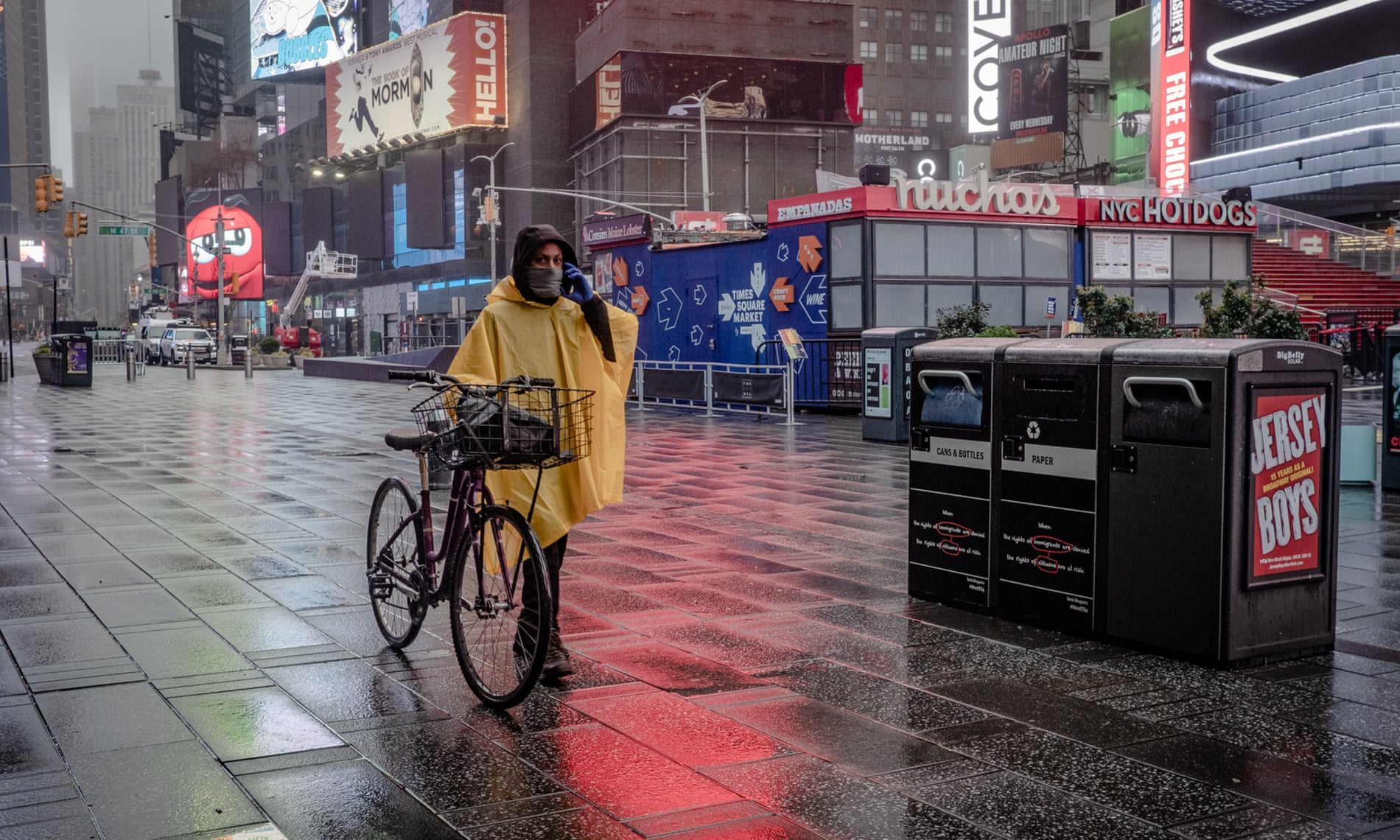
In most cities, life is a shadow of what it once was, with streets empty, arenas abandoned, businesses shuttered. Well-heeled residents have skipped town to country abodes and seaside getaways. Most of those who remain have slipped into an atomized existence — their movements curtailed, their social circles exponentially shrunk — that’s anathema to the whole point of living in a bustling, vibrant city.
From the financial capitals of the West to teeming megacities in the developing world, the crisis is both exposing profound systemic problems and raising tough questions about whether cities will ever be able to return to what they once were.
The imperatives of social distancing have plunged the world into a giant experiment in remote work, and some office workers may never want to return to the stresses, steep housing costs and public health risks associated with life in a dense, big city. As Cavendish noted, trends already underway may accelerate: The populations of global cities like New York, Paris and even Shanghai were declining before the pandemic struck, largely as a result of soaring rent prices.
UNESCO, the U.N. cultural agency, warned Tuesday that the pandemic may kill 1 in 8 of the world’s museums. Myriad local retailers and businesses that in part help cities distinguish themselves from suburban areas more beholden to corporate chains face extinction. A recent survey in the United States found that 70 percent of smaller restaurants don’t expect to reopen should the coronavirus crisis last more than four months. Hundreds of American towns and cities plan on cutting public services in the coming year as tax revenue plummets.
With many companies probably downsizing their physical footprints and demand for commercial real estate slowing, the skyscrapers that shape skylines from Manhattan to Mumbai may start to look more like white elephants than symbols of financial might.
“If pandemics become the new normal, then tens of millions of urban service jobs will disappear,” wrote Edward Glaeser, an economics professor at Harvard University. The only chance to prevent this labor market Armageddon is to invest billions of dollars intelligently in anti-pandemic health care infrastructure so that this terrible outbreak can remain a one-time aberration.”
Pandemics have inspired substantive innovation and change before. “In the 1850s, the cities of New York, Paris, and London rebuilt their sewage systems in response to a century-long global cholera pandemic that killed more than 1.5 million people and ushered in a new age of urban sanitation that spread across the globe,” wrote Steve LeVine in Medium’s Gen magazine.
Now the world’s cities may become crucibles for a new wave of experimentation. This may range from the benign — consider the many cities shutting down streets to car traffic and expanding public outdoor seating, pedestrian- and bicycle-only spaces — to the more sinister — consider the new technologies of surveillance and contact tracing that may come to dominate urban life even after the pandemic.
The crisis may provide a short window for our unaffordable, hypergentrified cities to reset and to reenergize their creative scenes,wrote University of Toronto urbanist Richard Florida. “Predictions of the death of cities always follow shocks like this one. But urbanization has always been a greater force than infectious disease.”


If Trump remains in the White House and the GOP retains control of the U.S. Senate, do not expect the required investment in an anti-pandemic infrastructure.  Voting in November for a straigh Democrat ticket has become all the more important.

Thursday, April 02, 2020

What Will Happen When Red States Need Help with Covid-19?

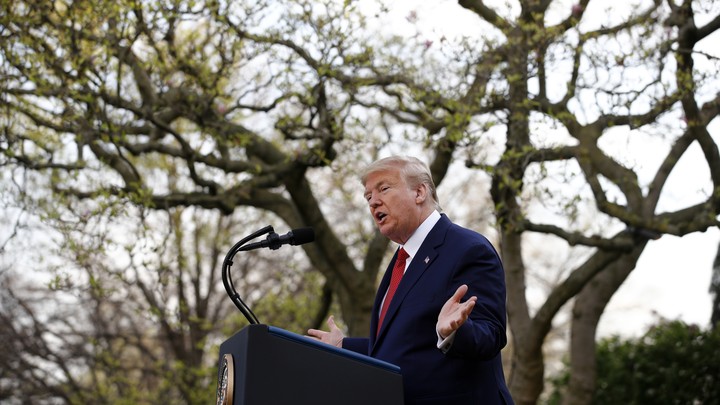
By many accounts Donald Trump has played political favoritism in doling out coronavirus aid and has bad mouthed governors of blue states yet at some point the virus crisis is going to engulf red states - many of which have been slow to enact stay home orders and other measures to slow the spread of the virus. Some red states still have not taken such measures.  While Trump hasn't paid a price as yet since blue states won't vote for him anyway, the equation could rapidly change as red states find themselves slipping into crisis mode.  Suddenly, Trump's failed leadership and ego driven reaction to the crisis could have serious political consequences.  A piece in The Atlantic looks at what may transpire in the near term.  Here are excerpts:
On Sunday morning, President Donald Trump got on the phone with Mayor Bill de Blasio to discuss what New York City needs to survive a white-hot outbreak that is only getting worse. De Blasio asked him to send more ventilators and military personnel, warning that in a week’s time, the health-care system could be overwhelmed.  
Until recently, de Blasio told me, none of his calls to the upper reaches of the White House were returned. Two weeks ago, the Democratic mayor said publicly that Trump was “betraying” his native city by not sending more life-saving medical equipment. Ever sensitive to criticism, Trump said, in turn: “I’m not dealing with him.”
Defeating a pandemic is hard enough, but Trump has introduced another layer of complexity: He has personalized the battlefield. He calls COVID-19 “the invisible enemy,” but he also seems fixated on the visible variety—all Democratic leaders, who in his view have been insufficiently grateful for the federal government’s response.
But Democrats can be useful foils for only so long—the virus is already moving beyond blue-state hot spots into the rural red states that are the pillars of Trump’s support. As more people become infected in broader swaths of the country, Trump will face a fresh wave of calls for ventilators, masks, and money. It won’t be so easy to demonize a handful of discontented governors and mayors. Complaints will be coming from friends.Trump has called Washington Governor Jay Inslee a “snake” and said he won’t speak to him. Inslee’s team sounds utterly baffled about what to do. “We’re trying to act as if we’re interacting with a normal president, or at least a normal Republican president,” an aide in Inslee’s administration told me.
“The administration’s response in general has been an abysmal failure, and he compounds that failure by regularly attacking the governors to whom he has passed the buck,” Senator Chris Murphy, a Connecticut Democrat, told me. “I just don’t think we can allow ourselves to normalize a president who is politically attacking the very governors who are trying to save lives right now in the absence of real federal leadership.”
Inside the White House, there seems to be little sympathy for some of the Democratic governors who have complained the loudest. . . . . Trump, though, is sensitive to anything he sees as ingratitude. If his administration sends planeloads of ventilators—a national resource—he wants a thank you, not a complaint about why it didn’t come sooner.
“It’s unprecedented that a president in the middle of something like this would ask you to bow down and kiss his you-know-what in order to get things that every citizen in the United States should get right now,” Jim Ananich, the Democratic leader of the Michigan state Senate, told me.
The virus’s spread will create political pressures Trump has so far escaped. At first the disease took root in densely packed blue states where many residents travel internationally and to which tourists flock. Trump seized on that fact, pointing to red states that have had comparatively few infections.
Conservative pundits have amplified Trump’s message. “These spreads are mainly in the blue states,” the author Dinesh D’Souza said in a recent Fox News appearance. “What I find kind of interesting is these blue-state governors and mayors, they’re criticizing Trump, but they also have the outstretched hand.”
Over time, though, Trump may find even some of his closest political allies demanding more help from the White House. Republicans’ traditional aversion to government intervention and economic aid will face a severe test as more and more of their constituents fall ill. Health experts expect infections to appear more widely as people living in red America travel out of state and then return home, and as people in stricken areas venture out.
“New York is the hardest-hit state right now only because New York has been doing more testing per capita pretty much than anyone else, and New York has a much higher population density, which is what we would expect,” Michael LeVasseur, an epidemiology and biostatistics professor at Drexel University, told me.
Before long, Republicans may be the ones with the outstretched hands. How Trump responds will prove revealing. Will he see pleas for help as more legitimate when they’re coming from red states rather than blue?

Saturday, February 15, 2020

California Exiles' Revenge on Trump

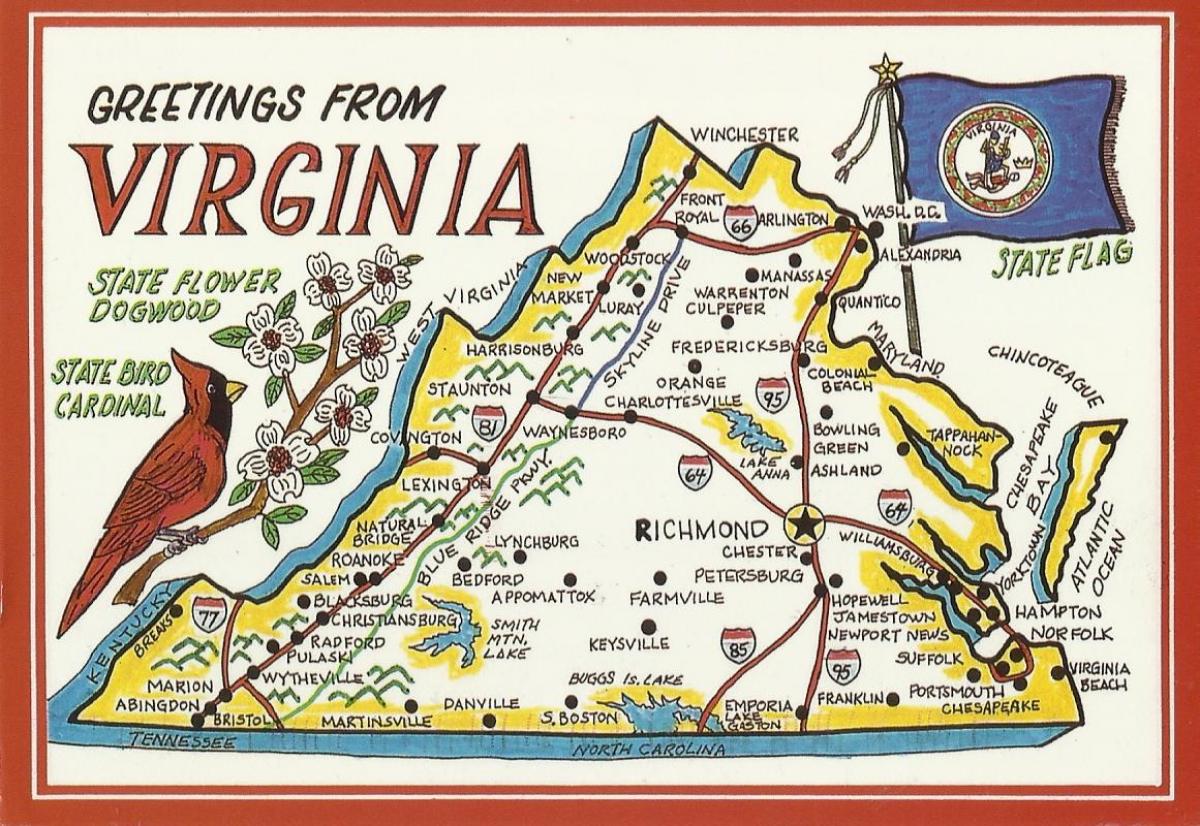
Virginia has moved into the blue state category due to two principal factors: (i) it has an increasingly college educated population, and (ii) it has seen a large influx of residents from liberal states.  These phenomenon are especially evident in Northern Virginia and the rest of Virginia's urban crescent that stretches south through Richmond and then south east to Hampton Roads. As a piece in the New York Times notes, similar things are happening in other states that are trending blue, often driven by exiles from California who take their more liberal views and support for the environment with them to their new home states. Donald Trump constantly trashes California and its progressive policies, yet that states' former residents are transforming the political landscape in Nevada. Colorado and Arizona - and, in time, perhaps even Texas.  Here are column highlights:
President Trump clearly hates the most populous state in the country he governs. While trashing California with his gutter mouth, the president has used his office to physically trash the home to nearly one in eight Americans — seeking to make its air more polluted, its water less clean, its forests more vulnerable to catastrophic fires.
But now the Golden State is poised to strike back. By moving its presidential primary from June to March 3, California will finally exert a political influence commensurate to its size. Almost 500 delegates, a fourth of the number needed to win the Democratic nomination, are at stake.
Perhaps more consequential — or at least overlooked — is what’s happening among the vast diaspora of more than 7.3 million people who have left California since 2007. They appear to be changing the political makeup of the states they’ve moved to, perhaps enough to alter the Electoral College map in favor of Democrats.
With nearly 40 million people, California is still gaining population — barely. But stratospheric home prices and unbearable rental costs have created a reverse “Grapes of Wrath,” forcing those who are not rich to flee to states with much lower costs of living.
The question is: Are they bringing California values — fierce defense of the environment, tolerance of immigrants and a multiracial society, insistence on universal health care — with them? It could be just demographic churn. But if you look at the changing politics of Nevada, Colorado and Arizona, all fast-growing states packed with new arrivals from California, the answer is yes. Texas may not be far behind.
In Nevada, to which 500,000 Californians moved between 2008 and 2018, Democrats won the governor’s mansion and a second U.S. Senate seat in 2018. There used to be more Republicans, by registration. But Democrats now have a 70,000-voter advantage, and they prevailed there in the last three presidential races.
Colorado, another favorite landing spot for those who can no longer afford California, is now reliably blue. Democrats won majorities there by more than 100,000 votes in the last two presidential elections. The state is likely to flip a Senate seat, bouncing the inept Republican Cory Gardner for a popular former governor, John Hickenlooper.
Arizona could be the next to fall to Democrats. The state known for retirees and tax-averse whites is becoming more diverse and younger and is full of ex-Californians. Between 2001 and 2014, Arizona added about a quarter-million people from its neighboring state to the west.
[I]f the Dems were to win Arizona’s 11 Electoral College votes, as polls show they could, and lose Wisconsin’s 10, while getting back Pennsylvania and Michigan, that would be enough to remove the vile and corrupt man occupying the White House.
Texas, the top state for California exiles, will probably come up short for Democrats this year, though it’s in play. Democrats have a growing advantage in Dallas, Houston, Austin and San Antonio, all seeing heavy U-Haul traffic from California.
Polls in Texas show Trump failing to get above 48 percent in matchups with Democrats. And 45 percent of voters wanted to impeach and remove him from office.
Trump treats these fellow citizens as aliens. He’s going out of his way to gut the state’s clean air standards, to turn the Eden of its public lands over to industrial pillagers and to cast its immigrant strivers as criminals. He has done nothing — rebuffing the state’s plea for additional housing vouchers for the poor — to mitigate the homeless crisis. He’d prefer a dystopia on the Pacific, largely because he lost the Golden State by more than four million votes.
And yet Californians, those who still proudly call it home and those who left their hearts there, could be the force that sends him packing.

Monday, January 27, 2020

Virginia Republicans Are Reaping What They Sowed


For twenty-six (26) years Virginia Republicans arrogantly held the Commonwealth back and catered to the extreme interests of the rural minority of Virginians and Christian extremists in particular.  During the last decade the Virginia GOP's power and arrogance was emboldened by almost obscene gerrymandering (some districts were so egregious that they struck down by the courts).  Like the national GOP, the Virginia GOP had no long term plan in the face of rapidly changing demographics and the growth of urban areas that one need not have been a psychic to realize would eventually be able to out vote the rural and knuckle dragging GOP base.  Indeed, the most recent example of Virginia Republican arrogance was their quick suppression of the special session on gun control called by Governor Northam in the wake of the mass shooting in Virginia Beach last May.  In the 2019 state elections, the majority of Virginians said "enough" and elected a Democrat majority to the General Assembly to enact the policies and legislation the majority has long wanted.  Now, Virginia Republicans are apoplectic about significant changes on many issues that they thwarted for decades.  A piece in the Washington Post looks at Virginia Republicans whining over a sea change their arrogance and disregard for the majority of Virginians brought about.  The ultimate irony? Republicans claiming Democrats are abusing their power even as Democrats are nowhere near as arrogant and dismissive of others as Republicans were for decades. Here are article highlights:
RICHMOND — One Republican delegate warns that Virginia is splitting in two. Another would support returning liberal Arlington and Alexandria to the District of Columbia. Lawmakers in West Virginia have offered to annex rural Frederick County, outside Winchester, to liberate it from its rapidly urbanizing home.
The change that Democrats promised in last fall’s election campaigns is hitting Richmond with full force, casting new light on political and cultural divisions that have simmered for years. As leaders quickly advance gun control, women’s rights and LGBTQ protections, many Republicans charge that they’re trampling on the interests of a new minority: rural conservatives who long held sway in the Capitol.
Last week’s massive gun rights rally was the rawest reaction yet to the demographic shifts turning Virginia from red to blue. While the state’s electorate has been tilting Democratic for more than a decade, this year’s General Assembly session shows what consolidated power looks like, with blue majorities in the legislature joining forces with Democratic Gov. Ralph Northam.
The abrupt change is playing out in ways large and small. Democrats grabbed national attention for approving the Equal Rights Amendment, while also changing the pronouns in official House rules from “he/him” to “she/her.” The weekly “Speaker’s Bible study” has become an “interfaith devotional” that kicked off with a rabbi. The word “Militia” is gone from the name of the House Public Safety Committee.
Democrats say the changes are meant to be more inclusive. “We’re telling people, ‘Yes, you belong here, you have someone you can relate to here,’ ” said Del. Danica A. Roem (D-Prince William), Virginia’s first openly transgender state lawmaker.
The upshot is that white men from red parts of Virginia hold less power this year than any time since Reconstruction.
In a sense, the change addresses old imbalances — and not just racial ones. Northern Virginia has never had positions of influence equal to its proportion of the state’s population and wealth, particularly in the House of Delegates. And Republicans over the past quarter-century have used their majorities to pass measures that Democrats found extreme, such as requiring ultrasounds before abortions or undoing any hint of restrictions on guns.
Northam’s predecessor, Terry McAuliffe (D), vetoed more bills than any governor in state history in what he called a “brick wall” against the excesses of a Republican-controlled legislature. In the House, which was under GOP control for 24 years, the shift has been painful. Former House speaker Kirk Cox (R-Colonial Heights) opted not to take over as minority leader and sits quietly during floor sessions, grimacing and whispering with colleagues. [M]any Democrats said they bristled at the optics of Gilbert, a white man, seeming to question the competence of female and black leaders. The phenomenon repeated Monday when Gilbert led an attack on a bill loosening abortion restrictions as a large crowd of women waited in the House gallery to witness final passage of the ERA. Lobbing repeated questions at House Majority Leader Charniele L. Herring (D-Alexandria), the bill’s sponsor, Gilbert at one point suggested she had missed something because she was consulting a colleague. Earlier this month, with one eye on history and the other on the gun rights movement sweeping across Virginia, Republicans in the West Virginia legislature advanced a resolution inviting neighboring Frederick County to cross the border and join the mountain state. Such an offer had technically been on the table since the Civil War, when West Virginia broke away from Richmond rather than secede.
While no one in Richmond seems keen on the idea, the proposal got LaRock thinking about how Alexandria and Arlington were originally included in the District of Columbia, until changing laws on slavery caused them to leave in the 1840s. Maybe, he told a local newspaper, they should go back.
But the problem for Republicans is that the values LaRock sees in Arlington and Alexandria have spread throughout the state. In last fall’s elections, it was suburban districts in places such as Prince William County, Chesterfield County outside Richmond and parts of Hampton Roads that gave Democrats their majorities in the legislature. “This is them realizing and being disappointed that they didn’t get more votes than they did,” Del. Jerrauld C. “Jay” Jones (D-Norfolk) said. “We are executing the will of the people of Virginia who came out to the ballot box.”
Northam, who has become the focus of rage from pro-gun activists for his promise of gun control, said through a spokeswoman that his agenda is more in step with the values of people across the state.
“Virginians have long supported things like universal background checks, ending the attacks on women’s rights, and ensuring workers can support themselves and their families,” the governor said in a written statement. “The difference is now, our legislature is finally listening.”
It’s ironic that Northam — who hails from the Eastern Shore and used to vote for Republicans — has become the bane of conservatives. When he ran for governor in 2017, some Democrats worried his rural roots and country accent would alienate suburban voters.
[H]is agenda for the coming weeks of the session is unabashedly blue. Even before Democrats have finished approving gun-control bills, they will move on to measures that expand voter access and ban discrimination against LGBTQ people. Democrats in the legislature also hope to raise the minimum wage, decriminalize marijuana, eliminate cash bail and more.
Roem, who in only her second term is now the first openly transgender person to chair a subcommittee, said Republicans need to get over it. . . . Now that the state’s most populous and wealthy region is in charge, she said, the message isn’t separation; it’s inclusion.
One can only hope a similar day soon sweeps America and the Republican agenda of hate and division and ignoring the wishes of the majority of Americans comes to a similar harsh end.

Thursday, November 14, 2019

Red and Blue Economies Are Heading in Sharply Different Directions

I have long maintained that part of the economic problems facing "red states" and red rural areas is that their social reactionary nature and hostility towards non-whites, non-straights and non-Christians makes them unattractive to the business of the 21st century and the future.  Here in Virginia, Southwest Virginia is a prime example.  That region continues to demand that state monies be used to turn around the region economically yet the residents (and, yes, there are exceptions) continue to embrace social, religious and political views that are anathema to the economic change they claim to want.  Now a study, as reported in the New York Times looks at the diverging paths of so-called blue economies associated with rising urban areas and those of red economies associated with rural and reactionary regions.  And yes, the red areas tend to be far more white and perhaps more racist.  Here are article highlights:

At a quick glance, red and blue metropolitan areas are performing equally well on average in the most watched indicators of labor market health. . . . Silicon Valley (blue) is booming. So is Provo, Utah (red).
But below the surface, red and blue local economies are worlds apart on enduring, fundamental measures that determine their future prospects and their biggest economic challenges.
The correlations between deeper economic measures and how the contrasting metro areas voted in 2016 are striking.
In bluer metros, more residents have college degrees: The 10 large metros with the highest educational attainment each voted for Hillary Clinton by at least a 10-point margin. Median household incomes are higher in bluer metros even after adjusting for the cost of living, which is higher in bluer metros as well. (Metro area is a better measure for a local labor market than a neighborhood, city, county or state.)
And bluer metros have a more favorable job mix for the future, with fewer manufacturing jobs, a higher share of harder-to-automate “non-routine” jobs, and a higher share of jobs in occupations projected to grow faster.
These measures — education, household income, cost of living, non-routine jobs and projected job growth — are highly correlated with one another, and with voting Democratic.
Other economic measures are less strongly correlated with partisanship but still show a pattern. Bluer metros have less year-to-year volatility of job growth. In part that’s because goods-related sectors like manufacturing and mining are more volatile and are clustered in Republican-leaning areas.
Home values have risen more in bluer metros than in redder ones. And blue metros have a higher prime-age employment-population ratio, even though the unemployment rate varies little by partisanship. That’s because red metros have a higher share of prime-age adults who are not in the labor force and therefore aren’t counted in the unemployment rate.
But there are a few places that vote differently than you’d expect from their local economic fundamentals. Colorado Springs and the Provo-Orem area, for instance, have education levels and an occupation mix more typical of blue metros but voted for Donald J. Trump in 2016 by a wide margin. On the flip side, Stockton, Calif., and El Paso look more like red metros economically but voted for Mrs. Clinton.
Why do some metros vote differently than their economics might suggest they would? Race, ethnicity and religion. Metros that vote Democratic despite having lower education and a job mix more typical of redder metros tend to have large Hispanic populations, including many in inland California and on the Texas border. Metros that vote more Republican despite having higher education and a blue-metro job mix tend to be whiter.
[I]ncome inequality — and all the social and political challenges that come with it — tends to be lower in redder metros. And while cost-of-living-adjusted household incomes are higher in bluer metros, cost-of-living-adjusted salaries for a given occupation are typically higher in redder metros.
There’s a reason for this difference: Bluer metros tend to have higher-paying occupations and fewer prime-age adults out of the labor force, which increases household incomes. But if you move from a bluer to a redder metro and find a job in the same occupation, you’re likely to get an increase in salary after taking living costs into account.
The economic challenges of blue metros — unaffordability and inequality — are different than those of red metros, which face lower living standards and greater risks of job loss. Even if the economy takes a back seat in the 2020 election to health care, immigration and President Trump’s record, these economic differences won’t be far from the surface. And if national economic conditions soften, these differences will become more reason for partisan disagreement on urgent policy priorities.
If the places that moved left between 2012 and 2016 continue getting bluer — and the places that swung Obama-to-Trump keep getting redder — the local economies of red and blue America will keep growing further apart.


Innovation and progressive thinking gravitates to blue regions while "conservatism," closed mindedness and an unwelcoming atmosphere toward those who are different concentrates in red regions. Both bring economic consequences. 

Sunday, November 10, 2019

The Demographic Revolution in Virginia

The husband and I spent part of yesterday morning at the Executive Mansion in Richmond where a celebratory air reigned in the wake of last week's Virginia elections and where the governor said it was time to be bold and move Virginia forward with the passage of progressive legislation long blocked by Republican control of the General Assembly.  It was part of a mindset that embraces Virginia's demographic changes and a much more diverse population that is increasingly highly educated and is powering Virginia to new levels of wealth not seen since before the Civil War when Virginia ranked among the wealthiest states,  In sharp contrast to this embrace of change and diversity, nothing is more frightening to the Republican Party of Virginia and its base that educated and non-white voters - two groups in particular who find Donald Trump and today's GOP's agenda of division repulsive. Nowhere is this sharp contrast more pronounced than in Virginia's booming suburban areas where those new to the state or who fled rural areas of the state - causing a significant brain drain and driving up the average age of residents in rural regions - have settled.  A lengthy piece in the New York Times looks at the demographic revolution in Virginia that is also occurring in some other Southern states  and even Texas.   The take away is that until the Virginia GOP ceases to be a party of tacit white supremacists and right wing Christian zealots, ts future prospects in Virginia are bleak.  Here are article highlights:

Once the heart of the confederacy, Virginia is now the land of Indian grocery stores, Korean churches and Diwali festivals. The state population has boomed — up by 38 percent since 1990, with the biggest growth in densely settled suburban areas like South Riding. One in 10 people eligible to vote in the state were born outside the United States, up from one in 28 in 1990. It is also significantly less white. In 1990, the census tracts that make up Mr. Katkuri’s Senate district were home to about 35,000 people — 91 percent of them white. Today, its population of 225,000 is just 64 percent white.
“It’s a totally different world,” said Charles Poland, 85, a retired history professor whose family has lived in Loudoun County for four generations. His family farm is now dotted with subdivisions filled with four and five-bedroom homes that sell for $750,000. The family legacy is a road named Poland. “If my parents came back today, they wouldn’t recognize the place. The changes came like a tidal wave.”
It’s not just Virginia. From Atlanta to Houston, this pattern is repeating itself — a new kind of suburbanization that is sweeping through politics. The densely populated inner ring suburbs are turning blue, while the mostly white exurban outer ring is redder than ever. Elections are won and lost along that suburban line, and in some places — like Atlanta, Denver, and Riverside County, Calif. — Democrats have begun to breach Republicans’ firewalls.
Democrats took control of the House and elevated Nancy Pelosi to speaker in 2018 because of victories in these fast-changing parts of America, and both parties are preparing for battle over these voters in 2020.
“What was interesting about 2018 was not just that Democrats succeeded in places where they didn’t in 2006, but also that they did as well in places that 10 years ago we never would have considered competitive,” said Amy Walter, national editor of The Cook Political Report, which provides analysis of elections and races.
In Virginia, the political pendulum has swung several times in the statehouse over the past decade. Large swaths of Virginia are still very conservative and Mr. Trump is popular in those places. In 2016, he won 93 of Virginia’s 133 counties, but it wasn’t enough to take the state.
The influx of immigrants and their U.S.-born children, the spread of high-density suburbia and the growth of higher education all tilt the field toward the Democrats. Still, that doesn’t give them a lock on the state, said Larry Sabato, director of the University of Virginia’s Center for Politics.
As Virginia’s population has grown it has also gotten wealthier. Households earning at least $150,000 have grown at three times the rate of the population over all.
But when he got his citizenship in March and started talking with his friends about whom to vote for in the first election of his life, he realized it had to be Democrats. Mr. Trump helped him decide.  “The way he speaks, you get the feeling that you are separate,” Mr. Katkuri said. “This is not what we signed up for in America.”
Of the 10 metro areas that had the largest South Asian growth, five are in the South, said Ms. Sridaran, who was born in Atlanta, after her father took a teaching job at Morehouse School of Medicine in the early 1980s.  One of them was Richmond.
In Centreville on Thursday — smack in the middle of House District 40, where the nonwhite population has jumped by more than fivefold since 1990, driven by immigrants from South Korea — several people said Mr. Trump was the reason they voted this week.
“People are just sick and appalled at this president,” said Dr. Charles Huh, a gastroenterologist, as he waited for takeout at the food court in Lotte Plaza Market, a Korean grocery store. “He’s the best thing Republicans have done for Democrats in a long time.”
“It is literally a new day in Virginia,” he said, a table of snacks set up in the back. He explained that demographic changes meant the people in the room were now in a position to help shape policy. “Come to Richmond,” he said. “This is really our chance.”
Thank goodness it is a new day in Virginia and, for the LGBT community the next legislative session will see passage of non-discrimination protections long blocked by Virginia Republicans.   A more welcoming state may, in fact further accelerate the demographic changes that have brought Virginia to this point. 

Tuesday, August 13, 2019

Will Texas be in Play in 2020

Texas state capitol.

One of the things that has pushed Virginia towards full "blue state" status has been the growth of its educated urban and suburban populations which seemingly have at last passed critical mass where they can out vote the reactionary, knuckle dragging rural regions of Virginia.  If the Democrats win control of the Virginia General Assembly n November, legislation long blocked by Republicans will win passage in the string of 2020 and the transformation from red to blue will be near complete. If this happens, expect much wailing and gnashing of teeth from rural areas and the Christofascist at The Family Foundation, Regent University and Liberty University where a 12th century world view still reigns.

Something similar is happening in Texas, although the process is not as far along as in Virginia. Both CNN and New Republic have pieces that look at the urban/suburban growth and the demographic change that have the potential to make 2020 a very bad year for Texas Republicans. Personally, I'd love to see the Texas GOP lose power.  While I have not lived in Texas in decades, I remain a member of the State Bar of Texas and cringe when I see the legislative poison and batshitery pushed by the Texas GOP.  First, these excerpts form the lengthy CNN piece:
The fast-growing metropolitan areas of Texas are moving to the front line of the battle between the two major political parties for control of the nation's direction.  Texas has been a linchpin of the Republican Party's national strength for a generation. But in 2018, Democrats recorded their most significant gains in decades in the state's largest urban centers.
 Now Texas Republicans face indications that the same recoil from President Donald Trump that has hurt the party in other diverse and well-educated metropolitan areas -- from suburban Philadelphia to Orange County, California -- could combine with growing racial diversity to move Texas from reliably red into a genuinely competitive state much more quickly than almost any analyst envisioned even a few years ago. "Trump has sped everything up by four to six years," says Richard Murray, a University of Houston political scientist. For the Republicans, he said, "it's a deadly combination of rapid demographic change and the immediate political dynamics." Texas remains a difficult, though not unreachable, target for Democrats in the 2020 presidential race -- in part because it's unclear whether any potential Democratic nominee other than Beto O'Rourke, who represented a House district in El Paso, would invest the massive sums required to truly compete in the state.
 But the party's improving position in Texas' thriving metropolitan areas is creating the opportunity for it to seriously contest as many as five or six more seats in the US House, possibly recapture enough seats to regain a majority in the state House of Representatives and mount highly competitive races both against Trump and Republican Sen. John Cornyn, who is seeking reelection next year. The battle for the allegiance of metropolitan Texas is likely to be one of the pivot points in American politics over the next decade. Republicans have carried Texas in every presidential race since 1976, and with the help of favorable district lines drawn by the GOP-controlled state Legislature, have been able to count on big margins from its state congressional delegation -- where Republicans now hold 23 of the 36 seats -- as well as its two Senate seats.
 It would fundamentally reshape the competition between the parties if Democrats can loosen the Republican grip on any of those prizes in Texas, especially its 38 Electoral College votes. And if Republicans can no longer count reliably on Texas -- or other Sun Belt states, including Arizona and Georgia, also being transformed by the same twin forces of urbanization and diversification -- it would represent a huge price for the Trump strategy of maximizing support among rural and working-class white voters that has strengthened the GOP in Rust Belt battlegrounds such as Ohio, Michigan and Wisconsin.
 The key to Texas' political future is whether it finally follows the geographic realignment that has transformed the politics of many other states over the past quarter century.  Across the country, Republicans since the 1980s have demonstrated increasing strength among voters who live in exurbs at the edge of the nation's metropolitan centers or beyond them entirely in small-town and rural communities. Democrats, in turn, have extended their historic dominance of the nation's urban cores into improved performance in inner suburbs, many of them well educated and racially diverse.
 Both sides of this dynamic have accelerated under Trump, whose open appeals to voters uneasy about racial, cultural and economic change have swelled GOP margins outside the metropolitan areas while alienating many traditionally center-right suburban voters. The key to the GOP's dominance of the state is that through most of this century it has also commanded majorities in the 27 counties that make up the state's four biggest metropolitan areas: Dallas/Fort Worth, Houston, San Antonio and Austin. Demographically similar places in states along the coasts and in the upper Midwest have moved consistently toward the Democrats since Bill Clinton's era. But in Texas, Republicans still carried 53% to 59% of the vote in those metropolitan counties in the four presidential races from 2000 through 2012, Murray and Cross found. In the Trump era, though, that metro strength has wavered for the GOP. In 2016, Hillary Clinton narrowly beat Trump across the 27 counties in Texas' four major metropolitan areas. Then in 2018, Democrat O'Rourke carried over 54% of the vote in them in his narrow loss to Sen. Ted Cruz, Murray and Cross found. O'Rourke won each of the largest metro areas, the first time any Democrat on the top of the ticket had carried all four since native son Lyndon B. Johnson routed Barry Goldwater in the 1964 presidential race, according to Murray and Cross.
 Looking just at the state's five largest urban counties -- Harris (Houston), Travis (Austin), Bexar (San Antonio), Tarrant (Fort Worth) and Dallas -- the change is even more stark. In 2012, Obama won them by a combined 131,000 votes. By 2016, Clinton expanded the Democratic margin across those five counties to 562,000 votes. In 2018, O'Rourke won those counties by a combined 790,000 votes, about six times more than Obama did in 2012. Along the way, Democrats ousted Republican US House incumbents in suburban Houston and Dallas seats and made substantial gains in municipal and state house elections across most of the major metro areas.
 Yet that, of course, still wasn't enough for O'Rourke to overcome Cruz's huge advantages in smaller nonmetro communities. That outcome underscores the equation facing Texas Democrats in 2020 and beyond: They must reduce the GOP's towering margins outside of the major metropolitan areas and/or expand their own advantage inside the metro centers. The stakes in the struggle for Texas' big metro areas are rising because they are growing so fast. While the four major metro areas cast about 60% of the statewide votes in the 1996 presidential election, that rose to about 69% in 2016 and 2018, Murray and Cross found. Murray expects the number to cross 70% in 2020.
 And the concentration of Texas' population into its biggest metropolitan areas shows no signs of slackening. The Texas Demographic Center, the official state demographer, projects that 70% of the state's population growth through 2050 will settle in just 10 large metropolitan counties.
 This urbanization is unfolding together with growing diversification. From 2010 through 2018, the US Census Bureau found, non-Hispanic whites accounted for only 14% of Texas' population growth; Asian-American growth roughly equaled whites', African Americans slightly exceeded both and Hispanics dwarfed all three -- they accounted for over 55% of Texas' population growth in that period. Democrats are cautiously hopeful that a backlash against Trump in minority communities will improve their turnout in 2020, particularly after a young white man echoed Trump's language of "invasion" before carrying out the recent mass shooting in El Paso. The sheer weight of the state's urbanization and diversification will eventually undermine a Trump-type strategy that focuses on maximizing the party's margins outside metro areas at the price of eroding its strength within them. But to close the gap in the next few elections, Democrats may need not only greater turnout but also slightly improved vote shares among their best groups: minorities and especially college-educated white voters. [T]he diverse young families now filling the suburbs of Texas' largest metropolitan areas are very different from the predominantly white families who powered their first wave of growth after the 1960s: While those earlier suburbanites were largely fleeing racially diverse cities, their successors today want to remain close to the cities while securing more affordable housing. "Fundamentally, that's a different kind of mindset," he says, "and that's a mindset that tends to align more with Democratic Party values." For 2020, both sides are preparing extensive voter-mobilization efforts targeted mostly at the major metropolitan areas. Dickey says the state GOP, which for years faced little effective challenge to its control, will launch a major organizational effort next year with both paid staff and volunteers to roll back the 2018 Democratic gains in the big population centers.
 [I]n Texas, as in other states, Trump's racially divisive messaging leaves the GOP facing a stiff headwind in metropolitan areas growing mostly with minority and well-educated white voters. "Trump is killing the urban Republican Party," Murray says flatly.  If that proves true even in Texas, whether in 2020 or soon after, it will fundamentally reshape the national electoral landscape.


The New Republic piece covers some of the same ground but puts more emphasis on how Trump and the Texas GOP's own growing extremism put the state more into possible play.  Here are excerpts:
When Beto O’Rourke proclaimed, during the second round of Democratic presidential debates, that “there’s a new battleground state, Texas, and it has 38 Electoral College votes,” eyes rolled in unison across America. We’ve all heard that nonsense before! Pundits and progressives have been predicting that minority-white Texas would go blue for so long, it’s practically become a running joke. 
But as people in Texas know, O’Rourke wasn’t blowing smoke. Although Republicans have continued to routinely swat away Democrats in statewide races (they haven’t lost one since 1990), while sending legions of unhinged conservatives to gum up the works in Washington, Democrats have taken control of every big city in the state over the past decade—a process that began in Dallas in 2006, when Democrats swept into power. More important, and more worrying for Republicans, that trend spilled over last year into the sprawling suburbs, long the bedrock of Texas Republicanism. Suddenly, Texas Republicans are on the defensive in their national fortress—and they’re both talking and acting like it. “The tectonic plates shifted in Texas in 2018,” Senator John Cornyn, the powerful Republican who’s facing reelection in 2020 (with just a 37 percent approval rating) said earlier this year. . . . “If Texas turns back to a Democratic state, which it used to be, then we’ll never elect another Republican [president] in my lifetime,” said Cornyn. A confluence of events over the past couple of weeks has reinforced Cornyn’s message. In what giddy Democrats are calling “the Texodus,” four Republican members of Congress announced, in short order, that they won’t be running for reelection in 2020; three of their seats, all in the suburbs, will likely go Democratic, adding to the two they took from Republicans in 2018. And then there was President Trump and the terrorism in El Paso. By 2022, Latino Texans are projected to outnumber whites, and the rising majority won’t soon forget the mass murder by a gunman, apparently inspired by Trump’s rhetoric, who took advantage of the state’s insanely lax gun laws. Nor will it forget the way the president put a target on the city’s back, falsely claiming in this year’s State of the Union that El Paso was “one of our nation’s most dangerous cities” before the border barriers went up, then amplifying the message in a rally there a few weeks later. “Murders, murders, murders!” Trump cried out as he talked about immigrants, while his fans chanted, “Build the wall!” Even before the El Paso massacre, Trump had been an albatross for Texas Republicans. While he carried the state in 2016, his single-digit margin of victory—in a state Hillary Clinton didn’t even try to contest—was the narrowest for Republicans in almost 20 years; even Mitt Romney had carried Texas by 16 points. In the Houston and Dallas-Fort Worth areas, which accounted for more than half of the state’s votes, Trump won only 48 percent, and early 2020 polls have shown him losing Texas to O’Rourke, Joe Biden, and Bernie Sanders.
Cal Jillson, a venerable political scientist at Southern Methodist University, is among those who think this president has accelerated the Democratic comeback in Texas. . . . .That’s not just because the president has trashed the image of Republicans for Texas Latinos, who’ve traditionally been more conservative than their peers in places like California; it’s also because the Texas GOP has wholeheartedly embraced Trumpism and Tea Partyism. Despite the state’s ultra-conservative reputation, this is a recent development: When the party rose to power in the 1990s, and then achieved dominance in the 2000s, its leading figures—Governors George W. Bush and Rick Perry—prevented right-wing lawmakers from passing Arizona-style anti-immigration laws.
Governor Greg Abbott and Lieutenant Governor Dan Patrick, right-wing ideologues who both won reelection last year, have unchained the pent-up lawmakers and activists who’d long chafed at the relative moderation of party leaders—and they’re steering the Texas GOP straight toward self-destruction. “You’ve got a very conservative group of Republicans in the legislature passing their preferred legislation,” Jillson noted, “while the wave builds on the other side and Democrats are making gains.”
[N]obody in Texas, aside from a few blinkered Republicans, believes that Democrats won’t continue to loosen the Republican stranglehold in 2020. At least half a dozen Republican seats in Congress will be ripe for the taking, and Democrats have a realistic chance of capturing the nine Republican seats in the state House they need to gain a majority—just in time for the next round of redistricting in 2021. If they regain a toehold of power in Austin, and can prevent Republicans from having total control over gerrymandering, Democrats could turn Texas blue in a hurry; if not, it’ll probably be a more gradual process over the next decade, with strict voter ID and other forms of suppression still intact, and districts artificially tilted in Republicans’ favor.
Whether Democrats regain power in Texas quickly or gradually, it still adds up to a doomsday scenario for Republicans—and a precious ray of light, through the fog and gloom of Trumpism, for Democrats. 
Sunday, November 19, 2017

Blue States Practice the Family Values Red States Pretend to Preach


One of the ironies - and signs of the sick hypocrisy of the evangelical and fundamentalist Christians who dominate politics in so-called  red states - is that red states have some of the highest levels of societal dysfunction in the country: highest teen pregnancies, the most child marriages, highest divorce rate, highest poverty levels, etc.  Meanwhile, red states also have the highest Internet porn usage and levels of prostitution.  In contrast, the blue states - godless states controlled by Satan if one believes the rants of Christofascist - have nowhere near the levels of societal dysfunction.  Stated another way, the majority of residents of blue states practice the family values the evangelicals claim to support while it is the evangelicals and fundamentalist Christians who most frequently trash true family values.  A column in the New York Times looks at the role reversal of who actually puts so-called family values into practice.  Here are excerpts:
As we watch Roy Moore thumping his Bible to defend himself from accusations of child molestation, let me toss out a verbal hand grenade: To some degree, liberals practice the values that conservatives preach.
This is complicated terrain with lots of exceptions, and the recent scandals involving Harvey Weinstein, Louis C.K. and Al Franken underscore that liberals can be skunks as much as anyone else. Yet if one looks at blue and red state populations as a whole, it’s striking that conservatives champion “family values” even as red states have high rates of teenage births, divorce and prostitution. In contrast, people in blue states don’t trumpet these family values but often seem to do a better job living them.
[O]f 32 states, those with the highest percentage of high school students who say they have had sex are Mississippi, Delaware, West Virginia, Alabama and Arkansas. All but Delaware voted Republican in the last presidential election.
Meanwhile, the five states with the lowest proportion of high school students who have had sex were New York, California, Maryland, Nebraska and Connecticut. All but Nebraska voted Democratic.
When evangelical kids have sex, they’re less likely to use birth control — and that may be a reason (along with lower abortion rates) that red states have high teen birthrates. Nine of the 10 states with the highest teen birthrates voted Republican in 2016. And nine of the 10 states with the lowest teen birthrates voted Democratic.
“Red regions of the country have higher teen pregnancy rates, more shotgun marriages and lower average ages at marriage and first birth,” Naomi Cahn and June Carbone wrote in their important 2010 book, “Red Families v. Blue Families.”
“Blue family values bristle at restrictions on sexuality, insistence on marriage or the stigmatization of single parents. Their secret, however, is that they encourage their children to simultaneously combine public tolerance with private discipline, and their children then overwhelmingly choose to raise their own children within two-parent families.”
Liberals, in other words, may be wary of strict moral codes, but they want to make damn sure that their own kids don’t have babies while in high school. It helps that they believe in comprehensive sex education and reliable birth control.
[T]he dozen states with the highest rates of child marriage, all voted Republican in 2016.  “Child marriage is happening at an alarming rate across the U.S., but available marriage-license data show more parents, judges and clerks in red states than in blue states seem comfortable with this human-rights abuse,” said Fraidy Reiss, founder of Unchained at Last, a nonprofit that fights child marriage.
Divorce rates show a similar pattern: They tend to be higher in red states than in blue states, with Arkansas highest of all. “Individual religious conservatism is positively related to individual divorce risk,” according to a 50-state study reported in the American Journal of Sociology.
Then there’s adultery and prostitution. One large international survey found that the largest group of customers on Ashley Madison, the dating website for married people, were evangelical Christians. And a major 2013 study found that men in the Houston and Kansas City metro areas were the most likely to call sex ads, while men in San Francisco and Baltimore were the least likely to.
[S]tatistical analysis suggests that religious conservatives end up divorcing partly because they marry early, are less likely to go to college and are disproportionately poor.
So the deeper problem seems to be the political choices that conservatives make, underinvesting in public education and social services (including contraception). This underinvestment leaves red states poorer and less educated — and thus prone to a fraying of the social fabric.
Liberals and conservatives alike don’t want kids pregnant at 16, and we almost all seek committed marriages that last. It’s worth noting that Bible-thumping blowhards like Roy Moore don’t help achieve those values, while investments in education and family planning do.

Here in Virginia, if one contrasts the conservative Christian/Republican areas of Southwest Virginia with the much more liberal so-called urban crescent, similar finds result.  The areas whining about family values practice them the least and are the most socially dysfunction.  Pretend piety in the pews does not translate into practice in everyday life.