Showing posts with label progressive cities. Show all posts

Wednesday, May 20, 2020

The Pandemic's Staggering Impact on the World’s Cities

As much as Trump's rural base hates America's cities and the "liberals" who live in them, cities - and generally the blue states in which they are located - have been the engines that have driven America's economy.  Moreover, blue states have paid far more into the federal system than they receive, thereby subsidizing red states which often are viewed as unattractive venues for new and progressive businesses.   Now, the coronavirus pandemic has hit cities with their denser populations especially hard and the economic impact may be long lasting, especially for those cities with the densest populations and most costly living costs. Service industries such as restaurants - some predictions are that 70% will never reopen - may be among those most severely harmed. Add to that the new working from home model which may change how large corporations with large numbers of white collar workers operate, and the impact may be magnified.  A piece in Washington Post looks at the huge impact.  Here are highlights: 
Cities across the world have become sites of the novel coronavirus pandemic’s greatest tragedies. New York City is possibly now the single biggest hot spot of the virus and has suffered close to a quarter of all U.S. deaths. It’s a similar ratio in London when set against the rest of Britain. Madrid’s toll may be even worse.
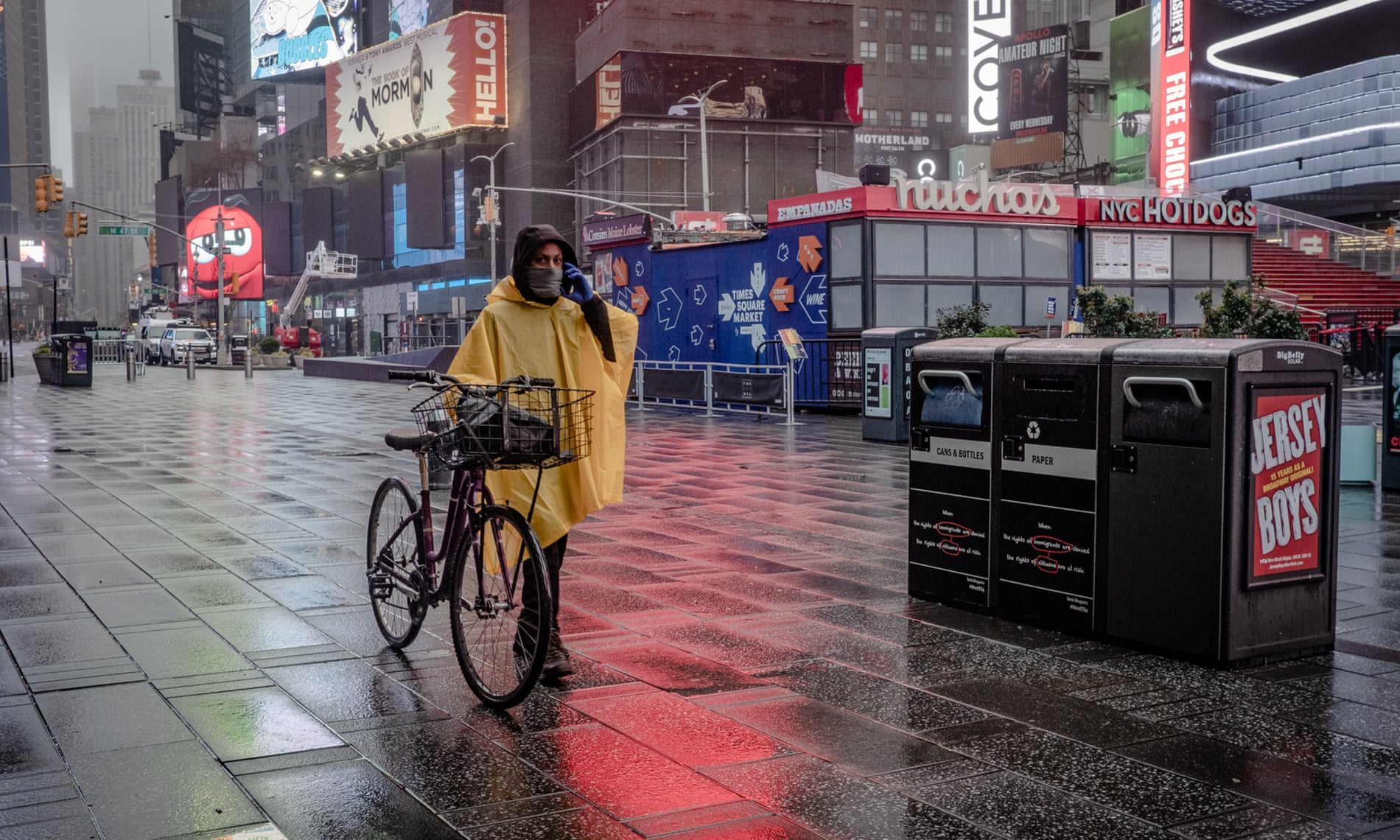
In most cities, life is a shadow of what it once was, with streets empty, arenas abandoned, businesses shuttered. Well-heeled residents have skipped town to country abodes and seaside getaways. Most of those who remain have slipped into an atomized existence — their movements curtailed, their social circles exponentially shrunk — that’s anathema to the whole point of living in a bustling, vibrant city.
From the financial capitals of the West to teeming megacities in the developing world, the crisis is both exposing profound systemic problems and raising tough questions about whether cities will ever be able to return to what they once were.
The imperatives of social distancing have plunged the world into a giant experiment in remote work, and some office workers may never want to return to the stresses, steep housing costs and public health risks associated with life in a dense, big city. As Cavendish noted, trends already underway may accelerate: The populations of global cities like New York, Paris and even Shanghai were declining before the pandemic struck, largely as a result of soaring rent prices.
UNESCO, the U.N. cultural agency, warned Tuesday that the pandemic may kill 1 in 8 of the world’s museums. Myriad local retailers and businesses that in part help cities distinguish themselves from suburban areas more beholden to corporate chains face extinction. A recent survey in the United States found that 70 percent of smaller restaurants don’t expect to reopen should the coronavirus crisis last more than four months. Hundreds of American towns and cities plan on cutting public services in the coming year as tax revenue plummets.
With many companies probably downsizing their physical footprints and demand for commercial real estate slowing, the skyscrapers that shape skylines from Manhattan to Mumbai may start to look more like white elephants than symbols of financial might.
“If pandemics become the new normal, then tens of millions of urban service jobs will disappear,” wrote Edward Glaeser, an economics professor at Harvard University. The only chance to prevent this labor market Armageddon is to invest billions of dollars intelligently in anti-pandemic health care infrastructure so that this terrible outbreak can remain a one-time aberration.”
Pandemics have inspired substantive innovation and change before. “In the 1850s, the cities of New York, Paris, and London rebuilt their sewage systems in response to a century-long global cholera pandemic that killed more than 1.5 million people and ushered in a new age of urban sanitation that spread across the globe,” wrote Steve LeVine in Medium’s Gen magazine.
Now the world’s cities may become crucibles for a new wave of experimentation. This may range from the benign — consider the many cities shutting down streets to car traffic and expanding public outdoor seating, pedestrian- and bicycle-only spaces — to the more sinister — consider the new technologies of surveillance and contact tracing that may come to dominate urban life even after the pandemic.
The crisis may provide a short window for our unaffordable, hypergentrified cities to reset and to reenergize their creative scenes,wrote University of Toronto urbanist Richard Florida. “Predictions of the death of cities always follow shocks like this one. But urbanization has always been a greater force than infectious disease.”


If Trump remains in the White House and the GOP retains control of the U.S. Senate, do not expect the required investment in an anti-pandemic infrastructure.  Voting in November for a straigh Democrat ticket has become all the more important.

Monday, October 06, 2014

Will Cities Turn Texas Purple?

Houston Skyline
Here in Virginia, while horrific gerrymandering has protected the Republicans in the Virginia General Assembly, in statewide elections it is seemingly becoming impossible for the GOP to win (this trend hopefully will continue and see Ed Gillespie go down to much deserved defeat).  Why?  The cities and urban areas no longer accept the GOP Kool-Aid and voodoo economics.   Some think a similar trend may be about to show itself in Texas where the progressive, modern cities are less and less friendly territory for the Christofascist and greed driven policies of the Texas Republican Party.  A column in the New York Times looks at the phenomenon which I hope will continue to play out. Here are highlights:
[A]s summer has turned to fall, Ms. Wendy Davis has entered new territory: Last week a poll by the Texas Lyceum, a nonpartisan, nonprofit educational institution, showed that Ms. Davis has narrowed that gap to just nine points, and pundits around the state are talking about a new momentum behind her. What happened?

The short answer is tactics. Ms. Davis’s campaign hasn’t been perfect, but she is dogged on the stump, and has stood up well to Mr. Abbott’s attacks.

Of course, Ms. Davis is still nine points back, and she has just five weeks to catch up. Which is why the longer explanation for her turnaround is more important, not just for Texas, but the country.

Many hoping to see Texas go purple point to the growth of its Hispanic community. And that’s part of it, but not everything. Population growth, soaring diversity and dense urbanization are also transforming Texas, much as they have done in Virginia and North Carolina.

Texas’ economy has been booming almost nonstop since 2000, and the state added 4.3 million people between 2000 and 2010. Americans came from every point on the map. Once a minority, the Hispanic population swelled, too, and will be the largest ethnic group in Texas this year (some say they could be the majority by 2020).

Yet there is far more to political change in Texas than the emerging Hispanic majority. Take greater Houston. The suburbs that once determined its voting patterns have become just one part of a megalopolis. Covering nearly as much territory as Maryland, the Houston area is the most diverse in America — even more so than New York or Los Angeles.  

Houston is not merely more Hispanic; the fastest-growing ethnic group is Asian. . . . And 98 percent of the population growth in the first 10 years of this century has been nonwhite.

The same trends are found in the Texas Triangle, an increasingly dense region bounded by Houston, San Antonio and Dallas-Fort Worth. It includes less than 20 percent of the state’s land but all its biggest cities. Conservative politicians do poorly in these settings.

The political shift is unmistakable. In Houston, 83 percent of residents favor a legal path to citizenship for undocumented immigrants. Six in 10 say abortion is morally wrong but oppose making it harder for women to get one. In August, an effort to repeal Houston’s new equal protection ordinance for gay, lesbian, bisexual and transsexual people failed.

Republican strength is on the wane in some of those key suburbs, too. The Republican margin in Fort Bend County shrank in 2012 from double digits to just six points.

None of this is to say that Ms. Davis will win — but she might. And four years from now, she, or another candidate, will have an even easier time. No, that dusky sky up there is not blue. It is still burnt orange — but with quite a bit of purple.

Monday, March 10, 2014

Hampton Mayor George Wallace Signs Mayors for Freedom to Marry Resolution.

As readers may recall, former Hampton Mayor Molly Ward signed the Mayors for Freedom to Marry Resolution back in 2010.  At the time, Ward was only one of three Virginia mayors to have signed the resolution - the others were the mayors of Charlottesville and Alexandria were the others.  Subsequently, Ward resigned as mayor and took a position in the Obama White House before being tapped for a position in Virginia Governor Terry McAuliffe's administration.  In the interim, the number of Virginia mayors signing onto the resolution has climbed to eleven mayors.  Now, it just moved up to twelve mayors.  Hampton's new mayor, George Wallace (pictured at left), has signed the resolution after my partner and I asked him to do so and provided him with information.  Other recent cities joining the list are Lexington, Norfolk, Capron, Petersburg, Ashland, Blacksburg, and Fairfax. It goes without saying that Victori Cobb and her fellow Christofascists at The Family Foundation are likely not too happy that the tide is shifting against them..  Here is the text of the resolution:

As mayors of great American cities, we proudly stand together in support of the freedom of same-sex couples to marry. We personally know many gay and lesbian people living in our cities who are in committed, loving relationships, who are active participants in the civic life of our communities, and who deserve to be able to marry the person with whom they share their life.    

We are proud that at its 2009 annual meeting, the U.S. Conference of Mayors unanimously approved a resolution stating that: “The U.S. Conference of Mayors supports marriage equality for same-sex couples, and the recognition and extension of full equal rights to such unions, including family and medical leave, tax equity, and insurance and retirement benefits, and opposes the enshrinement of discrimination in the federal or state constitutions.”  
 
Our cities derive great strength from their diversity, and gay and lesbian families are a crucial part. Studies have shown what we know through our hands-on experience—that cities that celebrate and cultivate diversity are the places where creativity and ideas thrive. They are the places where today’s entrepreneurs are most likely to choose to build the businesses of tomorrow. Allowing same-sex couples the right to marry enhances our ability to build this kind of environment, which is good for all of us.        
We stand for the freedom to marry because it enhances the economic competitiveness of our communities, improves the lives of families that call our cities home, and is simply the right thing to do.  We look forward to working to build an America where all people can share in the love and commitment of marriage with the person with whom they share their life.
A glaring absence? Richmond mayor Dwight Jones who wants to be chair of the Democratic Party of Virginia. 


Tuesday, November 26, 2013

Hampton Roads Cities Score Poorly on HRC's Municipal Equality Index

Low scoring Norfolk
With all the talk by local city leaders wanting to diversify the Hampton Roads economy and to attract innovators and entrepreneurs, they are missing one of the easiest methods to send a message of being "open for business" and "all are welcome": adopt LGBT friendly policies and programs.  Richard Florida has time and time again found that a vibrant and welcomed gay community is the "canary in the coal mine" for signalling open and welcoming communities and that gays even provide a "gay index" in determining which cities are leaders in technological innovation.   The Human Rights Campaign describes it's Municipal Equality Index report:

HRC's Municipal Equality Index (MEI) demonstrates the ways that many cities can—and do— support the LGBT people who live and work there, even where states and the federal government have failed to do so.

This year's report rates a total of 291 cities from every state in the nation, representing a total population total of 77,851,822. Search below to find your city's 2013 MEI scorecard. You can also download the full 2013 MEI report here or flip through a digital version below. Click here to see how your city scored on the 2012 MEI report.
So how did the three Hampton Roads cities considered fair?  Not well at all.  Inside Business describes the scores of Newport News, Norfolk and Virginia Beach this way:

Virginia Beach scored the highest in Hampton Roads with a score of 32 out of a possible 100. The city has a non-discrimination employment clause and a human rights commission. The city also reported its 2011 hate crime statistics to the FBI, has a positive public position on LGBT equality and has made positive efforts regarding LGBT equality, the report said.

Newport News came in second, with a score of 20. The report cited the city's human rights commission, the school system's anti-bullying policies and the police department's policy of reporting hate crime statistics to the FBI.

Chesapeake came in third with a score of 15. The report cited the city's non-discrimination employment policy and the police department's reporting of hate crime statistics.

Norfolk came in last, with a score of 12. The report cited the police department's practice of reporting hate crimes and the city's domestic partner registry, which the city was "forced to stop providing as a result of a restrictive state law."

Not a stellar showing by any means.  Norfolk in particular ought to be deeply embarrassed.  How did other parts of Virginia score? Here are some localities and their scores:

Alexandria --- 70

Arlington ---- 76

Fairfax County --- 40

Richmond ---- 36

What's really scary is that compared to Southwest Virginia, Hampton Roads is progressive and down right liberal.  It's small wonder that with the closure of the textile mills and furniture factories that few businesses have wanted to relocate to Danville or Martinsville.  Anti-gay bigotry carries a high economic price.  


Sunday, October 07, 2012

How the G.O.P. Became the Anti-Urban (and Anti-Knowledge) Party

There are many things wrong with today's Republican Party not the least of which is its transformation into a sectarian party controlled by the most extreme elements of the ignorance embracing, objective reality denying Christian Right.  Thus, as a lengthy column in the New York Times examines, today's GOP has largely rejected cities from its agenda since urban areas typically do not buy into the party's anti-knowledge agenda and thinly veiled racism and anti-gay bigotry.   Symptomatic of this reality is that even in Virginia, the more urban cities tend to almost uniformly vote Democrat.  In doing so, however, the GOP and its Christianist/Tea Party base sharply narrow the pool of would be supporters.  Here are some column highlights:

A LEADING Republican columnist, trying to re-stoke her candidate’s faltering campaign before the first presidential debate, felt so desperate that she advised him to turn to cities. 

“Wade into the crowd, wade into the fray, hold a hell of a rally in an American city — don’t they count anymore?” Peggy Noonan lamented in The Wall Street Journal. “A big, dense city with skyscrapers like canyons, crowds and placards, and yelling. All of our campaigning now is in bland suburbs and tired hustings.” 

But the fact is that cities don’t count anymore — at least not in national Republican politics.  The very word “city” went all but unheard at the Republican convention, held in the rudimentary city of Tampa, Fla. The party platform ratified there is over 31,000 words long.

The very few sections that address urban concerns contain similar complaints about cities’ current priorities — not to mention the very idea of city life. The Republican platform bitterly denounces the Democrats for diverting some highway fund money to Amtrak and harrumphs that it is “long past time for the federal government to get out of the way and allow private ventures to provide passenger service to the Northeast corridor. The same holds true with regard to high-speed and intercity rail across the country.” 

The Obama administration, the Republicans conclude damningly, is “replacing civil engineering with social engineering as it pursues an exclusively urban vision of dense housing and government transit.” 

Unsurprisingly, the chairman of the Republican platform committee, Gov. Bob McDonnell of Virginia, is from a state that has no city with a population of 500,000 or more. One of his two “co-chairmen” was Senator John Hoeven of North Dakota, which ranks 47th among the states in population density. The other was Marsha Blackburn, who represents a largely suburban district of Tennessee. 

IT could hardly be otherwise. The Republican Party is, more than ever before in its history, an anti-urban party, its support gleaned overwhelmingly from suburban and rural districts — especially in presidential elections.   This wasn’t always the case.  During the heyday of the urban political machines, from the Civil War to the Great Depression, Republicans used to hold their own in our nation’s great cities.

In the 1928 presidential election, the Republican Herbert Hoover swept to victory while carrying cities all across the country: Philadelphia; Pittsburgh; Chicago; Detroit; Atlanta; Birmingham, Ala.; Houston; Dallas; Omaha and Los Angeles. With the possible exception of Houston or maybe Omaha, it’s all but inconceivable that Mr. Romney will carry any of those cities.

The Great Depression secured their loyalty to the Democratic Party. Franklin Delano Roosevelt made the cities showcases for the New Deal — especially New York, under the liberal Republican reformer, Fiorello H. La Guardia. Federal money poured in, but in the end the New Deal was about more than building new bridges or getting people off the bread lines. Contrary to Mr. Romney’s contention that government aid automatically turns people into “victims” and “dependents,” Washington’s intervention turned urban Americans from subjects into citizens who could claim the necessities of life as a right, not a favor. 

Save for mavericks like La Guardia, Republicans had little to add to this battle for the soul of the city. Increasingly, a Republican mayor of a major city became a curiosity. In presidential elections, big cities went Republican only during landslides.  

FOR Republicans, cities now became object lessons on the shortcomings of activist government and the welfare state — sinkholes of crime and social dysfunction, where Ronald Reagan’s “welfare queens” cavorted in their Cadillacs. 

But urban living was far from dead. Instead, the American economy began to reinvent itself in cities, as they became cleaner, greener, safer, more prosperous, more fun. As the demographic wheel turned again, both new immigrants and a generation of Americans born and raised in the ’burbs moved back in.  

Today, four-fifths of the population lives in an urban area — the highest percentage in our history. Although the country remains largely suburban, one in 12 Americans lives in a city of over a million people. More than ever, they are stakeholders, owning where previous generations rented, creating their own jobs and opportunities. . . . . Most of these individuals are skilled, highly educated “job creators” for themselves and others — the very demographic that Republicans claim to want to attract. 

Yet the national Republican Party still can’t get seem to get past its animus toward the very idea of urban life. The only place that Amtrak turns a profit is the Northeast corridor — yet all Republicans can think to do is privatize it, along with the local rail lines on which millions of Americans have been commuting into cities to work for as long as a century and a half. Republicans promise to ban same-sex marriage, make it easier for anyone to get a gun, delegitimize and destroy what they mockingly call “public employees’ unions,” and deport the immigrant workers performing so many thankless but vital tasks. 

In short, they promise to rip and tear at the immensely complex fabric of city life while sneering at the entire “urban vision of dense housing and government transit.” There is a terrible arrogance here that has ramifications well beyond the Republicans’ electoral prospects.

A Republican Party seeking to actively win cities, not just vilify them or suppress their vote, could open the party up to all sorts of new immigrant voters, like Asian and Latino Americans — and maybe even bring back part of an old voting bloc: black people.  

The prospects for any such change don’t seem high right now. But that may change, too, out of necessity. The Republican refusal to contest the cities has left them in a permanently defensive stance in national campaigns. . . . . Republicans increasing their percentage of the vote mainly in aging districts that are losing population. In the meantime, as urban areas continue to grow, they become more and more intertwined with what were once distant suburbs, making “urban” issues all the more pertinent to everyone. 

Republicans may not want to go to the cities. But that doesn’t much matter. The cities are coming to them. 
Personally, I hope the GOP does not wake up to the fact that its anti-city mindset is part of what I hope and believe is slow form of suicide.  One can only hope that the resultant death comes sooner as opposed to later.

Friday, September 28, 2012

Austin Passes Resolution Supporting Gay Marriage

Earlier in the week I noted that the City of Austin, Texas was poised to take up a resolution endorsing gay marriage.  As it turned out, the vote to pass the resolution was unanimous.  There must be some serious spittle flying among Christofascist groups like FRC.  Here are highlights from KUT News:

Today Austin became the first city in Texas to pass a resolution in support of same sex marriage.  The measure passed the City Council unanimously this morning.

Before the vote, local civil rights groups declared their support for the resolution, which was sponsored by Mayor Pro Tem Sheryl Cole and co-sponsored by Mayor Lee Leffingwell and Council member Laura Morrison.

At a press conference, Mayor Pro Tem Cole spoke about the evolution of rights in Texas, quoting Dr. Martin Luther King: “… Injustice anywhere is injustice everywhere. Whatever afflicts once directly also afflicts one indirectly.”

Council member Morrison acknowledged the progress made within the Austin community, when it comes to civil rights, but said there was still a ways to go. Morrison pointed to practicality when making her point.
“Marriage equality provides important legal and economic protections including access to health care, parenting rights, property rights and other protections,” said Morrison.

The practical implications of the resolution are unlikely to be great. In 2005, Texas voters approved an amendment to the state constitution, banning same sex marriage and civil unions. Travis County was the only county in the state where a majority did not support the amendment.

Wednesday, September 26, 2012

Austin Poised to Adopt Resolution in Support of Gay Marriage

This should be fun to watch!  What?  The city of Austin, Texas (i.e., the capital of Texas) is likely to pass a resolution supporting gay marriage.  Can't you see the spittle flying and the convulsions over taking Texas Christofacists?  Frankly, the city's action make sense.  The creative class has been documented to be attracted to cities with high "gay indexes."  Thus, what better way to make the city stand out as gay friendly and gay welcoming than to adopt a resolution that will send the Neanderthals in the Texas legislature and the closet case in the governor's mansion crazy.   Gay Star News has details.  Here are excerpts:

Austin, already known as the most progressive city in Texas, could become the first city in the state to officially support gay marriage.

The City Council on Thursday (27 September) will vote on a formal resolution which comes after a petition in support of the resolution posted by Equality Texas was signed by 1,700 people.

Equality Texas says in a statement that the council resolution 'recognizes that marriage is a powerful and important affirmation of love and commitment and a source of social support and recognition.'

'Passage of this resolution will send the message to state and national leaders that Austin is a community that values equality for all its citizens,' the group states. 'The resolution will also send the message that the City of Austin believes all couples in loving and committed relationships should be given the opportunity to create stronger and more successful families through civil marriage.'

Also supporting the resolution are the Human Rights Campaign, the Anti-Defamation League, the NAACP, and the Mexican American Legal Defense and Education Fund.

I hope the resolution passes and I find it interesting that both the NAACP and Mexican American Legal Defense and Education Fund - which represent citizens despised by today's GOP - are backing the measure.  Don't expect any city in Virginia other than perhaps Charlottesville to even consider such a resolution anytime soon. 

Sunday, May 06, 2012

Obama Kicks Off Virginia Campaign at Richmond's VCU

Even as the Virginia GOP tries to move Virginia backwards to a pre-Civil War society, Virginia's cities are slowly growing in population to a point where they are on the cusp of being able to out vote the backward rural bastions of the GOP.  Yes, there are still many Kool-Aid drinking knuckle draggers in Virginia Beach and Chesapeake (the latter in particular), but over all the urban vote seems to want to move forward into the 21st century rather than return to the 19th century.  Moreover, the urban populations reflect the racial diversity that is the new America - much to the horror of the white supremacist friendly Virginia GOP.  Thus, it's no surprise that Barack Obama kicked off his campaign in Virginia in Richmond, the former capital of the Confederacy, which in many ways is evolving into a progressive city (at least by Virginia standards).  The photo above shows some of the large crowd that turned out at Virginia Commonwealth University.  Blue Virginia notes the sharp contrast in the crowd against the GOP base:

Notice a few things about the crowd that Willard will never match? 1) Enthusiasm (why would anyone in their right mind be enthused about a corporate robot?); 2) numbers (Remember when Willard had a rally in a football stadium, and it was 99% empty? Guarantee - that will NOT happen to Barack Obama today, or any day in this campaign!); 3) a crowd that looks like America, in all its diversity (Willard's crowd - older and white, pretty much. Not that there's anything at all wrong with older white people - there are good and bad people in every race, religion, ethnicity, etc. - but crowds that are consistently made up of 95% older white people, as are invariably seen at Republican rallies, is NOT representative of the demographics of today's America. Sorry Willard.) 


Wednesday, April 18, 2012

The Impermanent Republican Majority

Back in 2004 Karl Rove boasted of a permanent Republican Majority. That, of course, was before many Americans opened their eyes to the folly of the Chimperator's fools errand in Iraq and before GOP policies tanked the U.S. economy and nearly triggered another Great Depression. The GOP strategy focused on the red fly over states and the so-called exurbs of major cities. With the collapse of the housing market and rising gas prices, those same exurbs with their "Mcmansions" are no longer such a hot commodity. Indeed, many homeowners now find themselves trapped in the exurbs with upside down mortgages. Meanwhile, more people are headed back to the more liberal center cities. A column in the New York Times looks at the likely ongoing collapse of Rove's strategy. Here are some excerpts:

[T]here was no more jaw-dropping figure from the 2004 presidential election than this finding from the nation’s far-flung metropolitan frontier: George W. Bush carried 97 of the nation’s 100 fastest growing counties. . . . . New century America was pulling young families and newly middle class immigrants to the far exurbs, creating a vibrant new habitat for the Republican Party.

Many of the cities, at least some of the more hollowed-out and aging urban cores, were written off as inconsequential. The new electoral game was in the places where farm fields were being plowed under for asphalt. In Karl Rove’s strategy for a “durable Republican majority,” as he called it, lasting at least a generation, the exurbs were a key component of his master plan.

After a monumental housing collapse, and eight years of less-predictable changes in where Americans live, that thinking has been thrown out.

[N]ow the population boom to the exurbs is over, at least for the moment, according to Census Bureau figures released earlier this month. An analysis of those numbers done by William H. Frey, a demographer at the Brookings Institution, found that growth in the cities, and densely-populated older suburbs, has eclipsed that of the exurbs since 2010.

For political strategists reading the fine print in county-by-county population shifts, Frey’s point is one of several reasons to junk Rove’s majority scenario. Among the factors driving the urban growth spurt are a desire by young people to live closer to the urban core than the urban frontier, high gas prices and the toxic housing and lending environment. More American live alone than ever before — about 33 million people, 28 percent of all households — and most of them live in cities.

All of which bodes well for Democrats, the urban party. Obama won 21 of the 25 largest metro areas in 2008. Among population clusters in swing states, he carried the Denver metro area by 17 points, Las Vegas metro by 19 points and Orlando, the fastest-growing urban area in Florida, by 9. He also won the Tampa-St. Petersburg area, by five. Each of these showings were big moves for Democrats.

By winning the urban vote — which made up 30 percent of the electorate in 2008 – in such a lopsided manner, Democrats could afford to lose rural areas, which were 21 percent of the overall vote. When Sarah Palin talked on the campaign trail about the “real America,” she was referring to a shrinking one.

The trends since the housing collapse have made older suburbs denser, and thus more likely to vote Democratic in the minds of some strategists. Racial diversity, and the need for more government services and infrastructure, tend to make the older suburbs more like cities in their voting behavior, said Ruy Teixeira, who has written extensively about changing election demographics.

Teixeira has been predicting an emerging Democratic majority since 2002 – based on voting trends of young people, ethnic minorities and white, college-educated city dwellers. . . . The new population figures have only fortified Teixeira’s view. At the same time, turnout in this year’s Republican primary has been dominated by aging white male voters, not exactly a roadmap for the future, given the trends.

But before these Home Depot-cluttered counties can be painted blue, some caution is in order. It’s misleading to think the exurban frontier is closed, or even emptying out. What has settled down is the growth rate. . . . . Low interest rates, stable gas prices and a bounce back in the housing industry could bring fresh life to the far fringes.

Still, for Democrats, the geography of tomorrow is the urban renaissance – a boundary that now includes big parts of suburbia.

Wednesday, January 11, 2012

Fundraiser for Hampton Mayor Molly Ward

In the Hampton Roads area the City of Hampton has surprisingly shown itself to be among the most welcoming to LGBT owned businesses and LGBT professionals. This reality is in has been in sharp contrast to the City of Norfolk where the city's official policy seems to be to harass and make LGBT businesses and LGBT residents unwelcome. Much of the City of Hampton's progressive approach to the LGBT community and a realization that in the changing economic environment ALL businesses need to be welcome and allowed to flourish traces to Hampton Mayor Molly Ward - who also played a major role in securing the designation of Fort Monroe as a national monument by Barack Obama. In May, Molly Ward - who the Boyfriend and I count as a friend - will be up for re-election in a contested race.

On Sunday, January 22, 2012, from 4:00 to 6:00PM a fundraiser will be held to support Mayor Ward's re-election effort. I invite local readers to attend and support this wonderful straight LGBT ally. If you cannot attend, please support Mayor Ward financially. Details are set out below. Special guests will be Senator Mark Warner and Congressman Bobby Scott. Help keep the City of Hampton headed in the right direction and accepting to all citizens.


Yes, the Boyfriend and I are sponsors and putting our money where our mouths are.

Tuesday, November 29, 2011

City of Hampton To Host December HRBOR Networking Event

In an exciting development, the December, 2011, business networking event for Hampton Roads Business OutReach ("HRBOR") will be sponsored by The City of Hampton, Department of Economic Development and the event will be held in the Grand Lobby of the historic Chamberlin at Fort Monroe. This is the first time that a local city has sought to host one of HRBOR's monthly business networking events. I hope local readers will try to attend.


For new readers, HRBOR is a broad based coalition of LGBT owned and LGBT supportive businesses and professionals dedicated to the development, growth and advocacy of Hampton Roads and its LGBT community. By promoting an environment in which diversity can flourish, HRBOR is committed to the economic growth and prosperity of not only its members but also the larger Hampton Roads community.


Guest speakers will include Hampton Mayor, Molly Ward, special Guest Speaker, Glenn Oder, Director of the Fort Monroe Authority for the Commonwealth of Virginia and a representative from the National Park Service now that Fort Monroe has been designated a national monument by President Barack Obama. The event will provide a great opportunity to learn more about plans for Fort Monroe and neighboring Phoebus. It will also provide the LGBT community to show case the reality that we are important players in the local economy.


What: Second Thursday Business Net-Working Event
Host: City of Hampton, Department of Economic Development and Hampton Mayor Molly Ward
Where: The Chamberlin at Fort Monroe, 2 Fenwick Road, Hampton VA 23651
When: Thursday, December 8th, from 6 p.m. - 8 p.m.
Parking: Ample Parking at the Chamberlin, Please have Picture ID available for Parking Lot Attendant
Featured Non-profit: To be Announced
Food Sponsor: City of Hampton, Department of Ecomonic Development
Cash Bar
Cost:
Free to Members
Guests: $15.00 Fee

Wednesday, May 11, 2011

Economically Booming Northern Virginia Far More Liberal than Rest of Virginia

I noted a Washington Post poll yesterday that showed that a plurality of Virginians now favor gay marriage and a majority favor gay couples adopting. The poll also showed something that I have discussed a lot on this blog: that liberal social views equate to economic growth while closed mindedness and bigotry towards others equate to stagnation or decline. The Washington Post has discussions of this phenomenon which ought to be a wake up call to political leaders in other parts of Virginia who need to grow a spine and flat out say that catering to Christianist policies is economic poison. Will it happen? Probably not. At least not in most areas of the state, especially those at the bottom of the economic heap like southwest Virginia (the city of Martinsville is a prime examle) where bigotry and prejudice are more akin to what existed back at the time of Loving v. Virginia than what ought to predominate in 2011. Not surprisingly, many college educated residents of Hampton Roads leave the area to settle in Northern Virginia and/or D.C. Here are some findings from the Washington Post poll on that parallel directly with progressiveness and economic growth:
*
In case there was any doubt that Northern Virginia is a liberal enclave in an otherwise conservative state, check out these tidbits from the new Washington Post poll of Virginians:
*
• In the entire Commonwealth, 42 percent of those polled support the Obama health care reforms — but that number jumps to 60 percent in Fairfax-Arlington-Alexandria.

• Asked to classify themselves on social issues, fully 50 percent of Fairfax-Arlington-Alexandria respondents called themselves “liberal,” compared with 31 percent for the rest of the state.
*
Though 60 percent of Fairfax-Arlington-Alexandria respondents support Obama’s health care plan, that number drops to 44 percent in the Rest of Northern Virginia. In the rest of Virginia, the support is 38 percent.
*
When it comes to support of gay marriage, 64 percent of Fairfax-Arlington-Alexandria backs it, while only 47 percent of the Rest of Northern Virginia does. Combining the two groups, 63 percent of Northern Virginia supports gay marriage, compared to 42 percent of the rest of the state.
*
The exurbs were slightly more liberal on gay adoption and abortion. While 68 percent of Fairfax-Arlington-Alexandria respondents supported legalizing adoption by gay parents, 56 percent of those in the Rest of Northern Virginia did too. The rest of the state came in at 51 percent.
*
But when respondents were asked about their economic status, 32 percent of Fairfax-Arlington-Alexandria residents said they were “getting ahead financially.” Only 17 percent of the Rest of Northern Virginia respondents said that. For the rest of the state, the total was 15 percent.
*
A graphic of these findings can be found here.

Wednesday, September 01, 2010

Mexico City Opens Office to Woo LGBT Honeymooners

A while back I noted how Mexico City, Mexico planned to woo same sex honeymooners following the legalization of gay marriage in the Mexican capital. Now, the city has formally opened the new gay tourism office. CNN has coverage of this step in a country which despite severe crime problems and poverty is out stripping the United States in terms of marriage equality. I find it nothing short of humiliating that the USA is increasingly shown to be a fraud when it comes to equality and freedom of religion for all of its citizens. Here in Virginia and under federal laws such as DOMA and DADT the religious dogma of Christianists has been made the defacto state and national religion. Here are highlights from CNN:
*
Mexico City, Mexico (CNN) -- As more governments approve same-sex marriage laws, officials here are hoping to attract a growing part of the tourism market: gay honeymoons.
*
The first couple to wed under Argentina's recent law allowing same-sex marriages nationwide arrives in Mexico this week on an all-expenses-paid trip -- part of a new push by the government in Mexico City, Mexico to woo gay travelers. "We hope that many same-sex couples who get married around the world spend their honeymoons here," says Alejandro Rojas, the city's tourism secretary.
*
In July, the city opened an office aimed at catering to gay tourists that officials describe as the first of its kind in Latin America. "We are a very tolerant, liberal, avant-garde city," Rojas says. Officials inaugurated the new office by cutting a rainbow-colored ribbon. Rojas said the office's goal is to make Mexico City the No. 1 gay-friendly destination in Latin America.
*
For years, it was rare to see gay rights issues gaining traction in Mexico and other Latin American countries. Not anymore, according to Javier Corrales, a professor of political science at Amherst College in Massachusetts. "Latin America currently has some of the most gay-friendly cities in the developing world," says Corrales, who ranks cities' gay-friendliness in a new book he co-edited, "The Politics of Sexuality in Latin America."
*
In addition to training local hotels and restaurants on how to be sensitive to gay clientele, officials say they hope to create maps of the city highlighting attractions for gay tourists and possibly host an international gay tourism conference. Hotels, restaurants and businesses in Mexico City have responded positively to the program so far, Rojas said.
*
Gay tourists represent 15 percent of the world's tourism market, and they spend more money than heterosexual tourists when they travel, he says. Recognizing the commercial value of gay tourism is a positive step, Navarro says, but it also shows that more social change is needed. "I hope that there comes a day in the future when they don't have to have an office for gay tourists, just like there isn't an office for Asian tourists," Navarro says.
*
Meanwhile, southeastern Virginia continues to keep its head stuck in the sand and kisses the ass of folks like Pat Robertson and his fellow theocrats. Ditto for the religious extremists who currently occupy the Virginia governor's mansion and office of attorney general.

Saturday, June 21, 2008

The World's Best Places to Live 2008

BusinessWeek has a new ranking of the best cities to live in around the world based upon on 39 key quality-of-life issues. Ranking number 4 this year is perhaps my favorite city in the world all things considered: Vancouver, British Columbia. The setting of the city is physically beauty and it is cosmopolitan and progressive, with a feel that is a mix of an American city and that of a European capital. I loved it, as did my son when I took him there back in 2004. What is amazing (or depressing depending upon one's view) is that the Hampton Roads area of Virginia has a similar population as the greater Vancouver area, but we are so backwards and lacking in progressive thinking. Pat Robertson and the loonies that he panders to definitely are an obstacle to this area's emergence as a first class metropolitan area. Hopefully, in time HRBOR and other progressive organizations can do some good in changing the area's image. Believe me, if I could find a nice Vancouver guy to sweep me off my feet and marry me, I'd relocate in a heart beat. A full listin og cities can be found at the link. Here are a few story highlights:
*
What foreign postings are most coveted by expatriate executives? To find out, Mercer Human Resource Consulting, which provides advice to multinational companies on international assignments, has come up with a global ranking of the world's most livable cities based on 39 key quality-of-life issues. They include political stability, currency-exchange regulations, political and media censorship, school quality, housing, the environment and public safety. Mercer . . . considered 215 cities around the globe. Switzerland's main commercial and cultural center, Zurich, topped the list this year, followed by Geneva, and Vancouver and Vienna, which tied for third.
*
No. 3: Vancouver, Canada
Mercer score: 107.6
2007 rank: No. 3
GDP: $1.274 trillion (2007 est.)
Population: 33,212,696 (total country);
560,000 (total city)
Life expectancy: 81.16 years