Showing posts with label social distancing. Show all posts

Tuesday, May 26, 2020

Watching Fox News May Be Harmful to Your Health

(Screenshot: Fox Business)
Personally, I have long viewed watching Fox News as a form of self-administered lobotomy given that studies have shown its viewers to be among the most poorly informed and its programming often consisting of propaganda rather than legitimate news. Now, in the age of Covid-19, a new study (which can be found here) suggests that watching Fox News may also be harmful to one's health and may literally endanger Fox viewers' lives but also the lives of others in their communities as Fox News viewers failed to accept the dangers of the pandemic and refuse to comply with social distancing, wearing masks, etc.  A piece in Talking Points Memo looks at the study's findings which  also note the ties between support of Donald Trump and noncompliance with stay home orders and other heath precautions.  Here are article excerpts:
A new study produced by business school profs at Columbia and University of Chicago suggests that viewing Fox News is strongly correlated with ignoring social distancing guidance during the first weeks of the COVID19 epidemic and is in fact driving that non-compliance.
The researchers looked at geospatial data derived from anonymized cell phone data and cable channel position by ZIP code around the country. They found that a 1% increase in Fox News viewership in a zip code reduced social distancing by 8.9%.
The study abstract follows …
We test for and measure the effects of cable news in the US on regional differences in compliance with recommendations by health experts to practice social distancing during the early stages of the COVID-19 pandemic. We use a quasi-experimental design to estimate the causal effect of Fox News viewership on stay-at-home behavior by using only the incremental local viewership due to the quasi-random assignment of channel positions in a local cable line-up. The average partial effect of Fox News viewership in a zipcode implies that 1 percentage point increase in cable viewership reduces the propensity to stay at home by 8.9 percentage points compared to the prepandemic average.  We find a persuasion rate of Fox News on non-compliance with stay-at-home behavior during the crisis of about 33.5%-50% across our various social distancing metrics.
From reviewing the study it’s not entirely clear to me whether the persuasive effect of Fox News is demonstrated as opposed to the correlation. Fox News viewership is a marker for conservatives. Conservatives are less likely to social distance, etc. But that likely amounts to something similar since Fox is the key source of political information not only for Fox viewers but for the conservative information ecosystem generally.
The authors do note, revealingly, that they are not able to fully distinguish between the impact of Fox News commentators versus the administration officials and especially [Trump] the President whose views are so aggressively repeated and amplified.   

Monday, May 25, 2020

Covid-19’s New Surge Across Rural America

Crowd not social distancing in Alamance County, North Carolina, on Saturday.
Back in early April Alabama governor Kay Ivey said the following: “Y’all, we are not Louisiana, we are not New York state, we are not California,” she said, suggesting that the fate of hard-hit parts of the country would not be shared by Alabama.  Now, Alabama's Capital, Montgomery, has so many covid-19 cases that the infected are being sent to Birmingham since Montgomery lacks sufficient hospital capacity.  Ivey represents the mind-set of far too many residents of rural areas and red states that almost seemed to take glee as the pandemic hit New York City and other large urban areas especially hard,  Now, the pandemic is moving into the very same rural areas and red states, many of which are woefully unprepared and lack hospitals and medical personnel to deal with the crisis.   A piece in the Washington Post looks at the situation, noting that the pandemic "has taken hold in counties where residents flout social distancing guidelines or believe the pandemic to be exaggerated, the virus’s lethality a myth spread by President Trump’s political foes and a liberal media."  Here are article highlights:
The novel coronavirus arrived in an Indiana farm town mid-planting season and took root faster than the fields of seed corn, infecting hundreds and killing dozens. It tore though a pork processing plant and spread outward in a desolate stretch of the Oklahoma Panhandle. And in Colorado’s sparsely populated eastern plains, the virus erupted in a nursing home and a pair of factories, burning through the crowded quarters of immigrant workers and a vulnerable elderly population.
As the death toll nears 100,000, the disease caused by the virus has made a fundamental shift in who it touches and where it reaches in America, according to a Washington Post analysis of case data and interviews with public health professionals in several states. The pandemic that first struck in major metropolises is now increasingly finding its front line in the country’s rural areas; counties with acres of farmland, cramped meatpacking plants, out-of-the-way prisons and few hospital beds.
In these areas, where 60 million Americans live, populations are poorer, older and more prone to health problems such as diabetes and obesity than those of urban areas. They include immigrants and the undocumented — the “essential” workers who have kept the country’s sprawling food industry running, but who rarely have the luxury of taking time off for illness.
Rural counties now have some of the highest rates of covid-19 cases and deaths in the country, topping even the hardest-hit New York City boroughs and signaling a new phase of the pandemic — one of halting, scattered outbreaks that could devastate still more of America’s most vulnerable towns as states lift stay-at-home orders.
In many of those places, where the health-care system is already stretched thin, even a minor surge in patients is enough to overwhelm.
Where and when hot spots arise in America’s most isolated counties is, in part, a matter of chance. But crowded spaces, and populations with poor access to health care, quickly facilitate the spread.
Of the 25 rural counties with the highest per capita case rates, 20 have a meatpacking plant or prison where the virus took hold and spread with abandon, then leaped into the community when workers took it home.
It has taken hold in counties where residents flout social distancing guidelines or believe the pandemic to be exaggerated, the virus’s lethality a myth spread by President Trump’s political foes and a liberal media.
“We’ve got a little bit of everything: folks who feel their rights have been taken away because they’ve been asked to stay home and they lost jobs and they’re really hurting, and we have folks who are very concerned and frightened and won’t leave their house,” said Rebecca Burns, a health officer for the agency that covers Hillsdale County, Mich., which last month topped the state for the highest death toll among rural counties, after a nursing home outbreak. . . . . We have to continue to watch,” Burns added, during a week when members of a conservative militia stood outside a Hillsdale County barbershop, brandishing guns to “protect” its reopening, in defiance of the governor’s orders. “Anyone who thinks this is one and done is probably wrong,” she said.
Lim also fears the outbreak is facilitated by people in the conservative farming community not following preventive measures.  “If you go to the local Walmart, I would say 10 percent of people are wearing masks, and the restaurants … that are open are packed,” Lim said. “I’m a registered Republican, by the way,” he added. “But [people] don’t seem to know the science behind it. Even though they see the news, they just think it’s all overblown.”
To epidemiologists and physicians, this checkerboard spread was all very predictable. It was never a question of whether the virus would hit rural America, but when.
Early on, two warning signals blared from opposite sides of the country.
In Blaine County, Idaho, population 2,200, an outbreak spurred by the annual influx of wealthy tourists seeking ski slopes turned the resort region into one of the first rural hot spots. The infection rate soared and was, at one point in late March, the highest in the nation.
That same month, more than 2,000 miles away, the virus began its siege on southwest Georgia. Most believe it was introduced at a well-attended Dougherty County funeral, an event that soon led to many more funerals. From Albany, the county seat and a regional hub, infections radiated to neighboring locales with ferocious intensity.
Health officials have estimated that urban areas have more than twice the number of physicians per capita as rural areas and more than 8.5 times the number of specialists.
And in many more regions, there are no hospitals for hundreds of miles, the result of closures amid crushing financial pressures. Since 2010, 130 rural hospitals have shut their doors, according to an ongoing study from the University of North Carolina.

Friday, May 22, 2020

Beach Towns to New York City Residents: Go Away

Today marks the beginning of the Memorial Day weekend and some beach resort towns do not want visitors from New York City.  Virginia Beach's beaches are open with restrictions - the rest of Virginia's beaches are not - as the City tourism industry hopes the weekend, traditionally when high summer revenues begin - will not be a total washout despite an improving weather forecast (this week has been wretched).  Meanwhile, in New Jersey and beach towns on Long Island are trying to make visits by residents of New York City difficult  through parking restrictions, bans on short term rentals and AirBnB rentals.  It may be a foreshadowing of a very different summer season for many resort towns that are in the catch-22 of needing revenues, but fearing visits from outsiders, especially those from Covid-19 hot spots.  Here are highlights from the New York Times:
In the Hamptons, the locals have put up barricades to limit parking and deployed enforcement officers to ticket outsiders. Jersey Shore towns have banned short-term leases and Airbnb rentals. The Suffolk County executive’s office taunted Mayor Bill de Blasio: “Do your job. Figure out a plan to safely reopen your beaches.”
Since the coronavirus pandemic began, tensions have repeatedly flared over whether too many New York City residents have decamped to outlying vacation areas, potentially taking the virus with them. But now the region appears on the brink of a full-fledged (and nasty) battle over beaches, touched off by the city’s decision to keep its shoreline closed.
In normal times, the Memorial Day weekend start of beach season sparks a mass migration from the city to Long Island, the Jersey Shore and, to a lesser extent, Connecticut. But the closings in New York City have led to a backlash from local officials in those areas, who say they fear that their shorelines will be overwhelmed by an exodus of sun-starved New Yorkers blocked from their own beaches, which can in normal times attract a million people a day.
To maintain social distancing, beaches across the region are moving to limit access to everyone. On the Jersey Shore, some towns are reducing parking and keeping their iconic boardwalks closed, with seaside restaurants providing takeout and delivery service only.
But special rules have also been adopted to keep outsiders away. Westchester County, just north of the city, has restricted its beaches at Playland in Rye and Croton Point Park to county residents. In Groton, Conn., only residents can use Eastern Point Beach on weekends and holidays.
The most sweeping rebuke of outsiders, however, seems to be coming from Long Island, many of whose beaches are convenient to New York City.
The Suffolk County executive, Steve Bellone, closed two county-run beaches — Smith Point, on Fire Island, and Cupsogue Beach, in the Hamptons — to nonresidents. He took to Twitter to chide Mr. de Blasio, who had earlier in the week said restrictions “should not be about any ill feeling toward people depending on where they come from.”
Oyster Bay, Hempstead and Brookhaven, all on Long Island, have also moved to limit access. Farther east, the Town of East Hampton suspended the sale of nonresident parking permits and began enforcing summer beach parking regulations early this year.
Mr. de Blasio, however, has warned that opening the city’s 14 miles of public beaches may pose risks to the strict social-distancing rules that city health officials have credited with helping to ease the peak virus infection rates seen in April.
It is part of a difficult balance Mr. de Blasio has tried to strike between providing critical cooling options without squandering the city’s hard-fought gains in bringing case numbers down.
New York City has had roughly 200,000 confirmed cases of the coronavirus and more than 20,000 deaths, a toll that exceeds those in most countries around the world.
Long Island has also been a hot spot in the outbreak, with roughly 78,000 cases and roughly 4,400 deaths.
Corey Johnson, the New York City Council speaker, said the solution to the spat with Long Island was simply to open city beaches immediately.  “I’m not sure it’s realistic to believe that people will not attempt to swim this summer,” Mr. Johnson said, “and we don’t want to be arresting people in the midst of this pandemic.”


Wednesday, May 20, 2020

The Pandemic's Staggering Impact on the World’s Cities

As much as Trump's rural base hates America's cities and the "liberals" who live in them, cities - and generally the blue states in which they are located - have been the engines that have driven America's economy.  Moreover, blue states have paid far more into the federal system than they receive, thereby subsidizing red states which often are viewed as unattractive venues for new and progressive businesses.   Now, the coronavirus pandemic has hit cities with their denser populations especially hard and the economic impact may be long lasting, especially for those cities with the densest populations and most costly living costs. Service industries such as restaurants - some predictions are that 70% will never reopen - may be among those most severely harmed. Add to that the new working from home model which may change how large corporations with large numbers of white collar workers operate, and the impact may be magnified.  A piece in Washington Post looks at the huge impact.  Here are highlights: 
Cities across the world have become sites of the novel coronavirus pandemic’s greatest tragedies. New York City is possibly now the single biggest hot spot of the virus and has suffered close to a quarter of all U.S. deaths. It’s a similar ratio in London when set against the rest of Britain. Madrid’s toll may be even worse.
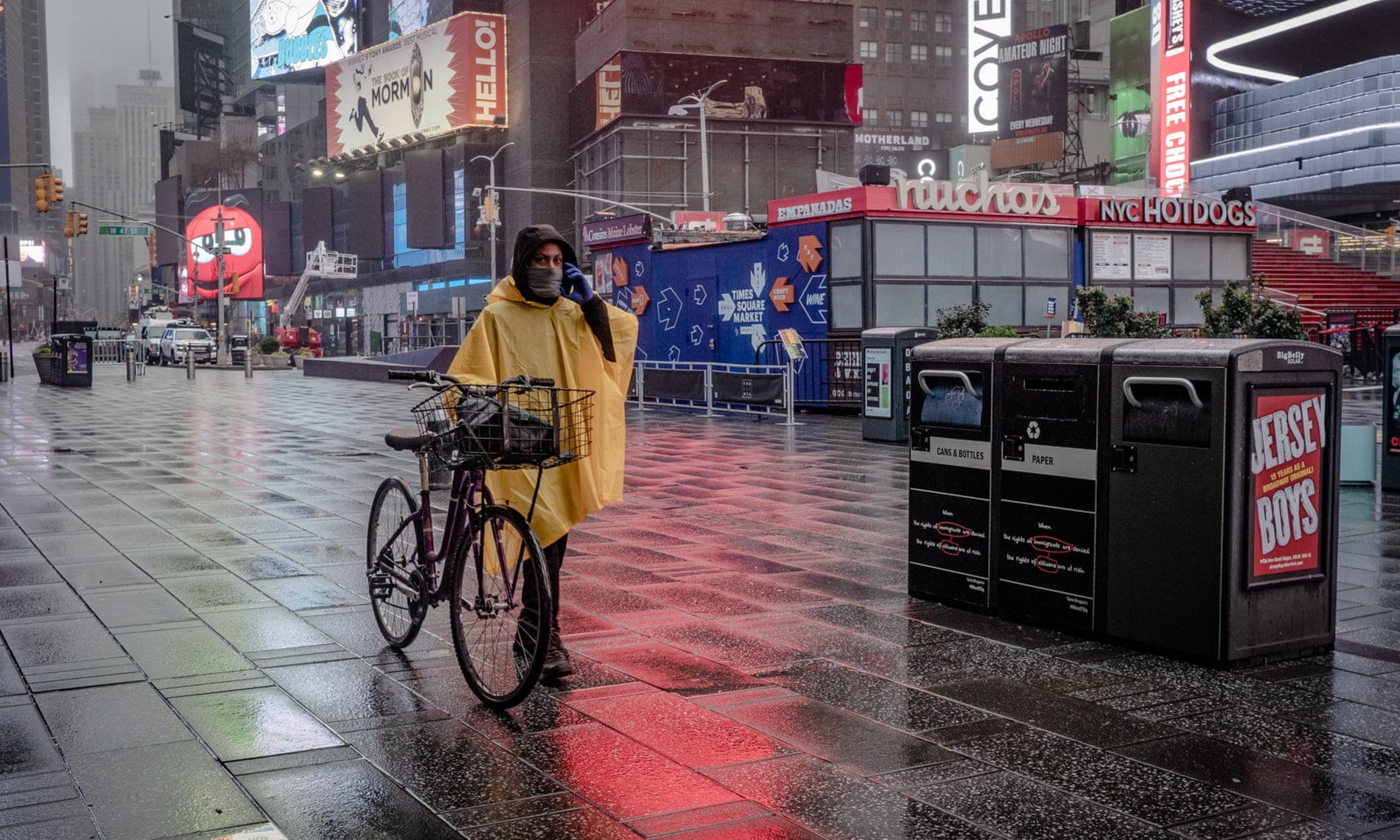
In most cities, life is a shadow of what it once was, with streets empty, arenas abandoned, businesses shuttered. Well-heeled residents have skipped town to country abodes and seaside getaways. Most of those who remain have slipped into an atomized existence — their movements curtailed, their social circles exponentially shrunk — that’s anathema to the whole point of living in a bustling, vibrant city.
From the financial capitals of the West to teeming megacities in the developing world, the crisis is both exposing profound systemic problems and raising tough questions about whether cities will ever be able to return to what they once were.
The imperatives of social distancing have plunged the world into a giant experiment in remote work, and some office workers may never want to return to the stresses, steep housing costs and public health risks associated with life in a dense, big city. As Cavendish noted, trends already underway may accelerate: The populations of global cities like New York, Paris and even Shanghai were declining before the pandemic struck, largely as a result of soaring rent prices.
UNESCO, the U.N. cultural agency, warned Tuesday that the pandemic may kill 1 in 8 of the world’s museums. Myriad local retailers and businesses that in part help cities distinguish themselves from suburban areas more beholden to corporate chains face extinction. A recent survey in the United States found that 70 percent of smaller restaurants don’t expect to reopen should the coronavirus crisis last more than four months. Hundreds of American towns and cities plan on cutting public services in the coming year as tax revenue plummets.
With many companies probably downsizing their physical footprints and demand for commercial real estate slowing, the skyscrapers that shape skylines from Manhattan to Mumbai may start to look more like white elephants than symbols of financial might.
“If pandemics become the new normal, then tens of millions of urban service jobs will disappear,” wrote Edward Glaeser, an economics professor at Harvard University. “The only chance to prevent this labor market Armageddon is to invest billions of dollars intelligently in anti-pandemic health care infrastructure so that this terrible outbreak can remain a one-time aberration.”
Pandemics have inspired substantive innovation and change before. “In the 1850s, the cities of New York, Paris, and London rebuilt their sewage systems in response to a century-long global cholera pandemic that killed more than 1.5 million people and ushered in a new age of urban sanitation that spread across the globe,” wrote Steve LeVine in Medium’s Gen magazine.
Now the world’s cities may become crucibles for a new wave of experimentation. This may range from the benign — consider the many cities shutting down streets to car traffic and expanding public outdoor seating, pedestrian- and bicycle-only spaces — to the more sinister — consider the new technologies of surveillance and contact tracing that may come to dominate urban life even after the pandemic.
The crisis may provide a short window for our unaffordable, hypergentrified cities to reset and to reenergize their creative scenes,” wrote University of Toronto urbanist Richard Florida. “Predictions of the death of cities always follow shocks like this one. But urbanization has always been a greater force than infectious disease.”


If Trump remains in the White House and the GOP retains control of the U.S. Senate, do not expect the required investment in an anti-pandemic infrastructure.  Voting in November for a straigh Democrat ticket has become all the more important.

Thursday, May 14, 2020

Beach Closures Could Spell Trouble for Virginia Beach’s Merchants

Virginia Beach boardwalk.
Memorial Day weekend marks the traditional beginning of the summer tourism season in Virginia Beach which is critical to the economic survival of many hotels, restaurants, and tourism related businesses, many of which even have the loan repayment and/or rent schedules loaded into the summer months since revenues fall so sharply once fall and winter arrive.  With a number of businesses reopening tomorrow under restrictions (the husband's salon will reopen on Tuesday with major restrictions on operations), Virginia's beaches remain closed and Virginia Beach tourism  related businesses are frantic about the impact.  A piece in the Washington Post looks at the situation and the pressure on Governor Northam to allow the beaches to open - I have had client calls since it is known that the husband and I know the governor - in what may be a catch-22 situation.  While the City and business owners want to open with restrictions, the big questions are (i) whether or not tourists would comply with social distancing - probably not, in my view - and (ii) will tourists from outside the region visit and bring the virus to Virginia Beach which so far has had far less cases that parts of the state from which tourists will likely come.  Here are article highlights:
Electricians wearing masks bustled around developer Bruce Thompson on the 23rd floor of his new hotel, its multimillion-dollar views of the oceanfront marred by one flaw: no people on the beach.
The coronavirus pandemic is wreaking havoc on businesses everywhere, but as most of the state prepares to start loosening restrictions on Friday, merchants in Virginia Beach are feeling left out.
Gov. Ralph Northam decided not to include beaches in his first phase of reopening, keeping the sand closed to everything but solitary exercise and fishing. With Memorial Day less than two weeks away, that spells trouble for all resort-city businesses, from hotels to the three-for-$10 T-shirt shops, henna tattoo parlors andpirate-themed minigolf courses on Atlantic and Pacific avenues.
“We’re in a really bad situation,” said Thompson, a major political donor who served on a panel of business leaders advising Northam (D) about ways to reopen the state’s economy. He said he was outraged when the beach wasn’t part of the reopening plan unveiled last week.
“I talked to the governor almost every day until last Friday,” Thompson said this week. “On Friday night, I asked him what the hell happened, and we haven’t had a lot of conversation since then.”
City officials are working with the state to put together a plan to get people back onto the sand by Memorial Day weekend. They feel caught in the middle, literally, as Ocean City, Md., partially reopened earlier this month and the Outer Banks of North Carolina prepares to welcome visitors this weekend.
Memorial Day is not off the table to have a phased-in reopening, but it’s got to be driven by the health data,” Northam’s chief of staff, Clark Mercer, said in an interview.
The pandemic has not hit Virginia Beach as severely as some other parts of the state, illustrating the challenge Northam faces as he tries to chart a consistent path out of the crisis. The city had reported 519 cases and 18 deaths as of Wednesday — a fraction of the toll in Prince William County in Northern Virginia, which has a similar population but 3,181 cases and 65 fatalities.
Yet the economic impact of the shutdown has hammered oceanfront tourism. Virginia Beach has canceled more than 500 licensed events in the past two months, officials said, from weddings to sports tournaments to Pharrell Williams’s “Something in the Water” music festival that was expected to draw 65,000 attendees.
The city has submitted a plan to the state for managing a reopened oceanfront, including a staff of “safety ambassadors” to break up large groups (in a friendly way), massive cleaning protocols and law enforcement patrols that would include drones and all-terrain vehicles.
Deputy City Manager Ronald H. Williams Jr. said employees are being hired and trained and could have been ready to go by this weekend.
“That was definitely a goal for the city,” Williams said. Now he’s working daily with state officials to find “what would give them the comfort level for a safe operating environment” by Memorial Day weekend, he said.
Virginia Beach is also a potential political flash point, a wealthy area with a large population of active-duty and retired military members that traditionally leaned red. Democrats have made gains there since President Trump was elected in 2016 but by extremely thin margins.
Northam has insisted that he won’t be swayed by political or economic arguments in deciding the state’s timetable. But Virginia Beach business owners say the damage there is becoming too great to ignore.
“It’s just kind of ghostly,” said Russell Lyons, walking past an empty hotel swimming pool, waterfalls silent and artificial rocks streaked and bare. Lyons’s family owns seven hotels in Virginia Beach, and he serves as president of the local hotels association.
The scariest part, he said, is the timing of the shutdown. Tourism is highly cyclical in Virginia Beach; most hotels operate in the red during winter months, taking out lines of credit to cover expenses, he said. They pay off loans as business ramps up during spring, then bank profits between June and mid-September.
But this year, occupancy has cratered since the state of emergency went into effect in mid-March. His family’s hotels are averaging less than 20 percent capacity. At times over the past few weeks, some got as low as a single occupant.
“We’ve had more staff than guests,” he said.
Trouble might hit in the fall, when owners can’t pay their debt and have to sell out. “It’s terrifying,” Lyons said.
Restaurants face a similar predicament. Rockafeller’s has been in business for 31 years in a waterfront neighborhood south of the oceanfront, fishing and pleasure boats lining the creek outside its plate-glass windows. Owner B.J. Baumann said she had to furlough employees who have been with her from the beginning.
With Northam expected to roll back some restrictions on Friday, Baumann has brought back half the staff to freshen up paint and stain the floors in anticipation of reopening for half-capacity, outdoor-only dining. But until the beaches reopen and tourists come back, she has no idea whether the restaurant will survive.
Farther north, no one has more at stake than Thompson, who had planned to open his $125 million Marriott a month ago. With its $7.5 million, 23rd-floor restaurant modeled after venues in Miami and Los Angeles, the tower anchors a vast beachfront complex that includes homes and condos and is only partly complete.
Now, Thompson said, he has had to lay off 400 workers, had more than 80 weddings cancel and watched condo buyers back out.
“We’re in a really bad situation. We don’t have our beach,” he said, noting that the mortgage payment on the new tower is $625,000 per month. If retailers are allowed to reopen, he said, the 28-mile-long, 100-foot-wide beach at the foot of his hotel should be able to do the same.


Monday, May 04, 2020

Models Shift to Predict Dramatically More U.S. Covid-19 Deaths

Virginia's governor Ralph Northam - the only US governor who is a physician - just extended Virginia's business shutdown for another week as reported by the Virginian Pilot. Whether the May 15, 2020, opening date gets further delayed will depend on whether Virginia sees 14 days of improvement.  Meanwhile, a number of GOP lead states are opening up businesses and playing a game of Russian roulette with their citizens' lives.  New reports on models predicting the Covid- 19 death rate suggest that  Northam may be taking the wiser choice given the new predictions that 134,000 Americans will die of Covid-19 between now and August (243,000 if one includes the upper end of the margin of error).  A Johns Hpkins report predicted 3,000 deaths per day by June (that would be a daily death rate not too much less than the 9-11 fatality number).   It goes without saying that Trump is cheering on governors reopening their states focusing as always only on himself and what a weak economy could mean for his re-election hopes. The Washington Post looks at the disturbing model predictions.  Here are excerpts:
A key model of the coronavirus pandemic favored by the White House nearly doubled its prediction Monday for how many people will die from the virus in the U.S. by August – primarily because states are reopening too soon.
The Institute for Health Metrics and Evaluation at the University of Washington’s School of Medicine is now projecting 134,000 coronavirus-related fatalities, up from a previous prediction of 72,000. Factoring in the scientists’ margin of error, the new prediction ranges from 95,000 to 243,000.
Dr. Christopher Murray, the director of IHME, told reporters on a call Monday the primary reason for the increase is many states’ “premature relaxation of social distancing.”
For the first time, Murray explained, the model is factoring in data from four different cell phone providers showing a major uptick in Americans’ going out in public. This rise of mobility in the last week or 10 days is likely leading to an increase in transmission, he said.
Even with its latest forecast, the University of Washington model is still far more optimistic than a model developed by Johns Hopkins for CDC predicting as many as 3,000 deaths per day by June.
In a statement on Monday evening, the Johns Hopkins Bloomberg School of Public Health called the leaked models “preliminary analyses,“ saying that they had been provided to the Federal Emergency Management Agency to help in scenario planning, were not a final version and were not meant to be used or presented as forecasts.
Still, the statement added, “the information illustrates that there are some scenarios, including the premature relaxation of social distancing, that are likely to cause significant increases in the number of COVID-19 cases and deaths in the United States.“
In a statement to reporters, White House deputy press secretary Judd Deere said that the internal report obtained by The New York Times was “not a White House document” and hadn’t been presented to the coronavirus task force.
The CDC document projects north of 175,000 new cases of Covid-19, the respiratory illness caused by the novel coronavirus, each day. That’s up from about 25,000 new cases per day last week and more than four times the peak of about 37,000 new cases per day.
The alarming modeling comes as some states are already beginning to put parts of the White House’s phased reopening plan into motion despite concerns that the administration’s guidelines for doing so have not yet been met. It also underscores fears that moving too fast to relax strict social-distancing restrictions could fuel a dangerous second wave of infections.
The CDC document found some reason for optimism, noting that nationwide, the trajectory of new illnesses in "multiple counties, including hard hit areas in Louisiana and in the New York City region" has continued to decrease, and that incidence rates have recently plateaued around Chicago.
Still, it found that there "remains a large number of counties whose burden [of illness] continues to grow or are in an elevated incidence plateau, including in the Great Lakes region, parts of the Southeast, Northeast, and around southern California." The document includes a color-coded map of the country with darker spots peppered throughout, and it states that the goal "is to have all communities be represented in the lighter colors, demonstrating little to no disease burden and no increase in trajectory."
Murray also noted that the updated University of Washington model also now takes into account the ramping up of testing in most states, as well as warming temperatures heading into late spring and early summer. But he cautioned that the impact of temperature on coronavirus transmission is not yet fully understood, and likely will not be for several more months.
For now, IHME is assuming that every degree Celsius the temperature goes up will lead to a 2 percent decline in transmission. “Are we sure about that? No,” he said.

Friday, April 03, 2020

Will Red States Residence Bear the Cost of GOP Idiocy?

Alabama governor, Kay Ivey.
The last number I heard was that 12 states still have no "stay at home" or mandatory "social distancing" orders.  All 12 are states with right wing Republican governors who seemingly see Covid-19 as purely a blue state problem.  Florida likely belatedly adopted such a measure but even then exempted church gathers from the social distancing requirements and the ban on large gatherings.  As one friend stated, if these Christofascists would only infect themselves and die, it might be a positive thing socially, but unfortunately, they will infect others and put medical personnel at risk,  Sadly, from 25 years following right wing "Christian" groups, the last thing they think about is others, it's always all about them.  The governor of Alabama - a state where George Wallace would not be able to be elected today because he'd be too liberal - exemplifies the idiocy that courses through GOP controlled governors' mansions.  A piece in the Washington Post looks at the phenomenon and what may come home to roost in this sates.  Here are article excerpts (Hobby Lobby mentioned in the article is privately owned by Christofascists):
Kay Ivey, the Republican governor of Alabama, put down a marker last week in affirming that it was “not the time to order people to shelter in place.”
“Y’all, we are not Louisiana, we are not New York state, we are not California,” she said, suggesting that the fate of hard-hit parts of the country would not be shared by Alabama.
In Missouri, Republican Gov. Mike Parson said he was not inclined to “make a blanket policy,” adding, “It’s going to come down to individual responsibilities.”
And in Florida, where Gov. Ron DeSantis issued a statewide stay-at-home order this week under growing pressure as his state’s death toll mounted, a Tampa-area megachurch pastor who was arrested for holding services in violation of a local order announced Thursday he was considering reopening the church in time for Easter and is “praying and seeking the Lord for wisdom.”
[G]overnment and private-sector leaders across a large swath of the country remain defiant that the devastation unfolding in New York and other seemingly faraway cities should not curtail life in their own communities.
In some cases, skeptics have been slow to acknowledge the science behind the spread of the novel coronavirus. In others, such as Florida, politicians took heed of demands from the business community, which lobbied DeSantis as recently as during a Monday webinar to balance medical imperatives with economic needs. Elsewhere, adamance about local autonomy was pronounced. Some, meanwhile, maintained that it was religious authority that mattered.
Experts are now warning that a group of governors in the South and the Great Plains — largely Republican-led states — risk acting too late.
Alabama, for example, has more than 1,100 cases, with just five counties untouched by the virus. New infections have risen as sharply as in California.
In some cases, the resistance has led to rising political tensions, with often Democratic mayors imposing orders of their own that they acknowledge have limited effect when surrounding jurisdictions do not act. “As a city, we need to operate as if we could be anyone else,” said Mayor Randall Woodfin of Birmingham, Ala. “I think we’re in the middle of a storm.”
Lyda Krewson, the mayor of St. Louis, said her city’s stay-at-home order was undermined by the absence of a blanket policy, warning, “We have a fluid society, frankly.”
The pleas have not been from politicians alone. Joining Krew­son and others in appealing to the Missouri governor was the state’s medical association, which sent a letter to Parson saying a statewide order was the “only way to curb the exponential spread of covid-19 in Missouri.” In Texas, the state’s hospital and nurses associations sent a joint letter to the Republican governor, Greg Abbott, telling him, “The time has come for Texas to issue a statewide stay-at-home order.” Abbott announced a new statewide directive Tuesday but refused to call it a stay-at-home order.
“Part of the problem is just reluctance to wrap your head around the fact that the numbers could get that bad that fast,” said W. Craig Fugate, a former FEMA administrator.
He singled out the South, saying, “It’s almost a different approach, waiting to know it’s bad. I’m afraid that by the time they have reports of cases, it’s already too late.”
Effective planning has been thwarted by the multiple models available to state officials, who choose to rely on certain numbers and not others, the official said, based on a “political decision that is out of the hands of the responders.”
Interviews with mayors, business leaders and health officials in states where stay-at-home orders were recently imposed illustrated how decisive Tuesday’s White House briefing was to their thinking, as Trump struck a newly solemn tone and his advisers unveiled grim projections even with best-case mitigation efforts.
DeSantis acknowledged as much in remarks Wednesday, saying of his statewide order, “I did speak with the president about it.”
The industries exempted from his order, including landscaping and boating in addition to food service and others, resembled the catalogue of essential services requested by the Florida Chamber of Commerce, which sent a letter to DeSantis outlining its view of an appropriate government response on March 22., . . . . “we must be mindful that the policies intended to protect human health and curb the pandemic do not also cause an even worse effect on the economy and jobs.”
After initially barring local jurisdictions from ordering residents to stay at home, Arizona’s governor, Republican Doug Ducey, this week reversed himself and issued a statewide order.
But Will Humble, a former director of the state’s health department, said it was unenforceable. “It says it’s a stay-at-home order, but try to find something that’s not exempted that wasn’t already closed,” he said.
Within states that have issued sweeping directives, there has also been defiance from businesses, as well as religious leaders and vacationers.
The decision by Hobby Lobby to reopen stores in multiple states that had ordered nonessential businesses closed prompted state law enforcement officials to send cease-and-desist letters to the company, which is based in Oklahoma City. . . . . Hobby Lobby’s corporate office did not respond to a request for comment.


Thursday, April 02, 2020

What Will Happen When Red States Need Help with Covid-19?

By many accounts Donald Trump has played political favoritism in doling out coronavirus aid and has bad mouthed governors of blue states yet at some point the virus crisis is going to engulf red states - many of which have been slow to enact stay home orders and other measures to slow the spread of the virus. Some red states still have not taken such measures.  While Trump hasn't paid a price as yet since blue states won't vote for him anyway, the equation could rapidly change as red states find themselves slipping into crisis mode.  Suddenly, Trump's failed leadership and ego driven reaction to the crisis could have serious political consequences.  A piece in The Atlantic looks at what may transpire in the near term.  Here are excerpts:
On Sunday morning, President Donald Trump got on the phone with Mayor Bill de Blasio to discuss what New York City needs to survive a white-hot outbreak that is only getting worse. De Blasio asked him to send more ventilators and military personnel, warning that in a week’s time, the health-care system could be overwhelmed.  
Until recently, de Blasio told me, none of his calls to the upper reaches of the White House were returned. Two weeks ago, the Democratic mayor said publicly that Trump was “betraying” his native city by not sending more life-saving medical equipment. Ever sensitive to criticism, Trump said, in turn: “I’m not dealing with him.”
Defeating a pandemic is hard enough, but Trump has introduced another layer of complexity: He has personalized the battlefield. He calls COVID-19 “the invisible enemy,” but he also seems fixated on the visible variety—all Democratic leaders, who in his view have been insufficiently grateful for the federal government’s response.
But Democrats can be useful foils for only so long—the virus is already moving beyond blue-state hot spots into the rural red states that are the pillars of Trump’s support. As more people become infected in broader swaths of the country, Trump will face a fresh wave of calls for ventilators, masks, and money. It won’t be so easy to demonize a handful of discontented governors and mayors. Complaints will be coming from friends.Trump has called Washington Governor Jay Inslee a “snake” and said he won’t speak to him. Inslee’s team sounds utterly baffled about what to do. “We’re trying to act as if we’re interacting with a normal president, or at least a normal Republican president,” an aide in Inslee’s administration told me.
“The administration’s response in general has been an abysmal failure, and he compounds that failure by regularly attacking the governors to whom he has passed the buck,” Senator Chris Murphy, a Connecticut Democrat, told me. “I just don’t think we can allow ourselves to normalize a president who is politically attacking the very governors who are trying to save lives right now in the absence of real federal leadership.”
Inside the White House, there seems to be little sympathy for some of the Democratic governors who have complained the loudest. . . . . Trump, though, is sensitive to anything he sees as ingratitude. If his administration sends planeloads of ventilators—a national resource—he wants a thank you, not a complaint about why it didn’t come sooner.
“It’s unprecedented that a president in the middle of something like this would ask you to bow down and kiss his you-know-what in order to get things that every citizen in the United States should get right now,” Jim Ananich, the Democratic leader of the Michigan state Senate, told me.
The virus’s spread will create political pressures Trump has so far escaped. At first the disease took root in densely packed blue states where many residents travel internationally and to which tourists flock. Trump seized on that fact, pointing to red states that have had comparatively few infections.
Conservative pundits have amplified Trump’s message. “These spreads are mainly in the blue states,” the author Dinesh D’Souza said in a recent Fox News appearance. “What I find kind of interesting is these blue-state governors and mayors, they’re criticizing Trump, but they also have the outstretched hand.”
Over time, though, Trump may find even some of his closest political allies demanding more help from the White House. Republicans’ traditional aversion to government intervention and economic aid will face a severe test as more and more of their constituents fall ill. Health experts expect infections to appear more widely as people living in red America travel out of state and then return home, and as people in stricken areas venture out.
“New York is the hardest-hit state right now only because New York has been doing more testing per capita pretty much than anyone else, and New York has a much higher population density, which is what we would expect,” Michael LeVasseur, an epidemiology and biostatistics professor at Drexel University, told me.
Before long, Republicans may be the ones with the outstretched hands. How Trump responds will prove revealing. Will he see pleas for help as more legitimate when they’re coming from red states rather than blue?

Tuesday, March 24, 2020

U.S Governors Reject Trump’s Dangerous Coronavirus Timeline

A recent post looked at Donald Trump's desperate desire to end social distancing and to send all Americans back to work to improve his re-election chances come November.  Boosting the stock market and keeping the economy from retracting is more important to Trump than the lives of American citizens.  Since we have a self-absorbed sociopath in the White House it is encouraging that a majority of the nation's governors are rejecting Trump's "imaginary timeline" to quote Maryland Gov. Larry Hogan, a Republican.  Meanwhile, Hogan, Governor Northam of Virginia and the Mayor of Washington, D.C., announced a joint regional response to the COVID-19 crisis.  A piece in Huffington Post looks at the adults in the room saying "no" to the petulant child's foolish statements.  (An exception to common sense and sanity -Texas’ lieutenant governor, Dan Patrick who said grandparents are willing to die to support the economy)  Here are article highlights:
Governors across the nation on Tuesday rejected President Donald Trump’s new accelerated timeline for reopening the U.S. economy, as they continued to impose more restrictions on travel and public life in an attempt to curb the spread of the coronavirus.
The dismissal of Trump’s mid-April timeframe for a national reopening came from Republicans and Democrats, from leaders struggling to manage hot spots of the outbreak and those still bracing for the worst. Maryland Gov. Larry Hogan, the head of the National Governors Association and a Republican, called the messaging confusing since most leaders are still focused on enforcing the restrictions, not easing them. He accused the White House of running on a schedule made of some “imaginary clock.”
The pushback suggests Trump’s talk of an early reboot is unlikely to gain traction. In most cases, it’s state leaders — not the federal government — who are responsible for both imposing and lifting the stay-at-home orders and other restrictions intended to stop the contagion.
But the governors’ reaction also revealed the striking disconnect and growing tensions between Trump and the state leaders closer to the front lines of a crisis that threatens to overwhelm U.S. hospitals and claim thousands of lives.
As soon as next week, Trump wants to take another look at recommendations about business closures and self-isolation, and said Tuesday the country could reopen by Easter Sunday — less than a month away. “Our people want to return to work,” he said.
But governors suggested that view had little connection to the reality they’re facing. California Democratic Gov. Gavin Newsom said he and Trump are “clearly operating under a different set of assumptions.” California, home to 40 million people and the world’s fifth-largest economy, reported hundreds of new known cases of COVID 19 and now has more than 2,200, according to a tally by Johns Hopkins University.
In New York, Gov. Andrew Cuomo on Tuesday said the infection rate was doubling every three days and pleaded for more federal help as the number of cases in the state surpassed 20,000.
Even some of Trump’s usual allies are continuing to move ahead with tighter controls on travel, commerce and mobility, despite the president’s words. In Texas, Republican Gov. Greg Abbott has endorsed stay-at-home orders that continued to spread through the biggest cities. Arizona Gov. Doug Ducey said public health needed to come first, and South Dakota Gov. Krisiti Noem is stressing limiting business activity, not relaxing them. Among the few statehouse leaders to publicly endorse Trump’s view was Texas’ lieutenant governor, Dan Patrick, 69, who on Monday suggested that people his age and older can “take care of ourselves ” as the nation gets back to work. The Centers for Disease Control and Prevention says people over 65 are at higher risk for the disease. Hogan, the Maryland governor, told CNN. “We don’t think that we’re going to be in any way ready to be out of this in five or six days or so, or whenever this 15 days is up from the time that they started this imaginary clock.”

Friday, March 20, 2020

Will Surviving a Plague End Trumpism?

No living native Americans have ever lived through an experience like the nation now faces. 9-11 was a national trauma, but its impacts were short term for most of the country save New York City first and foremost, and around the Pentagon and Shanksville, Pennsylvania, to a lesser extent.  The questions that some are asking are (i) will this change America's divided state, and (ii) will it end Trumpism and its focus on an "us versus them" mentality.   A piece in Politico looks at these questions as does a column in New York Magazine by Andrew Sullivan.  Here is a taste from the optimistic piece in Politico piece: 

[N]o matter how the coronavirus pandemic passes, or how quickly, there is likely in these strange housebound weeks a new political epoch being born.


Trumpism as a style is defined not just by boasting and bluster; his triumphalism depends on projecting certitude. The president early on acted as if he could indeed create reality by proclamation, when he assured the public that U.S. infections would soon be down to zero.
Only in recent days, as the possibility of widespread domestic disease mounts, has Trump acknowledged imprecision—the fragmentary nature of our understanding of how far the virus has spread, how effective efforts to blunt its impact will be, or when these efforts will be deemed sufficient.
The coronavirus pandemic does not remotely have the cataclysmic shock and violence of 9/11. For many people, however, the virus’ actual day-in, day-out impact will be more pervasive. 9-11 was followed by a period, which turned out to be short-lived, of national connection and goodwill. Trump, who has made mockery and castigation of opponents his signature, surely did not conjure fuzzy feelings from many quarters with his appeal at the White House on Wednesday that, “We are all in this together.”
Yet the pandemic has a logic that transcends politics and personal feeling. Never mind how one feels about Trump. Never mind how we feel about one another. The reality of a dangerous virus is that we are all in this together.


Andrew Sullivan's piece is lengthier and notes among other things that much of America's medical supplies come from China - the nation Trump is seeking to blame for his administrations failure to prepare for a pandemic.  It also looks at how the pandemic could either strengthen Trump - especially among his cult followers - or be his undoing.  It might also force Americans to reassess where American society had descended.  Which direction will prevail is yet to be seen.  Here are column highlights:

And this will change us. It must. All plagues change society and culture, reversing some trends while accelerating others, shifting consciousness far and wide, with consequences we won’t discover for years or decades. The one thing we know about epidemics is that at some point they will end. The one thing we don’t know is who we will be then.
I know that I was a different man at the end of the plague of AIDS than I was at the beginning, just as so many gay men and many others were. You come face-to-face with mortality and the randomness of fate, and you are changed. You have a choice: to submit to fear and go under, or to live with the virus and do what you can. And the living with it, while fighting it, is what changes you over time; it requires more than a little nerve and more than a little steel. Plague living dispenses with the unnecessary, lays bare whom you can trust and whom you can’t, and also reveals what matters. Plagues destroy so much — but through the devastation, they can also rebuild and renew. . . . . Like wars, plagues can make us see where we are, shake us into a new understanding of the world, reshape our priorities, and help us judge what really matters and what actually doesn’t. Testing kits matter. Twitter not so much. Politically, who knows? Much will depend on the skills of the politicians grasping this moment for their various ends. But a lot is at stake, and I suspect that those who think COVID-19 all but kills Donald Trump’s reelection prospects are being, as usual, too optimistic.
National crises, even when handled at this level of incompetence and deceit, can, over time, galvanize public support for a national leader. As Trump instinctually finds a way to identify the virus as “foreign,” he will draw on these lizard-brain impulses, and in a time of fear, offer the balm of certainty to his cult and beyond. It’s the final bonding: blind support for the leader even at the risk of your own sickness and death. Watching Fox News operate in real time in ways Orwell described so brilliantly in Nineteen Eighty-Four — compare “We had always been at war with Eastasia” with “I’ve felt that it was a pandemic long before it was called a pandemic” —  you’d be a fool not to see the potential for the Republican right to use this plague for whatever end they want. On the other hand, even further incompetence or failure on Trump’s part could finally, maybe, puncture the cult, and deliver the White House to Biden and the Congress to the Democrats. And the huge sums now being proposed by even the GOP to shore up the economy and the stock market at a time of massive debt, as well as the stark failures of our public-health planning, could make an activist government agenda much more politically palatable to Americans. “You never want a serious crisis to go to waste,” as Rahm Emanuel once put it. And if a public-health catastrophe doesn’t bring home the need for effective universal health care, what could? This virus is also an opportunity for the left to move away from its unpopular woke identity obsessions toward a case for structural economic change fitting for the scale of the epidemic. For the weeks and months ahead, we’ll be spending much, much more time at home, or communicating entirely virtually. There will abruptly be less work to do, and less money coming in, and marriages under the acute stress of unending cohabitation. We will retreat into our online worlds, where viruses only affect computers, and withdraw from our neighbors when we could do with coming together. Good will happen too. Surely it will. The silence in the streets portends something new. The other day, I realized I’d been texting a lot less and calling a lot more. I wanted to make sure my friends and family were okay, and I needed to see their faces and hear their voices to be reassured. As we withdraw from each other in the flesh, we may begin to appreciate better what we had until so recently: friendship and love made manifest by being together, simple gifts like a shared joint, a head resting on your shoulder, a hand squeezed, a toast raised. These weeks of confinement can be seen also, it seems to me, as weeks of a national retreat, a chance to reset and rethink our lives, to ponder their fragility. I learned one thing in my 20s and 30s in the AIDS epidemic: Living in a plague is just an intensified way of living. It merely unveils the radical uncertainty of life that is already here, and puts it into far sharper focus. The trick, as the great religions teach us, is counterintuitive: not to seize control, but to gain some balance and even serenity in absorbing what you can’t. . . . There may be moments in this great public silence when we learn and relearn this lesson.

Wednesday, March 18, 2020

Trump Supporters Are in Denial About the Virus Threat

When one chooses to listen to a propaganda network that spins an alternate reality non-stop (despite the availability of countless reputable news sources) because it legitimizes one's hatreds and prejudices, the consequence is that when governmental agencies and medical experts saying things that impact with this fantasy world, these accurate and perhaps lifesaving messages are ignored.  At least that is what is happening in the context of the coronavirus nightmare.  Hard core Trump supporters and many Republicans either do not believe the threat is real or - the always dangerous Ron Paul continues to say it is a hoax - or downplay the situation.  If this willful rejection of reality continues, these Trump cult followers will be endangering not only themselves - for whom I have zero sympathy since they have made the conscious decision to embrace ignorance - but also their communities.  A piece in the Washington Post looks at the phenomenon.  Here are excerpts:
Behold, the perils of the Pinocchio presidency.  For three years, President Trump told his supporters that the federal government perpetrates hoaxes and frauds, that the media produces fake news and that nothing is on the level except for his tweets. He did the same with the novel coronavirus, portraying it as an ordinary flu that would “disappear” and accusing Democrats of a hoax and the media of exaggerating.
Belatedly, Trump has begun to speak the truth about the virus, which by some estimates could kill more than 2 million Americans without attempts to control it.
But Trump’s late conversion to reality has left behind one group of Americans that will be difficult to convince: his own supporters. Their alternative-facts diet has left them intolerant of anything the government and the media feed them.
An alarming new poll from NPR, PBS NewsHour and Marist shows that the number of Republicans who believe the virus is a real threat has actually fallen over the past month, from 72 percent in February to just 40 percent now. A majority of Republicans now say the threat has been blown out of proportion — more than double the 23 percent who said so last month.
Naturally, they’re not so inclined to cooperate with efforts to slow the virus’s spread. Only 30 percent of Republicans plan to avoid large gatherings (vs. 61 percent of Democrats), a Wall Street Journal/NBC poll found just before Trump proposed such limits. Republicans were half as likely to say they were rescheduling travel and a third as likely to stop eating out at restaurants.
Key Trump allies aren’t cooperating, either. West Virginia Gov. Jim Justice (R) recommended on Monday: “If you want to go to Bob Evans and eat, go to Bob Evans and eat.”
Also Monday, Ron Paul, the former presidential candidate and father of Sen. Rand Paul (R-Ky.), said, “People should ask themselves whether this coronavirus ‘pandemic’ could be a big hoax, with the actual danger of the disease massively exaggerated.”
After weeks of false reassurances and disinformation, Trump abruptly shifted this week. At Tuesday’s briefing, he lavishly praised the government scientists and public health experts he had until lately been contradicting, and he celebrated recent bipartisanship.
For once, he put his priority where it should be: on the human toll. “For the markets, for everything, it’s a very simple, very simple solution. We want to get rid of it. We want to have as few deaths as possible.” And he admonished those not following social-distancing guidelines: “I’m not happy with those people.”
There can be no doubt who “those people” are: Fox-News viewing Trump supporters who, until this week, had been encouraged to believe Trump’s claims that the virus was well under control. . . . . After encouraging his Fox fan base for weeks to scoff at the virus, Trump now finds that his presidency, the U.S. economy and countless lives depend on him convincing them otherwise.


I am not sure how one convinces those who reject anything they do not want to hear.  Perhaps we will witness Darwin's theory in practice as the willfully ignorant fail to survive.