Showing posts with label needless deaths. Show all posts

Saturday, July 25, 2020

Canada Got Better. The United States Got Trump

Even as numerous studies have shown that there is more possibility of upward social mobility in Europe than America, the American dream remains alive - just north of the border in Canada.  How did this come to be?  Simple, actually.  Years of failed Republican policies and an active reverse Robin Hood effort combined with a desire to create a new Gilded Age has taken a severe toll on average Americans.  Canada has avoided such policies and also has a far better medical system.  It also has had far more responsible political leadership as has been highlighted by the manner in which Canada has handled the Covid-19 pandemic.  Canada is far closer to arriving back at normalcy while in America, matters are nothing less than a catastrophe in a number of states, especially states with Republican governors. As a piece in The Atlantic by former Republican David Frum lays out, the biggest difference is that Canada is not burdened with the malignancy America has in the White House.  Here are article highlights:

I reached the Canadian border on the Fourth of July. Usually, the Thousand Islands crossing station between New York and Ontario is busy on summer weekends. Not this time. Eight of the nine lanes were closed, and only one car waited ahead of me in the single open queue.
Despite the light traffic, I waited a while for my inspection—and when it was my turn, the car behind me waited a while too. In mask and gloves, an official inspected my Canadian birth certificate, asked whether I was transporting any weapons, then probed my plans for the 14 days of self-isolation required after entering Canada.
What would I do for groceries? How would I walk my two dogs on the trip? Did I understand Ontario’s masking rules? At what phone number could I be reached during my self-isolation?
Over the next two weeks, that number would receive texts, robocalls, and a live call from Canadian health services. The robocalls delivered motivational messages.

Outside of Toronto, businesses are reopening in Ontario.
My wife and I celebrated the end of quarantine by going out to dinner at a local restaurant. The tables were spaced more widely than before. Paper menus had vanished, probably never to return. Servers were masked. Otherwise, though, things seemed … almost normal. We asked the chef—an old friend—how things had gone for him and his family during the lockdown. Not too bad, he answered. Aid from the government had supported the business and kept him on the payroll. He was optimistic that school would reopen in September.
The next morning, I had a meeting at the local hotel. A checkpoint had been placed in the parking lot. My temperature was taken before I could enter the building. After my meeting, I ran some of the errands that had accumulated during our 14 days in quarantine. People wore masks in all interior spaces, and often outdoors, too. I asked a clerk at the town supermarket whether the requirement had caused any trouble. She seemed surprised by the question: “It says so right on the door.”
North of the border, the disease is abating. Canada has steadily gained ground against the virus, even as the United States has surrendered to it.
In the first months of the year, the trajectory of the disease in Canada approximately tracked the trajectory in the United States. Then, in early summer, the two countries’ experiences began to radically diverge.
At the end of April, the United States was reporting new cases at a rate—relative to population—approximately double Canada’s. That was only 12 weeks ago. On July 22, the United States reported new cases at a rate 14 times Canada’s.
In raw terms: On July 22, the 37.5 million people of Canada recorded 543 new coronavirus cases and eight fatalities. That same day, the 328 million people of the United States reported a staggering 69,730 new cases and 1,136 deaths.
When you arrive in Canada, you instantly understand the basic cause of the disparity. It’s not the health-care system, exactly—although that has coped better, too.  . . . . my two Canadian nephews took the precaution of a COVID-19 test before coming to visit us in the country. They got the test on a walk-in basis. The results arrived a few hours later: all clear.
Outside the hospitals and clinics, people in every walk of life are taking the disease seriously. They wear masks. They stand outside of stores. They don’t complain all the time about trivial inconveniences.
[N]obody has thought to make a political issue out of the science of fighting pandemics. Back in April, the Conservative premier of Ontario denounced people protesting social-distancing rules as “irresponsible, reckless, and selfish.” The Conservative premier of Alberta has distributed 40 million free masks in his 4.4-million-person province. Left, right, and center, Canadians wear coats when it gets cold. Left, right, and center, they wear masks during a pandemic spread by airborne droplets. It’s just not something to argue over.
On July 22, Quebec reported zero deaths from COVID-19. That same day, the state of Arizona, home to 1 million fewer people than the province of Quebec, reported 89 deaths.
Canada is not a star of the COVID-19 class. Per capita, it has suffered three times as many deaths from the disease as Australia and Germany. What the Canadian example does show, however, is what the United States could have looked like if the U.S. effort had not been led by malicious, self-seeking incompetents. Some Americans would still be getting sick; some would be dying. The disease would remain very much a problem to reckon with. But the worst would be over. Reopening schools would be feasible. Transit systems would not threaten the lives of their users. Economic recovery would have begun.
Instead, the Trump administration and Trump-swayed governors have turned a crisis into a catastrophe—a catastrophe that continues to get uniquely worse in the United States even as it ebbs almost everywhere else in the developed world. In retrospect, the most humiliating fact about the coronavirus pandemic was that under responsible leadership and with some moderate amount of social cohesion, it was a highly manageable threat. Within less than six months of the first cases, it became apparent what to do. Almost everybody else in the developed world then did it. Almost everybody else in the developed world is now collecting the benefits of having done it.
Donald Trump, following the imperatives of his own ego, refused to do it. He then imposed that refusal on the federal government, and encouraged it in Republican-led states, as Fox News hosts and Facebook posters applauded.
It could have been otherwise. It still could be. But in July as in January, the biggest difference between the United States and the rest of the developed world is that the U.S. has the misfortune of having Donald Trump in charge.
America is exceptional alright, but not in good way.

Friday, July 24, 2020

Why America Failed to Beat Covid-19 in One Word: Trump

The myth of American exceptionalism drives me to distraction.  Almost every nation sees itself as exceptional in some ways and history is littered with former empires and so-called great powers that disappeared or seen their glory days fade away.  Now, in the age of a worldwide pandemic, America has shown itself to be exceptional in the worse way possible: the pandemic is out of control in many states and Americans are banned from traveling to most parts of the world. Europe, Canada, Mexico, most of the Caribbean region, including the Bahamas, will not allow Americans to visit.  America finds itself somewhere between a laughing stock and an object of pity.  How did this happen?  One word - actually, one name - explains it all: Trump.  A column in the New York Times compares the US response to that of Italy, a country often viewed by many as dysfunctional, especially its bureaucracy, and the comparison is damning.   Of course, besides Trump, America has another huge negative working against it: the fake news outlets of the far right and "conservatives" who reject science and knowledge and blindly support the con-artist in the White House.  Here are column highlights:

A few days ago The Times published a long, damning article about how the Trump administration managed to fail so completely in responding to the coronavirus. Much of the content confirmed what anyone following the debacle suspected. One thing I didn’t see coming, however, was the apparently central role played by Italy’s experience.
Italy, you see, was the first Western nation to experience a major wave of infections. Hospitals were overwhelmed; partly as a result, the initial death toll was terrible. Yet cases peaked after a few weeks and began a steep decline. And White House officials were seemingly confident that America would follow a similar track.
We didn’t. U.S. cases plateaued for a couple of months, then began rising rapidly. Death rates followed with a lag. At this point we can only look longingly at Italy’s success in containing the coronavirus: Restaurants and cafes are open, albeit with restrictions, much of normal life has resumed, yet Italy’s current death rate is less than a 10th of America’s.
Donald Trump keeps boasting that we’ve had the best coronavirus response in the world, and some credulous supporters may actually believe him, my guess is that many people are aware that our handling of the virus has fallen tragically short compared with, say, that of Germany. It may not seem surprising, however, that German discipline and competence have paid off (although we used to think that we were better prepared than anyone else to deal with a pandemic). But how can America be doing so much worse than Italy?
For all its problems, Italy is a serious and sophisticated country, not a comic-opera stage set. Still, Italy entered this pandemic with major disadvantages compared with the United States.
Unfavorable demography and economic troubles are also major Italian disadvantages. The ratio of seniors to working-age adults is the highest in the Western world. Italy’s growth record is deeply disappointing: Per capita G.D.P. has stagnated for two decades.
When it came to dealing with Covid-19, however, all these Italian disadvantages were outweighed by one huge advantage: Italy wasn’t burdened with America’s disastrous leadership.
Italy quickly moved to do what was necessary to deal with the coronavirus. It instituted a very severe lockdown, and kept to it. Government aid helped sustain workers and businesses through the lockdown. The safety net had holes in it, but top officials tried to make it work; in a supreme case of non-Trumpism, the prime minister even apologized for delays in aid.
And, crucially, Italy crushed the curve: It kept the lockdown in place until cases were relatively few, and it was cautious about reopening.
America could have followed the same path. . . . But the Trump administration and its allies pushed for rapid reopening, ignoring warnings from epidemiologists. Because we didn’t do what Italy did, we didn’t crush the curve; quite the opposite. Matters were made worse by pathological opposition to things like wearing masks, the way even obvious precautions became battlegrounds in the culture wars.
So cases and then deaths surged. Even the promised economic payoff from rapid, what-me-worry reopening was a mirage
Incredibly, Trump and his allies seem to have given no thought at all about what to do if the overwhelming view of experts was right, and their gamble on ignoring the coronavirus didn’t pan out. A miraculous boom was Plan A; there was no Plan B.
[T]ens of millions of workers are about to lose crucial unemployment benefits, and Republicans haven’t even settled on a bad response. On Wednesday Senate Republicans floated the idea of reducing supplemental benefits from $600 a week to just $100, which would spell disaster for many families.
For someone like Trump, all this must be humiliating — or would be if anyone dared tell him about it. After three and a half years of Making America Great Again, we’ve become a pathetic figure on the world stage, a cautionary tale about pride going before a fall.
These days Americans can only envy Italy’s success in weathering the coronavirus, its rapid return to a kind of normalcy that is a distant dream in a nation that used to congratulate itself for its can-do culture. Italy is often referred to as “the sick man of Europe”; what does that make us?

Sunday, July 19, 2020

Trump's Critical Role in Leading America to a Pandemic Catastrophe

Covid-19 is out of control in a number of states - included GOP led states that rushed to reopen at the demand of Donald Trump - and now Trump is trying to block more funds for testing and contact tracing and refuses to back a nationwide mandate that masks be worn in public settings.  Trump's reasons for blocking the funding is that in his mind more testing will show the magnitude of the pandemic and further highlight his regime's failure to properly lead in fighting the pandemic in the manner successfully used in other advanced nations. The resistance to masks seems to be part of Trump - and his knuckle dragging base's rejection of science and expertise in general.  Sadly, Trump's current conduct is more of what has played a critical role in what might have been a successfully contained pandemic to one that is now gripping much of the country and forcing a number of states to reconsider shutting down their economies.  A very long piece in the New York Times looks at Trump's role in leading much of the country to disaster.  Here are article highlights:

Each morning at 8 as the coronavirus crisis was raging in April, Mark Meadows, the White House chief of staff, convened a small group of aides to steer the administration through what had become a public health, economic and political disaster.
Seated around Mr. Meadows’s conference table and on a couch in his office down the hall from the Oval Office, they saw their immediate role as practical problem solvers. Produce more ventilators. Find more personal protective equipment. Provide more testing.
But their ultimate goal was to shift responsibility for leading the fight against the pandemic from the White House to the states.  . . . an attempt to escape blame for a crisis that had engulfed the country — perhaps one of the greatest failures of presidential leadership in generations.
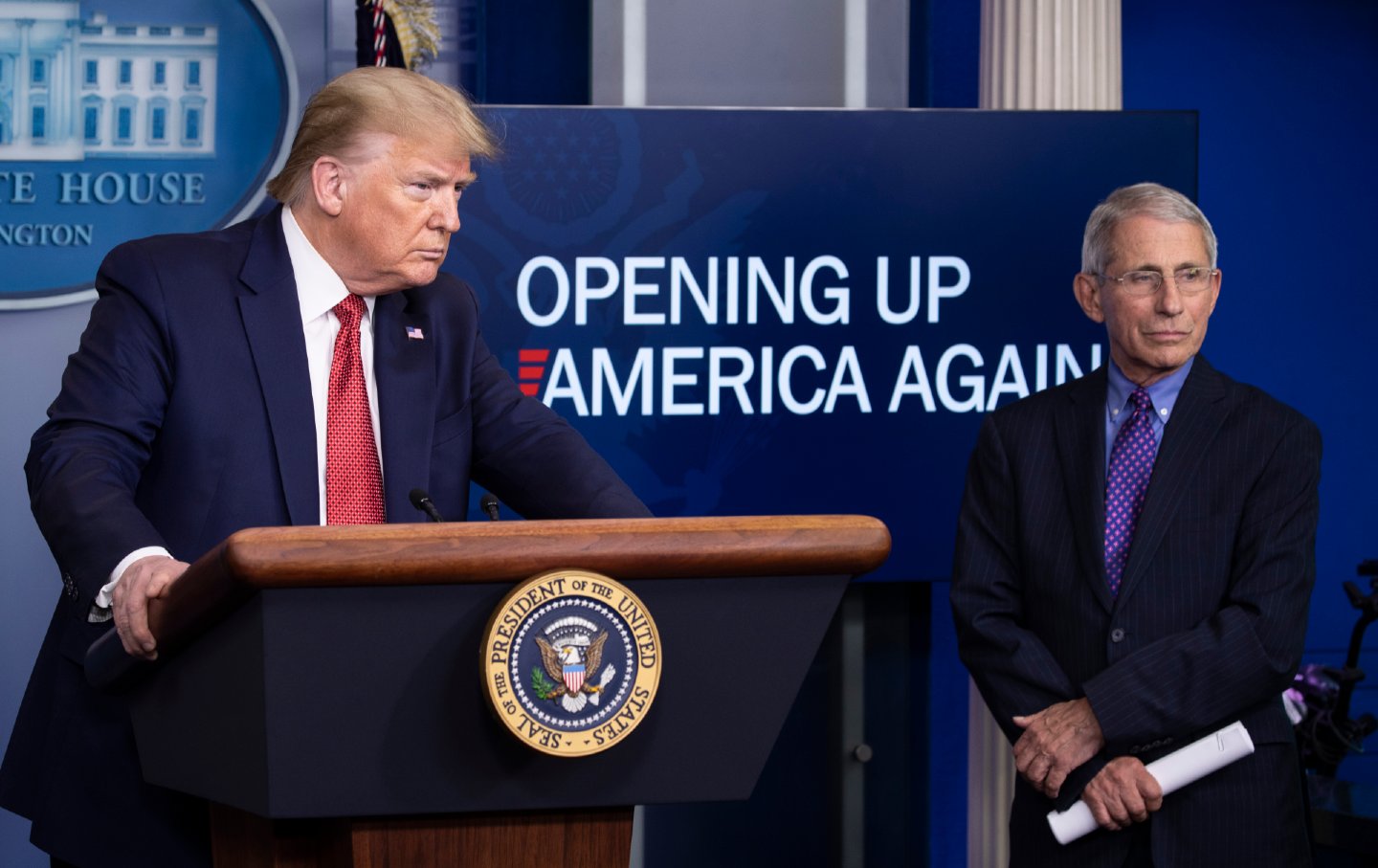
Over a critical period beginning in mid-April, President Trump and his team convinced themselves that the outbreak was fading, that they had given state governments all the resources they needed to contain its remaining “embers” and that it was time to ease up on the lockdown.
In doing so, he was ignoring warnings that the numbers would continue to drop only if social distancing was kept in place, rushing instead to restart the economy and tend to his battered re-election hopes.
A sharp pivot soon followed, with consequences that continue to plague the country today as the virus surges anew.
Even as a chorus of state officials and health experts warned that the pandemic was far from under control, Mr. Trump went, in a matter of days, from proclaiming that he alone had the authority to decide when the economy would reopen to pushing that responsibility onto the states. The government issued detailed reopening guidelines, but almost immediately, Mr. Trump began criticizing Democratic governors who did not “liberate” their states.
Mr. Trump’s bet that the crisis would fade away proved wrong. But an examination of the shift in April and its aftermath shows that the approach he embraced was not just a misjudgment. Instead, it was a deliberate strategy that he would stick doggedly to as evidence mounted that, in the absence of strong leadership from the White House, the virus would continue to infect and kill large numbers of Americans.
He and his top aides would openly disdain the scientific research into the disease and the advice of experts on how to contain it, seek to muzzle more authoritative voices like Dr. Anthony S. Fauci and continue to distort reality even as it became clear that his hopes for a rapid rebound in the economy and his electoral prospects were not materializing.
Now, interviews with more than two dozen officials inside the administration and in the states, and a review of emails and documents, reveal previously unreported details about how the White House put the nation on its current course during a fateful period this spring.
·         Key elements of the administration’s strategy were formulated out of sight in Mr. Meadows’s daily meetings, by aides who for the most part had no experience with public health emergencies and were taking their cues from [Trump] the president.
·         Dr. Birx . . . failed to account for a vital variable: how Mr. Trump’s rush to urge a return to normal would help undercut the social distancing and other measures that were holding down the numbers.
·        [Trump] The president quickly came to feel trapped by his own reopening guidelines. States needed declining cases to reopen, or at least a declining rate of positive tests. But more testing meant overall cases were destined to go up, undercutting [Trump's] the president’s push to crank up the economy. The result was to intensify Mr. Trump’s remarkable public campaign against testing, a vivid example of how he often waged war with science and his own administration’s experts and stated policies.
·         Mr. Trump’s bizarre public statements, his refusal to wear a mask and his pressure on states to get their economies going again left governors and other state officials scrambling to deal with a leadership vacuum.
·         Not until early June did White House officials even begin to recognize that their assumptions about the course of the pandemic had proved wrong.
It was the end of March and his initial, 15-day effort to slow the spread of the virus by essentially shutting down the country was expiring in days. Sitting in front of the Resolute Desk in the Oval Office were Drs. Fauci and Birx, along with other top officials. Days earlier, Mr. Trump had said he envisioned the country being “opened up and raring to go” by Easter, but now he was on the verge of announcing that he would keep the country shut down for another 30 days.
“Do you really think we need to do this?” the president asked Dr. Fauci. “Yeah, we really do need to do it,” Dr. Fauci replied, explaining again the federal government’s role in making sure the virus did not explode across the country.
But even as [Trump] the president was acknowledging the need for tough decisions, he and his aides would soon be looking to do the opposite — build a public case that the federal government had completed its job and unshackle the president from ownership of the response.
By mid-April, Mr. Trump had grown publicly impatient with the stay-at-home recommendations he had reluctantly endorsed. Weekly unemployment claims made clear the economy was cratering and polling was showing his campaign bleeding support. Republican governors were agitating to lift the lockdown and the conservative political machinery was mobilizing to oppose what it saw as constraints on individual freedom.
The wind down of the federal government’s response would play out over the next several weeks. The daily briefings with Mr. Trump ended on April 24. The Meadows team started barring Dr. Fauci from making most television appearances, lest he go off message and suggest continued high risk from the virus.
By June the president was regularly making nonsensical statements like, “If we stop testing right now, we’d have very few cases, if any.”
Later, it was clear that states that rushed to reopen before meeting the criteria in the guidelines — like Arizona, Texas and Alabama — would have among the worst surges in new cases.
Dr. Birx’s belief that the United States would mirror Italy turned out to be disastrously wrong. The Italians had been almost entirely compliant with stay-at-home orders and social distancing, squelching new infections to negligible levels before the country slowly reopened. Americans, by contrast, began backing away by late April from what social distancing efforts they had been making, egged on by Mr. Trump.
The real-world consequences of Mr. Trump’s abdication of responsibility rippled across the country.
Other nations had moved aggressively to employ an array of techniques that Mr. Trump never mobilized on a federal level, including national testing strategies and contact tracing to track down and isolate people who had interacted with newly diagnosed patients.
“These things were done in Germany, in Italy, in Greece, Vietnam, in Singapore, in New Zealand and in China,” said Andy Slavitt, a former federal health care official who had been advising the White House.
“They were not secret,” he said. “Not mysterious. And these were not all wealthy countries. They just took accountability for getting it done. But we did not do that here. There was zero chance here that we would ever have been in a situation where we would be dealing with ‘embers.’ ”
By early June, it was clear that the White House had gotten it wrong. . . . . Digging into new data from Dr. Birx, they concluded the virus was in fact spreading with invisible ferocity during the weeks in May when states were opening up with Mr. Trump’s encouragement and many were all but declaring victory.
The number of new cases has now surged far higher than the previous peak of more than 36,000 a day in mid-April. On Thursday, there were more than 75,000 confirmed new cases, a record.
Mr. Trump’s disdain for testing continues to affect the country.
“When we were trying to get people to wear masks, they would point to the president and say, well, not something that we need to do,” he said.
Mr. Suarez expressed similar frustrations with Mr. Trump’s dismissive approach to mask wearing. “People follow leaders,” he said, before rephrasing his remarks. “People follow the people who are supposed to be leaders.”
Trump has thousands of avoidable deaths on his hands.

Thursday, May 21, 2020

The Four Men Responsible For America’s COVID-19 Disaster

Trump, Azar and Redfield.

With a majority of states now "reopening" their economies, millions of Americans remain unemployed or furloughed and it is unclear when the economy will full recover - some analysts point to late 2021. In this state, the question becomes why was the United States so ill prepared and why was the national response bungled so badly?  A very long piece in Rolling Stone looks at the disastrous federal response and names four individuals as ultimately to blame, starting with Donald Trump who has always treated the pandemic as a PR and political issue rather than a public health emergency.  While Trump set the tone, the disaster was compounded by his appointees who were picked based on ideology and/or ties to far right Christians rather than for the true expertise and competence. In making these flawed appointments, Trump was following both GOP ideology and pandering to leading Christofascists.  The results have proven deadly for tens of thousands of Americans.  Here are highlights from the article which is an indictment of Trump and ultimately the GOP "small government" agenda and obsession with funding cuts to finance tax cuts for the very wealthy (read the entire piece):  
Dr. Robert Redfield, the director of the Centers for Disease Control, flanked Donald Trump at the podium in the White House briefing room. It was February 29th, the day of the first reported U.S. death from the coronavirus, and [Trump] the president fielded an urgent question: “How should Americans prepare for this virus?” a reporter asked. “Should they go on with their daily lives? Change their routine? What should they do?”
A tall man, with a tan, freckled head, and a snow-white chinstrap beard, Redfield stepped to the podium. “The risk at this time is low,” Redfield told the country. “The American public needs to go on with their normal lives.”
This reassurance came at precisely, and tragically, the wrong time. With a different answer, much of the human devastation that was about to unfold in the United States would have been avoidable. Academic research from Imperial College in London, modeling the U.S. response, estimates that up to 90 percent of COVID-19 deaths could have been prevented had the U.S. moved to shut down by March 2nd. Instead, administration leaders dragged their feet for another two weeks, as the virus continued a silent, exponential assault. By early May, more than 75,000 Americans were dead.
Even as he spoke, Redfield knew the country should be taking a different course. The Coronavirus Task Force had resolved to present the president with a plan for mitigation efforts, like school and business closures, on February 24th, but reportedly reversed course after Trump exploded about the economic fallout. Instead, the CDC director continued touting “aggressive containment” to Congress on February 27th.
Experts tell Rolling Stone that ship had sailed when the virus made the leap from infected travelers into the general public. “If you’ve got a community spreading respiratory virus, it’s not going to be containable,” says Dr. Amesh Adalja, a senior scholar at the Johns Hopkins University Center for Health Security. “You have to shift to mitigation right away.”
Patty Murray is the ranking member of the Senate’s top health committee, and represents Washington state, the nation’s first coronavirus hot spot. She blames the administration for a delay that “overwhelmed the health care system and resulted in tens of thousands of deaths.” And she singles out Redfield, in particular, for “dereliction of duty.”
“We had ample notice to get our country ready,” says Ron Klain, who served as President Obama’s Ebola czar, and lists the rolling out of testing, securing protective equipment, and building up hospital capacity as necessary preventative steps. “We spent all of January and February doing none of those things, and as a result, when this disease really exploded  in March, we weren’t prepared.”
The government leaders who failed to safeguard the nation are CDC Director Redfield; FDA Commissioner Stephen Hahn; Health and Human Services Secretary Alex Azar; and of course, President Trump. Together, these men had the power to change the direction of this pandemic, to lessen its impact on the economy, and constrain the death toll from COVID-19. Each failed, in a series of errors and mismanagement that grew into a singular catastrophe — or as Jared Kushner described it on Fox & Friends, “a great success story.”
Precious weeks slipped by — amid infighting, ass covering, and wasted effort — and the virus slipped through the nation’s crippled surveillance apparatus, taking root in hot spots across the country, and in particular, New York City.
The mismanagement cost lives. With adequate testing from the beginning, says Dr. Howard Forman, a Yale professor of public-health policy, “we would have been able to stop the spread of this virus in its tracks the way that many other nations have.” Instead, says Sen. Murray, the administration’s response was “wait until it’s too late, and then try and contain one of the most aggressive viruses that we’ve ever seen.”
Blind to the virus’s penetration and unable to target mitigation where it was needed, the administration and state governors had to resort to the blunt instrument of shuttering the economy, says Dr. Ashish Jha, director of the Harvard Global Health Institute. And the lack of testing kept us in limbo. “Our economy is shut down because we still do not have adequate testing,” Jha says. “We have been woefully behind from the beginning of this pandemic.”
If the president’s deputies made trillion-dollar mistakes, accountability for the pandemic response lies with Trump, who waived off months of harrowing intelligence briefings, choosing to treat the coronavirus as a crisis in public relations, rather than a public-health emergency. Having staked his re-election on a strong economy, Trump downplayed the virus.
The front-line agency built to respond to a pandemic, the CDC, was placed in unreliable hands. Dr. Robert Redfield is a right-wing darling with a checkered scientific past. His 2018 nomination was a triumph for the Christian right, a coup in particular for evangelical activists Shepherd and Anita Smith, who have been instrumental in driving a global AIDS strategy centered on abstinence.
Redfield championed discriminatory policies that he defended as “good medicine” — including quarantining of HIV-positive soldiers in a segregated barracks. These soldiers were routinely given dishonorable discharges after superiors rooted out evidence of homosexuality, and left to suffer the course of their devastating disease without health insurance.
When his CDC appointment was announced in March 2018, Sen. Murray warned of Redfield’s “pattern of ethically and morally questionable behavior,” as well as his “lack of public-health expertise,” and urged Trump to “reconsider.” But the CDC post does not require Senate approval. Redfield sought to reassure CDC staff that his views had modernized, and that he now embraced condoms to slow HIV infection.
The CDC reports to the Department of Health and Human Services, led by Alex Azar, a former executive for the pharmaceutical giant Eli Lilly who gained infamy, in his five-year tenure, by doubling the price of insulin.
Azar is a creature of the GOP establishment: He cut his teeth as a Supreme Court clerk to Antonin Scalia, worked with Brett Kavanaugh on the Clinton-Whitewater investigation under special counsel Ken Starr, and served as a deputy HHS administrator in the George W. Bush era, before becoming Eli Lilly’s top lobbyist.
Azar sought to shrink the CDC, an agency that has been on the chopping block throughout the Trump administration. In HHS’s most recent budget proposal — unveiled this past February, 10 days after the World Health Organization declared a global emergency over the coronavirus — Azar sought an $85 million cut to the CDC’s Emerging and Zoonotic Infectious Diseases program and a $25 million cut to Public Health Preparedness and Response. Azar defended the budget at the time as making “difficult, prudent choices.”
The Trump administration had also hollowed out the CDC’s China presence, slashing staff from 47 to barely a dozen. These cuts were part of a broad-reaching drawdown of America’s disease preparedness, including Trump’s decision to disband the National Security Counsel’s pandemic-response team.
Stephen Hahn had been on the job at the FDA for barely a month. A bald, 60-year-old of modest height, Hahn has an impeccable résumé — he served as chief medical executive at the University of Texas MD Anderson Cancer Center — but he had no experience running a government agency.
The need to engage the private sector for coronavirus testing was not only foreseeable, it was foreseen — by Trump’s first FDA commissioner, Scott Gottlieb. In a January 28th Wall Street Journal article, “Act Now to Prevent an American Epidemic,” Gottlieb warned that the “CDC will struggle to keep up with the volume of screening.” He said the government must begin “working with private industry to develop easy-to-use, rapid diagnostic tests.”
If Hahn read his predecessor’s call to action, he did not act on it. . . . . Yet the failure to activate the private sector was the key difference between the U.S. response to the coronavirus and that of South Korea, which first detected the virus in its country at the same time the U.S. did. “Instead of going through regulatory hijinks,” says Milton, the University of Maryland virologist, South Korea “turned their biomedical industry loose, and they started producing lots of tests right away.”
The testing breakdown had left the nation blind to the true scope of the outbreak. By March 1st, the CDC’s official tally of coronavirus cases had spiked from the 15 cases touted by Trump to 75. But researchers at Northeastern University have now developed models showing there were likely 28,000 infections at the time, in just five major cities, including New York and Seattle.
Having plunged the nation headlong and unprepared into the deadliest disease outbreak in a century, President Trump is now proving to be one of the greatest obstacles to an effective national response.
Sebelius ultimately blames Trump for failing to end the infighting and fix the testing failure. “The White House has a unique way to get agencies’ attention, by making it clear that they want a solution, and everybody at the table with that solution within 24 hours,” she says. “If the president wants this to happen, it will happen.” But on his visit to the CDC in Atlanta, Trump had made an extraordinary admission: That he did not want to let passengers from a cruise ship, then suffering an outbreak off the California coast, to come on shore because the tally of patients would rise. “I like the numbers being where they are,” Trump said.
Trump plainly saw effective testing as a threat to his political messaging that the administration was containing the virus. By standing at CDC headquarters to declare that the tests were “perfect” and that he didn’t want COVID-19 numbers going up, the president was doing the exact opposite of demanding a fix. For the president’s deputies, Sebelius says, “there couldn’t be a clearer signal.”
In the event that Trump is still president when a vaccine becomes available, Sebelius argues that the loose confederations that have formed in the Northeast, Midwest, and Pacific states to coordinate their reopenings may need to band together in a shadow government to sidestep Trump. “Maybe governors will put together their own system,” she says, “and ignore what’s happening in the White House.”

Again, read the entire piece.

Sunday, May 17, 2020

Like Trump, Iran’s Clerics Have Bungled Their Coronavirus Response

When one is motivated by a thirst for power, ideology and an indifference for others, responding to a pandemic will be a problem, especially when the ideology is based on ignorance embracing religious doctrine.  Leave out the religious motivations and America has seen its repose to Covid-19 bungled by the malignant narcissist in the White House.  In Iran the bungled response has been orchestrated by Islamic extremist clerics who embrace a medieval form of Islam that puts reactionary religious doctrine above all else.  The incompetence of the response is not being lost on the Iranian people, many of whom are highly educated and are chaffing under the theocratic rule of clerics who ought to be relegated to some back water mosque in the hinterland of the country.  A piece in the Washington Post looks at Iran's bungled pandemic response which should remind America's the science, not religion should determine how a response to a medical catastrophe is managed.  Religion should have absolutely no role in civilian government.  Here are article highlights:
The Iranian cartoon [see above image] shows two traditional healers, including a turbaned cleric, preparing to treat a coronavirus patient on all fours with beakers of camel urine and violet leaf oil, remedies hailed by some clergymen as surefire cures for covid-19.
On the wall hangs a picture of Iran's supreme leader, Ayatollah Ali Khamenei, donning a nurse's cap and putting a finger to his lips, signaling critics to remain silent.
The sketch was posted last month on the Telegram channel of a mainstream news outlet, the Iranian Labor News Agency, before being swiftly taken down.
Its appearance, however brief, represented a rare criticism of Iran’s ruling religious establishment by the media and came amid a wider outcry among Iranians over the role played by the Shiite Muslim clergy during the pandemic.
Since Iran’s outbreak first erupted in the holy city of Qom, religious leaders have resisted calls for quarantines, protested orders to close shrines, cast the coronavirus as an American conspiracy, and promoted traditional or Islamic medicine as a panacea for covid-19, the disease it causes. Their actions have angered senior health officials and stoked long-existing doubts within the Iranian population about whether the clergy are fit to rule.
In Iran, a Shiite theocracy, clerics preside over and participate in all matters of the state. But their botched response to the pandemic may be weakening the clergy’s political stature, at a time when its influence was already under pressure, political analysts say.
As the religious elite fumbled and deaths from the virus mounted — Iran has now reported nearly 7,000 deaths and more than 118,000 infections — the country’s powerful security services have stepped in to conduct disease surveillance, disinfect public spaces and even oversee victims’ burials, a role long reserved for civilian authorities and Shiite clerics.
It’s a dynamic with implications for Iran’s political future, as the battle heats up to succeed Khamenei and a more modern middle class grows tired of theocratic government.
“The clergy’s apparent resistance to the state’s virus control mandates will likely be marked as a point of no return for public mistrust of clerics and suspicion about their ability to serve as rational authorities in the political or social sphere,” Mehdi Khalaji, a fellow at the Washington Institute for Near East Policy, wrote in a recent policy analysis. . . . . [T]he clerics’ “spectacular failure” to respond adequately to the outbreak “will make power players less interested in seeking ideological or political support from the clergy post-Khamenei.”
“They could have repaired their image by helping people or giving emotional support” to victims, Mohammad said of the clerics. “But they ruined it further by weighing in on things they don’t know about, such as medicine.”
The cartoon depicting the huckster healers appeared to hit a nerve with the clerical-run government. While the artist, Reza Aghili, lives in exile in Turkey beyond the reach of authorities, the news director of ILNA and the manager of its Telegram channel were arrested late last month for allegedly insulting “Islam’s sacred principles” and religious leaders, according to the Paris-based Reporters Without Borders, a press freedom watchdog group.
“In my opinion,” Aghili said in an interview, “not only the clergy’s popularity but Islam’s popularity in general is the lowest it has ever been.”
“I think that the Revolutionary Guard is winning the people’s trust, while the clergy has been losing it,” Amir, 30, said. He also spoke on the condition of using only his first name to comment freely about the security forces. “The older generation is angry at the clerics and will curse them,” he said. “While the younger generation just makes jokes at their expense.”
Mahshid, a 33-year-old market researcher in Tehran who spoke on the condition that her full name would not be used so she could comment critically without fear of reprisal, had nothing good to say about the clerics. “I think that the clergy is entirely irrelevant to society in Iran today,” she said.
Grand Ayatollah Yusuf Saanei, a former member of Iran’s powerful Guardian Council, is among those who reject the clergy’s involvement in political affairs.
In an interview via Telegram, Saanei, who is based in Qom, said those who have promoted alternative therapies and rejected public health guidance are part of “an inept group who try to cling to sharia” or Islamic law.


An increasingly educated population is increasingly at odds with a version of Islam than celebrates ignorance and ignores objective reality.  The result will likely be similar to what we are witnessing in the USA - the younger generations will walk away from religion entirely and with good reason. 

Monday, May 04, 2020

Models Shift to Predict Dramatically More U.S. Covid-19 Deaths

Virginia's governor Ralph Northam - the only US governor who is a physician - just extended Virginia's business shutdown for another week as reported by the Virginian Pilot. Whether the May 15, 2020, opening date gets further delayed will depend on whether Virginia sees 14 days of improvement.  Meanwhile, a number of GOP lead states are opening up businesses and playing a game of Russian roulette with their citizens' lives.  New reports on models predicting the Covid- 19 death rate suggest that  Northam may be taking the wiser choice given the new predictions that 134,000 Americans will die of Covid-19 between now and August (243,000 if one includes the upper end of the margin of error).  A Johns Hpkins report predicted 3,000 deaths per day by June (that would be a daily death rate not too much less than the 9-11 fatality number).   It goes without saying that Trump is cheering on governors reopening their states focusing as always only on himself and what a weak economy could mean for his re-election hopes. The Washington Post looks at the disturbing model predictions.  Here are excerpts:
A key model of the coronavirus pandemic favored by the White House nearly doubled its prediction Monday for how many people will die from the virus in the U.S. by August – primarily because states are reopening too soon.
The Institute for Health Metrics and Evaluation at the University of Washington’s School of Medicine is now projecting 134,000 coronavirus-related fatalities, up from a previous prediction of 72,000. Factoring in the scientists’ margin of error, the new prediction ranges from 95,000 to 243,000.
Dr. Christopher Murray, the director of IHME, told reporters on a call Monday the primary reason for the increase is many states’ “premature relaxation of social distancing.”
For the first time, Murray explained, the model is factoring in data from four different cell phone providers showing a major uptick in Americans’ going out in public. This rise of mobility in the last week or 10 days is likely leading to an increase in transmission, he said.
Even with its latest forecast, the University of Washington model is still far more optimistic than a model developed by Johns Hopkins for CDC predicting as many as 3,000 deaths per day by June.
In a statement on Monday evening, the Johns Hopkins Bloomberg School of Public Health called the leaked models “preliminary analyses,“ saying that they had been provided to the Federal Emergency Management Agency to help in scenario planning, were not a final version and were not meant to be used or presented as forecasts.
Still, the statement added, “the information illustrates that there are some scenarios, including the premature relaxation of social distancing, that are likely to cause significant increases in the number of COVID-19 cases and deaths in the United States.“
In a statement to reporters, White House deputy press secretary Judd Deere said that the internal report obtained by The New York Times was “not a White House document” and hadn’t been presented to the coronavirus task force.
The CDC document projects north of 175,000 new cases of Covid-19, the respiratory illness caused by the novel coronavirus, each day. That’s up from about 25,000 new cases per day last week and more than four times the peak of about 37,000 new cases per day.
The alarming modeling comes as some states are already beginning to put parts of the White House’s phased reopening plan into motion despite concerns that the administration’s guidelines for doing so have not yet been met. It also underscores fears that moving too fast to relax strict social-distancing restrictions could fuel a dangerous second wave of infections.
The CDC document found some reason for optimism, noting that nationwide, the trajectory of new illnesses in "multiple counties, including hard hit areas in Louisiana and in the New York City region" has continued to decrease, and that incidence rates have recently plateaued around Chicago.
Still, it found that there "remains a large number of counties whose burden [of illness] continues to grow or are in an elevated incidence plateau, including in the Great Lakes region, parts of the Southeast, Northeast, and around southern California." The document includes a color-coded map of the country with darker spots peppered throughout, and it states that the goal "is to have all communities be represented in the lighter colors, demonstrating little to no disease burden and no increase in trajectory."
Murray also noted that the updated University of Washington model also now takes into account the ramping up of testing in most states, as well as warming temperatures heading into late spring and early summer. But he cautioned that the impact of temperature on coronavirus transmission is not yet fully understood, and likely will not be for several more months.
For now, IHME is assuming that every degree Celsius the temperature goes up will lead to a 2 percent decline in transmission. “Are we sure about that? No,” he said.

Monday, April 27, 2020

Why Trump Failed America

If one is honest, looks at the facts, all of Trump's lies, and considers all the ways that the Trump/Pence regime weakened America's ability to meet the Covid-19 crisis  - e.g, disbanding the National Security Council pandemic directorate, slashing funding for the CDC, and rescinding Obama era regulations for nursing homes that might has slowed the spread of the virus among the  nursing home residents - the only conclusion is that Trump has spectacularly failed America. But even beyond all of this, there is an added reason for Trump's failure: he is a malignant narcissist who lies incessantly and cares only about himself and satiating his unquenchable ego.  All the warning signs were on open display ranging from his boasts about "grabbing p*ssy" without consequence to being able to shoot someone on 5th Avenue without consequence.  Sadly, Trump's calls to racism and religious extremism were followed by many who should have known better even as Democrats in a funk stayed home and by default voted for Trump.  A column at CNN looks at all of this and Trump's very nature that guaranteed his huge failure to safeguard America.  Americans should never again put someone with Trump's mental and psychological illness in the Oval Office - or any high office.  Here are column excerpts:
Watching President Donald Trump wrestle with this epic crisis reminds me of the old fable about the Scorpion and the Frog.
You'll remember that the scorpion asks the frog for a ride across a river, only to sting the frog when they are midway across. When the startled frog asks why the scorpion would repay his kindness so cruelly and kill them both, the scorpion shrugs. "It's my nature." Trump could have made this unparalleled and agonizing trial for our country an occasion for personal triumph — if he were only able to take the personal out of it. But that is not his nature.
This moment of extraordinary pain and crisis calls for steadiness and sobriety; empathy for the widespread pain and suffering of others; absolute transparency; a willingness to listen and learn; and rigorous, disciplined attention to detail. None of these qualities are within his nature.
Many governors across America have enhanced their popularity simply by doing their jobs during this deadly outbreak of the coronavirus. Even in a polarized nation, it might have been the same for Trump if, from the start, he had leveled with the country about the nature of the threat, followed expert advice and made the case for the painful and decisive steps required to save lives.   But that's not his nature. Instead, the [Trump] President spent six weeks dismissing the threat and offering false assurances as public health experts frantically warned what was to come.
 Trump ostensibly feared that an acknowledgment of the severity of the virus and the draconian steps required to protect Americans would tank the stock market and the economy, which he had hoped to make the springboard to his re-election. So he insisted on an alternative storyline. US cases would not surpass 15, he said in February, even as some public health experts warned of a potential pandemic. "Miraculously," he suggested with a flourish, the virus could just fade away with a change in the weather.
 As Covid-19 had begun its deadly march across the nation, Trump was accusing Democrats and the media of politicizing the disease in what amounted to a Coronavirus "hoax" to damage him.
While some governors were mobilizing against the threat, [Trump] the President sent the nation and federal bureaucracy the opposite signal, delaying the necessary steps, which cost the nation valuable time to gird for the battle and deepened the crisis.
 Since the day he finally recalibrated, appearing at the podium in the White House briefing room in March to declare war on Covid-19, [Trump] the President has spent most of his briefing time spinning his administration's uneven and tardy response (which he rated a 10 out of 10) rather than giving the American people the sober and accurate assessment they need. Truth and accountability are not his nature. Americans of all stripes are bound together by a common calamity, hungry for a unifying leader who will rise above partisanship. But that is not Trump's nature. He has suggested that governors, desperately asking the federal government for more testing supplies, were acting out of political motivation.
 Trump is who Trump has been from the beginning of his long career in the public eye: a super narcissist and shameless self-promoter, unwilling to accept responsibility or the truth and unable to think about anyone but himself. If he had been more in this historic moment, it would have done so much to strengthen his brand and his prospects of reelection -- not to mention comfort his wounded country. But it is no surprise that he could not. It's just not his nature.

Thursday, April 23, 2020

The "Reopen" Protests Are Anything But Spontaneous

Billionaire Robert Mercer.
As intimated in yesterday's posts, the "Reopen the Economy" protests that have sprung up in various parts of the country are intended to appear as "grass root" and spontaneous events organized by working class Americans yet the reality is something quite different.  Indeed, like the "Tea Party" movement that erupted after Barrack Obama's election, these  protests are being funded and organized by right wing organizations, many funded by billionaires with organizing efforts coming from right wing operatives, some with ties to the White House. Further coordinating the effort is Fox News, the perennial propaganda network of the far right.  Some of the names include familiar billionaires of the right wing: Koch, DeVos, Mercer - all opponents of democracy and progressive values - whose organizations are playing key roles in manipulating the Trump faithful, racists and white supremacists.  A piece in the New York Times looks at this reality.  Here are excerpts:

I frst became aware of the political influence of Charles and David Koch in 2009 when I started looking into who was behind the protests at health care town halls.
The Tea Party, formed after America elected its first black president, used a series of health care town halls to spur angry Republicans to oppose the Affordable Care Act as a socialist takeover of American medicine. Little matter that it was modeled on a plan devised by Mitt Romney, a Republican, when he was the governor of Massachusetts.
Such false claims about the act have not aged well, as millions of Americans now depend on the law for health care coverage as the coronavirus contagion sweeps across the nation. And yet a Tea Party co-founder, Mark Meckler, is using the same tactics and same phony claims to stir his followers to protest against governors seeking to mitigate the Covid-19 death toll by closing businesses and banning public gatherings.
That public anger is both real and manufactured. The same was true in 2009, when the Koch fortune fueled the Tea Party’s attacks on the Obama administration’s health care law.
As we face Tea Party 2.0, let’s not be fooled again.  The protests playing out now have the same feel as the Tea Party protests aided by Koch-financed Americans for Prosperity and others a decade ago — and with good reason: Early evidence suggests they are not organic but a brush fire being stoked by some of the same people and money that built the Tea Party.
Look no further than the first protest organized by the Michigan Conservative Coalition and the Michigan Freedom Fund . . . . to see that the campaign to “open” America flows from the super rich and their front groups.
Stephen Moore — a fellow at the Heritage Foundation, a Koch ally and a Trump adviser — admitted as much in a video I obtained comparing these new protesters to Rosa Parks, as first reported in The Times.
Mr. Moore, who is now leading an enterprise to end the virus precautions called Save Our Country, which includes the Koch-backed American Legislative Exchange Council, boasted that he has been working behind the scenes with a conservative donor who agreed to cover bail and legal fees for demonstrators who get arrested for defying Wisconsin’s virus protective measures.
Others are providing legal assistance as well. The Times reports that a private Facebook group called Reopen NC has retained the legal services of Michael Best & Friedrich, a Wisconsin law firm whose clients include President Trump. The firm is well known for its work with dark-money groups that fought the recall of the Koch ally Gov. Scott Walker of Wisconsin and waged war on unions.
Then there’s the Convention of States, established in 2015 with a big contribution from the conservative hedge fund billionaire Robert Mercer. The group recruits activists at gun shows to support a balanced-budget amendment and is promoting the protests online via “Open the States.
[T]his week one of Mr. Meckler’s organizers told supporters via Facebook that “optics are everything” and that they should be sure to wear a mask to the protests and stand six feet apart — because it will make the crowds look bigger.
COS and a Koch-financed public relations firm, In Pursuit Of, are also purchasing domain names tied to protests to open the states, suggesting they are investing for a long battle — even as the death toll rises.
The consequences are already starting. One week after a Kentucky protest, the state experienced its largest spike in coronavirus cases. Other states may soon see similar spikes.
Those fanning these flames, including President Trump and Fox News hosts, are unlikely to get burned by infection themselves, though they may be goading their followers to risk their health by attending mass demonstrations.
America is now facing three calamities: a deadly contagion, a capricious president and a well-funded right-wing infrastructure willing to devalue human life in pursuit of its political agenda. Some very rich men and women are making this medical disaster worse through their reckless bellows, inflaming people to demand that states open now no matter how many lives that costs.
The Trump base, of course will never grasp the fact that they are being used yet again,  They are too blinded by their bigotry and hatred of others to open their eyes and realize they are being played for fools - again.

Wednesday, April 15, 2020

Trump’s Desperate and Deadly Search for a Scapegoat

One thing that can be depended upon when dealing with a malignant narcissist such as Donald Trump is that they will NEVER admit that anything is their fault. Any misfortune or calamity MUST be the fault of someone else because their narcissistic personality disorder prevents them from ever admitting a mistake or miscalculation - no matter what the objective evidence indicates otherwise. Today, in a further morally bankrupt attempt to shift blame from his own and his administrations failures and incompetence in handling the coronavirus threat, Trump has targeted the World Health Organization and cut US funding to the international organization - a move criticized even by a number of otherwise self-prostituting Republicans.  A column in the New York Times looks at this dangerous move by a tyrant who seemingly increasingly sees himself as a monarch rather than a elected official who serves at the bidding of the public.  Here are column highlights:
Thousands of Americans would be alive today if President Trump had spent more time listening to the World Health Organization instead of trying to destroy it.
Trump’s announcement that he is halting American funding for the W.H.O. just as the world is facing a raging pandemic is a dangerous attempt to find a scapegoat for his own failings.
Yes, some of the complaints about the W.H.O.are valid,  . . . . But it has still managed the coronavirus crisis far better than the Trump administration has.
The W.H.O. tweeted its first warning about the coronavirus on Jan. 4 and then rang alarm bells, culminating at the end of that month when it declared a “public health emergency of international concern.” It developed an effective diagnostic test that is used in dozens of countries, while the United States still cannot manage adequate testing.
In late January and in February, the W.H.O. issued increasingly urgent warnings about the coronavirus. Trump ignored them, instead insisting that it was “totally under control,” predicted the number of infections would drop, declared that “it’s going to disappear” and consistently downplayed the virus while talking up the stock market.
Trump’s passivity — even as the W.H.O. and his own advisers warned him of the risks — squandered the chance to acquire more personal protective equipment for doctors and nurses. His likening of Covid-19 to the flu led people to join public gatherings like Mardi Gras and Florida spring break, and that is one reason the United States has had 80 deaths per million inhabitants from Covid-19, compared with four per million in South Korea and fewer than one per million in Taiwan.
The W.H.O. is bureaucratic, frustrating, timid — and indispensable. No other organization can fill its international role overseeing the fight against disease. It has battled an outbreak of Ebola since last year in Congo, and that’s one reason we haven’t had Ebola cases in the United States.
Every day, the W.H.O. saves lives. It has promoted safe childbirth, and the number of women dying in childbirth has been cut almost in half over 25 years. It fights female genital mutilation and helps women with obstetric fistula. It is struggling to eliminate cervical cancer. It is part of the campaign against polio.
Normally, an American president is a leader in global health, and Democrats and Republicans have often cooperated on a humanitarian agenda. President George W. Bush started a program against H.I.V./AIDS called Pepfar that has saved 17 million lives. President Barack Obama helped lead the global effort to end the Ebola outbreak in West Africa in 2014-16.
In contrast, Trump has provided zero global leadership against the coronavirus, and he is now trying to crush the one organization providing such leadership.
Trump’s main complaint about the W.H.O. is that it is too close to China, and there’s some truth to that — but Trump himself fawned over China’s response to the pandemic. “China has been working very hard to contain the Coronavirus,” Trump tweeted on Jan. 24. “I want to thank President Xi.”
Gutting the W.H.O. would mean more kids dying of malnutrition, more moms dying of cervical cancer, and the coronavirus infecting more people in more countries — impairing the pandemic response, which may well cost even more American lives. And all because an American president is seeking a scapegoat for his own ineptitude.
Yes, Americans have died unnecessarily from Covid-19, and I’ve been seared by my own reporting in “hot zones” of New York hospitals. But if Trump insists on holding people accountable, he needn’t denounce the W.H.O. He can gaze in the mirror.