Showing posts with label Tea Party. Show all posts

Thursday, April 23, 2020

The "Reopen" Protests Are Anything But Spontaneous

Billionaire Robert Mercer.
As intimated in yesterday's posts, the "Reopen the Economy" protests that have sprung up in various parts of the country are intended to appear as "grass root" and spontaneous events organized by working class Americans yet the reality is something quite different.  Indeed, like the "Tea Party" movement that erupted after Barrack Obama's election, these  protests are being funded and organized by right wing organizations, many funded by billionaires with organizing efforts coming from right wing operatives, some with ties to the White House. Further coordinating the effort is Fox News, the perennial propaganda network of the far right.  Some of the names include familiar billionaires of the right wing: Koch, DeVos, Mercer - all opponents of democracy and progressive values - whose organizations are playing key roles in manipulating the Trump faithful, racists and white supremacists.  A piece in the New York Times looks at this reality.  Here are excerpts:

I frst became aware of the political influence of Charles and David Koch in 2009 when I started looking into who was behind the protests at health care town halls.
The Tea Party, formed after America elected its first black president, used a series of health care town halls to spur angry Republicans to oppose the Affordable Care Act as a socialist takeover of American medicine. Little matter that it was modeled on a plan devised by Mitt Romney, a Republican, when he was the governor of Massachusetts.
Such false claims about the act have not aged well, as millions of Americans now depend on the law for health care coverage as the coronavirus contagion sweeps across the nation. And yet a Tea Party co-founder, Mark Meckler, is using the same tactics and same phony claims to stir his followers to protest against governors seeking to mitigate the Covid-19 death toll by closing businesses and banning public gatherings.
That public anger is both real and manufactured. The same was true in 2009, when the Koch fortune fueled the Tea Party’s attacks on the Obama administration’s health care law.
As we face Tea Party 2.0, let’s not be fooled again.  The protests playing out now have the same feel as the Tea Party protests aided by Koch-financed Americans for Prosperity and others a decade ago — and with good reason: Early evidence suggests they are not organic but a brush fire being stoked by some of the same people and money that built the Tea Party.
Look no further than the first protest organized by the Michigan Conservative Coalition and the Michigan Freedom Fund . . . . to see that the campaign to “open” America flows from the super rich and their front groups.
Stephen Moore — a fellow at the Heritage Foundation, a Koch ally and a Trump adviser — admitted as much in a video I obtained comparing these new protesters to Rosa Parks, as first reported in The Times.
Mr. Moore, who is now leading an enterprise to end the virus precautions called Save Our Country, which includes the Koch-backed American Legislative Exchange Council, boasted that he has been working behind the scenes with a conservative donor who agreed to cover bail and legal fees for demonstrators who get arrested for defying Wisconsin’s virus protective measures.
Others are providing legal assistance as well. The Times reports that a private Facebook group called Reopen NC has retained the legal services of Michael Best & Friedrich, a Wisconsin law firm whose clients include President Trump. The firm is well known for its work with dark-money groups that fought the recall of the Koch ally Gov. Scott Walker of Wisconsin and waged war on unions.
Then there’s the Convention of States, established in 2015 with a big contribution from the conservative hedge fund billionaire Robert Mercer. The group recruits activists at gun shows to support a balanced-budget amendment and is promoting the protests online via “Open the States.”
[T]his week one of Mr. Meckler’s organizers told supporters via Facebook that “optics are everything” and that they should be sure to wear a mask to the protests and stand six feet apart — because it will make the crowds look bigger.
COS and a Koch-financed public relations firm, In Pursuit Of, are also purchasing domain names tied to protests to open the states, suggesting they are investing for a long battle — even as the death toll rises.
The consequences are already starting. One week after a Kentucky protest, the state experienced its largest spike in coronavirus cases. Other states may soon see similar spikes.
Those fanning these flames, including President Trump and Fox News hosts, are unlikely to get burned by infection themselves, though they may be goading their followers to risk their health by attending mass demonstrations.
America is now facing three calamities: a deadly contagion, a capricious president and a well-funded right-wing infrastructure willing to devalue human life in pursuit of its political agenda. Some very rich men and women are making this medical disaster worse through their reckless bellows, inflaming people to demand that states open now no matter how many lives that costs.
The Trump base, of course will never grasp the fact that they are being used yet again,  They are too blinded by their bigotry and hatred of others to open their eyes and realize they are being played for fools - again.

Tuesday, April 21, 2020

Echos of Charlottesville: Trump Praises Covid-19 Protesters


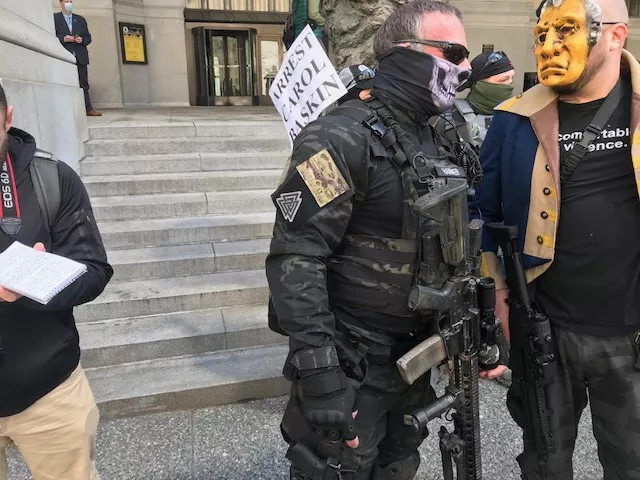
When out of state far right Neo-Nazis and white supremacists invaded the grounds of the University of Virginia and terrorized the city of Charlottesville, Virginia, in 2017, Donald Trump could never bring himself to condemn the far right extremists and ultimately said there were "very good people" on both sides of the protests.  Tell that to Charlottesville residents or supporters and alumni of the University who remain livid to this day that outside elements invaded Charlottesville. Now, we are again seeing Trump unwilling to condemn the far right protesters showing up in state capitals to protest stay at home orders supported by medical experts.  Many of these protesters look much like those who invaded Charlottesville: armed militias, white supremacists, and anti-government extremists who Trump has incited through tweets.  These protesters consist of the deplorables that Hillary Clinton so aptly described. A piece in Huffington Post looks at Trump's coddling of dangerous extremists, many of whom are armed.  Here are excerpts:

President Donald Trump on Sunday defended right-wing protesters he appeared to previously encourage to rally across the country for states to reopen the economy despite governments and health experts deeming it not safe enough to do so.
Since last week, thousands of protesters in more than a dozen states have taken to the streets to demand stay-at-home orders be lifted, even though public health officials have warned that lifting restrictions too early could lead to a spike in cases. 
The protesters have been mostly right-wing followers, anti-vaccination advocates and gun rights activists who in some photos can be seen standing close together without masks or gloves, in defiance of the social distancing guidelines meant to slow the spread of the virus and flatten the curve.
At Sunday’s White House coronavirus briefing ― an event that the president has mostly used to campaign and push misinformation ― Trump was asked what his advice would be to protesters who want to lift states’ stay-at-home orders.
“You’re allowed to protest. … I watched a protest and they were all six feet apart, I mean it was a very orderly group of people,” Trump said, despite photo evidence of many of these rallies showing otherwise. “But you know, some governors have gone too far. Some of the things that happened are uh, maybe not so appropriate, and I think in the end it’s not gonna matter because we’re starting to open up our states.
“I see protesters for all sorts of things, and I’m with everybody,” he said. Asked on Sunday if he was concerned that his tweets helped incite violence against the governors ― some of whom are receiving death threats from protesters ― Trump immediately denied it.
“I’ve seen the people, I’ve seen the interviews of people. These are great people,” Trump said. “Look they want to get ― they call cabin fever, you’ve heard the term ― they’ve got cabin fever.
When the reporter who asked the question pointed out there have also been Nazi flags flown at these rallies, Trump repeated: “No, no.” . . . . These people love our country and they wanna get back to work.”

Trump’s enabling response to the protesters echoed his handling of the 2017 Unite the Right rally in Charlottesville, Virginia ― where neo-Nazis protested against taking down Confederate monuments in a violent white supremacist rally that left one counter-protester dead and dozens more wounded.
After the Charlottesville violence, Trump refused to single out the activity of white supremacists and instead falsely claimed that there was “bigotry and violence on many sides.” He then doubled down on his comments, equating Nazis with people who are against fascism by saying there were “very fine people on both sides” at the rally.
Whether my Republican "friend" like it or not, Trump's main appeal to his base is his open racism and refusal to condemn the most extreme elements of the far right, people to whom such "friends" have tied themselves through their continued support of Trump. 

A column in the Washington Post looks at the hypocrisy and derangement of these protesters:
We haven’t heard from them much in the past 3½ years. Not that they shouldn’t have found plenty of fodder for outrage: record deficits and debt; an autocrat in the White House who regularly claims extra-constitutional authority; economic policies that tilt heavily in favor of the wealthy and big business.
Tea party activists have looked the other way on all of these things throughout the presidency of Donald Trump. But now they are appearing again in state capitals across the country, screaming and waving their “Don’t Tread on Me” banners to vent at the lifesaving measures that governors have taken in the face of an epidemic that has already caused upward of 40,000 deaths in the United States.
There is a legitimate — and reasonable — debate to be had about how much economic pain the country should be willing to bear to bring the epidemic under control.
But that is not what we are hearing in their nihilistic fury. Some of them carry Confederate flags and assault weapons as they protest. Theirs is a doctrine fueled not by high-minded principles, but by conspiracy theories and populist resentment.
Tea party 2.0 is proposing a tri-cornered suicide pact: Give them liberty from stay-at-home orders and give them death. And while they are at it, endanger the lives of everyone around them as well.
[P]olls show the vast majority of Americans want restrictive measures to remain in place to fight the virus.
Two-thirds of respondents in a poll that Pew Research Center released last week said they were more concerned that states would move too quickly to lift the measures, as opposed to only 32 percent who said they feared it would not happen fast enough. In an April 8 Quinnipiac University poll, 81 percent said they would support a national stay-at-home order, rather than leaving it up to the discretion of the states.
The Quinnipiac survey also showed that nearly three-quarters approve of their governors’ handling of the crisis; by comparison, only 46 percent felt positive about Trump’s performance.

Saturday, October 14, 2017

The Roots of Republican Dysfunction and Insanity


Today's Republican Party bears no resemblance to what it was even 15 years ago, although the roots of the party's current dysfunction and championing of hate and bigotry began much further back in time.  Richard Nixon's implementation of the so-called "Southern Strategy" put out the welcome mat for racists and white supremacists, but for many years the "adults in the room" in the party leadership were able to keep the more virulent racists under control and largely out of view other than dog whistle messaging. Next, the Christofascists were made welcome in a low key manner under Reagan and the insanity of the party base began in earnest.   Foolishly, George W. Bush threw the doors to the party wide open to religious extremists when he and Karl Rove used same sex marriage as tool to secure Bush's reelection in 2004.  From that point on, the party's embrace of ignorance and bigotry became raging torrent.  This insanity and war against modernity reach its apogee with the election of Donald Trump, a/k/a Der Trumpenführer.  A piece in the New York Times looks at the GOP's descent to the ugly reality that it has become, something too many otherwise decent Republicans - I could name names but I will not - refuse to recognize as they continue to support a party that in fact no longer exists except in their own minds.  Here are column highlights:
[A]fter nine months of party control of Congress and the White House, the Republicans have accomplished essentially nothing. They have become a party without a consensus.
It would be easy to simply blame the president for the party’s disarray. Donald Trump’s aversion to policy detail, his chaotic management style and his combustible personality have all contributed to the party’s failures this year.
Yet it would also be a mistake to pin the party’s problems on Mr. Trump alone. He is not their root cause. Instead, he is an avatar of the party’s pathologies, the culmination of its cynical and shambolic trajectory over the last two decades.
Many of those issues can be traced back to the administration of George W. Bush, which functioned as an enormous political bait and switch. The 43rd president campaigned on humble foreign policy and prudent conservative solutions, but his presidency quickly became oriented almost exclusively around a political defense of the Iraq war.
This meant that domestic policy, and the realm of domestic policy expertise, became an afterthought at best, an opportunity for cynical political maneuvering at worst.
But Mr. Bush’s post-Sept. 11 popularity instilled the administration with an arrogance that extended far beyond the war itself. The president’s inner circle became convinced that the Republican Party was destined for years of unbroken political domination; the ambition-spoiling concerns of the “reality-based community” no longer needed to be taken into account.
National security fear-mongering and culture war controversies, especially over same-sex marriage, were employed to rally the base and ensure its loyalty, even as dissatisfaction with Mr. Bush’s governance continued to grow.
The Bush presidency, then, was both a failure and a fraud. Instead of foreign policy restraint and modest conservative governance, the Bush administration delivered a pair of endless deficit-financed wars, cynical posturing over social issues, soaring federal spending and, eventually, a large-scale emergency intervention in the economy.
Arguably as important as the particular failures themselves, however, was the way the party infrastructure — its leaders and functionaries, its activists and operators — formed a partisan phalanx around the president, playing down his flaws, if not refusing to acknowledge them. . . . by excusing Mr. Bush’s errors, Republicans radically expanded the trust deficit, creating a yawning gap between the party’s base and its elites, one that has persisted, and grown, in the years since. . . .
Mr. Bush left many voters on the right angry, resentful and suspicious — of war, of policy, of ideology, of the very idea of political solutions and leadership.  It attracted hucksters and manipulators, in the media and in the activist sphere, and embraced a cast of unconventional and unqualified candidates. Republican Party elites were only too happy to exploit this inchoate energy as long as it was useful.
The defeats of both Mr. McCain and Mr. Romney left the party leaderless, and Mr. Bush’s shredded reputation meant it could not follow the course he had laid out. So the party became defined by what was left: its resentments and suspicions, its antagonisms and obsessions, its anger and its differences. It retreated into tribalism and anti-intellectualism. Eventually, the sideshow became the main event.
Mr. Trump, of course, is the biggest sideshow of them all. He exploited the gap between the base and the elites, embodying the dysfunction and disarray that already existed.
Mr. Trump’s goals have more to do with Twitter feuds and personal aggrandizement than any particular policies. Under Mr. Trump, the party’s chief internal debate is not so much about which governing vision to pursue but whether there should be one at all.
Republican voters, meanwhile, were attracted to shallow political entertainers and obviously unqualified candidates long before Mr. Trump threw his hat in the ring.  Mr. Trump didn’t cause any of this. He just took advantage of it. He is the most successful huckster of the bunch.


Thursday, February 23, 2017

Hypocrisy Filled Republicans Accuse Protesters of "Organizing"


Back when the Tea Party was organizing, Republicans thought it was great since the target of the venom was Democrats and progressive policies. Once the aim was shifted to incumbent Republicans, the GOP love affair for the Tea Party became something different.  Indeed, much of the GOP is now controlled by the very same Christofascists and white supremacists who used the Tea Party moniker to hide their real agenda.  Now that these same pitch fork carrying reactionaries control the Republican Party and have Der Trumpenführer as their anointed leader, suddenly organizing for political change is something abhorrent - at least if the organizers and protesters are liberals and progressives rather than right wing Christian extremists and would be KKK members and white nationalists.  A piece in New York Magazine looks at the hypocrisy filled Republicans now decrying what they applauded when the insurgents were "conservatives."  Here are excerpts:Last night, congressional Republicans came home to rooms full of angry people. At town halls across the country, conservative lawmakers were protested, heckled, and shouted at. A few unfortunate souls were even asked to explain — in detail — the GOP plan for replacing the Affordable Care Act.
But Republicans aren’t worried. They’re onto liberals’ cute little game. They’ve realized that these so-called “protests” are, in truth, tactical demonstrations — planned, in advance — by people who want to bring about political change.
“The so-called March on Washington was actually, in numerous cases, planned out by civil-rights activists.”
And yet, this seems to be a genuine Republican talking point. Two days before Trump’s tweet, Texas senator John Cornyn shared a New York Post article that also tries to discredit the protests by claiming that they are strategically organized.
To be fair, “the protests are planned” is a considerably more honest line of attack than the “paid protesters” claim that preceded it. 
So, liberal activists are conscious of optics and, when possible, try to engineer an impression of widespread opposition via such nefarious tactics as “not all sitting together.”
It’s legitimate for conservative commentators and politicians to highlight these tactics. And, for many Republican House members, it’s probably true that town hall protests give a false impression of the scale of dissent in their red districts.
But there’s still a certain comedy to these complaints. The “training manual” Sperry stumbled upon has been proudly shared by Democrats and liberal activists over social media for months. The central charge of Sperry’s op-ed is that Organizing for Action is, in truth, an Obama-aligned front-group whose true purpose is … organizing for action.
Of course, the audiences at these town halls aren’t perfect representations of district-wide public opinion. And of course, professional political organizers are trying to channel liberal outrage in productive directions. This is how politics is practiced on both sides of the aisle. Earlier this month, the tea-party-aligned outside group FreedomWorks announced that it will be organizing rallies and town hall counter-protests in support of Obamacare repeal.
OFA’s “training manual” isn’t what’s unusual here. What’s unusual is the number of people eager to study it.  Activists do try to create an exaggerated impression of public support for their goals. But the more people they organize, the less hyperbolic that impression becomes.
The anti-Trump and anti-GOP protests need to continue to grow and make sure that Trump's approval numbers tank further and to insure the Congressional Republicans start worrying more about their own re-election prospects supporting the delusional, if not insane, standard bearer of their party.

Tuesday, March 15, 2016

The Tea Party's Revenge on Marco Rubio


Today may usher in the end of Marco Rubio's presidential quest - and perhaps his political career.   Expectations are that he will fair poorly in the Florida primary, taking a third place finish.  The irony is that it is the forces he rode to power that are not determined to end his career.  I make no pretense about my dislike of the so-called Tea Party and its embrace of ignorance and thinly veiled racism.  Rubio at one time prostituted himself to the Tea Party faction and now he is about to face the consequences of his heresy of once supporting comprehensive immigration reform.  A piece in The Daily Beast looks at his likely payback today.  Here are excerpts:
If Marco Rubio’s campaign flames out in Florida tonight, as polls suggest, it will be delicious revenge for the Tea Partiers who have been waiting years to embarrass the senator in his home state.
“We’re going to have a sweet taste in our mouths tomorrow when little Marco gets embarrassed by those he betrayed. He betrayed all of Florida, but mostly he betrayed people like me who worked hard to get him elected,” said Dan Ray, a founding member of Tea Party group in The Villages, a large retirement community in Florida, where Rubio campaigned earlier this week.
When Rubio joined with the so-called Gang of Eight to propose a bipartisan, comprehensive immigration reform bill, Tea Party groups saw it as akin to an act of treason. They had supported the young lawmaker, preferring him to the alternative, Gov. Charlie Crist (who later became a Democrat). They had also trusted him on the issue of immigration—and worked as foot-soldiers to get him elected.
The people who elected him in 2010 don’t trust him anymore.”  
Like Ray, Hall had supported Rubio in 2010, volunteering as a liaison for his staff with conservative activists. She now says she is “ashamed” that she worked so hard for him.
Jack Oliver, the legislative director for Floridians for Immigration Enforcement, can recite the date, from memory, where he believes he was sold a bill of goods. It was Dec. 22, 2009, he said: the day when Rubio “conned us all... and then went out to con the rest of the citizens of Florida.”
Instead of a resounding victory on home turf, polls seem to indicate a humiliating defeat is in Rubio’s very near future. A number of public polls show billionaire businessman Donald Trump leading Marco Rubio by double digits, in some cases by more than 20 percentage points. A Quinnipiac University poll published Monday shows Trump leading Rubio in the senator’s home state, 46 percent to 22 percent.
Florida’s Tea Partiers have found at least one unifying theme to rally against once more: Repaying Rubio on Tuesday night—by making sure he loses big.
And Oliver couldn’t be more pleased: “I expect him to lose by double digits… The informed voters aren't buying his B.S. anymore.”

I have little sympathy for Marcoot who has shown that his is only too willing to say anything that he thinks will play well with the ugliest elements of the GOP base.   Selling one's soul can carry a very high price.

Tuesday, December 01, 2015

Ted Cruz's Scary Supporters

Listening to some pundits on satellite radio, some think the GOP presidential nomination contest will ultimately come down to "mainstream candidates" Marco Rubio and Ted Cruz.  In what universe Ted Cruz is "mainstream" the pundits don't say.  Cruz is a demagogue and a very scary one at that.  He most certainly is no friend to LGBT Americans (he has tried to claim that the Colorado Springs shooter is transgender) or women, minorities, or non-religious extremists.  The good news is that some believe that his current rise in the polls is limited because of the nature of those in the GOP he attracts: "very conservative" Republicans which translates to members of the Christian Taliban and white supremacists, although I remain baffled as to why the latter support Cruz who is Hispanic.  A piece in the New York Times looks at the nature of Cruz's supporters and why, if we are lucky, his appeal will not translate outside of Iowa.  Here are excerpts:

Polls say Ted Cruz is gaining in Iowa, where two new ones show him reaching second place with around 20 percent of the vote. But the same polls suggest he has a big challenge: He has very little support outside of a growing base of self-described “very conservative” voters.

“Very conservative” voters can propel Mr. Cruz to victory in Iowa, a caucus state, but according to exit poll data from 2008 and 2012, those types of voters represent a smaller share of the electorate in every primary state. To win, he will need to broaden his appeal, count on a divided field or hope to face a candidate with even more limited appeal.
In the most recent Quinnipiac survey of Iowa, he had a large 16-point lead among voters who described themselves as “very conservative.” With 38 percent of their support, his strength there was greater than that of any other candidate in any ideological category. But he held the support of just 14 percent of “somewhat conservative” voters and a mere 6 percent of self-described moderate or liberal Republicans. The most recent national Quinnipiac survey showed the same basic breakdown in support for him.
Iowa is as good as it gets for a candidate like Mr. Cruz — “very conservative” voters represent 47 percent of the G.O.P. electorate there, according to exit polls in 2012. Self-described moderate and liberal voters represented just 17 percent of that electorate.

The electorate is so conservative because the delegate selection process begins with caucuses, which draw the most engaged, activist and conservative voters. In primary states, the electorate is very different. Across the Mississippi River in Wisconsin, moderate voters actually outnumber “very conservative” voters, 39 percent to 32 percent. There is not a single primary state where “very conservative” voters represent as  large a share of the electorate as they do in Iowa, according to exit and entrance polls. 

This is not to say that Mr. Cruz can’t win with something resembling his current coalition. But it does frame what would be a long and narrow path to the nomination.

To win, Mr. Cruz would have a few options. He could do so well among “very conservative” voters that he could swamp his challengers, especially if multiple candidates with more appeal among self-described moderate voters split the rest of the field.

The Cruz campaign seems cognizant of its narrow base; it has deftly focused on building a broader coalition from the very start, when he announced his candidacy at Liberty University, a Christian university in Virginia. The decision was made on the assumption that his victory depended on uniting his Tea Party base with the religious right — two large factions that, together, would represent something near a majority of the Republican electorate but that often split in Republican primaries.  

But so far, none of these efforts have shown up in the polls for Mr. Cruz. He has made gains mainly insofar as he has maximized his support among his most natural voters. His support among evangelicals appears to be partly a matter of overlap; evangelicals tend to be relatively conservative.

Ultimately, candidates who start with lopsided, factional appeal usually struggle to broaden their base, even when they’re viewed favorably throughout a party, like Bernie Sanders. But Mr. Cruz isn’t facing anyone like Hillary Rodham Clinton; indeed, the establishment-backed candidates are as weak as they have ever been at this stage. A strong factional candidate could win in a year like this.
Let's hope that Cruz finds it impossible to expand his scary base and ultimately fizzles out.

Wednesday, October 14, 2015

Race - The Real Reason the Republican Party is Imploding

I have said it before and I will say it again: the descent of the Republican Party began when white, racist, Christofascists were cynically welcomed in to the party by the so-called GOP establishment which put short term electoral victories over the long term future and viability of the party.  These angry white conservative Christians - many of whom, particularly in the South view the Jim Crow era a golden period in America - have become a cancer in the GOP that has proved to be just as hard to eradicate as the AIDS virus.   A piece in Salon looks at the role racism has played in the coming implosion of the GOP.  Here are highlights:
Republicans in the House are reportedly no closer to finding John Boehner’s successor. As a matter of fact, things have gotten so bad that the conservative establishment is begging Rep. Paul Ryan to take the job. He says he’d rather not.

But over the weekend, it started to look like Ryan may not have to resign himself to the miserable fate of being one of the most powerful people on the planet — at least not yet. Because according to reports which first emanated from Breitbart.com and other tribunes of the far right, but which have since been corroborated by the New York Times and others, even Ryan may not be conservative enough to please the 30-40 extremists who felled Boehner, thwarted McCarthy, and call themselves members of the House Freedom Caucus.
 
ADVERTISING
Yes, that’s right: The Republican Party is now beholden to a faction so zealously reactionary that Paul “Ayn Rand is the reason I got involved in public service” Ryan is, in its reckoning, much too far to the left.

[R]ecognizing the problem is the easy part. The harder part is acknowledging where it comes from. Brooks chalks the GOP’s militancy up to 30 years of “rhetorical excesses, mental corruptions and philosophical betrayals” and suggests that Republicans are “addicted to a crisis mentality.”  . . . . 
No, as is so often true in American politics, the problem is race.

Some hardliners pay lip service to his supporting the 2008 bailouts when explaining their opposition to Ryan. But if you follow the far-right press, or listen to rank-and-file activists, it’s blindingly obvious that conservatives’ real problem with Paul Ryan is that he not only supports comprehensive immigration reform, but supports higher levels of overall immigration, too. “There’s nobody in the Republican Party who could be worse than Paul Ryan,” said Roy Beck, a leading “immigration control” activist, to Breitbart. “Open Borders is in his ideological DNA. That’s the terrifying thing.”

Where they break from the rest of the political establishment is in their analysis; that apocalyptic stuff about the end of the republic, the New Black Panther Party, and immigration being akin to “invasion.”

But that’s not craziness; that’s racism. They’re different. So if Brooks and others really want to know how this dysfunction got started, they’ll have to look back further. Before the Tea Party, and before Paul Ryan was even born. They’ll have to examine the roots of today’s Republican Party. I’d recommend they start with Richard Nixon and the presidential campaign of 1968.

As noted before, the GOP has become so extreme on race that I often wonder why they do not hand out KKK robes at the beginning of GOP city and county committee meetings.  The GOP was not always like this - certainly not in the more distant years past when I was on the Virginia Beach City Committee for the GOP.


Monday, October 12, 2015

How the GOP Establishment Allowed the Hijacking of Congress


There have been many post mortems of how the Republican Party got to the point where it now finds itself hostage to extremists who have no desire to govern the nation but instead wreak havoc on the system and increase government paralysis.   A piece in the Los Angeles Times rightly lays out the reality that the current hijacking of the House of Representatives was done with the complicity of the so-called GOP establishment.  The only thing that it fails to do is to properly tie the descent into insanity with the rise of the Christofascists within the GOP - the very same Christofascists who make up the bulk of the Tea Party saboteurs.  Expect nothing to change in the GOP until this lunatic element is eradicated from the GOP or becomes irrelevant.  With the would be 2016 GOP presidential candidates prostituting themselves willy nilly to these folks, this is not going to happen any time soon.  Logic, reason and a grasp of objective reality simply hold no sway with those living in a fantasy world. Here are column excerpts:

The irony is that McCarthy and Boehner helped many of the rebels get elected. McCarthy was one of the three leaders of the GOP's “Young Guns” program, which recruited up-and-coming conservatives for House elections in 2010 and after. Another was Eric Cantor (R-Va.), a Boehner deputy who lost his seat when an insurgent defeated him in the Republican primary. The third, Paul Ryan (R-Wis.), is now almost every Republican's favorite candidate for speaker — but on Friday he said he wasn't interested.

Boehner wasn't part of the new wave; he was an old-line conservative who believed in blocking the agenda of a Democratic president, but also accepted the need to compromise to keep the federal government running. And that enraged many of the insurgents, who had promised voters they wouldn't agree to half-measures. They believe they were sent to Washington to obstruct compromises, not support them.

Their intransigence produced a series of fruitless crises.

In 2011, they demanded that Boehner refuse to allow a rise in the federal debt ceiling if Obama and the Democratic-led Senate didn't agree to all the spending cuts they wanted. The gambit failed. In 2013, they shut the federal government for 16 days in an attempt to force the repeal of Obama's health insurance program; that gambit failed too.

After his decision to retire, Boehner denounced the GOP radicals as “false prophets” who misled their own voters. They “whip people into a frenzy believing they can accomplish things that they know — they know! — are never going to happen,” he said last week.

But don't feel too bad for him: Boehner stood by while that whipping took place.

“Now he's saying the House has been hijacked by radicals, but the pilots of this airline gave the hijackers first-class seats,” Norman J. Ornstein of the American Enterprise Institute, a longtime Congress-watcher, told me. “They encouraged them, incited them, promised them things. And now the hijackers want what they were promised.”

As radical as the insurgents are, it would be wrong to dismiss them as a fringe group. Even as they antagonized Boehner, they built a national constituency that may be a majority among grass-roots Republicans. A Fox News poll last month reported that 62% of GOP primary voters believe they have been “betrayed” by the party's leaders; 66% believe leaders have failed to do everything possible to block Obama's agenda.

The GOP's insurgent impulse, in other words, isn't merely a result of gerrymandering or conservative microclimates in rural America. It's a product of the same widespread anger that has made Donald Trump, Ben Carson and Carly Fiorina potential presidential nominees.

Last week, the insurgents — who have organized themselves as the Freedom Caucus, with about 40 members — auditioned McCarthy and others for speaker. As the price for their support, they demanded written promises from McCarthy: a Freedom Caucus member as his deputy, more limits on the speaker's power to appoint committee chairmen, no punishment for members who buck party discipline. McCarthy would have been crazy to say yes.

The sensible thing at this point might be for the Republican conference to split. After all, it's already operating as an unstable coalition of two mini-parties: the Freedom Caucus and what you might call the Governing Caucus.
Republicans will keep their majority — but it still won't be a usable, workable majority. They'll have the satisfaction of telling their constituents that they refused to compromise. But they still won't get anything done.

Friday, October 09, 2015

The GOP's Self-Created Chaos

Reactions to Kevin McCarthy's surprise removal of himself from consideration to be the next Speaker of the House continue.  The biggest issues and reflections are (i) who can possibly restore order, if not sanity, to the Republican Party, and (ii) how did the GOP become so insane and out of ouch with reality.  It seems that there is some consensus - at least outside of the GOP - that the party establishment bears responsibility.  Most however, refrain from getting at the real root cause: the empowerment of the Christofascists and evangelical Christians in the Republican Party.  When I resigned from the Virginia Beach City Committee, I stated that until the party once again honored the concept of the separation of church and state, I could not be a member of the GOP.  In the intervening years, things have only gotten worse.  With the rise of white evangelicals and Christian extremists, we have seen the attendant rise and acceptance of racism and white supremacy within the GOP (the "Tea Party" is merely a label to hide the real nature of the insane party base).   What is frightening is that there seems to be no way to stop the metastasizing cancer that these people represent.  A column in the Washington Post looks at the GOP's self-destruction as a serious political party.  Here are excerpts:

At this point, I worry we’re going to start finding members of the Republican establishment curled up in their beds, eyes clenched shut and ears covered with trembling hands, moaning “make it stop, make it stop, make it stop.” 

Pity their suffering, but remember that they brought it on themselves.

The insurrection that propelled billionaire Donald Trump into the lead for the GOP nomination and ultimately made House Speaker John Boehner (R-Ohio) surrender his gavel in frustration rages on unabated. This was no mere summer skirmish. If anything, the rebellion is gaining strength.
It is dawning on the party grandees that their most recent predictions of Trump’s demise, like earlier ones, were wrong.

And there is a reason for Trump’s success that goes beyond his skill at burnishing his personal brand: He is saying what much of the GOP base wants to hear. 

The party establishment has only itself to blame. From the moment President Obama took office, Republicans in Congress have been selling the base a bill of goods. They demonized Obamacare and cynically swore to repeal it, knowing they could not. They balked at sensible immigration reform, deciding instead to do nothing. They engaged in Pyrrhic brinkmanship over the budget and the debt ceiling, fully aware that in the end they would have to back down.

Promising to do the impossible was an effective short-term strategy for raising money and winning midterm elections. But if you keep firing up your supporters and letting them down, they become disillusioned. They begin to think the problem might not be Obama and the Democrats. It might be you.

That same dynamic is happening in the House, where Boehner’s decision to walk away has emboldened, not chastened, the ultraconservative revolutionaries in the GOP ranks.

In the Democratic Party, the conflict is ideological — left vs. center-left. In the GOP, the struggle looks existential. 

Put another way, it’s not hard to imagine a party in which there’s room for both Hillary Clinton and Bernie Sanders, and you can easily imagine one supporting the other as standard-bearer. But a tent that can hold, say, both Trump’s view on undocumented immigrants — hunt them down and kick them out — and Bush’s support for compassionate reform? That’s not a political party, it’s a food fight.

The Republican establishment may ultimately find some way to drag one of its presidential candidates through the primaries. But chaos, Trump has shown, is the GOP’s new normal.

Thursday, October 08, 2015

The GOP Sinks Deeper into Chaos

As I have said before, the Republican Party has become an insane asylum under the control of the patients, many of who suffer from severe delusions and detachment from objective reality.  With John Boehner's unexpected announcement last month that he was resigning as Speaker of the House of Representatives, many thought that Kevin McCarthy - not one of my favorite people - would succeed Boehner.  Now, McCarthy has thrown the GOP into chaos by his sudden announcement that he would be withdrawing his name from consideration.  Whether McCarthy changed his mind after realizing that he's suffer the same difficulties as Boehner, feeling that his honesty about the true nature of the House Benghazi committee was toxic, or knew that some other bombshell might be forthcoming, his withdrawal has left the lunatic right rejoicing and less insane Republicans fearful of what may yet be to come.  A column in the Washington Post looks at the batshitery reigning supreme in the GOP.  Here are highlights:
Less than a year after a sweeping electoral triumph, Republicans are on the verge of ceasing to function as a national political party.

The most powerful and crippling force at work in the ­once-hierarchical GOP is anger, directed as much at its own leaders as anywhere else.

First, a contingent of several dozen conservative House members effectively forced Speaker John A. Boehner (Ohio) to resign rather than face a possibly losing battle to hold on to his job. Now they have claimed House Majority Leader Kevin McCarthy (Calif.), who had been considered the favorite to replace Boehner until he announced Thursday that he is dropping out of the race.

With no obvious replacement for Boehner in sight, “it is total confusion — a banana republic,” said Rep. Peter T. King (R-N.Y.). “Any plan, anything you anticipate — who knows what’ll happen? People are crying, they don’t have any idea how this will unfold, at all.”

Parallel currents of rage and chaos have been roiling the 2016 presidential race, diminishing hopes that an eventual nominee can bring order and direction to the increasingly dysfunctional party.

But government experience has become a liability for Republicans, rather than a credential. Celebrity billionaire Donald Trump, the leader in every poll, has rallied the conservative base by mocking the entire GOP establishment as weak and feckless. Many of the other candidates have followed his lead.

The forces that have made the House ungovernable are coming from the same wellspring of insurgency, beginning with the tea party movement, that propelled the Republicans back into control of Congress.

Battalions of conservative ground troops have come to Capitol Hill in the past five years with expectations that were not in line with what could actually be achieved while there is still a Democrat in the White House.

Disappointed in their ability to follow through on their campaign promises to turn back President Obama’s policies, they trained their fire on their own commanders.

For all their gains on the state and local level, Republicans are deepening the problems that have cost them the popular vote in all but one of the last six presidential elections. The divisive and exclusionary rhetoric of their 2016 contenders has hit a chord with primary voters . . . .
but threatens to further alienate key groups of voters in an increasingly diverse country.

Their contempt for compromise has also undermined the Republicans’ drive to prove that they can actually govern.  

Junior members of Congress no longer have to seek the favor of more senior ones to rise through the ranks. Modern media has given them the power to play to a national audience — as presidential contender and first-term senator Ted Cruz (R-Tex.) has demonstrated in the Senate.

In July, Cruz went so far as to call Majority Leader Mitch McConnell (R-Ky.) a liar on the floor of the Senate. Such a breach of decorum would have been unthinkable in earlier times, but it has burnished Cruz’s image with the conservative base.

At the Obama White House, officials were not gloating at the Republican turmoil — in part, because it could pose problems for carrying out their own agenda. For instance, the president is going to have to rely on a large number of GOP votes to pass a Pacific Rim free-trade deal that is drawing opposition from Obama’s own party.

Candidly, I do not know how the Christofascists and Tea Party (a euphemism in my view for Christofascists and white supremacists) can be brought under control .  They are simply crazy and logic and reason - and objective reality - get nowhere with them.  The GOP establishment allowed them to hijack the party base and now the price may be the ultimate death of the GOP.


Tuesday, September 29, 2015

GOP Anarchy in the House of Representatives

As a former Republican I remain dumbfounded at the party's descent into insanity - at least until I remember the so-called GOP establishment's welcoming of the Christofasicts and those hiding behind the Tea Party label into the party.  Short term expediency has left the party with a metastasizing cancer that needs to be somehow stopped or else the party is headed toward eventual oblivion.  The question thus becomes one of whether somehow the dwindling number of sane Republicans in the party will overthrow the extremists or not.   Given how far right "mainstream" Republicans have become, the prospects do not look encouraging.  Geo­ffrey Kabaservice, the the author of book “Rule and Ruin: The Downfall of Moderation and the Destruction of the Republican Party, From Eisenhower to the Tea Party,” has an op-ed in the New York Times that looks at the troubling reality of today's GOP.  Here are excerpts:
REPUBLICANS aren’t big fans of Karl Marx, but perhaps they should ponder his observation that history repeats itself first as tragedy, then as farce. As preposterous presidential candidates dominate the polls and extremists topple congressional leaders, the Republican Party is headed for a replay of the catastrophic Goldwater revolt of the early 1960s. It may be an entertaining spectacle, but it’s dangerous.

The Republican Party has long been divided into comparatively moderate and conservative factions, but historically the conservatives were realists, too. Senator Robert Taft of Ohio, the great conservative leader of the mid-20th century, understood that his side had to make incremental steps toward its goals. It had to devise detailed policy alternatives to Democratic proposals, work with party leadership and build coalitions both within the party and across party lines.
But the early 1960s witnessed an overthrow of Taftian realism.

As Goldwater famously wrote: “My aim is not to pass laws, but to repeal them. It is not to inaugurate new programs, but to cancel old ones.”. . . . Goldwater’s followers viewed any Republicans who wanted to govern as traitors to be stamped out. . . . He would win the 1964 election, they believed, because a hidden majority would flock to the polls when presented with a candidate who wasn’t what we would now call “politically correct.”

Years ago, I wrote a history of the Republican civil war between the moderates and radicals of the Goldwater era. I’m sufficiently alarmed, watching history repeat itself, that I now work as a research consultant for the Main Street Partnership, an organization of over 70 members of Congress who represent the moderate-conservative wing of the Republican Party. Their rivals are members of the Freedom Caucus, who would rather close the government than compromise.

The radicals have no realistic alternative solutions of their own. Even to contemplate the negotiations and compromises such policies entail would sully their ideological purity. Senator Goldwater, despite his brave talk of repeal, was an isolated, powerless legislator. The extremists who opposed John A. Boehner as speaker are likewise a small faction without the ability to accomplish any positive program.

[M]any members of the Freedom Caucus put a higher priority on scoring purity points than on carrying out the nation’s business. Its chairman, Representative Jim Jordan of Ohio, is, by this accounting, the second-least effective member of Congress. The only one who’s even less effective is another longtime critic of Mr. Boehner, Representative Steve King of Iowa . . . .

The Republican Party’s unhappy ideological adventure in the early ’60s ended in disaster.  . . . . The present resurgence of anti-governing conservatism is also likely to end badly for Republicans. The extremists have the ability to disrupt the Congress, but not to lead it. Their belief that shutdowns will secure real concessions is magical thinking, not legislative realism.

The rebranding of Republicanism as a force for anarchy has spilled into the presidential contest and threatens the general election chances of the eventual nominee. The Republican establishment, and the party’s governing majority, have the power to quell this insurgency, whether by abandoning the so-called Hastert rule, which requires a majority of the majority to approve of legislation before it can come up for a vote, or by mounting primary challenges of their own. 

Friday, August 14, 2015

Donald Trump: The Last Whimper of the Angry White Man


The Republican Party is at war with modernity.   The GOP wasn't always this way, but with the hijacking of the party base by the Christofascists and the Tea Party (which is largely Christofascists masquerading under a different label), modernity itself became the enemy.  Throw in angry white males who feel their once unchallenged privilege is under attack - by women, gays, racial minorities, and non-Christians., etc - and one has the  recipe for the insanity of today's Republican Party.  Enter Donald Trump to the stage with racist sound bites and other verbal diarrhea and one gets a surge for the Donald in the polls.  A piece in Salon looks at the sickness of the GOP and why Trump represents a dying gasp of angry white males.  Here are highlights:

Now that the first Republican debate is more than a week behind us, we should pause for a moment’s reflection on what we’ve learned about the party, its candidates and its electorate. If taken seriously, this question suggests others about the state of our national political media. None of the answers are very edifying, much less comforting.

Having entered the race in mid-June with a speech in which he implied that the Mexican government was targeting our Southern border with wave-upon-wave of “rapists” and other miscreants, Trump stayed the course with a luxurious blast of invective, a bloom of rhetorical fisticuffs that suggested a forensic version of Charles Sumner’s 1856 caning on the floor of the Senate.

Everyone agreed a crescendo of some sort was reached on the morning after the debate, when Trump, having tangled the night before with moderator (and Fox News anchor) Megyn Kelly, seemed to suggest that her “silly questions” were prompted by menstrual cramps.

Two facts about all this deserve special notice. The first is that the tenor of Trump’s rhetoric has been directly related to the trend in his poll numbers — the wilder and harsher the former, the higher he has climbed in the latter. The second is the desperate (and largely futile) struggle of our political media to make some sense of the first fact. 

When you repeatedly get something wrong, you need an explanation  . . . . that explanation is the meme, repeated ad taedium if not ad nauseam, that the GOP base likes Trump because he seems as angry as it is. His pugnacious manner, his willingness to insult opponents — or just anyone who disagrees with him — his brusque tone and dismissive gestures: All these things, we’re told, are like catnip to the Republican faithful. Mostly older and white and male, and wholly pissed-off, these folks are tired of namby-pamby politicians who whine about “bipartisan solutions” and want to find ways to “work with the other side.”

As explanations go, this one isn’t completely off-track. It does get one (very important) thing right: the GOP base is mad as hell. But as a theory of Republican politics, it’s sort of like attempts to attribute the Napoleonic Wars to Bonaparte’s shame over his small stature. There has to be something more than anger at work in the GOP, because anger alone doesn’t explain the distinctive shape of its obsessions. The real question is this: What is it angry about?

Donald Trump is, in a sense, the perfect candidate for our political media. He is the culmination of the effort to divorce politics from thought, to depict it as simply a moment of neurotic display. Indeed, it is not hard to imagine that Trump really has no political ideas at all, outside of the conviction, common among the exploiting class, that government should always conduct itself in such a way as to maximize the value of his assets. Trump’s campaign is the latest episode in a life devoted to an endless exhibitionism: . . . 

Trump is a self-promoter of genius, so it is no coincidence that he structured his campaign around a series of insults directed at Hispanics, a Vietnam-era POW, the Bush dynasty, and women. Each of these targets represents an actor of special significance in the haunted passion play that is the Tea Party mind.  

A political party shapes its electorate as it shapes itself. The GOP as it exists today is the legacy of decisions made 50 years ago in the wake of white Southern reaction to the civil rights movement. To make itself attractive to the millions of voters suddenly unmoored from their century-long allegiance to the Democratic Party, Republicans adopted a darker, harsher version of conservative politics. They would no longer combine a pragmatic acceptance of the modern state with a cautious, realistic assessment of its limitations and delusions. The state engineered by progressive Republicans such as Theodore Roosevelt and New Deal Democrats . . . .  was an abomination to be destroyed.

Today’s Republican electorate — mostly white and male, and clustered in the small towns of the Midwest and, especially, the South — is the electorate you get when this is the message you preach for half a century. It consists of the ever diminishing numbers of people who continue to find it compelling. But however implausible it may seem to the rest of us, this dark vision of modernity as essentially a kind of heresy is the source of the Tea Party’s rage. It has an idea of what the world should look like, and it is shocked and horrified by the distance of that idea from the reality it detects all around it.

Central to that idea is the concept of dispossession. As I have argued before, the deeply Protestant roots of Southern revanchism posit a world in which rightful authority belongs to white heterosexual males who have, through fortitude and invention, wrested wealth from the detritus of a fallen world. The men of the Tea Party experience modern life as one continuous assault on this birthright.

The GOP base is indeed angry, but its anger is not some free-floating tantrum. It is an expression of a particular worldview, one that sees modern life as a deliberate, willful, well-designed effort to divest the virtuous white remnant of its privileges and to shower these on the unworthy and unholy. 

This merely perpetuates the long, sorry story of the GOP’s relations with its fabled “base.” The Tea Party and its predecessors — the John Birchers and the White Citizens Councils, the Goldwaterites, the Reaganites, the Moral Majority, the “Contract With America” crowd and the Christian Coalition — have a history of bestowing their loyalty on politicians, and on a party, whose interest in them is more strategic than principled.  . . . Donald Trump, scourge of the elites, hammer of the modern world, is merely the latest avatar in a long line of failed gods.

Saturday, July 25, 2015

Lafayette Shooter: Anger for Women, Liberals, the Government and a Changing World.

Lafayette gunman
The image of Lafayette, Louisiana mass shooter John Russell Houser that is emerging suggests that he could be the poster boy for much of the GOP base/Tea Party or the membership of The Family Foundation here in Virginia.   He apparently held anger towards women, liberals, the government and a changing world and hated gays - all standard memes in today's GOP.  And, thanks largely to GOP opposition to sane and rational gun control laws, Houser was able to get a gun and tragically end the lives of two young women and damage the lives of numerous others.   It's a story line that is frighteningly more and more common, yet nothing will likely be done to end America's gun violence carnage.  The only winners will be the gun manufacturers who bank roll the NRA.  The New York Times looks at the image that is emerging of Houser.  Here are excerpts:
[O]n Thursday night, Lafayette, which boasts of being the happiest city in the country, joined Chattanooga, Tenn.; Charleston, S.C.; Aurora, Colo.; Newtown, Conn., and so many others on the long list of cities scarred by gun violence. The gunman, John Russell Houser, became the latest figure in a gallery of angry men with weapons who walked into a movie theater, a church, a school or a workplace and shattered the lives of people there.

Accounts from acquaintances, law enforcement officials and court records portrayed Mr. Houser, 59, of Phenix City, Ala., who also took his own life, as a man with a diffuse collection of troubles and grievances — personal, political and social — who had a particular anger for women, liberals, the government and a changing world.

Because he had been accused of both domestic violence and soliciting arson, though never successfully prosecuted, he was denied a permit to carry a concealed pistol. His family repeatedly described him as violent and mentally ill; his mental health had been called into question going back decades, and he spent time in a hospital receiving psychiatric care.
Given his history, he should not have been allowed to own a gun, said Sheriff Heath D. Taylor of Russell County, where Mr. Houser lived.

Mr. Houser’s instability and fury had been evident for years, said Calvin Floyd, the former host of a television talk show in Columbus, Ga., that frequently featured Mr. Houser as a guest in the 1990s.

Mr. Houser believed that women should not work outside their homes, and “had a lot of hostility toward abortion clinics,” Mr. Floyd said. He was the sort of person who believed “that all the trouble started when they took Bibles out of school and stopped prayer.”

On Twitter, antigovernment discussion boards, and other forums online, a person using the names Rusty Houser, J. Rusty Houser, and John Russell Houser praised the Westboro Baptist Church, whose members, driven by a loathing of gays, stage protests at military funerals; Timothy J. McVeigh, who bombed a government building in Oklahoma City in 1995, killing 168; and even Adolf Hitler. The Southern Poverty Law Center, which tracks racist and antigovernment groups, said the posts were all from Mr. Houser.

Mr. Houser legally bought the gun he used in the shooting from a pawnshop in Phenix City last year, law enforcement officials said. A purchase at a store requires a federal background check, and serious mental illness can be grounds for denial, but the database of prohibited buyers is imperfect.

In 1989, he was accused of trying to hire a man to start a fire at a Columbus law firm that represented pornographic theaters, which Mr. Houser opposed. A grand jury declined to indict him . .

“He was crazy,” Ms. Bone said outside the home where Mr. Houser flew the Confederate battle flag. “But I didn’t think he would kill someone.”

It is unclear what led to the shooting in Lafayette, said Colonel Edmonson, of the State Police. “To put a motive to it is just something that we simply can’t do right now,” he said.
Charleston and now Lafayette.  The common thread?  Both gunman were right wingers.  When are state and local authorities going to recognize the danger that right wing extremists pose to law abiding citizens and the need for a major overhaul of our gun control laws?