Showing posts with label COVID-19. Show all posts

Saturday, July 25, 2020

Canada Got Better. The United States Got Trump

Even as numerous studies have shown that there is more possibility of upward social mobility in Europe than America, the American dream remains alive - just north of the border in Canada.  How did this come to be?  Simple, actually.  Years of failed Republican policies and an active reverse Robin Hood effort combined with a desire to create a new Gilded Age has taken a severe toll on average Americans.  Canada has avoided such policies and also has a far better medical system.  It also has had far more responsible political leadership as has been highlighted by the manner in which Canada has handled the Covid-19 pandemic.  Canada is far closer to arriving back at normalcy while in America, matters are nothing less than a catastrophe in a number of states, especially states with Republican governors. As a piece in The Atlantic by former Republican David Frum lays out, the biggest difference is that Canada is not burdened with the malignancy America has in the White House.  Here are article highlights:

I reached the Canadian border on the Fourth of July. Usually, the Thousand Islands crossing station between New York and Ontario is busy on summer weekends. Not this time. Eight of the nine lanes were closed, and only one car waited ahead of me in the single open queue.
Despite the light traffic, I waited a while for my inspection—and when it was my turn, the car behind me waited a while too. In mask and gloves, an official inspected my Canadian birth certificate, asked whether I was transporting any weapons, then probed my plans for the 14 days of self-isolation required after entering Canada.
What would I do for groceries? How would I walk my two dogs on the trip? Did I understand Ontario’s masking rules? At what phone number could I be reached during my self-isolation?
Over the next two weeks, that number would receive texts, robocalls, and a live call from Canadian health services. The robocalls delivered motivational messages.

Outside of Toronto, businesses are reopening in Ontario.
My wife and I celebrated the end of quarantine by going out to dinner at a local restaurant. The tables were spaced more widely than before. Paper menus had vanished, probably never to return. Servers were masked. Otherwise, though, things seemed … almost normal. We asked the chef—an old friend—how things had gone for him and his family during the lockdown. Not too bad, he answered. Aid from the government had supported the business and kept him on the payroll. He was optimistic that school would reopen in September.
The next morning, I had a meeting at the local hotel. A checkpoint had been placed in the parking lot. My temperature was taken before I could enter the building. After my meeting, I ran some of the errands that had accumulated during our 14 days in quarantine. People wore masks in all interior spaces, and often outdoors, too. I asked a clerk at the town supermarket whether the requirement had caused any trouble. She seemed surprised by the question: “It says so right on the door.”
North of the border, the disease is abating. Canada has steadily gained ground against the virus, even as the United States has surrendered to it.
In the first months of the year, the trajectory of the disease in Canada approximately tracked the trajectory in the United States. Then, in early summer, the two countries’ experiences began to radically diverge.
At the end of April, the United States was reporting new cases at a rate—relative to population—approximately double Canada’s. That was only 12 weeks ago. On July 22, the United States reported new cases at a rate 14 times Canada’s.
In raw terms: On July 22, the 37.5 million people of Canada recorded 543 new coronavirus cases and eight fatalities. That same day, the 328 million people of the United States reported a staggering 69,730 new cases and 1,136 deaths.
When you arrive in Canada, you instantly understand the basic cause of the disparity. It’s not the health-care system, exactly—although that has coped better, too.  . . . . my two Canadian nephews took the precaution of a COVID-19 test before coming to visit us in the country. They got the test on a walk-in basis. The results arrived a few hours later: all clear.
Outside the hospitals and clinics, people in every walk of life are taking the disease seriously. They wear masks. They stand outside of stores. They don’t complain all the time about trivial inconveniences.
[N]obody has thought to make a political issue out of the science of fighting pandemics. Back in April, the Conservative premier of Ontario denounced people protesting social-distancing rules as “irresponsible, reckless, and selfish.” The Conservative premier of Alberta has distributed 40 million free masks in his 4.4-million-person province. Left, right, and center, Canadians wear coats when it gets cold. Left, right, and center, they wear masks during a pandemic spread by airborne droplets. It’s just not something to argue over.
On July 22, Quebec reported zero deaths from COVID-19. That same day, the state of Arizona, home to 1 million fewer people than the province of Quebec, reported 89 deaths.
Canada is not a star of the COVID-19 class. Per capita, it has suffered three times as many deaths from the disease as Australia and Germany. What the Canadian example does show, however, is what the United States could have looked like if the U.S. effort had not been led by malicious, self-seeking incompetents. Some Americans would still be getting sick; some would be dying. The disease would remain very much a problem to reckon with. But the worst would be over. Reopening schools would be feasible. Transit systems would not threaten the lives of their users. Economic recovery would have begun.
Instead, the Trump administration and Trump-swayed governors have turned a crisis into a catastrophe—a catastrophe that continues to get uniquely worse in the United States even as it ebbs almost everywhere else in the developed world. In retrospect, the most humiliating fact about the coronavirus pandemic was that under responsible leadership and with some moderate amount of social cohesion, it was a highly manageable threat. Within less than six months of the first cases, it became apparent what to do. Almost everybody else in the developed world then did it. Almost everybody else in the developed world is now collecting the benefits of having done it.
Donald Trump, following the imperatives of his own ego, refused to do it. He then imposed that refusal on the federal government, and encouraged it in Republican-led states, as Fox News hosts and Facebook posters applauded.
It could have been otherwise. It still could be. But in July as in January, the biggest difference between the United States and the rest of the developed world is that the U.S. has the misfortune of having Donald Trump in charge.
America is exceptional alright, but not in good way.

Friday, July 24, 2020

Why America Failed to Beat Covid-19 in One Word: Trump

The myth of American exceptionalism drives me to distraction.  Almost every nation sees itself as exceptional in some ways and history is littered with former empires and so-called great powers that disappeared or seen their glory days fade away.  Now, in the age of a worldwide pandemic, America has shown itself to be exceptional in the worse way possible: the pandemic is out of control in many states and Americans are banned from traveling to most parts of the world. Europe, Canada, Mexico, most of the Caribbean region, including the Bahamas, will not allow Americans to visit.  America finds itself somewhere between a laughing stock and an object of pity.  How did this happen?  One word - actually, one name - explains it all: Trump.  A column in the New York Times compares the US response to that of Italy, a country often viewed by many as dysfunctional, especially its bureaucracy, and the comparison is damning.   Of course, besides Trump, America has another huge negative working against it: the fake news outlets of the far right and "conservatives" who reject science and knowledge and blindly support the con-artist in the White House.  Here are column highlights:

A few days ago The Times published a long, damning article about how the Trump administration managed to fail so completely in responding to the coronavirus. Much of the content confirmed what anyone following the debacle suspected. One thing I didn’t see coming, however, was the apparently central role played by Italy’s experience.
Italy, you see, was the first Western nation to experience a major wave of infections. Hospitals were overwhelmed; partly as a result, the initial death toll was terrible. Yet cases peaked after a few weeks and began a steep decline. And White House officials were seemingly confident that America would follow a similar track.
We didn’t. U.S. cases plateaued for a couple of months, then began rising rapidly. Death rates followed with a lag. At this point we can only look longingly at Italy’s success in containing the coronavirus: Restaurants and cafes are open, albeit with restrictions, much of normal life has resumed, yet Italy’s current death rate is less than a 10th of America’s.
Donald Trump keeps boasting that we’ve had the best coronavirus response in the world, and some credulous supporters may actually believe him, my guess is that many people are aware that our handling of the virus has fallen tragically short compared with, say, that of Germany. It may not seem surprising, however, that German discipline and competence have paid off (although we used to think that we were better prepared than anyone else to deal with a pandemic). But how can America be doing so much worse than Italy?
For all its problems, Italy is a serious and sophisticated country, not a comic-opera stage set. Still, Italy entered this pandemic with major disadvantages compared with the United States.
Unfavorable demography and economic troubles are also major Italian disadvantages. The ratio of seniors to working-age adults is the highest in the Western world. Italy’s growth record is deeply disappointing: Per capita G.D.P. has stagnated for two decades.
When it came to dealing with Covid-19, however, all these Italian disadvantages were outweighed by one huge advantage: Italy wasn’t burdened with America’s disastrous leadership.
Italy quickly moved to do what was necessary to deal with the coronavirus. It instituted a very severe lockdown, and kept to it. Government aid helped sustain workers and businesses through the lockdown. The safety net had holes in it, but top officials tried to make it work; in a supreme case of non-Trumpism, the prime minister even apologized for delays in aid.
And, crucially, Italy crushed the curve: It kept the lockdown in place until cases were relatively few, and it was cautious about reopening.
America could have followed the same path. . . . But the Trump administration and its allies pushed for rapid reopening, ignoring warnings from epidemiologists. Because we didn’t do what Italy did, we didn’t crush the curve; quite the opposite. Matters were made worse by pathological opposition to things like wearing masks, the way even obvious precautions became battlegrounds in the culture wars.
So cases and then deaths surged. Even the promised economic payoff from rapid, what-me-worry reopening was a mirage
Incredibly, Trump and his allies seem to have given no thought at all about what to do if the overwhelming view of experts was right, and their gamble on ignoring the coronavirus didn’t pan out. A miraculous boom was Plan A; there was no Plan B.
[T]ens of millions of workers are about to lose crucial unemployment benefits, and Republicans haven’t even settled on a bad response. On Wednesday Senate Republicans floated the idea of reducing supplemental benefits from $600 a week to just $100, which would spell disaster for many families.
For someone like Trump, all this must be humiliating — or would be if anyone dared tell him about it. After three and a half years of Making America Great Again, we’ve become a pathetic figure on the world stage, a cautionary tale about pride going before a fall.
These days Americans can only envy Italy’s success in weathering the coronavirus, its rapid return to a kind of normalcy that is a distant dream in a nation that used to congratulate itself for its can-do culture. Italy is often referred to as “the sick man of Europe”; what does that make us?

Sunday, July 19, 2020

Trump's Critical Role in Leading America to a Pandemic Catastrophe

Covid-19 is out of control in a number of states - included GOP led states that rushed to reopen at the demand of Donald Trump - and now Trump is trying to block more funds for testing and contact tracing and refuses to back a nationwide mandate that masks be worn in public settings.  Trump's reasons for blocking the funding is that in his mind more testing will show the magnitude of the pandemic and further highlight his regime's failure to properly lead in fighting the pandemic in the manner successfully used in other advanced nations. The resistance to masks seems to be part of Trump - and his knuckle dragging base's rejection of science and expertise in general.  Sadly, Trump's current conduct is more of what has played a critical role in what might have been a successfully contained pandemic to one that is now gripping much of the country and forcing a number of states to reconsider shutting down their economies.  A very long piece in the New York Times looks at Trump's role in leading much of the country to disaster.  Here are article highlights:

Each morning at 8 as the coronavirus crisis was raging in April, Mark Meadows, the White House chief of staff, convened a small group of aides to steer the administration through what had become a public health, economic and political disaster.
Seated around Mr. Meadows’s conference table and on a couch in his office down the hall from the Oval Office, they saw their immediate role as practical problem solvers. Produce more ventilators. Find more personal protective equipment. Provide more testing.
But their ultimate goal was to shift responsibility for leading the fight against the pandemic from the White House to the states.  . . . an attempt to escape blame for a crisis that had engulfed the country — perhaps one of the greatest failures of presidential leadership in generations.
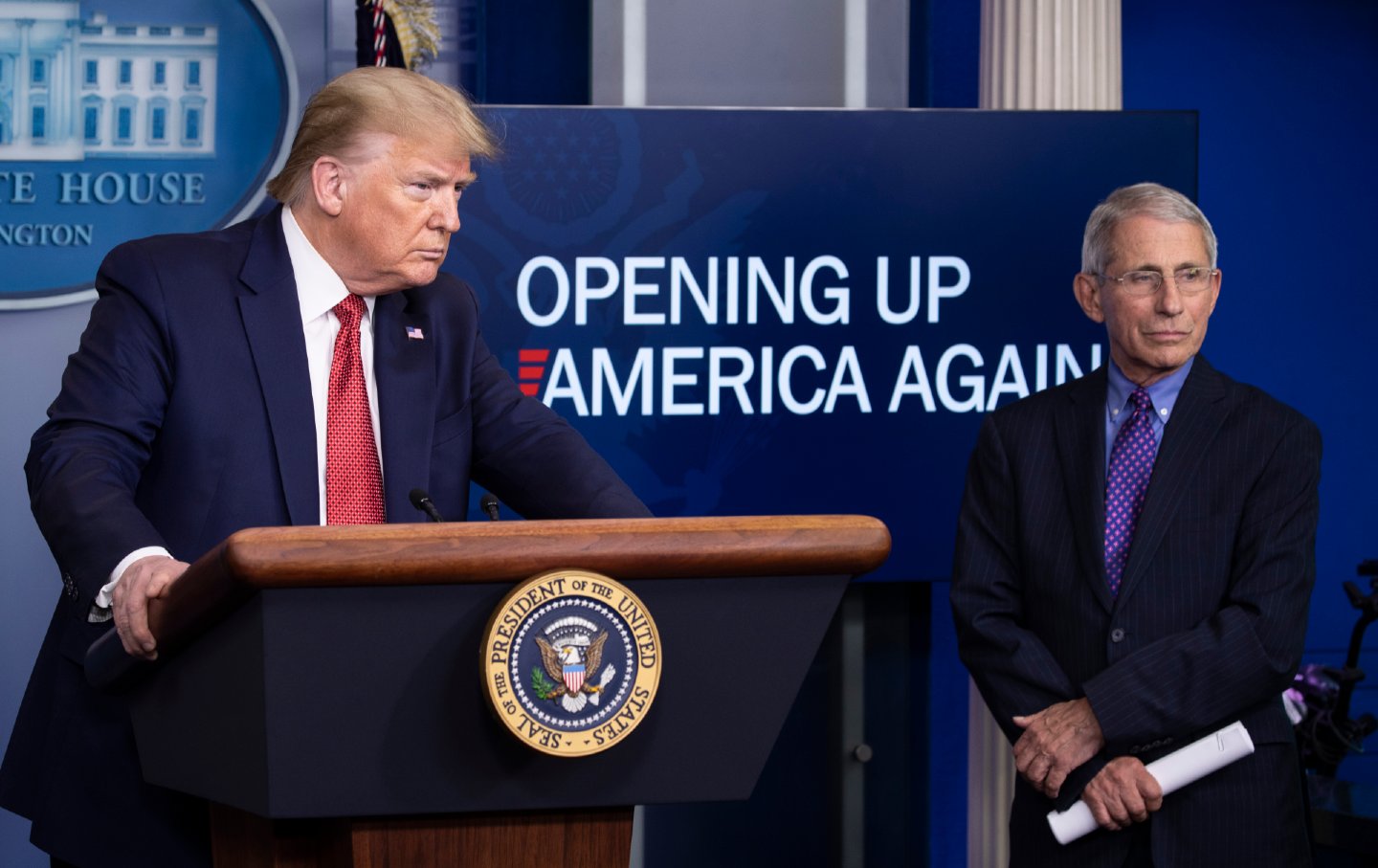
Over a critical period beginning in mid-April, President Trump and his team convinced themselves that the outbreak was fading, that they had given state governments all the resources they needed to contain its remaining “embers” and that it was time to ease up on the lockdown.
In doing so, he was ignoring warnings that the numbers would continue to drop only if social distancing was kept in place, rushing instead to restart the economy and tend to his battered re-election hopes.
A sharp pivot soon followed, with consequences that continue to plague the country today as the virus surges anew.
Even as a chorus of state officials and health experts warned that the pandemic was far from under control, Mr. Trump went, in a matter of days, from proclaiming that he alone had the authority to decide when the economy would reopen to pushing that responsibility onto the states. The government issued detailed reopening guidelines, but almost immediately, Mr. Trump began criticizing Democratic governors who did not “liberate” their states.
Mr. Trump’s bet that the crisis would fade away proved wrong. But an examination of the shift in April and its aftermath shows that the approach he embraced was not just a misjudgment. Instead, it was a deliberate strategy that he would stick doggedly to as evidence mounted that, in the absence of strong leadership from the White House, the virus would continue to infect and kill large numbers of Americans.
He and his top aides would openly disdain the scientific research into the disease and the advice of experts on how to contain it, seek to muzzle more authoritative voices like Dr. Anthony S. Fauci and continue to distort reality even as it became clear that his hopes for a rapid rebound in the economy and his electoral prospects were not materializing.
Now, interviews with more than two dozen officials inside the administration and in the states, and a review of emails and documents, reveal previously unreported details about how the White House put the nation on its current course during a fateful period this spring.
·         Key elements of the administration’s strategy were formulated out of sight in Mr. Meadows’s daily meetings, by aides who for the most part had no experience with public health emergencies and were taking their cues from [Trump] the president.
·         Dr. Birx . . . failed to account for a vital variable: how Mr. Trump’s rush to urge a return to normal would help undercut the social distancing and other measures that were holding down the numbers.
·        [Trump] The president quickly came to feel trapped by his own reopening guidelines. States needed declining cases to reopen, or at least a declining rate of positive tests. But more testing meant overall cases were destined to go up, undercutting [Trump's] the president’s push to crank up the economy. The result was to intensify Mr. Trump’s remarkable public campaign against testing, a vivid example of how he often waged war with science and his own administration’s experts and stated policies.
·         Mr. Trump’s bizarre public statements, his refusal to wear a mask and his pressure on states to get their economies going again left governors and other state officials scrambling to deal with a leadership vacuum.
·         Not until early June did White House officials even begin to recognize that their assumptions about the course of the pandemic had proved wrong.
It was the end of March and his initial, 15-day effort to slow the spread of the virus by essentially shutting down the country was expiring in days. Sitting in front of the Resolute Desk in the Oval Office were Drs. Fauci and Birx, along with other top officials. Days earlier, Mr. Trump had said he envisioned the country being “opened up and raring to go” by Easter, but now he was on the verge of announcing that he would keep the country shut down for another 30 days.
“Do you really think we need to do this?” the president asked Dr. Fauci. “Yeah, we really do need to do it,” Dr. Fauci replied, explaining again the federal government’s role in making sure the virus did not explode across the country.
But even as [Trump] the president was acknowledging the need for tough decisions, he and his aides would soon be looking to do the opposite — build a public case that the federal government had completed its job and unshackle the president from ownership of the response.
By mid-April, Mr. Trump had grown publicly impatient with the stay-at-home recommendations he had reluctantly endorsed. Weekly unemployment claims made clear the economy was cratering and polling was showing his campaign bleeding support. Republican governors were agitating to lift the lockdown and the conservative political machinery was mobilizing to oppose what it saw as constraints on individual freedom.
The wind down of the federal government’s response would play out over the next several weeks. The daily briefings with Mr. Trump ended on April 24. The Meadows team started barring Dr. Fauci from making most television appearances, lest he go off message and suggest continued high risk from the virus.
By June the president was regularly making nonsensical statements like, “If we stop testing right now, we’d have very few cases, if any.”
Later, it was clear that states that rushed to reopen before meeting the criteria in the guidelines — like Arizona, Texas and Alabama — would have among the worst surges in new cases.
Dr. Birx’s belief that the United States would mirror Italy turned out to be disastrously wrong. The Italians had been almost entirely compliant with stay-at-home orders and social distancing, squelching new infections to negligible levels before the country slowly reopened. Americans, by contrast, began backing away by late April from what social distancing efforts they had been making, egged on by Mr. Trump.
The real-world consequences of Mr. Trump’s abdication of responsibility rippled across the country.
Other nations had moved aggressively to employ an array of techniques that Mr. Trump never mobilized on a federal level, including national testing strategies and contact tracing to track down and isolate people who had interacted with newly diagnosed patients.
“These things were done in Germany, in Italy, in Greece, Vietnam, in Singapore, in New Zealand and in China,” said Andy Slavitt, a former federal health care official who had been advising the White House.
“They were not secret,” he said. “Not mysterious. And these were not all wealthy countries. They just took accountability for getting it done. But we did not do that here. There was zero chance here that we would ever have been in a situation where we would be dealing with ‘embers.’ ”
By early June, it was clear that the White House had gotten it wrong. . . . . Digging into new data from Dr. Birx, they concluded the virus was in fact spreading with invisible ferocity during the weeks in May when states were opening up with Mr. Trump’s encouragement and many were all but declaring victory.
The number of new cases has now surged far higher than the previous peak of more than 36,000 a day in mid-April. On Thursday, there were more than 75,000 confirmed new cases, a record.
Mr. Trump’s disdain for testing continues to affect the country.
“When we were trying to get people to wear masks, they would point to the president and say, well, not something that we need to do,” he said.
Mr. Suarez expressed similar frustrations with Mr. Trump’s dismissive approach to mask wearing. “People follow leaders,” he said, before rephrasing his remarks. “People follow the people who are supposed to be leaders.”
Trump has thousands of avoidable deaths on his hands.

Tuesday, June 23, 2020

The Troubling Economic Outlook

States are reopening - some with surging cases of Covid-19 - and the American economy appears to have passed its nadir, but the economic future remains troubling. Some industries for now are doing remarkably well - real estate being one of them, at least for those who still have jobs and/or stashed savings that allow them to take advantage of historically low interest rates (I closed a refinance last week where a 15 year mortgage bore an interest rate of 2.25%).   Other sectors of the economy, however, remain bleak as restaurants and retail outlets struggle and the unemployment rate remains in double digits. Disturbingly, the federal government has no plan on how to cure the main factors threatening economic recovery and the Trump/Pence regime appears to want to pretend problems do not exist.  A long piece in The Atlantic looks at the situation and ponders whether America can rise to the challenges it faces or, if instead a long period of economic depression lies ahead.  Here are article highlights:

At least four major factors are terrifying economists and weighing on the recovery: the household fiscal cliff, the great business die-off, the state and local budget shortfall, and the lingering health crisis. Three months ago, the pandemic and ensuing shelter-in-place orders caused mass job loss unlike anything in recent American history. A virtual blizzard settled on top of the country and froze everyone in place. Nearly 40 percent of low-wage workers lost their jobs in March. More than 40 million people lost their jobs in March, April, or May.
Faced with this historic catastrophe, the United States marshaled a historic response: Republicans in the White House and Congress, generally hostile to the notion of economic stimulus for low-income households, came together with Democrats to achieve a $2 trillion rescue package, including a $1,200 onetime payment for most adults and $500 for many children, a radical expansion of the unemployment-insurance system to include gig workers, and a $600-a-week bump to unemployment-insurance payouts. It also created a sweeping small-business rescue plan, covering payroll for companies that kept their employees on the books.
The good: This money kept families afloat—at least for the first, intense months of shelter-in-place. New estimates suggest that the Congressional rescue plan prevented poverty rates from rising, with many jobless workers seeing their incomes increase during lockdown due to the expanded unemployment-insurance payouts. The bad: It left out roughly 15 million people in immigrant families, many of whom were working essential jobs stocking grocery shelves, delivering takeout, and drawing blood in hospitals. And the ugly: The big helicopter drop was a onetime thing, and the unemployment-insurance expansion was time-limited. Congress designed Uncle Sam’s help to dry up this summer, with the unemployment rate still in the double digits. Democrats and Republicans are negotiating another stimulus bill, but concerns about surging budget deficits are complicating the talks.
That means households are headed for a cliff. But not everyone will be affected by it equally. Rich workers, the ones with do-anywhere office jobs, have remained relatively untouched by job and earnings losses thus far. Wealthy families have seen their stock portfolios rebound to close to where they were in the winter. But poor workers—disproportionately black and Latino workers, as well as younger workers—have borne the heaviest employment and earnings losses. They entered this recession with no wealth cushion, many saddled with heavy rents and heavy debts. Income and job losses for them translate into a loss of demand economy-wide, absent federal intervention.
If and when that federal intervention dries up, millions of families just keeping their head above water will sink, as lost jobs and canceled hours force them to stop paying their rent and go into arrears on their debt payments. Hunger, homelessness, forgotten plans to attend community college, babies growing up in stressed households: These are the stakes. The CBO forecasts that every quarter through the end of 2021, American consumers will buy $300 billion to $370 billion less than they would have if the pandemic had never happened.
This steep decline in consumer spending will hasten mass business failure, the second factor weighing on the economy. The Paycheck Protection Program and other federal initiatives shoved an oxygen mask on many companies. But the PPP was scaled to help businesses through a short, intense disruption, though the economy is expected to remain sluggish for months and months. Moreover, the PPP did not include much aid for businesses with significant nonpayroll overhead costs, such as restaurants in high-cost cities. This means that many businesses will fail, if customers fail to return. Already, an estimated 100,000 small companies have shut permanently.
On top of that, numerous businesses—airlines, restaurants, live-events businesses, hotels, private schools, oil and gas companies—face severe and stubborn slumps. Students are not willing to pay as much for online learning as in-person instruction. Companies are not financing travel to conferences and sales meetings. Concerts and festivals are not expected to restart until scientists develop a coronavirus vaccine. Economists expect that 42 percent of people recently let go will not return to their former employers.
A third factor behind a possible second Great Depression is the budget crisis facing states and cities. The federal government does not have to balance its ledger year to year, and perpetually spends more than it takes in. Yet every state but Vermont and most cities and towns are required to remain in the black. Right now, sales taxes, real-estate-transfer taxes, income taxes, fines and fees—they are all collapsing, leaving local governments with a budget gap expected to total $1 trillion next year. Without help from Washington, this will necessarily mean massive service cuts and job losses: namely, an estimated 5.3 million job losses.
The shrinking of the government at the state and local level has already started, as Congress dithers on providing fiscal aid. Michigan is facing a $3 billion budget gap this year and a $4 billion one next year: It has instituted a work-share plan, asking two in three state employees to accept a partial furlough. In New Jersey, the government has asked 100,000 public workers to move to abbreviated schedules. Schools have already let go more workers than they did during the Great Recession, with nearly 500,000 positions lost.
A fiscal cliff for families. Rolling business failures. A budget crisis for state and local governments. Each is bad enough. Each might be a big-enough headwind to tip the economy into recession alone. But the last element is the true alpha and omega of our worst-case scenario: the catastrophe of the American government’s management of the novel-coronavirus pandemic.
Like many of its peer nations, the United States imposed shelter-in-place and social-distancing measures to curtail the spread of the virus. But it did so late, leading to the unnecessary deaths of tens of thousands of people. And it wasted the time these extreme measures bought, because the government failed to set up a strong test-and-trace regime. Countries including South Korea and New Zealand crushed the coronavirus. The United States merely patted it down. The country is reopening with the disease still spreading and maiming and killing, as several states experience a dramatic surge in caseloads.
The botched response means millions of parents will need to continue watching their young children instead of committing to work. It means thousands of offices will remain on work-from-home orders, hurting the commercial operations built to support them. It means Americans will avoid doctors’ offices, bars, and sporting events, staying at home and starving local businesses of revenue. It means localities might end up having to return to extreme social-distancing measures over the summer and fall. And it means fear and mistrust: depressed consumer confidence, ruined faith in government, and concerns about the economy’s ability to recover.
The Trump administration has repeatedly argued that there is a trade-off between the country’s economic health and its public health. But economists and physicians have repeatedly argued that that is untrue: Ending the pandemic would have been the single best thing the federal government could have done to preserve the country’s wealth, health, and economic functioning. The Trump administration, in its hubris, obstinacy, and incompetence, failed to do it.
All four of these factors, and the many others hurting families and killing Americans, are amenable to policy solutions. Congress could extend unemployment insurance, offer new help to flailing businesses, send monthly cash grants to poor families, offer fiscal relief to the states, and implement a nationwide test-and-trace program. The collapse is over. The rebound is under way. But a terrifying future awaits us, one that does not have to come to pass.

Sunday, May 17, 2020

Like Trump, Iran’s Clerics Have Bungled Their Coronavirus Response

When one is motivated by a thirst for power, ideology and an indifference for others, responding to a pandemic will be a problem, especially when the ideology is based on ignorance embracing religious doctrine.  Leave out the religious motivations and America has seen its repose to Covid-19 bungled by the malignant narcissist in the White House.  In Iran the bungled response has been orchestrated by Islamic extremist clerics who embrace a medieval form of Islam that puts reactionary religious doctrine above all else.  The incompetence of the response is not being lost on the Iranian people, many of whom are highly educated and are chaffing under the theocratic rule of clerics who ought to be relegated to some back water mosque in the hinterland of the country.  A piece in the Washington Post looks at Iran's bungled pandemic response which should remind America's the science, not religion should determine how a response to a medical catastrophe is managed.  Religion should have absolutely no role in civilian government.  Here are article highlights:
The Iranian cartoon [see above image] shows two traditional healers, including a turbaned cleric, preparing to treat a coronavirus patient on all fours with beakers of camel urine and violet leaf oil, remedies hailed by some clergymen as surefire cures for covid-19.
On the wall hangs a picture of Iran's supreme leader, Ayatollah Ali Khamenei, donning a nurse's cap and putting a finger to his lips, signaling critics to remain silent.
The sketch was posted last month on the Telegram channel of a mainstream news outlet, the Iranian Labor News Agency, before being swiftly taken down.
Its appearance, however brief, represented a rare criticism of Iran’s ruling religious establishment by the media and came amid a wider outcry among Iranians over the role played by the Shiite Muslim clergy during the pandemic.
Since Iran’s outbreak first erupted in the holy city of Qom, religious leaders have resisted calls for quarantines, protested orders to close shrines, cast the coronavirus as an American conspiracy, and promoted traditional or Islamic medicine as a panacea for covid-19, the disease it causes. Their actions have angered senior health officials and stoked long-existing doubts within the Iranian population about whether the clergy are fit to rule.
In Iran, a Shiite theocracy, clerics preside over and participate in all matters of the state. But their botched response to the pandemic may be weakening the clergy’s political stature, at a time when its influence was already under pressure, political analysts say.
As the religious elite fumbled and deaths from the virus mounted — Iran has now reported nearly 7,000 deaths and more than 118,000 infections — the country’s powerful security services have stepped in to conduct disease surveillance, disinfect public spaces and even oversee victims’ burials, a role long reserved for civilian authorities and Shiite clerics.
It’s a dynamic with implications for Iran’s political future, as the battle heats up to succeed Khamenei and a more modern middle class grows tired of theocratic government.
“The clergy’s apparent resistance to the state’s virus control mandates will likely be marked as a point of no return for public mistrust of clerics and suspicion about their ability to serve as rational authorities in the political or social sphere,” Mehdi Khalaji, a fellow at the Washington Institute for Near East Policy, wrote in a recent policy analysis. . . . . [T]he clerics’ “spectacular failure” to respond adequately to the outbreak “will make power players less interested in seeking ideological or political support from the clergy post-Khamenei.”
“They could have repaired their image by helping people or giving emotional support” to victims, Mohammad said of the clerics. “But they ruined it further by weighing in on things they don’t know about, such as medicine.”
The cartoon depicting the huckster healers appeared to hit a nerve with the clerical-run government. While the artist, Reza Aghili, lives in exile in Turkey beyond the reach of authorities, the news director of ILNA and the manager of its Telegram channel were arrested late last month for allegedly insulting “Islam’s sacred principles” and religious leaders, according to the Paris-based Reporters Without Borders, a press freedom watchdog group.
“In my opinion,” Aghili said in an interview, “not only the clergy’s popularity but Islam’s popularity in general is the lowest it has ever been.”
“I think that the Revolutionary Guard is winning the people’s trust, while the clergy has been losing it,” Amir, 30, said. He also spoke on the condition of using only his first name to comment freely about the security forces. “The older generation is angry at the clerics and will curse them,” he said. “While the younger generation just makes jokes at their expense.”
Mahshid, a 33-year-old market researcher in Tehran who spoke on the condition that her full name would not be used so she could comment critically without fear of reprisal, had nothing good to say about the clerics. “I think that the clergy is entirely irrelevant to society in Iran today,” she said.
Grand Ayatollah Yusuf Saanei, a former member of Iran’s powerful Guardian Council, is among those who reject the clergy’s involvement in political affairs.
In an interview via Telegram, Saanei, who is based in Qom, said those who have promoted alternative therapies and rejected public health guidance are part of “an inept group who try to cling to sharia” or Islamic law.


An increasingly educated population is increasingly at odds with a version of Islam than celebrates ignorance and ignores objective reality.  The result will likely be similar to what we are witnessing in the USA - the younger generations will walk away from religion entirely and with good reason. 

Thursday, May 14, 2020

Pandemic and Economic Collapse Slam Trump Across Rust Belt


Some Donald Trump supporters are so invested in their racism and hatred of "liberals" that they will likely never open their eyes to the reality that Trump's tariff wars and tax cuts for the very wealthy and regulation cuts to big business are the real source of their worsening personal financial situations.  Then there are evangelicals so obsessed with Trump's promises of special rights that place them above the law and grant them a license to discriminate that they seem unable to grasp the financial ruin Trump has ushered in for them.  Now, however, the covid-19 pandemic and the related economic collapse may wake some of them up, especially in hard hit rust belt states that collectively gave Trump a 70,000 vote margin and an Electoral College victory.  A piece in Politico looks at Trump's adverse current situation in these same rust belt states and how November will be a referendum on Trump's policies and failures to handle the pandemic crisis.  Here are highlights:

The Industrial Midwest was always going to be a battleground in November.
The region is now becoming a new frontline for Americans’ lives and livelihoods as coronavirus hotspots proliferate and jobless rates spiral. The confluence of a ferocious pandemic, deepening economic turmoil and rising political tensions is more pronounced here than anywhere else in the country. And it sets the stage for a combustible campaign season that is testing President Donald Trump’s efforts to move on and insulate himself from the crisis—and Joe Biden’s ability to blame him for the fallout.
On Thursday, Trump ventured to a swing county in Pennsylvania, stopping off at a Lehigh Valley medical equipment distributor where he used an official speech to mock “Sleepy Joe,” chastise governors for moving too slowly to reopen and assail the news media as a “disaster” while touting American workers.
“I say it’s the ‘transition to greatness.’ The transition is the third quarter," Trump said. "The fourth quarter is going to do very well. And next year is going to be through the roof.”
The numbers and interviews, however, paint a much grimmer picture. The virus has moved from urban centers like Detroit and Chicago into suburbs and more sparsely populated counties, a trend seen from western Pennsylvania to Minnesota and Iowa. In Wisconsin, Michigan and Pennsylvania—Democrats’ so-called “Blue Wall”—19 counties report coronavirus cases doubling in less than 14 days. Trump won all but one of those counties, by an average of 65 percent.
Democrats are working to ensure that doesn’t happen again by casting his stewardship over the virus and economy as a betrayal.
“There are so many things Trump has done to attack the labor movement to undermine and betray workers,” Sen. Sherrod Brown (D-Ohio) told POLITICO. “And since the coronavirus, he’s done nothing to help the essential workers.”
The region has been devastated by job losses amid pandemic-induced economic shutdowns, in some cases far outpacing the national average in terms of the proportion of their workforces that have applied for unemployment benefits since mid-March.
In Michigan, more than 3 in 10 workers have sought aid in the past two months, according to a POLITICO analysis of Labor Department data. Layoffs and furloughs are also piling up in Pennsylvania, where more than one-fourth of the workforce — or 29.6 percent — has filed an unemployment claim.
The double shock of the virus and financial meltdown has further sharpened partisan divides in the states. Wisconsin and Michigan were home to the highest percentage of people saying their state governments were overreacting to the crisis, according to a survey conducted by researchers at Harvard, Northeastern and Rutgers Universities last month.
Overall, however, the public has remained solidly behind governors who are urging caution, giving them high marks for their performances while their assessments of Trump’s handling of the outbreak sag.
And private surveys conducted by both parties and described to POLITICO show concerns about the virus and health care running ahead of worries over the economy.
Personal protective equipment also remains a problem in many jurisdictions, health officials say, and there are fears of how rural areas with rising caseloads and fewer hospitals will manage future outbreaks, particularly in Michigan, where health officials are starting to see spikes in rural counties.
The economic fallout is expected to be even more long-lasting, casting a shadow over the presidential election. Biden has maintained polling leads over Trump in Wisconsin, Pennsylvania and Michigan, while public polling of Ohio has been scarce.
The emerging economic downturn has also further undermined [Trump's] the president’s promises of reviving American manufacturing, particularly the steel industry.
In some industries — construction and building trades, for example — workers are used to long breaks between jobs, and many have filed for unemployment in the past. But the abrupt nature of the country’s shutdown threw many out of work with little warning, leaving them without time to prepare.
Democrats maintain that the region’s long standing financial difficulties were already being exacerbated by the Trump administration in the three years before the coronavirus struck. They point to tariffs and renewable fuel-standard waivers that impacted corn farmers. Manufacturing, too, has taken big hits. Last year, Pennsylvania saw a drop of 5,700 factory positions, while Michigan was down 5,300 and Wisconsin lost 4,100 jobs.
In her conversations with constituents, Sen. Tammy Baldwin (D-Wis.) says they now recognize Trump’s role in a string of earlier economic setbacks, which have been compounded by the virus.  “They are very clear about what those missteps are and, frankly, they are angry," Baldwin said.
Trump aides and allies are primarily focused on changing the subject from the pandemic and ensuing economic devastation — highlighting Biden’s vulnerabilities in the region rather than defending the administration’s response.
Pennsylvania Democratic Gov. Tom Wolf last month vetoed a GOP-backed bill to reopen more businesses. He's issued stern warnings in recent days that county leaders who defy current state orders will lose out on funding.
“Even though we are seeing a positive trend in our Covid-19 cases, we know that we’re far from done with this,” said Benjamin Weston, director of medical services for the Milwaukee County Office of Emergency Management, who added that the county will continue dealing with the coronavirus and continued outbreaks and surges until a vaccine is, hopefully, available sometime next year.
Democrats need to relentlessly hammer Trump for his trade wars, war against unions and the working class and utter malfeasance in the federal government covid-19 response.

Beach Closures Could Spell Trouble for Virginia Beach’s Merchants

Virginia Beach boardwalk.
Memorial Day weekend marks the traditional beginning of the summer tourism season in Virginia Beach which is critical to the economic survival of many hotels, restaurants, and tourism related businesses, many of which even have the loan repayment and/or rent schedules loaded into the summer months since revenues fall so sharply once fall and winter arrive.  With a number of businesses reopening tomorrow under restrictions (the husband's salon will reopen on Tuesday with major restrictions on operations), Virginia's beaches remain closed and Virginia Beach tourism  related businesses are frantic about the impact.  A piece in the Washington Post looks at the situation and the pressure on Governor Northam to allow the beaches to open - I have had client calls since it is known that the husband and I know the governor - in what may be a catch-22 situation.  While the City and business owners want to open with restrictions, the big questions are (i) whether or not tourists would comply with social distancing - probably not, in my view - and (ii) will tourists from outside the region visit and bring the virus to Virginia Beach which so far has had far less cases that parts of the state from which tourists will likely come.  Here are article highlights:
Electricians wearing masks bustled around developer Bruce Thompson on the 23rd floor of his new hotel, its multimillion-dollar views of the oceanfront marred by one flaw: no people on the beach.
The coronavirus pandemic is wreaking havoc on businesses everywhere, but as most of the state prepares to start loosening restrictions on Friday, merchants in Virginia Beach are feeling left out.
Gov. Ralph Northam decided not to include beaches in his first phase of reopening, keeping the sand closed to everything but solitary exercise and fishing. With Memorial Day less than two weeks away, that spells trouble for all resort-city businesses, from hotels to the three-for-$10 T-shirt shops, henna tattoo parlors andpirate-themed minigolf courses on Atlantic and Pacific avenues.
“We’re in a really bad situation,” said Thompson, a major political donor who served on a panel of business leaders advising Northam (D) about ways to reopen the state’s economy. He said he was outraged when the beach wasn’t part of the reopening plan unveiled last week.
“I talked to the governor almost every day until last Friday,” Thompson said this week. “On Friday night, I asked him what the hell happened, and we haven’t had a lot of conversation since then.”
City officials are working with the state to put together a plan to get people back onto the sand by Memorial Day weekend. They feel caught in the middle, literally, as Ocean City, Md., partially reopened earlier this month and the Outer Banks of North Carolina prepares to welcome visitors this weekend.
Memorial Day is not off the table to have a phased-in reopening, but it’s got to be driven by the health data,” Northam’s chief of staff, Clark Mercer, said in an interview.
The pandemic has not hit Virginia Beach as severely as some other parts of the state, illustrating the challenge Northam faces as he tries to chart a consistent path out of the crisis. The city had reported 519 cases and 18 deaths as of Wednesday — a fraction of the toll in Prince William County in Northern Virginia, which has a similar population but 3,181 cases and 65 fatalities.
Yet the economic impact of the shutdown has hammered oceanfront tourism. Virginia Beach has canceled more than 500 licensed events in the past two months, officials said, from weddings to sports tournaments to Pharrell Williams’s “Something in the Water” music festival that was expected to draw 65,000 attendees.
The city has submitted a plan to the state for managing a reopened oceanfront, including a staff of “safety ambassadors” to break up large groups (in a friendly way), massive cleaning protocols and law enforcement patrols that would include drones and all-terrain vehicles.
Deputy City Manager Ronald H. Williams Jr. said employees are being hired and trained and could have been ready to go by this weekend.
“That was definitely a goal for the city,” Williams said. Now he’s working daily with state officials to find “what would give them the comfort level for a safe operating environment” by Memorial Day weekend, he said.
Virginia Beach is also a potential political flash point, a wealthy area with a large population of active-duty and retired military members that traditionally leaned red. Democrats have made gains there since President Trump was elected in 2016 but by extremely thin margins.
Northam has insisted that he won’t be swayed by political or economic arguments in deciding the state’s timetable. But Virginia Beach business owners say the damage there is becoming too great to ignore.
“It’s just kind of ghostly,” said Russell Lyons, walking past an empty hotel swimming pool, waterfalls silent and artificial rocks streaked and bare. Lyons’s family owns seven hotels in Virginia Beach, and he serves as president of the local hotels association.
The scariest part, he said, is the timing of the shutdown. Tourism is highly cyclical in Virginia Beach; most hotels operate in the red during winter months, taking out lines of credit to cover expenses, he said. They pay off loans as business ramps up during spring, then bank profits between June and mid-September.
But this year, occupancy has cratered since the state of emergency went into effect in mid-March. His family’s hotels are averaging less than 20 percent capacity. At times over the past few weeks, some got as low as a single occupant.
“We’ve had more staff than guests,” he said.
Trouble might hit in the fall, when owners can’t pay their debt and have to sell out. “It’s terrifying,” Lyons said.
Restaurants face a similar predicament. Rockafeller’s has been in business for 31 years in a waterfront neighborhood south of the oceanfront, fishing and pleasure boats lining the creek outside its plate-glass windows. Owner B.J. Baumann said she had to furlough employees who have been with her from the beginning.
With Northam expected to roll back some restrictions on Friday, Baumann has brought back half the staff to freshen up paint and stain the floors in anticipation of reopening for half-capacity, outdoor-only dining. But until the beaches reopen and tourists come back, she has no idea whether the restaurant will survive.
Farther north, no one has more at stake than Thompson, who had planned to open his $125 million Marriott a month ago. With its $7.5 million, 23rd-floor restaurant modeled after venues in Miami and Los Angeles, the tower anchors a vast beachfront complex that includes homes and condos and is only partly complete.
Now, Thompson said, he has had to lay off 400 workers, had more than 80 weddings cancel and watched condo buyers back out.
“We’re in a really bad situation. We don’t have our beach,” he said, noting that the mortgage payment on the new tower is $625,000 per month. If retailers are allowed to reopen, he said, the 28-mile-long, 100-foot-wide beach at the foot of his hotel should be able to do the same.


Monday, May 11, 2020

Why the GOP May Lose Everything

All of these Republicans need to be forced into retirement.
I try to not get overly optimistic, but the 2020 elections have the possibility of  dealing the Republican Party and Donald Trump a horrific defeat and loss of control of both houses of Congress and the White House.  If it comes to pass, it will be most deserved and a repudiation of an agenda that has benefited the very wealthy and in the final analysis little or nothing to the vast majority of Americans. Indeed, the entire GOP game plan has been to use racism and religious extremism to dupe working class and middle class Americans to vote against their own best interests. The gambit worked in 2016, but signs indicate that 2020 may prove to be a different ball game, especially with the coronavirus pandemics underscoring the need for the very programs and policies the GOP wants to destroy. A column in the Washington Post looks at the rapidly changing outlook for the GOP come December.  If the economy continues to suffer and there is a second wave of the virus, things could get even worse for Republicans - and deservedly so.  Here are excerpts:
Montana Gov. Steve Bullock (D) says that when he first announced he would run for the U.S. Senate, he “didn’t know what Montana and the country was going to look like in the short period thereafter.” With the covid-19 crisis, all his time has been taken up by being a governor, not a candidate. So far, that has only helped him in his campaign to unseat Republican Sen. Steve Daines.
In Maine, House Speaker Sara Gideon, a Democrat seeking to end the long career of Republican Sen. Susan Collins, says the pandemic has “laid bare the inequities that already existed” and underscored the need for a “vision of what it means to work together and for each other instead of trying to sow divisiveness.” This brings home Gideon’s case against Collins’s willingness to ally with President Trump and Senate Majority Leader Mitch McConnell (R-Ky.), two of the most divisive figures in American politics.
Colorado’s former governor John Hickenlooper, a Democrat with a good chance of ousting incumbent Republican Sen. Cory Gardner, expresses a sense of gravity about this campaign that he never felt in his races for mayor of Denver or governor.
And Democrat Cal Cunningham, a veteran of Iraq and Afghanistan who is facing incumbent Republican Sen. Thom Tillis (N.C.), says that many North Carolinians today feel “an urgency that did not exist prior to March of this year” about “health coverage . . . about jobs, the economy.”
Issues that were once “percolating for many” are now “personal for everyone.”
If Bullock, Gideon, Hickenlooper and Cunningham all win, Democrats will likely take over the U.S. Senate and end McConnell’s days as majority leader.
And they are not the only challengers with a decent shot at Republican seats. In Arizona, Democrat Mark Kelly has been running ahead of Republican Sen. Martha McSally, and Republicans face vulnerabilities in Iowa, Georgia, possibly Kansas and perhaps even in South Carolina. McConnell, though favored, faces a spirited opponent in Amy McGrath, a former Marine fighter pilot. Only one Democratic incumbent, Sen. Doug Jones of Alabama, is an underdog. Having disastrously bungled the pandemic, Trump is not only falling well behind former vice president Joe Biden in the polls; he could also be creating a tidal wave that would give Democrats unified control of the federal government’s elected branches.
Hickenlooper and Gideon are running in states Trump lost in 2016, and the president’s increasing vulnerability in Arizona and North Carolina could open the way for Kelly and Cunningham.
My conversations with four of the top Senate challengers suggested that the coronavirus crisis has reinforced core arguments that helped the Democrats win the House in 2018, particularly around access to health care, while also increasing the saliency of inequality — in both economic and health outcomes — as a mainstream concern.
At the same time, Trump’s brutal belligerence has turned Democratic candidates into missionaries of concord. This allows them to be implicitly critical of the president and reach out to his one-time supporters at the same time.
If the GOP does lose everything, it will be because the Trumpian circus-plus-horror-show is entirely off-key for an electorate that has so much to be serious about.


Monday, May 04, 2020

Models Shift to Predict Dramatically More U.S. Covid-19 Deaths

Virginia's governor Ralph Northam - the only US governor who is a physician - just extended Virginia's business shutdown for another week as reported by the Virginian Pilot. Whether the May 15, 2020, opening date gets further delayed will depend on whether Virginia sees 14 days of improvement.  Meanwhile, a number of GOP lead states are opening up businesses and playing a game of Russian roulette with their citizens' lives.  New reports on models predicting the Covid- 19 death rate suggest that  Northam may be taking the wiser choice given the new predictions that 134,000 Americans will die of Covid-19 between now and August (243,000 if one includes the upper end of the margin of error).  A Johns Hpkins report predicted 3,000 deaths per day by June (that would be a daily death rate not too much less than the 9-11 fatality number).   It goes without saying that Trump is cheering on governors reopening their states focusing as always only on himself and what a weak economy could mean for his re-election hopes. The Washington Post looks at the disturbing model predictions.  Here are excerpts:
A key model of the coronavirus pandemic favored by the White House nearly doubled its prediction Monday for how many people will die from the virus in the U.S. by August – primarily because states are reopening too soon.
The Institute for Health Metrics and Evaluation at the University of Washington’s School of Medicine is now projecting 134,000 coronavirus-related fatalities, up from a previous prediction of 72,000. Factoring in the scientists’ margin of error, the new prediction ranges from 95,000 to 243,000.
Dr. Christopher Murray, the director of IHME, told reporters on a call Monday the primary reason for the increase is many states’ “premature relaxation of social distancing.”
For the first time, Murray explained, the model is factoring in data from four different cell phone providers showing a major uptick in Americans’ going out in public. This rise of mobility in the last week or 10 days is likely leading to an increase in transmission, he said.
Even with its latest forecast, the University of Washington model is still far more optimistic than a model developed by Johns Hopkins for CDC predicting as many as 3,000 deaths per day by June.
In a statement on Monday evening, the Johns Hopkins Bloomberg School of Public Health called the leaked models “preliminary analyses,“ saying that they had been provided to the Federal Emergency Management Agency to help in scenario planning, were not a final version and were not meant to be used or presented as forecasts.
Still, the statement added, “the information illustrates that there are some scenarios, including the premature relaxation of social distancing, that are likely to cause significant increases in the number of COVID-19 cases and deaths in the United States.“
In a statement to reporters, White House deputy press secretary Judd Deere said that the internal report obtained by The New York Times was “not a White House document” and hadn’t been presented to the coronavirus task force.
The CDC document projects north of 175,000 new cases of Covid-19, the respiratory illness caused by the novel coronavirus, each day. That’s up from about 25,000 new cases per day last week and more than four times the peak of about 37,000 new cases per day.
The alarming modeling comes as some states are already beginning to put parts of the White House’s phased reopening plan into motion despite concerns that the administration’s guidelines for doing so have not yet been met. It also underscores fears that moving too fast to relax strict social-distancing restrictions could fuel a dangerous second wave of infections.
The CDC document found some reason for optimism, noting that nationwide, the trajectory of new illnesses in "multiple counties, including hard hit areas in Louisiana and in the New York City region" has continued to decrease, and that incidence rates have recently plateaued around Chicago.
Still, it found that there "remains a large number of counties whose burden [of illness] continues to grow or are in an elevated incidence plateau, including in the Great Lakes region, parts of the Southeast, Northeast, and around southern California." The document includes a color-coded map of the country with darker spots peppered throughout, and it states that the goal "is to have all communities be represented in the lighter colors, demonstrating little to no disease burden and no increase in trajectory."
Murray also noted that the updated University of Washington model also now takes into account the ramping up of testing in most states, as well as warming temperatures heading into late spring and early summer. But he cautioned that the impact of temperature on coronavirus transmission is not yet fully understood, and likely will not be for several more months.
For now, IHME is assuming that every degree Celsius the temperature goes up will lead to a 2 percent decline in transmission. “Are we sure about that? No,” he said.