Showing posts with label Iran. Show all posts

Sunday, May 17, 2020

Like Trump, Iran’s Clerics Have Bungled Their Coronavirus Response

When one is motivated by a thirst for power, ideology and an indifference for others, responding to a pandemic will be a problem, especially when the ideology is based on ignorance embracing religious doctrine.  Leave out the religious motivations and America has seen its repose to Covid-19 bungled by the malignant narcissist in the White House.  In Iran the bungled response has been orchestrated by Islamic extremist clerics who embrace a medieval form of Islam that puts reactionary religious doctrine above all else.  The incompetence of the response is not being lost on the Iranian people, many of whom are highly educated and are chaffing under the theocratic rule of clerics who ought to be relegated to some back water mosque in the hinterland of the country.  A piece in the Washington Post looks at Iran's bungled pandemic response which should remind America's the science, not religion should determine how a response to a medical catastrophe is managed.  Religion should have absolutely no role in civilian government.  Here are article highlights:
The Iranian cartoon [see above image] shows two traditional healers, including a turbaned cleric, preparing to treat a coronavirus patient on all fours with beakers of camel urine and violet leaf oil, remedies hailed by some clergymen as surefire cures for covid-19.
On the wall hangs a picture of Iran's supreme leader, Ayatollah Ali Khamenei, donning a nurse's cap and putting a finger to his lips, signaling critics to remain silent.
The sketch was posted last month on the Telegram channel of a mainstream news outlet, the Iranian Labor News Agency, before being swiftly taken down.
Its appearance, however brief, represented a rare criticism of Iran’s ruling religious establishment by the media and came amid a wider outcry among Iranians over the role played by the Shiite Muslim clergy during the pandemic.
Since Iran’s outbreak first erupted in the holy city of Qom, religious leaders have resisted calls for quarantines, protested orders to close shrines, cast the coronavirus as an American conspiracy, and promoted traditional or Islamic medicine as a panacea for covid-19, the disease it causes. Their actions have angered senior health officials and stoked long-existing doubts within the Iranian population about whether the clergy are fit to rule.
In Iran, a Shiite theocracy, clerics preside over and participate in all matters of the state. But their botched response to the pandemic may be weakening the clergy’s political stature, at a time when its influence was already under pressure, political analysts say.
As the religious elite fumbled and deaths from the virus mounted — Iran has now reported nearly 7,000 deaths and more than 118,000 infections — the country’s powerful security services have stepped in to conduct disease surveillance, disinfect public spaces and even oversee victims’ burials, a role long reserved for civilian authorities and Shiite clerics.
It’s a dynamic with implications for Iran’s political future, as the battle heats up to succeed Khamenei and a more modern middle class grows tired of theocratic government.
“The clergy’s apparent resistance to the state’s virus control mandates will likely be marked as a point of no return for public mistrust of clerics and suspicion about their ability to serve as rational authorities in the political or social sphere,” Mehdi Khalaji, a fellow at the Washington Institute for Near East Policy, wrote in a recent policy analysis. . . . . [T]he clerics’ “spectacular failure” to respond adequately to the outbreak “will make power players less interested in seeking ideological or political support from the clergy post-Khamenei.”
“They could have repaired their image by helping people or giving emotional support” to victims, Mohammad said of the clerics. “But they ruined it further by weighing in on things they don’t know about, such as medicine.”
The cartoon depicting the huckster healers appeared to hit a nerve with the clerical-run government. While the artist, Reza Aghili, lives in exile in Turkey beyond the reach of authorities, the news director of ILNA and the manager of its Telegram channel were arrested late last month for allegedly insulting “Islam’s sacred principles” and religious leaders, according to the Paris-based Reporters Without Borders, a press freedom watchdog group.
“In my opinion,” Aghili said in an interview, “not only the clergy’s popularity but Islam’s popularity in general is the lowest it has ever been.”
“I think that the Revolutionary Guard is winning the people’s trust, while the clergy has been losing it,” Amir, 30, said. He also spoke on the condition of using only his first name to comment freely about the security forces. “The older generation is angry at the clerics and will curse them,” he said. “While the younger generation just makes jokes at their expense.”
Mahshid, a 33-year-old market researcher in Tehran who spoke on the condition that her full name would not be used so she could comment critically without fear of reprisal, had nothing good to say about the clerics. “I think that the clergy is entirely irrelevant to society in Iran today,” she said.
Grand Ayatollah Yusuf Saanei, a former member of Iran’s powerful Guardian Council, is among those who reject the clergy’s involvement in political affairs.
In an interview via Telegram, Saanei, who is based in Qom, said those who have promoted alternative therapies and rejected public health guidance are part of “an inept group who try to cling to sharia” or Islamic law.


An increasingly educated population is increasingly at odds with a version of Islam than celebrates ignorance and ignores objective reality.  The result will likely be similar to what we are witnessing in the USA - the younger generations will walk away from religion entirely and with good reason. 

Tuesday, February 25, 2020

CDC: Officials Warn Coronavirus Outbreaks Likely in the U.S.

A woman in Milan, Italy where a coronavirus outbreak has occurred.
While Donald Trump and his sycophants are ignoring the advise of experts and saying that the coronavirus has been contained and that no outbreaks are likely in the USA, medical experts are telling a very different story.  Indeed, some are saying that Americans need to be prepared for major disruptions with schools closed, businesses shut down, and potentially areas quarantined.  From its huge drop over the last two days - roughly 1900 points - the stock market is believing the medical experts and not the liar-in-chief in the White House.  Just as disturbing is the reality that the Trump/Pence regime has been cutting funding to the CDC and eliminating health officials who speak the truth based on scientific fact and knowledge during the regime's misrule.  A piece in the New York Times looks at what medical experts are saying in contrast to the lies of the Trump/Pence regime.  Here are article excerpts:
Federal health officials starkly warned on Tuesday that the new coronavirus will almost certainly spread in the United States, and that hospitals, businesses and schools should begin making preparations.
“It’s not so much of a question of if this will happen anymore but rather more of a question of exactly when this will happen,” Dr. Nancy Messonnier, director of the National Center for Immunization and Respiratory Diseases, said in a news briefing.
She said that cities and towns should plan for “social distancing measures,” like dividing school classes into smaller groups of students or closing schools altogether. Meetings and conferences may have to be canceled, she said. Businesses should arrange for employees to work from home.
“We are asking the American public to work with us to prepare, in the expectation that this could be bad,” Dr. Messonnier said.
Shortly after the news conference, stock markets plummeted for the second day as investors dumped stocks and turned to the safety of government bonds. The S&P 500 fell by more than 3 percent, following a 3.4 percent slide on Monday — the worst day for the American markets since February 2018.
In contrast to his own health officials, President Trump, traveling in India, played down the threat, saying, “You may ask about the coronavirus, which is very well under control in our country.”
[G]iven the outbreaks in more than two dozen countries, officials at the C.D.C. seemed convinced that the virus’s spread in the United States was inevitable, although they did not know whether the impact would be mild or severe.
“We cannot hermetically seal off the United States to a virus,” Alex M. Azar II, the secretary of health and human services, told a Senate panel on Tuesday. “And we need to be realistic about that.”
Globally, public health officials are confronting a multipronged threat. China’s battle to contain the epidemic has shown signs of success, with a plunge in the rate of new infections.
But this has been overshadowed by new clusters of infections in Iran, South Korea and Italy. The emergence of these new hubs underscored the lack of a coordinated global strategy to combat the coronavirus, which has infected nearly 80,000 people in 37 countries, causing at least 2,600 deaths.
In Iran, a spike in coronavirus infections — including to the top health official in charge of fighting the disease — has prompted fears the contagion may spread throughout the Middle East. In Italy, one of Europe’s largest economies, officials are struggling to prevent the epidemic from paralyzing the commercial center of Milan.
[L]awmakers from both the Democratic and the Republican parties grilled Mr. Azar and other members of the administration at the Senate hearing, apparently unconvinced that the Trump administration was prepared for the outbreak that the C.D.C. is forecasting.
Senator John Kennedy, Republican of Louisiana, grew exasperated when the acting secretary of the Department of Homeland Security, Chad F. Wolf, could not say how many people were expected to become infected.
Senator Patty Murray, Democrat of Washington, asked the health secretary whether he thought the United States currently had enough health masks in stock.
Hospital officials were assuming the efforts to contain the virus would delay, not prevent, a pandemic — sustained transmission of the coronavirus on more than one continent.
“We are really staging it, from a minor issue of small numbers of patients, to a full-blown community spread,” said Dr. Mark Jarrett, the chief quality officer at Northwell Health, which operates 23 hospitals on Long Island and elsewhere in New York.
Hospital administrators nationwide anticipate a wave of patients that could strain their intensive care units and isolation rooms. Many are starting to conserve medical supplies, including specialized masks and ventilators.
W.H.O. officials have also warned that the world is unprepared for a leap in infections, which could overwhelm medical resources in many countries. They also cautioned that new cases could suddenly resurge in China, as the government struggles to get people back to work.
And there are persistent doubts about the accuracy of infection figures reported by the Chinese government, raising the possibility that the true magnitude of the outbreak remains under reported.   

Sunday, January 26, 2020

Mike Pompeo: A Case Study in "Evangelical Christian" Hypocrisy

Perhaps I am a cynic when it comes to supposed Christians once they enter the realm of politics, especially evangelicals who make great show of wearing their religion on their sleeves even as they grasps for power and throw the gospel message to the gutter. From my experience, whether elected to political office or running allegedly "family values" organizations, no one lies more or is more willing to engage in the personal destruction of others.  Indeed, the Pharisees of the Bible appear down right virtuous and and suffused with kindness in comparison.  Which brings me to loudly self-proclaimed "Christian" Mike Pompeo who could be the poster child for evangelical Christian hypocrisy (Franklin Graham, Jerry Falwell, Jr., white supremacist Tony Perkins of FRC are other strong contenders).  In his complete self-prostitution to Donald Trump, Pompeo seemingly has no limit to how low he will go and to the lies he will disseminate.  A column in the Washington Post looks at Pompeo's moral bankruptcy.  Here are excerpts: 
I would like to apologize to Rex Tillerson.  I’m not apologizing for writing that he was “quite possibly the most ineffectual secretary of state since America’s rise to global prominence in 1898.”. . . . But I am apologizing for underestimating his virtues. Now that his successor as secretary of state, Mike Pompeo, is verbally assaulting a reporter and refusing to defend a career ambassador from character assassination — and possibly worse — I miss ol’ Rex and his Boy Scout ethos.
Tillerson was the only person with the guts to chew out Trump when the president denounced senior generals as a “bunch of dopes and babies” in a Pentagon meeting. “No, that’s just wrong,” Tillerson is quoted as saying. “Mr. President, you’re totally wrong. None of that is true.”
[A] former senior White House official described Pompeo as “among the most sycophantic and obsequious people around Trump.” That’s saying something, because Trump is surrounded by more servile courtiers than a medieval monarch.
While Tillerson worked to restrain Trump from leaving the Iran nuclear deal and the Paris climate accord, Pompeo has been nothing but a smirking cheerleader for the president’s most pugnacious instincts. He is, in fact, the mastermind behind a standoff that has left Iran closer to having a nuclear weapon than when Trump took office.
Pompeo’s rise to preeminence has not served either [Trump] the president or the country well. The secretary of state had a front-row seat to Trump’s efforts to blackmail Ukraine into announcing an investigation of Joe Biden — and he did nothing to stop the unethical actions that have now gotten Trump impeached. Pompeo readily cooperated when Trump’s goon squad, led by Rudolph W. Giuliani, decided that Ambassador Marie Yovanovitch had to be ousted so they could carry out what John Bolton called their “drug deal.” Although he later played dumb, Pompeo was a participant in the July 25 phone call in which Trump threatened Yovanovitch (“She’s going to go through some things”) and asked Ukrainian President Volodymyr Zelensky to “do us a favor” by investigating Biden. Pompeo refused to come to Yovanovitch’s defense even after the release of text messages showing that one of Giuliani’s confederates, Robert F. Hyde, claimed to have a team surveilling her and even implied that she might be harmed. On Friday, Mary Louise Kelly, the host of NPR’s “All Things Considered,” asked Pompeo if he owed Yovanovitch an apology. Pompeo didn’t like that question; he preferred to talk about Iran. He claimed (falsely), “I’ve defended every single person on this team,” and ended the interview. Afterward, Kelly reports, Pompeo “shouted at me for about the same amount of time as the interview itself,” dropping several “f-bombs” along the way. She said the secretary of state demanded, “Do you think Americans care about Ukraine?” and had an aide bring a blank map to see if she could point out where it’s located. She says she did. (One wonders if Trump — who reportedly doesn’t know that China and India share a more than 2,000-mile border — could pass the same test.) In any other administration (or, for that matter, any major company), Pompeo would be reprimanded, at the very least, for his abusive behavior. In this administration, his incivility will no doubt win further favor with [Trump] a president who views rudeness as a virtue. Pompeo has become a Trump mini-me who emulates his master in boorishness, bombast, bullying — and dishonesty. Every day that Pompeo stays in office, he makes Tillerson — once seen as the worst secretary of state ever — look better by comparison.

Indeed, Pompeo makes the case as to why evangelical Christians should be barred from public office.  

Tuesday, January 14, 2020

Suleimani Is Dead, Iraq Is in Chaos and ISIS Is Very Happy

America's foreign policy in the Middle East has been a disaster for decades - perhaps back to the 1950's and certainly 1979 when the US failed to support the Shah of Iran - and was only made worse long term by the Iraq War. Now, with Iraq pushing for the exodus of all American troops from its territory and US allies stepping back from counter-terrorism efforts, things will likely go from bad to worse with the big winners being ISIS and Iran with Trump's assassination of Gen. Qassim Suleimani making the situation for American interests less safe. Trump needed a diversion from his impeachment problems and, putting personal interests ahead of long term national interests, we now have arguably a far worse situation.  A column in the New York Times looks at where America now finds itself. Here are highlights:

In 2016, Donald Trump, then a candidate for president, described Barack Obama as the “founder of ISIS.” In the end, it may be Mr. Trump who comes to be known not as the terrorist group’s founder, but as its savior.
The Islamic State has been weakened considerably since its peak in 2015, when it controlled a territory the size of Britain, but the Trump administration’s targeted killing of Maj. Gen. Qassim Suleimani may have poised the group for a comeback. Just as the misguided American invasion of Iraq in 2003 revitalized Al Qaeda, some 17 years later, a return to chaos in the same country may yet do the same for the Islamic State.
Granted, the White House was correct to identify General Suleimani, the leader of Iran’s Quds Force, as an enemy of the United States. . . . But war in the Middle East is nothing if not complex; General Suleimani’s proxies also indirectly served American interests by fighting the Islamic State — to great effect.
Still, contrary to the breathless eulogies to him in Iran, he was not some indispensable hero who single-handedly defeated the Islamic State. Other commanders will fill his shoes, if not in star power then at least in strategic expertise. The real boon for the jihadists will be the second-order effects of his death.
First, and most obviously, American influence in Iraq is now living on borrowed time. One of those killed alongside General Suleimani, Abu Mahdi al-Muhandis, was the deputy commander of the Popular Mobilization Force, a coalition of pro-Iranian militias that nominally form part of the Iraqi armed forces. For many Iraqis, that made the strike an attack against Iraq as well as Iran, and put the Iraqi government, which already has a tense relationship with the United States, in an even tougher bind.
Recognizing the heightened tensions, the 6,000 American troops in the country have switched their focus to defending Americans in Iraq, rather than fighting the Islamic State or training Iraqi forces to do so. American allies including Germany and Britain have begun pulling their own forces from the country, . . .
Second, the chaos threatens Iraq’s stability. Tehran responded to the strike on General Suleimani with missile attacks on two American-run military bases last week. But it’s unlikely this will be the end of Iran’s retaliation. Iranian military strategy is defined by asymmetry — and particularly by the use of militant proxies. Under a screen of plausible deniability, Iran will most likely work to drive the United States out of Iraq.
In this, the Iranians will be brutal. During the American occupation — before the rise of the Islamic State made strange bedfellows of Washington and Tehran — Iranian proxies often exceeded Sunni extremists in terms of the number of casualties they inflicted on American forces. These proxies have lost no time in returning to attacks on American interests.
A conflict between Iranian proxies and the United States will tear at Iraq’s fragile governing structures, creating a power vacuum for the Islamic State to exploit. Iraq already has only a caretaker government. . . . . Iraq’s viability as a state is jeopardized. Add to that the harm to counterterrorism operations brought about by the “pause” in coalition assistance, and you have a combustible mix.
Third, and perhaps worst of all, General Suleimani’s death portends yet more sectarianism in Iraq. The parliamentary vote on Jan. 5 to expel American troops passed on the strength of votes from Shiite lawmakers; members of Parliament representing Iraq’s other main factions, the Kurds and the Sunni Arabs, abstained.
Extremist groups thrive on this kind of division. . . . . Moreover, the Iranian response to General Suleimani’s killing is likely to include an escalation in its conflict with Saudi Arabia, which is framed as a battle between Sunnis and Shiites. Ratcheting up these tensions will create still more openings for Sunni extremists such as the Islamic State.
The Islamic State still has deep pockets, affiliates around the world, and a knack for recruitment. General Suleimani’s death will have its leaders rubbing their hands in anticipation.
The damage is done. Without a major cooling of tensions, a jihadist resurgence might now be all but inevitable.

Friday, January 10, 2020

The Evangelicals Who Pray for War With Iran

Most sane people, be it in America or around the world, are in no rush to see the end of the world. Nor are they eager to see the Middle East explode in war.  The term "sane people," in my view, rules out extreme evangelical Christians who cling to a bizarre reading of the Bible - a book totally composed by unknown authors who lacked any modern knowledge - that makes them want the world and life as we know it to end.  They want the "End Times" to Armageddon to come.   And to make this happen, they need a war in the Middle East involving Israel even though it would mean all but a few members of the Jewish nation perish.  Frighteningly, two such evangelicals are in positions of power that make their lunacy very dangerous: Mike Pence and Mike Pompeo.  Both are in tight communication with some of the most extreme Christian dominionists who, despite occasional disavowals when exposed by the media, want a theocracy in America.  These zealots are anti-LGBT, want women in subordinate roles to men, and would impose their beliefs on all Americans.  A piece in New Republic looks at Pence and Pompeo's disturbing alliances.  Here are excerpts:

Last Friday, a day after Iranian Maj. Gen. Qassem Soleimani and nine others were killed in a U.S. drone strike in Iraq, the Christian Zionist advocacy group Christians United for Israel emailed its millions of supporters to praise President Trump’s move. “This Decisive Action Will Save Countless Lives,” read the subject line, echoing the assessment delivered that morning by Secretary of State Mike Pompeo on Fox and Friends.
Pompeo and Pence reportedly were the top officials pushing Trump to kill Soleimani. They’re also devout evangelicals and major allies of CUFI. This is not a coincidence. While the organization is best known for its unflagging “support” for Israel—that is, for Israel’s expansion of settlements in the occupied West Bank and protracted erasure of the possibility of a future Palestinian state—it has, since its founding in 2006, depicted Iran as an existential threat to Israel.
Televangelist John Hagee launched CUFI in 2006, calling for military action against Iran, then led by President Mahmoud Ahmadinejad, whom Hagee compared to Hitler. At the time, Hagee had been claiming that Iran would soon “have the nuclear capability to make a bomb, a suitcase bomb, a missile head, or anything they want to do with it.” That was untrue, given contemporaneous expert assessments of Iran’s projected nuclear advances. But for Hagee, a more militaristic approach was necessary in order to avert “an American Hiroshima.”
In his 2006 book, Jerusalem Countdown, Hagee imagined an elaborate scenario in which a U.S. or Israeli strike on Iran would trigger an “inferno [that] will explode across the Middle East, plunging the world toward Armageddon.” Faced with scrutiny over his apocalyptic theology, he strained to create a discrete image for his new political organization, insisting that his extensive writings on biblical prophecy about the Rapture and Second Coming were distinct from CUFI’s lobbying agenda. But it was a rocky start for the organization. In 2008, while running for president, John McCain first accepted, then rejected, Hagee’s endorsement. The rebuff was seen as damaging to the political neophyte and a brave stance by McCain against fringe elements within the GOP’s evangelical base. At CUFI’s annual Washington Summit, held just two months later, only three members of Congress attended.
But one of those three members was a certain congressman from Indiana: Pence. He continued to maintain close ties with the organization, and in 2014 CUFI paid for then-Governor Pence and his wife to travel to Israel to celebrate Christmas. With Pence as vice president, Hagee’s star has risen even more. He has claimed a role in convincing Trump to move the American Embassy in Israel from Tel Aviv to Jerusalem, . . . . Hagee delivered the benediction at the embassy dedication, a day Hagee described as “nothing short of a divine miracle!”
On matters of Iran, too, there has been a seamless relationship between CUFI and the Trump administration. In 2017, just a few months into Trump’s presidency, Pence addressed the CUFI Washington Summit, assuring attendees that “President Trump has put Iran on notice: America will no longer tolerate Iran’s efforts to destabilize the region and jeopardize Israel’s security,” and promising that under Trump, “the United States of America will not allow Iran to develop a useable nuclear weapon.” Trump’s subsequent actions have only elevated the specter of chaos in the region.  . . . . and yet, his evangelical supporters consider this one of his top accomplishments.
Pompeo, in a political career spanning three terms in the House of Representatives, a brief stint as CIA director, and now, as the country’s top diplomat, has promoted intertwining his Christian faith with his public service. But he has scoffed at charges that evangelicals promote theocracy. In a March 2019 interview with the Christian Broadcasting Network, while visiting Israel, Pompeo was asked whether Trump “has been sort of raised for such a time as this, just like Queen Esther, to help save the Jewish people from the Iranian menace?” “As a Christian,” Pompeo replied, “I certainly believe that’s possible.” . . . and then thanked God for President Trump—“an immovable friend of Israel.” “We’ve implemented the strongest pressure campaign in history against the Iranian regime,” Pompeo said, “and we are not done.”
Personally, if one is a science denying, theocracy supporting evangelical, you should not be allowed to hold any important political position, not because of your "faith" but rather due to you dangerous embrace of ignorance. 

Wednesday, January 08, 2020

Biden's Disastrous Iraq War Vote Comes Back to Haunt Him

Anyone who is honest will concede that the Iraq War was one of the worse disasters ever undertaken by the USA since at least the Vietnam War debacle.  And there were plenty of reasons to not believe the Bush/Cheney lies that Saddam Hussein had weapons of mass destruction.  Cheney in particular was obsessed with going to war and ultimately through his Halliburton stock holdings made a fortune as Americans died and trillions of dollars were squandered. Yet, Joe Biden voted for war in Iraq, displaying an enormous error in judgment.  Now, as Trump/Pence seem obsessed with repeating the Iraq disaster in Iran, Biden's error in his vote is coming back to haunt him.  A piece in Vanity Fair looks at the possible reckoning facing Biden which suggests that experience that consists of bad decisions is not a plus on the campaign trail.  Here are article highlights:  
Sanders, who in 2002 was Vermont’s sole congressman, delivered an impassioned speech against authorizing Bush to use force against Saddam Hussein and then voted no. The ruinous Iraq war that followed—and in some ways continues to unfold—made a strong case that Sanders was right. In 2016, he used Hillary Clinton’s vote in favor of the Iraq war to help mount a surprisingly strong primary bid. Now the killing of Soleimani, and the prospect of widening military action against Iran, have given Sanders an opening, one month before the Iowa caucuses, to hammer at a pillar of Biden’s 2020 rationale: that the former vice president’s vaunted record of experience is in fact malarkey because Biden has too often made the wrong call on big issues.
“We’re in this moment on Iraq where that fundamental flaw—I don’t want to get too soft here—that fundamental error in judgment by Joe Biden and many other establishment politicians has continued to remind people of what a disastrous mistake that 2002 vote was,” Faiz Shakir, Sanders’s campaign manager, told me shortly after the Soleimani news broke. “Bernie Sanders has a proven record of fighting for the right thing at the right time—on the first instance, not on the second, third, fourth, or fifth try, as the case might be with Joe Biden. So yes, you’re going to hear a lot more about his Iraq vote from us.”
The debate around Trump needing authorization to conduct further tit-for-tat with Iran could become a fault line in the primary,” said Brian Fallon, who was a top strategist for Clinton in 2016. “On the left, even insisting on congressional authorization is going to be viewed as, It’s okay to go to war with Iran, you just want Trump to do it the right way. Similar to when people were pussyfooting around on impeachment. Anything less than full-throated opposition to escalation with Iran will be seen as going down the same path as in 2002, and mark you as being part of the Democratic old guard.”
Biden will be facing increasing criticism over his Iraq vote from his Democratic rivals, and not just Sanders. “He supported the worst foreign policy decision made by the United States in my lifetime, which was the decision to invade Iraq,” Pete Buttigieg told an Iowa television interviewer. Next week the South Bend mayor will have the chance to say that to Biden’s face, onstage in Des Moines during the final Democratic debate before the Iowa caucuses. If Sanders doesn’t beat him to the punch, that is.
“Bernie has raised his concerns with Biden’s vote for the Iraq war in at least three debates prior,” Shakir said, “as a matter of distinction between not only their records, but their judgment. It’s nice that people can calibrate and get things right over time. Even better is getting it right the first time.”
For months Biden has largely stayed above the Democratic fray, keeping his focus on Trump. With the Iowa endgame shaping up as a tight five-way scramble, Biden may no longer have the luxury of leaving the sharpest words to his surrogates.

Tuesday, January 07, 2020

Unstable and Impeached, Trump Pushes USA Toward War with Iran

Many of us knew it was only a matter of time before Donald Trump's ignorance, impulsiveness and narcissism would land America in an international crisis.  Now, in the wake of Trump's assassination of Iran's top general - a number of legal scholars have made the case that a bad actor or not, the assassination was on questionable legal foundation under international law - American lives are at risk.  Meanwhile, America's allies are likely to stand aside and it is difficult to not wonder whether or not Trump's true motivation for the assassination was to distract Americans from the impeachment process and the continued stream of additional damning information against Trump, a proverbial "wag the dog " move.  Now, Iran has fired on American troops in Iraq even as Iraq moves to have those same troops evicted from that country.  Would Trump endanger American lives to further his own interests?  You'd better believe it - just ask the Ukrainians. Trump cares for no one but himself and those who think otherwise are, in my view, fools.  Americans and others will die because of this malignant occupant of the White House.  A column in the New York Times looks at the nightmare descending on the nation:.  Here are excerpts:
There are no more adults in the room.
After three harrowing years, we’ve reached the point many of us feared from the moment Donald Trump was elected. His decision to kill Maj. Gen. Qassim Suleimani, Iran’s second most important official, made at Mar-a-Lago with little discernible deliberation, has brought the United States to the brink of a devastating new conflict in the Middle East.
We don’t yet know how Iran will retaliate, or whether all-out war will be averted. But already, NATO has suspended its mission training Iraqi forces to fight ISIS. Iraq’s Parliament has voted to expel American troops — a longtime Iranian objective. . . . On Sunday, Iran said it will no longer be bound by the remaining restrictions on its nuclear program in the Joint Comprehensive Plan of Action, the deal that Trump abandoned in 2018. Trump has been threatening to commit war crimes by destroying Iran’s cultural sites and tried to use Twitter to notify Congress of his intention to respond to any Iranian reprisals with military escalation.
The administration has said that the killing of Suleimani was justified by an imminent threat to American lives, but there is no reason to believe this. One skeptical American official told The New York Times that the new intelligence indicated nothing but “a normal Monday in the Middle East,” and Democrats briefed on it were unconvinced by the administration’s case.
Rather than self-defense, the Suleimani killing seems like the dreadful result of several intersecting dynamics. There’s the influence of rapture-mad Iran hawks like Pompeo and Vice President Mike Pence. Defense officials who might have stood up to Trump have all left the administration.Trump likely had mixed motives. He was reportedly upset over TV images of militia supporters storming the American Embassy in Iraq. According to The Post, he also was frustrated by “negative coverage” of his decision last year to order and then call off strikes on Iran.
Beyond that, Trump, now impeached and facing trial in the Senate, has laid out his rationale over years of tweets. [Trump] The president is a master of projection, and his accusations against others are a decent guide to how he himself will behave. . . . . To Trump, a wag-the-dog war with Iran evidently seemed like a natural move for a president in trouble.
It’s hard to see how this ends without disaster. Defenders of Trump’s move have suggested that he might have re-established deterrence against Iran, frightening its leadership into restraint. But Vali Nasr, a Middle East scholar at Johns Hopkins University and former senior adviser to Obama’s State Department, tells me that Iran likely believes that it has to re-establish deterrence against the United States.
“If they don’t do anything, or if they don’t do enough, then Trump will get comfortable with this kind of behavior, and that worries them,” said Nasr. To Iranians, after all, America is the aggressor, scrapping a nuclear agreement that they were abiding by and imposing a punishing “maximum pressure” sanctions campaign. Just like militarists in the United States, they’re likely to assume that weakness invites attacks. “I don’t think they want to provoke war, but they do want to send a signal that they’re prepared for it,” said Nasr.
Meanwhile, ISIS benefits from the breach between Iraq and America. . . . . These networks will regenerate rapidly if we are forced to leave, and they will again turn their attention on the West.”
Unlike with North Korea, it’s difficult to imagine any photo op or exchange of love letters defusing the crisis the president has created. Most of this country has never accepted Trump, but over the past three years, many have gotten used to him, lulled into uneasy complacency by an establishment that has too often failed to treat him as a walking national emergency. Now the nightmare phase of the Trump presidency is here. The biggest surprise is that it took so long.
Trump must be removed by any means necessary.

Monday, January 06, 2020

Trump’s Ignorance Has Created an International Crisis

Huge crowds in Tehran.
Nothing is more dangerous than someone who is ignorant and poorly informed yet thinks them-self brilliant and knowledgeable, if not more knowledgeable than all others.  Pair this ignorance with a malignant narcissist personality disorder and the danger increases exponentially.   Yet this is the reality of the nature of the person now in the White House.  A person who cares noting about the harm he does to others so long his ego is satiated.  Now, America and the world face an international crisis with Iran - a nation far larger, wealthy and educated than Iraq - was in 2003 - because of the actions of this uncontrollable narcissist.  The only consolation, if it can be called such, is that Iran has suggested that it might target Trump properties for its retaliation.   In a column in the Washington Post former Republican Congressman Joe Scarborough looks at the danger the nation faces - all because of Trump's actions.  Here are column highlights:

During the early morning hours of Sept. 15, 1950, Gen. Douglas MacArthur would lead U.S. troops on the most audacious amphibious landing in U.S. history. The assault at Inchon in South Korea was viewed beforehand as being so reckless that the Joint Chiefs of Staff dismissed the proposal out of hand. “We drew up a list of every conceivable and natural handicap,” one naval officer remembered later, “and Inchon had them all.”
MacArthur’s arrogant belief in his own infallibility allowed him to see opportunity where others saw only peril. But the legendary general brought more than a bloated ego to battle; he also carried with him a mastery of military history and, with it, the knowledge of Japan’s successful 1904 landing at the same treacherous port. That insight served MacArthur well and reversed, almost overnight, the grim trajectory of America’s so-called Forgotten War.
President Trump’s decision last week to assassinate the most powerful military figure in the Middle East was, likewise, audacious. But unlike MacArthur at Inchon, Trump likely did not grasp the gravity of his decision. How could he? The former reality-TV star has long been ignorant of world history and current events. During a 2015 interview, then-candidate Trump did not even know who Maj. Gen. Qasem Soleimani was.
The danger posed by that ignorance is matched daily by the crises created by Trump’s own erraticism. His performance as commander in chief has been shaped by a collection of scattered grievances, emotional impulses and random tweets. As the Financial Times’s Philip Stephens has said of Trump’s foreign policy, “Looking for a framework is like searching for symmetrical patterns in a bowl of spaghetti.”
This is, after all, a president who spent last summer withholding military aid from a besieged democratic ally while pressuring its leaders to investigate a political opponent. Then, stepping in front of a bank of White House cameras, he asked the same of China.
Trump’s increasingly erratic behavior received much attention at the time, with the Associated Press’s Jonathan Lemire and Zeke Miller noting in July that the United States’ foreign policy had become unmoored after Defense Secretary Jim Mattis, Director of National Intelligence Daniel Coats and others were driven from the administration. Jeffrey Goldberg, editor of the Atlantic, followed with an article appropriately titled “He’s Getting Worse,” in which he glumly noted that “there is no reason to hope that he will reform.
His followers reward his radicalism and his handlers are among the most cynical figures in American political history.”
We now find ourselves living through a time when those same administration officials are providing reckless counsel to an ignorant and erratic president. Though he shares MacArthur’s sense of infallibility, Trump spends most of his waking hours showing the world just how fallible he is. Critics have long warned of a time when this fatally flawed man would be forced to confront an international crisis.
That time has arrived and it is a crisis of Trump’s own making.
Contrary to the vows of candidate Trump, it is likely that the killing of Soleimani will now only deepen U.S. involvement in a region that has already claimed too many American lives. With Russia firmly ensconced in Syria, Iraqi discontent on the rise and Iran’s nuclear program restarted, expect more Americans to die across the Middle East in the coming years. With his audacious attack, Trump has further isolated the United States from its allies, provided a lifeline to Iran’s terrorist regime and broken yet another of his campaign promises.
Inchon this is not.
And Trump is no MacArthur.

Friday, January 03, 2020

Trump Is Wrong In Thinking Attacking Iran Will Get Him Reelected

Being of a "certain age" I remember the Vietnam War debacle well and lost friends to America;s folly in the late 1960's and early 1970's. When the George W. Bush - sometimes known as the Chimperator on this blog - launched the Iraq War, I had a huge sense of deja vu which sadly proved all too accurate. Indeed, when a former law partner who had served in Vietnam saw "Fog of War" with me back in the early 2000's, his reaction was that Iraq was Vietnam all over again. In each of these poorly conceived wars, individuals Americans paid with their lives and the nation squandered billions of dollars.  Now, it seems, Donald Trump - a man who doesn't read, knows little history and wants one page bullet style briefing reports - wants to launch an even more insanely conceived war against Iran - a nation far larger and better educated and wealthy than Iraq - in the hope that it will win him re-election. A piece in New York Magazine makes the case of why Trump's insane desire for a war with Iran will not assure him re-election.   Here are article highlights:
Beginning in 2011, and continuing through the next year, Donald Trump began obsessively predicting that President Obama would start a war with Iran in order to be reelected. Trump stated it publicly, on at least a half-dozen occasions, explicitly positing that attacking Iran would help Obama win reelection.
Trump’s attacks on Obama were the purest form of projection. They reflect his cynical belief that every president will naturally abuse their powers, and thus provide a roadmap to his own intentions.
And indeed, Trump immediately followed the killing of Qasem Soleimani by metaphorically wrapping himself in the stars and stripes. No doubt he anticipates at least a faint echo of the rally-around-the-flag dynamic that has buoyed many of his predecessors. But Trump’s critics need not assume he will enjoy any such benefit, and should grasp that their own response will help determine it.
One salient fact is that it’s not 2001, or even 2003. A poll earlier this summer found that just 18 percent of Americans prefer to “take military action against Iran” as against 78 percent wanting to “rely mainly on economic and diplomatic efforts.”
It is in part due to public war weariness that Republicans have sworn repeatedly, for years, that they would not go to war with Iran. The possibility of such a military escalation was precisely the central dispute between the parties when the Obama administration struck its nuclear deal. . . . And as Trump mulled following through on his threat to abrogate the deal, conservatives furiously denied that doing so would lead to military conflict.
Trump’s allies have framed the issue as being about Qasem Soleimani’s moral culpability, or Iran’s responsibility for escalating the conflict. And it is certainly true that Iran is a nasty, aggressive, murderous regime. But none of this refutes the fact that Trump’s Iran policy is failing on its own terms. Having violated a diplomatic agreement on the premise that doing so would not lead to war, they are now blaming Iran for the war they insisted would never happen.
Americans historically support their presidents in foreign conflicts, both the wise ones and unwise ones alike, at least initially. Trump no doubt believes the halo effect will last at least through November — that he might undertake an action that would harm his reelection out of some larger sense of duty to the nation or the world is unfathomable.
But presidents traditionally benefit from a presumption of competence, or at least moral legitimacy, from their opposition. Trump has forfeited his. He will not have Democratic leaders standing shoulder to shoulder with him, and his practice of disregarding and smearing government intelligence should likewise dispel any benefit of the doubt attached to claims he makes about the necessity of his actions. Trump has made it plain that he views American war-fighting as nothing but the extension of domestic politics.
I fear for members of the military who may loose their lives - and for their families - as a result of Trump's self-centered war mongering.  I nearly lost a family member in the Afghanistan disaster. Others may not be as luck as we were. 

Thursday, September 19, 2019

It Is Time for Saudi Arabia - a False Ally - to Defend Itself

Amnesty International says Saudi Arabia ranks
 after China and Iran for the number of executions.
Over the last three-quarters of a century America has squandered trillions of dollars protecting Saudi Arabia - one of the world's worse human rights violators - and other theocratic regimes in the Middle East not to mention the squandering of the lives of thousands of American military personnel.  Meanwhile, Saudi Arabia is the third largest spender on military equipment and arms in the world - only America and China spend more- even as it continues to fund radical Islam which preaches hate against the West and America in particular (15 of the 9-11 hijackers subscribed to this toxic dogma).  Despite all this, America is supposed to respect Saudi culture - an oxymoron, in my view - and ignore the abuse of women, gays, and the jailing and murder of political opponents and human rights activists.  Now, the Saudis want America to go to war with Iran, an equal menace to human rights that has a competing form of toxic Islam.  It's time for Americans to say "no" in unmistakable terms to being played to act as Saudi Arabia mercenary. Hopefully, enough public opposition will force the narcissistic moron in the White House from squandering more American treasure and lives protecting a nation whose "values" are an insult to what America is supposed to represent.  A column in the New York Times argues that it is time for the Saudis and similar corrupt and despotic regimes to go it alone.  Here are highlights:

The missiles that struck last weekend in Saudi Arabia did not just destroy oil tanks. They also dealt the final blow to a doctrine that has been fading for years: the belief that the United States maintains a security umbrella able to protect the oil-rich Persian Gulf states from their enemies — and, especially, from Iran.
President Trump’s miscalculations helped get us here. But the current Gulf crisis is not just about this administration and the pitfalls of its “maximum pressure” campaign against Iran. The United States has been disengaging from the Middle East since the catastrophe of the 2003 Iraq invasion. Now that shale has made America so much less dependent on the Middle East’s oil, it is hard to imagine any American president risking significant blood and treasure to defend Saudi Arabia.
For decades, the leaders of the Gulf seemed to believe their close ties with the United States (and the billions of dollars spent on American weapons) made them almost invulnerable. But the faith in American power always blinked away some inconvenient facts. Iran’s population and military strength dwarf those of the Gulf countries, and the United States is nearly 10,000 miles away. In any conceivable war, the Gulf’s cities would be among the first targets. And unlike Iran, those cities are intensely vulnerable: A single bomb could shatter the status of Dubai as a safe hub for trade, transport and tourism. Now the nightmare appears to be coming true. On Saturday, several volleys of Iranian missiles eluded the Saudis’ expensive American-supplied defenses, neatly puncturing oil storage tanks and facilities at two of the kingdom’s most important sites and causing global oil prices to spike. The damage was limited, but its message was not: Iran could strike the Gulf’s economic lifeline at any time.
The political follow-up has been equally chilling to Riyadh. Mr. Trump, reluctant to be drawn into a war that could damage his election prospects, responded with his usual blend of bluster and bargaining.
It is still too early to say what will come of all this. If the provocations do not spin into open war — which would almost surely force the United States to get involved — Iran is likely to emerge stronger in any subsequent diplomacy, whether with the Trump administration or its neighbors across the Gulf.
The American commitment to protect the Gulf monarchies has its roots in 1945, when Franklin D. Roosevelt met with Saudi Arabia’s first king, Abdelaziz ibn Saud. It grew stronger during the Cold War, when presidents from Harry Truman through George Bush believed protecting Saudi Arabia’s oil fields was essential to fighting Communism.
The relationship has been tested — first by the attacks of Sept. 11, 2001, in which 15 of the 19 hijackers were Saudis, then by the belief among Gulf leaders that President Barack Obama abandoned them during the Arab uprisings of 2011.
The Saudis and Emiratis initially believed he would be a tougher guardian than Mr. Obama. They were delighted when he [Trump] withdrew from the nuclear deal with Iran and reimposed heavy sanctions.
More recently, though, Gulf leaders have become uneasy about the mismatch between Mr. Trump’s rhetoric and his actions.  . . . .  His decision to fire John Bolton, his hawkish national security adviser, has strengthened a belief that Mr. Trump does not want war. But many feared he would stumble into one.
The Emiratis now appear to be wondering if they can rely on this president. After a series of attacks on tankers in the Persian Gulf, they pointedly refused to blame Tehran, and then quietly sent a diplomatic delegation to Iran. They also pulled most of their troops out of the war in Yemen.
Will the Saudis respond in the same way? They have been waging a ruinous proxy war in Yemen since 2015, with the goal of teaching Iran a lesson. The lesson now seems to be flowing in the other direction. The Houthi militia in Yemen,  which is allied with Iran, took responsibility for the missiles that struck Saudi Arabia last week. No one seems to take that claim seriously, but the Houthis have been firing drones and missiles at Saudi Arabia with rising frequency. The Saudis may have to recognize that only diplomacy will bring that war to an end.
[A]t this point, it seems more likely that his [Trump's] fecklessness will provide them with a very different, and perhaps more enduring legacy: the recognition that they must learn to manage Iran without American help.


With the trillions of dollars wasted in the Middle East, America's infrastructure could have been rebuilt and murderous regimes might well have destroyed themselves.  No more American lives or money should be spent protecting a false ally. 

Tuesday, September 17, 2019

Iran Might Be America’s Enemy, But Saudi Arabia Is No Friend

Will Trump sell out America's true interest for the sake of the Saudis?

It is beyond frustrating that in general, America never learns from past mistakes or history.  This problem is multiplied ten fold with the Trump/Pence with a cretin when it comes to knowledge of history in the White House whose twin motivations are thrilling his toxic, knuckle dragging base and satiating his ego, when not engaging in corruption to enrich himself at public expense. Nowhere at the moment is this more evident that bellicose talk of war with Iran at the ultimate behest of the nation that furnished the vast majority of the 9-11 hijackers and which has done more to fund Islamic extremism than any other nation.  I refer, of course, to Saudi Arabia, America's false ally.  Making the situation even more disturbing is Trump's boast that the American military - which was unable to fully subdue and create lasting regime change in Iraq, a much smaller and poorer country - is ready to take on Iran.  A column in the New York Times looks at this dangerous case of amnesia and flawed analysis.  Here are excerpts: 
In 1987, an Iraqi warplane attacked an American Navy frigate, the Stark, on patrol in the Persian Gulf. Accepting Saddam Hussein’s explanation that the attack, which killed 37 sailors, had been an accident, American officials promptly used the episode, which came at the height of the Iran-Iraq war, to ratchet up pressure on Tehran. The incident provided the impetus for what became a brief, and all but forgotten, maritime war between the United States and Iran.
Last week, someone — precisely who remains to be determined — attacked two oil refineries in Saudi Arabia. American authorities have been quick to blame Iran, and the possibility of a violent confrontation between the two countries is once again growing. Before making a decision on whether to pull the trigger, President Trump would do well to reflect on that 1987 episode and its legacy.
Back then, the United States had become involved in the very bloody and seemingly interminable Iran-Iraq war, which Hussein had instigated in 1980 by invading Iran. As that war turned into a brutal stalemate, President Ronald Reagan and his advisers persuaded themselves that it was in America’s interests to come to Iraq’s aid. Iran was the “enemy,” so Iraq became America’s “friend.”
 The principal beneficiary was Hussein, who wasted no time in repaying Washington by invading and annexing Kuwait soon after his war with Iran ground to a halt. Thus did America’s “friend” become America’s “enemy.”
The encounter with Iran became a precedent-setting event and a font of illusions. Since then, a series of administrations have indulged the fantasy that the direct or indirect application of military power can somehow restore stability to the gulf.
In fact, just the reverse has occurred. Instability has become chronic, with the relationship between military policy and actual American interests in the region becoming ever more difficult to discern.
In 2019, this now well-established penchant for armed intervention finds the United States once more involved in a proxy conflict, this time a civil war that has ravaged Yemen since 2015. Saudi Arabia supports one side in this bloody and interminable conflict, and Iran the other.
 [T]he United States has thrown in its lot with Saudi Arabia, providing support comparable to what the Reagan administration gave Saddam Hussein back in the 1980s. But American-assisted Saudi forces have exhibited no more competence today than did American-assisted Iraqi forces back then. So the war in Yemen drags on.
 Concrete American interests in this conflict, which has already claimed an estimated 70,000 lives while confronting as many as 18 million with the prospect of starvation, are negligible. Once more, as in the 1980s, the demonization of Iran has contributed to a policy that is ill advised and arguably immoral.
[N]either side deserves support. Iran may well qualify as America’s “enemy.” But Saudi Arabia is not a “friend,” regardless of how many billions Riyadh spends purchasing American-manufactured weaponry and how much effort Crown Prince Mohammed bin Salman invests in courting President Trump and members of his family.
The conviction, apparently widespread in American policy circles, that in the Persian Gulf (and elsewhere) the United States is compelled to take sides, has been a source of recurring mischief. No doubt the escalating rivalry between Saudi Arabia and Iran poses a danger of further destabilizing the gulf. But the United States is under no obligation to underwrite the folly of one side or the other.
Power confers choice, and the United States should exercise it. We can begin to do so by recognizing that Saudi Arabia’s folly need not be our problem.

Tuesday, September 10, 2019

John Bolton: Proof That Prostituting Oneself to a Narcissistic is a Bad Idea

I have never been a fan of now former National Security Adviser John Bolton.   I have always seen him as dangerous and a threat to the international alliances that has served the USA well. Indeed, I'd even call Bolton a war monger.  But compared to Donald Trump, Bolton is sane and rational and my have restrained some of Trump's more insane and dangerous impulses. With Bolton gone, many worry who will replace him and what further damage can Trump inflict on the nation and world given his disturbing mental state. Meanwhile, the lesson to be learned from Bolton's demise is that endeavoring to prostitute oneself to a malignant narcissist is a dangerous game and the likely loser will be one's reputation and place in history.  A column in the Washington Post by a former Republican looks at the troubling situation we face.  Here are excerpts:
John Bolton should never have joined an administration in which the president was overtly corrupt, sympathetic to dictators, weirdly beholden to Russian President Vladimir Putin and a pathological liar. Like so many others, Bolton will go down as someone driven by unquenchable thirst for relevance and power with the hubris to think he could bend President Trump to his will. Instead, Bolton became an enabler for a president who allowed himself to be snowed by North Korea’s Kim Jong Un and revealed he never had a game plan for Iran . . . .
 Rather than quit on principle at dozens of junctures, Bolton clung to his job, only to be rudely fired. Bolton, to put it mildly, never played well with others and therefore was uniquely unqualified for the job of national security adviser, who is supposed to be the honest broker in government. It would be an understatement to say both anti-Trump conservatives and Democrats are positively giddy seeing the blusterous, aggressive adviser end his career in semi-disgrace. Quite apart from the double scoop of schadenfreude, many in the foreign policy community are genuinely relieved. “I’m just thankful we got through Bolton’s tenure without him starting a war,” said Max Bergmann of the Center for American Progress and a former State Department official. “He no doubt tried, but was boxed in by the administration’s own incompetence and his inability to convince others to go along.” Others, however, are more worried now. Former ambassador to Turkey, Eric S. Edelman, told me, “For his flaws, I think John was one of the few forces really holding Trump back from doing some crazy things. This is is just one more indication that we are now facing Trump unplugged. He is really thrashing around. It is very worrisome.” Veteran diplomat Aaron David Miller notes, “You can only play Dr. No so many times. Bolton was out of sync with Trump on Iran, North Korea, Afghanistan and Venezuela." He added, “[Secretary of State Mike] Pompeo played the game of Trump whisperer better than Bolton.” Precisely because Bolton differed with Trump on all these topics, sycophantic Sens. Tom Cotton, Ted Cruz and other uber-hawks who thought they, too, could bend Trump toward their view should wise up. Trump is not a valiant defender of the West and protector of our allies. He’s a dangerous and corrupt patsy in the hands of strongmen. Likewise, Rep. Tom Malinowski (D-N.J.), who served in the Obama administration, said, “No glee [here]. I’ve obviously never been a Bolton fan, . . . . However, he said, Bolton “was fired for something he was right about — his opposition to capitulating to the Taliban — and because Trump doesn’t like being laughed at and needed to lash out at someone. I worry about who and what comes next.” This is also a dicey move for Israeli Prime Minister Benjamin Netanyahu, who sacrificed bipartisan friendship with the United States to gain favor in the eyes of Trump. Netanyahu kids himself if he thinks Trump would let Israel stand in the way of the historic deal he is itching to sign. Former Israeli ambassador Daniel Shapiro tells me, “Trump fired Bolton over disagreements they had. Chief among them was Bolton’s support for ever-escalating pressure on Iran versus Trump’s desire for talks on a new nuclear deal.” He adds, "Israel and the Gulf states have to wonder if this move presages not just a meeting between Trump and [Iranian President Hassan] Rouhani, but a real move by Trump toward a modestly upgraded Iran nuclear deal. It sure looks like it.” In fact any deal is likely to be worse, given that the Iranians know Trump is the worst negotiator on the planet. Other allies should be equally nervous since when unrestrained, even from questionable advice, Trump does things such as invite the Taliban to Camp David, side with Putin over our intelligence community, try to pullout abruptly from Syria, attack allies (even Denmark), involve us in a no-win trade war and make the United States a laughingstock on the international stage. If Bolton wants to save his reputation, he can render one final service: Collect up all the former national security officials and tell the American people just how unfit is this president. It’s time for the sycophancy and careerism to end and the patriotism to start.

Saturday, June 29, 2019

Trump Is Fast Forwarding America's Decline

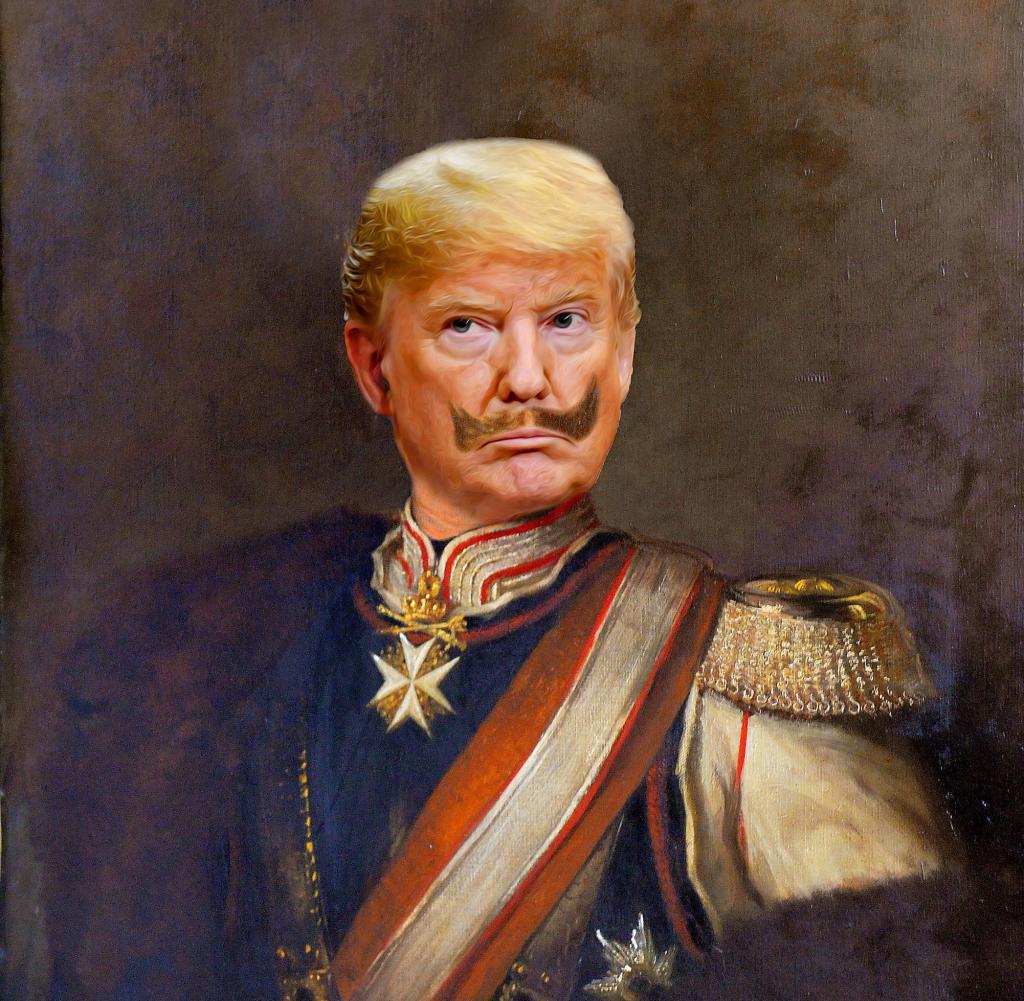
Trump as Wilhelm II.
Donald Trump's mantra is to "make America great again" yet his regime is rapidly destroying standing in the world. While using many of Adolph Hitler's tactics of attacking the free press, demonizing targeted groups, and lying incessantly, as noted in a prior post, Trump's behavior mimics that of the narcissistic, impetuous Kaiser Wilhelm II who used nationalism to lead Germany into WWI  and ultimate disaster, including an overthrow of the monarchy.  The other irony, of course, is that if one looks at those who attended Trump's rallies - e.g., his recent kick off in Florida - they look like losers and what my late maternal grandmother would have described as "white trash" were she still living. Hardly folks that reflect American greatness. Under Trump, America has gone from the recognized leader of the democratic world to being an untrustworthy ally with a leader who prefers hobnobbing with dictators and autocrats, or in the case of Saudi Arabia, out right murderers.  A column in the New York Times looks at America's accelerating decline under Der Trumpenführer. Here are excerpts:

So Vladimir Putin, the Russian president, has told The Financial Times, “The liberal idea has become obsolete.” It has, he says, “outlived its purpose.” President Trump finds him amusing. In Japan, at the G-20 summit meeting, he wags his finger at Putin and says, with a grin: “Don’t meddle in the election, President.”
It’s a measure of American decline over the past three decades that Putin’s claim, however objectionable, is no longer preposterous and Trump’s frivolity no longer surprising. Thirty years ago, the Berlin Wall fell. Two years later, the Soviet Union was gone. The liberal idea was triumphant, and American power virtually uncontested in “the unipolar moment.”
Liberalism posited the indivisibility of freedom and human dignity, as well as the idea that the rule of law and democracy offered the best chance for human advancement, peace and prosperity. Its spread appeared inevitable and irreversible. Its guiding spirit was the United States.
The road from that high-water mark of the American idea to Trump’s autocrat-coddling indecency offers a story of squandered American opportunity and eroded American self-belief that Edward Gibbon would have qualified as “decline and fall.” All Democratic candidates should be asked what they intend to do about it.
I can think of no better guide for reflection than William Burns’s book, “The Back Channel,” his wonderful memoir of a life in diplomacy. . . . back in 1993, in a memo to the incoming Clinton administration, he wrote: “Democratic societies that fail to produce the fruits of economic reform quickly, or fail to accommodate pressures for ethnic self-expression, may slide back into other ‘isms,’ including nationalism.”
Burns, now the president of the Carnegie Endowment for International Peace, attributes the loss of America’s “unrivaled position of strength” in part to inevitable geopolitical trends, including the rise of China and India in the “Pacific century.”
This was, however, compounded by what he calls “grievous missteps.” They included the post-9/11 “inversion of force and diplomacy” that saw a disoriented United States lurch onto a “road to war in Iraq” that “was distinctive for its intensity and indiscipline.”
The unhappy sidelining and devaluation of diplomacy is a theme of the book. It has, for Burns, culminated in Trump’s “savaging of American diplomacy” that has left “our friends confused, our adversaries emboldened, and the foundations of the international system we built and preserved for seven decades alarmingly fragile.” He writes of “unilateral diplomatic disarmament” under Trump, born of “equal parts ideological contempt and stubborn incompetence.” The president’s view of diplomacy is “narcissistic, not institutional,” Burns observes, full of “muscular posturing and fact-free assertions” that insult allies and indulge autocrats. Burns played a leading role in negotiating [the Iran nuclear deal] that Trump called “the worst deal ever” before withdrawing from it. This, Burns writes, “was exactly the kind of risky, cocky, ill-considered bet that had shredded our influence before, and could easily do so again.” For Burns, the erosion of American power and influence long predates Trump. He regrets the loss of the extraordinary American cohesion that, at the end of the Cold War, secured the place of a united Germany in NATO. He notes the failure to perceive early enough how Russian “humiliation and wounded pride” would, under Putin, spur a Russian resurgence.
NATO expansion was, he suggests, “premature at best, and needlessly provocative at worst” — a debatable point in my view, given the need to secure and stabilize the liberation of more than 100 million long subjugated people in Central Europe and the Baltic States.
He thinks President Obama made a mistake by not upholding his “red line” against the Syrian regime’s use of chemical weapons. The Obama administration “had blinked” and, Burns notes, “it would leave an enduring mark.” Into that vacuum Putin strode.
Now the Russian president claims liberalism is obsolete. He is wrong. It is more necessary than ever even as Trump scoffs at it. But America’s ability to promote liberal democracy cannot be served by what Burns calls “a State Department in which officers are bludgeoned into timidity, or censor themselves, or are simply ignored.”


Be very afraid.