Showing posts with label Vietnam War. Show all posts

Friday, January 03, 2020

Trump Is Wrong In Thinking Attacking Iran Will Get Him Reelected

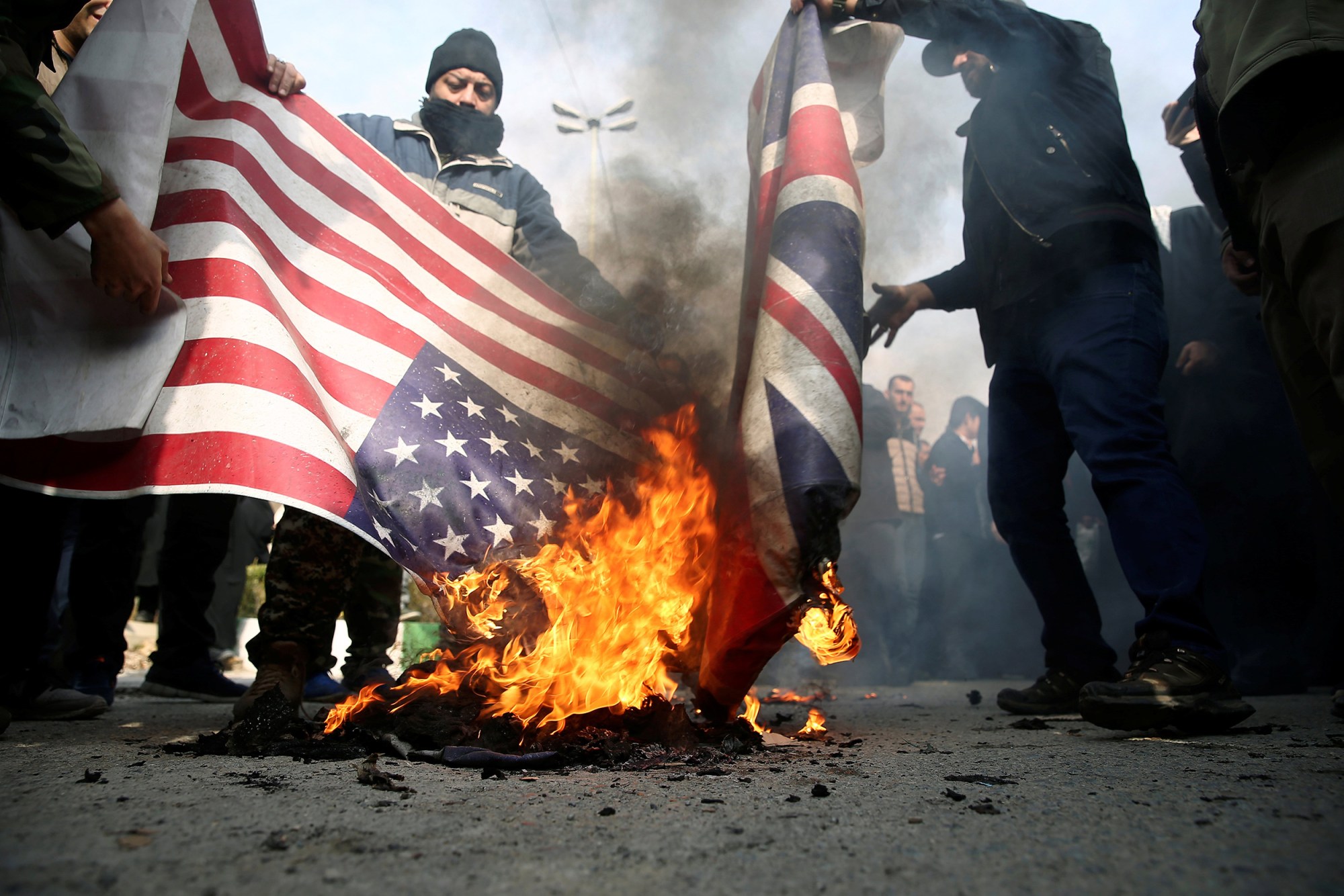
Being of a "certain age" I remember the Vietnam War debacle well and lost friends to America;s folly in the late 1960's and early 1970's. When the George W. Bush - sometimes known as the Chimperator on this blog - launched the Iraq War, I had a huge sense of deja vu which sadly proved all too accurate. Indeed, when a former law partner who had served in Vietnam saw "Fog of War" with me back in the early 2000's, his reaction was that Iraq was Vietnam all over again. In each of these poorly conceived wars, individuals Americans paid with their lives and the nation squandered billions of dollars.  Now, it seems, Donald Trump - a man who doesn't read, knows little history and wants one page bullet style briefing reports - wants to launch an even more insanely conceived war against Iran - a nation far larger and better educated and wealthy than Iraq - in the hope that it will win him re-election. A piece in New York Magazine makes the case of why Trump's insane desire for a war with Iran will not assure him re-election.   Here are article highlights:
Beginning in 2011, and continuing through the next year, Donald Trump began obsessively predicting that President Obama would start a war with Iran in order to be reelected. Trump stated it publicly, on at least a half-dozen occasions, explicitly positing that attacking Iran would help Obama win reelection.
Trump’s attacks on Obama were the purest form of projection. They reflect his cynical belief that every president will naturally abuse their powers, and thus provide a roadmap to his own intentions.
And indeed, Trump immediately followed the killing of Qasem Soleimani by metaphorically wrapping himself in the stars and stripes. No doubt he anticipates at least a faint echo of the rally-around-the-flag dynamic that has buoyed many of his predecessors. But Trump’s critics need not assume he will enjoy any such benefit, and should grasp that their own response will help determine it.
One salient fact is that it’s not 2001, or even 2003. A poll earlier this summer found that just 18 percent of Americans prefer to “take military action against Iran” as against 78 percent wanting to “rely mainly on economic and diplomatic efforts.”
It is in part due to public war weariness that Republicans have sworn repeatedly, for years, that they would not go to war with Iran. The possibility of such a military escalation was precisely the central dispute between the parties when the Obama administration struck its nuclear deal. . . . And as Trump mulled following through on his threat to abrogate the deal, conservatives furiously denied that doing so would lead to military conflict.
Trump’s allies have framed the issue as being about Qasem Soleimani’s moral culpability, or Iran’s responsibility for escalating the conflict. And it is certainly true that Iran is a nasty, aggressive, murderous regime. But none of this refutes the fact that Trump’s Iran policy is failing on its own terms. Having violated a diplomatic agreement on the premise that doing so would not lead to war, they are now blaming Iran for the war they insisted would never happen.
Americans historically support their presidents in foreign conflicts, both the wise ones and unwise ones alike, at least initially. Trump no doubt believes the halo effect will last at least through November — that he might undertake an action that would harm his reelection out of some larger sense of duty to the nation or the world is unfathomable.
But presidents traditionally benefit from a presumption of competence, or at least moral legitimacy, from their opposition. Trump has forfeited his. He will not have Democratic leaders standing shoulder to shoulder with him, and his practice of disregarding and smearing government intelligence should likewise dispel any benefit of the doubt attached to claims he makes about the necessity of his actions. Trump has made it plain that he views American war-fighting as nothing but the extension of domestic politics.
I fear for members of the military who may loose their lives - and for their families - as a result of Trump's self-centered war mongering.  I nearly lost a family member in the Afghanistan disaster. Others may not be as luck as we were. 

Monday, May 30, 2016

Americans Need to Know More History


As I have noted numerous times, I was a history major in college and believe that in order to have an informed population, far more Americans desperately need to know more history.  If more Americans were knowledgeable of American history, for example, they's know that America was not founded as a "Christian nation." Likewise, they'd better understand the futility of many of America's recent wars that have been waged with almost zero knowledge of the history of Indochina in the case of the Vietnam War disaster and most recently in the seemingly endless disasters in the Middle East.  They would also recognize the danger posed by Neo-fascists like Donald Trump and his hate and bigotry motivated followers.    An op-ed in the Los Angeles Times looks at why we need more history majors to counter the dangers we face due to Americans' ignorance of accurate history.  Here are highlights:
Since the beginning of the Great Recession in 2007, the history major has lost significant market share in academia, declining from 2.2% of all undergraduate degrees to 1.7%. The graduating class of 2014, the most recent for which there are national data, included 9% fewer history majors than the previous year’s cohort, compounding a 2.8% decrease the year before that. The drop is most pronounced at large research universities and prestigious liberal arts colleges.
This is unfortunate — not just for those colleges, but for our economy and polity. 
Conventional wisdom offers its usual facile answers for these trends: Students (sometimes pressured by parents paying the tuition) choose fields more likely to yield high-paying employment right after graduation — something “useful,” like business (19% of diplomas), or technology-oriented. History looks like a bad bet.
Politicians both draw on those simplicities and perpetuate them . . . . . Governors oppose public spending on “useless” college majors. History, like its humanistic brethren, might prepare our young people to be citizens, but it supposedly does not prepare workers — at least not well paid ones.
Over the long run, however, graduates in history and other humanities disciplines do well financially. Rubio would be surprised to learn that after 15 years, those philosophy majors have more lucrative careers than college graduates with business degrees. History majors’ mid-career salaries are on par with those holding business bachelor's degrees. Notably these salary findings exclude those who went on to attain a law or other graduate degree.
The utility of disciplines that prepare critical thinkers escapes personnel offices, pundits and  politicians (some of whom perhaps would prefer that colleges graduate more followers and fewer leaders). But it shouldn’t. Labor markets in the United States and other countries are unstable and unpredictable. In this environment — especially given the expectation of career changes — the most useful degrees are those that can open multiple doors, and those that prepare one to learn rather than do some specific thing.
History students, in particular, sift through substantial amounts of information, organize it, and make sense of it. In the process they learn how to infer what drives and motivates human behavior from elections to social movements to board rooms.
Employers interested in recruiting future managers should understand (and many do) that historical thinking prepares one for leadership because history is about change — envisioning it, planning for it, making it last. In an election season we are reminded regularly that success often goes to whoever can articulate the most compelling narrative. History majors learn to do that.
Everything has a history. To think historically is to recognize that all problems, all situations, all institutions exist in contexts that must be understood before informed decisions can be made. No entity — corporate, government, nonprofit — can afford not to have a historian at the table. We need more history majors, not fewer. 

Saturday, January 02, 2016

The GOP's Delusional Invocations of "American Exceptionalism"


One thing that drives me to distraction is the Republican Party's constant bloviating about "American Exceptionalism."  Yes, Democrats, including Barack Obama, succumb at times to citing American exceptionalism, but the frequency of use pales compared to that of Republicans.  Worse yet, the GOP invocations of American exceptionalism always seem to include a re-writing of history, refusal to learn from past catastrophes - e.g., the Iraq War - and a blindness to the ugliness in America's past.  Without being honest about the past and accurate history, America is doomed to repeat past mistakes and allow injustices to fester.  A column in Salon that looks at history from the Vietnam War forward underscores the GOP's delusions on "American exceptionalism."  Here are excerpts:


The Vietnam War ended 40 years ago, yet this brutal episode continues to haunt America and affect our foreign policy, our culture, and our national identity. . . . the catastrophic war left the idea of American exceptionalism in tatters as the conflict came to be seen by many citizens as unnecessary and immoral, undermining the basic American belief that the United States is the greatest force for good in the world.
In his wide-ranging book “American Reckoning: The Vietnam War and Our National Identity” (Viking), historian Christian Appy explores the complex history of the war, from the Cold War fear and idealism that led to the initial American involvement to the ruthless and seemingly endless and grotesque conflict that perplexed the military, devastated Vietnam, and fueled an antiwar movement at home. Appy also looks at the aftermath of the war, analyzing the amnesia and pumped up patriotism in its wake as well as the wariness of further military intervention. But, as Appy observes, historical memory faded and policy makers after 9/11 ignored the lessons of Vietnam, launching protracted and indecisive wars in the Middle East as an imperial presidency directed foreign affairs without the consent of the citizenry.
[T]he evidence I found indicated that roughly 80 percent of the men who served in Vietnam came from poor or working-class families. The draft system of the era was class-biased in ways that allowed men with greater economic means far more opportunity to avoid military service or to find forms of service (like the military reserves) that kept them out of Vietnam. And few men of privilege volunteered.
To put it most plainly, [American exceptionalism] it’s the belief that the United States is the greatest nation on earth, unrivaled not only it its wealth and power, but in the quality of its institutions and values, and the character of its people. That faith has been with us for centuries and has often had a religious underpinning—the idea that we are providentially destined for our unique mission in the world. When it reached its heyday during World War II and the early Cold War, American exceptionalism was the driving ideological force of our particular brand of imperialism. It was founded on the appealing idea that we are the greatest force for good in the world and therefore have the right and responsibility to assert “global leadership.”
[I]n many ways the political and cultural values and institutions that have shaped American exceptionalism (republicanism, various kinds of freedom, etc.) were constructed on the backs of dispossessed native peoples, enslaved Africans, and, over time, the domination of many foreign lands and people. Of course, the faithful have tended to view all such devastating evidence as insignificant or temporary blemishes along the road to ever greater freedom for all.
The Vietnam War, in my view, was the first experience that shattered that broad faith. . . . . in the face of war crimes like the My Lai massacre in which a company of U.S. soldiers slaughtered some 500 unarmed and unresisting civilians in 1968, many war supporters proposed that all nations do similarly horrible things in war. Well, that excuse is itself a rejection of a core ingredient of American exceptionalism—the idea that we put a higher price on life than other nations and cultures.
Perhaps it’s a tell-tale sign of a dying empire when leaders know that their exercise of military power is failing but they continue the killing nonetheless in a desperate effort to avoid defeat, to avoid humiliation, to avoid looking weak.
I have a chapter called “Paper Tigers” that is really about the significance of gender in prolonging and expanding a war that American leaders believed was failing but did not have the moral courage to stop. . . . . their primary concern was maintaining “credibility” and that really boiled down to preserving an image of national and personal toughness.
Not only is that, in my view, a kind of insanity, but it didn’t work. The longer we stayed in Vietnam the more our international credibility was shredded. It didn’t even work for LBJ in personal political terms—the war led him to drop out of the presidential campaign of 1968. As for Nixon, his illegal efforts to silence antiwar criticism (and thus preserve his credibility) were the first crimes of Watergate that ultimately forced him to resign.
Forced relocation was designed to deprive the Viet Cong of civilian support in the countryside and it ultimately displaced 5 to 10 million people. Their ancestral villages were then burned down or bulldozed and proclaimed “free fire zones” where the U.S. claimed the right to fire at anything that moved in the area.
Far from “winning hearts and minds,” policies like these simply served to drive more and more Vietnamese to an anti-government, anti-U.S. position.
Although Iraq, Afghanistan and other nations of the Greater Middle East in which we engage in seemingly endless war are all vastly different from Vietnam (and each other) there are certainly commonalities in the way the U.S. has behaved in all of those places. Once again our troops have been sent to war under false pretexts, in faraway countries in which they are widely perceived as hostile invaders or occupiers, to prop up local regimes that lack the broad support of their own people, and to wage brutal counter-insurgency against an elusive and difficult-to-identify enemy (while also being told somehow to win the hearts and minds of the people). Moreover, our presidents have prolonged these wars, as in Vietnam, long after the American public has turned against them, and once again we have failed to achieve our stated objectives.
[F]inally dispense with American exceptionalism. I don’t think the historical record justifies the faith, it alienates other people and nations (for obvious reasons), and it contributes to public acquiescence to the tiny few who make foreign policy in our name and are all to ready and willing to assure us that they can be trusted to use our “indispensable” power as a force for good in the world.
[T]hose [presidential candidate] comments strike me as delusional and reflexive invocations of American exceptionalism based on the threadbare idea that we are a force for stability and peace in the world no matter how glaringly the facts contradict the claim. They remind me of the remark Vice President George H.W. Bush made in 1988 shortly after the U.S. Navy shot down an Iranian civilian airliner over the Persian Gulf killing all 290 passengers. Running for president at the time, Bush said: “I will never apologize for the United States of America. Ever. I don’t care what the facts are.”
Just as they don't want to face the reality that their religious beliefs are untrue, much of the GOP base refuses to face the fact that "American exceptionalism" is a myth that is dangerous.

Monday, March 30, 2015

American Exceptionalism is a Lie


Fifty years ago America's disaster in Vietnam began to accelerate in earnest.  Locally, as one might expect in an area with a huge military population, the local newspaper has begun running some commemorative articles on the misadventure in Vietnam and to date the stories only put a positive spin on the story.   Sadly, it is part of the myth of American exceptionalism that keeps too many Americans from being honest about the many truly ugly aspects of the nation's history.  America has not always been the guy in the white hat out of some western movie.  Indeed, there are times that America is the bad guy - not that one would ever hear such an admission from xenophobic "patriots."  A piece in Salon looks at the need for Americans to be honest about the past so that future misdeeds can perhaps be avoided.  Here are highlights:
“I didn’t know there was a bad war,” George Evans recalled. . . .  there was one thing George trusted completely—his nation’s military power and the good that it did. With all his heart he believed the United States was on the side of justice and freedom and all our wars were noble.Despite personal hardships, you could always count on Americans to be the good guys, and always victorious. It was simply unimaginable that the United States might betray that faith. “I was raised in a family and neighborhood of extreme patriots,” George explains.

But George’s faith in America’s global goodness was forever destroyed in Vietnam, where he served as an air force medic. “I realized that the country I was from was not the country I thought it was.” One day at the hospital in Cam Ranh Bay he was ordered to clean the bodies of two young Vietnamese boys. They were dead.  . . . . George later learned that the boys were hit by an American military truck driver who may have been competing with other drivers over “who could hit a kid. They had some disgusting name for it, something like ‘gook hockey.’ ”

With the possible exception of the Civil War, no event in U. S. history has demanded more soul-searching than the war in Vietnam. The false pretexts used to justify our intervention, the indiscriminate brutality of our warfare, the stubborn refusal of elected leaders to withdraw despite public opposition, and the stunning failure to achieve our stated objectives—these harrowing realities provoked a profound national identity crisis, an American reckoning. The war made citizens ask fundamental questions: 

The Vietnam War still matters because the crucial questions it raised remain with us today: Should we continue to seek global military superiority? Can we use our power justly? Can we successfully intervene in distant lands to crush insurgencies (or support them), establish order, and promote democracy? What degree of sacrifice will the public bear and who among us should bear it? Is it possible for American citizens and their elected representatives to change our nation’s foreign policy or is it permanently controlled by an imperial presidency and an unaccountable military-industrial complex?

My main argument is that the Vietnam War shattered the central tenet of American national identity—the broad faith that the United States is a unique force for good in the world, superior not only in its military and economic power, but in the quality of its government and institutions, the character and morality of its people, and its way of life. A common term for this belief is “American exceptionalism.”

[T]he faith in American exceptionalism has hardly disappeared. Countless times since the Vietnam War our presidents have invoked it in support of wars and interventions around the world. Although the public has been more reluctant to use military force than its leaders, there is still substantial support for the idea that our power is benign and that America remains a singularly admirable nation. That’s why virtually everyone who runs for higher office in the United States pledges allegiance to the creed.Yet even many ardent believers understand that the faith is no longer as broad or assured as it was before the Vietnam War.

When it finally ended in 1975, 58,000 Americans had died, and three million Vietnamese.  . . . . many others believed the war exposed American exceptionalism as a dangerous myth. 

[T]he broad acceptance of Cold War policies was bolstered by the era’s equally broad religiosity. The idea that the United States was engaged in a godly crusade against atheistic Communism was not an extreme position in the 1950s, but part of everyday discourse.

It was still unimaginable to most Americans that their own nation would wage aggressive war and justify it with unfounded claims, that it would support antidemocratic governments reviled by their own people, and that American troops would be sent to fight in countries where they were widely regarded not as liberators, but as imperialist invaders. 

By 1971, 58 percent of Americans had concluded that the war in Vietnam was not just a mistake, but immoral. More than at any time in our past, broad sections of the public, cutting across lines of class, gender, race, and religion, rejected the claim that American military power was an invincible force for good. Many concluded that the United States was as capable of wrongdoing as any nation or people, if not more so. And by 1973, when the final U. S. troops were withdrawn from Vietnam, only a quarter of Americans still trusted the government to do the right thing.

For the political right, defeat in Vietnam was an intense motivator. Conservatives were determined to rebuild everything they thought the war had destroyed—American power, pride, prestige, and patriotism. Above all, they wanted to resuscitate a faith in American supremacy. Their restoration project was a key factor in the rightward movement of American culture and politics in the decades after Vietnam. It depended, in part, on efforts to redefine the political and moral meanings of the Vietnam War. Ronald Reagan was elected president in 1980 saying Vietnam had been a “noble cause”—a war that should have been fought and could have been won.. . . .a new mainstream consensus emerged around the idea that the Vietnam War had primarily been an American tragedy that had badly wounded and divided the nation. 

The attacks of 9/11 decisively destroyed the cautionary lessons of the Vietnam War, at least among the tiny group of people who formulated American foreign policy. George W. Bush launched a “Global War on Terror” premised on the idea that the United States was an exemplar of all that was good in the world fighting against all that was evil. He started two wars that led to protracted occupations and provoked bloody anti-American insurgencies.

If the legacy of the Vietnam War is to offer any guidance, we need to complete the moral and political reckoning it awakened. And if our nation’s future is to be less militarized, our empire of foreign military bases scaled back, and our pattern of endless military interventions ended, a necessary first step is to reject—fully and finally—the stubborn insistence that our nation has been a unique and unrivaled force for good in the world. Only an honest accounting of our history will allow us to chart a new path in the world. The past is always speaking to us, if we only listen.
Today's Republican Party is striving to maintain the myth and, worse yet, fanning the flames of racism, bigotry, and religiosity that helped create the Vietnam - and Iraq - nightmare.  One can only hope Americans will open their eyes to the lie. 

Monday, May 26, 2014

Memorial Day Reflections - How to Truly Honor the Fallen

Hampton National Cemetery - Hampton, Virginia

Memorial Day is a day set aside to honor those who gave their lives in the defense of this.  It is due and appropriate to remember those who gave the ultimate sacrifice for their country.  Having nearly lost a son-in-law in Afghanistan, the day touches me even more than once was the case. Sadly, however, Memorial Day is also a day when craven, disingenuous politicians posture and pose claiming to honor the fallen and by extension our troops in uniform.   It is all a ruse, of course, because they very same politician - especially those on the Republican side of the isle, seem only too ready to throw away the lives of American service members on fools errands or situations which in the last analysis have no real bearing on America's vital interests.  

I invite everyone to make a vow to the fallen:  we will never again allow our national leaders to throw away lives on idiot conceived fool's errands like the Iraq War and the still ongoing disaster in Afghanistan.  And let's not forget the thousands who died in Vietnam on a similar fool's errand beginning a nearly a half century ago. If one truly honors the fallen and truly supports our troops, one does not squander their lives and bankrupt the nation in the process.   Better yet, demand accountability for those who threw away American lives and treasure.

Monday, February 17, 2014

The LBJ Renaissance


I will confess to the fact that I am of an age where I remember JFK's assassination and Lyndon B. Johnson's swearing in as Kennedy's succession and then his 1964 re-election.  I also remember his disastrous decision to escalate the fool's errand in Vietnam following the Gulf of Tonkin Resolution. This fatal decision ultimately led to Johnson's decision not to seek re-election in 1968.  Johnson was not without his faults, but sadly his contributions to the advancement of civil rights is now often obscured by the Vietnam War disaster.  But for Johnson, the civil rights effort begun under John F. Kennedy might have died.   As The Daily Beast reports, a new appreciation of Johnson's civil right role - at least out of GOP/white supremacist circles - is re-emerging.  It is telling that the GOP claims that Democrats "buy votes" from blacks through handouts.  The reality is that many blacks still remember which political party forced through the Voting Rights Act - and Act that Republicans seek to gut and render useless.  Here are some excerpts:


History often casts its glow fickly. Sometimes we get a sense of how one will be reflected in its light contemporaneously. Sometimes it takes a little longer to sort things out.

In 1865, when an assassin’s bullet felled Abraham Lincoln, his loss was felt immediately and his place in the presidential pantheon all but assured. Though he had elicited withering criticism during the course of his four-year presidency, the sixteenth president had lived to see the Civil War to its bloody end, keeping the Union whole while putting a constitutional end to the odious institution of slavery. “It is small consolation that he died at a moment in the war when he could best be spared,” wrote Harper’s Weekly just after his death, “for no nation is ready for the loss of such a friend.”


It has taken history far longer to catch up to the legacy of our 36th president, Lyndon Johnson.  
A hundred years after Lincoln’s passing, Johnson stood before Congress and delivered one of the great, unheralded speeches of its age, a plea before Congress to put the Voting Rights Act of 1965 into law. Though slavery had long been abolished at Lincoln’s hand, racism, virulent and intractable, continued to plague much of America. A year earlier, Johnson had signed the Civil Rights Act of 1964, the first meaningful civil rights bill since Reconstruction, striking down Jim Crow laws that allowed for racial segregation throughout the South.

“[I]t is all of us who must overcome the crippling legacy of bigotry and injustice,” Johnson said as he looked over his former Congressional colleagues in the House chamber, many of them unyielding segregationists, as his mouth tightened and his eyes narrowed determinedly. “And we shall overcome.”

Through what became known legendarily as “the Johnson Treatment”—wielding political capital, horse-trading, threatening, cajoling, flattering, whatever it took—Johnson got his Voting Rights Act. He considered the law his greatest legislative accomplishment. That’s saying something given that he also saw through Medicare, Medicaid, the Immigration Act, the Elementary and Secondary Education Act, the Higher Education Act, the Clean Air Act, the Wilderness Act, the Public Broadcasting Act, the Arts & Humanities Act and a spate of other landmark laws. 

It took Lyndon Johnson to finish what Abraham Lincoln had started.

Yet despite his titanic role in America’s quest for civil rights, the greatest domestic movement of the Twentieth Century, LBJ has been largely underappreciated—even ignored—until recently. While Lincoln won his war, vanquishing the Confederate Army, Johnson could never quite overcome the Communist insurgency in Vietnam. It was Ho Chi Minh who prevailed, not LBJ.

Now, forty-five later, Lyndon Johnson seems to finally be getting his due; history’s light is beginning to penetrate the shroud of Vietnam that has darkened his legacy. “I absolutely think the time has come,” said Doris Kearns Goodwin of reevaluating Johnson’s legacy in a front page New York Times story on Sunday. “When he left the office, the trial and tribulations of the war were so emotional that it was hard to see everything else he had done beyond Vietnam.”

[I]n early April, the LBJ Presidential Library will host a Civil Rights Summit to mark the act’s fiftieth anniversary that will draw a host of luminaries including many aging heroes of Civil Rights movement and as many as four U.S. presidents. Moreover, LBJ is regularly upheld in the media as a president who got laws passed through Congress at a time when Washington sausage-making has all but ground to a halt.

Though Johnson died over four decades ago, succumbing to heart failure at his beloved LBJ Ranch in 1973 at the age of 64, we are only now starting to get the true measure of the man.

Wednesday, September 11, 2013

America's Hypocrisy In Decrying Assad's Use of Chemical Weapons


I'm by no means anti-America, but at times the hypocrisy that this country displays is shocking given some of the past actions of the national government and the U.S. Military.  Yes, the use of chemical weapons against civilians and children in Syria by most likely the Assad regime is horrible and against international laws that date back to the 1920's.  But how quickly America forgets the horrors or its own past conduct.  The image above that shows screaming children who were hit by American Napalm in Vietnam (other children were killed) is an iconic reminder that America has less than clean hands when it piously condemns the actions of others.  And when it comes to the use of poison gas, how quickly some have forgotten the USA's aid during the Iran/Iraq war during the Reagan years when America supplied chemical weapons used in the conflict.  George Will has a column that helps remind us that when one knows accurate history, America frequently doesn't live up to the standards it likes to apply to others.  Here are column excerpts:


U.S. power and security are somewhat dependent on a president’s stature, which should not be diminished unnecessarily. Neither, however, should America’s well-being be equated with a president’s policy preferences or political health. The real but limited importance of presidential prestige and the real but limited diminution of it that would result from blocking Obama’s attack both matter. But so do the manifest and manifold weaknesses of his argument. 

Skepticism is warranted, given the prodigies of confusion in administration statements, including historical amnesia. 

Bashar al-Assad’s use of chemical weapons is only his most recent, and he is not the first to have used such weapons in war since the 1925 Geneva Protocol proscribing them. But because attacking Syria is said to be necessary as reinforcement of the 1925 “norm,” it matters that the norm has been violated before. In the 1960s, Egypt used chemical weapons against Yemen. Saddam Hussein used them not only against disobedient Iraqis but in the 1980-88 war with Iran. A March 23, 1984, CIA report said: “Iraq has begun using nerve agents . . . [which] could have a significant impact on Iran’s human wave tactics, forcing Iran to give up that strategy.” A new article by Shane Harris and Matthew M. Aid in Foreign Policy says that in 1988:
“The United States learned through satellite imagery that Iran was about to gain a major strategic advantage by exploiting a hole in Iraqi defenses. U.S. intelligence officials conveyed the location of the Iranian troops to Iraq, fully aware that Hussein’s military would attack with chemical weapons, including sarin, a lethal nerve agent.” 
U.S. officials denied acquiescing in such attacks because Iraq never announced them. But Harris and Aid quote retired Air Force Col. Rick Francona, a military attache in Baghdad during the 1988 strikes, saying, “The Iraqis never told us that they intended to use nerve gas. They didn’t have to. We already knew.” 
I disagree with much of the rest of the column, but the point quoted need to not be forgotten.   Americans - especially politicians - like to forget America's many sins.  The rest of the world is less prone to such amnesia and, if Obama and America as a whole want to be believed and want to hold the moral high ground, it is important that complete and accurate history be remembered.  Too often it is not.

Thursday, January 31, 2013

The Hagel Witch Hunt - The GOP Has Learned Nothing

This blog has published a number of posts taking to task politicians who claim that they "support the troops" while on the campaign circuit yet who betray the troops and throw away American lives - and also bankrupt the country - as they seek to go off on one foreign war fool's errand after another.  The totally unnecessary Iraq War and the continuing fiasco in Afghanistan are two prime example.  And in questioning today directed at Defense Secretary nominee Chuck Hagel, the biggest GOP objection to Hagel seemingly is that he (i) calls the Iraq War for the needless disaster that it was and (ii) isn't sufficiently reckless and willing to take the nation into un-winnable wars.    Indeed, one would think the GOP's only concern is to maximize profits to defense contractors.  The lives of American troops?  They simply are not an issue to these members of the GOP.  Perhaps because so many of these assholes don't even have family members in the military in harm's way.   The Daily Beast looks at the GOP effort to crucify Hagel because his isn't enough of a war monger.  Here are highlights:

The contentious Senate hearing for Secretary of Defense nominee Chuck Hagel divided starkly along partisan lines, with Republicans attacking their former colleague with the pitchfork zeal of heretic hunters.

Hagel’s calm recitation of consensus catechism on issues ranging from Iran to Israel to nuclear weapons didn’t seem to make any impression on his conservative critics.

This was personal. John McCain repeatedly interrupted his “old friend” and fellow Vietnam Vet with palpable anger, his fury directed at Hagel’s opposition to the Iraq War and the 2007 troop surge. The core offense appeared to be Hagel’s contention that the invasion of Iraq was the worst foreign policy “disaster” since Vietnam – a parallel that infuriates McCain.
Oklahoma Senator Jim Inhofe, a Republican, reinforced his reputation as possibly the worst U.S. Senator with bear-baiting questions like this: “Why do you think that the Iranian foreign ministry so strongly supports your nomination for Secretary of Defense?”
 
Alabama Senator Jeff Sessions doggedly focused on a report by the anti-nuke group Global Zero, which advocates the elimination of nuclear weapons. The report was co-authored by Hagel, four generals and a number of ambassadors. The organization itself has hundreds of international leaders who have signed on to its recommendations, including Reagan’s Secretary of Defense Frank Carlucci, Carter National Security Advisor Zbignew Brezinksi, 9/11 Commission Co-Chair Lee Hamilton and General Anthony Zinni. Sessions and other Republican senators kept cherry-picking phrases from the report and ignoring substantive subtlety, despite Hagel’s repeated assurance and demonstrated record in opposing unilateral disarmament and support for modernizing the U.S. nuclear program. This clarification by the authors might help calm any genuine concerns, if they exist.

It made me wonder what Sessions would have said to Ronald Reagan, who advocated for nuclear disarmament more than 150 times, according to his aide Martin Anderson, in statements like this: “I believe we’ve come to the point that we must go at the matter of realistically reducing… if not totally eliminating, nuclear weapons—the threat to the world.”

A Democratic President nominating a Republican to his cabinet is usually seen as bipartisan outreach. But not this time. The reason, I think, is threefold.
First, it reflects the polarization afflicting the Republican party and its intolerance of dissent. Hagel is a small-government conservative but a committed internationalist who is wary of unilateral American over-extension, views that extend from his experience as a twice-wounded enlisted infantryman in Vietnam.
Second, it reflects the tortured legacy of the Iraq War and the contradictions it creates for conservatives who feel compelled to defend that war of choice, predicated on flawed intelligence presented to the American people. Hagel earned the enduring anger of the neo-conservative crowd by openly criticizing the Bush administration for its prosecution of the Iraq war and subsequently opposing the Surge. Defenders of the Bush administration now often try to delink the decision to invade from the decision to double down with the surge as a way of reclaiming the high ground. It is now clear that Hagel was right at least on this count: the invasion of Iraq was an ideologically driven overreach that proved a costly distraction from Afghanistan in terms of both blood and treasure while further destabilizing the region. History, as Hagel noted, will be the ultimate judge.
Third, it reflects the deep animus that still exists for President Obama on the part of some conservatives–so much so that any Republican who consents to serve with him is seen as a traitor to the tribe, a dynamic also seen in the GOP’s primary rejection of Utah governor and former Obama China Ambassador Jon Huntsman, despite being arguably the most fiscally conservative candidate in the 2012 pack. By consenting to serve with President Obama–and therefore creating bipartisan cover for the Democrat’s defense strategy–Hagel has committed an unpardonable sin.

My view?  The next time you encounter a GOP elected official bloviating about "supporting the troops," call them out.  I certainly plan on doing so. They are lying assholes.


Thursday, September 27, 2012

Jim Webb Verbally Eviscerates Romney During Virginia Beach Remarks

AP Photo
I haven't always been a happy supporter of Jim Webb even though I did vote for him six years ago when he ran against my former law school roommate, George "Macaca" Allen.  A case in point is when Webb was waffling on DADT repeal and I was contacted by his communications director after slamming Webb in a blog post.  Webb went a long way to wipe out any displeasure I might have had with him when he eviscerated - or perhaps castrates is a better term - Mitt Romney while speaking at Barack Obama's campaign stop in Virginia Beach today.  The thrust of Webb's remarks: castigating Romney for lobbying in support of the Vietnam War and then using a special exemption from service for Mormon missionaries and spending critical war years in Europe. I understand where Webb is coming from.  I'm 60 years old and only missed the draft because I had a high lottery number (269 as I recall).  Unlike Romney, I never sought an exemption.  And I never agitated in support of the Vietnam fiasco.  And, yes, I lost childhood friends in that fool's errand that is similar in so many ways to the ongoing disaster in the Middle East.    Politico has details on Webb's statements.  Here are highlights:

Webb’s bladework today on Mitt Romney was as unexpected as it was memorable.  From Webb’s introductory remarks before Obama’s Virginia Beach appearance:
Governor Romney and I are about the same age. Like millions of others in our generation, we came to adulthood facing the harsh realities of the Vietnam War. 2.7 million in our age group went to Vietnam, a war which eventually took the lives of 58,000 young Americans and cost another 300,000 wounded. The Marine Corps lost 100,000 killed or wounded in that war. During the year I was in Vietnam, 1969, our country lost twice as many dead as we have lost in Iraq and Afghanistan combined over the past 10 years of war. 1968 was worse. 1967 was about the same. Not a day goes by when I do not think about the young Marines I was privileged to lead.
This was a time of conscription, where every American male was eligible to be drafted. People made choices about how to deal with the draft, and about military service. I have never envied or resented any of the choices that were made as long as they were done within the law. But those among us who stepped forward to face the harsh unknowns and the lifelong changes that can come from combat did so with the belief that their service would be honored, and that our leaders would, in the words of President Abraham Lincoln, care for those who had borne the battle, and for their widows and their children.
Those young Marines that I led have grown older now. They’ve lived lives of courage, both in combat and after their return, where many of them were derided by their own peers for having served. That was a long time ago. They are not bitter. They know what they did. But in receiving veterans’ benefits, they are not takers. They were givers, in the ultimate sense of that word. There is a saying among war veterans: “All gave some, some gave all.” This is not a culture of dependency. It is a part of a long tradition that gave this country its freedom and independence. They paid, some with their lives, some through wounds and disabilities, some through their emotional scars, some through the lost opportunities and delayed entry into civilian careers which had already begun for many of their peers who did not serve.
And not only did they pay. They will not say this, so I will say it for them. They are owed, if nothing else, at least a mention, some word of thanks and respect, when a presidential candidate who is their generational peer makes a speech accepting his party’s nomination to be commander-in-chief. And they are owed much more than that — a guarantee that we will never betray the commitment that we made to them and to their loved ones.
[C]oming from Webb — a voice for the white working class, a former Navy secretary and decorated Vietnam veteran whose son left college to enlist as an infantry private in the Marine Corps and fought in the Iraq War — his words carry a punch that few other Democratic surrogates can muster.
 That's right.  Military veterans receiving benefits and those on active duty do not pay income taxes on their benefits.  These individuals are part of the 47% that Mitt Romney holds in thinly veiled contempt.  The man is despicable.  
Mitt Romney in 1968 - while thousands of young Americans were dying in Vietnam

Wednesday, May 30, 2012

Vietnam Dodging Romney Whines About Shrinking Military Budget

One of the things this blog focuses on the most in terms of politics and religion is exposing hypocrisy.  Hypocrisy that seems the most plentiful among the "godly Christian" crowd and the Republican Party and its members.  Of the latter group, Mitt Romney is no exception.  A case in point is his whining about reductions in military spending as if Romney has a clue about military life.  Why do I say that?  Because during the Vietnam era Romney dodged military service by using a religious exemption and serving as a Mormon missionary in France.  America Blog looks at Romney's Vietnam service and his ridiculous claims that America's security will be threatened if the social safety net isn't slashed to fund the military.  Here are highlights:

Oh please, Mitt. As if it's not amusing enough that Romney replaced his military service during the Vietnam war with a few years living in the posh and flashy 16th arrondissement. (It's the new money, flashy part of Paris on the western edge of town.) Somehow service in the neighborhood of nannies and sports cars has made Romney certain that what the already bloated Pentagon needs is more money.

Maybe Romney math is different from real math, but US defense spending already dwarfs the rest of the world and it's not even close. One would need to add countries ranked second through fifteenth to slightly pass the annual US military spending so spare me the story about how damaging cuts would weaken the US.

What is weakening the US is too much war spending and not enough spending at home. But for the Romney class, spending on social programs that benefit the 99% is a waste of money. The real waste of money in the US these days is giving away tax cuts to people like Mitt Romney, who hasn't worked in years yet still makes millions each year thanks to GOP tax cuts.

Dear god, the man has all kinds of money but can't buy a clue.
Echoing portions of his stump speech in which he cites the threat of a resurgent Russia, a nuclear Iran and a rising China as obstacles to an "American Century," Romney closed his speech at this Memorial Day tribute to veterans with a political message about a choice between divergent military philosophies this November.

"We have two courses we can follow: One is to follow the pathway of Europe. To shrink our military smaller and smaller to pay for our social needs. And they of course rely on the strength of America and they hope for the best. Were we to follow that kind of course, there would be no one that could stand to protect us,"
Of course, Romney and his wealthy cronies don't want to pay a penny more to protect America.  No, they want to take the food from the mouths of poor children and out of the pockets of working class folks while they themselves spend more on yachts and fine living complete with garages with elevators for their many cars.

Saturday, October 16, 2010

Outgoing Marine Corps Commandant is a Bigot and Good Riddance

I'm of an age where I spent most of my teen years watching the evening news which had coverage of the daily carnage in Viet Nam - and the constant statements of senior U. S. military personnel that "we are winning," we just need a little more time, blah, blah, blah. None of these statements were true, of course, but it's the nature of the top U.S. military brass to always lie so that they can continue their war games which claim the lives of young service members and squander the nation's financial strength. The same thing is happening now in the Middle East except we no longer have the nightly video of wounded and dead Americans on the screen. If we did, we'd have been out of the fool's errand launched by Chimperator Bush long ago. So why do Americans even listen to the lies and pontifications of the senior military brass? It baffles me, personally, because they have an accuracy/truthfulness that makes weather forecasters look like prophets with near 100% scores of accuracy. Yet Obama and others in civilian government pander and kiss the asses of these jerks. And the media gives them a platform to spout their bullshit ideas all to frequently with no anchor willing to challenge them factually.
*
A case in point - Gen. James Conway, outgoing commandant of the Marine Corps. General Conway - who might be better called Gen Bigot - shot off his mouth on Fox News on DADT and whined that "as many as 95 percent of Marines would be uncomfortable serving alongside openly gay troops." Does He have any hard data to support this statement? Of course not. But that never stops the senior military brass. Maybe a better question to the good general would be how many young and women he and his senior brass cronies have wrongly sent to their deaths over his career. Now there's a number that could likely be supported with hard data. I suspect the number would be shocking and strip Conway of any credibility on any issue. Here's a sampling of Conway's verbal diarrhea from Fox News:
*
Gen. James Conway told Fox News' Jennifer Griffin that a majority of his men and women think a repeal of the "Don't Ask, Don't Tell" policy barring gays from serving openly will be problematic, so he has to believe that, too.
*
"When we take a survey of our Marines, by and large, they say that they are concerned that it will cause potential problems with regard to their order and discipline -- that it will impact their sense of unit cohesion," Conway said.
*
Gen. Conway was the first member of the Joint Chiefs of Staff to speak out against a repeal earlier this year after Defense Secretary Robert Gates and Joint Chiefs Chairman Admiral Mike Mullen publicly endorsed President Obama's desire to change the law.
*
Conway is known for being outspoken, sometimes a renegade, and didn't always agree with the advice being given from the field about the way ahead in Iraq and Afghanistan. He often butted heads with Gen. David Petraeus over the surge in Iraq.
*
"Frankly, David Petraeus and I disagreed a little bit on this," Conway said. It was Conway's belief that the Marines stationed in Anbar were well on their way to turning the war's momentum. "So we have said that the surge reinforced successes that were already happening in the Anbar."
*
Conway is still singing the Viet Nam era script both militarily and in terms of social issues. My thoughts on him? Good riddance. His retirement next week cannot come soon enough.

Sunday, August 01, 2010

Kiss This War Goodbye

Frank Rich has joined the chorus of those calling for a true and honest assessment - as opposed to the military's never changing false assessment that with more troops they can win - of the USA's fool's errand in the Middle East. The nation went to war with a limited goal in Afghanistan that Bush/Cheney in their near orgasm to attack Iraq threw away. Then the country went into Iraq based on pretty much complete lies disseminated by Bush/Cheney. And now we are in one Hell of a mess with no positive outcome likely no matter how much spin the White House and military try to use. We believed the DOD and Pentagon in the Vietnam debacle and we did so again in this latest mess. When will we learn that these are NOT trustworthy sources when it comes to decisions that will unleash their ability to play at war. Yes, I'm a cynic, but I lived through the Vietnam years and saw the same lies and deceit which cost 58,000+ American lives. The number of deaths for Americans has been lower this time around, but only because medical advances have allowed more to survive in a horribly maimed condition.
*
Rich's piece in the New York Times begins with a reprise of the release of the Pentagon Papers back in 1971 and his own first experience which demonstrates that the government response to having the real truth aired hasn't changed:
*
That false calm vanished overnight once Richard Nixon, erupting in characteristic rage and paranoia, directed his attorney general, John Mitchell, to enjoin The Times from publishing any sequels. The high-stakes legal drama riveted the nation for two weeks, culminating in a landmark 6-to-3 Supreme Court decision in favor of The Times and the First Amendment. Ellsberg and The Times were canonized. I sold my first magazine article, an Ellsberg profile, to Esquire, and, for better or worse, cast my lot with journalism. That my various phone conversations with Ellsberg prompted ham-fisted F.B.I. agents to visit me and my parents only added to the allure.
*
Now fast forward almost 40 years and something similar may well be coming down. What is it - the Wikileaks disclosures, of course ,which are show the true nastiness, murder of civilians, and deliberately misleading efforts of the military leadership to make a rosy picture out of a f*cked up mess. And once again, the top leadership of the nation want to go after the leakers rather than deal with the objective truth which has been hidden from the American public. Indeed, Obama is on the way towards morphing into a cross between Chimperator Bush and Richard Nixon if things are not reigned in. Democracy only works when the true facts are out for the basis of decision making. Sadly, since this Afghanistan/Iraq fiasco began, the true facts have been kept hidden from the American public. Obviously, this needs to change and the USA needs to get its troops the Hell out of the Middle East as quickly as possible. And if there are to be prosecutions, it's not the leakers who need to be prosecuted. Intentional lies, cover ups, and those proffering failed policies have cost thousands of American lives, countless Iraqi and Afghan lives, and upwards of a trillion dollars that would have been far better spent rebuilding the USA's economy and aiding American citizens. Here are more highlights from Rich's column:
*
Last week the left and right reached a rare consensus. The war logs are no Pentagon Papers. They are historic documents describing events largely predating the current administration. They contain no news. They will not change the course of the war.
*
About the only prominent figures who found serious parallels between then and now were Ellsberg and the WikiLeaks impresario, Julian Assange. They are hardly disinterested observers, but they’re on the mark — in large part because the impact of the Pentagon Papers on the Vietnam War (as opposed to their impact on the press) was far less momentous than last week’s chatter would suggest. No, the logs won’t change the course of our very long war in Afghanistan, but neither did the Pentagon Papers alter the course of Vietnam. What Ellsberg’s leak did do was ratify the downward trend-line of the war’s narrative. The WikiLeaks legacy may echo that. We may look back at the war logs as a herald of the end of America’s engagement in Afghanistan just as the Pentagon Papers are now a milestone in our slo-mo exit from Vietnam.
*
The [Pentagon] papers’ punch was in the many inside details they added to the war’s chronicle over four previous administrations and, especially, in their shocking and irrefutable evidence that Nixon’s immediate predecessor, Lyndon Johnson, had systematically lied to the country about his intentions and the war’s progress. Though Nixon was another liar, none of this incriminated him. His anger about the leak would nonetheless drive him to create a clandestine “plumbers” unit whose criminality (including a break-in at the office of Ellsberg’s psychiatrist) would lead to Watergate.
*
The public’s reaction to the Afghanistan war logs has largely been a shrug . . . Yet the national yawn that largely greeted the war logs is most of all an indicator of the country’s verdict on the Afghan war itself, now that it’s nine years on and has reached its highest monthly casualty rate for American troops. Many Americans at home have lost faith and checked out.
*
Americans know that our counterinsurgency partner, Hamid Karzai, is untrustworthy. They know that the terrorists out to attack us are more likely to be found in Pakistan, Yemen and Somalia than Afghanistan. And they are starting to focus on the morbid reality, highlighted in the logs, of the de facto money-laundering scheme that siphons American taxpayers’ money through the Pakistan government to the Taliban, who then disperse it to kill Americans.
*
Unlike Nixon, Obama is still adding troops to his unpopular war. But history is not on his side either in Afghanistan or at home.
*
It physically sickens me to think of the thousands of young Americans who have died for this mistake launched by Bush/Cheney and foolishly continued by Obama. I also cannot help but wonder how many more will die because Obama, DOD and the Pentagon continue to refuse to admit that the whole affair has been a mistake. I have children of my own and I can only imagine the rage some parents of the needlessly dead must be feeling as more of the real truth comes out. Their children did not die for the country. They died because of the hubris of Bush and Cheney and the Pentagon's inability to ever find a war that it won't falsely claim it can win.