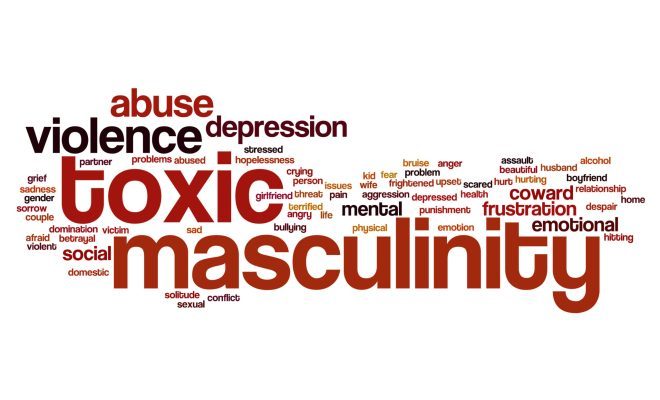
Growing up gay (even in the closet) one often doesn't fall into the toxic masculinity category although one is well aware of all that term encompasses. Indeed, if one is gay or rightly or wrongly targeted as gay, suddenly you become a preferred target of the toxic masculinity of your peers and classmates. The result can become that you strive ever so hard to "pass" and be one of the guys. The emotional cost can be extreme and the effort difficult if you do not excel in team sports. I did not and was saved by the fact that I was lucky enough to have a family that owned a summer home and was vested in snow skiing which gave me the opportunity to excel at water skiing, sailing, snow skiing and other things that compensated for my other team sports deficiency. Despite my "lucky breaks," high school was one of the most horrible periods of my life. Most boys are not as lucky as I was and, as lengthy piece in
The Atlantic lays out, America is suffering a crisis in the way boys are socialized and too often emotionally stunted and not allowed to be fully human. The "jock culture" in particular leads to misogyny all to often. With two young grandsons, I do not want to see their personalities stifled and warped by America's cult of toxic masculinity. How this problem can be fixed is difficult to answer, particularly since so many fathers are victims of the same forces. Here are article highlights:
I’ve spent two years talking with boys across
America—more than 100 of them between the ages of 16 and 21—about masculinity,
sex, and love: about the forces, seen and unseen, that shape them as men.
Though I spoke with boys of all races and ethnicities, I stuck to those who
were in college or college-bound, because like it or not, they’re the ones most
likely to set cultural norms. Nearly every guy I interviewed held relatively
egalitarian views about girls, at least their role in the public sphere. They
considered their female classmates to be smart and competent, entitled to their
place on the athletic field and in school leadership, deserving of their
admission to college and of professional opportunities. They all had female
friends; most had gay male friends as well. That was a huge shift from what you
might have seen 50, 40, maybe even 20 years ago. They could also easily reel
off the excesses of masculinity. They’d seen the headlines about mass
shootings, domestic violence, sexual harassment, campus rape, presidential
Twitter tantrums, and Supreme Court confirmation hearings. A Big Ten football
player I interviewed bandied about the term toxic masculinity. “Everyone
knows what that is,” he said, when I seemed surprised.
Yet when asked
to describe the attributes of “the ideal guy,” those same boys appeared to be
harking back to 1955. Dominance. Aggression. Rugged good looks (with an
emphasis on height). Sexual prowess. Stoicism. Athleticism. Wealth (at least
some day). It’s not that all
of these qualities, properly channeled, are bad. But while a 2018 national
survey of more than 1,000 10-to-19-year-olds commissioned by Plan
International USA and conducted by the polling firm PerryUndem found that young
women believed there were many ways to be a girl—they could shine in math,
sports, music, leadership (the big caveat being that they still felt valued primarily
for their appearance)—young men described just one narrow route to successful
masculinity.* One-third
said they felt compelled to suppress their feelings, to “suck it up” or “be a
man” when they were sad or scared, and more than 40 percent said that when they
were angry, society expected them to be combative. In another survey, which
compared young men from the U.S., the U.K., and Mexico, Americans reported more
social pressure to be ever-ready for sex and to get with as many women as
possible; they also acknowledged more stigma against homosexuality, and they
received more messages that they should control their female partners, as in:
Men “deserve to know” the whereabouts of their girlfriends or wives at all
times.
Feminism may
have provided girls with a powerful alternative to conventional femininity, and
a language with which to express the myriad problems-that-have-no-name, but
there have been no credible equivalents for boys. Quite the contrary: The
definition of masculinity seems to be in some respects contracting. When
asked what traits society values most in boys, only 2 percent of male
respondents in the PerryUndem survey said honesty and morality, and only 8
percent said leadership skills—traits that are, of course, admirable in anyone
but have traditionally been considered masculine. When I asked my subjects, as
I always did, what they liked about being a boy, most of them drew a blank.
“Huh,” mused Josh, a college sophomore at Washington State. (All the teenagers
I spoke with are identified by pseudonyms.) “That’s interesting. I never really
thought about that. You hear a lot more about what is wrong with guys.”
While following
the conventional script may still bring social and professional rewards to boys
and men, research shows that those who rigidly adhere to certain masculine
norms are not only more likely to harass and bully others but to themselves
be victims of verbal or physical violence. They’re more prone to binge-drinking,
risky sexual behavior, and getting in car accidents. They are also less happy
than other guys, with higher depression rates and fewer friends in whom they
can confide.
It wasn’t always
thus. According to Andrew Smiler, a psychologist who has studied the history of
Western masculinity, the ideal late-19th-century man was compassionate, a
caretaker, but such qualities lost favor as paid labor moved from homes to
factories during industrialization. In fact, the Boy Scouts, whose creed urges
its members to be loyal, friendly, courteous, and kind, was founded in 1910 in
part to counter that dehumanizing trend. Smiler attributes further distortions
in masculinity to a century-long backlash against women’s rights. During World
War I, women proved that they could keep the economy humming on their own, and
soon afterward they secured the vote. Instead of embracing gender equality, he
says, the country’s leaders “doubled down” on the inalienable male right to
power, emphasizing men’s supposedly more logical and less emotional nature as a
prerequisite for leadership.
Then, during the
second half of the 20th century, traditional paths to manhood—early marriage,
breadwinning—began to close, along with the positive traits associated with
them. Today many parents are unsure of how to raise a boy, what sort of
masculinity to encourage in their sons. But as I learned from talking with boys
themselves, the culture of adolescence, which fuses hyperrationality with
domination, sexual conquest, and a glorification of male violence, fills the
void.
For Cole, as for
many boys, this stunted masculinity is a yardstick against which all choices,
even those seemingly irrelevant to male identity, are measured. When he had a
choice, he would team up with girls on school projects, to avoid the
possibility of appearing subordinate to another guy. “With a girl, it feels
safer to talk and ask questions, to work together or to admit that I did
something wrong and want help,”
There is no difference between the sexes’ need for connection
in infancy, nor between their capacity for empathy—there’s actually some
evidence that male infants are
more expressive than females. Yet, from the get-go, boys are relegated to
an impoverished emotional landscape. . . . Despite that, according to Judy Y.
Chu, a human-biology lecturer at Stanford who conducted a study of boys from
pre-K through first grade, little boys have a keen understanding of emotions
and a desire for close relationships. But by age 5 or 6, they’ve learned to
knock that stuff off, at least in public: to disconnect from feelings of
weakness, reject friendships with girls (or take them underground, outside of
school), and become more hierarchical in their behavior.
By adolescence,
says the Harvard psychologist William Pollack, boys become “shame-phobic,”
convinced that peers will lose respect for them if they discuss their personal
problems. My conversations bore this out. Boys routinely confided that they
felt denied—by male peers, girlfriends, the media, teachers, coaches, and
especially their fathers—the full spectrum of human expression. . . . . Cole
spoke of his mom with unbridled love and respect. His father was another
matter. “He’s a nice guy,” Cole said—caring and involved, even after the
divorce—“but I can’t be myself around him. I feel like I need to keep
everything that’s in here”—Cole tapped his chest again—“behind a wall, where he
can’t see it. It’s a taboo—like, not as bad as incest, but …”
Other boys also
pointed to their fathers as the chief of the gender police, though in a less
obvious way. . . . “there’s a block there. There’s a hesitation, even though I
don’t like to admit that. A hesitation to talk about … anything, really. We
learn to confide in nobody. You sort of train yourself not to feel.”
Only after
multiple interviews did I realize that when boys confided in me about
crying—or, even more so, when they teared up right in front of me—they were
taking a risk, trusting me with something private and precious: evidence of
vulnerability, or a desire for it. Or, as with Rob, an inability to acknowledge
any human frailty that was so poignant, it made me want to, well, cry.
I was struck by
how many had dropped athletics they’d enjoyed because they couldn’t stand the Lord
of the Flies mentality of teammates or coaches. Perhaps the most extreme
example was Ethan, a kid from the Bay Area who had been recruited by a small
liberal-arts college in New England to play lacrosse. He said he’d expected to
encounter the East Coast “ ‘lax bro’ culture,” but he’d underestimated its
intensity. “It was all about sex” and bragging about hooking up, and even the
coaches endorsed victim-blaming, Ethan told me. “They weren’t like that in
class or around other people; it was a super-liberal school. But once you got
them in the locker room …” He shook his head. “It was one of the most jarring
experiences of my life.” . . . So he quit the team; not only that, he
transferred. “If I’d stayed, there would’ve been a lot of pressure on me to
play, a lot of resentment, and I would’ve run into those guys all the time.
This way I didn’t really have to explain anything.” At his new school, Ethan
didn’t play lacrosse, or anything else.
What the longtime
sportswriter Robert Lipsyte calls “jock culture” (or what the boys I talked
with more often referred to as “bro culture”) is the dark underbelly of
male-dominated enclaves, whether or not they formally involve athletics:
all-boys’ schools, fraternity houses, Wall Street, Silicon Valley, Hollywood,
the military. Even as such groups promote bonding, even as they preach honor,
pride, and integrity, they tend to condition young men to treat anyone who is
not “on the team” as the enemy (the only women who ordinarily make the cut are
blood relatives— bros before hos!), justifying any hostility toward
them. Loyalty is paramount, and masculinity is habitually established through
misogynist language and homophobia.
Just because
some young men now draw the line at referring to someone who is openly gay as a
fag doesn’t mean, by the way, that gay men (or men with traits that read as
gay) are suddenly safe. If anything, the gay guys I met were more conscious of
the rules of manhood than their straight peers were. They had to be—and because
of that, they were like spies in the house of hypermasculinity.
Guys who
identify as straight but aren’t athletic, or are involved in the arts, or have
a lot of female friends, all risk having their masculinity impugned. What has
changed for this generation, though, is that some young men, particularly if
they grew up around LGBTQ people, don’t rise to the bait. “I don’t mind when
people mistake me for being gay,” said Luke, a high-school senior from New York
City. “It’s more of an annoyance than anything, because I want people to
believe me when I say I’m straight.” The way he described himself did, indeed,
tick every stereotypical box. “I’m a very thin person,” he said. “I like
clothing. I care about my appearance in maybe a more delicate way. I’m very in
touch with my sensitive side. So when people think I’m gay?” He shrugged. “It
can feel like more of a compliment. Like, ‘Oh, you like the way I dress? Thank
you! ’ ”
Sexual conquest—or perhaps more specifically, bragging
about your experiences to other boys—is, arguably, the most crucial aspect of
toxic masculinity. . . . there’s this “race for experience,” because if you get
behind, by the time you do hook up with a girl “she’ll have hit it with, like,
five guys already. Then she’s going to know how to do things” you don’t—and
that’s a problem, if she tells people “you’ve got floppy lips” or “don’t know
how to get her bra off.”
No matter how often I heard it, the brutal language that
even a conscientious young man like Nate used to describe sexual contact—you
hit that!—always unnerved me. In mixed-sex groups, teenagers may talk about
hooking up (already impersonal), but when guys are on their own, they nail,
they pound, they bang, they smash, they hammer. They tap that ass, they tear
her up. It can be hard to tell whether they have engaged in an intimate act or
just returned from a construction site.
It’s not like I
imagined boys would gush about making sweet, sweet love to the ladies, but why
was their language so weaponized ? The answer, I came to believe, was
that locker-room talk isn’t about sex at all, which is why guys were ashamed to
discuss it openly with me. The (often clearly exaggerated) stories boys tell
are really about power: using aggression toward women to connect and to
validate one another as heterosexual, or to claim top spots in the adolescent
sexual hierarchy. Dismissing that as “banter” denies the ways that language can
desensitize—abrade boys’ ability to see girls as people deserving of respect
and dignity in sexual encounters.
Boys may know
when something is wrong; they may even know that true manhood—or maybe just
common decency—compels them to speak up. Yet, too often, they fear that if they
do, they’ll be marginalized or, worse, themselves become the target of derision
from other boys. Masculinity, then, becomes not only about what boys do say,
but about what they don’t—or won’t, or can’t—say, even when they wish
they could. The psychologists Dan Kindlon and Michael Thompson, the authors of Raising
Cain: Protecting the Emotional Life of Boys, have pointed out that silence
in the face of cruelty or sexism is how too many boys become men.
[I]t’s time to
rethink assumptions about how we raise boys. That will require models of
manhood that are neither ashamed nor regressive, and that emphasize emotional
flexibility—a hallmark of mental health. Stoicism is valuable sometimes, as is
free expression; toughness and tenderness can coexist in one human. In the
right context, physical aggression is fun, satisfying, even thrilling. If your
response to all of this is Obviously, I’d say: Sure, but it’s a mistake
to underestimate the strength and durability of the cultural machinery at work
on adolescent boys. Real change will require a sustained, collective effort on
the part of fathers, mothers, teachers, coaches.
Personally, I am not optimistic. Too many fathers and coaches are a major part of the problem. Yet, if things do not change, we can expect more Donald Trumps and misogynists and the dangers they pose to society and the world.




/media/img/2020/06/23/Atlantic_America_slump_v1/original.png)