Showing posts with label broken healthcare system. Show all posts

Sunday, June 28, 2020

The Decline of the American World

If one surveys the so-called great powers over the course of history, all eventually fade and give way to successor powers - e.g, the Persian Empire, the Roman Empire, the Byzantine Empire, Spain. France, the British Empire,  Some have fallen due to military might of other nations, yet most have also declined due to internal problems and a failure/refusal to address the problems.  Of course, there is also the issue of failed leadership that has served to exacerbate internal and external threats and problems. A very long piece The Atlantic looks at America as it seemingly finds itself a such a cross roads with a totally unfit occupant in the White House who serves only to worsen external and internal threats. Compounding the situation is America's long history of refusing to be honest about its history and its moral failings that are all too often swept under the myth of American exceptionalism.  Another four more years of Trump in the White House would only serve to further accelerate America;s decline.  Already, the damage done has been incalculable.  Here are article highlights:

“He hated America very deeply,” John le Carré wrote of his fictional Soviet mole, Bill Haydon, in Tinker Tailor Soldier Spy. Haydon had just been unmasked as a double agent at the heart of Britain’s secret service, one whose treachery was motivated by animus, not so much to England but to America. “It’s an aesthetic judgment as much as anything,” Haydon explained, before hastily adding: “Partly a moral one, of course.”
I thought of this as I watched the scenes of protest and violence over the killing of George Floyd spread across the United States and then here in Europe and beyond. . . . . The beauty of America seemed to have gone, the optimism and charm and easy informality that entrances so many of us from abroad.
At one level, the ugliness of the moment seems a trite observation to make. And yet it gets to the core of the complicated relationship the rest of the world has with America.
Le Carré’s reflection on the motivations of anti-Americanism—bound up, as they are, with his own ambivalent feelings about the United States—are as relevant today as they were in 1974, when the novel was first published. Where there was then Richard Nixon, there is now Donald Trump, a caricature of what the Haydons of this world already despise: brash, grasping, rich, and in charge. In the president and first lady, the burning cities and race divides, the police brutality and poverty, an image of America is beamed out, confirming the prejudices that much of the world already have—while also serving as a useful device to obscure its own injustices, hypocrisies, racism, and ugliness.
It is hard to escape the feeling that this is a uniquely humiliating moment for America. As citizens of the world the United States created, we are accustomed to listening to those who loathe America, admire America, and fear America (sometimes all at the same time). But feeling pity for America? That one is new, even if the schadenfreude is painfully myopic. If it’s the aesthetic that matters, the U.S. today simply doesn’t look like the country that the rest of us should aspire to, envy, or replicate.
Even in previous moments of American vulnerability, Washington reigned supreme. Whatever moral or strategic challenge it faced, there was a sense that its political vibrancy matched its economic and military might, that its system and democratic culture were so deeply rooted that it could always regenerate itself. It was as if the very idea of America mattered . . . Now, something appears to be changing. America seems mired, its very ability to rebound in question. A new power has emerged on the world stage to challenge American supremacy—China—with a weapon the Soviet Union never possessed: mutually assured economic destruction.
For the United States, this cultural dominance is both an enormous strength and a subtle weakness. It draws in talented outsiders to study, build businesses, and rejuvenate itself, molding and dragging the world with it as it does, influencing and distorting those unable to escape its pull. Yet this dominance comes with a cost: The world can see into America, but America cannot look back. And today, the ugliness that is on display is amplified, not calmed, by the American president.
America’s closest allies are looking on with a kind of stunned incomprehension, unsure of what will happen, what it means, and what they should do, largely bound together with angst and a shared sense, as one influential adviser told me, that America and the West are approaching something of a fin de siècle.
[T]he confluence of recent events and modern forces has made the present challenge particularly dangerous. The street protests, violence, and racism of the past few weeks have erupted at the very moment the country’s institutional failings have been exposed by the COVID-19 pandemic, reinforced by its apparently unbridgeable partisan divide, which is now even infecting parts of the American machine that have so far been untouched: its federal agencies, diplomatic service, and the long-standing norms underpinning the relationship between civilians and the military. All of this is happening in the final year of the first term of the most chaotic, loathed, and disrespected president in modern American history.
Most of those I spoke to were, however, clear that Trump’s leadership has brought these currents—in tandem with the pressure of relative economic decline, the rise of China, the reemergence of great-power politics, and the decline of the West as a spiritual union—to a head in a manner and speed previously unimaginable.
[T]he nadir of American prestige has, until now, been the revelations of torture and abuse inside the Abu Ghraib prison near Baghdad in 2004. “Today, it is much worse,” he said. What makes things different now, according to Duclos, is the extent of division within the United States and the lack of leadership in the White House. “We live with the idea that the U.S. has an ability to rebound that is almost unlimited,” Duclos said. “For the first time, I’m starting to have some doubts.”
Put bluntly, Trump is unique. At the most basic level, Bush never recoiled from the core idea that there was a Western song, and that the lyrics should be composed in Washington. Trump today hears no unifying music—only the dull beat of self-interest.
One senior adviser to a European leader, who did not want to be named relating private deliberations, told me that Continental snobbery at the notion of American leadership of the free world, of the “American Dream” and other clichés dismissed until now as hopelessly naive, has suddenly been exposed by Trump’s cynicism.
Those that I spoke to divided their concerns, implicitly or explicitly, into those caused by Trump and those exacerbated by him—between the specific problems of his presidency that, in their view, can be rectified, and those that are structural and much more difficult to solve. Almost everyone I spoke to agreed that the Trump presidency has been a watershed not just for the U.S. but for the world itself: It is something that cannot be undone. Words once said cannot be unsaid; images that are seen are unable to be unseen.
The immediate concern for many of those I interviewed was the apparent hollowing out of American capacity. Lawrence Freedman, a professor of war studies at King’s College London, told me the institutions of American power themselves have been “battered.” The health system is struggling, the municipalities are financially broke, and, beyond the police and the military, little attention is being paid to the health of the state itself. Worst of all, he said, “they don’t know how to fix it.”
A European ambassador told me Trump himself is an expression of American decline. “Choosing Trump is a way of not very successfully adapting to the globalized world,” the diplomat, who asked for anonymity, said. It is a sign of the United States following other great powers downward, . . . . “The Netherlands were the dominant global power in the 18th century. Today they are a successful country, but they have simply lost their power. To some extent the U.K. and France are on the journey to become the Netherlands, and the U.S. is on the journey to be Britain and France.” . . . “The collapse of the American Empire is a given; we are just trying to figure out what will replace it.”
America’s problem is that the rest of the world can see when it has fallen below its achievements. In moments such as the current one, it is hard to dispute some of the criticisms leveled by the country’s most vociferous critics from abroad: that it is irredeemably racist or overly ambivalent to poverty and violence, police brutality and guns. The rights and wrongs don’t appear particularly complicated in this dilemma, even if the country itself is.

Monday, March 23, 2020

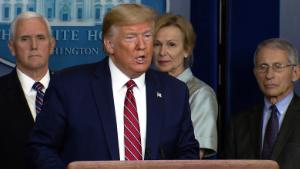
Governors in Growing Uproar over Trump’s Lagging Coronavirus Response

In November 2016, a majority of voters recognized that Donald Trump was unfit for office - hence Hillary Clinton's 3 million more votes in the popular vote. Now, when the nation faces an unprecedented crisis, Trump's unfitness is on daily display.  His "press conferences" are a stream of lies, boasting and preening, and a failure to show any leadership.  His racist and right wing Christian agenda is not going to save the nation from what it faces and hopefully the members of his base will begin to realize they were played for fools.  As Trump fails to lead and exercise powers that might better coordinate the national response to the COVID-19 crisis, governors, mayors and hospital CEO are being left to fend for themselves. A piece in the Washington Post looks at Trump's massive failure.  Here are highlights:

President Trump’s response to the coronavirus pandemic sparked uproar and alarm among governors and mayors on Sunday as Trump and his administration’s top advisers continued to make confusing statements about the federal government’s scramble to confront the crisis, including whether he will force private industry to mass produce needed medical items.
As deaths climbed and ahead of a potentially dire week, Trump — who has sought to cast himself as a wartime leader — reacted to criticism that his administration has blundered with a torrent of soaring boasts and searing grievances.
[T]he growing gulf between the White House and officials on the front lines of the pandemic underscored concerns in cities, states and Congress that Trump does not have a coherent or ready plan to mobilize private and public entities to confront a crisis that could soon push the nation’s health-care system to the brink of collapse.
“We’re all building the airplane as we fly it right now,” Michigan Gov. Gretchen Whitmer (D) said on ABC’s “This Week.” “It would be nice to have a national strategy.”
Federal Emergency Management Agency Administrator Peter T. Gaynor said Sunday the president has not yet invoked the Defense Production Act, which would allow the government to order companies to ramp up the production of ventilators and protective masks, among other products.
Gaynor’s remarks directly contradicted what Trump told reporters on Friday, when he said he had “invoked” the law and “put it into gear” — and were coupled with vague optimism about corporate America’s ability to do what is necessary without being compelled by an executive order.
Major auto companies signaled last week that they are studying the feasibility of making ventilators but made no promises about the pace of production, should it begin. A spokesperson for Ford said, “Ford stands ready to help the administration in any way we can, including the possibility of producing ventilators and other equipment.”
There are many obstacles. Ford, General Motors and Fiat Chrysler — the Big Three automakers — have suspended production at their North American plants through at least the end of March because of the coronavirus and after union leaders sought that pause.
The administration’s sunny outlook about companies’ ability to act was met with sharp disagreement from governors facing mounting illness and deaths from covid-19, the disease caused by the novel coronavirus.
“We need the product now,” Cuomo said at a news conference on Sunday. “We have cries from hospitals around the state. I’ve spoken to governors around the country, and they’re in the same situation.”
New York Mayor Bill de Blasio announced Sunday that there are now 8,000 cases in his city, with 60 deaths. He pleaded with Trump to deploy the military to the nation’s financial capital, home to more than 8 million people.
“April is going to be a lot worse than March, and May could be worse than April,” de Blasio said. “We are very much on our own at this point.”
Many governors and mayors said they feel ill-equipped for the coming storm, particularly the expected deluge of patients at hospitals and health centers.
Pritzker [of Illinois] said on CNN that his state has received about a quarter of the personal protective equipment it has ordered from the federal government.
“I’ve got people working the phones calling across the world, frankly, to get this stuff to Illinois,” Pritzker said, as he worried that states are probably “overpaying” in part because of the lack of decisive action by Trump.
Democrats were not Trump’s lone critics on Sunday. Maryland Gov. Larry Hogan, a centrist Republican, said the Trump administration, through FEMA, “has to take the lead” in securing medical items.
“We are getting some progress. Now, it’s not nearly enough. It’s not fast enough. We’re way behind the curve,” Hogan said on NBC’s “Meet the Press,” as he detailed how Maryland is scrambling to find supplies without any guarantees from the federal government.
Turmoil at hospitals is challenging governors by the hour. Speaking Sunday on CBS, Richard Pollack, president of the American Hospital Association, said “the most immediate thing we need is personal protective equipment: the masks, the gowns, the goggles, that type of equipment to protect our health-care heroes that are on the front lines. That is what is most essential now. If we don’t protect our health-care workers, the system will completely collapse.”
Former Pentagon officials who handled Defense Production Act policy for Democratic and Republican administrations said the Trump administration has so far made little use of the law.
“All of this should have started months ago, so we are behind,” said Bill Greenwalt, a defense consultant who led acquisition policy in the George W. Bush administration. “On production, I think we will find out that our base is not capable of producing what we need as I expect much of it has been outsourced to China and elsewhere.”
Trump — who will be judged by voters at the polls in eight months — also faced criticism from former vice president Joe Biden, the delegate leader for the Democratic presidential nomination, who issued a statement in response to Gaynor’s interview on CNN.
“Mr. President, stop lying and start acting,” Biden said. “Use the full extent of your authorities, now, to ensure that we are producing all essential goods and delivering them where they need to go.”


This is not a reality TV show.  Lives and the nation's economy are at stake and Trump thinks he's still playing a part on The Apprentice.  Be very, very afraid.

Monday, December 02, 2019

Health Care Costs Are Killing the Middle Class

Any solution to the health care crisis in the United States must focus in part of slowing the soaring costs of health care and health insurance. Americans spend more on health insurance than in any other advance economy and the cost are rising faster than in any other advanced nation. The consequence is that the middle class is suffering an ever tightening financial squeeze as costs go up and more and more employers shift cost to employees. "Medicare for All" does nothing to lower much less slow soaring costs as a column in the Washington Post points out.  Rather, it merely shifts how skyrocketing costs are paid without addressing the underlying problem.  Obviously, one thing that needs to be done is to end the gouging of patients by the pharmaceutical industry.  Another is to end the empire building of hospital systems that focuses more on a monopoly game against other providers than on the delivery of medical services to patients.  Here are column excerpts:

The idea that most middle-class Americans have been treading water economically is conventional wisdom. It is already playing a role in the 2020 campaign, as the Democratic presidential candidates propose policies (Medicare-for-all, free college tuition at state schools, subsidies for child care, to mention a few) intended to relieve the financial stress on millions of middle-income families.
But the conventional wisdom is wrong — or at least misleading. Although the squeeze is not a myth, it’s highly localized: uncontrolled medical spending. This is crowding out other spending, from wages to defense budgets. If we don’t stabilize health costs (and there is little sign that we will), we should expect the squeeze to continue indefinitely. Income inequality would also probably worsen.
We now have a new study from economist Richard Burkhauser of Cornell University that illuminates health care’s peculiar role. . . . . In recent decades, the median income of U.S. households has grown slowly, stagnated or declined. In 2018, according to the Census Bureau, the median household income was $63,179; in 1999, it was $61,526.
But wait: The official figures don’t count health insurance, whether private or public (employer-paid insurance, Medicare and Medicaid — federal health coverage for the elderly and poor).
The simplest definition included labor income: wages, salaries, farm income and self-employment. Defined this way — and adjusted for inflation — median income has dropped 21 percent from 1970 to 2016. This explains why so many Americans feel squeezed.
However, that’s not the end of the story. A broader definition of income includes all labor income, interest and dividend payments, Social Security, other government transfers and — most important — the value of private and public health insurance. Under this definition, median income rose 68 percent from 1970 to 2016. By this definition — and reflecting the impact of health insurance — typical households have enjoyed a slow increase in living standards over nearly half a century. 
Which definition of income to believe? Why, both, of course.
We have the worst of both worlds. We don’t count health insurance as a form of earnings that would improve median income. . . . . because health spending is concentrated among a relatively small proportion of people. In 2016, the top 5 percent of patients accounted for half of all medical spending, according to data from the Kaiser Family Foundation. By contrast, the lowest 50 percent of spenders accounted for only 3 percent of total spending.
Sanders’s approach is self-defeating and ultimately undesirable. It makes us hostage to explosive health spending. We can’t control what we refuse to control. Almost any systematic effort to curb spending is subject to attack as cruel or immoral, despite the obvious reality that not all health spending is of the same value.
In the early 1960s, before Medicare and Medicaid, which were enacted in 1965, health spending was about 2 percent of federal outlays. Now it is nearly one-third, at $1.3 trillion.
Corporations compound the pressures on take-home pay as frustrated companies shift more health costs back on their employees through higher premiums and deductibles. This, too, intensifies the middle-class “squeeze.”
Total health spending is now about 18 percent of the economy (gross domestic product), about twice the level of many advanced societies.
The effects are felt keenly by middle-income Americans and the poor, because the high cost of modern medicine consumes more of their incomes. We have created a monster, inspired by good intentions, that is slowly and menacingly taking charge of our future.


Wednesday, October 23, 2019

Insurance Companies: A Major Problem in America's Health Care


Having gone through proton therapy and been on an expensive medication myself during the last year, I know first hand the problems most Americans face when seeking medical treatment.  One of the biggest is the effort by insurance companies to deny coverage and/or restrict permitted medications for the simple purpose of reducing payouts. The companies that happily take your premium payments simply do not want to have to pay out claims when their insureds need medical care or expensive medications.  In my own case, everything was eventually covered after protracted confrontations with my prescription insurance carrier.  Many are not so lucky and the reality is that most of us find non-medical personnel trying to dictate our medical care.  An op-ed in the Washington Post looks at this problem which, to me, is the reason a private for profit health insurance system without a significant challenge of a public option will never best serve individuals' and families' needs.  Here are column excerpts:
We know how important it is to have insurance so that we can get health care. As a physician, parent and patient, I cannot overemphasize that having insurance is not enough.
As a gastroenterologist, I often prescribe expensive medications or tests for my patients. But for insurance companies to cover those treatments, I must submit a “prior authorization” to the companies, and it can take days or weeks to hear back.
Because it ends up with the desired outcome, you might think this is reasonable. It’s not. On most occasions the “peer” reviewer is unqualified to make an assessment about the specific services. They usually have minimal or incorrect information about the patient. Not one has examined or spoken with the patient, as I have. None of them have a long-term relationship with the patient and family, as I have.
The insurance company will say this system makes sure patients get the right medications. It doesn’t. It exists so that many patients will fail to get the medications they need.
I’ve dealt with this system from the patient side, as well. My daughter has a rare genetic disorder . . . She receives applied behavior analysis therapy, an approach often used for autism, and which has been wildly successful in improving her skills and communication. But recently, our health insurer reduced the amount of therapy they thought she needed.
I probably have better access than almost anyone else can get, yet the ability of my daughter’s providers to mitigate denials for services they deem appropriate is slow and often ineffective.
My daughter can languish for months or years not receiving care that every highly qualified person who treats her agrees she needs. While we wait, the window to give her a little bit more function, a little bit less suffering and a little better life gets smaller.
Consumers have a right to appeal denials for health-care services, but regulations still largely focus on the process, not the content. For instance, insurers are required to notify you in writing of a denial, and patients have the right to an internal appeal; if that fails, some states also allow for an external review.
Insurance companies know that many patients don’t bother to appeal at all. A smaller fraction ask for an internal review, and still fewer seek or even know about external review options available in most states. Of the cases that do end up under external review, almost a third of all insurer denials are overturned. This is clear proof that whatever process insurers have to determine medical necessity is often not in line with medical opinion. A study of emergency room visits found that when one insurance company denied visits as being “not emergencies,” more than 85 percent of them met a “prudent layperson” standard for coverage.
This is a system that saves insurance companies money by reflexively denying medical care that has been determined necessary by a physician. And it should come as no surprise that denials have a disproportionate effect on vulnerable patient populations, such as sexual-minority youths and cancer patients.
When an insurance company reflexively denies care and then makes it difficult to appeal that denial, it is making health-care decisions for patients. In other words, insurance officials are practicing medicine without accepting the professional, personal or legal liability that comes with the territory.
We don’t have to put up with this. Health care in the United States is shockingly opaque; it’s time to take insurance companies out of our decision-making process.

Monday, June 17, 2019

Broken Health Care: As Insulin Cost Soars, Americans Drive to Canada

The myth continues that America has the best health care in the world.  To the extent this myth is true, it applies only to the very wealthy to whom cost is no obstacle. For millions of other Americans, even those with insurance, the system remains severely broken and remains a drive force in pushing individuals into bankruptcy.  Even if one does not need surgery or an extended hospital stay, prescription drug costs are sky high, often even for generic brands - I recently paid $545.00 for a generic drug that I need to deal with side effects of my proton therapy AFTER my insurance company made its co-pay.  Unlike so many others, I fortunately will not need to keep getting refills.  In the case of insulin, those who need it, need it it on a continuing basis and American pharmaceutical companies are proving to be rapacious at best.   Meanwhile, the federal government does nothing to bring down costs.  As a piece in the Washington Post reports, some Americans now travel to Canada to get insulin at one tenth (1/10th) the cost paid in the USA.  Here are highlights:

As their minivan rolled north, they felt their nerves kick in — but they kept on driving.  At the wheel: Lija Greenseid, a rule-abiding Minnesota mom steering her Mazda5 on a cross-border drug run.
Her daughter, who is 13, has Type 1 diabetes and needs insulin. In the United States, it can cost hundreds of dollars per vial. In Canada, you can buy it without a prescription for a tenth of that price.
So, Greenseid led a small caravan last month to the town of Fort Frances, Ontario, where she and five other Americans paid about $1,200 for drugs that would have cost them $12,000 in the United States.  “It felt like we were robbing the pharmacy,” said Quinn Nystrom, a Type 1 diabetic who joined the caravan that day. “It had been years since I had 10 vials in my hands.”
Like millions of Americans, Greenseid and Nystrom are stressed and outraged by the rising costs of prescription drugs in the United States — a problem Republicans and Democrats alike have promised to fix.
Insulin is a big part of the challenge. More than 30 million Americans have diabetes, according to the American Diabetes Association. About 7.5 million, including 1.5 million with Type 1 diabetes, rely on insulin.
Between 2012 and 2016, the cost of insulin for treating Type 1 diabetes nearly doubled, according to the nonprofit Health Care Cost Institute.
Some pharmaceutical companies, under pressure from U.S. lawmakers, have tried to reduce the cost for some patients. But many who rely on insulin still struggle. Large numbers resort to rationing — a dangerous and sometimes deadly practice.
Some diabetics and their families are taking matters into their own hands. They meet in coffee shops and strip mall parking lots to exchange emergency supplies. An unknown number travel outside the country to buy the lifesaving drug for less.
None of this is recommended by U.S. officials, and some of it might be illegal under Food and Drug Administration guidelines. But the organizers of the caravan — their word, a nod to the migrants traveling in groups through Mexico to the U.S. border — are speaking out about their trip because they want Americans to see how drug prices push ordinary people to extremes.
“When you have a bad health-care system, it makes good people feel like outlaws,” Greenseid said.
Barry Power, director of therapeutic content with the Canadian Pharmacists Association, said the group is tracking both U.S. drug-buying proposals and reports of cross-border trade closely but has yet to see a disruption to Canadian insulin supplies.
He said insulin prices in Canada are controlled through policy, including price caps and negotiations with manufacturers.  “This is something the U.S. could do,” he said.
Elizabeth Pfiester is founder and executive director of T1International, a British-based nonprofit that advocates for people with Type 1 diabetes around the world.
“It’s kind of a myth that America has the best health-care system in the world, because it is set up to allow Americans to go bankrupt or die because they can’t afford their medicine,” she said.
Pfiester grew up in the United States. One of the reasons her organization is based overseas, she said, is that the cost of treating her diabetes in the United States is so high.
They see buying in Canada as a short-term emergency measure and a way to call attention to U.S. pricing — not the answer.
“I don’t think that the solution is going outside the United States,” Greenseid said. “The reason they have lower prices is because they have put in regulations to make sure their citizens are not paying too much. We have not yet made that decision in the U.S.”
LaShawn McIver is senior vice president for government affairs and advocacy at the American Diabetes Association.  “Insulin is not a luxury, it is a matter of life and death,” she wrote in an emailed statement. “Action to reduce the high out-of-pocket costs that endanger the lives of the millions of Americans who depend on this medication is critical and urgently needed.”

Sunday, May 05, 2019

The Health-Care Crisis Has Spread to Employer Plans

America continues to have the most expensive, least efficient healthcare system - if one can even call it a system, given its fragmented nature - where people pay vastly more for the same procedures than people in Canada or Europe.  Add to that the ungodly high prescription drug costs that allow pharmaceutical companies in the USA to price gouge consumers, and it is a recipe for financial hardship for many who find themselves deferring care because they cannot pay policy deductibles.  While the focus of the Affordable Health Care Act was to bring insurance to the uninsured, a growing crisis is developing under employer based plans that are using ever increasing deductibles and prescription limitations as a means to cope with soaring costs.  It's little wonder that life expectancy is falling in the USA.  A piece in New York Magazine looks at the growing crisis.  Here are article excerpts:  

For most of this century, the big U.S. health-care policy issue has been providing insurance to the uninsured, including the uninsurable people with expensive health conditions. Yes, the majority of non-elderly Americans covered by employer-based insurance were affected by this debate insofar as sharing the costs of more universal coverage would increase their premiums and/or taxes. But for the most part, Americans were relatively happy with the insurance they got at work.
That’s changing, as is graphically illustrated by a major new survey conducted by the Los Angeles Times and the Kaiser Family Foundation that shows insurance deductibles, co-pays, and other “cost sharing” requirements by insurers are putting the squeeze on affected policyholders in a big way.
As the Times’ Noam Levy explains, the rise of deductibles has been dramatic:
In the last 12 years, annual deductibles in job-based health plans have nearly quadrupled and now average more than $1,300 [family coverage deductibles are far higher].
Yet Americans’ savings are not keeping pace, data show. And more than four in 10 workers enrolled in a high-deductible plan report they don’t have enough savings to cover the deductible.
One in six Americans who get insurance through their jobs say they’ve had to make “difficult sacrifices” to pay for healthcare in the last year, including cutting back on food, moving in with friends or family, or taking extra jobs. And one in five say healthcare costs have eaten up all or most of their savings.
And that’s not even counting those who skip care they need because they cannot afford to pay their “share” of steadily rising medical bills.  When people don’t get essential care, of course, insurance has failed everyone other than the insurer itself. And while everyone was aware cost-sharing requirements were steadily increasing, it did sneak up on policy-makers whose attention was elsewhere:
The 2010 healthcare law — often called Obamacare — provided landmark protections to Americans once shut out of health coverage. But as Democrats and Republicans fought over the law, Altman said, neither focused on the rapid run-up in costs for people covered through work.
But this was by no means accidental. High-deductible insurance plans were promoted both by the industry and by conservative politicians: . . . . Backers of the high-deductible strategy nevertheless argued that patients, given “skin in the game,” would become active consumers who would force drugmakers, hospitals and other medical providers to rein in prices.
If that sounds familiar to consumers of political rhetoric, it’s because Republicans have long promoted patient-driven competition as a health-care cost panacea, usually through a combination of high-deductible insurance plans and tax-preferred health savings accounts designed to help consumers save for out-of-pocket costs.
Guess who got left holding the bag? That’s right, the employees, who were essentially victims of a bait and switch.  Now, suddenly, people with employer-sponsored health insurance have more to worry about than fighting managed care and/or maintaining the right to choose doctors
This shift in sentiment also helps explain why Medicare for All is so popular an idea. Yes, seamless universal coverage is attractive, but getting rid of deductible, co-pays, and even (in the more generous proposals) premiums could be an even bigger deal. It’s enough to make proponents of “skin in the game” nervous:
Even former Utah Gov. Mike Leavitt, a Republican who supported the move to higher deductibles as Health and Human Services secretary in the George W. Bush administration, acknowledged that adjustments may be needed, even if returning to the days of no-deductible coverage is not the solution.
“There needs to be a way to relieve the pressure,” Leavitt said. “Otherwise, people will feel like they have no insurance at all.”
Exactly.