Showing posts with label Medicare for all. Show all posts

Monday, December 02, 2019

Health Care Costs Are Killing the Middle Class

Any solution to the health care crisis in the United States must focus in part of slowing the soaring costs of health care and health insurance. Americans spend more on health insurance than in any other advance economy and the cost are rising faster than in any other advanced nation. The consequence is that the middle class is suffering an ever tightening financial squeeze as costs go up and more and more employers shift cost to employees. "Medicare for All" does nothing to lower much less slow soaring costs as a column in the Washington Post points out.  Rather, it merely shifts how skyrocketing costs are paid without addressing the underlying problem.  Obviously, one thing that needs to be done is to end the gouging of patients by the pharmaceutical industry.  Another is to end the empire building of hospital systems that focuses more on a monopoly game against other providers than on the delivery of medical services to patients.  Here are column excerpts:

The idea that most middle-class Americans have been treading water economically is conventional wisdom. It is already playing a role in the 2020 campaign, as the Democratic presidential candidates propose policies (Medicare-for-all, free college tuition at state schools, subsidies for child care, to mention a few) intended to relieve the financial stress on millions of middle-income families.
But the conventional wisdom is wrong — or at least misleading. Although the squeeze is not a myth, it’s highly localized: uncontrolled medical spending. This is crowding out other spending, from wages to defense budgets. If we don’t stabilize health costs (and there is little sign that we will), we should expect the squeeze to continue indefinitely. Income inequality would also probably worsen.
We now have a new study from economist Richard Burkhauser of Cornell University that illuminates health care’s peculiar role. . . . . In recent decades, the median income of U.S. households has grown slowly, stagnated or declined. In 2018, according to the Census Bureau, the median household income was $63,179; in 1999, it was $61,526.
But wait: The official figures don’t count health insurance, whether private or public (employer-paid insurance, Medicare and Medicaid — federal health coverage for the elderly and poor).
The simplest definition included labor income: wages, salaries, farm income and self-employment. Defined this way — and adjusted for inflation — median income has dropped 21 percent from 1970 to 2016. This explains why so many Americans feel squeezed.
However, that’s not the end of the story. A broader definition of income includes all labor income, interest and dividend payments, Social Security, other government transfers and — most important — the value of private and public health insurance. Under this definition, median income rose 68 percent from 1970 to 2016. By this definition — and reflecting the impact of health insurance — typical households have enjoyed a slow increase in living standards over nearly half a century. 
Which definition of income to believe? Why, both, of course.
We have the worst of both worlds. We don’t count health insurance as a form of earnings that would improve median income. . . . . because health spending is concentrated among a relatively small proportion of people. In 2016, the top 5 percent of patients accounted for half of all medical spending, according to data from the Kaiser Family Foundation. By contrast, the lowest 50 percent of spenders accounted for only 3 percent of total spending.
Sanders’s approach is self-defeating and ultimately undesirable. It makes us hostage to explosive health spending. We can’t control what we refuse to control. Almost any systematic effort to curb spending is subject to attack as cruel or immoral, despite the obvious reality that not all health spending is of the same value.
In the early 1960s, before Medicare and Medicaid, which were enacted in 1965, health spending was about 2 percent of federal outlays. Now it is nearly one-third, at $1.3 trillion.
Corporations compound the pressures on take-home pay as frustrated companies shift more health costs back on their employees through higher premiums and deductibles. This, too, intensifies the middle-class “squeeze.”
Total health spending is now about 18 percent of the economy (gross domestic product), about twice the level of many advanced societies.
The effects are felt keenly by middle-income Americans and the poor, because the high cost of modern medicine consumes more of their incomes. We have created a monster, inspired by good intentions, that is slowly and menacingly taking charge of our future.


Tuesday, November 26, 2019

Medicare for All: Political Kryptonite

Giving away my age, I will admit that I like Medicare.  The coverage is far better than when I had private health care insurance and the premiums are considerably lower even when paying extra for supplemental and prescription drug coverage.  It also demonstrates how a public option for those who want it - something Pete Buttigieg is pushing in his campaign - could at last force serious competition on private health insurance companies which typically give would be subscribers arrays of plans that are near impossible to compare side by side but all of which are expensive and leave individuals choosing their preferred form of poison.  Medicare for those who want it also avoids potential political suicide for Democrats - something seemingly totally lost on Bernie Sanders and largely lost on Elizabeth Warren - why potentially paving the way toward a more expansive form of public option down the road.  Sometimes consistent evolution is far better than an overnight revolution.   Now, more Democrats seem to be waking to the reality that Sanders' and Warren's Medicare for all mantra could be pushing Democrats toward defeat in 2020 - something that I view as nothing less than a national catastrophe and the possible end of America's political system as we have known it.  A piece in the New York Times looks at this potential and why moderation is perhaps the best way to win in 2020.  Here are highlights:

Prominent Democratic leaders are sounding increasingly vocal alarms to try to halt political momentum for “Medicare for all,” opting to risk alienating liberals and deepening the divide in the party rather than enter an election year with a sweeping health care proposal that many see as a liability for candidates up and down the ballot.
From Michigan to Georgia, North Dakota to Texas, Democratic elected officials, strategists and pollsters are warning that the party’s commitment to the Obama-era Affordable Care Act — widely seen as critical to electoral gains in 2018 and 2019 — could slip away as a political advantage in 2020 if Republicans seize on Medicare for all and try to paint Democrats as socialists on health care.
“When you say Medicare for all, it’s a risk. It makes people feel afraid,” said Gov. Gina Raimondo of Rhode Island, . . . “We won in Kentucky and Louisiana, barely, in part, because we won on health care. I don’t think we can afford to lose on health care.”
While Democrats won the House in 2018 by decrying Republican efforts to undercut popular provisions in the Affordable Care Act, the Democratic presidential primary race has turned in large part on whether to replace that law with a more expansive, single-payer system, financed by higher taxes and linked to an end to private health insurance.
[M]oderate leaders in the [presidential nomination] race, like Joseph R. Biden Jr., the former vice president, and Pete Buttigieg, the mayor of South Bend, Ind., support adding a public health care option to the current law. While the primary race is fluid and unpredictable, Medicare for all has steadily driven much of the Democratic discussion of health care.
A determination to shift those conversations is now spurring top Democratic officials to speak out more forcefully against Medicare for all, playing to the anxieties of Democrats who fear their party could once more lose crucial Electoral College battlegrounds like Pennsylvania, Michigan and Wisconsin to Mr. Trump if they push for a nationwide overhaul of health care coverage and benefits.
Warnings are being issued at all levels of the Democratic Party, from union members who fear losing hard-won benefits, to candidates running in swing districts, all the way up to former President Barack Obama, who offered a pointed warning about the risks of overreach at a gathering of donors in Washington, D.C., this month.
Many are gravely concerned about the impact that having a presidential nominee who backs Medicare for all at the top of the ticket would have on the most vulnerable Democratic candidates.
[A]s the race moves closer and closer to the start of primary voting, other polling indicates that voters in key battleground states have grown more skeptical of implementing Medicare for all. A survey released this month by the Kaiser Family Foundation and Cook Political Report found that nearly two-thirds of swing voters in Michigan, Minnesota, Pennsylvania and Wisconsin rated a Medicare for all plan that would eliminate private insurance as a “bad idea.”
Internal polling conducted by the Democratic Governors Association in October found that Gov. John Bel Edwards of Louisiana tested 15 points higher on health care than his Republican challenger. Their polling found similar results in Kentucky, where Andy Beshear, the Democratic candidate and now governor-elect, polled 12 points higher than Gov. Matt Bevin, a Republican.
Even if Ms. Warren or Mr. Sanders fail to win the nomination, some Democrats from battleground and conservative states worry that the party has already damaged its brand heading into the general election.
“The politics are horrible for the Democratic Party, that’s my judgment,” said Ms. Heitkamp, who lost her seat representing North Dakota last year and is now heading up an effort to win rural voters. “We’re making the issue about our plan rather than what the president has or has not done.”
“Democrats need to start talking about the contrast with Trump on this,” said Mr. Brown, who has not endorsed a candidate in the primary race. “The conversation should not be Democrats fighting over the path to universal coverage.”
Congressional candidates are frequently asked whether they agree with the policy; candidates in all 10 of the most competitive Senate races have said they do not support it, preferring to keep their health care message focused on expanding Medicaid, protecting the Affordable Care Act and slamming repeal efforts by Republicans.
Other allies of Mr. Biden have begun speaking in increasingly apocalyptic terms about how a presidential nominee perceived as too far to the left — thanks to positions on issues like health care — would impact other candidates in competitive races.
“We’ve got to find ways that we can build on the success of the Affordable Care Act and ensure that everyone has coverage that works for them,” said Representative Chris Pappas, a New Hampshire Democrat elected last year. “Most of us who were recently elected to Congress, those who helped flip the majority in the House, really have a practical point of view of what’s actually going to deliver relief to families in our districts.”


Sadly, Sanders' and Warren's cult like followers appear blind to the reality that their candidates are pushing a plan too radical for a majority of voters at this point in time.  Winning in 2020 has to be the priority.  Without winning, no improvements can be made to the current system and, if Republicans retain control, continued efforts to destroy what has already been accomplished will increase. 

Tuesday, November 19, 2019

The Case for Staged Health Care Reform

A prior post made the case that in the 2018 mid-term elections, Democrats who ran on a Medicare for All platform did significantly worse than those who supported a more modest, staged approach to reforming the nation's health care coverage problem.  This has not deterred Bernie Sanders - who in my view should not even be allowed to run as a Democrat after he quickly jettisoned the Democrat Party after 2016 - and his followers who want an immediate single payer system regardless of the fact that a majority of Americans are not supportive of blowing up the current system overnight.  Lately, Elizabeth Warren seems to be moderating her proposals to more of a staged approach that would not end employer based coverage in one fell swoop.  Perhaps Warren is beginning to see political reality or perhaps its an attempt to address the criticisms and counter proposals of Buttigieg and others. A column in the New York Times looks at how health care reform continues to be a positive for Democrats and how a staged approach to reform may be the only one that is realistically feasible.  Here are column highlights:

Recent state elections — the Democratic landslide in Virginia, followed by Democratic gubernatorial victories in Kentucky and Louisiana — have been bad news for Donald Trump.
Among other things, the election results vindicate polls indicating that Trump is historically unpopular. All of these races were in part referendums on Trump, who put a lot of effort into backing his preferred candidates. And in each case voters gave him a clear thumbs down.
Beyond offering a verdict on Trump, however, I’d argue that the state elections offered some guidance on an issue that has divided Democrats, namely health care. What the results suggested to me was the virtue of medium-size reform: incremental enough to have a good chance of being enacted, big enough to provide tangible benefits that voters don’t want taken away.
Remember, there was a third governor’s race, in Mississippi, in which the G.O.P. held on. . . . So what made the difference?
Personalities surely mattered. Louisiana’s re-elected John Bel Edwards was widely liked, Kentucky’s defeated Matt Bevin widely disliked. Demography probably also mattered. Urban and especially suburban voters have turned hard against Trump, but rural voters haven’t, at least so far — and Mississippi is one of the few states left with a majority-rural population.
But there’s another difference among the three states. Kentucky and Louisiana took advantage of the Affordable Care Act to expand Medicaid, leading to steep drops in the number of uninsured residents; Mississippi hasn’t. This meant that voting Democratic in Kentucky and Louisiana meant voting to preserve past policy success, while the same vote in Mississippi was at best about hope for future reform — a much less powerful motivator.
It took years to get there, but in the end Pelosi [in 2010] was proved right, as health care became a winning issue for Democrats. In the 2018 midterms and in subsequent state elections, voters punished politicians whom they suspected of wanting to undermine key achievements like protection for pre-existing conditions and, yes, Medicaid expansion.
And this political reality has arguably set the stage for further action. At this point, as far as I can tell, all of the contenders for the Democratic presidential nomination are calling for a significant expansion of the government’s role in health care, although they differ about how far and how fast to go.
Which brings me to the latest development in intra-Democratic policy disputes: Elizabeth Warren’s proposal for a two-step approach to health reform. Her idea is to start with actions — some requiring no legislation at all, others requiring only a simple Senate majority — that would greatly expand health insurance coverage. These actions would, if successful, deliver tangible benefits to millions.
They would not, however, amount to the full Bernie, eliminating private insurance and going full single-payer. Warren still says that this is her eventual intention, and has laid out a plan to pay for such a system. But any legislative push would wait three years, giving time for voters to see the benefits of the initial changes.
Sanders supporters are, predictably, crying betrayal. For them it’s all or nothing: a commitment to single-payer has to be in the legislation from Day 1.
The trouble with such demands, aside from the strong probability that proposing elimination of private insurance would be a liability in the general election, is that such legislation would almost certainly fail to pass even a Democratic Senate. So all or nothing would, in practice, mean nothing.
The lesson I take from the politics of Obamacare, however, is that successful health reform, even if incomplete, creates the preconditions for further reform. What looks impossible now might look very different once tens of millions of additional people have actual experience with expanded Medicare, and can compare it with private insurance.
Although I’ve long argued against making Medicare for All a purity test, there is a good case for eventually going single-payer. But the only way that’s going to happen is via something like Warren’s approach: initial reforms that deliver concrete benefits, and maybe provide a steppingstone to something even bigger.
I continue to view both Sanders and Warren as un-electable especially given the demographics and mind sets in the hand full of swing states that will decide who wins the Electoral College even if that individual loses the popular vote by many millions of votes.

Sunday, November 17, 2019

Pete Buttigieg Jumps to Lead in Iowa Poll

A new Des Moines Register/CNN poll suggests that Iowa voters may not want the "revolution" and complete remaking of America's health care system being pushed by Bernie Sanders and Elizabeth Warren - both of whom I see as un-electable in a general election against Trump who merely needs to carry a few swing states to score another Electoral College win even if me loses the popular vote by up to 5 million votes (further proof why the Electoral College needs to be abandoned).  In the poll, moderate Pete Buttigieg has taken a commanding lead with 25% of the would be caucus goers.  Rather than a forced Medicare for All plan - something a post from yesterday suggests is a vote loser - Buttigieg prefers a Medicare for those who want it that would leave employer based plans in place yet which over time could transition towards a larger government plan option. Sanders and Warren cultist are no doubt in an uproar, but elections are not about forced ideological purity, but rather winning the general election. Like Warren and Joe Biden has likewise fallen in the polls indicating to me that more Democrat voters are coming to believe that he is not up to defeating Donald Trump.  The true focus needs to be on who can win in states like Pennsylvania, Ohio, Michigan, Wisconsin and Iowa.  Winning by huge majorities in New York or California or even Virginia will not make for an Electoral College win.  The New York Times looks at the new poll results:

DES MOINES — Pete Buttigieg continues to surge in Iowa, leapfrogging Senator Elizabeth Warren and former Vice President Joseph R. Biden Jr. to hold a commanding lead among likely Democratic caucus goers, according to a new poll from The Des Moines Register and CNN.
The poll showed that Mr. Buttigieg, the 37-year-old mayor of South Bend, Ind., was the first choice for 25 percent of would-be Democratic caucusgoers, a significant increase from the 9 percent he held in September, when The Register last polled the state. The support placed him far ahead of the rest of the field — with the other three top candidates in a virtual tie for second: Ms. Warren at 16 percent and Mr. Biden and Senator Bernie Sanders at 15 percent.
The results are the latest evidence of Mr. Buttigieg’s strength in Iowa, where his moderate political views, plain-spoken style and military history have resonated in the early voting state. Since September, when he placed fourth in the Register poll, he has more than doubled his on-the-ground staff to over 100 and has opened more than 20 field offices. He recently completed another bus tour in the state.
Speaking to reporters in Long Beach, Calif., on Saturday night during the state’s Democratic convention, Mr. Buttigieg said the just-released poll numbers were “extremely encouraging.”
His rise also suggests that voters, in Iowa at least, are increasingly favoring a centrist agenda — a view that has drawn two new entrants, Deval Patrick, the former governor of Massachusetts, and Michael R. Bloomberg, the former mayor of New York City, into the race this month.
The poll results reflect the deep split within the Democratic Party over whether it is veering too far to the left to defeat President Trump. Speaking on Friday to a room of wealthy liberal donors, former President Barack Obama expressed concern about some of the policy ideas being promoted by some of the candidates, citing health care and immigration as issues where the proposals may not align with public opinion.
[H]is remarks were seen as an implicit criticism of Mr. Sanders and Ms. Warren, two of the leading candidates who are pushing policy plans once considered too liberal, like “Medicare for all,” with the broader goal of “political revolution” and “big, structural change.”
“Even as we push the envelope and we are bold in our vision we also have to be rooted in reality,” Mr. Obama said. “The average American doesn’t think we have to completely tear down the system and remake it.”
Ms. Warren, who led the Register’s September poll, with 22 percent, fell 6 percentage points.
Mr. Biden, who has seen his standing in Iowa slowly slip, dropped 5 percentage points.
In addition to identifying a new Iowa front-runner, the poll has once again delineated a clear divide between the top tier of Democratic candidates — Mr. Buttigieg, Ms. Warren, Mr. Biden and Mr. Sanders — and the rest of the field. The next-closest candidate in the poll was Senator Amy Klobuchar, with 6 percent, followed by a cluster of White House hopefuls with 3 percent, including Senator Cory Booker, Senator Kamala Harris and Andrew Yang.
Mr. Bloomberg, who has suggested he would skip the first four early nominating states, including Iowa, if he were to officially enter the race, was at 2 percent.
The other thing that Buttigieg continues to do is field an amazing digital campaign out reach.  Every single day I receive messages from his campaign - the husband and I are on seemingly  on every Democrat donor list there is - while I receive nothing from any of the other candidates.  Buttigieg's outreach covers everything from policy positions to, of course, fundraising. 

Saturday, November 16, 2019

Medicare for All: A Vote Loser

Bernie Sanders and Elizabeth Warren and their respective rabid supporters are adamant about nothing less than Medicare for all in contrast to others, including Pete Buttigieg who want a more moderate, blended approach to expanding health care coverage.  Personally, I view Medicare for all as a laudatory goal, but in order to get to full coverage implemented, candidates need to get elected.  Results from the 2018 mid-term elections suggest that Medicare for all is a vote loser and could be kryptonite to getting elected.   Thus, I support a more moderate approach such as Buttigieg's which would not sweep away employer based plans and potentially alienate moderate voters and Republicans - few as they may be - who are sickened by Donald Trump.  A piece at Larry Sabato's Crystal Ball looks at the cautionary message from what happened to Democrats running on Medicare for all in the 2018 midterms.  Here are excerpts:
“Medicare for All” has emerged as a key issue in the 2020 Democratic presidential nomination campaign. Two of the leading candidates, Sens. Bernie Sanders (I-VT) and Elizabeth Warren (D-MA), have made Medicare for All a central issue in their campaigns. Warren’s and Sanders’ proposals would abolish private health insurance in the U.S. within a few years and move all Americans into a government health plan based on the current Medicare program but with no copayments or deductibles.
Several Democratic candidates, including former Vice President Joe Biden, who has led in most national polls, have been highly critical of this idea. These candidates, along with a number of health policy experts and pundits, have attacked Sanders’ and Warren’s Medicare for All proposal as prohibitively expensive and politically unrealistic. They have also argued that embracing Medicare for All would alienate many independents and moderate Democrats and risk costing Democrats the electoral votes of several key swing states.
But 2020 is not the first election in which Medicare for All was an important campaign issue. It was also debated extensively during the 2018 midterm elections. By examining the impact of Medicare for All on the results of the 2018 U.S. House elections, we may gain some insights into how this issue could affect the 2020 presidential election.
Democratic candidates supporting Medicare for All did substantially worse than those who did not — winning only 45% of their races compared with 72% for the non-supporters. Their average vote margin of 0.5 percentage points was also somewhat worse than the average vote margin of 3.5 points for the non-supporters. This was true despite the fact that in terms of 2016 presidential vote margin, the districts of supporters were somewhat more Democratic (average Clinton margin of -0.2 points) than the districts of non-supporters (average Clinton margin of -2.7 points).
[A]fter controlling for all of the other variables affecting the outcomes of these contests, Democratic candidates who endorsed Medicare for All did significantly worse than those who did not. The estimated coefficient of -4.6 indicates that support for Medicare for All cost Democratic candidates in these competitive districts almost five points of vote margin — a substantial effect in a close election.
An analysis of the impact of Medicare for All on the 2018 House elections indicates that Democratic challengers and open seat candidates in competitive districts who endorsed a version of Medicare for All similar to that proposed by Bernie Sanders and Elizabeth Warren did significantly worse than those who did not. This negative effect, close to five points of margin after controlling for a variety of other factors, was clearly large enough to affect the outcomes of some House contests.
It is possible that the estimated effect of Medicare for All was a byproduct of other differences between supporters and non-supporters. For example, supporters might have taken more liberal positions on a variety of other issues as well as Medicare for All. Even if that is the case, however, these findings are not encouraging to supporters of Medicare for All. They indicate that candidates in competitive races who take positions to the left of the median voter could get punished at the polls. Democratic presidential candidates would do well to take heed of these results, particularly as the eventual nominee determines what he or she wishes to emphasize in the general election.
Yes, Sanders and Warren supporters will be livid with this post, but elections are about WINNING, not ideological purity.

Monday, October 21, 2019

Biden and Warren Can’t Avoid Their Weaknesses Forever

While both remain in the lead in various polls on the Democrat presidential nomination contest, both Joe Biden and Elizabeth Warren leave me with a sense of unease and a continued fear that neither can defeat Trump in a general election.  On Biden's part - if one overlooks his constant gaffes and age - the albatross of his son Hunter hangs over him and he refuses to fully and properly address the issue - something that plays directly into the hands of Trump and Fox News, the GOP state news channel.  On Warren's part, her refusal to admit that her health care plan would raise taxes in a very visible way is an Achilles heel that will not go away.  This, combined with her liberalism in general could likewise play to Trump's advantage. As a piece in New York Magazine notes, neither one of these candidates appears willing to address these liabilities and prepare for an onslaught by Trump should they win the nomination.  Here are article highlights:
If you paid close attention to the Democratic presidential debate this week, you noticed something that Democrats might find disturbing. The two leading candidates — Elizabeth Warren and Joe Biden, probably in that order — both faced tough questions that could damage them in the general election. And neither appears prepared to defend themselves against what is coming.
Begin with Biden, who has a simple problem with no clear solution. His son, Hunter, traded on his father’s name. In Ukraine, Hunter Biden accepted a lucrative position on the board of Burisma, a Ukrainian energy company. Burisma surely believed hiring the vice-president’s son would give it political juice with the United States government. It did not. . . . Yet this does not fully absolve either Joe or Hunter. . . . At minimum, the arrangement marginally spent down the moral capital of the American government and economy by promoting the perception that official favor can be purchased through family members of powerful officials.
Trump, of course, has degraded that moral capital a million times over with his open nepotism and self-dealing. The problem Biden faces is that it is difficult to communicate the nuance of his position. . . . . Biden’s response to this dilemma was to elide it completely. At the debate, Biden simply insisted he and Hunter did nothing wrong while deflecting the inquiry.
For human and understandable reasons, Biden is obviously reluctant to scold his troubled son in public. Yet the fact is that his son’s behavior is an albatross for the father, and all indications suggest that, if Biden wins the nomination, the damage from this relationship will only grow.
Warren, for her part, faced yet another round of criticism over her refusal to acknowledge the financing mechanism of the health-care plan she has endorsed. The political weak point of the Sanders plan is that it would move 157 million Americans off of employer-sponsored insurance and onto Medicare. In theory, this should work out great. (I would be happy to trade my employer insurance for Medicare.) In practice, this requires convincing half the country to swap their current insurance for a government plan, and to convert their health-care premiums (which are nontransparent and remitted directly by their employer, reducing their wages only indirectly) into taxes (which are paid directly). Poll after poll shows both these changes turn the abstractly popular notion of broader coverage upside down.
Warren’s strategy is to dodge both objections. She has, in the past, avoided the question of people losing their employer insurance by saying nobody likes their insurance company. . . . On taxes, she changes the question to total cost and refuses to acknowledge that taxes will go up in the swap.
Warren’s admirers consider this dodge to be clever, but the last debate shows just how politically corrosive it could become. The problem is that Sanders, who wrote the damn bill, openly admits taxes would go up.  . . . The contrast between one Medicare for All supporter honestly admitting how the plan would work, and the other one refusing to admit it, did not make her look good. It gave her opponents an opening to cast her as shady, which they seized.
Pete Buttigieg pointed out that Warren’s response was “a yes or no question that didn’t get a yes or no answer.” Biden said, “it’s important to be straightforward with them,” and Amy Klobuchar added, “at least Bernie’s being honest here.” This is not merely a problem of Warren being associated with an unpopular policy. It is a question that is corroding her reputation for honesty, which is a foundation of her outsider, truth-telling brand.
As with Biden, Warren will find the reality that Trump is orders of magnitude worse to be of little value. Republicans have a party-controlled mass-media apparatus that has trained its rank and file to support liars, but the Democrats do not.
If Biden wants to beat Trump, he needs to put more distance between himself and his son. If Warren wants to beat Trump, she needs to ditch Bernie’s health-care plan and come up with one that doesn’t have political poison pills. The question with both candidates is, what steps are they willing to take to win?

Monday, July 01, 2019

Democratic Candidates Veer Left, Ignoring Winning 2018 Strategy


Having been involved in both the GOP and the Democrat parties over the last three decades, I often think that at various times, each party has shown itself to be its own worse enemy.  Now, in the lead up to the 2020 presidential and federal elections, Democrat candidates seem to be quickly becoming a potential threat to defeating Donald Trump and holding the House of Representatives and gaining control of the U.S. Senate.  As a prior post noted, some are jumping on board the reparations bandwagon which I perceive to be an absolute loser in the 2020 general election.  Similarly, many of the would be presidential nominees are lurching leftward seemingly oblivious to the realities that (i) one most be able to win the general election, not just the primary, and (ii) voters - and especially GOP attack ads - will not allow far left statements and positions to go forgotten come the 2020 general election.  What plays with the so-called liberal elites doesn't play well in key states such as Pennsylvania, Ohio, Michigan and Wisconsin.  A piece in the Washington Post looks at what drives me to distraction as candidates pander to extreme elements of the Democrat base with no thought to what will happen once the winner of the primary contest is selected.  Here are highlights:

With a full embrace of liberal positions on hot-button issues from immigration to health care, taxes and abortion, the Democratic presidential field has effectively abandoned the strategy that propelled the party to a landslide victory in the 2018 midterms, when Democrats flipped 43 GOP House seats and won 31 districts that Trump carried in 2016. The sharp shift to the left, laid bare over the course of two nights last week on the Miami debate stage, has scrambled the country’s political dynamics headed into a 2020 campaign in which Democrats hope the 2018 results, combined with Trump’s relatively low approval ratings, would put them in a strong position to retake the White House.
Last year’s midterm strategy focused on what party leaders viewed as a sensibly moderate message designed to attract centrist voters. In that campaign, Democratic congressional candidates denounced GOP tax increases for the middle class in Trump’s 2017 tax cut and blasted Republican plans to take away federal protections for preexisting conditions in private insurance.
But many of the leading Democratic presidential candidates are running on a Medicare-for-all plan that would replace private insurance entirely for most Americans and raise middle class taxes to pay for it. Several of the candidates support plans to not just increase background checks for guns but buy back guns already in circulation. They are also elevating social issues Trump has embraced politically in the past like police misconduct, transgender rights and immigration.
“These are not mainstream proposals. Think about it. They are way to the left of Barack Obama,” said Jim McLaughlin, a pollster working on Trump’s reelection campaign. “They are talking about middle class and small business tax increases, no restrictions on abortion. How do you think these things are going over in places like Pennsylvania and Ohio?”
Democratic strategists from the 2018 campaign agree there is a danger.
“We should not be deploying strategies right now that make the national battlefield smaller,” said Dan Sena, the former executive director of the Democratic Congressional Campaign Committee. His research on the electorate after Trump’s 2016 win concluded it was a mistake to get into a simple base turnout fight against Trump, who has proved remarkably successful at motivating non-college educated white voters to go to the polls.
In the short term, the new Democratic messaging is aimed less at suburban swing voters in key states like Wisconsin and Michigan than at liberal donors clustered in coastal cities and nonwhite voters in the party’s base, who tend to be more liberal and hold significant sway over the nominating fight.
Last year’s midterm strategy focused on what party leaders viewed as a sensibly moderate message designed to attract centrist voters. In that campaign, Democratic congressional candidates denounced GOP tax increases for the middle class in Trump’s 2017 tax cut and blasted Republican plans to take away federal protections for preexisting conditions in private insurance.
But it is not clear how dramatically the candidates plan to pivot if they do win the nomination, and whether they will be successful. Many reject the argument that more liberal policies will alienate needed voters. They point to Trump’s inability to use immigration fears of migrant caravans to stop a Democratic wave in 2018.
Warren and Sanders, in particular, have cast Trump as a symptom of broader rot in the American political system, not the root cause. The larger problem can only be fixed, they argue, with dramatic policy changes that shift resources from the wealthy, including new taxes on Wall Street, corporate profits or the richest Americans. They contend that message will ultimately resonate with many of the same working-class white voters who supported Trump in 2016.
[S]ome veterans of Obama’s 2012 reelection also chimed in with concern, not just for the coming election but for the prospect of governing, even if Democrats recapture the Senate and hold the House.
“I wonder if we’re solving a problem that is not there and spending the vast majority of our political capital on it,” said Obama’s former campaign press secretary Ben LaBolt, who is unaffiliated in the 2020 race. “Expanding upon and improving Obamacare accomplishes the vast majority of goals that Democrats are looking for.”
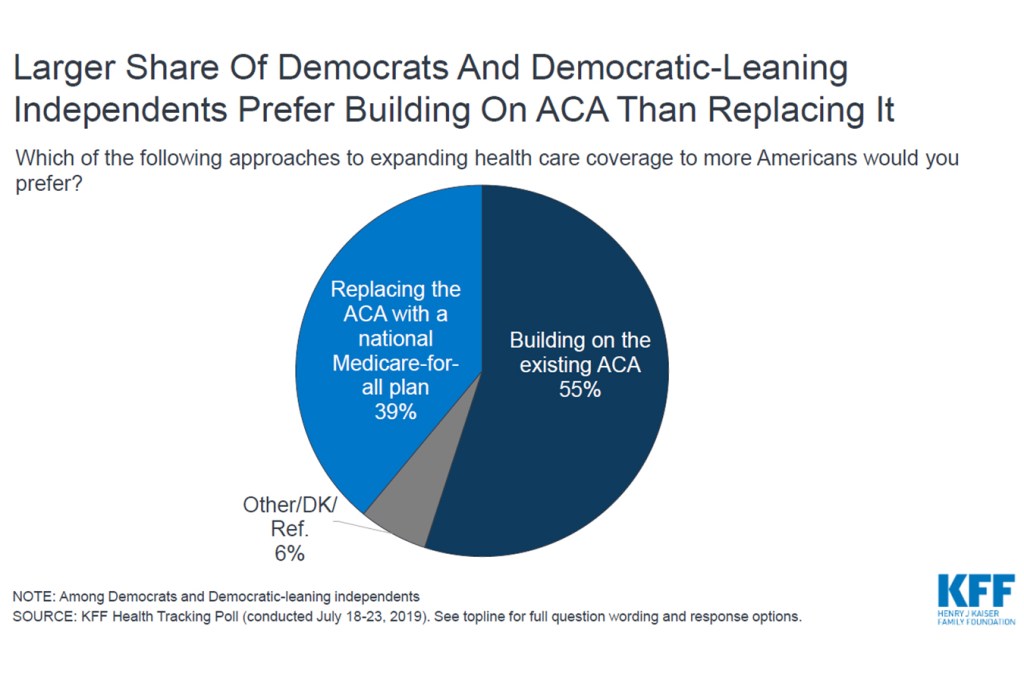
Polling shows that single payer health care remains a confounding idea for many Americans. Recent Kaiser Family Foundation polls have found that 56 percent of the nation favors the Medicare-for-all, compared to 74 percent of Americans who support expanded Medicare as an option for younger Americans in addition to private insurance.
When the same people were told that a Medicare-for-all plan would raise taxes and eliminate private health insurance, support fell to 37 percent.
Rick Tyler, a conservative Republican strategist who has become a vocal critic of Trump, said he believes Democrats are playing right into Trump’s hands.
“They are not talking to the blue collar workers that I understand that vote in Pennsylvania and Michigan,” Tyler said. “Are they seriously capable of choosing a nominee who is going to beat Donald Trump? Right now, I have my doubts.”

Sunday, May 05, 2019

The Health-Care Crisis Has Spread to Employer Plans

America continues to have the most expensive, least efficient healthcare system - if one can even call it a system, given its fragmented nature - where people pay vastly more for the same procedures than people in Canada or Europe.  Add to that the ungodly high prescription drug costs that allow pharmaceutical companies in the USA to price gouge consumers, and it is a recipe for financial hardship for many who find themselves deferring care because they cannot pay policy deductibles.  While the focus of the Affordable Health Care Act was to bring insurance to the uninsured, a growing crisis is developing under employer based plans that are using ever increasing deductibles and prescription limitations as a means to cope with soaring costs.  It's little wonder that life expectancy is falling in the USA.  A piece in New York Magazine looks at the growing crisis.  Here are article excerpts:  

For most of this century, the big U.S. health-care policy issue has been providing insurance to the uninsured, including the uninsurable people with expensive health conditions. Yes, the majority of non-elderly Americans covered by employer-based insurance were affected by this debate insofar as sharing the costs of more universal coverage would increase their premiums and/or taxes. But for the most part, Americans were relatively happy with the insurance they got at work.
That’s changing, as is graphically illustrated by a major new survey conducted by the Los Angeles Times and the Kaiser Family Foundation that shows insurance deductibles, co-pays, and other “cost sharing” requirements by insurers are putting the squeeze on affected policyholders in a big way.
As the Times’ Noam Levy explains, the rise of deductibles has been dramatic:
In the last 12 years, annual deductibles in job-based health plans have nearly quadrupled and now average more than $1,300 [family coverage deductibles are far higher].
Yet Americans’ savings are not keeping pace, data show. And more than four in 10 workers enrolled in a high-deductible plan report they don’t have enough savings to cover the deductible.
One in six Americans who get insurance through their jobs say they’ve had to make “difficult sacrifices” to pay for healthcare in the last year, including cutting back on food, moving in with friends or family, or taking extra jobs. And one in five say healthcare costs have eaten up all or most of their savings.
And that’s not even counting those who skip care they need because they cannot afford to pay their “share” of steadily rising medical bills.  When people don’t get essential care, of course, insurance has failed everyone other than the insurer itself. And while everyone was aware cost-sharing requirements were steadily increasing, it did sneak up on policy-makers whose attention was elsewhere:
The 2010 healthcare law — often called Obamacare — provided landmark protections to Americans once shut out of health coverage. But as Democrats and Republicans fought over the law, Altman said, neither focused on the rapid run-up in costs for people covered through work.
But this was by no means accidental. High-deductible insurance plans were promoted both by the industry and by conservative politicians: . . . . Backers of the high-deductible strategy nevertheless argued that patients, given “skin in the game,” would become active consumers who would force drugmakers, hospitals and other medical providers to rein in prices.
If that sounds familiar to consumers of political rhetoric, it’s because Republicans have long promoted patient-driven competition as a health-care cost panacea, usually through a combination of high-deductible insurance plans and tax-preferred health savings accounts designed to help consumers save for out-of-pocket costs.
Guess who got left holding the bag? That’s right, the employees, who were essentially victims of a bait and switch.  Now, suddenly, people with employer-sponsored health insurance have more to worry about than fighting managed care and/or maintaining the right to choose doctors
This shift in sentiment also helps explain why Medicare for All is so popular an idea. Yes, seamless universal coverage is attractive, but getting rid of deductible, co-pays, and even (in the more generous proposals) premiums could be an even bigger deal. It’s enough to make proponents of “skin in the game” nervous:
Even former Utah Gov. Mike Leavitt, a Republican who supported the move to higher deductibles as Health and Human Services secretary in the George W. Bush administration, acknowledged that adjustments may be needed, even if returning to the days of no-deductible coverage is not the solution.
“There needs to be a way to relieve the pressure,” Leavitt said. “Otherwise, people will feel like they have no insurance at all.”
Exactly.

Wednesday, April 24, 2019

Democrats Take Note: Bernie Sanders Scares A Lot of People

While in the top tier of candidates in early polls, Bernie Sanders has lots of baggage and is potentially frightening to moderates that must be won over in the 2020 general election if Democrats hope to prevail.  Yes, Bernie's cult like followers - who are, in my opinion, very much akin to Trump's in terms of blind, unreasoning devotion - do not want to hear concerns or criticisms, but with so much on the line in the 2020 election, rational thought is required. A thoughtful piece in the Washington Post does a balance assessments of the liabilities that Sanders could bring to the fore if he were the Democrat nominee.  To Sanders supporters, all I can say is that not wanting to hear valid concerns does not make them any less true.  Here are excerpts:

I asked a group of Democratic and liberal-leaning consultants, pollsters, economists and political scientists what the likelihood of a Sanders’ nomination was, what his prospects would be in the general election, and how Democratic House and Senate candidates might fare with Sanders at the top of the ticket. When necessary, I offered them the opportunity to speak on background — with no direct attribution — to encourage forthcoming responses.
The answers I got from Democrats who make their living in politics revealed considerable wariness toward Sanders — the response many Sanders supporters would expect.
“Point 1, I am very worried about Bernie. Socialism is a problem word,” a Democratic operative with ties to the party establishment said: Sure he has a “stick it to the elites” message that could explain it, but it’s a problem. Point 2, Democrats are doing very well in the suburbs. Bernie could threaten that shift with an economic frame that is just too much for them. He could become a huge problem in the suburbs of Atlanta, Charlotte, Denver, Orange County, etc. where the key Senate and House races will take place.
“Bernie is one Democrat who probably cannot win,” said a second operative:
I worry about his style for swing women voters. His proposals are good and have agenda-setting strength. I think his language of no alternative-no compromise-socialist will spook too many voters.
In the most important election in the lifetime of many Democrats — with Trump poised for a second term — the electability of the Democratic nominee is the top concern.
Democratic primary voters and caucus goers are more liberal than voters in the general election, including the Democratic electorate as a whole. They are more likely to be comfortable with the idea of socialism and more tolerant of what the Daily Mail called Sanders’ “very 1960s love life,” of the content of Sanders’ early writings and of his son born outside of marriage — matters, for better or worse, that are of concern to socially moderate and more conservative voters on whom much is riding in this election.
Sanders and his supporters have argued that his early history is part of a no longer relevant past and that he intends to run on his platform, not on his personality or personal life. Nonetheless, if Sanders wins the nomination, Trump and his Republican Party are certain to try to make the young Bernie Sanders a major issue.
What are the politics of Sanders’ commitment to democratic socialism?
An August 2018 YouGov survey found that 26 percent of voters had a favorable view of socialism (6 percent “very favorable,” 20 percent “somewhat favorable”) while 42 percent had an unfavorable view (31 percent very, 11 percent somewhat).
During the primaries, Sanders is unlikely to face demands for a persuasive response to charges that the domestic spending programs he supports — Medicare for All, a federal job guarantee, a Green New Deal, free tuition at public colleges, universal child care — would cost trillions of dollars. The libertarian-leaning Mercatus Center at George Mason University estimated that Medicare for All alone would cost “$32.6 trillion during its first 10 years of full implementation,” which would require tax hikes on the middle class as well as on the rich and corporations — a sum that would, in fact, be virtually impossible to raise or procure.
Daron Acemoglu, a professor of economics at M.I.T., who has thought deeply about global and domestic inequality, draws a clear distinction between socialism and social democracy. In Acemoglu’s view, which he expressed by email, Sanders’ “economists don’t understand basic economics. They are not just dangerous, they are clueless.” Socialist regimes “from Cuba to the eastern bloc have been disastrous both for economic prosperity and individual freedom.”
Acemoglu questions Sanders’ economic sophistication, arguing that social democracy, when practiced by competent governments, is a phenomenal success. Everywhere in the west is to some degree social democratic, but the extent of this varies. We owe our prosperity and freedom to social democracy.
The trick, though, Acemoglu argues, is that social democracy “did not achieve these things by taxing and redistributing a lot. It achieved them by having labor institutions protecting workers, encouraging job creation and encouraging high wages.”
Jagdish N. Bhagwati, an economist at Columbia and an expert in development economics and international trade, . . . described Sanders’ thinking as “a little bit naive,” displaying little “understanding of the complexity of the issues he raises.” Sanders, Bhagwati says, is in great need of “first-rate people to sort things out.”
In Bhagwati’s view, if Sanders continues to propose solutions to major problems “from the heart and not the head,” he will “not get anywhere other than shadow politics.”
Democrats are banking on making the 2020 election a referendum on Trump. How likely are the more controversial aspects of Sanders’ politics to blunt that strategy and turn the contest into a referendum on both Trump and Sanders?
A March NBC/Wall Street Journal poll found that 50 percent of all voters described themselves as “very uncomfortable” with Trump’s bid for re-election, and another 9 percent said they have “some reservation.” None of the Democratic candidates were viewed with the same level of discomfort, but Sanders had the highest percentage of voters, at 37 percent, who were “very uncomfortable” with his campaign, along with 21 percent who said they have “some reservations.” . . . In other words, Sanders carries a lot of baggage.
Democratic primaries, as I mentioned earlier, are hardly a proving ground for how well a democratic socialist — and a self-declared social and cultural outsider — will sell in November, something Trump and the Republican Party are already gearing up to turn into a major 2020 issue.
The question extends beyond Sanders. Democratic constituencies competing to pick a candidate to square off against Trump next year face a difficult-to-resolve problem. Will they find themselves flying blind, entangled in a cause more than a campaign as they leave too much of the middle-of-the-road electorate behind 
As I have said before, in a general election, I do not view Sanders as electable.  Democrats need a candidate who can win in November 2020.

Friday, February 01, 2019

Don't Be Fooled, It’s Republicans Who Ruined the Country

The other day a local young, privileged, white gay man with no children to support wrote an op-ed in the Virginian Pilot that stated he was proud to be a Republican and then went on to bloviate about the usual supposed merits of the Republican agenda: smaller government, fiscal responsibility, etc., etc.  Things that might once have been true of the GOP more than two decades ago when I was an active Republican. Those days, however, are long gone and Republicans cut from that cloth are as extinct as the dinosaurs in today's party of Trump. The reality is that today's GOP has overseen the rise of wealth disparity not seen since the Gilded Age and the slow death of the middle class. Further, today's GOP's core base consists of religious extremists and white supremacists.  Yet, I am sure that this young Republican views himself as a centrist even though personally I do not understand how one can still claim to be a Republican and not in fact be a racist. A column in the New York Times looks at the problem of so-called political centrists who continue the error of much of the media that gives false equivalency to Republicans and Democrats.  As the column points out, the real extremism is with the GOP despite pretense to the contrary. Until average Americans  (and the media) wake up to this reality, expect damage to the nation by the GOP to continue.  Here are column excerpts:

Why is American politics so dysfunctional? Whatever the deeper roots of our distress, the proximate cause is ideological extremism: Powerful factions are committed to false views of the world, regardless of the evidence.
Notice that I said factions, plural. There’s no question that the most disruptive, dangerous extremists are on the right. But there’s another faction whose obsessions and refusal to face reality have also done a great deal of harm.
But I’m not talking about the left. Radical leftists are virtually nonexistent in American politics; can you think of any prominent figure who wants us to move to the left of, say, Denmark? No, I’m talking about fanatical centrists.
Over the past few days we’ve been treated to the ludicrous yet potentially destructive spectacle of Howard Schultz, the Starbucks billionaire, insisting that he’s the president we need despite his demonstrable policy ignorance. Schultz obviously thinks he knows a lot of things that just aren’t so. Yet his delusions of knowledge aren’t that special. For the most part, they follow conventional centrist doctrine.
Schultz, however, still declares debt our biggest problem. Yet true to centrist form, his deficit concerns are oddly selective. Bowles and Simpson, charged with proposing a solution to deficits, listed as their first principle … reducing tax rates. Sure enough, Schultz is all into cutting Social Security, but opposes any tax hike on the wealthy.  Funny how that works.
In general, centrists are furiously opposed to any proposal that would ease the lives of ordinary Americans. Universal health coverage, says Schultz, would be “free health care for all, which the country cannot afford.”
[S]ingle-payer health care (actually called Medicare!) hasn’t bankrupted Canada. In fact, every advanced country besides America has some form of universal health coverage, and manages to afford it.
The real issue with “Medicare for all” isn’t costs — the taxes needed to pay for it would almost surely be less than what Americans now pay in insurance premiums. The problem instead would be political: It would be tricky persuading people to trade private insurance for a public program. That’s a real concern for Medicare-for-all advocates, but it’s not at all what either Schultz or Bloomberg is saying.
Finally, the hallmark of fanatical centrism is the determination to see America’s left and right as equally extreme, no matter what they actually propose.
[N]ow, with Democrats taking a turn that is more progressive but hardly radical, centrist rhetoric has become downright hysterical. Medicare and Medicaid already cover more than a third of U.S. residents and pay more bills than private insurance.
But Medicare for all, says Schultz, is “not American.” Elizabeth Warren has proposed taxes on the wealthy that are squarely in the tradition of Teddy Roosevelt; Bloomberg says that they would turn us into Venezuela.
Where does the fanaticism of the centrists come from? Much of the explanation, I think, is sheer vanity.  Both pundits and plutocrats like to imagine themselves as superior beings, standing above the political fray. They want to think of themselves as standing tall against extremism right and left. Yet the reality of American politics is asymmetric polarization: extremism on the right is a powerful political force, while extremism on the left isn’t. What’s a would-be courageous centrist to do?
The answer, all too often, is to retreat into a fantasy world, almost as hermetic as the right-wing, Fox News bubble. In this fantasy world, social democrats like Harris or Warren are portrayed as the second coming of Hugo Chávez, so that taking what is actually a conservative position can be represented as a brave defense of moderation.
But that’s not what is really happening, and the rest of us have no obligation to indulge centrist delusions.
It is nothing short of delusion to pretend the extreme GOP of today is the same as the party of my youth and young adulthood.  That party is dead and gone and its successor has inflicted real harm on millions of Americans.  It's time to accept that reality.