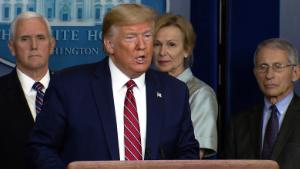
In November 2016, a majority of voters recognized that Donald Trump was unfit for office - hence Hillary Clinton's 3 million more votes in the popular vote. Now, when the nation faces an unprecedented crisis, Trump's unfitness is on daily display. His "press conferences" are a stream of lies, boasting and preening, and a failure to show any leadership. His racist and right wing Christian agenda is not going to save the nation from what it faces and hopefully the members of his base will begin to realize they were played for fools. As Trump fails to lead and exercise powers that might better coordinate the national response to the COVID-19 crisis, governors, mayors and hospital CEO are being left to fend for themselves. A piece in the Washington Post looks at Trump's massive failure. Here are highlights:
PresidentTrump’s response to the coronavirus pandemic sparked uproar and alarm among governors and mayors on Sunday as Trump and his administration’s top advisers continued to make confusing statements about the federal government’s scramble to confront the crisis, including whether he will force private industry to mass produce needed medical items.As deaths climbed and ahead of a potentially dire week, Trump — who has sought to cast himself as a wartime leader — reacted to criticism that his administration has blundered with a torrent of soaring boasts and searing grievances.
[T]he growing gulf between the White House and officials on the front lines of the pandemic underscored concerns in cities, states and Congress that Trump does not have a coherent or ready plan to mobilize private and public entities to confront a crisis that could soon push the nation’s health-care system to the brink of collapse.
“We’re all building the airplane as we fly it right now,” Michigan Gov. Gretchen Whitmer (D) said on ABC’s “This Week.” “It would be nice to have a national strategy.”
Federal Emergency Management Agency Administrator Peter T. Gaynor said Sunday the president has not yet invoked the Defense Production Act, which would allow the government to order companies to ramp up the production of ventilators and protective masks, among other products.
Gaynor’s remarks directly contradicted what Trump told reporters on Friday, when he said he had “invoked” the law and “put it into gear” — and were coupled with vague optimism about corporate America’s ability to do what is necessary without being compelled by an executive order.
Major auto companies signaled last week that they are studying the feasibility of making ventilators but made no promises about the pace of production, should it begin. A spokesperson for Ford said, “Ford stands ready to help the administration in any way we can, including the possibility of producing ventilators and other equipment.”
There are many obstacles. Ford, General Motors and Fiat Chrysler — the Big Three automakers — have suspended production at their North American plants through at least the end of March because of the coronavirus and after union leaders sought that pause.
The administration’s sunny outlook about companies’ ability to act was met with sharp disagreement from governors facing mounting illness and deaths from covid-19, the disease caused by the novel coronavirus.
“We need the product now,” Cuomo said at a news conference on Sunday. “We have cries from hospitals around the state. I’ve spoken to governors around the country, and they’re in the same situation.”
New York Mayor Bill de Blasio announced Sunday that there are now 8,000 cases in his city, with 60 deaths. He pleaded with Trump to deploy the military to the nation’s financial capital, home to more than 8 million people.
“April is going to be a lot worse than March, and May could be worse than April,” de Blasio said. “We are very much on our own at this point.”
Many governors and mayors said they feel ill-equipped for the coming storm, particularly the expected deluge of patients at hospitals and health centers.
Pritzker [of Illinois] said on CNN that his state has received about a quarter of the personal protective equipment it has ordered from the federal government.
“I’ve got people working the phones calling across the world, frankly, to get this stuff to Illinois,” Pritzker said, as he worried that states are probably “overpaying” in part because of the lack of decisive action by Trump.
Democrats were not Trump’s lone critics on Sunday. Maryland Gov. Larry Hogan, a centrist Republican, said the Trump administration, through FEMA, “has to take the lead” in securing medical items.
“We are getting some progress. Now, it’s not nearly enough. It’s not fast enough. We’re way behind the curve,” Hogan said on NBC’s “Meet the Press,” as he detailed how Maryland is scrambling to find supplies without any guarantees from the federal government.
Turmoil at hospitals is challenging governors by the hour. Speaking Sunday on CBS, Richard Pollack, president of the American Hospital Association, said “the most immediate thing we need is personal protective equipment: the masks, the gowns, the goggles, that type of equipment to protect our health-care heroes that are on the front lines. That is what is most essential now. If we don’t protect our health-care workers, the system will completely collapse.”
Former Pentagon officials who handled Defense Production Act policy for Democratic and Republican administrations said the Trump administration has so far made little use of the law.
“All of this should have started months ago, so we are behind,” said Bill Greenwalt, a defense consultant who led acquisition policy in the George W. Bush administration. “On production, I think we will find out that our base is not capable of producing what we need as I expect much of it has been outsourced to China and elsewhere.”
Trump — who will be judged by voters at the polls in eight months — also faced criticism from former vice president Joe Biden, the delegate leader for the Democratic presidential nomination, who issued a statement in response to Gaynor’s interview on CNN.
“Mr. President, stop lying and start acting,” Biden said. “Use the full extent of your authorities, now, to ensure that we are producing all essential goods and delivering them where they need to go.”
This is not a reality TV show. Lives and the nation's economy are at stake and Trump thinks he's still playing a part on The Apprentice. Be very, very afraid.