Showing posts with label uneducated whites. Show all posts

Wednesday, November 27, 2019

What's Wrong in America: Declining Life Expectancy

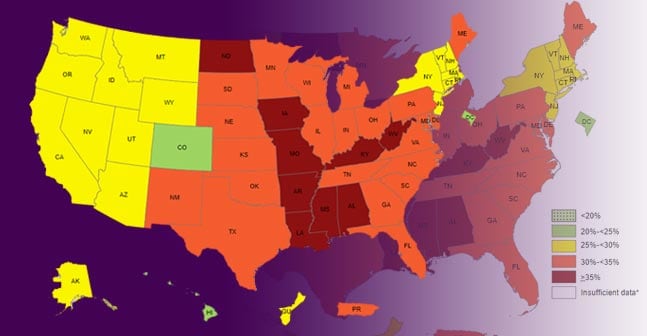
Map of those overweight and obese by state. 
Life expectancy is continuing to rise in other advanced, wealthy nations, including the liberal European nations so derided by American conservatives. Such is not the case in the United States where life expectancy is falling, with sharp decreases in age brackets often considered the prime time of one's life.  A report published in the Journal of the American Medical Association looks at the unwanted reality and where the death rate has risen the most: mostly in mid-western "swing states" and the South, regions where Republican political rule predominates. While no one cause explains the phenomenon, there are a number of factors noted in the report, particularly, America's obesity problem.  Go to Europe and walk around almost any city and you will NOT see the large numbers of overweight people and those you do see will most often be American tourists. My own thoughts on this particular problem of obesity focuses on (i) Americans' poor diet and addiction to high calorie fast food and (ii) vastly over-sized portions at American restaurants (things you do not see in Europe).  Then, of course, most other advanced nations have some version of universal health care, something lacking in the USA.  The Washington Post looks at the report and the dire outlook for the future.  Here are article highlights:

Death rates from suicide, drug overdoses, liver disease and dozens of other causes have been rising over the past decade for young and middle-aged adults, driving down overall life expectancy in the United States for three consecutive years, according to a strikingly bleak study published Tuesday that looked at the past six decades of mortality data.
The report, published in the Journal of the American Medical Association, was immediately hailed by outside researchers for its comprehensive treatment of a still-enigmatic trend: the reversal of historical patterns in longevity.
Despite spending more on health care than any other country, the United States has seen increasing mortality and falling life expectancy for people age 25 to 64, who should be in the prime of their lives. In contrast, other wealthy nations have generally experienced continued progress in extending longevity.
[T]he broad trend detailed in this study cuts across gender, racial and ethnic lines. By age group, the highest relative jump in death rates from 2010 to 2017 — 29 percent — has been among people age 25 to 34.
The findings are sure to fuel political debate about causes and potential solutions because the geography of rising death rates overlaps to a significant extent with states and regions that are hotly contested in the run-up to the 2020 presidential election.
About a third of the estimated 33,000 “excess deaths” that the study says occurred since 2010 were in just four states: Ohio, Pennsylvania, Kentucky and Indiana — the first two of which are critical swing states in presidential elections. The state with the biggest percentage rise in death rates among working-age people in this decade — 23.3 percent — is New Hampshire, the first primary state.
“It’s supposed to be going down, as it is in other countries,” said the lead author of the report, Steven H. Woolf, director emeritus of the Center on Society and Health at Virginia Commonwealth University. “The fact that that number is climbing, there’s something terribly wrong.”
He said many factors are at play. The opioid epidemic is a major driver of the worrisome numbers but far from the sole cause. The study found that improvements in life expectancy, largely because of lower rates of infant mortality, began to slow in the 1980s, long before the opioid epidemic became a national tragedy.
“Some of it may be due to obesity, some of it may be due to drug addiction, some of it may be due to distracted driving from cellphones,” Woolf said. Given the breadth and pervasiveness of the trend, “it suggests that the cause has to be systemic, that there’s some root cause that’s causing adverse health across many different dimensions for working-age adults.”
The average life expectancy in the United States fell behind that of other wealthy countries in 1998, and since then the gap has grown steadily. Experts refer to this gap as the United States’ “health disadvantage.”
Princeton professors Anne Case and Angus Deaton, whose much-publicized report in 2015 highlighted the death rates in middle-aged whites, published a paper in 2017 pointing to a widening gap in health associated with levels of education, a trend dating to the 1970s. Case told reporters their research showed a “sea of despair” in the United States among people with only a high school diploma or less.
Obesity is a significant part of the story. The average woman in the United States today weighs as much as the average man half a century ago, and men now weigh about 30 pounds more. Most people in the United States are overweight — an estimated 71.6 percent of the population age 20 and older, according to the CDC. That figure includes the 39.8 percent who are obese, defined as having a body mass index of 30 or higher in adults (18.5 to 25 is the normal range). Obesity is also rising in children; nearly 19 percent of the population age 2 to 19 is obese.
“These kids are acquiring obesity in their early teen years, sometimes under the age of 10,” said S. Jay Olshansky, a professor of public health at the University of Illinois at Chicago. “When they get up into their 20s, 30s and 40s, they’re carrying the risk factors of obesity that were acquired when they were children. We didn’t see that in previous generations.”

Monday, April 17, 2017

The GOP Base: The Least Educated U.S. Religious Groups


I often blame the Republican Party's growing celebration of ignorance and denial of objective and scientific fact on the element of the party base that I describe as the Christofascists - namely evangelical Christians and fundamentalist Christians.  There are reasons for this groups avoidance of or discounting of facts: (i) facts and scientific knowledge threaten their legend and myth based religious beliefs, and (ii) they are among the least educated elements of American society.  Thus, as the Christofascists have risen in the Republican Party, the party has transformed from a stereo-typically party of affluence and education to one that is the exact opposite.  Indeed, one would now believe that a competition exists within the GOP to see who can be the most ignorant and most strongly reject facts and knowledge.  But, back to the Christofascists.  A study by Pew Research Center of the levels of education among religious groups in America has confirmed what I have long thought: the elements of the evangelical/fundamentalist Christian that make up the GOP's base are  the least educated (and I would argue the most ignorant) elements in America.  It's little wonder why Trump and his sixth grade level odf speaking appealed to them.  Here are findings from Pew:  
Attainment of a four-year college degree in the United States, often regarded as a key asset for economic success, varies by race and gender. But the share of people completing a college education also differs by religion, with members of some faith groups much more educated, on average, than others.
By far, Hindus and Unitarian Universalists have among the largest share of those with a college degree – 77% and 67% respectively. Roughly six-in-ten Jews (59%) have college degrees, as do similar shares in both the Anglican church (59%) and the Episcopal Church (56%).
These groups are among the top of a list of 30 U.S. religious groups ranked by educational attainment . . . . 
Other religious groups also have a higher percentage of college graduates than the full sample of more than 35,000 U.S. adults surveyed in the 2014 Religious Landscape Study, among whom 27% completed university. They include Buddhists and members of the Presbyterian Church (U.S.A.) – both at 47% – as well as Orthodox Christians (40%), Muslims (39%) and Mormons (33%).
Since Catholics make up one-in-five adults, it is not surprising that their share of members with a college degree (26%) roughly mirrors that of the general public.
What the article does not directly highlight is the fact that Southern Baptists and other evangelical Christians are in the basement when it comes to educational attainment.  To me this makes me ask the following: why as a country do we continue to give undeserved deference to the beliefs of the least educated and least informed segment of the population?  It makes absolutely no sense.  When will the mainstream media wake up to this reality?

Wednesday, March 02, 2016

Today's GOP: The Rise of American Authoritarianism

As the GOP establishment wrings its hands, Marco Rubio tries to put a positive face on a disastrous showing yesterday in the Super Tuesday primaries, and Ben Carson finally suspends his insane candidacy, one thing appears clear: today's GOP is enamored with authoritarian strong men and extremists who pledge to "make America great again" and protect "religious freedom" as they ride rough shod over the rights of many Americans.  A very lengthy piece in Vox looks at the trend  - which in my view parallel's what happened in Germany in the early 1930's - and the threat it poses to democracy.  GOP authoritarianism is a danger to  the rule of law and the rights of minorities.  For the LGBT community, the trend is particularly frightening: one third of Trump's supporters want to ban LGBT individuals from America.  Here are some extensive article excerpts:  
Perhaps strangest of all, it wasn't just Trump but his supporters who seemed to have come out of nowhere, suddenly expressing, in large numbers, ideas far more extreme than anything that has risen to such popularity in recent memory. In South Carolina, a CBS News exit poll found that 75 percent of Republican voters supported banning Muslims from the United States. A PPP poll found that a third of Trump voters support banning gays and lesbians from the country. Twenty percent said Lincoln shouldn't have freed the slaves.
Last September, a PhD student at the University of Massachusetts Amherst named Matthew MacWilliams realized that his dissertation research might hold the answer to not just one but all three of these mysteries.
MacWilliams studies authoritarianism — not actual dictators, but rather a psychological profile of individual voters that is characterized by a desire for order and a fear of outsiders. People who score high in authoritarianism, when they feel threatened, look for strong leaders who promise to take whatever action necessary to protect them from outsiders and prevent the changes they fear.
So MacWilliams naturally wondered if authoritarianism might correlate with support for Trump.
He polled a large sample of likely voters, looking for correlations between support for Trump and views that align with authoritarianism. What he found was astonishing: Not only did authoritarianism correlate, but it seemed to predict support for Trump more reliably than virtually any other indicator. He later repeated the same poll in South Carolina, shortly before the primary there, and found the same results . . . .

[A]t Vanderbilt University, a professor named Marc Hetherington was having his own aha moment. He realized that he and a fellow political scientist, the University of North Carolina's Jonathan Weiler, had essentially predicted Trump's rise back in 2009, when they discovered something that would turn out to be far more significant than they then realized.
That year, Hetherington and Weiler published a book about the effects of authoritarianism on American politics. Through a series of experiments and careful data analysis, they had come to a surprising conclusion: Much of the polarization dividing American politics was fueled not just by gerrymandering or money in politics or the other oft-cited variables, but by an unnoticed but surprisingly large electoral group — authoritarians.
This trend had been accelerated in recent years by demographic and economic changes such as immigration, which "activated" authoritarian tendencies, leading many Americans to seek out a strongman leader who would preserve a status quo they feel is under threat and impose order on a world they perceive as increasingly alien.
These Americans with authoritarian views, they found, were sorting into the GOP, driving polarization. But they were also creating a divide within the party, at first latent, between traditional Republican voters and this group whose views were simultaneously less orthodox and, often, more extreme. . . . . And so it was all but inevitable that, eventually, authoritarians would gain enough power within the GOP to make themselves heard.
Authoritarians are thought to express much deeper fears than the rest of the electorate, to seek the imposition of order where they perceive dangerous change, and to desire a strong leader who will defeat those fears with force. They would thus seek a candidate who promised these things. And the extreme nature of authoritarians' fears, and of their desire to challenge threats with force, would lead them toward a candidate whose temperament was totally unlike anything we usually see in American politics — and whose policies went far beyond the acceptable norms.
A candidate like Donald Trump. . . . Trump, it turns out, is just the symptom. The rise of American authoritarianism is transforming the Republican Party and the dynamics of national politics, with profound consequences likely to extend well beyond this election.
Authoritarians prioritize social order and hierarchies, which bring a sense of control to a chaotic world. Challenges to that order — diversity, influx of outsiders, breakdown of the old order — are experienced as personally threatening because they risk upending the status quo order they equate with basic security.
This is, after all, a time of social change in America. The country is becoming more diverse, which means that many white Americans are confronting race in a way they have never had to before. Those changes have been happening for a long time, but in recent years they have become more visible and harder to ignore. And they are coinciding with economic trends that have squeezed working-class white people.
[A]uthoritarians skew heavily Republican. More than 65 percent of people who scored highest on the authoritarianism questions were GOP voters. More than 55 percent of surveyed Republicans scored as "high" or "very high" authoritarians.
And at the other end of the scale, that pattern reversed. People whose scores were most non-authoritarian — meaning they always chose the non-authoritarian parenting answer — were almost 75 percent Democrats.
But the research on authoritarianism suggests it's not just physical threats driving all this. There should be another kind of threat — larger, slower, less obvious, but potentially even more powerful — pushing authoritarians to these extremes: the threat of social change.
This could come in the form of evolving social norms, such as the erosion of traditional gender roles or evolving standards in how to discuss sexual orientation. It could come in the form of rising diversity, whether that means demographic changes from immigration or merely changes in the colors of the faces on TV. Or it could be any changes, political or economic, that disrupt social hierarchies.
What these changes have in common is that, to authoritarians, they threaten to take away the status quo as they know it — familiar, orderly, secure — and replace it with something that feels scary because it is different and destabilizing, but also sometimes because it upends their own place in society. According to the literature, authoritarians will seek, in response, a strong leader who promises to suppress the scary changes, if necessary by force, and to preserve the status quo.
[A]n astonishing 44 percent of authoritarians believe same-sex marriage is harmful to the country. Twenty-eight percent rated same-sex marriage as "very bad" for America, and another 16 percent said that it’s "bad." Only about 35 percent of high-scoring authoritarians said same-sex marriage was "good" or "very good" for the country.
[W]hite people are also facing the loss of the privileged position that they previously were able to take for granted. Whites are now projected to become a minority group over the next few decades, owing to migration and other factors. The president is a black man, and nonwhite faces are growing more common in popular culture. Nonwhite groups are raising increasingly prominent political demands, and often those demands coincide with issues such as policing that also speak to authoritarian concerns.
If Trump loses the election, that will not remove the threats and social changes that trigger the "action side" of authoritarianism. The authoritarians will still be there. They will still look for candidates who will give them the strong, punitive leadership they desire. . . .
It would also mean more problems for the GOP. . . . The authoritarian base will drag the party further to the right on social issues, and will simultaneously erode support for traditionally conservative economic policies. . . . And in the meantime, the forces activating American authoritarians seem likely to only grow stronger. Norms around gender, sexuality, and race will continue evolving.
For decades, the Republican Party has been winning over authoritarians by implicitly promising to stand firm against the tide of social change, and to be the party of force and power rather than the party of negotiation and compromise. But now it may be discovering that its strategy has worked too well — and threatens to tear the party apart.

In my view, these authoritarians are in need of a mental health intervention.  Their fears are irrationals and down right psychotic.  

Monday, February 01, 2016

The GOP's Insidious Holy War

As noted many times on this blog, I attribute the descent of the Republican Party largely with the rise of the Christofascists within the party.  We are seeing the fruits of this hijacking of the party by religious extremists in Iowa where the GOP contest looks more like a contest to select the next leader of a right wing religious denomination than selecting the leader a world superpower.  Equally unsettling is the reality that has tracked education levels and the least educated among Christians - and some would also argue low IQ's - is among the evangelical denominations.  Thus, in Iowa, we see the least educated being give a role in selecting the nation's leader.  It's a frightening spectacle as noted in a New York Times column over the weekend.  Here are column highlights:

IN the final, furious days of campaigning here, it was sometimes hard to tell whether this state’s Republicans were poised to vote for a president or a preacher, a commander or a crusader.

The references to religion were expansive. The talk of it was excessive. A few candidates didn’t just profess the supposed purity of their own faith. They questioned rivals’ piety, with Ted Cruz inevitably leading the way.

The evangelist or the apostate: That’s how the choice was framed. And it underscored the extent to which the Iowa caucuses have turned into an unsettling holy war.

Religion routinely plays a prominent part in political campaigns, especially on the Republican side, and always has an outsize role in Iowa, where evangelical Christians make up an especially large fraction of the Republican electorate.

Jeb Bush questioned Trump’s faith. Marco Rubio kept going out of his way to extol his own.  HE released a television commercial here in which he speaks directly to the camera about what it means to be Christian. “Our goal is eternity, the ability to live alongside our creator for all time,” he says. “The purpose of our life is to cooperate with God’s plan.”

During last week’s debate, he worked religion into an answer to a question that had nothing to do with it.

Cruz’s whole strategy for capturing the presidency hinges on evangelicals’ support, as Robert Draper details in The Times Magazine.

He rails against abortion rights and same-sex marriage in speeches that sound like sermons, with references to Scripture and invocations of God.

It’s impossible to know the genuineness of someone’s faith. That’s among the reasons we shouldn’t grant it center stage. 

Religion was integral to our country’s founding. It’s central to our understanding of the liberty that each of us deserves. But so are the principles that we don’t enshrine any one creed or submit anyone — including those running for office — to religious litmus tests. So why does a Republican race frequently resemble such an exam?

One of the speakers expressed joy at the thought of “a president who’s willing to kneel down and ask God for guidance as he’s leading our country.”  Cruz had declared such willingness in Iowa in November at an evangelical conference where a right-wing pastor talked about the death penalty for gay people and the need for candidates to accept Jesus as the “king of the president of the United States.”

I’m less interested in whether a president kneels down than in whether he or she stands up for the important values that many religions teach — altruism, mercy, sacrifice — along with the religious pluralism that this country rightly cherishes. And while I agree that Trump is unfit for the Oval Office, Corinthians has nothing to do with it.

Monday, November 30, 2015

The Killing of Middle America


I frequently note that the Republican Party has turned duping working class whites into voting against their own best financial and social interest into an art form.   The GOP wants to kill unions - the cornerstone of Middle America's financial security in the 1950's through at least part of the 1970's - completely, to slash the social safety net, kill efforts to raise the minimum wage, slash regulations so that large corporations and businesses can loot the economy even more thoroughly, and, of course, give massive tax cuts to the wealthy.  The result of the GOP agenda is literally killing less educated middle class whites who are seeing longevity fall.   A piece in Salon looks at the phenomenon and the slow suicide these people are committing by allowing themselves to be duped through plays on religion, race and other prejudices to vote for their real enemies.  Like the author, I have lost friends who refuse to see that their own so-called conservatism is destroying their future.  Here are column highlights: 
I have a friend I grew up with in white, working class rural Nevada. He was one of the coolest guys I knew, and I admired him. We reconnected a few years ago, and he has become a rightwing warrior, filled with rage and spouting a startling amount of hate for Mexicans, Muslims, the government and most especially Barack Obama. He has advanced little in his career, and because of my public embrace of liberalism, we aren’t friends anymore. I still check his Facebook page on occasion, because I want to understand what happened to him, and what happened to people like him, with whom I share a common past, but a very different present.

A recent, shocking study has laid bare the cost of his (and many others) nonstop, futile outrage. Middle-aged, white people between ages 45 and 54, and specifically those with a high school education or less, have seen increased sickness and early death. This is the only demographic to see this kind of increase in mortality anywhere in the first world. They are dying sooner than they should in a merciless war they’ve declared on themselves.

The much-covered study has generated plenty of chattering among fancy people about underlying causes, from economics to failing masculinity, demographics and divorce, to a growing powerlessness among the white working class, but I think most of the answers have failed to nail it. Middle-aged white America is reaping the fruit of two decades of outrage and hate aimed at minority groups, government programs, unions and anyone who dares to point out the dysfunction of “wholesome, Christian” America. They vote against any program that aims to tackle our social or financial problems as a society, instead opting for the same bootstrap, libertarian, anti-government rhetoric that has failed us since the days of Ronald Reagan. In short, they are committing suicide en masse via the voting booth.

[T]he elevated death rates are being driven by a small subset of the white working class.  . . . . There is no better example of extremism and hopelessness of the white working class than the current standard bearer in the GOP primary. Donald Trump leads with less-educated, working-class white people—the same group that is driving the increased mortality overall. Like a half empty bottle of Scotch, they are reaching for Trump out of desperation, outrage and xenophobia, because they have no idea what else to do. Their jobs are gone, wages are flat and the very idea of building a middle class life with a high school education is folly these days. Thus they have turned to ever more extreme rightwing politics, and with every win things only get worse.

The saddest part is working class America benefits the most from an activist, effective and liberal government, something they fight hardest against.  . . . . It’s not all their fault. They’ve been fed a steady stream of total nonsense that both enrages and distracts them from reality. . . . . From coffee cups at Starbucks to the removal of Confederate Flags to Syrian refugees, it doesn’t even matter so long as we fit in our two minutes worth of hate. It’s all an elaborate stage production, manufactured by Fox News, talk radio and rightwing politicians, that fills the lives of the working class with terrorists, feminist, atheists and gay people, convenient groups used to distract from who is really screwing them over this week. The votes of the working class have been neutralized or co-opted with tidy scapegoats, the Second Amendment, Jesus and white victimhood.

As a voting bloc white America turned the reins of society over to angry assholes, out-of-control corporations and pandering politicians thinking their community would be spared, but once the beast was unleashed, it was never going to be satisfied.