Showing posts with label authoritarians. Show all posts

Wednesday, December 11, 2019

America Starts to Feel a Little More Soviet

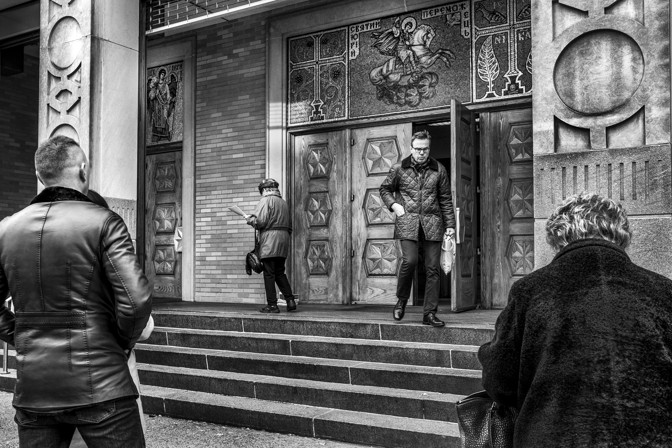
NYC's St. George Ukrainian Catholic Church.
Many historians and columnists - as well as this blog - have lamented the drift of America towards an authoritarian regime where actions once expected only from dictatorships and the so-called banana republics of the past are now common place among the Trump/Pence regime and Republican sycophants. America's decline is being noticed abroad as well where other NATO leaders whisper about Trump - America's version of Kim Jong-un. It is also being noticed by those who immigrated to America seeking a better life and a political system that supposedly held to ideals embodied in the U.S. Constitution who now, as noted in a piece in The Atlantic, feel as if they are witnessing a Soviet/Putin form of corrupt authoritarian rule.   The world is watching to see if Congress steps up to defend America's supposed ideals by impeaching and removing Trump from office or if we are witnessing the first major step in the death of the American republic.  Here are excerpts from the Atlantic piece: 

Walk down a barely marked stairway into a basement in New York’s East Village on a Sunday morning, and you may find yourself in a hub of Ukrainian American life. Members of the vast Ukrainian diaspora regularly gather here, at a church-run restaurant called Streecha, trading the latest on Ukrainian politics over plates of pierogi and bowls of borscht. As formal impeachment hearings against President Donald Trump were finally getting under way recently, several of the patrons here told me that America had lately been feeling more like home—and not in a good way.
Diplomats and officials as prominent as Secretary of State Mike Pompeo have attempted to revive Ronald Reagan–style rhetoric about America’s role as the world’s foremost defender of liberty and freedom, including signaling support for Ukrainian self-determination. Meanwhile, [Trump] the president and his associates appear to be more invested in courting power and personal gain, from Trump’s cozy press conferences with Russian President Vladimir Putin to his attempt to get the Ukrainian government to investigate the family of former Vice President Joe Biden.
The Ukrainians I met here weren’t surprised by this Trumpian mode of politics, in part because it’s very similar to the status quo in the part of the world they come from. The impeachment inquiry is a test not just of Trump’s character, but of the country’s: Is a pitch for America’s exceptionalism still plausible, or is corruption the only true universal principle any government will ever embrace?
“I used to think that American politicians and politics is much more nice than Ukrainian,” Natalie, a short, chatty woman who gave her age as “in her 30s or 40s,” told me. “Come on. It’s even worse.” . . . . The United States government is just as corrupt as Ukraine’s, Natalie said, comparing political leaders here to squabbling seventh graders. This realization has been disappointing, she said, because she is an American by choice: She came to the U.S. a little less than a decade ago, after feeling pushed out of Ukraine by instability and lack of opportunity.
[Trump’s] The president’s personal lawyer Rudy Giuliani and his business associates have come under fire for trying to coordinate a Ukrainian investigation into the Bidens. And Trump, of course, is now the subject of an impeachment inquiry focused on his apparent attempt to pressure Ukrianian President Volodymyr Zelensky into a similar investigation.
As this unlikely series of events has unfolded, Trump and his allies have taken to casually demonizing Ukraine as suspicious and untrustworthy, calling back to Cold War–era stereotypes of Soviet spies and no-goodniks. Leaders ranging from Senator John Kennedy of Louisiana to [Trump] the president himself have promoted the false claim that Ukraine, not Russia, interfered in the 2016 U.S. presidential election. (Kennedy later walked back his statement.)
The portrait of his [Trump’s] behavior that has emerged in news reports and congressional testimony is one of using his office for personal gain: He sought to leverage military aid to a vulnerable ally in order to damage a major political opponent. This move had real consequences for Ukraine, where millions of people are currently living under Russian occupation in the eastern part of the country and soldiers fighting Russian troops are underarmed and strapped for resources. The message of his actions was clear, said Natalie, the woman I met at Streecha: “Trump has no idea where is Ukraine, what is Ukraine, and what’s going on in Ukraine.”
Iwan Kinal, a 35-year-old who grew up in New Jersey and wore a furry black Cossack hat as we stood outside St. George Ukrainian Catholic Church in the cold, told me he’s a lifelong Republican and even likes some of Trump’s policies. But he’s been disturbed to hear the president echo what he described as Russian propaganda about Crimea, Ukraine’s Black Sea peninsula, which Russia seized in 2014. “I’m disappointed in his treatment and his opinion of Ukraine from the start,” Kinal said of Trump.
As the impeachment inquiry and other investigations have revealed, Russian propaganda has in fact infiltrated American political discourse, sometimes at the very highest levels of government. Fiona Hill, who served for two years on Trump’s National Security Council, said during November’s impeachment hearings that members of the House Intelligence Committee itself were perpetrating “a fictional narrative” created by Russian security services that Russia did not, in fact, interfere in the 2016 U.S. presidential election, and that Ukraine may have done so instead. The truth has become subservient to political expediency, and the American government has become a little more similar to any other strongman regime.
Just as Ukraine has long been a football in Russia’s regional schemes, it has now become a Rorschach test in America’s partisan feuds, consequences be damned. “Ukrainian people have been dying for five years in that territory, and they still do,” said Natalie, referring to the Donbas region, where Ukraine is attempting to fight off a Russian incursion. But in America, all that seems to matter are politicians’ personal fortunes and the next domestic elections, reminiscent of so many strongman regimes. As people die in her home country, Natalie said, all of this “is just a game, unfortunately.”
An irony is that the church referenced in the article is where my father was baptized.  His parents fled Austria-Hungry shortly before WWI and settled in New York City.  My paternal grand parents fled a monarchy for political freedom.  Now, I find myself living in a country drifting towards Trump's self-styled monarchy if Congress fails to act and stop the cancer.

Monday, August 26, 2019

Trump Allies Attack and Intimidate Journalists

Taking another page from the Nazi regime in Germany in the early 1930's, Trump minions and sycophants are now actively targeting journalists and legitimate news outlets that report on the misdeeds and corruption of Donald Trump, a/k/a Der Trumpenführer on this blog, and his cronies and cabinet officials.  The goal is to intimidate the press and impose a form of self-censorship that is a direct attack on democracy and the role of the free press in exposing official corruption and wrongdoing.  Anyone who cares about democracy and the U.S. Constitution should be very afraid of what this organized campaign says about Trump's contempt for the rule of law and desire to rule as an authoritarian. Do NOT fall for Trump's claims that he is not directly involved in this effort. Here are highlights from the New York Times, one of the targeted news outlets, on this dangerous and sinister development:

A loose network of conservative operatives allied with the White House is pursuing what they say will be an aggressive operation to discredit news organizations deemed hostile to President Trump by publicizing damaging information about journalists.
It is the latest step in a long-running effort by Mr. Trump and his allies to undercut the influence of legitimate news reporting. Four people familiar with the operation described how it works, asserting that it has compiled dossiers of potentially embarrassing social media posts and other public statements by hundreds of people who work at some of the country’s most prominent news organizations.
The group has already released information about journalists at CNN, The Washington Post and The New York Times — three outlets that have aggressively investigated Mr. Trump — in response to reporting or commentary that the White House’s allies consider unfair to Mr. Trump and his team or harmful to his re-election prospects.
The research is said to extend to members of journalists’ families who are active in politics, as well as liberal activists and other political opponents of the president. . . . . Some involved in the operation have histories of bluster and exaggeration. And those willing to describe its techniques and goals may be trying to intimidate journalists or their employers.
[A]mong the central players in the operation is Arthur Schwartz, a combative 47-year-old conservative consultant who is a friend and informal adviser to Donald Trump Jr., the president’s eldest son. Mr. Schwartz has worked with some of the right’s most aggressive operatives, including the former Trump adviser Stephen K. Bannon.
“If the @nytimes thinks this settles the matter we can expose a few of their other bigots,” Mr. Schwartz tweeted on Thursday in response to an apologetic tweet from a Times journalist whose anti-Semitic social media posts had just been revealed by the operation. “Lots more where this came from.”
The information unearthed by the operation has been commented on and spread by officials inside the Trump administration and re-election campaign, as well as conservative activists and right-wing news outlets such as Breitbart News. In the case of the Times editor, the news was first published by Breitbart, immediately amplified on Twitter by Donald Trump Jr. and, among others, . . .
The Trump campaign said it was unaware of, and not involved in, the effort, but suggested that it served a worthy purpose. “We know nothing about this, but it’s clear that the media has a lot of work to do to clean up its own house,” said Tim Murtaugh, the campaign’s communications director.
The campaign is consistent with Mr. Trump’s long-running effort to delegitimize critical reporting and brand the news media as an “enemy of the people.” [Trump] The president has relentlessly sought to diminish the credibility of news organizations and cast them as politically motivated opponents.  Journalism, he said in a tweet last week, is “nothing more than an evil propaganda machine for the Democrat Party.”
[U]sing journalistic techniques to target journalists and news organizations as retribution for — or as a warning not to pursue — coverage critical of [Trump] the president is fundamentally different from the well-established role of the news media in scrutinizing people in positions of power.
“If it’s clearly retaliatory, it’s clearly an attack, it’s clearly not journalism,” said Leonard Downie Jr., who was the executive editor of The Post from 1991 to 2008. Tension between a president and the news media that covers him is nothing new, Mr. Downie added. But an organized, wide-scale political effort to intentionally humiliate journalists and others who work for media outlets is.
A. G. Sulzberger, the publisher of The Times, said in a statement that such tactics were taking the president’s campaign against a free press to a new level.  “They are seeking to harass and embarrass anyone affiliated with the leading news organizations that are asking tough questions and bringing uncomfortable truths to light,” Mr. Sulzberger said. “The goal of this campaign is clearly to intimidate journalists from doing their job, which includes serving as a check on power and exposing wrongdoing when it occurs. The Times will not be intimidated or silenced.”
In a statement, a CNN spokesman said that when government officials, “and those working on their behalf, threaten and retaliate against reporters as a means of suppression, it’s a clear abandonment of democracy for something very dangerous.”

Friday, June 14, 2019

A Russian Reporter Beats the Kremlin

In what might be a cautionary tale for Donald Trump - assuming he watched anything but Fox News - in terms with is treatment of the free press can be found in perhaps the most unlikely place: Vladimir Putin's Russia. Putin has long sought to silence the independent press, especially when the press seeks to expose the corruption that defines Putin himself, not to mention his cronies and fellow oligarchs.  For Fox News viewers, an oligarch is a very rich (and often unscrupulous if not criminal) business leader with a great deal of political influence.  In standard Putin form, he had journalist Ivan Golunov arrested in early June on fabricated drugs charges in an effort to silence his reporting on the dirty and likely criminal behavior of Putin cronies.  What Putin likely did not count on is the public backlash to Golunov's arrest which forced the charges to be dropped and Golunov to be released (personally, if I were Golunov, I'd lease the country ASAP before he can be mysteriously murdered on Putin's orders).  Putin's Russia is the image of how Donald Trump sees himself and how he wants to be above the law. Golunov's release suggests that perhaps Trump should consider rethinking his game plan. I believe a majority of Americans are not racist, brain dead Trump supporters.  At some point, they will cease believing his lies.  A piece in Politico looks at Putin's - and by extension, Trump's - miscalculation.  Here are highlights:
MOSCOW—The men who ordered the arrest of Ivan Golunov in early June on fabricated drugs charges can have had no idea how his name would be known to millions within just a few hours and overshadow the speeches of Vladimir Putin and Xi Jinping at the St. Petersburg Economic Forum the same weekend.
The reaction was so strong—from street demonstrations in Moscow to three daily newspapers sharing the same front page to protest Golunov’s arrest—that the authorities actually backed down on June 11, just five days after taking him into custody. Charges against Golunov were dropped and the Ministry of Interior announced it was suspending the police officers involved.
Why the big fuss? After all, Golunov is not a celebrity, still less a political heavyweight. He’s a journalist, well-known, before last week, only to a small circle—amongst whom I am proud to include myself, as I have known him for 15 years. The police who seized him surely reckoned he was a nobody they could detain quite brazenly.
That was a big mistake on their part. In fact, it was Golunov’s unassuming modesty that propelled the kind of protests that Russia has not seen for years.
Golunov did his journalistic work with quiet professionalism and did not befriend Russia’s big shots. His work spoke for itself. That is precisely why so many ordinary Russians came out to support him. Seeing what happened to a professional doing his job, they understood with frightening clarity their own defenselessness vis-à-vis the Russian state’s security machine.
Golunov’s work touched on sensitive topics, to be sure. He had investigated state procurements and those dark corners of Russian government business where officials worked with criminals under the protection of the security services: the lucrative cemetery business, the commercial dealings of the Russian Orthodox Church, how the Moscow’s mayor offices procured building materials for street renovation.
Despite the grim information he uncovered, Golunov is not one of Russia’s classic “opposition journalists.” If one of the threads he was pulling at led to Putin, Golunov would name him for sure, but he is not in the business of unmasking the whole of Russia’s ruling regime, as some others are.
This is why his arrest for drug possession on June 6 sent a chill through many ordinary citizens. Not every Russian feels like fighting against the Putin regime. But literally every one of them feels defenseless against the police and intelligence services, knowing how they can use the trick of planting drugs on a person to make him lose his job or business or ruin his life in just a few minutes.
In 2004, 40,000 people were in jail in Russia on various drugs charges. Today that number stands at an immense 140,000, 80 percent of whom have confessed to possessing drugs, often in private and uncontested hearings. Amazingly, the accused always seem to possess just the right amount of narcotics to make them eligible for criminal prosecution.
Alleged drug possession is now a way that officials can extract a bribe, confiscate a business, force someone to emigrate or simply to keep silent. (This is not to say that drug addiction is not a serious problem in Russia—it is).
In other words, Ivan Golunov’s story—with what looks like a happy ending on June 11—should not be read as another tale of Russia’s Westernized liberals fighting the regime. The whole Russian media community rose up to defend him, including journalists from pro-government outlets such as RT.
[T]his issue is bigger than being for or against Putin. It has galvanized everyone, from the businessman to the journalist to the Central Asian guest worker who feels unprotected by the law in today’s Russia.
Now that Golunov is free and several senior policemen are being punished, it’s not just the editors who “want blood,” a large segment of society wants it too. They want to see the higher-ups who dreamed up this abominable episode held to account and arrested.
In Italy, the murder of anti-mafia investigator Giovanni Falcone in 1992 caused such public revulsion that it became a turning point in the fight against the Mafia. The protest against Golunov’s arrest has a similar feeling about it—Russians want to be rid of the mafia-like grip the security services have over their everyday lives. That is on their minds much more than a fight for true democracy. Although winning the battle for one might eventually pave the way to the other.
While has tried nothing like what Putin tried, I suspect he would if he could.  An narcissistic authoritarian in high office is a danger to every law abiding, morally decent citizen. 

Friday, October 19, 2018

Trump Celebrates Assault Of Reporter


Donald Trump has been an apologist for the brutal Saudi regime that by all evidence had Washington Post journalist Jamal Khashoggi murdered and dismembered. And, as the Washington Post is reporting, Trump supporters have mounted a whispering campaign against Jamal Khashoggi that is designed to protect President Trump from criticism of his handling of the dissident journalist’s alleged murder by operatives of Saudi Arabia. These efforts include highlighting his association with the Muslim Brotherhood in his youth and raising conspiratorial questions about his work decades ago.  The goal?  To telegraph the message that his murder was justified.  It is all part and parcel with Trump’s contempt for the free press which is the last backstop to keeping dishonest politicians and authoritarians honest and accountable.  If you doubt this, look at Trump's praise for Congressman Greg Gianforte's physical assault on a reporter at a rally last night in Montana.  Just as frightening, the crowd cheered.   All of this is reminiscent of Hitler's war against the free press as he rose to power - as is the behavior of far too many Americans who ought to know better if they are the moral people they pretend to be.  Here are highlights from ABC News on Trump's foul behavior:
Donald Trump kicked off a western tour in Montana on Thursday ostensibly to support Matt Rosendale as he attempts to unseat Sen. Jon Tester, but it was his praise for Congressman Greg Gianforte's physical assault on a reporter that stole the show.
Gianforte is running for re-election as the state’s lone seat in the House of Representatives, and made national headlines during a special election for assaulting a reporter in a moment caught on audio tape.
"Any guy that can do a body slam, he is my type!" Trump said to cheers.  "I was in Rome with leaders when I heard about it, and I heard that he body-slammed a reporter," Trump said.  Trump said he was afraid Gianforte would lose after the moment, but then recalled, "Wait a moment, I know Montana."
Gianforte pleaded guilty and was sentenced to community service for the incident. He apologized on the night of his election victory, saying, "When you make a mistake you have to own it."
For Trump, the Montana Senate race is personal. Trump came to Montana on the attack against Tester, a two-term Democratic senator, who is in a close race against Matt Rosendale, the current state auditor.
[Trump] The president has made it his mission to unseat Tester, whose office publically released information about alleged misconduct that led to White House physician Adm. Ronny Jackson’s failed nomination to lead the Department of Veterans Affairs. Jackson denied allegations of misconduct and that he overprescribed medications, but eventually withdrew his name from consideration. Trump never forgot.
[Trump] The president spoke at length about immigration and falsely said that Democrats are supporting a caravan of immigrants traveling up from Central America. . . . “As you know, I’m willing to send the military to defend our Southern border if necessary all because of the illegal immigration onslaught brought by the Democrats because they refuse to acknowledge or to change the laws -- they like it,” Trump said. While Trump comfortably won the Big Sky state by 20 points, Tester, a moderate Democrat, maintains a slight lead in what has become one of the most expensive political contests in the small state’s history as millions of dollars have poured into Montana. It’s the president’s third trip to Montana, and Tester is only a few points ahead of Rosendale in recent polls.


Praising violence against journalists and playing on racial hatred - all perfectly fine with Trump supporters, including evangelical Christians who like the Pharisees of the Bible make a show of their feigned religiosity even as they betray Christ's message.  

Friday, October 27, 2017

Fear of the Rainbow Flag: Cynical Scapegoating of Gays in Egypt.


Last week in a post I noted the rising tide of homophobia around the world, including here in America under the regime of Donald Trump and Mike Pence, the latter of whom is a Christofascist himself.   Now a piece in the New York Times looks specifically at the growing anti-LGBT zealotry in Egypt, a country where technically homosexuality isn't illegal, but where thuggish rulers and religious fanatics are scapegoating gays as  (i) a means to distract the populous form the failures of both groups to bring prosperity and freedom to the country, and (ii) a way to fabricate an external enemy - western tolerance - to rally support for leaders who could care less about the best interests of the populace.  Ironically, these are  similar to the tactics Der Trumpenführer is employing to bolster his support among evangelical Christians and outright Christofascists here in America. Stated another way, America's would be strong man is mimicking the tactics of real life strong men.  Here are highlights from the article:
On Oct. 21, militants fired rockets and detonated explosives in the desert southwest of Cairo, killing at least 59 Egyptian police officers and security officials in the worst assault on security forces since 2015. The shocking attack is the latest reminder of the very real threat that armed militants pose to Egypt’s security forces.
President Abdel Fattah el-Sisi seems incapable of quelling this menace. . . . So with such a real and present danger, why would Mr. Sisi’s government, aided by a team of media personalities and religious authorities, spend the past month whipping up a frenzy over another kind of “threat” altogether?
As part of what can best be described as hysterical homophobia, more than 65 people, mostly gay men, have been arrested in the crackdown against L.G.B.T. Egyptians. At least 20 people have received prison sentences, ranging from six months to six years.
This wave of arrests and raids began after gay-pride rainbow flags were flown at a concert by a Lebanese indie-rock band, Mashrou’ Leila, whose lead singer, Hamed Sinno, is openly gay. It was not the first time fans displayed rainbow flags at a Mashrou’ Leila concert, a gay friend who has attended some of the band’s previous concerts in Cairo reminds me. He also reminds me that rainbow flags were flown in Tahrir Square during the 18 days of protest that toppled President Hosni Mubarak in 2011.
Same-sex relationships are not illegal in Egypt, but gay men are arrested under “debauchery” laws. So why now? Why the parade of men “confessing” to being gay and “repenting” on TV talk shows, and the psychiatrists touting “conversion therapy”?
It would be easy to label the crackdown a distraction. There is much that Egyptians need distracting from: disastrous economic austerity policies, the insurgency in Sinai, 60,000 political prisoners.
And it does make for a convenient topic. Egypt’s political parties might disagree on how to remedy any or all of those issues — but homophobia cuts across disagreement. . . . . my friend told me. “Some people think gay people should be stoned, others recommend burning them after stoning, while some sheikhs are saying their hands and legs should be cut on opposite sides of their bodies, and ask in the softest of voices for their imprisonment or deportation.”
But there is more than just distraction at play. A talk-show host who suggested that both terrorism and homosexuality were being used to “ruin our youth” by a nameless external enemy offered perhaps the most honest explanation for this vicious round of homophobia in Egypt: the conflation of a security threat with a “moral” threat.
Across the Middle East and North Africa, increasingly bold expressions of sexual freedom are clearly unsettling regimes accustomed to being guardians not just of “national security” but also of our bodies and sexualities. Mr. Sinno is unapologetically “brown, queer and from a Muslim family” by his own description. . . . . Armed with social media and audacity, more people are questioning taboos around religion and sexuality.
Egypt, of course, is far from alone in its witch hunt. From Chechnya to Azerbaijan and from Tanzania to Indonesia there are similar crackdowns by governments obsessed with policing people’s sexuality. (And let’s not forget that President Sisi’s booster, President Trump, is no friend to L.G.B.T. rights.)
Morality crusades unite military regimes and religious zealots alike. Mr. Sisi, a former army general who became president after forcing out Mohamed Morsi, of the Muslim Brotherhood, understands the potency of connecting the catchall “national security” to “inciting debauchery” as a deliberate reminder that the Islamists do not hold the copyright on piety.
On Oct. 19 — a day of global solidarity with L.G.B.T. Egyptians — I saw Mashrou’ Leila in concert in Montreal. That day, a protest had been held outside the Egyptian Consulate there. Some concertgoers flew an Egyptian flag alongside a rainbow flag. Mr. Sinno told the audience that the best way to fight the crackdown in Egypt was to keep up international pressure. He understands the importance of visibility — for safety and for solidarity.
 Human rights around the world used to be a concern for America. Now, under Trump/Pence, not so much.  Indeed, America voted against a United Nations resolution that condemned the death penalty for gays due to their involvement in consenting relationships between adults.  America has indeed fallen and will likely only increase in ugliness under the current misrule. 

Thursday, September 28, 2017

The Trump Voter Paradox


Like many progressives, I find myself at a loss at times understanding how friends and acquaintances who seemingly are nice and decent people can support today's Republican Party much less have voted for Donald Trump.  Why do they look the other way when Der Trumpenführer engages in the use of language and behavior that they would never tolerate at their country club or yacht club - indeed, such behavior (e.g., "pussy grabbing") might cause one to have one's membership suspended.  Similarly, how do they support a party agenda that directly harms those they act as if they care about. Is the friendly facade and civility just a charade?  Yes, there are truly foul supporters of Trump - e.g., white supremacists and Christofascists - but these labels don't outwardly apply to many.  It is a paradox that has led me to unfriend some on Facebook and lessen social interaction with some.   Equally baffling is the fact that some of these Republicans, if engaged in a one on one conversation actually support policies much more liberal and compassionate than what they political party stands for.  A column in the New York Times looks at this bizarre paradox.  Here are excerpts:
Roy Moore’s decisive victory over Luther Strange in the Republican Senate primary runoff on Tuesday in Alabama confirms — as I have reported before — that many Republican voters have a strong sense of white identity, that they harbor high levels of racial resentment and that they sometimes exhibit authoritarian leanings.
At the same time, that’s not a complete picture.
A 2013 study of red and blue America, conducted well before the seismic events of the last two years, sheds additional light on the Republican electorate and provides a more complicated understanding of contemporary conservatism.
In “Divided We Stand: Three Psychological Regions of the United States and Their Political, Economic, Social, and Health Correlates,” Peter J. Rentfrow, a reader in the psychology department at the University of Cambridge, along with five co-authors, explores the results of standardized personality tests given to 1.6 million people in the United States from 1999 to 2010.
The Rentfrow paper breaks the country into three “psychological regions” and ranks each region on personality dimensions known as the big five traits: extroversion, agreeableness, conscientiousness, neuroticism and openness to experience.
The most conservative and most Republican of the three psychological regions — which Rentfrow labels “Cluster 1: Friendly and Conventional” — extends across the northern tier of the United States from Montana to Michigan, down through the Midwest to almost all of the South for a total of 26 states. Rentfrow found that the Cluster 1 region is
less affluent, has fewer highly educated residents, and is less innovative compared with states in the other regions. States in this region also appeared to have higher levels of social capital and less social tolerance compared with states in other regions. Moreover, friendly and conventional states were more politically conservative and Protestant compared with other regions.
My question went as follows:
Some research shows that Republicans, and Trump voters in particular, score high on measures of authoritarianism and on critical, if not hostile, views of African-Americans and immigrants. How does this fit with your finding that residents of the most Republican region are friendly, sociable and considerate?
Rentfrow replied that
individuals high in authoritarianism score low in openness. So in this sense, the patterns of results we find at the regional level are consistent.
Many whites in the South, he argued, abide by an “honor culture.” As long
as everyone is respectful and abides by the social norms, everyone is happy and agreeable. But when threats are made against one’s reputation or values, acts of violence and physical aggression are considered appropriate forms of retribution.
In some ways, the profile we observe touches on the surface of this profile — the friendly and considerate aspect when all is well. But I think we’re now beginning to see more of the aggressive aspects. I think many people, perhaps especially in this region, have begun to feel threatened by the changes taking place in society and are reacting with anger.
Karen Stenner, the author of “The Authoritarian Dynamic,” pointed out that the Rentfrow study found that red state voters were simultaneously “friendly” and less “socially tolerant.”  Stenner explained this seeming contradiction by noting that
it is a lot easier to be generous and considerate and civic-minded and invested in one’s community if one’s community is full of people much like oneself. The kinds of behaviors we get out of authoritarians depend critically on how and where they have drawn the boundaries of “us” and “them.” They can be very attentive to “us,” but also tend to be very particular about whom “us” includes.
John Jost, a professor of psychology and politics at N.Y.U., expands upon the implications of the word “conscientiousness” in describing red state voters:
Conscientiousness is correlated with measures of racism, sexism, homophobia, prejudice, authoritarianism, social dominance, and system justification. I suspect that this personality factor has more to do with a need for order or desire for rule-following, which can easily take an authoritarian turn, than other aspects of conscientiousness that we might associate with, say, honesty or integrity.
Jonathan Haidt, a social psychologist at N.Y.U.’s Stern School of Business . . . cited an essay that he and Emily Ekins, the director of polling at the Cato Institute, published in February 2016, “Donald Trump supporters think about morality differently than other voters.” In contrast to Republican primary voters who supported candidates other than Trump, they noted, voters who supported him “score high on authority/loyalty/sanctity and low on care.” These voters, according to Ekins and Haidt, “are the true authoritarians — they value obedience while scoring low on compassion.” In fact, authoritarian voters with a sense of besieged white identity are more than a “grain” in the Republican electorate. . . . And the clout of the authoritarian, white identity wing of the Republican Party is such that Trump is governing to please this wing first and foremost.
From his apocalyptic threats to Kim Jong-un to his call for the firing of protesting N.F.L. players, from his pardon of Joe Arpaio to his defense of pro-Nazi protesters in Charlottesville, Trump has remained the leader of hard-right, white America.
This strategy won him the presidency in 2016 when millions of non-authoritarian white Republicans — sympathetic, kind, affectionate, conscientiousness, persevering, thorough and reliable — made a pact with the devil and chose party loyalty over conscience.

The take away?  Some friends and acquaintances seem to put order - which equates to blacks, gays, and other minorities "knowing their place" - above kindness and compassion. To me, that is a serious moral defect. I am left still not sure of how to interact with such people when I must do so. I surely am left feeling that I cannot trust them. 

Friday, September 01, 2017

Trump's Indifference to the Rule of Law


It has been a week since Der Trumpenführer pardoned white supremacist Joe Arpaio who has  - as previously noted - a horrific record of abusing the civil rights of Hispanics and costing Maricopa County, Arizona many millions of dollars, yet the condemnations keep on coming from those who care about the rule of law and have a shred of empathy for other human beings.  The Arpaio pardon and Trump's anti-transgender ban directive - both announced a week ago - underscore the reality that Trump cares about only two elements in American society: (i) Christian extremists and (ii) white supremacists (as previously noted, from my tracking of Christian "family values" for over 20 years, the two groups significantly overlap).  The take away: Trump holds the rule of law and the civil rights of citizens he doesn't like in contempt.  In his latest column, Andrew Sullivan unloads on Trump - and by extension, his white supremacist and Christofascist supporters.  Here are excerpts:
Even a week later, the stench of it hangs in the air. The pardon of Sheriff Joe Arpaio is one of the more chilling authoritarian moves that Trump has made so far. I say this not simply because Arpaio treated prisoners in his charge in barbaric ways; not just because the president described this brutality as Arpaio simply “doing his job”; not even because Arpaio proudly and constantly engaged in racial profiling, making Latino citizens and noncitizens alike afraid to leave their own homes. I say it for a simpler reason: because it is Trump’s deepest indication yet that the rule of law means nothing to him.
Yes, the pardon power has been abused before — as any perusal of Bill Clinton’s final days in office will confirm. But it makes a difference, it seems to me, when the president pardons a law-enforcement officer for openly breaking the law, and refusing to abide by a court order to stop doing so. It makes an even bigger difference if the pardon is granted long before the legal process has played itself out. This isn’t a pardon, as is usually the case, for someone who has served time, shows contrition and deserves some kind of mercy. It is a pardon seemingly designed to blow a raspberry at the court system, and tell anyone in law enforcement or border control or ICE or anywhere for that matter that, if you commit brutal or illegal acts, the big man has your back.
This is government as an unaccountable, legally immune thug. Of course Trump telegraphed this in the campaign by backing violence against dissenters in his rallies, championing torture, and when he recently told police officers it was fine to manhandle criminal suspects. I still have a hard time imagining a president of the United States openly showing contempt for due process or basic decency; but here we are. No one could defend this — even National Review and The Wall Street Journal were disgusted. But say what you like about Trump, this attraction to brute force, this reveling in it, is something he has never hidden.
Is it also a signal that the president could pardon — even preemptively — anyone caught up in criminality in the Mueller investigation? I suspect so, even though Mueller subtly responded to that threat last Wednesday, by letting it be known he is working alongside Eric Schneiderman, the attorney general of New York. State crimes, after all, can’t be pardoned by the president.
An instinctual despot like Trump can find even the most benign of the president’s constitutional powers — the pardon — and turn it against the rule of law. We really need to remind ourselves of this on a daily basis if we are not to become numb to it: to advance his own interests, there is nothing this president would not do. If we enter, as we well might, a constitutional crisis, we have been warned all too clearly what this man is capable of.

Wednesday, March 02, 2016

Today's GOP: The Rise of American Authoritarianism

As the GOP establishment wrings its hands, Marco Rubio tries to put a positive face on a disastrous showing yesterday in the Super Tuesday primaries, and Ben Carson finally suspends his insane candidacy, one thing appears clear: today's GOP is enamored with authoritarian strong men and extremists who pledge to "make America great again" and protect "religious freedom" as they ride rough shod over the rights of many Americans.  A very lengthy piece in Vox looks at the trend  - which in my view parallel's what happened in Germany in the early 1930's - and the threat it poses to democracy.  GOP authoritarianism is a danger to  the rule of law and the rights of minorities.  For the LGBT community, the trend is particularly frightening: one third of Trump's supporters want to ban LGBT individuals from America.  Here are some extensive article excerpts:  
Perhaps strangest of all, it wasn't just Trump but his supporters who seemed to have come out of nowhere, suddenly expressing, in large numbers, ideas far more extreme than anything that has risen to such popularity in recent memory. In South Carolina, a CBS News exit poll found that 75 percent of Republican voters supported banning Muslims from the United States. A PPP poll found that a third of Trump voters support banning gays and lesbians from the country. Twenty percent said Lincoln shouldn't have freed the slaves.
Last September, a PhD student at the University of Massachusetts Amherst named Matthew MacWilliams realized that his dissertation research might hold the answer to not just one but all three of these mysteries.
MacWilliams studies authoritarianism — not actual dictators, but rather a psychological profile of individual voters that is characterized by a desire for order and a fear of outsiders. People who score high in authoritarianism, when they feel threatened, look for strong leaders who promise to take whatever action necessary to protect them from outsiders and prevent the changes they fear.
So MacWilliams naturally wondered if authoritarianism might correlate with support for Trump.
He polled a large sample of likely voters, looking for correlations between support for Trump and views that align with authoritarianism. What he found was astonishing: Not only did authoritarianism correlate, but it seemed to predict support for Trump more reliably than virtually any other indicator. He later repeated the same poll in South Carolina, shortly before the primary there, and found the same results . . . .

[A]t Vanderbilt University, a professor named Marc Hetherington was having his own aha moment. He realized that he and a fellow political scientist, the University of North Carolina's Jonathan Weiler, had essentially predicted Trump's rise back in 2009, when they discovered something that would turn out to be far more significant than they then realized.
That year, Hetherington and Weiler published a book about the effects of authoritarianism on American politics. Through a series of experiments and careful data analysis, they had come to a surprising conclusion: Much of the polarization dividing American politics was fueled not just by gerrymandering or money in politics or the other oft-cited variables, but by an unnoticed but surprisingly large electoral group — authoritarians.
This trend had been accelerated in recent years by demographic and economic changes such as immigration, which "activated" authoritarian tendencies, leading many Americans to seek out a strongman leader who would preserve a status quo they feel is under threat and impose order on a world they perceive as increasingly alien.
These Americans with authoritarian views, they found, were sorting into the GOP, driving polarization. But they were also creating a divide within the party, at first latent, between traditional Republican voters and this group whose views were simultaneously less orthodox and, often, more extreme. . . . . And so it was all but inevitable that, eventually, authoritarians would gain enough power within the GOP to make themselves heard.
Authoritarians are thought to express much deeper fears than the rest of the electorate, to seek the imposition of order where they perceive dangerous change, and to desire a strong leader who will defeat those fears with force. They would thus seek a candidate who promised these things. And the extreme nature of authoritarians' fears, and of their desire to challenge threats with force, would lead them toward a candidate whose temperament was totally unlike anything we usually see in American politics — and whose policies went far beyond the acceptable norms.
A candidate like Donald Trump. . . . Trump, it turns out, is just the symptom. The rise of American authoritarianism is transforming the Republican Party and the dynamics of national politics, with profound consequences likely to extend well beyond this election.
Authoritarians prioritize social order and hierarchies, which bring a sense of control to a chaotic world. Challenges to that order — diversity, influx of outsiders, breakdown of the old order — are experienced as personally threatening because they risk upending the status quo order they equate with basic security.
This is, after all, a time of social change in America. The country is becoming more diverse, which means that many white Americans are confronting race in a way they have never had to before. Those changes have been happening for a long time, but in recent years they have become more visible and harder to ignore. And they are coinciding with economic trends that have squeezed working-class white people.
[A]uthoritarians skew heavily Republican. More than 65 percent of people who scored highest on the authoritarianism questions were GOP voters. More than 55 percent of surveyed Republicans scored as "high" or "very high" authoritarians.
And at the other end of the scale, that pattern reversed. People whose scores were most non-authoritarian — meaning they always chose the non-authoritarian parenting answer — were almost 75 percent Democrats.
But the research on authoritarianism suggests it's not just physical threats driving all this. There should be another kind of threat — larger, slower, less obvious, but potentially even more powerful — pushing authoritarians to these extremes: the threat of social change.
This could come in the form of evolving social norms, such as the erosion of traditional gender roles or evolving standards in how to discuss sexual orientation. It could come in the form of rising diversity, whether that means demographic changes from immigration or merely changes in the colors of the faces on TV. Or it could be any changes, political or economic, that disrupt social hierarchies.
What these changes have in common is that, to authoritarians, they threaten to take away the status quo as they know it — familiar, orderly, secure — and replace it with something that feels scary because it is different and destabilizing, but also sometimes because it upends their own place in society. According to the literature, authoritarians will seek, in response, a strong leader who promises to suppress the scary changes, if necessary by force, and to preserve the status quo.
[A]n astonishing 44 percent of authoritarians believe same-sex marriage is harmful to the country. Twenty-eight percent rated same-sex marriage as "very bad" for America, and another 16 percent said that it’s "bad." Only about 35 percent of high-scoring authoritarians said same-sex marriage was "good" or "very good" for the country.
[W]hite people are also facing the loss of the privileged position that they previously were able to take for granted. Whites are now projected to become a minority group over the next few decades, owing to migration and other factors. The president is a black man, and nonwhite faces are growing more common in popular culture. Nonwhite groups are raising increasingly prominent political demands, and often those demands coincide with issues such as policing that also speak to authoritarian concerns.
If Trump loses the election, that will not remove the threats and social changes that trigger the "action side" of authoritarianism. The authoritarians will still be there. They will still look for candidates who will give them the strong, punitive leadership they desire. . . .
It would also mean more problems for the GOP. . . . The authoritarian base will drag the party further to the right on social issues, and will simultaneously erode support for traditionally conservative economic policies. . . . And in the meantime, the forces activating American authoritarians seem likely to only grow stronger. Norms around gender, sexuality, and race will continue evolving.
For decades, the Republican Party has been winning over authoritarians by implicitly promising to stand firm against the tide of social change, and to be the party of force and power rather than the party of negotiation and compromise. But now it may be discovering that its strategy has worked too well — and threatens to tear the party apart.

In my view, these authoritarians are in need of a mental health intervention.  Their fears are irrationals and down right psychotic.