Showing posts with label Russian propaganda. Show all posts

Saturday, January 25, 2020

When Does Republican Partisanship Become Treason?

In my view, the Republican Party long ago lost any shred of basis for claiming to be the party of morality, patriotism or Christian values.  Ditto for evangelical Christians who have betrayed Christ's gospel message and support GOP policies of slashing the social safety net for the poor and elderly, empowering racists and white supremacists, separating families and literally putting children in cages, and embracing the most vile and immoral individual to every occupy the White House.  Now, however, as a column in the Baltimore Sun, Republican partisan ship is moving into a new and treasonous phase as Republicans, especially in Congress who have sworn an oath to defend the U.S. Constitution and protect the nation from foreign enemies, embrace Russian propaganda, attack America's allies, and weaken the nation both domestically and internationally.  The Grand Old Party is fast becoming the party of Putin.  Here are column highlights:

It bears repeating: Donald Trump was not only press-ganging Volodymyr Zelensky in an illegal scheme for partisan gain. He was rewriting the history of 2016 in order to wound enemies (Democrats) and help friends (Vladimir Putin) — as well as to give Kremlin operatives room to strike again.
It is in no way overstating the case to say [Trump] the president of the United States is the head of an international conspiracy to defraud the American people. It has remained to be seen how far the Republican Party is willing to go in defense of Mr. Trump’s conspiracy. Senate Republicans quickly conceded that Russia sabotaged Hillary Clinton’s candidacy, but stopped short of saying the president benefited (because admitting that would be admitting Mr. Trump is an illegitimate president.)
But now, as the impeachment process enters a new and dangerous phase, we are seeing new GOP behavior, though we have witnessed plenty of hints. One reporter wrote recently that Republicans decided the best way to defend the president is to embrace “the claim" of Ukrainian interference in the 2016 election. Let’s be clear. There was no Ukrainian interference. That’s according to the special counsel’s report, which cited one and a half dozen national security agencies. That’s according to the bipartisan Senate Intelligence Committee report. That’s according to every career official in the State Department who testified under oath last month.
The idea that the Democrats, not Mr. Trump’s campaign staffers, conspired with foreign operatives is more than “conspiracy theory.” It is a fascist ploy to turn lies into truth. This is why I said recently that Mr. Trump’s crime is so much worse than abuse of power. It’s treason. And the Republicans, like lemmings, are heading for a cliff.
Now, it’s one thing to follow the party wherever it goes. Ordinary partisan activity, however vile, isn’t something I care to debate now. It’s quite another thing, however, to know what you’re doing is wrong and do it anyway. The Republicans can’t not know.
First, because intelligence officials briefed Senate Republicans, telling them explicitly the Ukraine-attacked-us story is pure Putin disinformation. Second, because Fiona Hill, a former member of the White House National Security Council, and a Russia authority, was clear about what House Republicans were already doing. She said: “In the course of this investigation, I would ask that you please not promote politically driven falsehoods that so clearly advance Russian interests.
And now we have another reason why the Republicans can’t not know they are participating in conspiracy to defraud the American people. Rudy Giuliani, who is not regarded for his discretion, confessed to knowing the Ukraine-attacked-us story was bunk. Not only that, the president’s personal attorney actually said he decided to pursue “evidence” of Ukraine’s attack in order to undercut Robert Mueller’s report. . . . . I can go prove someone else committed this crime. So to defend Mr. Trump is to defend Russia.
Is that where the Republicans want to go? Well, yes, if Tucker Carlson is any indication. The Fox News host is on the bleeding edge of attempts by Trump partisans to expand what the American people think is acceptable behavior. On his show recently he said: “I’m totally opposed to these [US] sanctions [on Russia] and I don’t think we should be at war with Russia and I think we should take the side of Russia if we have to choose between Russia and Ukraine.”
[I]t’s fair for some conservative writers, like Charlie Sykes and Matt Lewis, to characterize the Republicans as dupes and stooges or parroting the Kremlin line. But at some point, we must face what it means for Republicans to know the truth but to advance Kremlin lies anyway, even when doing so slowly burns down the republic.
At some point soon, we must stop calling them dupes, and start calling them the enemy.
Personally, I have seen them as the enemy since Trump's election. Things have only gotten worse since January 2017.

Wednesday, December 11, 2019

America Starts to Feel a Little More Soviet

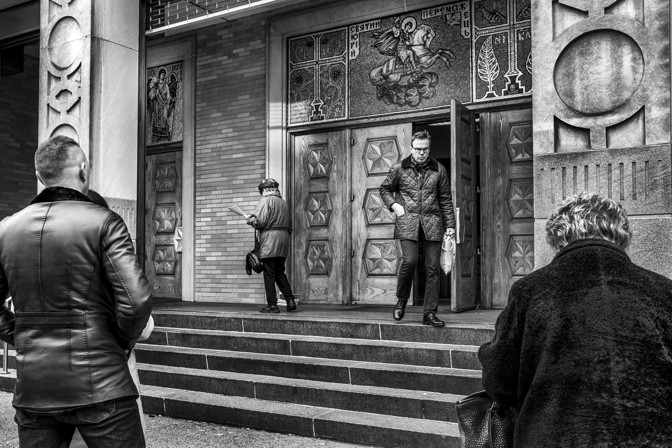
NYC's St. George Ukrainian Catholic Church.
Many historians and columnists - as well as this blog - have lamented the drift of America towards an authoritarian regime where actions once expected only from dictatorships and the so-called banana republics of the past are now common place among the Trump/Pence regime and Republican sycophants. America's decline is being noticed abroad as well where other NATO leaders whisper about Trump - America's version of Kim Jong-un. It is also being noticed by those who immigrated to America seeking a better life and a political system that supposedly held to ideals embodied in the U.S. Constitution who now, as noted in a piece in The Atlantic, feel as if they are witnessing a Soviet/Putin form of corrupt authoritarian rule.   The world is watching to see if Congress steps up to defend America's supposed ideals by impeaching and removing Trump from office or if we are witnessing the first major step in the death of the American republic.  Here are excerpts from the Atlantic piece: 

Walk down a barely marked stairway into a basement in New York’s East Village on a Sunday morning, and you may find yourself in a hub of Ukrainian American life. Members of the vast Ukrainian diaspora regularly gather here, at a church-run restaurant called Streecha, trading the latest on Ukrainian politics over plates of pierogi and bowls of borscht. As formal impeachment hearings against President Donald Trump were finally getting under way recently, several of the patrons here told me that America had lately been feeling more like home—and not in a good way.
Diplomats and officials as prominent as Secretary of State Mike Pompeo have attempted to revive Ronald Reagan–style rhetoric about America’s role as the world’s foremost defender of liberty and freedom, including signaling support for Ukrainian self-determination. Meanwhile, [Trump] the president and his associates appear to be more invested in courting power and personal gain, from Trump’s cozy press conferences with Russian President Vladimir Putin to his attempt to get the Ukrainian government to investigate the family of former Vice President Joe Biden.
The Ukrainians I met here weren’t surprised by this Trumpian mode of politics, in part because it’s very similar to the status quo in the part of the world they come from. The impeachment inquiry is a test not just of Trump’s character, but of the country’s: Is a pitch for America’s exceptionalism still plausible, or is corruption the only true universal principle any government will ever embrace?
“I used to think that American politicians and politics is much more nice than Ukrainian,” Natalie, a short, chatty woman who gave her age as “in her 30s or 40s,” told me. “Come on. It’s even worse.” . . . . The United States government is just as corrupt as Ukraine’s, Natalie said, comparing political leaders here to squabbling seventh graders. This realization has been disappointing, she said, because she is an American by choice: She came to the U.S. a little less than a decade ago, after feeling pushed out of Ukraine by instability and lack of opportunity.
[Trump’s] The president’s personal lawyer Rudy Giuliani and his business associates have come under fire for trying to coordinate a Ukrainian investigation into the Bidens. And Trump, of course, is now the subject of an impeachment inquiry focused on his apparent attempt to pressure Ukrianian President Volodymyr Zelensky into a similar investigation.
As this unlikely series of events has unfolded, Trump and his allies have taken to casually demonizing Ukraine as suspicious and untrustworthy, calling back to Cold War–era stereotypes of Soviet spies and no-goodniks. Leaders ranging from Senator John Kennedy of Louisiana to [Trump] the president himself have promoted the false claim that Ukraine, not Russia, interfered in the 2016 U.S. presidential election. (Kennedy later walked back his statement.)
The portrait of his [Trump’s] behavior that has emerged in news reports and congressional testimony is one of using his office for personal gain: He sought to leverage military aid to a vulnerable ally in order to damage a major political opponent. This move had real consequences for Ukraine, where millions of people are currently living under Russian occupation in the eastern part of the country and soldiers fighting Russian troops are underarmed and strapped for resources. The message of his actions was clear, said Natalie, the woman I met at Streecha: “Trump has no idea where is Ukraine, what is Ukraine, and what’s going on in Ukraine.”
Iwan Kinal, a 35-year-old who grew up in New Jersey and wore a furry black Cossack hat as we stood outside St. George Ukrainian Catholic Church in the cold, told me he’s a lifelong Republican and even likes some of Trump’s policies. But he’s been disturbed to hear the president echo what he described as Russian propaganda about Crimea, Ukraine’s Black Sea peninsula, which Russia seized in 2014. “I’m disappointed in his treatment and his opinion of Ukraine from the start,” Kinal said of Trump.
As the impeachment inquiry and other investigations have revealed, Russian propaganda has in fact infiltrated American political discourse, sometimes at the very highest levels of government. Fiona Hill, who served for two years on Trump’s National Security Council, said during November’s impeachment hearings that members of the House Intelligence Committee itself were perpetrating “a fictional narrative” created by Russian security services that Russia did not, in fact, interfere in the 2016 U.S. presidential election, and that Ukraine may have done so instead. The truth has become subservient to political expediency, and the American government has become a little more similar to any other strongman regime.
Just as Ukraine has long been a football in Russia’s regional schemes, it has now become a Rorschach test in America’s partisan feuds, consequences be damned. “Ukrainian people have been dying for five years in that territory, and they still do,” said Natalie, referring to the Donbas region, where Ukraine is attempting to fight off a Russian incursion. But in America, all that seems to matter are politicians’ personal fortunes and the next domestic elections, reminiscent of so many strongman regimes. As people die in her home country, Natalie said, all of this “is just a game, unfortunately.”
An irony is that the church referenced in the article is where my father was baptized.  His parents fled Austria-Hungry shortly before WWI and settled in New York City.  My paternal grand parents fled a monarchy for political freedom.  Now, I find myself living in a country drifting towards Trump's self-styled monarchy if Congress fails to act and stop the cancer.

Friday, January 04, 2019

Why Is Trump Spouting Russian Propaganda?


Anyone who isn't a dedicated Fox News or Breitbart follower knows that Donald Trump lies.  Indeed, most of what comes out of his mouth is untrue.  Yet something disturbing is now happening - and has been happening for a while now.  Trump is repeating Russian propaganda lies and stating falsehoods in the realm of foreign policy and history as true facts.  Disturbingly, one has to wonder where Trump is getting these falsehoods from since it certainly is not from U.S. foreign policy or national security advisers. If it's not from American advisers, where is it coming from?  One name seems to answer the question: Vladimir Putin. These lies are part of Putin's effort to rehabilitate myths about the former Soviet Union, a dictatorship/empire that Putin longs to restore, picturing himself, I suspect as Russia's new Tsar.  A piece in The Atlantic by a former Republican stalwart looks at this disturbing phenomenon and draws conclusions similar to my own.  Here are excerpts:

It was only one moment in a 90-minute stream of madness.
President Donald Trump convened a Cabinet meeting, at which he invited all its members to praise him for his stance on the border wall and the government shutdown.
There’s always a lively competition to see which member of the Cabinet can grovel most abjectly. The newcomer Matthew Whitaker may be only the acting attorney general, but despite—or perhaps because of—that tentative status, he delivered one of the strongest entries, saluting the president for sacrificing his Christmas and New Year’s holiday for the public good, and contrasting that to members of Congress who had left Washington during the Trump-created crisis.
But that was not the crazy part.
The crazy part came during the president’s monologue defending his decision to withdraw all 2,000 U.S. troops from Syria and 7,000 from Afghanistan, about half the force in that country.
“Russia used to be the Soviet Union,” he said.
Afghanistan made it Russia, because they went bankrupt fighting in Afghanistan. Russia … the reason Russia was in Afghanistan was because terrorists were going into Russia. They were right to be there. The problem is, it was a tough fight. And literally they went bankrupt; they went into being called Russia again, as opposed to the Soviet Union. You know, a lot of these places you’re reading about now are no longer part of Russia, because of Afghanistan.
To appreciate the shock value of Trump’s words, it’s necessary to dust off some Cold War history. Those of us who grew up in the last phases of the Cold War used to know it all by heart, but I admit I had to do a little Googling to refresh my faded memories. Through the 1970s, Afghanistan had been governed by a president who was friendly to the Soviet Union, but it was not reliably under Soviet control. That president, Mohammad Daoud Khan, became convinced that the local Communists were plotting against him. He struck first, assassinating one Communist leader in April 1978, and arresting others.
Instead of preventing the plot, this coup-from-above triggered it. In April 1978, the Communists—enabled by their strong presence in Afghanistan’s Soviet-trained military—seized power.
The new regime launched an ambitious modernizing agenda: women’s rights, land reform, secularization. That project went about as well as expected. While the Communists appealed to a small, educated elite in Kabul, they offended the ultraconservative countryside. Violent guerrilla resistance gathered. The guerrillas called themselves “mujahideen,” holy warriors. The Kabul government dismissed them as “bandit elements” and “terrorists.”
By the end of 1979, the Kabul-based Communist government was teetering, nearing collapse. The Soviet authorities in Moscow blamed the incompetence, corruption, and internecine violence of their local allies. In December 1979, they overthrew and killed the then-Communist leader, installed somebody more compliant, and deployed 85,000 troops to enforce their rule over the countryside. The Soviets had expected a brief, decisive intervention like those in Prague in 1968 or Budapest in 1956. Instead, the war turned into a grinding Vietnam-in-reverse. The Soviets withdrew, defeated, in 1989.
Here’s why Trump’s lopsided view of this story is so telling. Inflicting that defeat on the U.S.S.R. was a major bipartisan [American] foreign-policy priority of the 1980s. The policy was designed by Jimmy Carter’s national-security adviser, Zbigniew Brzezinski, and executed by the Reagan administration.
It’s amazing enough that any U.S. president would retrospectively endorse the Soviet invasion. What’s even more amazing is that he would do so using the very same falsehoods originally invoked by the Soviets themselves: “terrorists” and “bandit elements.”
It has been an important ideological project of the Putin regime to rehabilitate and justify the Soviet invasion and occupation of Afghanistan. Putin does not care so much about Afghanistan, but he cares a lot about the image of the U.S.S.R. In 2005, Putin described the collapse of the Soviet Union as (depending on your preferred translation) “the greatest geopolitical tragedy of the 20th century” or “a major geopolitical disaster of the 20th century”—but clearly a thing very much to be regretted.
The war in Afghanistan helped bring about that collapse, not because it bankrupted the Soviet regime—that was an effect of the break in the price of oil after 1985—but because it forced a reckoning between the Soviet regime and Soviet society. As casualties mounted, as soldiers returned home addicted to heroin, Soviet citizens began demanding the right to speak the truth, not only about the war in Afghanistan, but about all Soviet reality. As of mid-morning on January 3, the day after the president’s repetition of Soviet-Putinist propaganda in the Cabinet room, there has been no attempt by the White House to tidy things up: no presidential tweet, no corrective statement. The president’s usual defenders—Sean Hannity, Fox & Friends, the anti-anti-Trump Twitter chorus—have likewise ignored the whole matter. . . . There’s apparently nothing they can think of to say in exoneration or excuse.
Putin-style glorification of the Soviet regime is entering the mind of the president, inspiring his words and—who knows—perhaps shaping his actions. How that propaganda is reaching him—by which channels, via which persons—seems an important if not urgent question. But maybe what happened yesterday does not raise questions. Maybe it inadvertently reveals answers.