Showing posts with label Vladimir Putin. Show all posts

Tuesday, July 21, 2020

Trump Adopts the "Dictator's Handbook" as He Sinks in the Polls

Many of us realized that Donald Trump's election posed a grave threat to American democracy and moral decency.  Since his inauguration, Trump has shown that he will lie, slander others, put children in cages and now make illegal use of federal agents against citizens to try to prop up his sinking poll numbers.  His tactics are akin to those of Vladimir Putin and Bashar al-Assad who would destroy their nations before they would relinquish power.  Frighteningly, Congressional Republicans are deliberately looking the other way as Trump engages in illegal and dangerous conduct.  Meanwhile, those of us who pay attention find ourselves wonder if this is how decent moral Germans felt as they saw Hitler turned Germany into a police state.  Make no mistake, Trump cares nothing about the damage he does to the rule of law and the harm inflicted on citizens.  As always, with Trump, it is only about himself and his malignant ego.  A column in the New York Times looks at the parallels between Trump's current actions and those of cruel dictators.  Here are highlights, including what liberals and progressives need to do to blunt Trump's tactics:
Some presidents, when they get into trouble before an election, try to “wag the dog” by starting a war abroad. Donald Trump seems ready to wag the dog by starting a war at home. Be afraid — he just might get his wish.
“As the virus spread, and businesses had to shut down again and schools and universities were paralyzed as to whether to open or stay closed in the fall, Trump’s poll numbers nose-dived. Joe Biden opened up a 15-point lead in a national head-to-head survey.
“So, in a desperate effort to salvage his campaign, Trump turned to the Middle East Dictator’s Official Handbook and found just what he was looking for, the chapter titled, ‘What to Do When Your People Turn Against You?'
“Answer: Turn them against each other and then present yourself as the only source of law and order.”
America blessedly is not Syria, yet, but Trump is adopting the same broad approach that Bashar al-Assad did back in 2011, when peaceful protests broke out in the southern Syrian town of Dara’a, calling for democratic reforms; the protests then spread throughout the country.
But al-Assad did not want to share power, and so he made sure that the protests were not peaceful. He had his soldiers open fire on and arrest nonviolent demonstrators, many of them Sunni Muslims. Over time, the peaceful, secular elements of the Syrian democracy movement were sidelined, as hardened Islamists began to spearhead the fight against al-Assad. In the process, the uprising was transformed into a naked, rule-or-die sectarian civil war between al-Assad’s Alawite Shiite forces and various Sunni jihadist groups.
In the end, his country was destroyed and hundreds of thousands of Syrians were killed or forced to flee. But al-Assad stayed in power. Today, he’s the top dog on a pile of rubble.
[W]hen I heard Trump suggest, as he did in the Oval Office on Monday, that he was going to send federal forces into U.S. cities, where the local mayors have not invited him, the first word that popped into my head was “Syria.”
Listen to how Trump put it: “I’m going to do something — that, I can tell you. Because we’re not going to let New York and Chicago and Philadelphia and Detroit and Baltimore and all of these — Oakland is a mess. We’re not going to let this happen in our country.”
This is coming so straight from the Middle East Dictator’s Handbook, it’s chilling. In Syria, al-Assad used plainclothes, pro-regime thugs, known as the shabiha (“the apparitions”) to make protesters disappear. In Portland, Ore., we saw militarized federal forces wearing battle fatigues, but no identifiable markings, arresting people and putting them into unmarked vans. How can this happen in America?
Illiberal populists — whether Recep Tayyip Erdogan in Turkey, Jair Bolsonaro in Brazil, Rodrigo Duterte in the Philippines, Vladimir Putin in Russia, Viktor Orban in Hungary, Jaroslaw Kaczynski in Poland, or al-Assad — “win by dividing the people and presenting themselves as the savior of the good and ordinary citizens against the undeserving agents of subversion and ‘cultural pollution,’” explained Stanford’s Larry Diamond, author of “Ill Winds: Saving Democracy From Russian Rage, Chinese Ambition, and American Complacency.”
In the face of such a threat, the left needs to be smart. Stop calling for “defunding the police” and then saying that “defunding” doesn’t mean disbanding. If it doesn’t mean that then say what it means: “reform.”
All of this street violence and defund-the-police rhetoric plays into the only effective Trump ad that I’ve seen on television. It goes like this: A phone rings and a recording begins: “You have reached the 911 police emergency line. Due to defunding of the police department, we’re sorry but no one is here to take your call. If you’re calling to report a rape, please press 1. To report a murder, press 2. To report a home invasion, press 3. For all other crimes, leave your name and number and someone will get back to you. Our estimated wait time is currently five days. Goodbye.”
Today’s protesters need to trump Trump by taking a page from another foreign leader — a liberal — Ekrem Imamoglu, who managed to win the 2019 election to become the mayor of Istanbul, despite the illiberal Erdogan using every dirty trick possible to steal the election. Imamoglu’s campaign strategy was called “radical love.”
As a recent essay on Imamoglu’s strategy in The Journal of Democracy noted, he overcame Erdogan with a “message of inclusiveness, an attitude of respect toward [Erdogan] supporters, and a focus on bread-and-butter issues that could unite voters across opposing political camps. On June 23, Imamoglu was again elected mayor of Istanbul, but this time with more than 54 percent of the vote — the largest mandate obtained by an Istanbul mayor since 1984 — against 45 percent for his opponent.”
I bet that could work in America, too. It’s the perfect answer to Trump’s politics of division — and it’s the one strategy he’ll never imitate.

Wednesday, July 01, 2020

Why Does Trump Put Russia First?

Since before the 2016 election, Donald Trump has shown that time and time again he puts the interest of Vladimir Putin's Russia ahead of the interests of America and its NATO allies.  The constant question has been why.  Is it because Russian election interference put him in the White House?  Is it because laundered Russian money has kept his real estate ventures afloat given his in ability to secure loans from and U.S. banks?  Is it because he longs to rule America as a dictator as Putin rules Russia, supported by corrupt politicians and sycophants?  Now that it has become clear - despite Trump's lies and denials - that Russia paid bounties for the killing of American troops in Afghanistan and that Trump did nothing, the question becomes all the more relevant.  Former national Security Advisor Susan Rice has an op-ed in the New York Times that is an indictment of Trump and those in his regime who did nothing to punish Putin.  Indeed, Trump did Putin favors and helped Russia's objectives even after knowing Putin was paying for the murder of Americans.  As the 2020 election nears, Trump's betrayal of American military members is yet another reason he needs to be defeated - and thoroughly investigated once he is out of office.  Here are column excerpts (as disclaimer, I have a son-in-law who served in Afghanistan who was badly wounded in that fool's errand war):
Since at least February, and possibly as early as March 2019, the United States has had compelling intelligence that a committed adversary, Russia, paid bounties to Taliban-linked fighters to kill American troops in Afghanistan. American service members were reportedly killed as a result.
To this day, the president of the United States has done nothing about it.  Instead, President Trump dismissed the intelligence as not “credible” and “possibly another fabricated Russia hoax, maybe by the Fake News” that is “wanting to make Republicans look bad!!!”
Mr. Trump also claimed that neither he nor Vice President Mike Pence was ever told about this critical intelligence before it was first reported in The New York Times. Setting aside for a moment the credulity of that claim, whenever [Trump] the president learned of this deeply troubling intelligence, why did he not publicly condemn any Russian efforts to kill American soldiers and explore options for a swift and significant U.S. response?
None of this adds up.  As a former national security adviser, I find it exceedingly difficult to believe that no one told Mr. Trump about this intelligence.
It was reportedly contained in the president’s daily briefing, which is provided to all top-level national security officials. Even if Mr. Trump does not bother regularly to read the daily briefing, we must assume others do. If the president’s senior advisers — Robert O’Brien, the national security adviser; Richard Grenell, who stepped down in May as acting director of national intelligence; and Secretary of Defense Mark Esper, among others — thought it was unnecessary to inform the commander in chief of this life-or- death matter, then they are not worthy of service.
[T[he administration reportedly informed the British government, and the National Security Council convened an interagency meeting in March to discuss the intelligence and its implications.
Here’s what should have happened. Had I, as national security adviser, received even “raw” reporting that Russia was paying to kill U.S. service members, I would have walked straight into the Oval Office to brief the president.
Contrary to the spin-masters in the White House today, I would not have waited until we had absolute certainty. I would have said, “Mr. President, I want to make sure you are aware that we have troubling reporting that Russia is paying the Taliban to kill our forces in Afghanistan. . . . I will convene the national security team to get you some options for how to respond to this apparent major escalation in Russia’s hostile actions.”
If later the president decided, as Mr. Trump did, that he wanted to talk with President Vladimir Putin of Russia at least six times over the next several weeks and invite him to join the Group of 7 summit over the objections of our allies, I would have thrown a red flag: “Mr. President, I want to remind you that we believe the Russians are killing American soldiers. This is not the time to hand Putin an olive branch. It’s the time to punish him.”
If Mr. Trump was told about Russian actions, why did he not respond? If he was not told, why not? Are his top advisers utterly incompetent? Are they too scared to deliver bad news to Mr. Trump, particularly about Russia? Is Mr. Trump running a rogue foreign policy utterly divorced from U.S. national interests? If so, why?
A perilous pattern persists that underscores Mr. Trump’s strange propensity to serve Russian interests above America’s. Recall that, during his 2016 campaign, Mr. Trump publicly urged Russia to hack Hillary Clinton’s emails and praised WikiLeaks for publishing stolen documents.
He denied and dismissed Russian interference in the 2016 election, then took Mr. Putin at his word at a Helsinki meeting while undercutting the U.S. intelligence community, and obstructed the Mueller investigation and distorted its findings. Mr. Trump recklessly removed U.S. troops from northern Syria and allowed Russian forces to take over American bases.
Next, Mr. Trump unilaterally invited Mr. Putin to attend the Group of 7 meeting, a move that apparently upended the organization’s annual summit. Subsequently, without any consultation, Mr. Trump announced his decision to remove nearly a third of U.S. troops from Germany — a sudden and inexplicable withdrawal that weakens the U.S.-German relationship and harms NATO, while benefiting Russia.
Most recently, we have learned that even Russian efforts to slaughter American troops in cold blood do not faze this president. . . . . . Now Mr. Putin knows he can kill Americans with impunity.
At best, our commander in chief is utterly derelict in his duties, presiding over a dangerously dysfunctional national security process that is putting our country and those who wear its uniform at great risk. At worst, the White House is being run by liars and wimps catering to a tyrannical president who is actively advancing our arch adversary’s nefarious interests.
Vote a straight Democrat ticket in November at all levels of government.  Republicans must be severely punished for their betrayal of America through their pandering to Trump.

Thursday, April 23, 2020

Senate Intelligence Committee Confirms Russia Interfered in the 2016 Election to Aid Trump

Among the thousands of lies that issue from Donald Trump's lips is that claims that Russia interfered in the 2016 presidential election to aid him is a hoax.  A myth created by the "deep state" he fantasizes about but which does not exist.  Now, the U.S. Senate Intelligence, chaired by a Republican and with a Republican majority has issued its long awaited report and confirmed what the intelligence agencies concluded long ago: Russia interfered in the election with the direct goal of aiding in Trump's election.  Sane, thinking Americans already grasp this fact, but don't hold your breath waiting for the Trump base to ever accept that they were played by Putin.  That would run counter to their mental capabilities and against their deep seated bigotries that Trump and Putin skillfully played. The Washington Post looks at the Intelligence Committee findings.  Here are highlights:
THE SENATE Intelligence Committee has released a bipartisan report with a stark bottom line: What President Trump calls the “Russia hoax” isn’t a hoax at all.
The fourth and latest installment in lawmakers’ review of Moscow’s meddling examines a January 2017 assessment by the nation’s spy agencies that Mr. Trump has repeatedly attempted to discredit — and confirms it, unanimously. Russia sought to subvert Americans’ belief in our democracy, bring down Hillary Clinton and bolster her rival. That these legislators from both sides of the aisle are willing to say as much after three years of thorough investigation is an encouraging sign of some independent thinking still left in government. It’s also a reminder of the peril this independence is in today.
The committee members conclude that the intelligence community produced a “coherent and well-constructed . . . basis for the case of unprecedented Russian interference in the 2016 U.S. presidential election” despite a tight time frame.
 The Senate Intelligence Committee deserves accolades for its clear-eyed examination of a subject that shouldn’t be political but has become polarizing thanks to the president’s provocations. Yet lawmakers wouldn’t have had a report to analyze at all if it weren’t for an intelligence community willing to dig up inconvenient truths. This is the community Mr. Trump is slowly destroying, most recently by firing his director of national intelligence and nominating an unqualified loyalist to fill the slot, as well as by dismissing Inspector General Michael Atkinson for lawfully alerting Congress about a whistleblower complaint.
The most recent Russia report is a reminder of the need to protect our elections against a repeat performance, whether by disrupting online influence campaigns, securing critical infrastructure or requiring paper trails and risk-limiting audits at the ballot box. But it’s also a reminder of the need to protect the intelligence community from co-option by a leader hostile to any truths that threaten his power.

Saturday, February 22, 2020

Russia Is Interfering to Aid Bernie Sanders

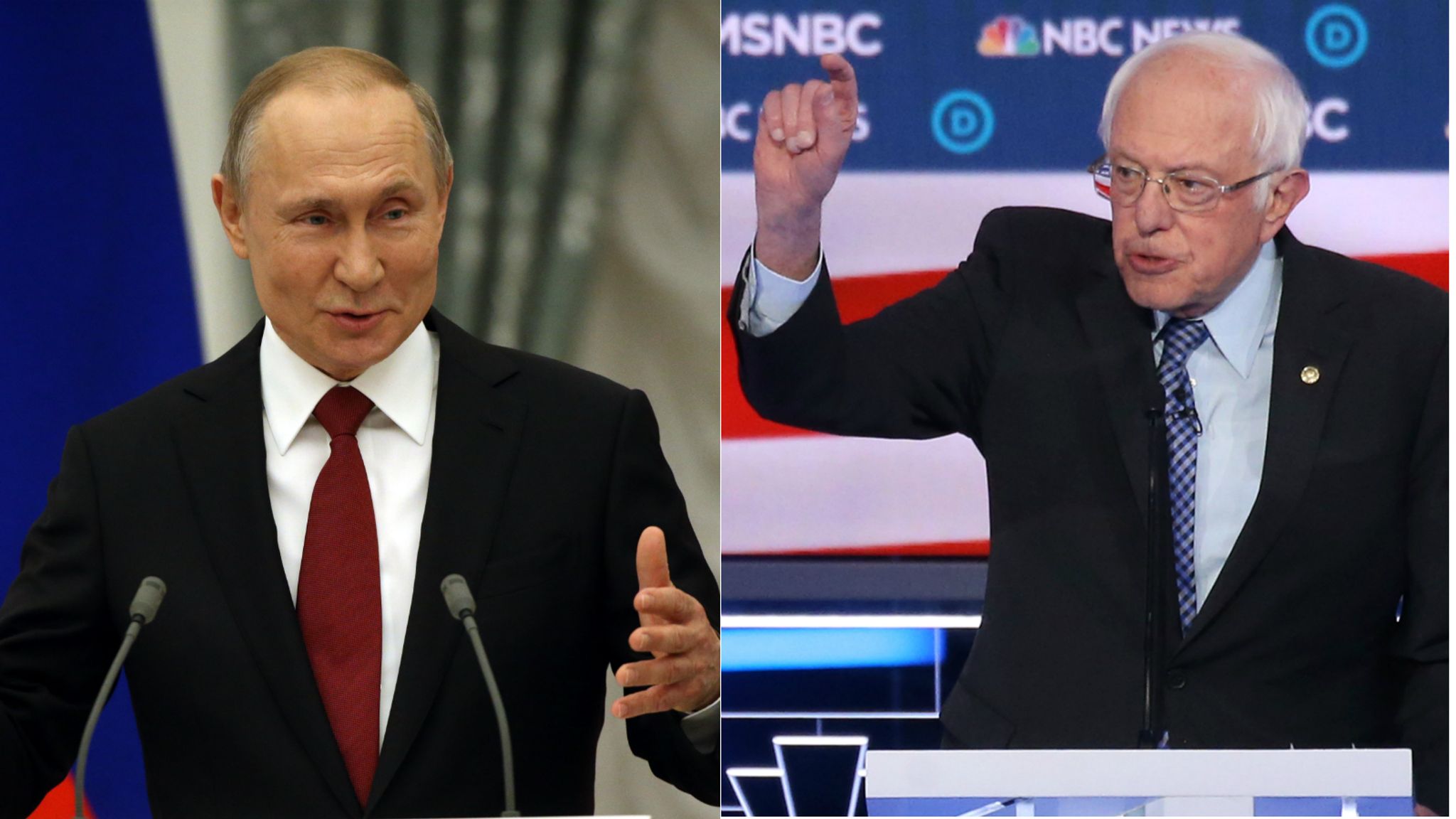
It has been documented that Russia interfered in the 2016 presidential election to aid Donald Trump - who since election has appeared to further Putin's agenda - and propped up third party candidates such as Jill Stein to siphon off support from Hillary Clinton.  Now, Russia is at it again and is working to aid Trump's re-election and, for now to aid Bernie Sanders who Russia sees as the least electable of those seeking the Democrat nomination.  Trump - who is lying if his lips are moving - disputes Russia's efforts, but the smart money is that the Russians are doing precisely what intelligence officials are alleging.  One looming threat to knowing the truth is Trump's appointment of Trump ideologue Richard Grinell to the position of acting director of national intelligence where he will likely undermine or eliminate anyone not parroting Trump's preferred propaganda. Meanwhile, Democrat primary voters need to be mindful of who Russia is aiding and why.  A piece in the New York Times looks at this latest Russian threat and Sanders' unconvincing disavowal of Russian efforts. Here are highlights:
Russia has been trying to intervene in the Democratic primaries to aid Senator Bernie Sanders, according to people familiar with the matter, and Mr. Sanders said on Friday that intelligence officials recently briefed him.
The disclosure came a day before the Nevada caucuses, where Mr. Sanders is a favorite, and followed revelations a day earlier that Moscow was interfering on President Trump’s behalf this year, as it did in 2016.
“The intelligence community is telling us they are interfering in this campaign right now in 2020,” Mr. Sanders separately told reporters in Bakersfield, Calif., where he held a rally on Friday. “And what I say to Mr. Putin: ‘If elected president, trust me, you are not going to be interfering in American elections.’”
On Friday, [Trump] the president aggressively disputed that Russia was interfering on his behalf. He called the disclosures a hoax and part of a partisan campaign against him. At a campaign rally in Las Vegas, Mr. Trump suggested that Mr. Putin would prefer Mr. Sanders, “who honeymooned in Moscow.”
Russia’s interference on behalf of both Mr. Trump, the dominant force in the Republican Party, and Mr. Sanders, a stalwart of the left, underscores its efforts to sow chaos across the political spectrum. Undermining the democratic system remains at the core of Russia’s effort to raise its own stature by weakening the United States, according to current and former officials.
Russia’s interference measures and their intensity remain murky, even as intelligence officials sound alarms.
In briefings to House Intelligence Committee members last week and to Mr. Sanders, officials said that Russia was actively interfering in the campaign, and people at the House briefing said intelligence officials said that Russia had a preference for Mr. Trump.
Revelations about the House briefing enraged [Trump] the president, who complained that Democrats would use Moscow’s support for him against him, people familiar with the matter said. Days later, he replaced the acting director of national intelligence, Joseph Maguire, though administration officials have said it was not a direct result of the briefing.
Richard Grenell, the American ambassador to Germany whom Mr. Trump appointed this week to replace Mr. Maguire, asked the agencies under his purview on Friday to provide the raw information and analysis that went into the briefing, people familiar with the matter said.
Mr. Grenell’s appointment has drawn criticism from former intelligence officials who question his lack of experience and his record as a partisan ideologue. . . . . officials have hastened planned exits, as Mr. Grenell looks to install his own team.
[P]eople who heard the briefing said that the intelligence officers presenting the material said, in response to questions from lawmakers, that Russia was trying to get Mr. Trump re-elected.
[S]ome current and former officials expressed doubt that Russian officials think that Mr. Sanders has a hidden affinity for Moscow. Instead, they said that a Russian campaign to support Mr. Sanders might ultimately be aimed at aiding Mr. Trump. Moscow could potentially consider Mr. Sanders a weaker general election opponent for [Trump] the president than a more moderate Democratic nominee, according to two people familiar with the matter.
Russia also worked to support — or at least not harm — Mr. Sanders in 2016. Operatives at a Russian intelligence-backed troll factory were instructed to avoid attacking Mr. Sanders or Mr. Trump, according to the report by the special counsel, Robert S. Mueller III, and an indictment he secured of 13 Russians working on the operation.
Both the indictment and Mr. Mueller’s report quoted internal documents from the Internet Research Agency ordering operatives to attack Hillary Clinton’s campaign. “Use any opportunity to criticize Hillary and the rest except for Sanders and Trump — we support them,” the document said.
Russian operatives used the troll factory in 2016 to pose on social media as Americans and sow divisions among already divisive issues like immigration, religion and race. It was one part of the Kremlin’s multipronged attack on the election that also included hackings of Democratic emails, payments to unsuspecting Americans to stage pro-Trump rallies in battleground states and at least one scouting trip to the United States in 2014.
His [Sanders’] online army of supporters is both coveted by his rivals and a source of complaints because of what they say is abusive behavior online.
Sadly, I see Sanders' ego as out of control as Trump's and doubt that he or his most militant supporters will face the fact that they are playing right into Putin's agenda.  Be very, very afraid of where this all ends. 

Wednesday, December 11, 2019

America Starts to Feel a Little More Soviet

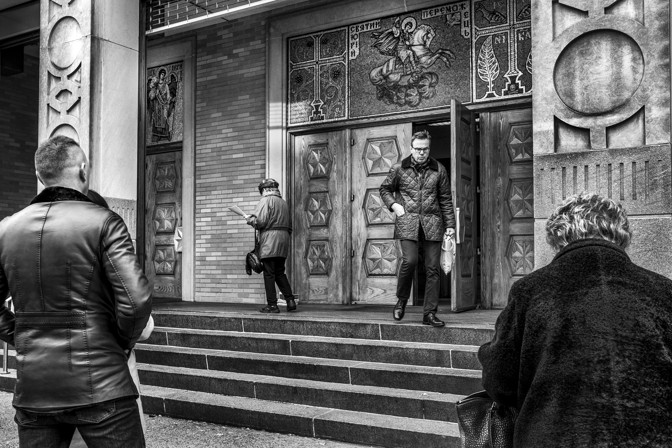
NYC's St. George Ukrainian Catholic Church.
Many historians and columnists - as well as this blog - have lamented the drift of America towards an authoritarian regime where actions once expected only from dictatorships and the so-called banana republics of the past are now common place among the Trump/Pence regime and Republican sycophants. America's decline is being noticed abroad as well where other NATO leaders whisper about Trump - America's version of Kim Jong-un. It is also being noticed by those who immigrated to America seeking a better life and a political system that supposedly held to ideals embodied in the U.S. Constitution who now, as noted in a piece in The Atlantic, feel as if they are witnessing a Soviet/Putin form of corrupt authoritarian rule.   The world is watching to see if Congress steps up to defend America's supposed ideals by impeaching and removing Trump from office or if we are witnessing the first major step in the death of the American republic.  Here are excerpts from the Atlantic piece: 

Walk down a barely marked stairway into a basement in New York’s East Village on a Sunday morning, and you may find yourself in a hub of Ukrainian American life. Members of the vast Ukrainian diaspora regularly gather here, at a church-run restaurant called Streecha, trading the latest on Ukrainian politics over plates of pierogi and bowls of borscht. As formal impeachment hearings against President Donald Trump were finally getting under way recently, several of the patrons here told me that America had lately been feeling more like home—and not in a good way.
Diplomats and officials as prominent as Secretary of State Mike Pompeo have attempted to revive Ronald Reagan–style rhetoric about America’s role as the world’s foremost defender of liberty and freedom, including signaling support for Ukrainian self-determination. Meanwhile, [Trump] the president and his associates appear to be more invested in courting power and personal gain, from Trump’s cozy press conferences with Russian President Vladimir Putin to his attempt to get the Ukrainian government to investigate the family of former Vice President Joe Biden.
The Ukrainians I met here weren’t surprised by this Trumpian mode of politics, in part because it’s very similar to the status quo in the part of the world they come from. The impeachment inquiry is a test not just of Trump’s character, but of the country’s: Is a pitch for America’s exceptionalism still plausible, or is corruption the only true universal principle any government will ever embrace?
“I used to think that American politicians and politics is much more nice than Ukrainian,” Natalie, a short, chatty woman who gave her age as “in her 30s or 40s,” told me. “Come on. It’s even worse.” . . . . The United States government is just as corrupt as Ukraine’s, Natalie said, comparing political leaders here to squabbling seventh graders. This realization has been disappointing, she said, because she is an American by choice: She came to the U.S. a little less than a decade ago, after feeling pushed out of Ukraine by instability and lack of opportunity.
[Trump’s] The president’s personal lawyer Rudy Giuliani and his business associates have come under fire for trying to coordinate a Ukrainian investigation into the Bidens. And Trump, of course, is now the subject of an impeachment inquiry focused on his apparent attempt to pressure Ukrianian President Volodymyr Zelensky into a similar investigation.
As this unlikely series of events has unfolded, Trump and his allies have taken to casually demonizing Ukraine as suspicious and untrustworthy, calling back to Cold War–era stereotypes of Soviet spies and no-goodniks. Leaders ranging from Senator John Kennedy of Louisiana to [Trump] the president himself have promoted the false claim that Ukraine, not Russia, interfered in the 2016 U.S. presidential election. (Kennedy later walked back his statement.)
The portrait of his [Trump’s] behavior that has emerged in news reports and congressional testimony is one of using his office for personal gain: He sought to leverage military aid to a vulnerable ally in order to damage a major political opponent. This move had real consequences for Ukraine, where millions of people are currently living under Russian occupation in the eastern part of the country and soldiers fighting Russian troops are underarmed and strapped for resources. The message of his actions was clear, said Natalie, the woman I met at Streecha: “Trump has no idea where is Ukraine, what is Ukraine, and what’s going on in Ukraine.”
Iwan Kinal, a 35-year-old who grew up in New Jersey and wore a furry black Cossack hat as we stood outside St. George Ukrainian Catholic Church in the cold, told me he’s a lifelong Republican and even likes some of Trump’s policies. But he’s been disturbed to hear the president echo what he described as Russian propaganda about Crimea, Ukraine’s Black Sea peninsula, which Russia seized in 2014. “I’m disappointed in his treatment and his opinion of Ukraine from the start,” Kinal said of Trump.
As the impeachment inquiry and other investigations have revealed, Russian propaganda has in fact infiltrated American political discourse, sometimes at the very highest levels of government. Fiona Hill, who served for two years on Trump’s National Security Council, said during November’s impeachment hearings that members of the House Intelligence Committee itself were perpetrating “a fictional narrative” created by Russian security services that Russia did not, in fact, interfere in the 2016 U.S. presidential election, and that Ukraine may have done so instead. The truth has become subservient to political expediency, and the American government has become a little more similar to any other strongman regime.
Just as Ukraine has long been a football in Russia’s regional schemes, it has now become a Rorschach test in America’s partisan feuds, consequences be damned. “Ukrainian people have been dying for five years in that territory, and they still do,” said Natalie, referring to the Donbas region, where Ukraine is attempting to fight off a Russian incursion. But in America, all that seems to matter are politicians’ personal fortunes and the next domestic elections, reminiscent of so many strongman regimes. As people die in her home country, Natalie said, all of this “is just a game, unfortunately.”
An irony is that the church referenced in the article is where my father was baptized.  His parents fled Austria-Hungry shortly before WWI and settled in New York City.  My paternal grand parents fled a monarchy for political freedom.  Now, I find myself living in a country drifting towards Trump's self-styled monarchy if Congress fails to act and stop the cancer.

Friday, August 23, 2019

Never Trump Ex-Republican: Why I Will Vote for Any 2020 Democratic Nominee


While driving between my law firm's offices today, I heard Thomas Nichols as a guest on the POTUS - Politics of the United States - channel on satellite radio.  The topic was his column last week in USA Today as to why he would vote for almost any Democrat nominee (other than Tulsi Gabbard and Marianne Williamson) in the 2020 presidential election.  Nichols is a former Republican, a Never Trumper, and is an academic specialist on international affairs, currently a professor at the U.S. Naval War College and at the Harvard Extension School. He's no intellectual slouch and knows much about the U.S. Constitution and foreign affairs. His work deals with issues involving Russia, nuclear weapons, and national security affairs.  His radio remarks were so strong that I found the USA Today piece which ought to be required reading for every voter in America since it makes it clear (i) why people MUST get to the polls in 2020, and (ii) why virtually anyone other than Trump would put the nation on a safer course.  Here are column excerpts:

I don’t care if Sen. Elizabeth Warren is a mendacious Massachusetts liberal. She could tell me that she’s going to make me wear waffles as underpants and I’ll vote for her. I don’t care if Sen. Kamala Harris is an opportunistic California prosecutor who wants to relitigate busing. She could tell me that I have to drive to work in a go-cart covered with Barbie decals and I’ll vote for her. I don’t care if Vermont Sen. Bernie Sanders is a muddle-headed socialist from a rural class-warfare state (where I once lived as one of his constituents). He could tell me he’s going to tax used kitty litter and I’ll vote for him.
All of the policy “what about” hypotheticals from my conservative friends are diversions. They’re trying to move the argument to policy to blind us to the reality that President Donald Trump is both unstable and compromised.
As I have argued for well over two years, there is plenty of evidence that the president is compromised by our most dedicated enemy. Even before the Mueller report laid bare the degree to which the Trump campaign welcomed Russian help, it was obvious that Trump feared Russian President Vladimir Putin — not only because Putin knew how much Trump had lied to the American people during the campaign about his dealings with Russia, but also likely because Moscow holds Trump’s closest financial secrets after years of shady dealings with Russian oligarchs.
Compulsive lying, fantastic and easily refuted claims, base insults and bizarre public meltdowns, however, are indeed signs of serious emotional problems. Trump has never been a reasonable man, but for two years, he has gotten worse. He literally cannot tell the truth from a lie, he often seems completely unable to comprehend even basic information, and he flies off the handle in ways that would make most of us take our children to a pediatrician for evaluation.
This is why policy doesn’t matter. I have only two requirements from the Democratic nominee. First, he or she must not be obviously mentally unstable. Second, the nominee must not be in any way sympathetic — or worse, potentially beholden — to a hostile foreign power. This rules out Gabbard, Williamson and maybe New York City Mayor Bill de Blasio, although in de Blasio’s case it’s hard to tell whether he is unstable or just a terrible person.
As for the rest of them, I am willing to live with whoever wins the Democratic primary process. I will likely hate the nominee’s policies, but at least I will not be concerned that he or she is incapable of understanding “the nuclear” or “the cyber.” I will feel like I have a shot at trying to convince my elected representatives that they should listen to the policy preferences of normal human beings instead of two old men wearing shirts that say they’d “rather be a Russian than a Democrat,” or a woman in a shirt indicating that she is willing to have the president grab her genitalia.
The Democratic candidate will promise to nominate people into Cabinet posts who will make me tear my hair out. But at least I will be confident that they are in charge of their own inner circle, instead of surrounded by unprincipled cronies who keep their own boss in the dark while taking a hatchet to the Constitution. Is there anyone that Warren or former Vice President Joe Biden could bring to, say, the Justice Department, whom I would fear more than an odious and sinister courtier like William Barr?
It is a sign of how low we have fallen as a nation that “rational” and “not compromised by an enemy” are now my only two requirements for the office of the president of the United States. Perhaps years of peace and prosperity have made us forget the terrifying responsibilities that attend the presidency, including the stewardship of enough nuclear weapons to blow the Northern Hemisphere to smithereens.
As long as the Democrats can provide someone who can pass these simple tests, their nominee has my vote.
Sadly, the analysis is 100% on point. Trump Must be defeated in 2020.

Saturday, June 29, 2019

Trump Is Fast Forwarding America's Decline

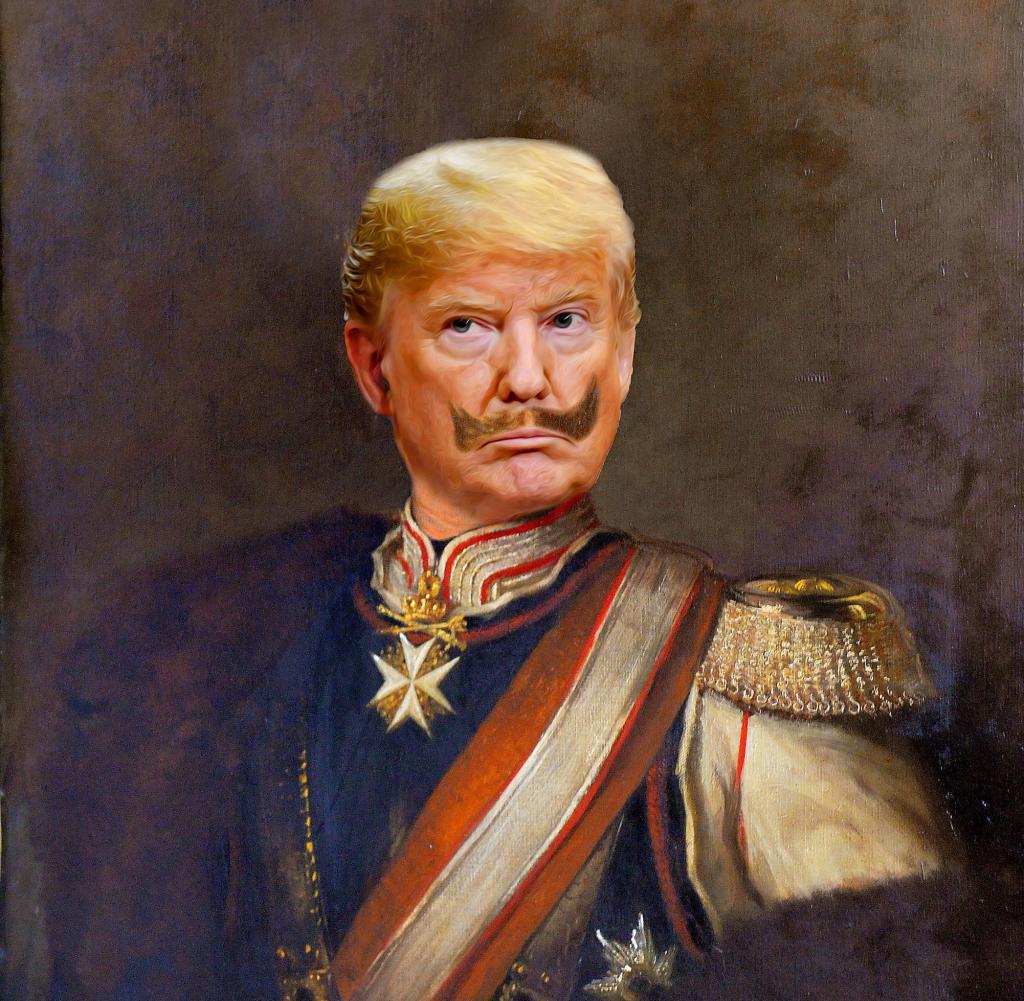
Trump as Wilhelm II.
Donald Trump's mantra is to "make America great again" yet his regime is rapidly destroying standing in the world. While using many of Adolph Hitler's tactics of attacking the free press, demonizing targeted groups, and lying incessantly, as noted in a prior post, Trump's behavior mimics that of the narcissistic, impetuous Kaiser Wilhelm II who used nationalism to lead Germany into WWI  and ultimate disaster, including an overthrow of the monarchy.  The other irony, of course, is that if one looks at those who attended Trump's rallies - e.g., his recent kick off in Florida - they look like losers and what my late maternal grandmother would have described as "white trash" were she still living. Hardly folks that reflect American greatness. Under Trump, America has gone from the recognized leader of the democratic world to being an untrustworthy ally with a leader who prefers hobnobbing with dictators and autocrats, or in the case of Saudi Arabia, out right murderers.  A column in the New York Times looks at America's accelerating decline under Der Trumpenführer. Here are excerpts:

So Vladimir Putin, the Russian president, has told The Financial Times, “The liberal idea has become obsolete.” It has, he says, “outlived its purpose.” President Trump finds him amusing. In Japan, at the G-20 summit meeting, he wags his finger at Putin and says, with a grin: “Don’t meddle in the election, President.”
It’s a measure of American decline over the past three decades that Putin’s claim, however objectionable, is no longer preposterous and Trump’s frivolity no longer surprising. Thirty years ago, the Berlin Wall fell. Two years later, the Soviet Union was gone. The liberal idea was triumphant, and American power virtually uncontested in “the unipolar moment.”
Liberalism posited the indivisibility of freedom and human dignity, as well as the idea that the rule of law and democracy offered the best chance for human advancement, peace and prosperity. Its spread appeared inevitable and irreversible. Its guiding spirit was the United States.
The road from that high-water mark of the American idea to Trump’s autocrat-coddling indecency offers a story of squandered American opportunity and eroded American self-belief that Edward Gibbon would have qualified as “decline and fall.” All Democratic candidates should be asked what they intend to do about it.
I can think of no better guide for reflection than William Burns’s book, “The Back Channel,” his wonderful memoir of a life in diplomacy. . . . back in 1993, in a memo to the incoming Clinton administration, he wrote: “Democratic societies that fail to produce the fruits of economic reform quickly, or fail to accommodate pressures for ethnic self-expression, may slide back into other ‘isms,’ including nationalism.”
Burns, now the president of the Carnegie Endowment for International Peace, attributes the loss of America’s “unrivaled position of strength” in part to inevitable geopolitical trends, including the rise of China and India in the “Pacific century.”
This was, however, compounded by what he calls “grievous missteps.” They included the post-9/11 “inversion of force and diplomacy” that saw a disoriented United States lurch onto a “road to war in Iraq” that “was distinctive for its intensity and indiscipline.”
The unhappy sidelining and devaluation of diplomacy is a theme of the book. It has, for Burns, culminated in Trump’s “savaging of American diplomacy” that has left “our friends confused, our adversaries emboldened, and the foundations of the international system we built and preserved for seven decades alarmingly fragile.” He writes of “unilateral diplomatic disarmament” under Trump, born of “equal parts ideological contempt and stubborn incompetence.” The president’s view of diplomacy is “narcissistic, not institutional,” Burns observes, full of “muscular posturing and fact-free assertions” that insult allies and indulge autocrats. Burns played a leading role in negotiating [the Iran nuclear deal] that Trump called “the worst deal ever” before withdrawing from it. This, Burns writes, “was exactly the kind of risky, cocky, ill-considered bet that had shredded our influence before, and could easily do so again.” For Burns, the erosion of American power and influence long predates Trump. He regrets the loss of the extraordinary American cohesion that, at the end of the Cold War, secured the place of a united Germany in NATO. He notes the failure to perceive early enough how Russian “humiliation and wounded pride” would, under Putin, spur a Russian resurgence.
NATO expansion was, he suggests, “premature at best, and needlessly provocative at worst” — a debatable point in my view, given the need to secure and stabilize the liberation of more than 100 million long subjugated people in Central Europe and the Baltic States.
He thinks President Obama made a mistake by not upholding his “red line” against the Syrian regime’s use of chemical weapons. The Obama administration “had blinked” and, Burns notes, “it would leave an enduring mark.” Into that vacuum Putin strode.
Now the Russian president claims liberalism is obsolete. He is wrong. It is more necessary than ever even as Trump scoffs at it. But America’s ability to promote liberal democracy cannot be served by what Burns calls “a State Department in which officers are bludgeoned into timidity, or censor themselves, or are simply ignored.”


Be very afraid.

Tuesday, June 18, 2019

The Religious Right Wants to Destroy Democracy

The so-called Christian Right - which in my view is neither right on issues nor Christian - has always had its element who wanted to over throw America's democracy to establish a theocracy with, of course, themselves in charge and dictating what others are allowed to think and how they are allowed to live their lives. Not that many years ago, huckster and scam artist Mike Huckabee - the father of the loathsome and  perpetually lying Sarah Huckabee Sanders - stated on Morning Joe that he wanted the Bible, not the U.S. Constitution, to be the governing factor in America's government.  Now, more and more of the ranks of the evangelicals - the Christofascist, if you will - are ready to overthrow democracy if they cannot inflict their will on the country through any other means. They look longingly at how Vladimir Putin has re-empowered the Russian Orthodox Church (which has a horrible record on its support of dictators) as a means to shore up his power.  Meanwhile, the Trump/Pence has promised the moon to evangelicals who have thrown principle and morality out the window in exchange for power. A lengthy piece in The Atlantic looks at this frightening trend of illiberalism and a longing for authoritarian rule.  Here are highlights:
By the tail end of the Obama administration, the culture war seemed lost. The religious right sued for détente, having been swept up in one of the most rapid cultural shifts in generations. Gone were the decades of being able to count on attacking its traditional targets for political advantage. In 2013, Chuck Cooper, the attorney defending California’s ban on same-sex marriage, begged the justices to allow same-sex-marriage opponents to lose at the ballot box rather than in court. Conservatives such as George Will and Rod Dreher griped that LGBTQ activists were “sore winners,” intent on imposing their beliefs on prostrate Christians, who, after all, had already been defeated.The rapidity of that cultural shift, though, should not obscure the contours of the society that the religious right still aspires to preserve: a world where women have no control over whether to carry a pregnancy to term, same-sex marriage is illegal, and gays and lesbians can be arrested and incarcerated for having sex in their own homes and be barred from raising children.

The religious right showed no mercy and no charity toward these groups when it had the power to impose its will, but when it lost that power, it turned to invoking the importance of religious tolerance and pluralism in a democratic society. That was then. The tide of illiberalism sweeping over Western countries and the election of Donald Trump have since renewed hope among some on the religious right that it might revive its cultural control through the power of the state. Inspired by Viktor Orbán in Hungary and Vladimir Putin in Russia, a faction of the religious right now looks to sectarian ethno-nationalism to restore its beliefs to their rightful primacy, and to rescue a degraded and degenerate culture. All that stands in their way is democracy, and the fact that most Americans reject what they have to offer.The past few weeks have witnessed a nasty internecine fight among religious conservatives about whether liberal democracy’s time has passed. Sohrab Ahmari, writing at First Things, attacked National Review’s David French for adhering to a traditional commitment to liberal democracy while “the overall balance of forces has tilted inexorably away from us.”Many religious conservatives see antidiscrimination laws that compel owners of public accommodations to serve all customers, laws that might compel priests to break the seal of confession if they are told of child abuse, and the growing acceptance of trans people as a kind of impending apocalypse. It is no surprise that among their co-partisans, Ahmari seems to have the upper hand here; in such circles, “Crush your enemies” almost always plays better than “The other side has rights too.”

The concerns Ahmari airs are not wholly without merit: Religious conservatives are not paranoid to imagine themselves pariahs someday in the future because of their views; it was not so long ago that liberal champions such as Barack Obama and Hillary Clinton held public positions that today would be described by the left as bigotry.

In spite of their disagreements, Ahmari and French are in accord about a great deal when it comes to abortion, women’s rights, and LGBTQ rights. French’s adherence to liberal democracy is a commitment to a set of rules under which these goals can be pursued in a pluralistic society: through public discourse, the courts, and the ballot box. For Ahmari and his ilk, this is insufficient. He seems to believe not only that the state should always settle such disputes in his favor, but that it should prevent cultural and political expressions he finds distasteful.This isn’t an exaggeration. In a since-deleted tweet, Ahmari praised Alabama Public Television for refusing to air an episode of the cartoon Arthur in which the titular character’s male teacher marries another man; his attack on French was preceded by another since-deleted eruption, over Drag Queen Story Hour at a public library, in which he cried, “To hell with liberal order”; and he has since suggested the humanities should be defunded because “they may be lost to us for good.”

If this is where Ahmari and his cohort are while the GOP still controls the courts, the Senate, and the presidency, imagine what they’ll be willing to countenance should they lose them. Ahmari’s demands here outline the United States that illiberals would like to see: one that resembles Orbán’s Hungary, where rigged electoral systems ensure that political competition is minimal, the press is tightly controlled by an alliance between corporations and the state on behalf of the ruling party, national identity is defined in religious and ethnic terms, and cultural expressions are closely policed by the state to ensure compliance with that identity. It is no surprise that the vast majority of black and Latino Christians see a secular but pluralist left as more trustworthy allies than conservatives who rail against “poisonous and censorious multiculturalism,” and darkly warn of a plot to “displace American citizens.”

The illiberals see the wealthy and upper-middle classes getting married, forming families, and raising children much as they did in the 1950s, and conclude that the problem with working-class Americans is not the diminished political power relative to their bosses, but the absence of a sharp enough lash, whether from the state or from a culture that has escaped the religious right’s grasp. Gillette should be making commercials about women staying at home and fathers going off to work, not dads teaching their trans sons to shave for the first time.

This understanding also helps illuminate the right’s eruption over YouTube’s decision to demonetize (but not remove) the channel of Steven Crowder, a conservative YouTuber who called the Vox reporter Carlos Maza a “lispy queer,” among other slurs. A world in which one can refer to gay people as “lispy queers” without repercussion is one in which the illiberal right is winning the culture war, so it matters little that YouTube is no less a private business than Masterpiece Cakeshop, and has a right to define the rules for using its platform. The same sort of protests that the right decries as illiberal when deployed against right-wing speakers on college campuses are suddenly a legitimate tactic when used against Drag Queen Story Hour.

The objective here, in Ahmari’s words, is to defeat “the enemy,” not adhere to principle, and that requires de-stigmatizing anew the kind of bigotry that was once powerful enough to sway elections.

[T]he illiberal faction in this debate retains Trump as its champion precisely because the president is willing to use the power of the state for sectarian ends, despite being an exemplar of the libertinism to which it is supposedly implacably opposed, a man whose major legislative accomplishment is slashing taxes on the wealthy, and whose most significant contribution to the institution of the family is destroying thousands of them on purpose. It is power that is the motivator here, and the best that could be said for these American Orbánists is that they believe that asserting an iron grip on American politics and culture would offer the greatest good for the greatest number of people. Every authoritarian movement has felt the same way.

The question of whether the Republican Party would abandon liberal democracy for sectarian ethno-nationalism was decided in the 2016 primary, and all French and Ahmari are doing is arguing about it after the fact. The commercial and social incentives for conservative writers to succumb to Trumpism are vast. . . . And the support Ahmari has drawn suggests that the conservative intelligentsia will offer less resistance to authoritarianism than it did in 2015 and 2016.

Trump is the symptom of the Republican Party’s turn toward illiberalism, not its cause; even before Trump ran for president, some Republican elites were plotting to diminish the political power of minorities and enhance those of white voters. Whatever their disagreements, the leaders of both the populist and establishment wings of the Republican Party have concluded that they cannot be allowed to lose power simply because a majority of American voters do not wish them to wield it. The president speaks of imprisoning his political rivals, and his voters cheer. He valorizes political violence, and his followers take note.Trump’s supporters exult in the head of state attacking private citizens who demand equal rights, then wave the banner of free speech exclusively in defense of expressions of bigotry. In the end, Trump will dictate the course of his party on these matters, and his base will do whatever he gives it license to do.

Writers such as French and Ahmari cannot shape this course; they can only argue about it after the fact.[T]his faction did not abandon its faith in liberalism’s capacity to solve problems during the decades of Jim Crow. It did not cry, “To hell with the liberal order!” over mass incarceration. It did not erupt in fury over the shattering of Latino families at the border, or the Trump-made aftermath of the catastrophe in Puerto Rico. It did not question whether liberalism had failed after the first, third, fourth or 15th mass shooting at a school, or because it is typical for Americans to beg strangers on the internet for money to cover their health-care costs or after an untimely death.

The state of emergency occurred when, and only when, liberal democracy ceased to guarantee victory in the culture war. The indignity of fighting for one’s rights within a democratic framework is fine for others, but it is beneath them.

[W]hat they describe as a crisis of liberal democracy is really just them not getting exactly what they want when they want it.

Friday, June 14, 2019

A Russian Reporter Beats the Kremlin

In what might be a cautionary tale for Donald Trump - assuming he watched anything but Fox News - in terms with is treatment of the free press can be found in perhaps the most unlikely place: Vladimir Putin's Russia. Putin has long sought to silence the independent press, especially when the press seeks to expose the corruption that defines Putin himself, not to mention his cronies and fellow oligarchs.  For Fox News viewers, an oligarch is a very rich (and often unscrupulous if not criminal) business leader with a great deal of political influence.  In standard Putin form, he had journalist Ivan Golunov arrested in early June on fabricated drugs charges in an effort to silence his reporting on the dirty and likely criminal behavior of Putin cronies.  What Putin likely did not count on is the public backlash to Golunov's arrest which forced the charges to be dropped and Golunov to be released (personally, if I were Golunov, I'd lease the country ASAP before he can be mysteriously murdered on Putin's orders).  Putin's Russia is the image of how Donald Trump sees himself and how he wants to be above the law. Golunov's release suggests that perhaps Trump should consider rethinking his game plan. I believe a majority of Americans are not racist, brain dead Trump supporters.  At some point, they will cease believing his lies.  A piece in Politico looks at Putin's - and by extension, Trump's - miscalculation.  Here are highlights:
MOSCOW—The men who ordered the arrest of Ivan Golunov in early June on fabricated drugs charges can have had no idea how his name would be known to millions within just a few hours and overshadow the speeches of Vladimir Putin and Xi Jinping at the St. Petersburg Economic Forum the same weekend.
The reaction was so strong—from street demonstrations in Moscow to three daily newspapers sharing the same front page to protest Golunov’s arrest—that the authorities actually backed down on June 11, just five days after taking him into custody. Charges against Golunov were dropped and the Ministry of Interior announced it was suspending the police officers involved.
Why the big fuss? After all, Golunov is not a celebrity, still less a political heavyweight. He’s a journalist, well-known, before last week, only to a small circle—amongst whom I am proud to include myself, as I have known him for 15 years. The police who seized him surely reckoned he was a nobody they could detain quite brazenly.
That was a big mistake on their part. In fact, it was Golunov’s unassuming modesty that propelled the kind of protests that Russia has not seen for years.
Golunov did his journalistic work with quiet professionalism and did not befriend Russia’s big shots. His work spoke for itself. That is precisely why so many ordinary Russians came out to support him. Seeing what happened to a professional doing his job, they understood with frightening clarity their own defenselessness vis-à-vis the Russian state’s security machine.
Golunov’s work touched on sensitive topics, to be sure. He had investigated state procurements and those dark corners of Russian government business where officials worked with criminals under the protection of the security services: the lucrative cemetery business, the commercial dealings of the Russian Orthodox Church, how the Moscow’s mayor offices procured building materials for street renovation.
Despite the grim information he uncovered, Golunov is not one of Russia’s classic “opposition journalists.” If one of the threads he was pulling at led to Putin, Golunov would name him for sure, but he is not in the business of unmasking the whole of Russia’s ruling regime, as some others are.
This is why his arrest for drug possession on June 6 sent a chill through many ordinary citizens. Not every Russian feels like fighting against the Putin regime. But literally every one of them feels defenseless against the police and intelligence services, knowing how they can use the trick of planting drugs on a person to make him lose his job or business or ruin his life in just a few minutes.
In 2004, 40,000 people were in jail in Russia on various drugs charges. Today that number stands at an immense 140,000, 80 percent of whom have confessed to possessing drugs, often in private and uncontested hearings. Amazingly, the accused always seem to possess just the right amount of narcotics to make them eligible for criminal prosecution.
Alleged drug possession is now a way that officials can extract a bribe, confiscate a business, force someone to emigrate or simply to keep silent. (This is not to say that drug addiction is not a serious problem in Russia—it is).
In other words, Ivan Golunov’s story—with what looks like a happy ending on June 11—should not be read as another tale of Russia’s Westernized liberals fighting the regime. The whole Russian media community rose up to defend him, including journalists from pro-government outlets such as RT.
[T]his issue is bigger than being for or against Putin. It has galvanized everyone, from the businessman to the journalist to the Central Asian guest worker who feels unprotected by the law in today’s Russia.
Now that Golunov is free and several senior policemen are being punished, it’s not just the editors who “want blood,” a large segment of society wants it too. They want to see the higher-ups who dreamed up this abominable episode held to account and arrested.
In Italy, the murder of anti-mafia investigator Giovanni Falcone in 1992 caused such public revulsion that it became a turning point in the fight against the Mafia. The protest against Golunov’s arrest has a similar feeling about it—Russians want to be rid of the mafia-like grip the security services have over their everyday lives. That is on their minds much more than a fight for true democracy. Although winning the battle for one might eventually pave the way to the other.
While has tried nothing like what Putin tried, I suspect he would if he could.  An narcissistic authoritarian in high office is a danger to every law abiding, morally decent citizen. 

Wednesday, May 29, 2019

Mueller Speaks: No Exoneration of Trump; Barr Mislead Public

Robert Mueller finally broke his silence and released a statement that he read today.  The statement confirms that Mueller's investigation did NOT conclude that Trump/his campaign had not committed a crime. Stated another way, the report in way exonerates Trump. Trump's claims to the contrary are, like so many other of his utterances, lies.  Mueller's statement also makes it clear that Attorney General William Barr has mislead the American public and seemingly has been more concerned with acting as Trump's consigliere than serving the citizens of  America.  One columnist in the Washington Post summed up Mueller's statement and the perilous state of our democracy in this manner:
If this man of precise language was not inviting Congress to impeach the president, he certainly seemed to be inviting the belief that he didn’t charge Trump with crimes only because he couldn’t. And because Mueller chooses words carefully, it’s also worth noting which one he didn’t use: “collusion.” Instead, he implicitly rebuked a president who constantly, maddeningly, refers to Vladimir Putin’s interference in the 2016 election as the “Russian hoax.” 
Mueller ended his nearly 10-minute statement where it began, and where the entire investigation began: with a Russian attack on the United States. There “were multiple, systematic efforts to interfere in our election, and that allegation deserves the attention of every American,” Mueller said.
If our country’s political health were better, the Russian attack would get the attention of every American. But Mueller gives us more credit than we deserve. His report assumed that our leaders would take seriously the Russian threat when presented with overwhelming evidence. It assumed that political leaders would soberly weigh the evidence that Trump obstructed his investigation.
Instead, Trump laughs about the whole thing with Putin, Republican leaders quash bipartisan efforts to protect the 2020 election from another attack, and GOP lawmakers, instead of pondering the president’s culpability and Mueller’s damning findings, demand investigations of investigators’ “treason” and attempted “coup.”  In appealing to their better angels, Mueller was naive. 
Russia is preparing to attack us — again. Trump is poised to benefit — again. Unlike in 2016, we now know Russia’s bad intentions, thanks to Mueller. That Trump and his allies facilitate the Russian attack by refusing to protect against it is the essence of collusion. 

Frighteningly, as the column notes, Trump, Putin, Russian intelligence agents and William Barr have other would be co-conspirators: Mitch McConnell, Lindsey Graham and every other Republican member of Congress who continues to act to protect Trump - and their own re-election chances - and giving Trump and his base political fellatio at the express of the nation as a whole.  For those inclined to read (which rules out Fox News viewers), the following is Mueller's entire statement as published by CNN.  Read it if you question my reading of it.

Two years ago, the Acting Attorney General asked me to serve as Special Counsel, and he created the Special Counsel's Office.
The appointment order directed the office to investigate Russian interference in the 2016 presidential election. This included investigating any links or coordination between the Russian government and individuals associated with the Trump campaign.
I have not spoken publicly during our investigation. I am speaking today because our investigation is complete. The Attorney General has made the report on our investigation largely public. And we are formally closing the Special Counsel's Office. As well, I am resigning from the Department of Justice and returning to private life.
I'll make a few remarks about the results of our work. But beyond these few remarks, it is important that the office's written work speak for itself.
Let me begin where the appointment order begins: and that is interference in the 2016 presidential election.
As alleged by the grand jury in an indictment, Russian intelligence officers who were part of the Russian military launched a concerted attack on our political system.
The indictment alleges that they used sophisticated cyber techniques to hack into computers and networks used by the Clinton campaign. They stole private information, and then released that information through fake online identities and through the organization WikiLeaks. The releases were designed and timed to interfere with our election and to damage a presidential candidate.
And at the same time, as the grand jury alleged in a separate indictment, a private Russian entity engaged in a social media operation where Russian citizens posed as Americans in order to interfere in the election.
These indictments contain allegations. And we are not commenting on the guilt or innocence of any specific defendant. Every defendant is presumed innocent unless and until proven guilty in court.
The indictments allege, and the other activities in our report describe, efforts to interfere in our political system. They needed to be investigated and understood. That is among the reasons why the Department of Justice established our office.
That is also a reason we investigated efforts to obstruct the investigation. The matters we investigated were of paramount importance. It was critical for us to obtain full and accurate information from every person we questioned. When a subject of an investigation obstructs that investigation or lies to investigators, it strikes at the core of the government's effort to find the truth and hold wrongdoers accountable.
Let me say a word about the report. The report has two parts addressing the two main issues we were asked to investigate.
The first volume of the report details numerous efforts emanating from Russia to influence the election. This volume includes a discussion of the Trump campaign's response to this activity, as well as our conclusion that there was insufficient evidence to charge a broader conspiracy.
And in the second volume, the report describes the results and analysis of our obstruction of justice investigation involving the President.
The order appointing me Special Counsel authorized us to investigate actions that could obstruct the investigation. We conducted that investigation and we kept the office of the Acting Attorney General apprised of the progress of our work.
As set forth in our report, after that investigation, if we had confidence that the President clearly did not commit a crime, we would have said that.
We did not, however, make a determination as to whether the President did commit a crime. The introduction to volume two of our report explains that decision.
It explains that under long-standing Department policy, a President cannot be charged with a federal crime while he is in office. That is unconstitutional. Even if the charge is kept under seal and hidden from public view—that too is prohibited.
The Special Counsel's Office is part of the Department of Justice and, by regulation, it was bound by that Department policy. Charging [Trump] the President with a crime was therefore not an option we could consider.
The Department's written opinion explaining the policy against charging a President makes several important points that further informed our handling of the obstruction investigation. Those points are summarized in our report. And I will describe two of them:
First, the opinion explicitly permits the investigation of a sitting President because it is important to preserve evidence while memories are fresh and documents are available. Among other things, that evidence could be used if there were co-conspirators who could now be charged.
And second, the opinion says that the Constitution requires a process other than the criminal justice system to formally accuse a sitting President of wrongdoing.
And beyond Department policy, we were guided by principles of fairness. It would be unfair to potentially accuse somebody of a crime when there can be no court resolution of an actual charge.
So that was the Justice Department policy and those were the principles under which we operated. From them we concluded that we would not reach a determination -- one way or the other -- about whether [Trump] the President committed a crime. That is the office's final position and we will not comment on any other conclusions or hypotheticals about the President.
We conducted an independent criminal investigation and reported the results to the Attorney General—as required by Department regulations.
The Attorney General then concluded that it was appropriate to provide our report to Congress and the American people.
At one point in time I requested that certain portions of the report be released. The Attorney General preferred to make the entire report public all at once. We appreciate that the Attorney General made the report largely public. I do not question the Attorney General's good faith in that decision.
I hope and expect this to be the only time that I will speak about this matter. I am making that decision myself—no one has told me whether I can or should testify or speak further about this matter.
There has been discussion about an appearance before Congress. Any testimony from this office would not go beyond our report. It contains our findings and analysis, and the reasons for the decisions we made. We chose those words carefully, and the work speaks for itself.
The report is my testimony. I would not provide information beyond that which is already public in any appearance before Congress.
In addition, access to our underlying work product is being decided in a process that does not involve our office.
So beyond what I have said here today and what is contained in our written work, I do not believe it is appropriate for me to speak further about the investigation or to comment on the actions of the Justice Department or Congress.
It is for that reason that I will not take questions here today.
Before I step away, I want to thank the attorneys, the FBI agents, the analysts, and the professional staff who helped us conduct this investigation in a fair and independent manner. These individuals, who spent nearly two years with the Special Counsel's Office, were of the highest integrity.
I will close by reiterating the central allegation of our indictments—that there were multiple, systematic efforts to interfere in our election. That allegation deserves the attention of every American.Thank you.

I for one are very fearful for the future if Republicans continue to put their increasingly toxic and corrupt party ahead of the best interests of the nation. Hopefully, history will deal with Trump, McConnell, Graham and others very harshly and they will rank with Hitler's collaborators who similarly worked to destroy Germany's democracy in the 1930's.