Showing posts with label American decline. Show all posts

Monday, July 27, 2020

America’s Global Standing is at a Low Point


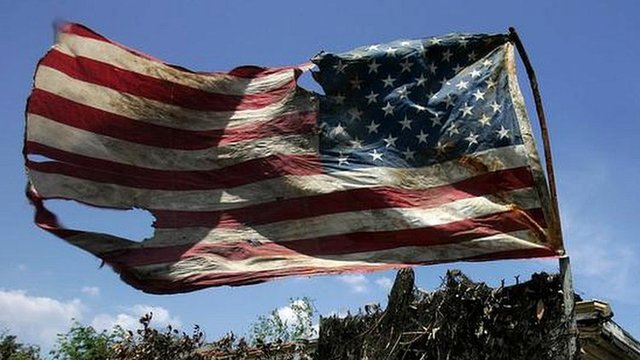
It's ironic that while Donald Trump's campaign theme was to "make America great again,"the reality of his term in office so far is that America's standing in the global community of nations is at a low point even as China's military continues to build, Russia gains ground in the Middle East, and our long-time allies see us as unreliable. Add in America's failed response to the Covid-19 pandemic, about which we are either laughed at or pitied, and America's image is in tatters.  A second irony is that but for Trump's racist, religiously extreme/ignorance embracing base, who think America is the greatest, everyone else can see that its not and that it's decline has been precipitous because of their cult leader.  We cannot take much more of Trump's "winning." An very long article in the Washington Post looks at America's failed stature, most of which tracks to the malignant narcissist in the White House, on the global scene.   Here are excerpts: 

America’s standing in the world is at a low ebb. Once described as the indispensable nation, the United States is now seen as withdrawn and inward-looking, a reluctant and unreliable partner at a dangerous moment for the world. The coronavirus pandemic has only made things worse.
President Trump shattered a 70-year consensus among U.S. presidents of both political parties that was grounded in the principle of robust American leadership in the world through alliances and multilateral institutions. For decades, this approach was seen at home and abroad as good for the world and good for the United States.
In its place, Trump has substituted his America First doctrine and what his critics say is a zero-sum-game sensibility about international relationships. America First has been described variously as nationalistic, populistic, isolationist and unilateralist. [Trump] The president has demeaned allies and emboldened adversaries such as China and Russia.
At home, Trump’s handling of the pandemic has created division and confusion rather than an effective national strategy. The rest of the world sees the United States not as a leader in dealing with the coronavirus but as the country with the highest number of coronavirus infections and covid-19 deaths, and with the disease far from under control. European nations have responded with the unprecedented step of blocking Americans from entering their countries.
Before the pandemic, [Trump] the president took a number of steps that signaled a retreat from collective involvement abroad, pulling out of the Paris climate agreement, the Iran nuclear deal and the Trans-Pacific Partnership trade pact. He raised doubts about the U.S. commitment to NATO. After a long-running quarrel with German Chancellor Angela Merkel, he has called for the withdrawal of more than a quarter of the 34,500 U.S. troops stationed in Germany.
When many world leaders participated in a World Health Organization assembly on the pandemic, the president was absent. Trump’s anger with China over the virus ultimately prompted him to withdraw the United States from the WHO.
“People are stunned about the effect of incapable leadership, or of polarizing leadership, of not being able to unify and get the forces aligned so you can address the problem [of the coronavirus],” said Thomas Kleine-Brockhoff, a vice president of the German Marshall Fund and director of its Berlin office. “And that, of course, results in a nosedive in how you view [the United States]. What you’re seeing is a collapse of soft power of America.”
“I think the U.S. is seen from my perspective as being involved in its own internal reckoning — like the rest of the world doesn’t really exist,”
“It hurts our brand. It hurts the status of our institutions. It’s going to weaken our economy and our economic power and soft power as a consequence,” said Stephen J. Hadley, who was a national security adviser to President George W. Bush. “It’s potentially a real setback.”
This is not the first time the world has held America in low esteem. The U.S. invasion of Iraq cost the country dearly, in lives and in prestige. George W. Bush left office highly unpopular, especially in Europe.
Still, by the numbers, Trump had an immediate and negative impact. A Gallup survey of impressions of world leadership after the first year of Trump’s presidency saw the rating of U.S. leadership plummet by 20 points — lower than Bush’s worst rating.
The following year, approval of U.S. leadership remained similarly low, and disapproval was higher than for the leadership in Germany, China and Russia. “In this climate, China’s leadership has gained a larger advantage in the ‘great power competition,’ and the other player, Russia, is now on a more even level with the U.S.,” the Gallup report said.
The Pew Research Center issued a report in January on international attitudes toward the United States and found 64 percent of people across 32 countries saying they had no confidence in Trump as the U.S. leader, though impressions of the U.S. as a whole remained positive.
President Trump is acting as no administration acted since the 1920s,” said Nicholas Burns, a career Foreign Service officer and former U.S. ambassador to NATO now teaching at Harvard’s Kennedy School. “Those presidents were engaged in the world. President Trump isn’t. He’s almost at war with the world.”
Ivo Daalder, president of the Chicago Council on Global Affairs and U.S. ambassador to NATO during the administration of President Barack Obama, said of Trump, “He doesn’t believe in alliances, open markets, promotion of freedom and human rights — the three pillars of [American] foreign policy. On the essential concept of the United States as the global leader of the international order, Donald Trump has thrown that all out the window.”
“By almost every measure, America’s standing and influence in the world has been damaged over the last three-and-a-half years. . . . You see it during a crisis. This is the first global crisis probably since World War II where the United States has not been in the lead. It’s kind of a stunning thing to see a transnational challenge like this without U.S. leadership.”
“I think this is the most dangerous moment the United States has faced in decades,” said the former Obama adviser Donilon. “We obviously are in the midst of multiple crises. Economic. Health. A serious societal upheaval. We have an election system that is vulnerable to outside interference. . . . We have the lowest point in our relationships with Russia and China in decades. I think democracy is under the most pressure in the world since the ’30s.”
Burns, a foreign policy adviser to the Biden campaign, said he thinks the former vice president, as president, would “quickly return the United States to a position of leadership” and that other governments would respond positively to that. “But I worry that it will take longer with the publics of these countries,” he added. “The memory of Donald Trump will not fade easily.”
[T]he last time this country’s standing was in decline, it was because of fears that the United States would exercise its vast powers excessively and unilaterally. That is not the issue today. Instead, it is a worry that the United States is no longer prepared or willing to use the powers it still has for the good of the world.

Thursday, July 16, 2020

America Is In a Downward Spiral. Worse is Still to Come

Like many so-called conservatives and Republicans, George Will - one of the deans of reasoned conservative thought - was an apologist for disastrous GOP policies and Republican shenanigans which harmed the country and laid the groundwork for the rise of Donald Trump.  Unlike those in the GOP who continue to prostitute themselves both to Trump and the white supremacist/religious extremists of the GOP base, Will finally opened his eyes and belatedly has come out strong in condemning the moral bankruptcy of Trump and today's Republican Party. In a column in the Washington Post he admits that America is in decline and lays much of the blame at the feet of Trump and the Republican political whores who have enabled him.   Further, he longs for a massive landslide victory by Joe Biden that will be so stark that even Trump's lies and his mindless, soulless followers will not be able to challenge the repudiation of Trump and all he and the GOP which is now a reflection of him stand for.  Here are column highlights:

Never has a U.S. election come at such a moment of national mortification. In April 1970, President Richard M. Nixon told a national television audience that futility in Vietnam would make the United States appear to the world as “a pitiful, helpless giant.” Half a century later, America, for the first time in its history, is pitied.
Not even during the Civil War, when the country was blood-soaked by a conflict involving enormous issues, was it viewed with disdainful condescension as it now is, and not without reason: Last Sunday, Germany (population 80.2 million) had 159 new cases of covid-19; Florida (population 21.5 million) had 15,300.
Under the most frivolous person ever to hold any great nation’s highest office, this nation is in a downward spiral. This spiral has not reached its nadir, but at least it has reached a point where worse is helpful, and worse can be confidently expected.
The nation’s floundering government is now administered by a gangster regime. It is helpful to have this made obvious as voters contemplate renewing the regime’s lease on the executive branch. Roger Stone adopted the argot of B-grade mobster movies when he said he would not “roll on” Donald Trump. By commuting Stone’s sentence, Stone’s beneficiary played his part in this down-market drama, showing gratitude for Stone’s version of omertà (the Mafia code of silence), which involved lots of speaking but much lying. Because the pandemic prevents both presidential candidates from bouncing around the continent like popcorn in a skillet, the electorate can concentrate on other things, including Trump’s selection of friends such as Stone and Paul Manafort, dregs from the bottom of the Republican barrel.
Today, there is a vast longing for respite from the 21st century, which — before the pandemic, two inconclusive wars and the Great Recession — began with a presidential election that turned on 537 Florida votes and was not decided until a Dec. 12, 2000, Supreme Court decision. Given Trump’s reckless lying and the supine nature of most Republican officeholders, it is imperative that the Nov. 3 result be obvious that evening.
[T]he pandemic will be an accelerant of preexisting trends: There will be a surge of early and mail voting. So, an unambiguous decision by midnight Eastern time Nov. 3 will require (in addition to state requirements that mailed ballots be postmarked, say, no later than Oct. 31) a popular-vote tsunami so large against [Trump] the president that there will be a continentwide guffaw when he makes charges, as surely he will, akin to those he made in 2016.
It is scandalous that in many places casting a ballot requires hours of standing in line. Larry Diamond of the conservative-leaning Hoover Institution at Stanford discerns another scandal: “The hard truth is that there has been a rising tide of voter suppression in recent U.S. elections. These actions — such as overeager purging of electoral registers and reducing early voting — have the appearance of enforcing abstract principles of electoral integrity but the clear effect (and apparent intent) of disproportionately disenfranchising racial minorities.
This nation built the Empire State Building, groundbreaking to official opening, in 410 days during the Depression, and the Pentagon in 16 months during wartime. Today’s less serious nation is unable to competently combat a pandemic, or even reliably conduct elections. This is what national decline looks like.
I hate to say it, but Will is 100% on the money.

Sunday, June 28, 2020

The Decline of the American World

If one surveys the so-called great powers over the course of history, all eventually fade and give way to successor powers - e.g, the Persian Empire, the Roman Empire, the Byzantine Empire, Spain. France, the British Empire,  Some have fallen due to military might of other nations, yet most have also declined due to internal problems and a failure/refusal to address the problems.  Of course, there is also the issue of failed leadership that has served to exacerbate internal and external threats and problems. A very long piece The Atlantic looks at America as it seemingly finds itself a such a cross roads with a totally unfit occupant in the White House who serves only to worsen external and internal threats. Compounding the situation is America's long history of refusing to be honest about its history and its moral failings that are all too often swept under the myth of American exceptionalism.  Another four more years of Trump in the White House would only serve to further accelerate America;s decline.  Already, the damage done has been incalculable.  Here are article highlights:

“He hated America very deeply,” John le Carré wrote of his fictional Soviet mole, Bill Haydon, in Tinker Tailor Soldier Spy. Haydon had just been unmasked as a double agent at the heart of Britain’s secret service, one whose treachery was motivated by animus, not so much to England but to America. “It’s an aesthetic judgment as much as anything,” Haydon explained, before hastily adding: “Partly a moral one, of course.”
I thought of this as I watched the scenes of protest and violence over the killing of George Floyd spread across the United States and then here in Europe and beyond. . . . . The beauty of America seemed to have gone, the optimism and charm and easy informality that entrances so many of us from abroad.
At one level, the ugliness of the moment seems a trite observation to make. And yet it gets to the core of the complicated relationship the rest of the world has with America.
Le Carré’s reflection on the motivations of anti-Americanism—bound up, as they are, with his own ambivalent feelings about the United States—are as relevant today as they were in 1974, when the novel was first published. Where there was then Richard Nixon, there is now Donald Trump, a caricature of what the Haydons of this world already despise: brash, grasping, rich, and in charge. In the president and first lady, the burning cities and race divides, the police brutality and poverty, an image of America is beamed out, confirming the prejudices that much of the world already have—while also serving as a useful device to obscure its own injustices, hypocrisies, racism, and ugliness.
It is hard to escape the feeling that this is a uniquely humiliating moment for America. As citizens of the world the United States created, we are accustomed to listening to those who loathe America, admire America, and fear America (sometimes all at the same time). But feeling pity for America? That one is new, even if the schadenfreude is painfully myopic. If it’s the aesthetic that matters, the U.S. today simply doesn’t look like the country that the rest of us should aspire to, envy, or replicate.
Even in previous moments of American vulnerability, Washington reigned supreme. Whatever moral or strategic challenge it faced, there was a sense that its political vibrancy matched its economic and military might, that its system and democratic culture were so deeply rooted that it could always regenerate itself. It was as if the very idea of America mattered . . . Now, something appears to be changing. America seems mired, its very ability to rebound in question. A new power has emerged on the world stage to challenge American supremacy—China—with a weapon the Soviet Union never possessed: mutually assured economic destruction.
For the United States, this cultural dominance is both an enormous strength and a subtle weakness. It draws in talented outsiders to study, build businesses, and rejuvenate itself, molding and dragging the world with it as it does, influencing and distorting those unable to escape its pull. Yet this dominance comes with a cost: The world can see into America, but America cannot look back. And today, the ugliness that is on display is amplified, not calmed, by the American president.
America’s closest allies are looking on with a kind of stunned incomprehension, unsure of what will happen, what it means, and what they should do, largely bound together with angst and a shared sense, as one influential adviser told me, that America and the West are approaching something of a fin de siècle.
[T]he confluence of recent events and modern forces has made the present challenge particularly dangerous. The street protests, violence, and racism of the past few weeks have erupted at the very moment the country’s institutional failings have been exposed by the COVID-19 pandemic, reinforced by its apparently unbridgeable partisan divide, which is now even infecting parts of the American machine that have so far been untouched: its federal agencies, diplomatic service, and the long-standing norms underpinning the relationship between civilians and the military. All of this is happening in the final year of the first term of the most chaotic, loathed, and disrespected president in modern American history.
Most of those I spoke to were, however, clear that Trump’s leadership has brought these currents—in tandem with the pressure of relative economic decline, the rise of China, the reemergence of great-power politics, and the decline of the West as a spiritual union—to a head in a manner and speed previously unimaginable.
[T]he nadir of American prestige has, until now, been the revelations of torture and abuse inside the Abu Ghraib prison near Baghdad in 2004. “Today, it is much worse,” he said. What makes things different now, according to Duclos, is the extent of division within the United States and the lack of leadership in the White House. “We live with the idea that the U.S. has an ability to rebound that is almost unlimited,” Duclos said. “For the first time, I’m starting to have some doubts.”
Put bluntly, Trump is unique. At the most basic level, Bush never recoiled from the core idea that there was a Western song, and that the lyrics should be composed in Washington. Trump today hears no unifying music—only the dull beat of self-interest.
One senior adviser to a European leader, who did not want to be named relating private deliberations, told me that Continental snobbery at the notion of American leadership of the free world, of the “American Dream” and other clichés dismissed until now as hopelessly naive, has suddenly been exposed by Trump’s cynicism.
Those that I spoke to divided their concerns, implicitly or explicitly, into those caused by Trump and those exacerbated by him—between the specific problems of his presidency that, in their view, can be rectified, and those that are structural and much more difficult to solve. Almost everyone I spoke to agreed that the Trump presidency has been a watershed not just for the U.S. but for the world itself: It is something that cannot be undone. Words once said cannot be unsaid; images that are seen are unable to be unseen.
The immediate concern for many of those I interviewed was the apparent hollowing out of American capacity. Lawrence Freedman, a professor of war studies at King’s College London, told me the institutions of American power themselves have been “battered.” The health system is struggling, the municipalities are financially broke, and, beyond the police and the military, little attention is being paid to the health of the state itself. Worst of all, he said, “they don’t know how to fix it.”
A European ambassador told me Trump himself is an expression of American decline. “Choosing Trump is a way of not very successfully adapting to the globalized world,” the diplomat, who asked for anonymity, said. It is a sign of the United States following other great powers downward, . . . . “The Netherlands were the dominant global power in the 18th century. Today they are a successful country, but they have simply lost their power. To some extent the U.K. and France are on the journey to become the Netherlands, and the U.S. is on the journey to be Britain and France.” . . . “The collapse of the American Empire is a given; we are just trying to figure out what will replace it.”
America’s problem is that the rest of the world can see when it has fallen below its achievements. In moments such as the current one, it is hard to dispute some of the criticisms leveled by the country’s most vociferous critics from abroad: that it is irredeemably racist or overly ambivalent to poverty and violence, police brutality and guns. The rights and wrongs don’t appear particularly complicated in this dilemma, even if the country itself is.

Sunday, June 21, 2020

The Whole World is Watching America’s Failure

The husband and I love foreign travel and have visited Europe a number of times - during my in-house counsel days, I also traveled to Africa - and we have cruised the Caribbean.  Thus we are conscious of what other nations think of America for good and for bad.  When the white supremacists invaded Charlottesville and the University of Virginia grounds we were in London (celebrating my birthday) and those events made the front page of all of the newspapers, included the Times of London.  It goes without say that none of the coverage was positive. Donald Trump's statement that some of the racist, neo-Nazi crowd were "very good people" left a sense of shock.   Since that day, Trump has continued to destroy America's image abroad with his failed response to the Covid-19 pandemic further undermining America's image.  Seemingly, Trump's base - many poorly educated and others, sadly racist - care nothing about the nation's fallen image.  But it matters greatly in terms of America's "soft power" versus military might.  A column in the Washington Post looks at the world's dismay (other than among dictators hostile to America) at what Trump has wrought.  Here are excerpts:
It’s remarkable to think that for all the damage President Trump had done to America’s image in the world before the beginning of this year, he could wound it even further. But has he ever.
As The Post’s Rick Noack reports, people in other countries are simply gob smacked at what a terrible job the United States is doing in controlling the novel coronavirus pandemic:
As coronavirus cases surge in the U.S. South and West, health experts in countries with falling case numbers are watching with a growing sense of alarm and disbelief, with many wondering why virus-stricken U.S. states continue to reopen and why the advice of scientists is often ignored.
Trump likes to say that after he was elected, respect for the United States was restored, but the truth is precisely the opposite. Even before the pandemic, Trump couldn’t have done more to degrade America’s standing than if that was his explicit goal. Not even George W. Bush, whose disastrous invasion of Iraq drew condemnation across the globe, did as much to undermine our image abroad.
Just the fact that the United States would elect such a vulgar, ignorant, corrupt buffoon was bad enough. But now our government’s incompetence is helping cause the bodies to pile up — and, it would be reasonable for other countries to worry, potentially affecting their own efforts to contain the virus. While international travel has been drastically reduced, it won’t be shut down forever. If you were watching what’s happening in the U.S. — where we have 2.2 million cases of covid-19 and almost 120,000 deaths, more than twice as much as any other country on both counts — would you be eager to welcome U.S. visitors?
And they are watching, which highlights one of the key features of the relationship of the United States to the world. Not only is American culture global — our movies, our music, our sports — but in other countries people pay a great deal of attention to the news coming out of this country, in a way that is not at all reciprocal. . . . . We might give a brief thought to a cyclone hitting Bangladesh or a corruption scandal in Italy, but most Americans care about the rest of the world only as it relates to us. It’s the privilege of being the global hegemon.
While people in other countries still admire the United States, the core characteristic of this administration’s foreign policy has been retreat. Trump withdrew from the Paris climate accords, abandoned the Iran nuclear deal, walked away from the World Health Organization, and heaped contempt on NATO. He has seldom missed an opportunity to express his admiration for the world’s most brutal dictators. Even before the novel coronavirus, citizens in most countries, particularly our staunchest allies, had poor views of him.
And now what does the world see? A country that has produced more Nobel prize winners than any other, with the world’s best universities and most innovative companies, failing disastrously to control a pandemic because of rampant incompetence and cronyism in its government — and that then rushes to resume normal social activities because its dumbest politicians and most idiotically selfish citizens think they should have the “freedom” to infect everyone around them.
If there’s good news, it’s that should Trump lose in November, the world will celebrate with us, just as they did in 2008 when Barack Obama was elected. All the hope people everywhere invested in Obama (too much, it turned out) was magnified by the relief at being rid of Bush.
This time there will be celebrations too, not because the world sees greatness in Joe Biden, but because if Donald Trump is no longer the most powerful person on earth, things can’t help but get better. That’s a feeling everyone everywhere ought to be able to share.

Saturday, June 29, 2019

Trump Is Fast Forwarding America's Decline

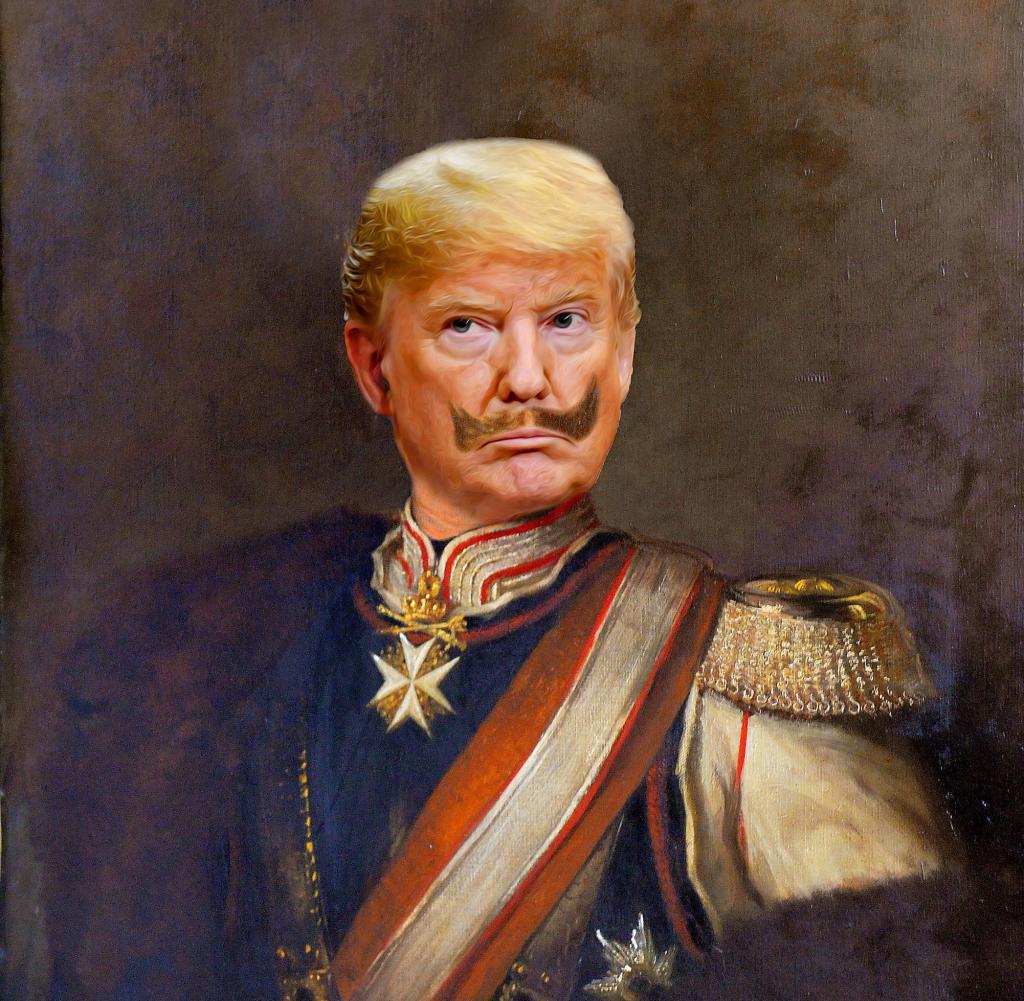
Trump as Wilhelm II.
Donald Trump's mantra is to "make America great again" yet his regime is rapidly destroying standing in the world. While using many of Adolph Hitler's tactics of attacking the free press, demonizing targeted groups, and lying incessantly, as noted in a prior post, Trump's behavior mimics that of the narcissistic, impetuous Kaiser Wilhelm II who used nationalism to lead Germany into WWI  and ultimate disaster, including an overthrow of the monarchy.  The other irony, of course, is that if one looks at those who attended Trump's rallies - e.g., his recent kick off in Florida - they look like losers and what my late maternal grandmother would have described as "white trash" were she still living. Hardly folks that reflect American greatness. Under Trump, America has gone from the recognized leader of the democratic world to being an untrustworthy ally with a leader who prefers hobnobbing with dictators and autocrats, or in the case of Saudi Arabia, out right murderers.  A column in the New York Times looks at America's accelerating decline under Der Trumpenführer. Here are excerpts:

So Vladimir Putin, the Russian president, has told The Financial Times, “The liberal idea has become obsolete.” It has, he says, “outlived its purpose.” President Trump finds him amusing. In Japan, at the G-20 summit meeting, he wags his finger at Putin and says, with a grin: “Don’t meddle in the election, President.”
It’s a measure of American decline over the past three decades that Putin’s claim, however objectionable, is no longer preposterous and Trump’s frivolity no longer surprising. Thirty years ago, the Berlin Wall fell. Two years later, the Soviet Union was gone. The liberal idea was triumphant, and American power virtually uncontested in “the unipolar moment.”
Liberalism posited the indivisibility of freedom and human dignity, as well as the idea that the rule of law and democracy offered the best chance for human advancement, peace and prosperity. Its spread appeared inevitable and irreversible. Its guiding spirit was the United States.
The road from that high-water mark of the American idea to Trump’s autocrat-coddling indecency offers a story of squandered American opportunity and eroded American self-belief that Edward Gibbon would have qualified as “decline and fall.” All Democratic candidates should be asked what they intend to do about it.
I can think of no better guide for reflection than William Burns’s book, “The Back Channel,” his wonderful memoir of a life in diplomacy. . . . back in 1993, in a memo to the incoming Clinton administration, he wrote: “Democratic societies that fail to produce the fruits of economic reform quickly, or fail to accommodate pressures for ethnic self-expression, may slide back into other ‘isms,’ including nationalism.”
Burns, now the president of the Carnegie Endowment for International Peace, attributes the loss of America’s “unrivaled position of strength” in part to inevitable geopolitical trends, including the rise of China and India in the “Pacific century.”
This was, however, compounded by what he calls “grievous missteps.” They included the post-9/11 “inversion of force and diplomacy” that saw a disoriented United States lurch onto a “road to war in Iraq” that “was distinctive for its intensity and indiscipline.”
The unhappy sidelining and devaluation of diplomacy is a theme of the book. It has, for Burns, culminated in Trump’s “savaging of American diplomacy” that has left “our friends confused, our adversaries emboldened, and the foundations of the international system we built and preserved for seven decades alarmingly fragile.” He writes of “unilateral diplomatic disarmament” under Trump, born of “equal parts ideological contempt and stubborn incompetence.” The president’s view of diplomacy is “narcissistic, not institutional,” Burns observes, full of “muscular posturing and fact-free assertions” that insult allies and indulge autocrats. Burns played a leading role in negotiating [the Iran nuclear deal] that Trump called “the worst deal ever” before withdrawing from it. This, Burns writes, “was exactly the kind of risky, cocky, ill-considered bet that had shredded our influence before, and could easily do so again.” For Burns, the erosion of American power and influence long predates Trump. He regrets the loss of the extraordinary American cohesion that, at the end of the Cold War, secured the place of a united Germany in NATO. He notes the failure to perceive early enough how Russian “humiliation and wounded pride” would, under Putin, spur a Russian resurgence.
NATO expansion was, he suggests, “premature at best, and needlessly provocative at worst” — a debatable point in my view, given the need to secure and stabilize the liberation of more than 100 million long subjugated people in Central Europe and the Baltic States.
He thinks President Obama made a mistake by not upholding his “red line” against the Syrian regime’s use of chemical weapons. The Obama administration “had blinked” and, Burns notes, “it would leave an enduring mark.” Into that vacuum Putin strode.
Now the Russian president claims liberalism is obsolete. He is wrong. It is more necessary than ever even as Trump scoffs at it. But America’s ability to promote liberal democracy cannot be served by what Burns calls “a State Department in which officers are bludgeoned into timidity, or censor themselves, or are simply ignored.”


Be very afraid.

Friday, February 22, 2019

Can America Ever Be Great Again After Trump?

Donald Trump campaigned under the slogan "make America great again."  The slogan was a lie because what he really meant was that he would bring back right wing white privilege and put "those people" - i.e., blacks, gays, Hispanics, non-Christians - back in their place and as in the imaginary good old days. Sadly, many Republicans who should have know better, understood Trump's real meaning and voted for him anyway, shedding any claim to moral decency in the process. Now, two years into the Trump nightmare, America finds itself the most isolated perhaps since the 1920's or perhaps even prior to WWI.  Europeans still like American tourists,. but view our leadership with justified contempt.  Meanwhile, the nation's social fabric is being torn apart and the nation's institutions are under daily attack by the demagogue in the White House and his Republican enablers and sycophants.  A column by a Washington Post columnist provides a review of Trump's damage to the nation.  It's an indictment of Trump, but also of those who continue to support him. Although not specifically mentioned, perhaps the most morally bankrupt are the evangelicals whose support of Trump has stripped them of moral authority on any topic.  Here are column excerpts:

There will be no Mount Rushmore for Donald Trump. But, if there's a presidential library, it should contain a Hall of Tweets, a Hall of Lies, a Hall of Insults and, with the "Marines' Hymn" softly playing, a Hall of Montezuma, with a section of his border wall. Finally, there should be a Hall of Consequences, the grandest in the place. No president since Franklin D. Roosevelt has mattered as much.
Trump has remade the Republican Party. It is no longer the party of Lincoln or Reagan, but increasingly a snarling, sneering collection of score-settlers, white nationalists, immigrant bashers, homophobes, science-deniers and religious reactionaries who praise a president who has lived a squalid personal life but who promised them a Supreme Court in their own image. Trump's GOP may not endure, but for the foreseeable future it reigns supreme.
Trump's dominance of his party is personified by Mitch McConnell. . . . . Trump has personally berated McConnell, but -- unburdened by either pride or principle -- McConnell does what the president wants. He faces re-election next year in a state, Kentucky, whose heart throbs for Trump. Understandably, McConnell fears vilification as a moderate.
In foreign affairs, the Trump presidency has had a huge impact. By fiat, by insult and by a dazzling display of historical ignorance, Trump has diminished the Atlantic alliance which every president since Roosevelt has supported and nourished. The lessons of World War II and of the implosion of the Soviet communist empire -- signal achievements of American involvement and leadership in the affairs of Europe -- are being discarded. . . . . . America may not yet be isolationist, but it is isolated.
Under Trump, the judiciary is being transformed. His judges not only are bitterly conservative but have been deemed unqualified by the American Bar Association at an unprecedented rate. He has vitiated Cabinet and other offices dealing with the environment and natural resources, turning over the grandeur of America to despoilers. Only his appointees' ineptness or sense of grandiosity -- EPA Administrator Scott Pruitt's $25,000 phone booth, for instance -- has slowed the onslaught. Pruitt did manage to get Trump to withdraw from the Paris climate agreement before he resigned.
But maybe the most damaging is how he has soiled the presidency itself. His incessant lying -- The Washington Post counted 8,459 false or misleading statements as of Feb 3 -- has turned the presidency into a gong show. He sits at the desk of presidents who took the truth seriously, who may have lied on occasion but never routinely. Trump, though, spouts lies like a drunken parrot, with, approximately, similar plumage. He has diminished the importance of truth, making it indistinguishable from lies -- just more noise.
Trump's attacks on the press are vividly demagogic. He has weakened its ability to be believed, to uncover scandal, to hold accountable the otherwise unaccountable. He applies the prefix "fake" to any news he does not like.
He has weakened the FBI, denigrated the CIA, praised Russia's Vladimir Putin and shrugged at the murder of a Post columnist by the Saudis. He is a president out of Orwell, a creature out of Kafka, a nightmare out of the Electoral College.
Will America recover from the Trump era? Not soon, maybe never. The wounds to the environment may never heal. Inept judges serve for life. Our erstwhile European allies will move on, finding their own way, which, we must pray, will not be the old way. The planet will cook and despots will thrive. Bad days are coming.
But maybe the most terrible consequence of all is the growing realization that Trump mined a vein of meanness in the American electorate. We are not the country we once were. . . . . He has not made America greater. Instead, he may have put greatness out of reach.

Tuesday, September 11, 2018

Trump is Harming America More than Any Foreign Adversary


Traveling in France and the United Kingdom, the husband and I have found ourselves repeatedly having to explain that we neither voted for Donald Trump nor do support literally any of his policies. The French and British by huge majorities despise Trump and cannot understand what would make Americans vote for such a foul individuals.  Rather than get into a discussion of the racism and religious extremism that motivates today's GOP base, it is easier to say that we are working to defeat Republicans and elect Democrats to block Trump's toxic agenda.  It would be hard to stress how much damage Trump has done to America's image across the globe. The other irony is that there are distinct parallels between the decline and fall of ancient Rome and the decline of Great Britain and what is currently taking place in America.  In both of the aforementioned empires, bad domestic decisions aimed at showering wealth on the rich and maintaining privilege combined with a failure to invest in the future in terms of social policies and modernizing infrastructure played major roles in the collapse of empire. We see the exact thing happening now in America under Republican misrule.  While the UK has done much to rebuild its infrastructure, the Brexit vote motivated by racism and animus towards non-Christians will likely wreck havoc on the UK economy and reverse past UK economic promise.  Joe Scarborough has a column in the the Washington Post looks at the damage being done.  Here are excerpts:
Cataclysmic events often bring with them violent and abrupt endings to settled ages and long-established norms. Those absorbing the impact of these historical aftershocks rarely grasp the epochal changes in real time.
Who could have imagined during their commute home on the night of Nov. 21, 1963, that an event in Dallas the next day would shake the postwar order guaranteed by America’s victory in World War II? Even after Lee Harvey Oswald’s shots rang out from the Texas School Book Depository, could anyone have foreseen the collapse of such an ordered age soon overtaken by the anarchy of Vietnam, the murders of the Rev. Martin Luther King Jr. and Bobby Kennedy, the race riots, Chicago, Kent State, Watergate, postindustrial rot and the cultural chaos set loose across the country by these events?
And could even the most insightful observer have foreseen — while staring at the billowing smoke set against New York’s brilliant September sky — the avalanche of strategic blunders set in motion by Osama bin Laden’s attack on the United States?
On Sept. 10, 2001, the United States dominated the world stage in a way no other country had since the height of the Roman and British empires. NATO’s long twilight struggle against the Soviet Union ended with Russia in ruins. The Japanese economic miracle, predicted by some to turn America into little more than a granary for Japan, had flatlined. And a rising China was still struggling with a multitude of internal security concerns and was eclipsed on the world stage by the Pax Americana. The United States deployed a dazzling display of both soft- and hard-power assets across the globe.
On the eve of bin Laden’s attacks, America’s gross domestic product was nearly 10 times China’s and 40 times Russia’s. The U.S. military machine was unparalleled, with the Pentagon spending more on national defense than the next 15 countries combined. And despite those staggering outlays, Washington was running a $125 billion surplus.
Seventeen years later, endless wars abroad and reckless policies at home have produced annual deficits approaching $1 trillion. President Trump’s Republican Party will create more debt in one year than was generated in the first 200 years of America’s existence. And while the United States has been mired in endless wars and bloody occupations over the past 17 years, China has used that same period to aggressively develop economic partnerships across Asia, Europe, Latin America and Africa. Perhaps that is one reason China will soon overtake the United States as the world’s largest economy.
Any discussion of policy failures since 2001 must begin with George W. Bush’s decision to invade Iraq even though no evidence linked Saddam Hussein’s regime to the Sept. 11, 2001 attacks. . . . . That war cost nearly 5,000 American lives, $2 trillion and inestimable damage to America’s credibility across the globe.
The excesses of Bush’s military adventurism led to his successor, President Barack Obama, placing the United States in a defensive crouch for the better part of eight years. The commander in chief defined his foreign policy approach this way: “Don’t do stupid [stuff].”
Sixteen years of strategic missteps have been followed by the maniacal moves of a man who has savaged America’s vital alliances, provided comfort to hostile foreign powers, attacked our intelligence and military communities, and lent a sympathetic ear to neo-Nazis and white supremacists across the globe.
For those of us still believing that Islamic extremists hate America because of the freedoms we guarantee to all people, the gravest threat Trump poses to our national security is the damage done daily to America’s image.
“America is an idea. Strip freedom, human rights, democracy and the rule of law from what the United States represents to the world and America itself is gutted.”
Osama bin Laden was killed by SEAL Team 6 before he accomplished that goal. Other tyrants who tried to do the same were consigned to the ash heap of history. The question for voters this fall is whether their country will move beyond this troubled chapter in history or whether they will continue supporting a politician who has done more damage to the dream of America than any foreign adversary ever could.

Saturday, May 12, 2018

The Accelerating End of American Hegemony

Trump and Idi Amin - same delusions, different skin color.

The mantra of Der Trumpenführer and his white, evangelical Christian nationalist supporters is to "make America great again," yet the foreign policies the malignant narcissist in the White House is pursuing will likely have  the exact opposite effect on the international stage.   Trump, of course, is so utterly ignorant of history and the need for alliances and while he envisions himself as a fabulous reincarnation of France's Louis XIV, he is in reality more akin to a tin pot African dictator - I think of Idi Amin who had a physique like Trump's and a similar obsession with self-importance and lacked a grasp on objective reality - with little credibility on the world stage.  A column in the Washington Post looks at how Trump is likely accelerating America's loss of hegemony in the world.  Here are highlights:

In retrospect, the era of American hegemony — the moment of the “sole superpower,” when the United States was the “essential” country — was remarkably brief. It began in 1991, with the collapse of the Soviet Union, probably peaked just before 9/11, and for the past decade — under Presidents George W. Bush and Barack Obama — it has been drawing slowly and unevenly to an end. Even while it lasted, this hegemony was partly a game of smoke and mirrors. It depended on perceptions: belief in American wealth, fear of American military power, admiration for American values. It depended on the absence of opponents: the collapse of the Soviet Union, the relative weakness of China.
Above all, it depended on an American willingness to invest: in diplomacy, in military power — but above all in alliances. By forging mutually advantageous agreements with Germans or South Koreans, the United States had far greater influence than it would have had otherwise. By creating and then expanding NATO, by maintaining troops in South Korea and Japan, the United States kept parts of Europe and Asia free to choose democracy, and open for commerce and trade. 
Trump knows no history and does not have any idea how the United States became an “essential” country, let alone a superpower. But he seems to believe that he can maintain that status, and even increase it, without making investments — diplomatic, military or monetary — at all. This week, the outline of what this means — call it “hegemony on the cheap” — suddenly came into sharp focus.
Trump’s abrupt withdrawal from the Iran nuclear deal exposed America’s weak hand. For we left — but then what? In different circumstances — after negotiations, after obtaining proof that Iran was in violation of the deal — it might have been possible to recreate the international coalition that imposed sanctions so successfully in the first place. In different circumstances, it might also have been possible to change the deal . . .
Instead, we are now in the worst of all possible worlds. We have broken the agreement with Iran, but we are unable to impose a new sanctions regime in its place. Instead of making a diplomatic investment, we are shouting and barking orders. Just after Trump’s announcement, the American ambassador to Germany issued a threat on Twitter: “German companies doing business in Iran should wind down operations immediately.” As a result, European leaders are not talking about Iran. They are talking about how they can protect their companies from American sanctions, and how they might retaliate.
Courtesy of the Iranian government, we have just learned that Trump recently sent a letter to Arab allies, demanding that they commit more military resources to solve Middle Eastern problems. Fair enough — but if they aren’t your resources, then you don’t get to decide how they will be used. In fact, quite a few Arab governments are already participating in Middle Eastern wars. Saudi Arabia is already fighting in Yemen, where we don’t have much say in what happens. We don’t have any control over what happens in Libya, either, where the United Arab Emirates, Egypt and other states are already participating in a proxy fight. If conflict spreads to Iran, the same will be true.
That moment of American hegemony really was impressive, and there are many places where the aura has yet to fade. It will take quite a bit of time for Europeans, not to mention Russians and Chinese, to find their way around U.S. sanctions on Iran, to invent alternative ways to invest, to create new sources of credit outside the existing international banking system. It will take time before the rearmed nations of the Middle East realize that there is no reason, any longer, to consult the U.S. government before going to war. It will take time before U.S. economic policy becomes so erratic that others decide not to preserve the dollar as the reserve currency, or not to reserve a space for Americans at the top table.
It may be many years before Americans finally notice that “hegemony on the cheap” means they no longer have much say in what happens outside their borders. But sooner or later that moment will come. Trump may have accelerated its arrival.
The irony is the parallel between Trump and his evangelical supporters who claim to be saving and protecting Christianity in America even as now almost 40% of Millennials have abandoned religion, mostly because they view conservative Christianity as something ugly and repulsive. The Chinese in particular must be relishing Trump's trashing of America's standing in the international order. 

Sunday, June 04, 2017

Donald Trump's America is an America in Retreat


Donald Trump, a/k/a Der Trumpenführer on this blog, was elected by those who, in my view, Hillary Clinton accurately described as a basket of deplorables: racists, would be white supremacists, increasingly marginalized whites who blame others for the consequences of their bad choices (dropping out of high school, drug use, alcohol abuse, etc.), those motivated by greed like Trump, those too lazy to get informed on issues and change the channel from Fox News, and, of course the Christofascists.  Indeed, Trump won the highest percentage of votes in regions that are increasing backwaters and in economic decline - in no small part because of their embrace of toxic, ignorance embracing right wing Christianity, and bigotry, all of which only increases the likelihood that new industries and progressive businesses will avoid them like the plague.  And rightly so. Now, Trump wants to take the nation as a whole in the same direction of this isolationist, bigoted and reactionary regions of the country.  Rather than making "America Great Again," this turn away from globalism and knowledge and a rejection of Enlightenment values will weaken America and make the future more dangerous. An editorial in the New York Times looks at this retreat into backwardness.  Here are excerpts:
The swiftness of President Trump’s transformation of America’s global image from a proud and valued leader to something more nearly resembling a whiny bully has heads spinning at home and abroad. Mr. Trump was elected on a slogan of “America First” and a promise that the country would never again be bound by agreements and conventions that, in his view, compromised its sovereignty. But the policies and pronouncements that have flowed from this promise have in fact made the United States, and his presidency, the object of disbelief, alarm, even derision.
America may be first in the eyes of the president, but in the eyes of the world it is in headlong retreat.
Trump has pulled out of the Trans-Pacific Partnership, ceding leadership on trade in Asia to China; refused to reaffirm the mutual defense commitment that has been the bedrock of trans-Atlantic security for half a century, forcing America’s European allies to think about dealing with threats like Russia on their own; and abandoned a landmark agreement on climate change signed by 190-plus other nations, ceding leadership on the issue to Europe and China, and, in the bargain, forfeiting the rewards of participating in a worldwide clean energy economy that the agreement will bring.
Anyone seeking answers for these reckless decisions beyond Mr. Trump’s campaign braggadocio might take note of one sentence in a remarkable op-ed article written by Lt. Gen. H. R. McMaster, Mr. Trump’s national security adviser, and Gary Cohn, director of the National Economic Council, for The Wall Street Journal. Mr. Trump, they wrote, has “a clear-eyed outlook that the world is not a ‘global community’ but an arena where nations, nongovernmental actors and businesses engage and compete for advantage.”
The authors presumably meant this as praise of hardheaded realism. It is actually a vision of a world of cutthroat competition and zero-sum outcomes deeply at odds with the more cooperative, rules-based vision that has motivated America and its allies since World War II. . . . . American leadership and engagement were undeniably good for this country and, more often than not, a force for global peace and security. . . . . Washington also led the way in promoting human rights and democracy.
America’s commitment to those institutions and values is now in question under a president who is arrogant in his disregard of history, nuance and, most important, understanding of American leadership and what in fact makes the country secure, prosperous and “great.”
Mr. Trump and his team, embroiled in controversy over Russia and other matters, have shown no inclination, much less skill, to do the hard thinking that must precede any decision to alter America’s role in the world. And even if they did attempt such preparation, it is hard to imagine any convincing argument for abrogating or even weakening the country’s leadership responsibilities, its defense of NATO and Europe, its preference for cooperative problem-solving and its commitment to democratic values and human rights.
Is this what Americans want? If not, they had better voice their opposition loudly and clearly. Mr. Trump, abetted inexplicably by people who should know better — General McMaster, Secretary of State Rex Tillerson and Defense Secretary Jim Mattis — is moving fast down a dangerous and uncertain road.

Sunday, May 31, 2015

Conservatives Are in Denial: America is No longer a Superpower

If one studies history, there is a long record of super powers that have held sway for periods of time before eventually going into decline - often because of over reach in their empires and financial exhaustion from never ending wars to maintain their influence.  The western Roman Empire is but one example - the eastern empire followed it 1000 years later - as is the former British empire upon which the sun once never set.  Some argue that America is no longer a super power even though it spends huge amounts on defense spending compared to other nations.  The middle class is in decline, life expectancy is not growing except for the wealth, our infrastructure is crumbing.  The list goes on.  A piece in Salon looks at the arguments as to why America is no longer a super power.  Here are excerpts:
Take a look around the world and it’s hard not to conclude that the United States is a superpower in decline. Whether in Europe, Asia, or the Middle East, aspiring powers are flexing their muscles, ignoring Washington’s dictates, or actively combating them. Russia refuses to curtail its support for armed separatists in Ukraine; China refuses to abandon its base-building endeavors in the South China Sea; Saudi Arabia refuses to endorse the U.S.-brokered nuclear deal with Iran; the Islamic State movement (ISIS) refuses to capitulate in the face of U.S. airpower. What is a declining superpower supposed to do in the face of such defiance?

This is no small matter. For decades, being a superpower has been the defining characteristic of American identity. The embrace of global supremacy began after World War II when the United States assumed responsibility for resisting Soviet expansionism around the world; it persisted through the Cold War era and only grew after the implosion of the Soviet Union, when the U.S. assumed sole responsibility for combating a whole new array of international threats.

In the wake of the utterly unexpected Soviet collapse, American strategists began to envision a world of just one, of a “sole superpower” (aka Rome on the Potomac). In line with this new outlook, the administration of George H.W. Bush soon adopted a long-range plan intended to preserve that status indefinitely. Known as the Defense Planning Guidance for Fiscal Years 1994-99, it declared: “Our first objective is to prevent the re-emergence of a new rival, either on the territory of the former Soviet Union or elsewhere, that poses a threat on the order of that posed formerly by the Soviet Union.”

H.W.’s son, then the governor of Texas, articulated a similar vision of a globally encompassing Pax Americana when campaigning for president in 1999. If elected, he told military cadets at the Citadel in Charleston, his top goal would be “to take advantage of a tremendous opportunity — given few nations in history — to extend the current peace into the far realm of the future. A chance to project America’s peaceful influence not just across the world, but across the years.”

For Bush, of course, “extending the peace” would turn out to mean invading Iraq and igniting a devastating regional conflagration that only continues to grow and spread to this day.
The problem, as many mainstream observers now acknowledge, is that such a strategy aimed at perpetuating U.S. global supremacy at all costs was always destined to result in what Yale historian Paul Kennedy, in his classic book The Rise and Fall of the Great Powers, unforgettably termed “imperial overstretch.” As he presciently wrote in that 1987 study, it would arise from a situation in which “the sum total of the United States’ global interests and obligations is… far larger than the country’s power to defend all of them simultaneously.”

Indeed, Washington finds itself in exactly that dilemma today. What’s curious, however, is just how quickly such overstretch engulfed a country that, barely a decade ago, was being hailed as the planet’s first “hyperpower,” a status even more exalted than superpower. But that was before George W.’s miscalculation in Iraq
[M]ajor and regional powers like China, India, Russia, Iran, Saudi Arabia, and Turkey have been building up their economic and military capabilities and, recognizing the weakness that accompanies imperial overstretch, are beginning to challenge U.S. dominance in many areas of the globe.

How, then, to reconcile the reality of superpower overreach and decline with an unbending commitment to global supremacy?

The first of two approaches to this conundrum in Washington might be thought of as a high-wire circus act.  It involves the constant juggling of America’s capabilities and commitments, with its limited resources (largely of a military nature) being rushed relatively fruitlessly from one place to another in response to unfolding crises . . . .

Clearly, in the face of multiplying threats, juggling has not proven to be a viable strategy.  Sooner or later, the “balls” will simply go flying and the whole system will threaten to fall apart. But however risky juggling may prove, it is not nearly as dangerous as the other strategic response to superpower decline in Washington: utter denial.

For those who adhere to this outlook, it’s not America’s global stature that’s eroding, but its will — that is, its willingness to talk and act tough. . . . Above all, of course, it means a willingness to employ military force. 

In this overheated environment, the 2016 presidential campaign is certain to be dominated by calls for increased military spending, a tougher stance toward Moscow and Beijing, and an expanded military presence in the Middle East.

However initially gratifying such a stance is likely to prove for John McCain and the growing body of war hawks in Congress, it will undoubtedly prove disastrous in practice. Anyone who believes that the clock can now be turned back to 2002, when U.S. strength was at its zenith and the Iraq invasion had not yet depleted American wealth and vigor, is undoubtedly suffering from delusional thinking.

Back, then, to our original question: What is a declining superpower supposed to do in the face of this predicament?

Anywhere but in Washington, the obvious answer would for it to stop pretending to be what it’s not. The first step in any 12-step imperial-overstretch recovery program would involve accepting the fact that American power is limited and global rule an impossible fantasy. Accepted as well would have to be this obvious reality: like it or not, the U.S. shares the planet with a coterie of other major powers — none as strong as we are, but none so weak as to be intimidated by the threat of U.S. military intervention. Having absorbed a more realistic assessment of American power, Washington would then have to focus on how exactly to cohabit with such powers — Russia, China, and Iran among them — and manage its differences with them without igniting yet more disastrous regional firestorms.

[W]hat this might entail: fewer military entanglements abroad, a diminishing urge to garrison the planet, reduced military spending, greater reliance on allies, more funds to use at home in rebuilding the crumbling infrastructure of a divided society, and a diminished military footprint in the Middle East.

But for any of this to happen, American policymakers would first have to abandon the pretense that the United States remains the sole global superpower — and that may be too bitter a pill for the present American psyche (and for the political aspirations of certain Republican candidates) to swallow. From such denialism, it’s already clear, will only come further ill-conceived military adventures abroad and, sooner or later, under far grimmer circumstances, an American reckoning with reality.

Monday, June 09, 2014

Conservative Christians: Living in a World Where Facts Can’t Exist.

Click image to enlarge
A new Gallup poll has revealed that far too many Americans live in a world where religious belief trumps science and objective facts.  On the political right one hears much moaning and carrying on about America's decline yet no one in that political realm is willing to look at what may be a root source of the problem, especially with globalization and increased scientific and research competition: too many American's embrace ignorance while our competition does not. And where is the embrace of ignorance strongest?  You guessed it, among the Christofascists and their political whore in the Republican Party.  Be it global warming, gay conversion, or a host of other issues, these people cling to myths that they need to satisfy their disturbed psyches and reject knowledge and science.  Eventually, the consequences are going to seriously catch up with us - if they haven't already.  A column in the New York Times looks at the frightening level of religious based ignorance that continues to predominate in America.  Here are highlights:
I am both shocked and fascinated by Americans’ religious literalism.  One Gallup report issued last week found that 42 percent of Americans believe “God created humans in their present form 10,000 years ago.”

It’s not only that Americans are more religious — Christian, in particular — but that for many, their beliefs in their religious text — the Bible, in particular — are literal.

As Gallup pointed out in a report issued last Wednesday, nearly a third of Americans continue to believe that the Bible “is the actual word of God and is to be taken literally, word for word.”

Furthermore, nearly half believe that it is “the inspired word of God but not everything in it should be taken literally.”

About a fifth of Americans said they believe the Bible is “an ancient book of fables, legends, history, and moral precepts recorded by man.”

Now, I don’t seek to deny anyone the right to believe as he or she chooses.

What worries me is that some Americans seem to live in a world where facts can’t exist.

Facts such as the idea that the world is ancient, and that all living things evolved and some — like dinosaurs — became extinct. Facts like the proven warming of the world. Facts like the very real possibility that such warming could cause a catastrophic sea-level rise.

How does America remain a world leader in an increasingly technological, science-based world, when so many of our citizens — and even our leaders, including Republicans who might run for president — deny basic science?

Americans, particularly political leaders, who choose religious piety must also create an intellectual framework in which things of faith that exist without proof can make space for truths for which there is proof.

Religious fundamentalism at the expense of basic scientific facts threatens to obscure America’s beacon of light with a bank of fog.
Fundamentalist religion - be it Christian or Muslim - is a blight on humanity.