Showing posts with label falling life expectancy. Show all posts

Monday, June 22, 2020

Americans Are Recognizing The U.S. is Falling Behind its Peers


I have been a long time critic of the concept of American exceptionalism - something that is far more myth than reality.  In fact, when America is measured by its peers across the rest of the developed, industrialized world, it comes up short.  If America is exceptional, it is a negative way.  America has some of the highest levels of childhood poverty, a crumbling infrastructure, insane levels of gun violence, millions who lack access to quality health care, a declining life expectancy, declining opportunities for upward social mobility - a number of European nations have better options for upward mobility - and a pathetic social safety net.  As a column in the Washington Post notes, one positive aspect of the Covid - 19 pandemic is that Americans are increasingly willing to open their eyes and face the fact that America is falling behind much of the rest of the developed world. The piece also suggest part of the problem: the obstruction of the Republican Party which remains focused on benefiting the wealthy at the expense of everyone else.  Possibilities for change and improvement exist, but they begin with the need for political change.  Here are excerpts:

Americans’ belief in American exceptionalism is declining — and that could be a good thing. National narcissism has rendered us complacent, even impotent, in the face of multiple crises.
On our biggest societal problems, the United States seems to have given up. Not because we can’t do better — but because many political leaders, particularly Republicans, apparently don’t think we need to. Their faith that America is already Living Its Best Life means there’s no need to learn from peer countries, or even gauge our relative performance. Consider:
Most of the rest of the developed world has managed to get covid-19′s spread under control. New cases across the European Union have plummeted; in New Zealand, the virus has been virtually wiped out. These and other places that have successfully mitigated the spread have enabled more citizens to safely return to their pre-covid-19 lifestyles, including even attending athletic events with packed crowds.
Meanwhile, here in the United States, the bodies pile up. New confirmed cases are again surging, especially across Sun Belt states. And political leaders seem to have no plan, nor even a plan to make a plan, for beating back the pandemic. Instead, they simply declare the virus vanquished, even as it claims more lives.
How did a country once known for our get-up-and-go come to shrug off mass death, particularly when other countries’ records suggest many U.S. covid-19 deaths were preventable?
Faith in American exceptionalism has curdled into resigned acceptance. We got so accustomed to resting on our laurels that we fell asleep.
This is of a piece with our supine responses to other national challenges that are unusually (sometimes uniquely) American. Much as they gave up on coronavirus containment, U.S. political leaders previously gave up on solving our epidemic of gun violence. And on our high numbers of police-perpetrated killings. Also our high rates of child poverty, uninsurance and carbon emissions.
On these and other metrics, the United States fares worse than most if not all other industrialized countries. Yet U.S. officials — from one party in particular — treat these crises as imaginary or unsolvable.
On the occasions political leaders do acknowledge that we’re not measuring up to peers, they excuse the failing as a trade-off necessary to pursue some other, supposedly superior American ideal. America can’t protect schoolchildren as other countries do, because we must prioritize unfettered access to firearms. America can’t save its grandparents from covid-19, because the Dow takes precedence. America can’t guarantee everyone health care, because [something something] liberty.
But there may be a ray of hope: Recent crises — involving health, the economy and police brutality — seem to have caused more Americans to question their country’s track record.
So suggests the COVID-19 Social Change Survey, a daily, nationally representative survey about the pandemic run by Northwestern University social scientists since mid-March. Some survey questions asked whether the United States is better, worse or about the same as other nations across about a dozen topics (economy, health care, criminal justice system, military, education, etc.).
On nearly every metric, the share of Americans rating the United States as “better” than other countries has declined since the pandemic began.
Other questions, from this survey and longer-term polling by Gallup, show declines in broader measures of national pride and confidence in U.S. institutions.
Normally, of course, reduced patriotism or institutional trust would not be positive developments. These declines can be constructive only if they spur the public — and elected officials — to create conditions that would inspire more patriotism and trust.
Maybe a more realistic assessment of our flaws — a crack in the national narcissism — will motivate change, at least if politicians ever catch up with their constituents.


Wednesday, November 27, 2019

What's Wrong in America: Declining Life Expectancy

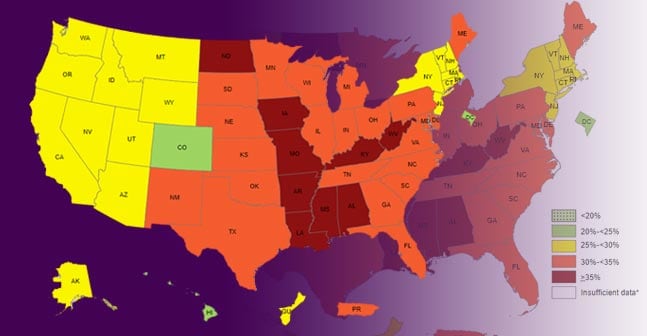
Map of those overweight and obese by state. 
Life expectancy is continuing to rise in other advanced, wealthy nations, including the liberal European nations so derided by American conservatives. Such is not the case in the United States where life expectancy is falling, with sharp decreases in age brackets often considered the prime time of one's life.  A report published in the Journal of the American Medical Association looks at the unwanted reality and where the death rate has risen the most: mostly in mid-western "swing states" and the South, regions where Republican political rule predominates. While no one cause explains the phenomenon, there are a number of factors noted in the report, particularly, America's obesity problem.  Go to Europe and walk around almost any city and you will NOT see the large numbers of overweight people and those you do see will most often be American tourists. My own thoughts on this particular problem of obesity focuses on (i) Americans' poor diet and addiction to high calorie fast food and (ii) vastly over-sized portions at American restaurants (things you do not see in Europe).  Then, of course, most other advanced nations have some version of universal health care, something lacking in the USA.  The Washington Post looks at the report and the dire outlook for the future.  Here are article highlights:

Death rates from suicide, drug overdoses, liver disease and dozens of other causes have been rising over the past decade for young and middle-aged adults, driving down overall life expectancy in the United States for three consecutive years, according to a strikingly bleak study published Tuesday that looked at the past six decades of mortality data.
The report, published in the Journal of the American Medical Association, was immediately hailed by outside researchers for its comprehensive treatment of a still-enigmatic trend: the reversal of historical patterns in longevity.
Despite spending more on health care than any other country, the United States has seen increasing mortality and falling life expectancy for people age 25 to 64, who should be in the prime of their lives. In contrast, other wealthy nations have generally experienced continued progress in extending longevity.
[T]he broad trend detailed in this study cuts across gender, racial and ethnic lines. By age group, the highest relative jump in death rates from 2010 to 2017 — 29 percent — has been among people age 25 to 34.
The findings are sure to fuel political debate about causes and potential solutions because the geography of rising death rates overlaps to a significant extent with states and regions that are hotly contested in the run-up to the 2020 presidential election.
About a third of the estimated 33,000 “excess deaths” that the study says occurred since 2010 were in just four states: Ohio, Pennsylvania, Kentucky and Indiana — the first two of which are critical swing states in presidential elections. The state with the biggest percentage rise in death rates among working-age people in this decade — 23.3 percent — is New Hampshire, the first primary state.
“It’s supposed to be going down, as it is in other countries,” said the lead author of the report, Steven H. Woolf, director emeritus of the Center on Society and Health at Virginia Commonwealth University. “The fact that that number is climbing, there’s something terribly wrong.”
He said many factors are at play. The opioid epidemic is a major driver of the worrisome numbers but far from the sole cause. The study found that improvements in life expectancy, largely because of lower rates of infant mortality, began to slow in the 1980s, long before the opioid epidemic became a national tragedy.
“Some of it may be due to obesity, some of it may be due to drug addiction, some of it may be due to distracted driving from cellphones,” Woolf said. Given the breadth and pervasiveness of the trend, “it suggests that the cause has to be systemic, that there’s some root cause that’s causing adverse health across many different dimensions for working-age adults.”
The average life expectancy in the United States fell behind that of other wealthy countries in 1998, and since then the gap has grown steadily. Experts refer to this gap as the United States’ “health disadvantage.”
Princeton professors Anne Case and Angus Deaton, whose much-publicized report in 2015 highlighted the death rates in middle-aged whites, published a paper in 2017 pointing to a widening gap in health associated with levels of education, a trend dating to the 1970s. Case told reporters their research showed a “sea of despair” in the United States among people with only a high school diploma or less.
Obesity is a significant part of the story. The average woman in the United States today weighs as much as the average man half a century ago, and men now weigh about 30 pounds more. Most people in the United States are overweight — an estimated 71.6 percent of the population age 20 and older, according to the CDC. That figure includes the 39.8 percent who are obese, defined as having a body mass index of 30 or higher in adults (18.5 to 25 is the normal range). Obesity is also rising in children; nearly 19 percent of the population age 2 to 19 is obese.
“These kids are acquiring obesity in their early teen years, sometimes under the age of 10,” said S. Jay Olshansky, a professor of public health at the University of Illinois at Chicago. “When they get up into their 20s, 30s and 40s, they’re carrying the risk factors of obesity that were acquired when they were children. We didn’t see that in previous generations.”