Showing posts with label lack of healthcare. Show all posts

Monday, May 25, 2020

Covid-19’s New Surge Across Rural America

Crowd not social distancing in Alamance County, North Carolina, on Saturday.
Back in early April Alabama governor Kay Ivey said the following: “Y’all, we are not Louisiana, we are not New York state, we are not California,” she said, suggesting that the fate of hard-hit parts of the country would not be shared by Alabama.  Now, Alabama's Capital, Montgomery, has so many covid-19 cases that the infected are being sent to Birmingham since Montgomery lacks sufficient hospital capacity.  Ivey represents the mind-set of far too many residents of rural areas and red states that almost seemed to take glee as the pandemic hit New York City and other large urban areas especially hard,  Now, the pandemic is moving into the very same rural areas and red states, many of which are woefully unprepared and lack hospitals and medical personnel to deal with the crisis.   A piece in the Washington Post looks at the situation, noting that the pandemic "has taken hold in counties where residents flout social distancing guidelines or believe the pandemic to be exaggerated, the virus’s lethality a myth spread by President Trump’s political foes and a liberal media."  Here are article highlights:
The novel coronavirus arrived in an Indiana farm town mid-planting season and took root faster than the fields of seed corn, infecting hundreds and killing dozens. It tore though a pork processing plant and spread outward in a desolate stretch of the Oklahoma Panhandle. And in Colorado’s sparsely populated eastern plains, the virus erupted in a nursing home and a pair of factories, burning through the crowded quarters of immigrant workers and a vulnerable elderly population.
As the death toll nears 100,000, the disease caused by the virus has made a fundamental shift in who it touches and where it reaches in America, according to a Washington Post analysis of case data and interviews with public health professionals in several states. The pandemic that first struck in major metropolises is now increasingly finding its front line in the country’s rural areas; counties with acres of farmland, cramped meatpacking plants, out-of-the-way prisons and few hospital beds.
In these areas, where 60 million Americans live, populations are poorer, older and more prone to health problems such as diabetes and obesity than those of urban areas. They include immigrants and the undocumented — the “essential” workers who have kept the country’s sprawling food industry running, but who rarely have the luxury of taking time off for illness.
Rural counties now have some of the highest rates of covid-19 cases and deaths in the country, topping even the hardest-hit New York City boroughs and signaling a new phase of the pandemic — one of halting, scattered outbreaks that could devastate still more of America’s most vulnerable towns as states lift stay-at-home orders.
In many of those places, where the health-care system is already stretched thin, even a minor surge in patients is enough to overwhelm.
Where and when hot spots arise in America’s most isolated counties is, in part, a matter of chance. But crowded spaces, and populations with poor access to health care, quickly facilitate the spread.
Of the 25 rural counties with the highest per capita case rates, 20 have a meatpacking plant or prison where the virus took hold and spread with abandon, then leaped into the community when workers took it home.
It has taken hold in counties where residents flout social distancing guidelines or believe the pandemic to be exaggerated, the virus’s lethality a myth spread by President Trump’s political foes and a liberal media.
“We’ve got a little bit of everything: folks who feel their rights have been taken away because they’ve been asked to stay home and they lost jobs and they’re really hurting, and we have folks who are very concerned and frightened and won’t leave their house,” said Rebecca Burns, a health officer for the agency that covers Hillsdale County, Mich., which last month topped the state for the highest death toll among rural counties, after a nursing home outbreak. . . . . We have to continue to watch,” Burns added, during a week when members of a conservative militia stood outside a Hillsdale County barbershop, brandishing guns to “protect” its reopening, in defiance of the governor’s orders. “Anyone who thinks this is one and done is probably wrong,” she said.
Lim also fears the outbreak is facilitated by people in the conservative farming community not following preventive measures.  “If you go to the local Walmart, I would say 10 percent of people are wearing masks, and the restaurants … that are open are packed,” Lim said. “I’m a registered Republican, by the way,” he added. “But [people] don’t seem to know the science behind it. Even though they see the news, they just think it’s all overblown.”
To epidemiologists and physicians, this checkerboard spread was all very predictable. It was never a question of whether the virus would hit rural America, but when.
Early on, two warning signals blared from opposite sides of the country.
In Blaine County, Idaho, population 2,200, an outbreak spurred by the annual influx of wealthy tourists seeking ski slopes turned the resort region into one of the first rural hot spots. The infection rate soared and was, at one point in late March, the highest in the nation.
That same month, more than 2,000 miles away, the virus began its siege on southwest Georgia. Most believe it was introduced at a well-attended Dougherty County funeral, an event that soon led to many more funerals. From Albany, the county seat and a regional hub, infections radiated to neighboring locales with ferocious intensity.
Health officials have estimated that urban areas have more than twice the number of physicians per capita as rural areas and more than 8.5 times the number of specialists.
And in many more regions, there are no hospitals for hundreds of miles, the result of closures amid crushing financial pressures. Since 2010, 130 rural hospitals have shut their doors, according to an ongoing study from the University of North Carolina.

Sunday, April 05, 2020

Appalachian Coal Communities Brace For Coronavirus

Appalachia - including large swaths of Southwest Virginia - is to a large extent an economic basket case due to multiple factors two of which are (i) the decline of the coal industry (which continues to shrink despite Trump's ridiculous claims to bring it back), and (ii) the region's reactionary politics and embrace of right wing Christianity that discourages new, progressive business from even considering relocating to the area. Now, Covid-19 may be poised to wreak havoc on a population that in general has poor health and a shortage of hospitals and medical care access, especially since many lack heath care insurance (unlike most Appalachian states, Virginia and Kentucky have expanded Medicaid).  A piece in Huffington Post looks at  the potential catastrophe if coronavirus moves into into Appalachia in a major way.  Here are highlights:

Coal is no longer the commodity it once was, but its legacy in Appalachia remains: scores of miners with black lung disease who are now at a high risk of suffering from the coronavirus.
Coal workers’ pneumoconiosis, better known as black lung, is a scarring of the lungs caused by years of coal dust inhalation. At least one in 10 underground miners has black lung, according to the Centers for Disease Control and Prevention, but experts say the actual number could be much higher. As the lungs scar, it becomes harder to breathe, so the thought of adding COVID-19, the respiratory disease caused by the coronavirus, to the mix is terrifying to these workers. 
[M]any fear it’s only a matter of time until the virus contributes to a triple-whammy in Appalachian mining communities: a population with elevated health risks, an economy in free-fall and limited health care resources. . . . . “It’s probably just going to wipe us out.”
Appalachia, which stretches from New York to Alabama and once produced most of the nation’s coal, is particularly at risk from the pandemic because of its residents’ poor health. Appalachians are more likely than other Americans to have ailments such as cancer, heart disease and diabetes, due in part to smoking and a more sedentary lifestyle, according to the Appalachian Regional Commission, all of which could exacerbate the effects of COVID-19. . . . COVID-19 “would be a nail in the coffin.
The Appalachian region has also lost dozens of rural hospitals in recent years, according to the University of North Carolina ― a trend in rural areas across the country. Black lung patients often travel an hour or more to visit doctors, Go said.  . . . And coronavirus has already stretched regional health care resources even thinner.
Telemedicine, which allows doctors to use video and other interactive tools to treat patients from afar, would be helpful during the pandemic, Doyle said. But, he added, many rural black lung patients have neither the technology nor broadband service for telemedicine.
The National Mining Association, which lobbied for these cuts, told HuffPost in a written statement that companies are “adjusting to this new reality and following government guidelines, with distancing measures being taken, increased cleaning schedules ... and limits on gatherings of groups.”
But in southern West Virginia, Doyle said he hasn’t seen much change in mining operations in recent weeks. Mine workers, recognizable in blue outfits with reflective stripes, are still walking around town as usual, he said, possibly spreading the virus without knowing.
“It looks to me like they’re going about their business,” Doyle said. “Until their co-workers start falling ill, I don’t think they’re going to change. A lot of people here are not convinced they need to do anything.”

Tuesday, December 03, 2019

HIV Is Coming to An Unprepared Rural America

Williamson, West Virginia.
Rural America has many problems facing it ranging from economic decline to scarce access to medical facilities to a mindset that in some that embraces ignorance and bigotry.  Now, as a column in the New York Times makes clear, some parts of rural America, including much of neighboring West Virginia is about to face an HIV crisis that it is ill prepared to deal with largely due to closed mindedness, the stigma attached to being gay and/or HIV positive and lack of access to progressive testing and medical treatment. Much of the increase in HIV positive residents come from drug use and shared needles yet, rather adopting policies that might reverse the trend, many localities are shuttering programs that might stem increased infections. Here are highlights from a very troubling column:

While there are still about a million people living with H.I.V. in the United States, in some of America’s largest cities, the news about H.I.V. and AIDS is surprisingly positive.
“New H.I.V. Diagnoses Fall to Historic Lows,” the New York City Department of Health announced on Nov. 22, reporting that the largest city in the United States had fewer new diagnoses of H.I.V. in 2018 than during any year since statistics were first kept in 2001. This was just a few weeks after Philadelphia’s Department of Public Health reported a 14 percent drop in the number of newly diagnosed H.I.V. infections overall, and a drop of more than one-third among black men who have sex with men — an especially vulnerable population.
San Francisco and Chicago have also seen their rates of new H.I.V. infections falling.
[I]n much of rural America, an opposite trend is emerging. There have of course always been cases of H.I.V. in sparsely populated parts of the country, but in these places far from cities, the conditions that lead to H.I.V. transmission are now intensifying — and rural America is not ready for the coming crisis.
Indeed, in Appalachian West Virginia, the crisis has already arrived. A cluster of 80 new H.I.V. infections has been diagnosed since early last year in Cabell County.
Unlike large urban areas that have dealt with similar health and substance crises in the past, and that have networks of service providers and consumers in place, small rural health jurisdictions often lack the infrastructure to confront the crisis and have little history of dealing with comparable health issues, she explained.
[W]hen prescription highs can’t be sustained, people often turn to using — and sharing — needles to inject heroin and then fentanyl, leading to hepatitis C and H.I.V. This avoidable crisis has been exacerbated by unemployment, declining coal mining production and economic pressures on regional press to act as effectively as a watchdog.
At the same time, health care is relatively inaccessible. “It’s not so easy to get to the nearest town to see a doctor,” Dr. Judith Feinberg, professor of medicine at West Virginia University, explained, pointing to a lack of transportation and stigma as the biggest barriers to testing and care. People living with H.I.V. are stigmatized everywhere, but those who live in large cities can get tested while feeling relatively anonymous in a clinic in ways rural dwellers cannot.
[T]he C.D.C. released a list of 220 counties similarly vulnerable to such outbreaks among people who use intravenous drugs. The densest concentration of those counties is along the Appalachian Trail, with 28 of them in West Virginia — more than half of the state’s 55 counties.
“There is no way that doesn’t wind up as an H.I.V. outbreak in the state,” Ms. Young says. Yet unlike in places like New York — with its comprehensive sex education; efforts at queer- and trans-specific public health; embrace of public syringe exchanges; and what its health commissioner, Oxiris Barbot, describes as a “sex positive approach” — when it comes to confronting its H.I.V. epidemic, rural America is ill-prepared at best and antagonistic at worst.
[D]espite research showing that syringe programs are effective at limiting transmission of H.I.V. and encouraging people to enter drug treatment, two cities in West Virginia — Clarksburg and Charleston — have recently moved to close or limit their needle-exchange programs. Negative press, business worries and conservative approaches are among the reasons the programs have been reduced when they urgently need to be expanded (along with statewide testing and education about preventive H.I.V. medication).
While it’s true that people who are black, queer, transgender, homeless, incarcerated or poor, or who use injection drugs, are disproportionately affected by H.I.V. and AIDS, the misguided impression that members of these groups are the only ones affected has unfortunately contributed to the media’s choice to deprioritize coverage of H.I.V. and AIDS in recent years.
Meanwhile, the rural, heterosexual white Americans who have been the subject of countless national profiles because they’re imagined —  incorrectly — to represent all of President Trump’s supporters, are more at risk all the time. But while we’re bombarded by analyses of many aspects of their plight, we don’t hear about this crisis facing them.
[T]he new major terrain of the crisis right now is in rural America, and it can’t be ignored any longer.

Wednesday, November 27, 2019

What's Wrong in America: Declining Life Expectancy

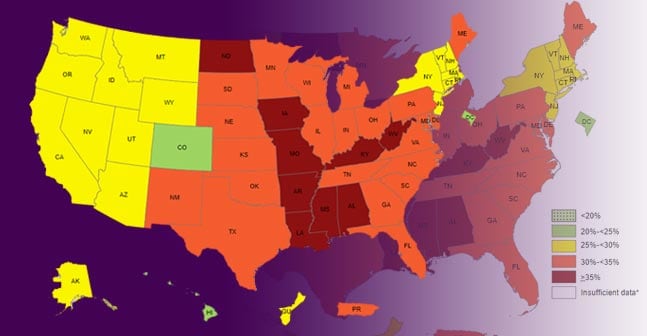
Map of those overweight and obese by state. 
Life expectancy is continuing to rise in other advanced, wealthy nations, including the liberal European nations so derided by American conservatives. Such is not the case in the United States where life expectancy is falling, with sharp decreases in age brackets often considered the prime time of one's life.  A report published in the Journal of the American Medical Association looks at the unwanted reality and where the death rate has risen the most: mostly in mid-western "swing states" and the South, regions where Republican political rule predominates. While no one cause explains the phenomenon, there are a number of factors noted in the report, particularly, America's obesity problem.  Go to Europe and walk around almost any city and you will NOT see the large numbers of overweight people and those you do see will most often be American tourists. My own thoughts on this particular problem of obesity focuses on (i) Americans' poor diet and addiction to high calorie fast food and (ii) vastly over-sized portions at American restaurants (things you do not see in Europe).  Then, of course, most other advanced nations have some version of universal health care, something lacking in the USA.  The Washington Post looks at the report and the dire outlook for the future.  Here are article highlights:

Death rates from suicide, drug overdoses, liver disease and dozens of other causes have been rising over the past decade for young and middle-aged adults, driving down overall life expectancy in the United States for three consecutive years, according to a strikingly bleak study published Tuesday that looked at the past six decades of mortality data.
The report, published in the Journal of the American Medical Association, was immediately hailed by outside researchers for its comprehensive treatment of a still-enigmatic trend: the reversal of historical patterns in longevity.
Despite spending more on health care than any other country, the United States has seen increasing mortality and falling life expectancy for people age 25 to 64, who should be in the prime of their lives. In contrast, other wealthy nations have generally experienced continued progress in extending longevity.
[T]he broad trend detailed in this study cuts across gender, racial and ethnic lines. By age group, the highest relative jump in death rates from 2010 to 2017 — 29 percent — has been among people age 25 to 34.
The findings are sure to fuel political debate about causes and potential solutions because the geography of rising death rates overlaps to a significant extent with states and regions that are hotly contested in the run-up to the 2020 presidential election.
About a third of the estimated 33,000 “excess deaths” that the study says occurred since 2010 were in just four states: Ohio, Pennsylvania, Kentucky and Indiana — the first two of which are critical swing states in presidential elections. The state with the biggest percentage rise in death rates among working-age people in this decade — 23.3 percent — is New Hampshire, the first primary state.
“It’s supposed to be going down, as it is in other countries,” said the lead author of the report, Steven H. Woolf, director emeritus of the Center on Society and Health at Virginia Commonwealth University. “The fact that that number is climbing, there’s something terribly wrong.”
He said many factors are at play. The opioid epidemic is a major driver of the worrisome numbers but far from the sole cause. The study found that improvements in life expectancy, largely because of lower rates of infant mortality, began to slow in the 1980s, long before the opioid epidemic became a national tragedy.
“Some of it may be due to obesity, some of it may be due to drug addiction, some of it may be due to distracted driving from cellphones,” Woolf said. Given the breadth and pervasiveness of the trend, “it suggests that the cause has to be systemic, that there’s some root cause that’s causing adverse health across many different dimensions for working-age adults.”
The average life expectancy in the United States fell behind that of other wealthy countries in 1998, and since then the gap has grown steadily. Experts refer to this gap as the United States’ “health disadvantage.”
Princeton professors Anne Case and Angus Deaton, whose much-publicized report in 2015 highlighted the death rates in middle-aged whites, published a paper in 2017 pointing to a widening gap in health associated with levels of education, a trend dating to the 1970s. Case told reporters their research showed a “sea of despair” in the United States among people with only a high school diploma or less.
Obesity is a significant part of the story. The average woman in the United States today weighs as much as the average man half a century ago, and men now weigh about 30 pounds more. Most people in the United States are overweight — an estimated 71.6 percent of the population age 20 and older, according to the CDC. That figure includes the 39.8 percent who are obese, defined as having a body mass index of 30 or higher in adults (18.5 to 25 is the normal range). Obesity is also rising in children; nearly 19 percent of the population age 2 to 19 is obese.
“These kids are acquiring obesity in their early teen years, sometimes under the age of 10,” said S. Jay Olshansky, a professor of public health at the University of Illinois at Chicago. “When they get up into their 20s, 30s and 40s, they’re carrying the risk factors of obesity that were acquired when they were children. We didn’t see that in previous generations.”