Showing posts with label war mongers. Show all posts

Friday, January 03, 2020

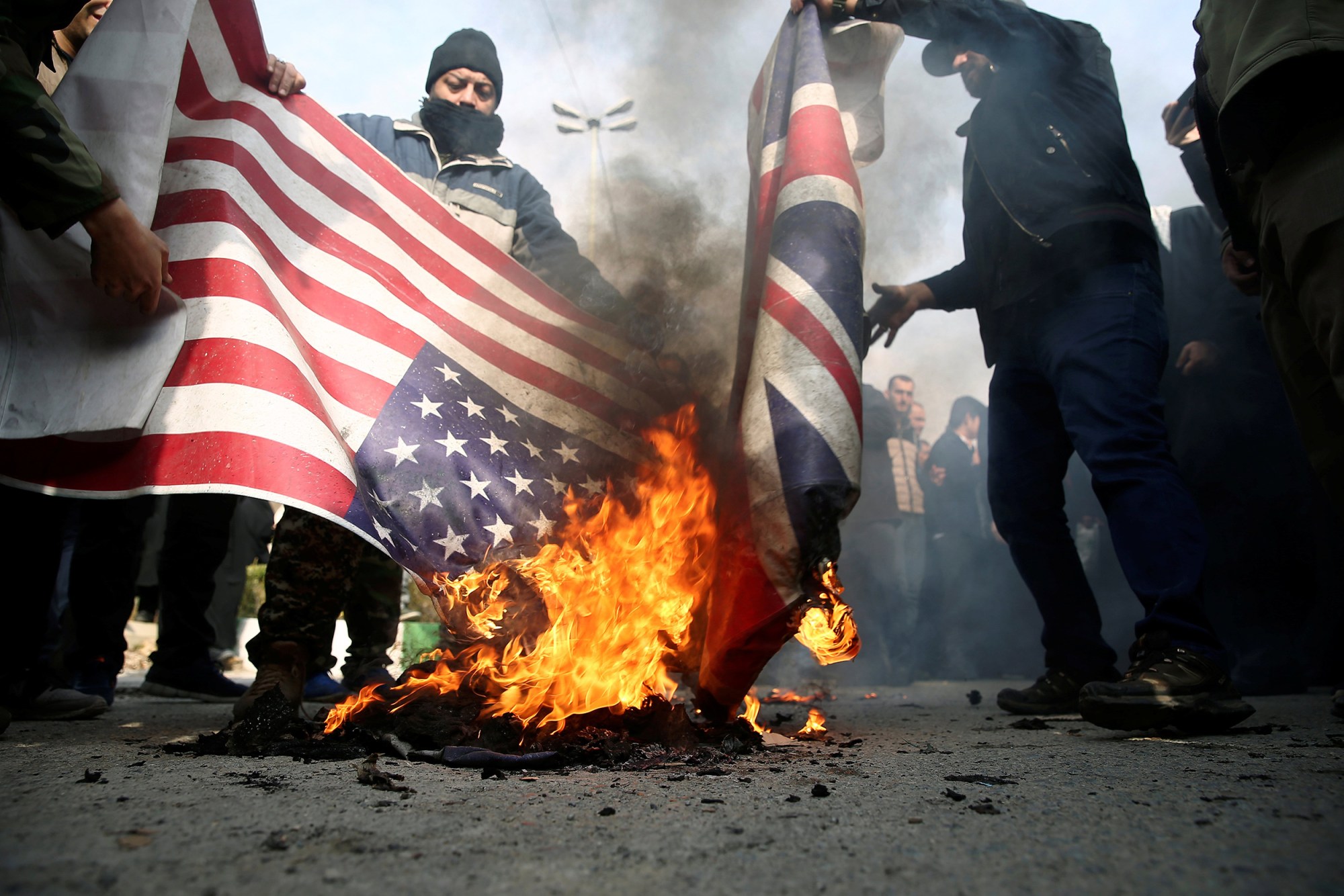
Trump Is Wrong In Thinking Attacking Iran Will Get Him Reelected

Being of a "certain age" I remember the Vietnam War debacle well and lost friends to America;s folly in the late 1960's and early 1970's. When the George W. Bush - sometimes known as the Chimperator on this blog - launched the Iraq War, I had a huge sense of deja vu which sadly proved all too accurate. Indeed, when a former law partner who had served in Vietnam saw "Fog of War" with me back in the early 2000's, his reaction was that Iraq was Vietnam all over again. In each of these poorly conceived wars, individuals Americans paid with their lives and the nation squandered billions of dollars.  Now, it seems, Donald Trump - a man who doesn't read, knows little history and wants one page bullet style briefing reports - wants to launch an even more insanely conceived war against Iran - a nation far larger and better educated and wealthy than Iraq - in the hope that it will win him re-election. A piece in New York Magazine makes the case of why Trump's insane desire for a war with Iran will not assure him re-election.   Here are article highlights:
Beginning in 2011, and continuing through the next year, Donald Trump began obsessively predicting that President Obama would start a war with Iran in order to be reelected. Trump stated it publicly, on at least a half-dozen occasions, explicitly positing that attacking Iran would help Obama win reelection.
Trump’s attacks on Obama were the purest form of projection. They reflect his cynical belief that every president will naturally abuse their powers, and thus provide a roadmap to his own intentions.
And indeed, Trump immediately followed the killing of Qasem Soleimani by metaphorically wrapping himself in the stars and stripes. No doubt he anticipates at least a faint echo of the rally-around-the-flag dynamic that has buoyed many of his predecessors. But Trump’s critics need not assume he will enjoy any such benefit, and should grasp that their own response will help determine it.
One salient fact is that it’s not 2001, or even 2003. A poll earlier this summer found that just 18 percent of Americans prefer to “take military action against Iran” as against 78 percent wanting to “rely mainly on economic and diplomatic efforts.”
It is in part due to public war weariness that Republicans have sworn repeatedly, for years, that they would not go to war with Iran. The possibility of such a military escalation was precisely the central dispute between the parties when the Obama administration struck its nuclear deal. . . . And as Trump mulled following through on his threat to abrogate the deal, conservatives furiously denied that doing so would lead to military conflict.
Trump’s allies have framed the issue as being about Qasem Soleimani’s moral culpability, or Iran’s responsibility for escalating the conflict. And it is certainly true that Iran is a nasty, aggressive, murderous regime. But none of this refutes the fact that Trump’s Iran policy is failing on its own terms. Having violated a diplomatic agreement on the premise that doing so would not lead to war, they are now blaming Iran for the war they insisted would never happen.
Americans historically support their presidents in foreign conflicts, both the wise ones and unwise ones alike, at least initially. Trump no doubt believes the halo effect will last at least through November — that he might undertake an action that would harm his reelection out of some larger sense of duty to the nation or the world is unfathomable.
But presidents traditionally benefit from a presumption of competence, or at least moral legitimacy, from their opposition. Trump has forfeited his. He will not have Democratic leaders standing shoulder to shoulder with him, and his practice of disregarding and smearing government intelligence should likewise dispel any benefit of the doubt attached to claims he makes about the necessity of his actions. Trump has made it plain that he views American war-fighting as nothing but the extension of domestic politics.
I fear for members of the military who may loose their lives - and for their families - as a result of Trump's self-centered war mongering.  I nearly lost a family member in the Afghanistan disaster. Others may not be as luck as we were. 

Friday, March 23, 2018

With Bolton's Appointment, It’s Time to Panic

Unhinged war monger John Bolton.
Donald Trump and his base of support centered on Christian extremists, white supremacists and general misogynists all live in an alternate, objective fact free universe.  Their world view which is full of  hate and paranoia is fanned by Fox News and other right wing "news" outlets that  present a daily dose of propaganda that would have made Joseph Goebbels proud.  Now, Trump has appointed John Bolton to be National Security Advisor.  Bolton is just as unhinged as the ugliest elements of Trump's base and, more frighteningly, is trigger happy and sees military action rather than diplomacy as a solution for  every foreign dispute.  He was a strong advocate of the Iraq War and seems to have learned nothing from that debacle.  A piece in Slate looks at why sane Americans and members of the military should be very, very afraid of where Trump/Pence may take the country.  Another piece in New York Magazine voices similar concerns.  First, here are highlights from Slate:
It’s time to push the panic button.
John Bolton’s appointment as national security adviser—a post that requires no Senate confirmation—puts the United States on a path to war. And it’s fair to say President Donald Trump wants us on that path.
After all, Trump gave Bolton the job after the two held several conversations (despite White House chief of staff John Kelly’s orders barring Bolton from the building). And there was this remark that Trump made after firing Rex Tillerson and nominating the more hawkish Mike Pompeo to take his place: “We’re getting very close to having the Cabinet and other things I want.”
Bolton has repeatedly called for launching a first strike on North Korea, scuttling the nuclear arms deal with Iran, and then bombing that country too. He says and writes these things not as part of some clever “madman theory” to bring Kim Jong-un and the mullahs of Tehran to the bargaining table, but rather because he simply wants to destroy them and America’s other enemies too.
His agenda is not “peace through strength,” the motto of more conventional Republican hawks that Trump included in a tweet on Wednesday, but rather regime change through war. He is a neocon without the moral fervor of some who wear that label—i.e., he is keen to topple oppressive regimes not in order to spread democracy but rather to expand American power.
In the early days of the George W. Bush administration, Vice President Dick Cheney finagled Bolton a job as undersecretary of state for arms control—an inside joke, since Bolton has never read an arms-control treaty that he liked. But his real assignment was to serve as Cheney’s spy in Foggy Bottom, monitoring and, when possible, obstructing any attempts at peaceful diplomacy mounted by Secretary of State Colin Powell.
When Powell got the boot, Cheney wanted to make Bolton deputy secretary of state, replacing Richard Armitage, who resigned along with his best friend Powell. But Powell’s replacement, Condoleezza Rice, who had been Bush’s national security adviser, blocked the move, fully aware of Bolton’s obstructionist ideology.
As a compromise, Bush nominated Bolton to be United Nations ambassador, but that move proved unbearable to even the Republican-controlled Senate at the time. . . . . he was hostile to the idea of international law, having once declared, “It is a big mistake for us to grant any validity to international law even when it may seem in our short-term interest to do so—because over the long term, the goal of those who think that international law really means anything are those who want to constrain the United States.”
These might be quaint notions for some eccentric midlevel aide to espouse, but the United Nations is founded on international law, Security Council resolutions are drafted to enforce international law, and . . . some of those resolutions were proving useful for expressing, and sometimes enforcing, U.S. national security interests. How could someone with these views serve as the U.S. ambassador to the U.N.?
In his confirmation hearings before the Senate Foreign Relations Committee, Bolton put on a dreadful show, grumbling and scowling through his walrus mustache.
[A]t least McMaster assembled—and often listened to—a professional staff at the National Security Council and insisted on ousting amateur ideologues, several of them acolytes of Flynn.
Bolton is not likely to put up with a professional staff, and the flood of White House exiles will soon intensify. One subject of discussion at Bolton’s Senate hearings, back in 2005, was his intolerance of any views that differed from his own. He displayed this trait most harshly when, as undersecretary of state, he tried to fire two intelligence analysts who challenged his (erroneous) view that Cuba was developing biological weapons and supplying the weapons to rogue regimes.
Nor is Bolton at all suited to perform one of a national security adviser’s main responsibilities—assembling the Cabinet secretaries to debate various options in foreign and military policy, mediating their differences, and either hammering out a compromise or presenting the choices to the president.
Then again, there may now no longer be many differences to mediate in this administration. The last of the grown-ups is Secretary of Defense James Mattis . . . . [Trump] didn’t know that Mattis regularly consulted a personal library of some 7,000 volumes on history and strategy, that (like most generals) he’s not too keen to go to war unless he really has to, and that (also like most generals) he takes the Geneva Conventions seriously and opposes torture.
With Tillerson out, Bolton in, and Pompeo waiting in the wings for confirmation, Trump is feeling his oats, coming into his own, like Trump is free to be Trump. Finding out just who that is may make the rest of us duck and cover.
The New York Magazine piece contains this:
From the outset of his presidency, to which he was elevated with barely any preparation, Donald Trump was surrounded by a protective cordon of advisers, as a child monarch might. In return for absorbing his tantrums, they would educate their unsteady charge, who would wind up, after pratfalls and drama, inflicting no more ruin on the country than a normal modern Republican president might. . . . Somehow it seemed we might muddle through.
Now Trump is breaking through the protective cordon. The people who joined the government to save Donald Trump from himself, or to save the world from Trump, are leaving. Gary Cohn and Rex Tillerson are gone. Trump is reorganizing his legal team, mobilizing for war against the special counsel. And now he has finally cast off his most important minder, National Security Adviser H.R. McMaster, and replaced him with John Bolton.
Bolton . . . is a true believing ideologue firmly encamped on his party’s right flank, who appears regularly on Fox News to propound ultra-simplistic solutions to the world’s problems, which Trump can easily grasp on his sofa.
Bolton’s foreign policy notions can be quickly operationalized, given the near-total command the executive branch has over foreign policy. What’s more, those ideas have the potential to kill large numbers of people.
Bolton has long been estranged from a substantial segment of his own party, which regards him as dangerous. . . . . while many of his colleagues came away at least somewhat chastened by their errors, Bolton did not. “I still think the decision to overthrow Saddam was correct,” he said in 2015.
Bolton is considered so dangerous, even by many Republican hawks, because he is a true believer, deeply in the grips of black and white notions of simple morality that are difficult to reconcile with the messy reality that is the world. There is a long history of ideologues joining a presidential administration and terrifying the establishment, only to be assimilated into its bureaucratic routines. But Bolton’s character and history seem to defy any such domestication.
The combination of Bolton and Trump poses an especially potent danger. Trump once declared “I love war, in a certain way.” Both men think in terms of zero-sum conflict and harbor an obsession with dominating their adversaries. They are temperamental twins. In North Korea or elsewhere, Bolton could goad Trump into dangerous reaction.
It has been the tail risks – any number of low-probability, high impact events that are far more likely to occur with an authoritarian buffoon in the White House than under a normal president. Trump has spent his presidency surrounded by people who were at least attempting to contain these risks – say, a Constitutional crisis, or a meltdown of the international order. As awful and comically surreal as the first year and a quarter of his term has been, after Trump has taken full command of his administration, we may see it as a golden age.
Be very afraid.  Those of us who live in an area like Hampton Roads, Virginia, with a huge military personnel do not want to see the lives of friends and neighbors thrown away yet again.  Just as importantly, we should not want to see Trump by either mistake or design authorize the use of nuclear weapons.  

Sunday, April 16, 2017

Why Trump’s Attempt to Scare North Korea May Horrifically Backfire


Throughout his real estate career, Donald Trump has used bullying - added to ignoring the law and associating with mafia figures - to accomplish his goals.  Stated another way, he thinks he can do whatever he wants and people are supposed to give in to him. It's a characteristic of many narcissist that they are so self-absorbed that they try to ride rough shod over others.  Frighteningly, this mindset now animates the White House and it could yet have truly disastrous consequences for literally millions of people. With North Korea, Trump doesn't seem to grasp that he is facing a regime headed by an individual (or individuals) even more un-tethered from reality than he is himself.  Throw in huge doses of paranoia and a near martyr complex among North Korea's leaders and it makes for an immensely dangerous mix.  My fear is that Trump is in way, way over his head and that, if he acts in his usual manner, a catastrophe could be in the offing.  Here are excerpts from New York Magazine that underscore the dangers we face with an unfit commander-in-chief in the White House:
President Trump and his advisers have taken a more and more threatening stance toward North Korea since January, and the isolated dictatorship has responded with threats of its own. Foreign-policy experts say a breaking point could be looming. Saturday marked the 105th anniversary of the birth of North Korea’s founder, Kim Il-sung, and the regime there commemorated the holiday with displays of military force — though, thankfully, not with a nuclear test, as many experts feared. Still, there is a sense of a collision course. Several days ago, the U.S. military moved a brigade of warships to the Korean Peninsula, as a show of force. Then on Friday, the North Korean government threatened to attack major American military bases in South Korea, saying it could destroy them almost instantly.
[W]e spoke with George Lopez, professor emeritus at the Krok Institute for International Peace Studies, which is based at Notre Dame University. He has advised the United Nations and various governments on North Korea and sanctions issues since 1992. Lopez also proposes a set of directions for getting out of this conflict — directions that favor diplomacy over military force. What American leaders fail to understand, he says, is that they can’t scare North Korea by threatening war.

Obama’s people told Trump’s top foreign-policy people this was their biggest worry. Obama seems to have told Trump in their one-on-one meeting that North Korea was going to be Trump’s biggest dilemma and that he needed a regional approach to it.
[T]his [past] week, the administration used what many would call a prohibited weapon in the Afghan theater, and it has also launched these strikes on Syria. . . . I think it was not without some delight in the White House that there was a secondary messaging effect to North Korea. These actions went in conjunction with the U.S. moving a small Navy brigade to the Korean Peninsula, and also with Trump’s meeting and phone calls with the Chinese president, to signal that our patience is running out.
Meanwhile, it’s unclear who is the Asia expert most influential in the White House’s national security staff, and the last time I checked the State Department chart, we still didn’t have a fully staffed Bureau of Asian Affairs. . . . .
[O]ne strategy that a group of us have advocated over the last couple weeks is to say, “Military force is so crazy to think about, the next best option is financial bankruptcy and economic strangulation.” That is, if you want to take the gloves off, take the gloves off in the trading and financial sector. Take a lesson from the tightening of the noose around Iran, and go after commodities, go after general trade sectors. You absolutely implement the top five or six recommendations of the U.N. Panel of Experts, which would hold all states in the Asian region responsible for ending corresponding banking accounts with not only North Korean banks, but with the shadow companies they’ve set up in Malaysia and China and elsewhere.
China needs to get tighter with the financial actors within its country who continue to sustain unabated channels to illicit financing for North Korea. There are a series of draconian financial measures that then get the attention of the great young dictator, and you can say, “The next move is yours. Do we talk or not?” But what this administration has done is put us in an all-or-nothing bind. Either he blinks or we blink.

[T]he issuing of the threat against South Korea [by North Korea] is a smart approach that says, “Well, let’s talk militarily. You could knock out our nuclear sites, but you can’t knock out the 175 major artillery batteries we have, poised to shoot at the minute we detect that we’re being attacked — and those can knock out 80 percent of Seoul. So the blood will be on your hands if you choose to initiate an attack against our nuclear sites.” In other words, “You’re not the only people who can issue ultimatums, and you’re not the only people who have military deliverables that are supposed to make us quake and fear that we must change our behavior.”
This regime has had an ideology, through three generations, that the war of liberation of South Korea will come when the United States oversteps its boundaries. And remember, they don’t have a peace treaty with the United States. If they were interested in peace, they would be proactive in coming back to the bargaining table and finishing off the armistice agreement from 1953.
This isn’t Syria. This isn’t Afghanistan. This is the point at which, if a U.S. missile crosses into North Korean territory, all bets on everything are off. It fits their worldview, that sooner or later, they will have to fire everything they have. That’s the only way the North could potentially survive an exchange.

[W]e need a U.S. policy that doesn’t put them in a position where their trigger fingers get nervous. You have to deal with the nuclear weapons and the missiles on their own terms, and you can’t use the potential for war against them as leverage. . . . They’re ready for war.

[W]e have to end their access to money — in all forms. We have to end the access of Korean diplomats marching off with big duffle bags, pretending they’re off to go play golf in Poland, when what they’re really doing is carrying gold bars and loads of cash, which ultimately goes to fund the various services that run the missiles. And you do need China’s help for that. Right now, China is looking the other way.
We’ve got to make sure our president doesn’t approach the microphone and says, “That’s the last straw. I’m taking actions in the next 48 hours, and they’ll never know what I’m going to do until I do it.” You can’t have that. In other words, someone needs to lasso him, quite frankly, and make sure we have a clearly articulated dynamic.
We think we can intimidate the North Korean leadership into keeping their powder dry. What we’re doing, more than anything else, is playing into their ongoing scenario of a likely, if not inevitable, confrontation with the West. . . . If you’re going to use as your calculus of success or failure, of an unarticulated policy, who blinks first, you’re on really, really shaky ground.
Be very, very afraid,   Would that Trump voters had even considered this scenario rather falling for appeals to racism and resentment over lost white privilege and extremist religious beliefs. Elections have consequences as the world could soon find out. 

Saturday, February 04, 2017

Trump's Dangerous Foreign Policy Games


Thankfully, my son-in-law is no longer in the military given the dangerous and reckless games that the delusional Der Fuhrer is playing.  That said, living in Hampton Roads with its huge military presence, we know many men and women who may find themselves in harm's way because of the mentally ill commander-in-chief occupying the White House. Indeed, for the first time in many years some residents of the region are once again conscious that the area would be a first strike target if Trump were to trigger a nuclear war. Obama's steady hand is gone and madness now reigns in the White House.   Much of the world now worries what this foul individual might unleash either deliberately or through his own delusions.  A column in the New York Times looks at Trump's dangerous games which are likely to continue to distract his cretinous base from the reality that coal jobs and others promised by Der Fuhrer are never coming back.  Indeed, the strategy mirrors that of Putin who seeks to distract the average Russian from the reality of the economic disaster over which he presides.  Here are article excerpts:
For the past couple of months, thoughtful people have been quietly worrying that the Trump administration might get us into a foreign policy crisis, maybe even a war.
Partly this worry reflected Donald Trump’s addiction to bombast and swagger, which plays fine in Breitbart and on Fox News but doesn’t go down well with foreign governments. But it also reflected a cold view of the incentives the new administration would face: as working-class voters began to realize that candidate Trump’s promises about jobs and health care were insincere, foreign distractions would look increasingly attractive.
The most likely flash point seemed to be China, the subject of much Trumpist tough talk, where disputes over islands in the South China Sea could easily turn into shooting incidents.
But the war with China will, it seems, have to wait. First comes Australia. And Mexico. And Iran. And the European Union. (But never Russia.)
And while there may be an element of cynical calculation in some of the administration’s crisismongering, this is looking less and less like a political strategy and more and more like a psychological syndrome.
The Australian confrontation has gotten the most press, probably because it’s so weirdly gratuitous. Australia is, after all, arguably America’s most faithful friend in the whole world, a nation that has fought by our side again and again. . . . . But this is the age of Trump: In a call with Malcolm Turnbull, Australia’s prime minister, the U.S. president boasted about his election victory and complained about an existing agreement to take some of the refugees Australia has been holding, accusing Mr. Turnbull of sending us the “next Boston bombers.”
[A]t least Mr. Trump didn’t threaten to invade Australia. In his conversation with President Enrique Peña Nieto of Mexico, however, he did just that.
The blowups with Mexico and Australia have overshadowed a more conventional war of words with Iran, which tested a missile on Sunday. This was definitely a provocation. But the White House warning that it was “putting Iran on notice” raises the question, notice of what? Given the way the administration has been alienating our allies, tighter sanctions aren’t going to happen. Are we ready for a war?
There was also a curious contrast between the response to Iran and the response to another, more serious provocation: Russia’s escalation of its proxy war in Ukraine. Senator John McCain called on the president to help Ukraine. Strangely, however, the White House said nothing at all about Russia’s actions until Nikki Haley, the United Nations ambassador, issued a condemnation late Thursday night to the Security Council. This is getting a bit obvious, isn’t it?
Oh, and one more thing: Peter Navarro, head of Mr. Trump’s new National Trade Council, accused Germany of exploiting the United States with an undervalued currency.
[W]hat we’re hearing sounds like a man who is out of his depth and out of control, who can’t even pretend to master his feelings of personal insecurity. His first two weeks in office have been utter chaos, and things just keep getting worse — perhaps because he responds to each debacle with a desperate attempt to change the subject that only leads to a fresh debacle.
America and the world can’t take much more of this. Think about it: If you had an employee behaving this way, you’d immediately remove him from any position of responsibility and strongly suggest that he seek counseling. And this guy is commander in chief of the world’s most powerful military.
As noted in past posts, America could not prevail in Iraq yet Trump seems to want war with Iran - a far larger and more advanced country than Iraq ever was.  Yes, it would make the white supremacists and Christofascists happy and distract the bubba's in the hinterland, but how many American lives would be thrown away and how many billions of dollars squandered?  And that doesn't even factor in the countless innocent civilians that would likely be killed.  Oops, I forgot.  With Trump's base, if you aren't a white, heterosexual right wing Christian, you're not really human, so your death doesn't matter.  Trump needs to be removed from office NOW!

Saturday, March 14, 2015

Army General Trashes Tom "Male Michele Bachmann" Cotton

With Michele Bachmann no longer in Congress - although she continues to utter batshit crazy remarks - it increasingly seems that not ready for prime time Senator Tom Cotton is the new Bachmann substitute.  All he has to do is get down the crazy eye stares to complete the package.  If he wants to perfect his village idiot persona, he can bleach his hair blond so that we can call him a blond bimbo as well.  Retired Army Major Gen. Paul D. Eaton is none too happy with Cotton and while stopping short of calling him a traitor suggested that he was leading a "mutiny."  A piece in the Washington Post looks at the general's trashing of Cotton.  Here are excerpts:
The open letter to the leaders of the Islamic Republic of Iran signed by 47 senators and instigated by Sen. Tom Cotton (R-Ark.) was a stunning breach of protocol. One so outrageous that my former colleagues at the New York Daily News dubbed the signers “traitors.” While it is indeed a slap in the face of President Obama and an affront to the presidency, I’m not sure I would go that far, especially since Cotton is an Army veteran of the Iraq and Afghanistan wars. So, I turned to retired Major Gen. Paul D. Eaton for perspective. He wouldn’t say Cotton and Co. were “traitors,” either. He had a better word.

“I would use the word mutinous,” said Eaton, whose long career includes training Iraqi forces from 2003 to 2004. He is now a senior adviser to VoteVets.org. . . . they defied the chain of command in what could be construed as an illegal act.” 

Eaton certainly had stern words for Cotton. “What Senator Cotton did is a gross breach of discipline, and especially as a veteran of the Army, he should know better,” . . .
to directly engage a foreign entity, in this way, undermining the strategy and work of our diplomats and our Commander in Chief, strains the very discipline and structure that our foreign relations depend on, to succeed.”

 The consequences of Cotton’s missive were plainly apparent to Eaton. “The breach of discipline is extremely dangerous, because undermining our diplomatic efforts, at this moment, brings us another step closer to a very costly and perilous war with Iran,” he said. . . .  “I think Senator Cotton recognizes this, and he simply does not care,”. . . . 

“I expect better from the men and women who wore the uniform,” Eaton said of Cotton. And the American people deserve better from the Senate.
Mutineers are typically court martialed and imprisoned - an idea I find attractive for Mr. Cotton.  And should his stunt lead us to war with Iran, he should be forced to resign his seat in the Senate and go to the front - preferably leading at the front of a charge like the civil war generals (who suffered a very high mortality rate).  Perhaps all 47 Republicans should have to do the same.  Just saying  . . . 

Monday, October 22, 2012

Romnesia: Tonight's Foreign Policy Edition

With Romney having flip flopped more than a hooked fish in the bottom of a boat - or lied constantly for those who like to call a spade a spade - on virtually every issue.  Now, with tonight's debate focused on foreign policy, Romney will likely once again conveniently forget all of his previous statements - suffer from Romnesia, if you will - and once again pander to debate viewers and say whatever he thinks is most politically expedient at the moment.  If you don't believe how many times Romney has flip flopped on his positions, Blue Virginia has put together a great compilation of Mitt's serious "Romnesia" problems.  The compilation should be required reading because it underscores the reality that if Romney is elected, there is no basis to know what the Hell the man would do in office.  Here are some highlights:
In the 24 hours before the final presidential debate, Mitt Romney’s Romnesia has apparently spread to his national security positions. He’s tried to backpedal on his bluster, his pledge to arbitrarily increase defense spending by $2 trillion without saying how he’d pay for it, and his criticism of the President’s commitment to getting our troops home. But this is nothing more than a cynical attempt to hide his true – and extreme – positions from the American people.

Here are the facts:
TODAY: Romney Adviser Dan Senor On Afghanistan: Romney Has Said “And He'll Say It Again Tonight, We Need Diplomatic Solution To The Iranian Nuclear Crisis.” ROBINSON: “Doesn't he have to be careful here? I mean, this could be a delicate and perhaps productive moment - perhaps not - in the relations -- relationship between the US and Iran, and in our efforts on the Iranian nuclear program. Doesn't Romney have to walk very carefully in terms of what he says about…” SENOR: “That's always the case. That’s always the case. I mean, the Iranian government and the administration both said this ‘New York Times’ story is not accurate. So I'm not sure he has to respond to a story that both governments involved have said is not true. That said, if you listen to what he said, and he'll say it again tonight, we need diplomatic solution to the Iranian nuclear crisis. It's gotten really bad.” [Morning Joe, MSNBC, 10/22/12] 


ROMNEY HAS ISSUED VOLATILE RHETORIC ON IRAN THREATENING “IF YOU WANT PEACE, PREPARE FOR WAR”

Romney To Iran: “If You Want Peace, Prepare For War.” “The United States needs a very different policy. Si vis pacem, para bellum. That is a Latin phrase, but the ayatollahs will have no trouble understanding its meaning from a Romney administration: If you want peace, prepare for war.” [Mitt Romney Op-Ed, Wall Street Journal, 11/10/11]

Romney Said He Would Be “Just As Ready To Engage Our Military Might” On Behalf Of Israel As He Is Ready To Engage In Diplomacy.Romney: “As President, I will be ready to engage in diplomacy. But I will be just as ready to engage our military might. Israel will know that America stands at its side, in all conditions and in all consequence.” [Romney Speech, AIPAC, 3/6/12]
  
Romney When Asked If He Supported A “First Strike” Against Iran Either By Israel Or U.S.: “Yes.” Host: “Do you support a first strike against them, either by Israel or by us or a combination of the two to halt that process?” Romney: “Yes, and I think you actually have to act before they had a weapon, a deliverable weapon. They have to understand that we will take military, kinetic action if they continue to pursue a nuclear option. That is unacceptable to us. That is unacceptable to Israel. It's unacceptable to the world.” [Rick and Bubba Show, XM Radio, 3/9/12]
  
Romney On Taking A First Strike Against Iran: “Yes, And I Think You Actually Have To Act Before They Had A Weapon, A Deliverable Weapon.” [Rick and Bubba Show, XM Radio, 3/9/12]

Romney Declined To Say What Kind Of Military Strike He Would Order To Stop Iran From Acquiring A Nuclear Weapon But Did Say “Of Course” He Was Prepared To Act Unilaterally. “BAIER: Would you be prepared to do it unilaterally if need be? ROMNEY: Of course.” [Special Report With Bret Baier, Fox News, 11/29/11]

Romney Said He Was “Being Pretty Serious” About The Idea Of Military Action Against Iran. “Mr. Obama accused the GOP field of taking the idea of war with Iran too casually. ‘I think all of us are being pretty serious,’ Mr. Romney said in his news conference.” [Wall Street Journal, 3/7/12; Romney Press Availability, 3/6/12]

Romney: “We Should Always Make Sure That They Recognize That To The United States Of America, Iran Becoming Nuclear Is Unacceptable, And We Have Options On The Table, But They’re Not Just On The Table But In Our Hands.” [Romney-Ryan Town Hall, Manchester, NH, 8/20/12]

ROMNEY OFTEN WARNS THAT IRAN IS CLOSE VERY CLOSE TO NUCLEAR CAPABILITY

Romney: “Iran Today Has Never Been Closer To A Nuclear Weapons Capability.”  [Romney Foreign Policy Address  to the Virginia Military Institute, Lexington, VA, 10/8/12]

Romney: “If Barack Obama Gets Reelected Iran Will Have A Nuclear Weapon.” [Romney Event, Snellville, GA, 3/4/12]

Romney: “If We Re-Elect Barack Obama, Iran Will Have A Nuclear Weapon. And If You Elect Mitt Romney, Iran Will Not Have A Nuclear Weapon.” [CBS/National Journal Debate, 11/12/11]

TODAY: ROMNEY HAS TRIED TO BACK AWAY FROM HIS $2 TRILLION IN PROPOSED DEFENSE SPENDING…

Headline: “Romney Camp Blurs $2 Trillion Defense Spending Goal.” [Talking Points Memo, 10/22/12]

Talking Points Memo: The Romney Campaign Is Obscuring A Clearly Defined Policy Proposal, Which Serves As The Basis For Democratic Claims That Romney Wants To Spend $2 Trillion Additional Dollars On Defense Spending Over The Next 10 Years.”  [Talking Points Memo,10/22/12]

·         Romney Adviser: “The Goal Of” Increasing Defense Spending To “4 Percent Of GDP… Is Not Going To Be Achieved Overnight Or Perhaps Even By The End Of The First Term.” “Mitt Romney’s pledge to spend at least 4 percent of the U.S. gross domestic product on the military isn’t an immediate goal or even one he is sure to meet in a first term as president, according to a defense adviser. ‘The goal of 4 percent of GDP remains and is unchanged,’ Dov Zakheim, a former Pentagon comptroller who advises Romney, said in an e-mail. “But that goal is not going to be achieved overnight or perhaps even by the end of the first term.’” [Bloomberg, 10/22/12]

…BUT INDEPENDENT ANALYSIS SHOWS HIS PLAN TO RAISE DEFENSE SPENDING TO 4% OF GDP, WHICH ROMNEY SAID IS “ESSENTIAL TO KEEPING AMERICAN SAFE,” WOULD REQUIRE A $2 TRILLION INCREASE

Romney Defense Plan: “Reverse Obama-Era Defense Spending Cuts With The Goal Of Setting A Core Defense Spending Floor Of 4% Of GDP.” [Defense Fact Sheet, Romney For President, 7/24/12]

·         Romney: Raising Defense Spending To 4% Of GDP Is “Essential To Keep America Safe.” Romney: “I’m, I think I’m the only guy suggesting that we should raise our Defense budget to 4% of our total GDP, which is about one-fifth of federal spending. For me, that’s essential to keep America safe.” [Hugh Hewitt Show, 11/18/11]
There's much more, but you get the drift.  Romney says one thing at one moment in time and then totally forgets his prior positions and statements if the audience changes or he thinks the public mood has shifted.  As for what he'd actually do, we have ZERO assurance.

Former Mossad Head Praises Obama And Criticizes Romney

With the third and final presidential debate set to start in a few minutes, it is interesting to read an article in the Times of Israel that carries the views of Efraim Halevy (pictured at left), the former head of the Mossad - for Fox News viewers, the Mossad is the Israeli equivalent of the CIA - who praise Barack Obama and criticizes Mitt Romney's bellicose sabre rattling which Halvey believes could force the USA and Israel into a war with Iran.  With a son-in-law in the Army, I have no use for those who have served ZERO time in the military themselves yet are hellbent to send other people's children off to die in avoidable wars.  It's no coincidence that none of Romney's sons - like their dad who viewed himself as too important to serve in Vietnam -  have ever served in the military.  Here are pertinent highlights from the Times of Israel article:

Former Mossad chief Efraim Halevy spoke out in favor of US President Barack Obama’s strategy for coping with Iran through sanctions and diplomacy, while criticizing Republican presidential candidate Mitt Romney for taking an extreme position.

“The goal of economic sanctions is to convince Iran’s leaders to abandon their nuclear drive, not to prepare the ground for a military strike,” Halevy said in an interview to Israel Radio Monday morning.

Halevy said that if it wasn’t for Obama’s “brave” strategy, Tehran would not now be facing a severe economic crisis. He added that engaging in negotiations with Iran doesn’t mean putting aside sanctions.
The former head of Israel’s spy agency criticized Romney’s policy on Iran, arguing that the Republican challenger’s refusal to hold talks with Tehran leaves no room for any options other than conducting a military strike.
 
“In order to be effective with one’s enemies, you have to have two essential capabilities: To overcome them by force if necessary… and do everything you can to get into their minds and try to understand how they see things… and where, if at all, there is room for common ground of one kind or another,” said Halevy. “I think that what we have had over the years is an abundance of one side, and a dearth of the other.”

Halevy made his comments following the Saturday publication of a New York Times report that claimed that Iran had agreed to hold direct talks with the US over its uranium enrichment program following the US elections. The report has since been denied by both the White House and Tehran.

Strategic Affairs Minister Moshe Ya’alon told Israel Radio that Jerusalem has known for some time of behind-the-scenes contact between the US and Iran, and that it has no objections. Ya’alon said that direct talks would receive Israel’s blessing if they bring an end to Iran’s nuclear program.