Showing posts with label voting against economic interest. Show all posts

Tuesday, May 19, 2020

Amid An Economic Crisis Trump Wants to Lower Unemployment Benefits


Time and time again in the past working class and many middle class Americans have voted against their own economic best interest as they succumb to the GOP's siren songs or racism and Christian extremism. Now, with literally millions of Americans suffering from unemployment, Trump and his GOP sycophants in the U.S. Senate want to reduce unemployment benefits, providing yet another example of why voting Republican is insane for normal, working Americans. Should Trump and the GOP get their wish unemployed workers could see a huge reduction in benefits which might literally leave people going hungry or defaulting on their other bills (such as utilities). It's another example of the callousness of the GOP which, if successful, would force desperate workers back to work with employers who will be in a position to dictate Scrooge like terms. A piece in New York Magazine looks at the disturbing Trump/GOP agenda.  Here are highlights:

Most of the debate over a new coronavirus stimulus measure involves new assistance Democrats think the country needs that Republicans oppose on grounds that such past legislation as the $2.2 trillion Cares Act needs to be fully implemented before Congress takes further action. So it’s one party wanting to act, and another wanting to “pause” (except for the complication that Republicans really, really want a liability shield for corporations).
Trouble is, Republicans are also very interested in taking away an existing stimulus measure that many of them opposed in the first place — the enhanced unemployment insurance designed to keep low-income Americans from a disastrous drop in living standards in anticipation of a big boost in joblessness. There was a lot of fretting in the Senate that the $600-per-week federal add-on to UI benefits in the CARES Act might enable low-wage workers in poorer states to make more money on unemployment than they did in the jobs they had lost. That led to a floor revolt led by Republicans senators Ben Sasse, Lindsey Graham, Tim Scott, and Rick Scott to cap the payments at the level of past wages . . . . It failed to achieve anything like the 60 votes necessary . . . . but subsequently, Republicans troubled by all that extra money corrupting the morals of shiftless unemployment beneficiaries have been calling for “reforming” the measure.
Now it looks like [Trump] the president is joining those in his party who believe the unemployment check is too damn high. According to Seung Min Kim of the Washington Post, “Trump on Tuesday privately expressed opposition to extending a weekly $600 boost in unemployment insurance for laid-off workers affected by the coronavirus pandemic,” per three sources. It’s unclear whether Trump simply wants to cap or lower payments, or let the federal UI enhancement lapse altogether.
Either way, you have to wonder why [Trump] a president with no fixed philosophy of the federal government’s role in the economy would do anything to reduce stimulus efforts since a rapid recovery is generally deemed vital to his reelection.
What makes the UI issue different from other forms of federal stimulus spending, however, is that it’s precisely the sort of thing Trump’s CEO buddies probably care about just as much as free-market ideologues do. High UI benefits, like high minimum wage levels, threaten the fundamental power imbalance that serves as the silver lining for business owners during a deep recession. If they could get away with it, they might promote lower UI benefits —and minimum wages — in an emergency like this to ensure a robust buyer’s market for labor.
Trump’s own motives on this issue might be colored even more by his desire to declare the coronavirus pandemic over, and the economy in full recovery. You don’t need enhanced UI benefits if the economy is racing back towards full employment . . . . . At the earliest possible juncture, he’ll favor a resumption not just of normal life but of normal, pre-recession economic and labor policies.
Unfortunately, wishing the pandemic and its economic effects are over doesn’t make it so, and cutting off enhanced UI could make that happy day more remote, some economists believe: Come July 31, if the emergency UI top-up isn't extended, unemployed workers will effectively get a pay cut of 50-75% overnight.
But if “Mission Accomplished” is where Trump intends to pivot in the weeks ahead, he will have the eager support of Republicans who really do want to return to starving the federal government beast and enjoying all the deregulation the administration has quietly conducted as the hospital beds filled up.

Sunday, January 05, 2020

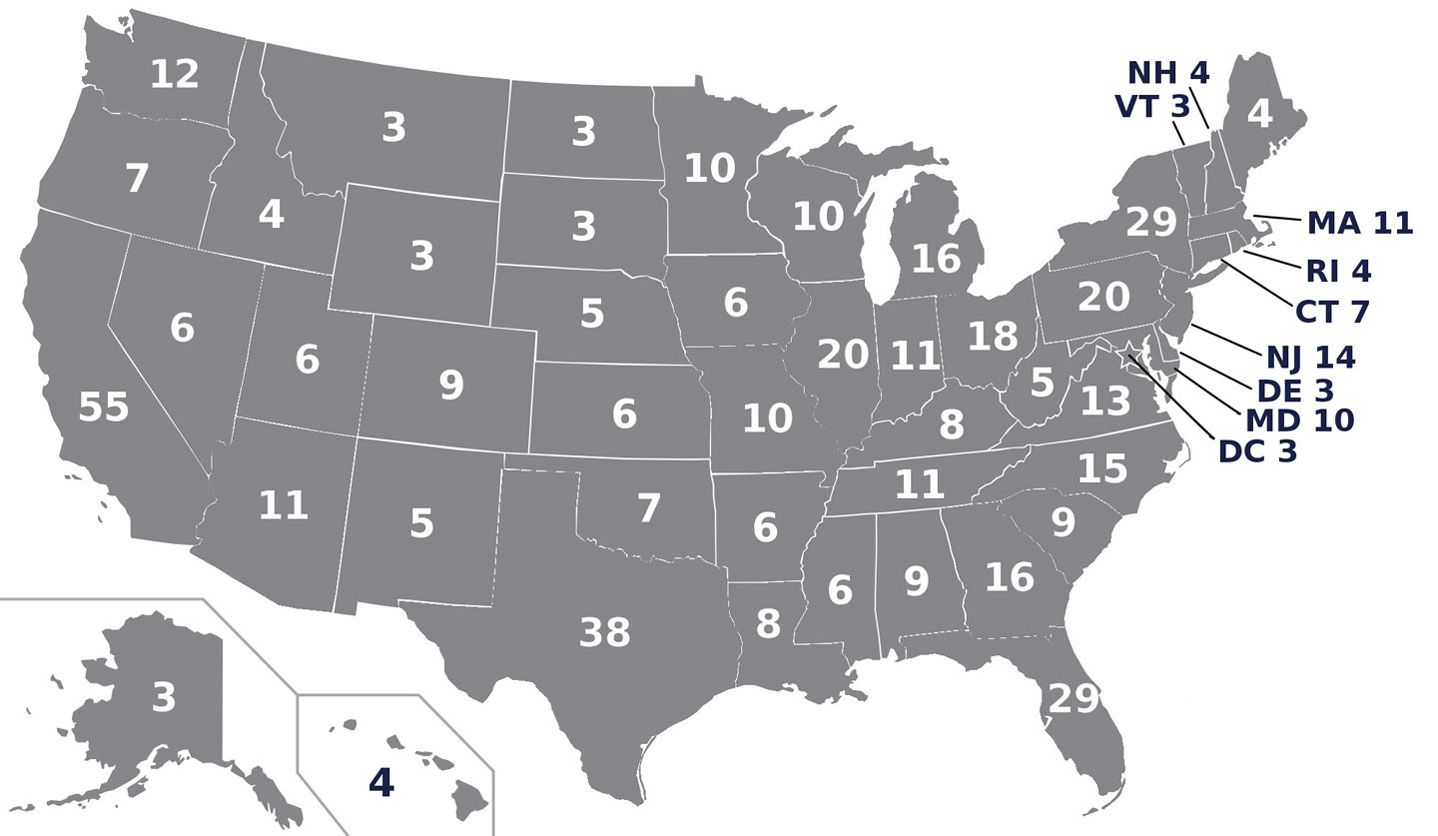
Multiple Routes to a Democrat 2020 Electoral College Win

At this point, there are several take ways in the 2020 presidential contest: (i) national polls mean little, and (ii) focus needs to remain on the list of states that in some combination will put the Democrat candidate over the 270 Electoral College number. But the combination of critical states varies and may or may not include the rust belt states where Trump's message of racism and shameless pandering to religious extremists caused voters to vote against their own economic interest. A piece in the Intelligencer looks at the possible routes to victory in an election that could well be the most important ever for America and by extension the world.   Here are article excerpts:

The sizable gap between Donald Trump’s 304-227 Electoral College majority in 2016 and the paltry 46.1 percent of the popular vote he commanded (trailing Hillary Clinton’s 48.2 percent) has made political observers looking forward to the 2020 contest more focused than usual on state battlegrounds as opposed to the national balance of power. And obviously, most Democrats have obsessed about flipping the three Rust Belt states Trump won that shocked everyone: Pennsylvania and Michigan (Democratic since 1988) and Wisconsin (Democratic since 1984). That Democrats made gains in 2018 in these three states has made them a continued focus for 2020, and moderate presidential candidates Joe Biden, Pete Buttigieg, and Amy Klobuchar have emphasized their supposed strength in the Rust Belt.
But all along there have been arguments for alternative routes to 270 electoral votes that might be open to a Democrat, and at Larry Sabato’s Crystal Ball, Seth Moskowitz has laid them out in fascinating detail.
As he notes, flipping back the three big Rust Belt states would require (with all else staying the same) a conversion of a mere 78,000 votes — or 1,690 popular votes per electoral vote. But there’s been a lot of talk lately about Wisconsin being more obdurate MAGA country than it was in 2016. So is there a simple way for Democrats to win with Pennsylvania and Michigan? Well, yes: If they can win Arizona, which Trump carried by 91,000 votes in 2016, that would get the job done.
There is an even simpler route for a Democratic electoral vote majority: flip Florida, one of the closest 2016 states (Trump won it by just under 113,000 votes), and flip Michigan, too, and the Democrat would win even if the GOP retained Pennsylvania, Wisconsin, Arizona, Georgia, and North Carolina.
And there are scenarios for a Democratic win that won’t count on any of the lost Rust Belt states, with 270-plus electoral votes built on a combination of flipping Arizona, Georgia, and North Carolina (requiring a net gain of 475,000 popular votes) or more simply Arizona and Florida (requiring just 204,000 additional net votes).
There’s even a contingency in which a Democrat could lose all three of the Rust Belt battleground states Trump won in 2016 — plus lose Arizona, Florida, Georgia, and North Carolina — but still get to 270 electoral votes by carrying blue-trending Texas.
The bottom line is that the Democratic path to victory in 2020 is no more preordained than was a Republican path in 2016 that we thought might require wins in places Trump ultimately lost like Nevada, New Hampshire, and Virginia. But it will remain true that no one should place too much stock in national polls unless the race becomes something of an unlikely blowout.

Friday, December 13, 2019

How Democracies Die

History tells us that individuals and nations often do not make good decisions and live to regret mistakes in judgment.  The election in Britain yesterday may be one such example as that nation appears hell bent now to leave the European Union thereby setting the stage from new efforts in Scotland to break away and perhaps even Northern Ireland to follow suit. England may revel in it xenophobia and go it along attitude now, but down the it may be a different tale.  History also tells us that democracies die often not just because of the rise of a strong man, but also because too many citizens and allow it to happen.  The end of democracies from as far back as the death of the Roman Republic also lays blame for the decline of democratic rule on politicians willing to sell their souls in order to cling to personal power - at least in the short term - with little or care for the nation's or their constituents long term future.  We are now witnessing such conduct by most elected Republicans in America. Like the English, many Americans may come to long regret their shortsightedness of today in the light of a far worse tomorrow.  A column in the New York Times makes this case and urges one to not give up the resistance.  Here are highlights:  
The despair felt by climate scientists and environmentalists watching helplessly as something precious and irreplaceable is destroyed is sometimes described as “climate grief.”
Lately, I think I’m experiencing democracy grief. For anyone who was, like me, born after the civil rights movement finally made democracy in America real, liberal democracy has always been part of the climate, as easy to take for granted as clean air or the changing of the seasons. When I contemplate the sort of illiberal oligarchy that would await my children should Donald Trump win another term, the scale of the loss feels so vast that I can barely process it.
After Trump’s election, a number of historians and political scientists rushed out with books explaining, as one title put it, “How Democracies Die.” In the years since, it’s breathtaking how much is dead already. Though the president will almost certainly be impeached for extorting Ukraine to aid his re-election, he is equally certain to be acquitted in the Senate, a tacit confirmation that he is, indeed, above the law. His attorney general is a shameless partisan enforcer. Professional civil servants are purged, replaced by apparatchiks. The courts are filling up with young, hard-right ideologues. One recently confirmed judge, 40-year-old Steven Menashi, has written approvingly of ethnonationalism.
In “How Democracies Die,” Professors Steven Levitsky and Daniel Ziblatt of Harvard describe how, in failing democracies, “the referees of the democratic game were brought over to the government’s side, providing the incumbent with both a shield against constitutional challenges and a powerful — and ‘legal’ — weapon with which to assault its opponents.” This is happening before our eyes.

In The Washington Post, Michael Gerson, a former speechwriter for George W. Bush and a Never Trump conservative, described his spiritual struggle against feelings of political desperation: “Sustaining this type of distressed uncertainty for long periods, I can attest, is like putting arsenic in your saltshaker.”
I reached out to a number of therapists, who said they’re seeing this politically induced misery in their patients. . . . . Karen Starr, a psychologist who practices in Manhattan and on Long Island, some of her patients were “in a state of alarm,” but that’s changed into “more of a chronic feeling that’s bordering on despair.” Among those most affected, she said, are the Holocaust survivors she sees. “It’s about this general feeling that the institutions that we rely on to protect us from a dangerous individual might fail,” she said.
Trump, she said, has made bigotry more open and acceptable, something her patients feel in their daily lives. “When you’re dealing with people of color’s mental health, systemic racism is a big part of that,” she said.
Obviously, this is hardly the first time that America has failed to live up to its ideals. But the ideals themselves used to be a nearly universal lodestar. The civil rights movement, and freedom movements that came after it, succeeded because the country could be shamed by the distance between its democratic promises and its reality. That is no longer true.
Democrats and anti-Trump Republicans are often incredulous seeing the party of Ronald Reagan allied with Vladimir Putin’s Russia, but the truth is, there’s no reason they should be in conflict. The enmity between America and Russia was ideological. First it was liberal democracy versus communism. Then it was liberal democracy versus authoritarian kleptocracy.
But Trump’s political movement is pro-authoritarian and pro-oligarch. It has no interest in preserving pluralism, free and fair elections or any version of the rule of law that applies to the powerful as well as the powerless. It’s contemptuous of the notion of America as a lofty idea rather than a blood-and-soil nation.
The nemeses of the Trumpist movement are liberals — in both the classical and American sense of the world — not America’s traditional geopolitical foes. This is something new in our lifetime.
Thus we have a total breakdown in epistemological solidarity. In the impeachment committee hearings, Republicans insist with a straight face that Trump was deeply concerned about corruption in Ukraine. Republican Senators like Ted Cruz of Texas, who is smart enough to know better, repeat Russian propaganda accusing Ukraine of interfering in the 2016 election. The Department of Justice’s Inspector General report refutes years of Republican deep state conspiracy theories about an F.B.I. plot to subvert Trump’s campaign, and it makes no difference whatsoever to the promoters of those theories, who pronounce themselves totally vindicated.
But despair is worth discussing, because it’s something that organizers and Democratic candidates should be addressing head on. Left to fester, it can lead to apathy and withdrawal. Channeled properly, it can fuel an uprising. I was relieved to hear that despite her sometimes overwhelming sense of civic sadness, Landsman’s activism hasn’t let up. She’s been spending a bit less than 20 hours a week on political organizing, and expects to go back to 40 or more after the holidays. “The only other option is to quit, and accept it, and I’m not ready to go there yet,” she said. Democracy grief isn’t like regular grief. Acceptance isn’t how you move on from it. Acceptance is itself a kind of death.
I for one will not quite.  I fear too much for the future of my children and grandchildren if Trumpism and Republican treason is left unopposed.  Thankfully, at least for the next two years, Virginia is poised to do its part to oppose Trump/Republican misrule.

Friday, December 06, 2019

Can a Southwest Virginia Coal Town Reinvent Itself?

Grundy, Virginia.
Here in Virginia rural area politicians continue to run on an agenda of "god, guns and bashing fags" and a majority of residents support Donald Trump who promised to bail them out of their economic plight but instead has mere made a show of hating the same people they hate: non-whites, gays, non-right wing Christians and, of course, liberals. Meanwhile their economic fortunes continue in a death spiral and the younger generations leave for more urban areas and a better financial future.  A lengthy piece in the New York Times looks at the efforts of one Southwest Virginia town's efforts to reinvent itself.  Lots of state and federal monies have been poured in seemingly with little success. The reason, in my view that the article does not address? The area remains very unwelcoming to outsiders and those in the racial and social demographic groups the residents and Trump hate and far too many of the residents cling to form of right wing Christianity that is nothing short of scary to progressive forward thinking people and businesses. No amount of economic development funding is going to change this obstacle to economic rebirth.  Thus, the economic decline and depopulation continues.  Here are article highlights:

GRUNDY, Va. — Jay Rife surveys the landscape — hundreds of flat, grassy acres reclaimed from a spent mountaintop mine once operated by the Paramont Coal Company. A few handsome homes stand on one end of the project. An 80,000-square-foot shell, to house some future manufacturing operation, is being built on another. For the intrepid, there are trails for all-terrain vehicles. There’s an R.V. park. The whole site has been wired for broadband. Elk have been imported from Kentucky for tourists to look at.
Buchanan County, where Grundy sits, has spent $35 million to $40 million on the development, called Southern Gap, some seven miles from town along U.S. 460. Mr. Rife, the head of the county’s Industrial Development Authority, says the project “is going to be the salvation of Buchanan County.”
Few places have had as many shots at deliverance. None, so far, have succeeded in stemming Grundy’s inexorable decline.
This corner of southwestern Virginia has long sought alternatives to coal as a source of sustenance. The Appalachian School of Law, which opened in the 1990s in the shell of Grundy Junior High School, was heralded as a new economic engine, lubricated — of course — with taxpayer funds. So was the Appalachian College of Pharmacy, founded in 2003 some 20 minutes down the road in Oakwood. County officials considered a dental school, but figured it was too expensive. . . . Then there is downtown Grundy itself, much of which was moved up the hill to avoid periodic floodwaters from the Levisa Fork, a tributary of the Big Sandy River.
Virginia estimates that the relocation and flood-proofing projects, started almost 20 years ago, cost $170 million in federal and state funds, more than $170,000 for every woman, man and child living in town today. The Army Corps of Engineers shaved off the flank of a mountain across the river to create an elevated platform on which the new commercial district would sit. Virginia’s Department of Transportation bulldozed much of the old downtown and routed U.S. 460 through it, built on top of a levee protecting what was left of Grundy’s old center. Finally, in 2011, Walmart opened a superstore to anchor the new site, perched somewhat oddly above a two-story, publicly funded parking lot.
Still, the effort does not quite amount to a reinvention. The economic engine is still the one that carried this corner of Appalachia through the 20th century. “We are a one-industry community, and that’s coal,” Mr. Rife said. A few steps from Walmart, an office of Welmore Energy, a coal-producing subsidiary of the Ukrainian steel conglomerate Metinvest, serves as a reminder of that dominance.
And that, today, is a problem. At the peak of coal’s fortunes in the 1970s, more than 35,000 people lived in Buchanan. Over 5,000 worked in the mines. Mr. Rife remembers downtown sidewalks in Grundy, the county seat, packed with thousands of people on weekend shopping expeditions. Karen Brown, the principal of Grundy High School, recalls Porsches and Mercedes-Benzes parked in the high school lot when she went to school there.
Coal is still the most prominent business, employing one in six workers in the county and accounting for one-third of its total wages. But it can no longer support such living standards. . . . The county population has declined to under 22,000, of whom almost 3,500 people receive disability benefits. Over a quarter live in poverty. And it is getting old. The only age group that has grown in the last two decades is the population over 55.
Grundy is hardly unique. It is one of many victims of globalization, technology and other economic dislocations that have wreaked havoc with small-town America. For years, most economists argued that rather than spend millions in pursuit of a new economic engine for such places, it would make more sense to help residents seek opportunities elsewhere.
But the proliferation of towns like Grundy across what used to be the nation’s industrial heartland — stymied by joblessness, awash in opioids and frustration — has prompted a new sense of alarm. . . . Lawrence H. Summers, once a top economic adviser to President Barack Obama, put it this way: “There is probably no issue more important for the political economy of the next 15 years, not just in the United States but around the world, than what happens in the areas that feel rightly that they are falling behind and increasingly left apart.”
Migration, as economists would have predicted, has become an increasingly compelling option: Those lucky enough to find work somewhere else leave. They include Ms. Brown’s two daughters — Peyton, 23, and Bailee, 25 — who last summer followed their husbands from the coal industry to more stable jobs at the Toyota plant in Georgetown, Ky.
Overwhelmingly, they support President Trump, who promised to bring coal back. But it doesn’t look as if they have much faith in the promise. As Hoot Dellinger said, leaning over the edge of his booth, “This community will never prosper again.”
Without prosperity, who will stay? “Ninety percent of the girls become nurses and leave,” Mr. Ward said. “We’ve seen a lot of guys chasing gas up in the Marcellus Shale.” But even moving doesn’t always work out. As shale jobs there have waned, Mr. Ward added, “a lot of them are trying to come back, and there’s nothing to come back to.”
I do not know what the solution is since, far too many refuse to accept that their mind set and right wing religious and social views are perhaps among the biggest obstacles to positive change. 

Sunday, November 24, 2019

Trump Loving Rural America: Its Own Worse Enemy

Continuing the theme of the last post on a broader scale a piece in The Independent authored by one who grew up in a small town rural area looks at why Donald Trump - and GOP policies in general - are supported by rural voters even though they do nothing to help them economically.  It also looks at the predominating closed mindedness and racism (even as residents would swear they aren't racist) that are primary force behind their war against modernity itself in many ways. It is seemingly impossible to bridge the political and economic gap between rural and urban areas as the divergence in levels of education and acceptance of those who are different continues to grow. Most maddening is the refusal of so many - but not all - rural/small town residents to that their economies will not improve as long as they are so hostile to change and those who are different from themselves.  Here are article highlights: 
I grew up in a small town in California, with a population of just over 2,000. When I was in the third grade, my classroom had exactly one black student. It was an election year: George H W Bush versus Michael Dukakis. When the traditional student poll was held, she was the only student who said she preferred Dukakis. Other students pressured her until she changed her vote to Bush.
It’s hard to overstate the small-town social pressure to conform. . . . For many in rural America, it’s downright logical to deny objective reality on any particular issue. Supporting a Democrat might mean a better standard of living in some ways. But, it will also come at a personal cost.
People especially value the opinions of those who model success in their daily lives. Donald Trump spent years playing a successful businessman in a game show that many of these people watched regularly. To them, he’s practically a hometown success story. Of these, there are too few. Between 2008 and 2017, 99 per cent of America’s job and population growth was in metropolitan areas. Rural Americans are being left behind.
So, when those rural Americans not coming up with ways to make their own problems worse, they’re looking for out-groups to blame. Like the minorities who live in those thriving urban centers, and have an increasingly equitable share of power in Washington, DC. Rural voters are far more likely to believe that black and Latinx people are abusing government assistance programs, for example. The racist resentment is vast, and a growing body of research has found that support for Trump is fueled almost entirely by hatred of out-groups: In 2016, the strongest predictors of Trump support were bigotry and lack of education.
All of this is coded in political language, of course — which is why simply being female, or a person of color, is enough for voters to view a candidate as more left-of-center than their actual policy positions. To far too many, the word “liberal” has become a slur for anyone who doesn’t look like them.
[T]o them, racism is a Klansman in a movie. It isn’t a contemporary power structure, or an implicit bias that gets black teenagers killed. They don’t see that. They can, on the other hand, see themselves struggling. They just very earnestly do not get it. The minorities they do know are — like that little girl in my third grade class — pressured to fit in, to stay quiet.
All of this is exacerbated by the fact that rural teens are stubbornly less likely to pursue higher education than their urban counterparts, even as the low- and middle-skill jobs in their areas disappear.
So, Trump’s attitudes really aren’t any different from the actual feelings of many rural Americans. How can they condemn him for it? Even if they don’t agree, they can identify him with people they love, in spite of those attitudes. He is their father, their uncle, their boss — and his re-election slogan may just as well be, “I don’t see what’s so racist about that.”
It will surprise no one who has lived in rural America, or pays attention to Trump’s tweets, that Trump voters are more likely to believe conspiracy theories. Institutions like science, education and government are run, after all, by liberals. Many Americans will see a story in the newspaper as less trustworthy than the meme or obvious hoax site shared by someone they know.
Add to the equation a steady diet of fringe media with no accountability itself and you have a rural population that largely believes Trump is no more guilty of corruption than the Clintons, the Obamas, the Bushes, or anyone else. The perception is that he is just being given a hard time because he happens to be one of them.
Rural America supports Trump because they believe that urban elites hate him — and they believe that urban elites hate them, too. And I don’t think they’ll turn on him in significant numbers until they stop seeing him as one of their own.
Meanwhile, of course, rural residents continue to want taxes derived from urban residents to bail them out economically. 

Rural Virginia Demonstrates Why It is Dying Economically

Both Governor Ralph Northam and his predecessor Terry McAuliffe have pushed for a Virginia that is "open for business and welcoming to all" as part of their successful effort to attract new businesses and investment to Virginia. It's an approach that recognizes that businesses are only going to relocate to areas that will be welcoming to and where transferred employees will want to live.  This simple concept has not sunk into the minds of much of the population of rural Virginia - especially Southwest Virginia - who demand that the state government (and the rest of the taxpayers in the state finance) do something to turn around the continued economic decline of their region.  Yet perhaps the biggest deterrent to an economic turn around is the residents themselves many of whom continue to be racist, elect racist and homophobic representatives to the General Assembly who seek to disenfranchise minority voters, and who are hostile to those they deem "other" - which translates to any non-white and non-right wing Christian. 

Now, with Democrats in control of state government and poised to pass legislation long backed by a majority of Virginians, including sensible gun control laws, the rural areas are vowing to refuse to enforce any new gun control laws and showing themselves to be precisely the types of areas new progressive businesses would want to avoid. And the avoidance is not limited to businesses.  One couple I know moved to a rural county thinking they'd like living in the country.  Now their plan is to move to the Richmond area since they do not want their children to grow up in such a racist and bigoted environment. The Washington Post looks at the rural insanity that will only help these areas to die even more economically.  Here are highlights:
AMELIA COURTHOUSE, Va. — Families, church groups, hunt clubs and neighbors began arriving two hours early, with hundreds spilling out of the little courthouse and down the hill to the street in the chilly night air.
They were here to demand that the Board of Supervisors declare Amelia County [population 13,020] a “Second Amendment sanctuary” where officials will refuse to enforce any new restrictions on gun ownership.
A resistance movement is boiling up in Virginia, where Democrats rode a platform on gun control to historic victories in state elections earlier this month. The uprising is fueled by a deep cultural gulf between rural red areas that had long wielded power in Virginia and the urban and suburban communities that now dominate. Guns are the focus. Behind that, there is a sense that a way of life is being cast aside.
In the past two weeks, county governments from the central Piedmont to the Appalachian Southwest — Charlotte, Campbell, Carroll, Appomattox, Patrick, Dinwiddie, Pittsylvania, Lee and Giles — have approved resolutions that defy Richmond to come take their guns.
Some of the unrest is fanned by gun rights groups, such as the National Rifle Association and the Virginia Citizens Defense League, which have used social media and old-fashioned networking to offer boilerplate language for resolutions. But the movement is speaking to the anxieties of many who are unsettled by a state that has shifted from red to blue with shocking speed.
 All of the top leaders in the new Democratic-controlled legislature hail from urban or suburban districts in Northern Virginia, Hampton Roads and Richmond. The liberal suburbs outside Washington have the largest delegation in the legislature. And the status of lawmakers from rural red parts of the state has never been lower. “We need to send a signal to Richmond about Northern Virginia. We don’t want their influence to affect us down here. We’re very different people,” said Clay Scott, a 25-year-old construction project manager whose family has lived in Amelia for generations. When the General Assembly convenes in January, Gov. Ralph Northam (D) has promised to move quickly with Democratic leaders to pass measures such as universal background checks, limits on the types and numbers of firearms that can be purchased and a “red flag” law allowing authorities to seize weapons from someone deemed a threat.
The proposals “were essentially on the ballot in November,” said Brian Moran, Northam’s secretary of public safety. “And the people have spoken through their votes.”
Refusing to carry out a judge’s order to seize weapons from someone would be breaking the law. That could mean jail time. Local agencies receive funding from the state, so even adopting the stance is provocative.
“The notion that law enforcement would not follow the law is appalling,” said Lori Haas, a longtime activist with the Coalition to Stop Gun Violence. “I suspect that many of these counties and their elected officials are posturing in front of certain voters.”
As the sanctuary movement has spread around the country, Giffords Law Center to Prevent Gun Violence found that it generally has not led to active resistance. “As a practical matter, these are largely symbolic,” said Adam Skaggs, chief counsel and policy director at Giffords. “We haven’t seen cases where there are folks that are outright defying the law.”
Only one person out of the dozens who spoke expressed a different point of view. Allison Crews, 44, . . . The main thing that impressed her about the public hearing, she said, was the number of people who showed up — far beyond anything she had seen in years of attending county meetings.
“I wish we’d see those crowds for things like water quality in the town, or the school system,” she said.


So many of these rural residents are their own worse enemies yet are too blind to grasp that reality.  The Amelia County website describes the county as an "undiscovered treasure" yet with residents like those attending the meeting described in the article, most tourists - who will come from urban areas the residents despise - will likely avoid it like the plague.

Thursday, November 14, 2019

Red and Blue Economies Are Heading in Sharply Different Directions

I have long maintained that part of the economic problems facing "red states" and red rural areas is that their social reactionary nature and hostility towards non-whites, non-straights and non-Christians makes them unattractive to the business of the 21st century and the future.  Here in Virginia, Southwest Virginia is a prime example.  That region continues to demand that state monies be used to turn around the region economically yet the residents (and, yes, there are exceptions) continue to embrace social, religious and political views that are anathema to the economic change they claim to want.  Now a study, as reported in the New York Times looks at the diverging paths of so-called blue economies associated with rising urban areas and those of red economies associated with rural and reactionary regions.  And yes, the red areas tend to be far more white and perhaps more racist.  Here are article highlights:

At a quick glance, red and blue metropolitan areas are performing equally well on average in the most watched indicators of labor market health. . . . Silicon Valley (blue) is booming. So is Provo, Utah (red).
But below the surface, red and blue local economies are worlds apart on enduring, fundamental measures that determine their future prospects and their biggest economic challenges.
The correlations between deeper economic measures and how the contrasting metro areas voted in 2016 are striking.
In bluer metros, more residents have college degrees: The 10 large metros with the highest educational attainment each voted for Hillary Clinton by at least a 10-point margin. Median household incomes are higher in bluer metros even after adjusting for the cost of living, which is higher in bluer metros as well. (Metro area is a better measure for a local labor market than a neighborhood, city, county or state.)
And bluer metros have a more favorable job mix for the future, with fewer manufacturing jobs, a higher share of harder-to-automate “non-routine” jobs, and a higher share of jobs in occupations projected to grow faster.
These measures — education, household income, cost of living, non-routine jobs and projected job growth — are highly correlated with one another, and with voting Democratic.
Other economic measures are less strongly correlated with partisanship but still show a pattern. Bluer metros have less year-to-year volatility of job growth. In part that’s because goods-related sectors like manufacturing and mining are more volatile and are clustered in Republican-leaning areas.
Home values have risen more in bluer metros than in redder ones. And blue metros have a higher prime-age employment-population ratio, even though the unemployment rate varies little by partisanship. That’s because red metros have a higher share of prime-age adults who are not in the labor force and therefore aren’t counted in the unemployment rate.
But there are a few places that vote differently than you’d expect from their local economic fundamentals. Colorado Springs and the Provo-Orem area, for instance, have education levels and an occupation mix more typical of blue metros but voted for Donald J. Trump in 2016 by a wide margin. On the flip side, Stockton, Calif., and El Paso look more like red metros economically but voted for Mrs. Clinton.
Why do some metros vote differently than their economics might suggest they would? Race, ethnicity and religion. Metros that vote Democratic despite having lower education and a job mix more typical of redder metros tend to have large Hispanic populations, including many in inland California and on the Texas border. Metros that vote more Republican despite having higher education and a blue-metro job mix tend to be whiter.
[I]ncome inequality — and all the social and political challenges that come with it — tends to be lower in redder metros. And while cost-of-living-adjusted household incomes are higher in bluer metros, cost-of-living-adjusted salaries for a given occupation are typically higher in redder metros.
There’s a reason for this difference: Bluer metros tend to have higher-paying occupations and fewer prime-age adults out of the labor force, which increases household incomes. But if you move from a bluer to a redder metro and find a job in the same occupation, you’re likely to get an increase in salary after taking living costs into account.
The economic challenges of blue metros — unaffordability and inequality — are different than those of red metros, which face lower living standards and greater risks of job loss. Even if the economy takes a back seat in the 2020 election to health care, immigration and President Trump’s record, these economic differences won’t be far from the surface. And if national economic conditions soften, these differences will become more reason for partisan disagreement on urgent policy priorities.
If the places that moved left between 2012 and 2016 continue getting bluer — and the places that swung Obama-to-Trump keep getting redder — the local economies of red and blue America will keep growing further apart.


Innovation and progressive thinking gravitates to blue regions while "conservatism," closed mindedness and an unwelcoming atmosphere toward those who are different concentrates in red regions. Both bring economic consequences. 

Wednesday, October 02, 2019

Trade War and Oil Industry Waivers Continue to Harm Farmers

Empty grain receiving facility - photo credit: Washington Post.
Ironically, it is Republicans who preach - or at least pretend to preach - the mantra of personal responsibility and that bad decisions and actions should reap consequences on those who make bad life decisions. Thus, for example if suffers the consequences of being gay or poor, somehow one's choices are to blame, not social and economic barriers.  Applying this rule, it is delicious to see Mid-West farmers who helped elect Donald Trump pay an enormous economic and financial price for their bad and - in my view - morally bankrupt decision. I truly worry about the children and youths who are suffering as a result, but as for the adults who chose to vote for a narcissistic demagogue who played to their worse instincts and bigotries, they sadly deserve their fate.  Frighteningly, many continue to refuse to see their own fault in what has now befallen them.  A piece in the Washington Post looks at the continued economic devastation  Trump's self-created trade wars and pandering to the oil industry continues to wreak in the Mid-West in particular.  Here are story highlights (Note the idiocy and insanity: "Many of those grumbling about Trump today concede they are unlikely to vote for a Democratic presidential candidate next year."):
SIOUX CENTER, Iowa — On a typical day, about 80 tractor trailers full of corn line up to dump their loads at Siouxland Energy Cooperative, the ethanol plant just outside of town. The air throbs with the noise and vibration of this industrial moonshine operation, which distills nature’s harvest into a cleaner-burning fuel.
But today, the warm Iowa sun shines on an almost empty parking lot, and the machinery sits idle.
After two decades, Siouxland this month halted operations following the Environmental Protection Agency’s decision to exempt 31 small oil refiners from a federal law requiring them to blend ethanol in their gasoline. The waivers, which the Trump administration has approved almost four times as often as its predecessor, have undercut demand for ethanol and the corn used to make it, farmers said.
“The waivers are what pushed us over the edge,” said Steve Westra, 46, the plant manager. “It absolutely killed the potential for anybody to make any money at this.”
For Iowa farmers already suffering from an extended trade war with China, the ruling has made ethanol the focus of their growing ire over President Trump’s policies.
The trade war has cost farmers potential Chinese orders for the corn-based fuel as well as for a byproduct that is used as animal feed. Now, the refinery exemptions are compounding the financial pain — and threatening political consequences for [Trump] the president, who won this state and its six electoral votes in 2016.
“I supported Trump in the last election. Today, if the election were held, I don’t think I could vote for him,” said Kelly Nieuwenhuis, 60, a corn and soybean farmer in Primghar, about 40 miles east. “It’s definitely growing, the displeasure with the Trump administration.” . . . .Many of those grumbling about Trump today concede they are unlikely to vote for a Democratic presidential candidate next year.
In recent days, amid a rising impeachment furor, the White House has scrambled to midwife a compromise between ethanol advocates and the oil industry. . . . The discontent in deeply conservative northwest Iowa has its roots in [Trump’s] the president’s confrontation with China, which farmers initially backed.
The trade war’s mounting costs are especially evident in this corner of the corn belt. Iowa’s fourth congressional district, which sprawls from the Nebraska and Minnesota borders to the outskirts of Des Moines, has lost more export sales to China than any other district in the country, according to the U.S.-China Business Council.
China’s retaliation for [Trump's] the president’s tariffs on Chinese goods last year cost farmers 78 percent of their $856 million in oilseed and grain shipments to China, the study found.
Those figures may understate the toll. The trade war erupted as farmers were counting on a major increase in Chinese orders for U.S. ethanol and an ethanol byproduct called distillers dried grain (DDG.) Those potential sales for the past two years have now become casualties of the trans-Pacific conflict, Nieuwenhuis said.
China in 2015 had purchased more than 5 million metric tons of DDG, a high-protein animal feed, valued at $1.4 billion, according to the U.S. Grains Council. By the following year, China was the No. 3 export market for American ethanol, purchasing more than 200 million gallons, worth almost $350 million, the industry group said. Since then, DDG sales have plunged by roughly 98 percent; ethanol orders are virtually nonexistent.
China targeted Midwestern farmers for retaliation, calculating that complaints from a key part of Trump’s political base might cause him to buckle. The president so far has instead tried to make farmers whole with a $28 billion bailout and promises of future riches.
Neither seems to be working. Multiple farmers said the Agriculture Department payments that [Trump] the president bills as full compensation for lost Chinese sales, while better than nothing, still leave them in the red.
[The Trump/Pence] administration has exempted more than 38 billion gallons of gasoline and diesel fuel from ethanol blending requirements compared with just 7.4 billion in President Obama’s final three years, according to the Renewable Fuels Association, an industry group.


It is sad that racial animus and clinging to extremist religious beliefs mean more to a majority of these farmers than their own economic survival.  Adding insult to injury is that the rest of America has been forced to pay 28 billion to save these farmers from the consequences of their own idiocy and bigotry.

Tuesday, August 27, 2019

Trump's Trade War Deepens Farmers' Financial Plight

In 2016 many American farmers succumbed to Donald Trump's racist messaging and voted for a bombastic con-man who had bankrupted numerous companies, lost millions of dollars for others, and left a trail of unpaid contractors.  Now, Trump's trade war with China is pushing many of these same farmers towards their own bankruptcy filings.  Divine justice?  Perhaps, yet some surveys continue to show strong majorities of farmers putting their support for Trump's racist and xenophobic policies ahead of their own financial well being.  It's a case of the GOP's long ability to use race and other forms of bigotry to induce individuals to vote against their own interests on steroids.   Do I wish these folks well?  Not really and perhaps if the trade war with China continues they will reap the economic catastrophe they deserve.  A piece in the New York Times looks at the deepening financial plight in the heartland.  Here are excerpts:

American farmers have become collateral damage in a trade war that Mr. Trump began to help manufacturers and other companies that he believes have been hurt by China’s “unfair” trade practices.
More than a year into the trade dispute, sales of American soybeans, pork, wheat and other agricultural products to China have dried up as Beijing retaliates against Mr. Trump’s tariffs on Chinese imports. Lucrative contracts that farmers long relied on for a significant source of income have evaporated, with Chinese buyers looking to other nations like Brazil and Canada to get the commodities they need. Farm bankruptcy filings in the year through June were up 13 percent from 2018 and loan delinquency rates are on the rise, according to the American Farm Bureau.
The predicament of farmers is becoming a political problem for Mr. Trump as he heads into an election year. For months, farmers have remained resolute, continuing to pledge support to [Trump] a president who says his trade policies will help the agricultural industry win in the end. While there are few signs of an imminent blue wave in farm country, a growing number of farmers say they are losing patience with [Trump's] the president’s approach and are suggesting it will not take much to lose their vote as well.
Mr. Trump, who regularly brags about an economic boom despite signs of a slowdown, has in some cases made matters worse.
We’re not starting to do great again,” Brian Thalmann, the president of the Minnesota Corn Growers Association, told Mr. Perdue at the event. “Things are going downhill and downhill quickly.”
On Monday, after a 72-hour period during which Mr. Trump twice escalated his trade war with China, Mr. Thalmann said he could no longer support [Trump] the president as he did in 2016.
Losing the world’s most populous country as an export market has been a major blow to the agriculture industry. Total American agricultural exports to China were $24 billion in 2014 and fell to $9.1 billion last year, according to the American Farm Bureau. Exports of farm products to China fell by $1.3 billion in the first half of the year, the agriculture group said this month.
A report from the Agriculture Department this month found that Canadian wheat exports to China have “rocketed” this year, while exports from the United States have plunged.
The administration has tried to mollify farmers by rolling out two financial aid packages totaling $28 billion. . . . But as the trade fight gets uglier, farmers are beginning to panic. Last week, Mr. Trump said he would increase tariffs on $250 billion worth of Chinese imports to 30 percent and impose a 15 percent tax on another $300 billion worth later this year. China has already said it will no longer buy American agricultural products and announced on Friday that it would raise tariffs on $75 billion of exports from America.
The trade conflict’s toll on farmers is spreading to the manufacturers that serve them. Deere & Company, the maker of agricultural equipment, said this month that it was cutting its profit forecast for the second time this year. The company’s chief executive said farmers were delaying purchases because of concerns about access to export markets.
Mr. Trump is also trying to appease corn farmers who complain that an Environmental Protection Agency decision this month will hamper ethanol production. Farmers say the agency’s decision to exempt small oil refineries from a requirement to blend corn-based ethanol into gasoline has led to a drop in demand for the fuel.
At Minnesota’s Farmfest, it was clear that Mr. Perdue’s Southern charm could go only so far. His answers to questions about how the trade war with China would end were curt, and his quip about whining farmers left some with a sour taste.
But many farmers continue support Mr. Trump and express hope that [Trump] the president knows what he is doing in his dealings with China. A July survey from Farm Journal found that 79 percent of 1,100 farmers still back Mr. Trump despite the lack of progress in negotiations with China. And Mr. Perdue largely remains an effective emissary, with the industry still hoping Mr. Trump can pull off the kind of trade deal he has been promising.


Putting one's hope in a liar and con man doesn't strike me as a smart thing to do, yet Trump's continued calls to white nationalism seem to drown out all common sense in some circles. 

Wednesday, May 15, 2019

Alabama (and the GOP) Reveals Its True Extremism

Alabama state capitol.
Ironically, on the same day that U.S. News published a ranking of the best and worse states to live in in the USA based on a number of criteria (the list factored in states’ health care, education, economy, infrastructure, public safety, opportunity and the fiscal stability of its state government, among other factors) with Alabama ranking second from the worse with the worse education system (Louisiana took last place and Mississippi was second from the bottom), the Alabama legislature enacted and the governor signed into law a bill that bans almost all abortions, even in instances of rape and incest.  Under existing U.S. Supreme Court rulings, the law is unconstitutional and is guaranteed to be challenged in the courts. Meanwhile, Alabama has further demonstrated its extremism that, in my view, tracks directly to the Christofascist take over of the Republican Party. The result? Even fewer businesses will consider locating to the state and there will be an even worse drain of the best and brightest from the state.  

I lived in Alabama years ago and the state was not this extreme. Indeed, I barely recognize how insane it has become politically. While some will blame the extreme legislation on inherent aspects of Alabama, the real root cause is the GOP which has become a sectarian party controlled by right wing Christian extremists. Indeed, the Virginia GOP is not much better and in rural parts of Virginia controlled by the GOP, the same religious and cultural extremism predominates.  There's a reason Southwest Virginia is an economic basket case: its the inhabitants and the politicians they elect. An op-ed in the Alabama Political Reporter that a former classmate noted looks at the problem with Alabama and puts the problem at the feet of the voters who continue to elect extremists and vote against their own best interests.  Here are highlights:
This is who we are. We are the state that just told rape victims they have to carry their rape babies to term. We are the state that just told pre-teen girls that they have to carry their incest babies to term. This is who we are.
Stop telling me otherwise. Please. I’m sick of hearing that “Alabama is better than this.” Or that “the good people of Alabama won’t stand for this.” It’s not and they do. All the time.  It’s time to face the facts. It’s not the Legislature. It’s not the governor. It’s not Alabama’s politicians.  It’s the voters. The people. They’re the problem in this state.
Every year, these conservative politicians roll into Montgomery and do incredibly embarrassing things. They push racist bills and insane gun legislation. They deny the rights of gay and transgender people. They suck money away from education and into their own pockets. And when election time rolls around, the voters send them all right back to do it all over again.
Mostly because those politicians promise to do that embarrassing nonsense — to keep the liberals away from your guns, to put the “thugs” in their place, to keep the gays away from your daughter in the public bathrooms and to put your money to work for the state.
And always, always always to protect the life of the unborn. (To hell with the born, of course.)  The people of Alabama line up to vote for them.
And why not? Isn’t life here grand for the working class? Don’t we have some of the lowest wages in the nation? Don’t we have some of the worst schools? Don’t we have the nation’s worst health care system? Don’t we have some of the worst infrastructure? Don’t we have some of the worst pollution?
You’d think that after 150 years of basing their votes on religion and hate instead of self-interest, some of those voters would take a look around. That large groups would get tired of being played for absolute fools by some of the worst con men to walk the planet. But they never, ever do.
Last November, in the midterms, I pointed out that Republican candidates literally had no plans to govern. I was specific. I directed everyone to their websites and social media, quoted them from debates, and then I compared them to their Democratic counterparts.  Didn’t matter.
Because that’s not what the majority of the people in this state care about. They don’t care about what’s right or who can best solve the state’s problems. They care about their team, and about what their friends and neighbors might think of them if they suddenly began thinking for themselves.
In any other context, if I told the voters of this state that a man was preventing a 12-year-old from aborting the baby fathered by her uncle, they would be angry at that man. But put it in the context of politics and they’re lining up to vote for the goober.
In the past few years, when they weren’t being sent to prison for one felony or another, Alabama Republicans have attacked Hispanics, blacks, gays, blacks, transgender people, blacks, teachers, anyone who practices a religion other than Christianity and blacks. And now, girls and women.
Their hateful bills have been ripped to shreds by federal courts and they have managed to drive away potential businesses looking to relocate to Alabama. Not to mention, the poor management of this state has deterred our best and brightest from sticking around and has driven a number of businesses out of the state.
All of that has not cost Republicans a single vote in this state. In fact, in those midterms I spoke about, the Republicans without a plan — running on nothing but hate and religion — gained seats in the Alabama Legislature.
Stop telling me we’re better than this. We’re not.
Frighteningly, if Republicans held the Governor's mansion in Virginia and a strong majority in both houses of the General Assembly, this type of insane legislation would be passed into law here as well. If you find this extreme legislation horrible, vote Democrat in November in the Virginia 2019 elections. 

Tuesday, May 14, 2019

Trump's Trade War Leaves Mid-West Farmers Reeling

The unkind part of me struggles to have much sympathy for Mid_West farmers who helped put Trump in the White House as they watch their führer pushing trade tariff policies that are wreaking havoc on their financial survival. They are, after all reaping what they sowed, motivated by racism and a war against modernity itself. The kinder side of me, feels sympathy for the children and youth who are suffering as a result of their parents' bigotry and overall idiocy.  Frighteningly, rather than admit his tariffs have been a failure, Trump wants to give a bailout to farmers and shift the costs of his failure to the rest of the American taxpayers.  One can only hope that the Democrat controlled House of Representatives rejects any such handout to farmers and that they are left to live with the consequences of their voting for an unfit candidate.  Actions do need to have consequences. NBC News looks at the growing plight of Trump supporting farmers.  Here are article highlights:
WATERLOO, Ill. — As Tim Bardole surveyed his farmland, the soil too wet to plant corn or soybeans because of a recent downpour, he remarked that there are few rays of hope for most American farmers these days. While the weather continues to hamper the planting season, the news over the weekend that the United States and China had only moved further away from a trade deal was seen by the farmers as another blow.
Bardole runs a 2,400-acre farm near Rippey, Iowa, with his father, brother and son. This time last year, they figured the trade dispute between China and the U.S., which had already created an economic nightmare for farmers, would be over by harvest time in the fall. Now, it appears there is no end in sight.
"We just keep hunkering down and doing what we can to reduce costs as much as possible, and digging into reserves, and borrowing more money and using up equity," Bardole said over the phone, adding that the entire industry is doing the same.
China announced Monday that, beginning June 1, it would impose tariffs on $60 billion of U.S. goods. That caused stock markets in the U.S. to tumble, and left farmers to face a future that looks financially bleaker than the historically tough years they have recently faced.
Because of the Trump administration’s trade tactics, the Congressional Research Service concluded in a report published in December that national net farm income dropped by more than $9 billion, or 12 percent, in 2018.
Things looks like they could get much worse as the trade dispute continues.
With the most recent news of the intensifying tensions between the U.S. and China, the price of soybeans has dropped below $8 a bushel for the first time since 2008, which comes as many Midwest farmers are facing rampant flooding on their land during the planting season.
Despite the financial strain that farmers have been enduring while the White House’s trade war continues, many had remained committed to the president and his negotiating tactics. Most farmers tend to agree that China is not an equal trading partner, so the common refrain is that they are willing to suffer short-term pain for long-term benefits.
But after years of hardship, confidence in Trump’s negotiating tactics has begun to waver among some of his most ardent supporters.
Kenneth Hartman, a fifth-generation farmer in Waterloo, Illinois, said he’s long been a Trump supporter . . . But, he added, farmers also need free trade and open markets or else the agriculture community will continue to erode. More than 160,000 farms in the U.S. disappeared from 2007 to 2017, according to the USDA Agriculture Census released in April.
Whether falling confidence in this particular trade negotiation will diminish Trump’s very solid backing among farmers overall, however, remains unclear.