Showing posts with label resistance to Trumpism. Show all posts

Friday, December 13, 2019

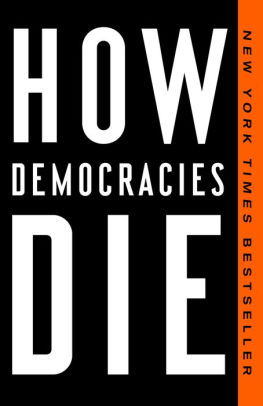
How Democracies Die

History tells us that individuals and nations often do not make good decisions and live to regret mistakes in judgment.  The election in Britain yesterday may be one such example as that nation appears hell bent now to leave the European Union thereby setting the stage from new efforts in Scotland to break away and perhaps even Northern Ireland to follow suit. England may revel in it xenophobia and go it along attitude now, but down the it may be a different tale.  History also tells us that democracies die often not just because of the rise of a strong man, but also because too many citizens and allow it to happen.  The end of democracies from as far back as the death of the Roman Republic also lays blame for the decline of democratic rule on politicians willing to sell their souls in order to cling to personal power - at least in the short term - with little or care for the nation's or their constituents long term future.  We are now witnessing such conduct by most elected Republicans in America. Like the English, many Americans may come to long regret their shortsightedness of today in the light of a far worse tomorrow.  A column in the New York Times makes this case and urges one to not give up the resistance.  Here are highlights:  
The despair felt by climate scientists and environmentalists watching helplessly as something precious and irreplaceable is destroyed is sometimes described as “climate grief.”
Lately, I think I’m experiencing democracy grief. For anyone who was, like me, born after the civil rights movement finally made democracy in America real, liberal democracy has always been part of the climate, as easy to take for granted as clean air or the changing of the seasons. When I contemplate the sort of illiberal oligarchy that would await my children should Donald Trump win another term, the scale of the loss feels so vast that I can barely process it.
After Trump’s election, a number of historians and political scientists rushed out with books explaining, as one title put it, “How Democracies Die.” In the years since, it’s breathtaking how much is dead already. Though the president will almost certainly be impeached for extorting Ukraine to aid his re-election, he is equally certain to be acquitted in the Senate, a tacit confirmation that he is, indeed, above the law. His attorney general is a shameless partisan enforcer. Professional civil servants are purged, replaced by apparatchiks. The courts are filling up with young, hard-right ideologues. One recently confirmed judge, 40-year-old Steven Menashi, has written approvingly of ethnonationalism.
In “How Democracies Die,” Professors Steven Levitsky and Daniel Ziblatt of Harvard describe how, in failing democracies, “the referees of the democratic game were brought over to the government’s side, providing the incumbent with both a shield against constitutional challenges and a powerful — and ‘legal’ — weapon with which to assault its opponents.” This is happening before our eyes.

In The Washington Post, Michael Gerson, a former speechwriter for George W. Bush and a Never Trump conservative, described his spiritual struggle against feelings of political desperation: “Sustaining this type of distressed uncertainty for long periods, I can attest, is like putting arsenic in your saltshaker.”
I reached out to a number of therapists, who said they’re seeing this politically induced misery in their patients. . . . . Karen Starr, a psychologist who practices in Manhattan and on Long Island, some of her patients were “in a state of alarm,” but that’s changed into “more of a chronic feeling that’s bordering on despair.” Among those most affected, she said, are the Holocaust survivors she sees. “It’s about this general feeling that the institutions that we rely on to protect us from a dangerous individual might fail,” she said.
Trump, she said, has made bigotry more open and acceptable, something her patients feel in their daily lives. “When you’re dealing with people of color’s mental health, systemic racism is a big part of that,” she said.
Obviously, this is hardly the first time that America has failed to live up to its ideals. But the ideals themselves used to be a nearly universal lodestar. The civil rights movement, and freedom movements that came after it, succeeded because the country could be shamed by the distance between its democratic promises and its reality. That is no longer true.
Democrats and anti-Trump Republicans are often incredulous seeing the party of Ronald Reagan allied with Vladimir Putin’s Russia, but the truth is, there’s no reason they should be in conflict. The enmity between America and Russia was ideological. First it was liberal democracy versus communism. Then it was liberal democracy versus authoritarian kleptocracy.
But Trump’s political movement is pro-authoritarian and pro-oligarch. It has no interest in preserving pluralism, free and fair elections or any version of the rule of law that applies to the powerful as well as the powerless. It’s contemptuous of the notion of America as a lofty idea rather than a blood-and-soil nation.
The nemeses of the Trumpist movement are liberals — in both the classical and American sense of the world — not America’s traditional geopolitical foes. This is something new in our lifetime.
Thus we have a total breakdown in epistemological solidarity. In the impeachment committee hearings, Republicans insist with a straight face that Trump was deeply concerned about corruption in Ukraine. Republican Senators like Ted Cruz of Texas, who is smart enough to know better, repeat Russian propaganda accusing Ukraine of interfering in the 2016 election. The Department of Justice’s Inspector General report refutes years of Republican deep state conspiracy theories about an F.B.I. plot to subvert Trump’s campaign, and it makes no difference whatsoever to the promoters of those theories, who pronounce themselves totally vindicated.
But despair is worth discussing, because it’s something that organizers and Democratic candidates should be addressing head on. Left to fester, it can lead to apathy and withdrawal. Channeled properly, it can fuel an uprising. I was relieved to hear that despite her sometimes overwhelming sense of civic sadness, Landsman’s activism hasn’t let up. She’s been spending a bit less than 20 hours a week on political organizing, and expects to go back to 40 or more after the holidays. “The only other option is to quit, and accept it, and I’m not ready to go there yet,” she said. Democracy grief isn’t like regular grief. Acceptance isn’t how you move on from it. Acceptance is itself a kind of death.
I for one will not quite.  I fear too much for the future of my children and grandchildren if Trumpism and Republican treason is left unopposed.  Thankfully, at least for the next two years, Virginia is poised to do its part to oppose Trump/Republican misrule.

Friday, January 04, 2019

American Exceptionalism Is a Dangerous Myth

As I have noted before, the myth of American exceptionalism is something that annoys me to no end and which continually prevents the United States from engaging in much needed soul searching about both its own history and what motivates foreign policy even today.  As lengthy a piece in New York Magazine notes, Donald Trump is revealing the self-centered ugliness of much of America's approach to other nations and his opponents need to not be blinded to the fact that self-interest and financial motivations have generally always been behind even America's altruistic policies. The Marshall Plan which helped rebuild Europe after WWII also ushered in a golden age of American manufacturing throough its reestablishment of markets for American companies.  As we go forward and the so-called Resistance tries to counter Trump's blatant selfish - and short sighted policies - and support the ideals of liberal democracies, they need to not be blinded to the reality of America's motivations, both past and present.  I don't say this to bash the United States but simply argue for recognizing reality.  Here are article highlights:
Donald Trump has done more to elevate the left’s critique of U.S. foreign policy than any politician in modern memory.
. . . . . [Trump] as a presidential candidate,. . . . .told Republican primary audiences that George W. Bush had lied the United States into Iraq; that said war had done a “tremendous disservice to humanity”; and that America could have saved countless lives by investing $5 trillion in domestic infrastructure instead. As commander-in-chief, Trump has suggested that there is no moral distinction between the U.S. and other great powers; that American foreign policy in the Middle East is largely dictated by the interests of arms manufacturers; and that the U.S. judges foreign regimes by their utility to American economic interests, not their commitment to human rights.
But if Trump’s descriptions of geopolitics echo Noam Chomsky, his prescriptions owe more to Attila the Hun. The president does see the invasion of Iraq as a criminal waste — but only because the U.S. failed to expropriate the region’s oil fields. He does imply that, in the eyes of the American state, Raytheon’s profits count more than journalists’ lives —but he sees that as a good thing. And when Trump suggests our country isn’t “so innocent,” he isn’t imploring neoconservatives to hold America to higher moral standards, but rather, to hold foreign autocrats to lower ones.
In other words, the Trump presidency can be read as an object lesson in the virtues of hypocrisy. Having a global hegemon that preaches human rights — while propping up dictators and incinerating schoolchildren — is bad. But having one that does those things while preaching nihilism is worse; not least because even a nominal commitment to liberal values can function as a constraint against their violation. Trump’s distaste for the whole “shining city on a hill” shtick has, among other things, enabled the Pentagon to tolerate higher levels of civilian casualties in the Middle East, the Israeli government to accelerate settlement expansion in the occupied West Bank, and the Saudi crown prince to take a bonesaw to international law.
It’s understandable, then, that many liberal intellectuals are eager to revive the national myths that Trump has busted. . . . . that compulsion is unfortunate; because it will be difficult for liberals to realize their vision for America’s exceptional future, if they refuse to grapple with its unexceptional past.
In the current issue of The Atlantic, former Hillary Clinton adviser Jake Sullivan presents one of the more compelling cases for making America exceptional again. Against Dick Cheney’s arrogant, unilateralist approach to world leadership — and Trump’s nihilistic disavowal of America’s international obligations — Sullivan offers a call for restoring the U.S. to its former role as a benevolent hegemon, one whose global supremacy is legitimated by its demonstrable commitment to spreading peace, democracy, and shared prosperity.
Crucially, Sullivan recognizes that this restoration is contingent on sweeping reform. He acknowledges that, in recent decades, U.S. foreign policy has often betrayed both its putative ideals and the concrete material interests of ordinary Americans — thereby inviting the cynicism of young idealists, and the xenophobic resentment of aging nationalists. Further, policymakers have habitually overreached militarily, while grossly underinvesting in cybersecurity, diplomacy, foreign aid, and other forms of soft power.
To rectify these errors, Sullivan argues that America should strive to build (and/or fortify) multilateral institutions of global governance; shape its geopolitical strategy around the interests of working people (by, among other things, cracking down on tax havens and international corruption); shift resources away from military pork and toward diplomacy, development, and technology; and exercise more humility when contemplating foreign intervention.
And yet, while Sullivan’s prescriptions for U.S. foreign policy are broadly consistent with those of progressive darlings like Elizabeth Warren and Bernie Sanders, his description of American grand strategy, pre-Trump, is as delusional as that of the median neoconservative.
Sullivan argues that the case for American leadership rests on the existence of American exceptionalism, which he defines as “the idea that the United States has a set of characteristics that gives it a unique capacity and responsibility to help make the world a better place.”
[T]he notion that the world’s wealthiest nation has an obligation to concern itself with the well-being of global humanity is self-evident. But whether America has proven itself uniquely qualified for this task is less clear.
Sullivan is no arrogant Chenyite; he acknowledges that the “story” of American exceptionalism is “incomplete.” There have always been “the mistakes, the complexities, the imperfections — things like covert regime change across Latin America, support for brutal dictators, the invasion of Iraq, and the tragedies (despite the best of intentions) of Somalia and Libya.”
In lieu of an explanation for how a great power uniquely committed to republican values came to organize so many authoritarian coups against republics, Sullivan offers a single quote from Reinhold Niebuhr: “Hypocrisy and pretension are the inevitable concomitants of the engagement between morals and politics.”
This is a means of evasion, not an argument. And it is utterly insufficient for countering the copious evidence disputing Sullivan’s narrative. For one thing, if Trump introduced zero-sum thinking into American grand strategy in 2016, how does one account for George Kennan’s authorship of the following quote, in a State Department “policy planning” document, circa 1948?
[W]e have about 50% of the world’s wealth but only 6.3% of its population. This disparity is particularly great as between ourselves and the peoples of Asia. In this situation, we cannot fail to be the object of envy and resentment. Our real task in the coming period is to devise a pattern of relationships which will permit us to maintain this position of disparity without positive detriment to our national security. To do so, we will have to dispense with all sentimentality and day-dreaming . . . .
The history of American foreign policy over the past seven. decades has been more consistent with Kennan’s summation of national purpose than Sullivan’s. More specifically, U.S. foreign policy has more consistently reflected the economic interests of American capital than it has the ideals of republicanism . . . . American exceptionalism is rooted in the improbable notion that the United States is uniquely unbeholden to the logic of power. [O]ur nation’s foreign policies are shaped, above all, by the material interests of those who enjoy the most power over our government. And let’s further stipulate that all American corporations, combined, invest more time and money into trying to influence public policy — and enjoy more intimate access to D.C. policy-makers — than do human-rights activists.
From these (highly plausible) premises, one would expect the U.S. to pursue a foreign policy that prioritizes the interests of corporate America over the promotion of democracy or human rights. Or, put differently: One would conclude that, in its glory days as “leader of the free world,” America’s primary beef with Communism wasn’t that it threatened the civil liberties of Eastern Europeans (or Southeast Asians, or Cubans), but rather, that it threatened the prerogatives of American capitalists.
It is much easier to reconcile the historical record with this theory, than with the opposite one.
Given the choice between supporting democratic governments that threaten the interests of major American corporations and investors — and authoritarian governments that don’t — the U.S. has almost invariably opted for the latter.
Acknowledging this reality does not require one to deny America’s various contributions to global well-being. It doesn’t even (necessarily) refute the notion that America has been a more benevolent hegemon than previous imperial powers. Our nation’s many crimes do not erase the past decades of peace in Europe, or poverty reduction in Asia. That American foreign policy is principally driven by corporate interests is not inconsistent with the idea that it has produced some positive-sum outcomes.
But the fact that American exceptionalism is a myth does have important implications for anyone who wishes to bend reality in its direction. Put simply, if one wishes to reform an institution, it’s best not to begin by wildly misconstruing how it works.
Sullivan’s call for reorienting U.S. foreign policy around the interests of working Americans is constructive. But his failure to recognize America’s unexceptional characteristics jeopardizes that project.
The exceptionalist narrative is most dangerous for the way it implies that assertions of American power on the world stage should be presumed well-intentioned, until proven otherwise. If the consensus view among liberal elites circa 2003 had been that American foreign policy is typically shaped by the mercenary interests of corporations (not least, arms manufacturers), they would likely have treated George W. Bush’s plans for Iraq with less credulity. Instead, in that instance (and many others), liberals championed a just, humanitarian intervention — only to find, to their shock and awe, that those prosecuting the war did not, in fact, have the purest of hearts.
[T]myth of American exceptionalism functions as rationale for the U.S. to subordinate international law to its own enlightened judgment.
Finally, the myth of American exceptionalism might do more to strengthen Trumpism than to undermine it. No small portion of our country’s xenophobia is informed by ubiquitous ignorance of our national sins. If one shares Sullivan’s faith in the beneficence of American global leadership, then it’s easy to conclude that Americans owe little to people in other countries. . . . . American exceptionalism suggests that the entire world owes a debt to the United States. Trumpism suggests the same — and then demands the world pay up.
Donald Trump has rebranded U.S. foreign policy in his image. Which is to say, he has put the ugliest possible face on American empire. For liberals, there is a strong temptation to call this hideous visage a mask; to insist that “this isn’t who we are.”
But it would be more accurate to say that this is who we’ve too often been. This hateful sociopath, immune to all human sentiments save fear and greed, devoid of all principles save a will to power, incapable of seeing the world from anyone’s perspective but his own — this is who we were to the peasants of Vietnam, and to the people of Jacobo Árbenz’s Guatemala, Salvador Allende’s Chile, Mohammad Mosaddegh’s Iran, João Goulart’s Brazil, and so many other fragile republics yearning to breathe free.
Trump’s great gift to the American people is that he has made our government’s ugliest features easier to see — and thus, to change. But if we respond by burying Uncle Sam’s deformities beneath the concealer of American exceptionalism, the change we make won’t even be skin deep.

Thursday, June 21, 2018

Why Trump’s Family-Separation Policy Failed


As the previous post noted, evil persists (i) when leaders and their supporters lack empathy for other humans regardless of their race or creed, (ii) a majority of the population is willing to rely on the so-called Nuremberg defense to shirk responsibility for their own actions or more on point, their failure to act.  The reversal of Der Trumpenführer's family separation policy demonstrates that while Trump, Pence, Sessions, Kirstjen Nielsen, Congressional Republicans, some 55% of Republicans, and many "Christian family values" groups have reached a moral depravity akin to that of Hitler's Germany, the majority of Americans - at least so far - have not thrown morality and decency aside.  The key going forward will to keep the majority united in opposing the evil that is Trump and Trumpism and in keeping a spotlight on the moral bankruptcy of Trump supporters who embraced the moral evil of the family separation policy.  A piece in New York Magazine looks at why Trump was forced to back down - for now, at least.  Here are article highlights:
[A] top aide to President Trump told Axios that he “doesn’t want to look weak” by abandoning his policy of family separation. Trump “feels boxed in, is frustrated and knows it’s bad politics — but also understands it’s not a fight he can back down from.”
But back down he did. In the face of overwhelming public pressure, Trump relented and agreed the policy his administration had deliberately engineered was a real policy, and that he could change it, and would.
Even a casual understanding of human psychology or American history would have made it patently obvious that the cruel method of terrorizing migrant families by wresting children from parents was bound to provoke a profound backlash. The prospect of losing a child is the most elemental fear any parent can imagine.
The willingness of Trump and his administration to plunge ahead anyway with a barbaric tactic is primarily a reflection of their moral emptiness. Homeland Security Secretary Kirstjen Nielsen reportedly opposed it in private, yet energetically obfuscated on its behalf in public. Why didn’t she resign in protest? Why hasn’t anybody?
The reversal also demonstrates the comprehensive failure of Trump’s immigration agenda. Trump is facing the inevitable dilemma of a populist leader: He was elected promising easy solutions, and is discovering none exist.
Trump’s internal assessment is, if anything, even more grim. “Over the past few months, Trump has called Nielsen and [Attorney General Jeff] Sessions to account as the number of immigrants flooding across the southern border has spiked. Arrests on the border nearly tripled year-over-year, rising to 40,344 this past May from 14,519 in May 2017,” reports Politico.
He subjected Nielsen to a tirade six weeks ago that lasted an incredible 30 minutes, and concerned the comprehensive failure of their efforts to control the border. Trump settled on family separation after every other method at his disposal collapsed. On the central policy promise he made, Trump is a flop, and he knows it.
The collapse revealed one more important thing: The power of mass revulsion. There are limits, after all, to what Trump can do without risking his patina of legitimacy as head of state. Outraged voters flooded Congress with calls, as they did to oppose the Republican plan to repeal Obamacare, and with the same success. Intense voter opposition matters.
It also matters when Laura Bush speaks out against him, and when Steve Schmidt resigns from the Republican party, and when American Airlines declares it won’t cooperate with the administration. It is a sign that the peripheral elements of Trump’s coalition have a breaking point, that while they can tolerate a great deal of sub-rosa venality, visceral outrages can create a dangerous reaction.
The damage of Trump’s horrific policy cannot be fully undone. But, in the face of his every instinct, Trump was forced to retreat. He didn’t want to look weak, but he does, because he is.


The resistance to Trump and Trumpism needs to continue and, if anything, intensify.  Giving Democrats control of the House of Representatives is the only guaranteed way to prevent future moral horros from being committed by a man who lacks any morals or decency. 

Tuesday, December 26, 2017

Hope for 2018 Despite Trump and an Annus Horribilis


The hypocrisy-filled Catholic Archbishop of Sydney, Australia, described 2017 as “annus horribilis” because of euthanasia laws in Victoria, the exposure of child sexual abuse in the Catholic church, and the legalization of same-sex marriage (for Fox News viewers, "annus horribilis" means horrible year.)  Here in America sane, rational and moral Americans likewise largely view 2017 as an annus horriblis thanks to Der Trumpenführer presence in the White House and a Republican controlled Congress that shows less spine and concern for American values of decency than the Roman senate under Augustus Caesar did for at least maintaining the traps of the Roman Republic.  Yet, despite the depressing year, there may be hope that America can clean its house and attempt to restore what has been lost.  A column in the New York Times looks at all the bad that has transpired but also why there is still cause for hope.  Once again, Virginia's election results are seen as one of the beacons of hope.  Here are column highlights:
Many of us came into 2017 expecting the worst. And in many ways, the worst is what we got.  Donald Trump has been every bit as horrible as one might have expected; he continues, day after day, to prove himself utterly unfit for office, morally and intellectually. And the Republican Party — including so-called moderates — turns out, if anything, to be even worse than one might have expected. At this point it’s evidently composed entirely of cynical apparatchiks, willing to sell out every principle — and every shred of their own dignity — as long as their donors get big tax cuts.
Meanwhile, conservative media have given up even the pretense of doing real reporting, and become blatant organs of ruling-party propaganda.
Yet I’m ending this year with a feeling of hope, because tens of millions of Americans have risen to the occasion. The U.S. may yet become another Turkey or Hungary — a state that preserves the forms of democracy but has become an authoritarian regime in practice. But it won’t happen as easily or as quickly as many of us had feared. 
Early this year the commentator David Frum warned that the slide into authoritarianism would be unstoppable “if people retreat into private life, if critics grow quieter, if cynicism becomes endemic.” But so far that hasn’t happened.
What we’ve seen instead is the emergence of a highly energized resistance. That resistance made itself visible literally the day after Trump took office, with the huge women’s marches that took place on Jan. 21, dwarfing the thin crowds at the inauguration. If American democracy survives this terrible episode, I vote that we make pink pussy hats the symbol of our delivery from evil.
And in case anyone wondered whether the vocal anti-Trump crowds and Trump’s hugely negative polling would translate into political action, a string of special elections — capped by a giant Democratic wave in Virginia and a stunning upset in Alabama — has put such doubts to rest.
Let’s be clear: America as we know it is still in mortal danger. Republicans still control all the levers of federal power, and never in the course of our nation’s history have we been ruled by people less trustworthy.
This obviously goes for Trump himself, who is clearly a dictator wannabe, with no respect whatsoever for democratic norms. But it also goes for Republicans in Congress, who have demonstrated again and again that they will do nothing to limit his actions.
The worse things look for Trump, the more closely Republicans tie themselves to him. . . . . And the growing evidence that the Trump campaign colluded with Russia doesn’t seem to have induced any prominent Republicans who weren’t already anti-Trump to take a stand. Instead, we’ve seen erstwhile critics like Lindsey Graham become obsequious toadies promoting Trump properties.  So we can’t count on the consciences of Republicans to protect us.
[A]s long as Republicans control Congress, constitutional checks and balances are effectively a dead letter.
So it’s going to be up to the American people. They may once again have to make themselves heard in the streets. They’ll certainly have to make their weight felt at the ballot box.  It’s going to be hard, because the game is definitely rigged. Remember, Trump lost the popular vote but ended up in the White House anyway, and the midterm elections will be anything but fair.
And even if voters rise up effectively against the awful people currently in power, we’ll be a long way from restoring basic American values. Our democracy needs two decent parties, and at this point the G.O.P. seems to be irretrievably corrupt. . . . it’s going to take a long struggle to turn ourselves back into the nation we were supposed to be. Yet I am, as I said, far more hopeful than I was a year ago. America is not yet lost.

Friday, November 24, 2017

Recommitting to Resisting Trump and All He Represents


With the holiday season upon us and "peace on earth and good will toward mankind" purportedly in the minds of most citizens, it is time to recommit to those values.  It is also time to recommit to resisting those who are anathema to such values.  In particular, it means recommitting to resisting the toxicity and indecency of the Trump/Pence regime and its Republican enablers and hate filled, Pharisee like evangelical Christian supporters.  A column in the New York Times looks at this need for re-commitment and reminds us of all that is abhorrent about the Trump/Pence regime.  Here are column highlights: 
Last Thanksgiving I wrote a column titled, “No, Trump, We Can’t Just Get Along,” in which I committed myself to resisting this travesty of a man, proclaiming, “I have not only an ethical and professional duty to call out how obscene your very existence is at the top of American government; I have a moral obligation to do so.”
I made this promise: “As long as there are ink and pixels, you will be the focus of my withering gaze.”  I have kept that promise, not because it was a personal challenge, but because this is a national crisis.
Donald Trump, I thought that your presidency would be a disaster. It’s worse than a disaster. I wasn’t sure that resistance to your weakening of the republic, your coarsening of the culture, your assault on truth and honesty, your erosion of our protocols, would feel as urgent today as it felt last year. But if anything, that resistance now feels more urgent.
Nothing about you has changed for the better. You are still a sexist, bigoted, bullying, self-important simpleton. But now all of the worst of you has the force of the American presidency.
The legitimacy of your presidency is in question. The corruption of your administration is not. You are a national stain and an international embarrassment. You are anti-intellectual and pro-impulse. The same fingers with which you compulsively tweet are dangerously close to the nuclear codes. You are historically unpopular and history will not be kind to you. It is all so dizzyingly distressing.
But what irks me most is your targeted attacks on historically marginalized populations as a political ploy to secure the support of the racists, misogynists and homophobes. . . . Your hostility toward minorities and your courting and coddling of the people who hate them has become a standard practice of your presidency.
We see it in the way that you attack N.F.L. players protesting police violence, while you encourage police officers to be more violent. We see this in the way that your Justice Department is moving to return to rigid, racially skewed drug policies that helped to fuel our unconscionable level of mass incarceration, a phenomenon Michelle Alexander calls “the new Jim Crow,” while also returning to a reliance on private prisons.
We see this in the devastating contrast between the ways you have talked about and treated hurricane victims in Texas versus in Puerto Rico.
Trump is clearly, blatantly, virulently hostile to people who are not white and non-Christian. That is not a statement of opinion, but a statement of demonstrated fact.
[I]t is Trump who is proving to be a threat to the L.G.B.T. community, particularly to transgender Americans, with his ban on trans people in the military, his rescinding of federal protections for trans students, and his Justice Department’s reversal of a policy protecting trans workers.
[T]he “Access Hollywood” tape was released on which Trump bragged about sexually assaulting women. And women came out in droves to personally accuse him of sexually inappropriate behavior, the kinds of accusations that people are now losing jobs over.
To add insult to injury, Trump the Groper has just thrown the weight and word of the presidency behind Roy Moore the Alleged Pedophile, choosing the claim of a single horrible man, even aside from the allegations, over nine women who seem to have nothing to gain by coming forward. Trump not only doesn’t respect women, he doesn’t even hear women.
This man is a pathological liar. He commends and conforms to anyone who pretends to love him, whether they are Russians or racists. He is inherently a patriarchal white supremacist and it seeps out in all sorts of ways, but it is most pronounced in the way that he attacks people who are not white and male. 
When you accept those truths, everything else makes sense. But accepting the truth is not the same as accepting the liar. Trump is unacceptable in every possible way, and must continue to be met at every turn with the strong arm of defiance. That is why today I recommit myself to resistance, and so should you.
And lest we forget the full Trump/Pence?GOP agenda, a second column reminds of the hideous aspects of that agenda.  Here's a short excerpt:
Meanwhile, everything this president and this Congress are doing on economic policy seems designed, not just to widen the gap between the wealthy and everyone else, but to lock in plutocrats’ advantages, making it easier to ensure that their heirs remain on top and the rest stay down.
It’s unclear whether the terrible tax bills being advanced by Trump and his allies will go through Congress; but environmental policy is largely set by administrative action, and this administration has been moving with stunning speed to get poisons back into our air and water. Not to mention the growing odds of climate catastrophe.
White supremacists are, of course, making a big comeback thanks to encouragement from the top. (They are, after all, “very fine people.”) So are anti-Semites, which is really no surprise to those who remember their history.
Even as old prejudices return, we’ve clearly entered a new age of politically potent anti-intellectualism. America built its world pre-eminence largely on the strength of its educational system. But according to Pew, 58 percent of Republicans now say that colleges and universities have a negative effect on the country, versus only 36 percent who see a positive effect.
And I don’t believe for a minute that this turn against education is a reaction to political correctness. It’s about the nasty habit scholarship has of telling you things you don’t want to hear, like the fact that climate change is real.
Finally, we’re now ruled by people who have no interest in letting hard thinking get in the way of whatever policies they want to follow. 

Wednesday, November 08, 2017

Trump and Trumpism Rejected in Virginia

I will admit that I am on a post election win high at the moment.  Last nigh's Democrat blow out victory has helped restore my faith in the decency of Americans - at least Virginians after a depressing year watching Donald Trump trash decency, wage war on LGBT citizens and strive to make the reprehensible normal.  Thankfully, Virginia rejected Trumpism and bitch slapped Republicans who for the most part have prostituted themselves to Trump and all but donned KKK robes as they sought to emulate his racism/hate and bigotry agenda.  A column in the Washington Post looks at the election aftermath.  It correctly notes that yesterday was a first step in taking America back from the forces of hate, division and bigotry.  Trump lost big time even though not on the ballot.  Here column are excerpts:
One year after President Trump rode a campaign of white nationalism into the White House, the American people struck back. Decisive Democratic wins for governor in New Jerseyand Virginia, not to mention the Democratic victories for lieutenant governor and attorney general, are a clear sign of the electorate’s disquiet with Trump’s low-road Twitter presidency.
But three other signs come to mind in the afterglow of Election Day 2017. Here are my quick thoughts.
Borrowing pages from Trump’s white-nationalist playbook will hurt you.
Nothing was more disturbing and degrading of the presidency than Trump’s both-sides nonsense in response to the ugly white supremacist rallies in Charlottesville, where Heather Heyer was allegedly killed by a racist who plowed his car into a crowd of counter-protesters. That Ed Gillespie adopted Trump’s rhetoric on monuments to Confederate generals and tried to scare voters with loose talk of Latino gangs clearly was a bridge too far the people of the commonwealth. 
No, Democrats don’t need to have a progressive, Bernie-anointed candidate to win.
Tom Perriello lost the primary to now-Governor-elect Ralph Northam, a centrist anchored in the establishment. Perriello was endorsed by Sen. Bernie Sanders, the Vermont independent who ran for president in the Democratic Party in 2016 but doesn’t see fit to join the party. But Perriello didn’t disappear. He worked hard on Northam’s behalf and not grudgingly. . . . Thus proving that a vanquished primary opponent who works hard to help his victor during the general election is essential.
The American people are not afraid of self-correction.
When the election was called for Northam, I was sitting in the same spot on my sofa where I watched in horror the dawn of Trump nation a year ago. The American people broke my heart that night. Everything that I knew to be true — hoped to be true — about my country was voided by voters who responded positively to the most racist, xenophobic and misogynistic campaign for president in recent memory. The fear his election unleashed was raw and palpable. But the ugliness and incompetence that followed Trump into the White House had an impact.
The Democratic gubernatorial victories in New Jersey and Virginia are the first sign of correction. Another is the successful run of Justin Fairfax, the newly-elected lieutenant governor of Virginia who will become only the second African American to win that seat. L. Douglas Wilder won the post in 1985. He went on to become the commonwealth’s and the nation’s first black governor. And yet another is the election of Danica Roem to the Virginia House of Delegates. She becomes the first openly transgender state legislator in the United States by defeating the homophobic and anti-transgender Republican incumbent Bob Marshall.
Zac Petkanas, former rapid response chief for Hillary Clinton’s presidential campaign, summed it up best in a tweet after the race was called for Northam. “The #resistance began on November 9, 2016,” he wrote. “The #revolution began tonight [Nov. 7].”
Onward to taking our country back from the marauding forces of division and hate in 2018. This is not over.


Thursday, May 11, 2017

Is It Time to Stop Being Polite And Start Raising Hell with Republicans


Many have argued that to succeed, Democrats must be polite and try to reason and "educate" Trump supporters.  Similarly, Democrats and anti-Trump forces are told to stop looking down on and being disdainful of Trump's racist and ignorant supporters.  I do not fully agree, or at least not insofar as it applies to Republicans and Republican staff and surrogates.  As my fellow LGBT blogger Michelangelo Signorile argues, it is time to go all out and raise Hell with Congressional Republicans and others who are protecting Trump and his corrupt and possibly treasonous regime.  It's time to make their lives Hell and pressure them relentlessly and make it clear that a majority of Americans do not support their Vichy France like conduct and their lies to protect a man who is nothing less than deplorable and unfit for the White House.    Here are highlights from Michelangelo's piece at HuffPost:  
Donald Trump made his most frightening authoritarian power grab yet in firing James Comey, the FBI director who was leading an investigation of his campaign’s possible collusion with Russia. 
This could be viewed as a direct step toward consolidating power and, yes, toward fascism, as we’ve seen play out in other countries ― in Turkey recently, and in many other countries in history from which you could choose as an example.
And Trump is only four months into his administration.
It’s time to move beyond polite protests within specified boundaries. It’s time to escalate the expression of our outrage and our anger in a massive way.
Starting today and from here on, no elected official ― certainly those in the GOP defending and supporting Trump on a variety of issues, for example ― should be able to sit down for a nice, quiet lunch or dinner in a Washington, DC eatery or even in their own homes. They should be hounded by protestors everywhere, especially in public ― in restaurants, in shopping centers, in their districts, and yes, on the public property outside their homes and apartments, in Washington and back in their home states. 
White House officials too ― those enabling the authoritarian ― need to be challenged everywhere, as do all those at the conservative think tanks who support Trump and those who publicly defend him in their columns and on television. 
The elected officials and White House staffers must be challenged going to and from their cars and at the many public speeches they give at organizations and think tanks throughout DC and elsewhere. They should be bombarded with questions and placards by groups of people as they head to media appearances at the cable networks where they spew their lies every day. And they should be challenged when they come off TV for what they just lied about.
These people also attend functions and fundraisers at night (which are easy to locate), and these events should be disrupted, inside and out, until these politicians answer to the recklessness in which they are engaged. Paul Ryan, the House Speaker, should not be able to attend any function, eat in public, or enjoy dinner at home without hearing people expressing how his actions are harming their lives and their families’ lives in terrible ways.
Donald Trump is not operating within boundaries ― nor is anyone who is enabling him. We must fight back with equal force. But let me be clear: I’m of course not calling for violence or any of the thuggish behavior of the Trump supporters during the campaign.
I’m calling for what ACT UP, the life-saving AIDS activist group with which I was involved, did in the ‘80s and ‘90s . . . You don’t need a large crowd, but you do need an idea that grips people, puts the target on notice, displays passion, makes a spectacle, and says, “No more business as usual.”
One of my old friends, Greg Gonsalves, wrote about how we need to “ACT UP To Stop Trumpcare.” After the Comey firing, we need to ACT UP against everything Trump, and against anyone enabling him.
Desperate times call for desperate measures, and for civil disobedience in the tradition of the civil rights movement. Democrats who don’t push hard should be targeted too. Right now, all business in the Senate should be made to stop immediately by Democrats, for example, until we have a special counsel in the Trump-Russia probe (which Democrats have called for). And we have to make them do it.
I’m imploring some in the Resistance to up the ante. Everything that’s already been undertaken ― the marches, the phone calls to Congress, the letter-writing, the protests, the town halls, putting up candidates for House races ― has been powerful and needs to continue. But it’s time to also be more forceful and more captivating.
The firing of Comey is an audacious turn toward fascism that must be stopped before it’s too late. We are now fighting for our lives as we know them. There’s no time to waste.


Wednesday, May 03, 2017

Historian: Almost Inevitable that Trump Will Attempt a Coup


Perhaps many of us are growing accustomed to the normalization of the reprehensible and destruction of political norms after 100 days of misrule by Der Trumpenführer, Reichsmarschall Pence, and his propaganda ministers.  As I speculated over the weekend, perhaps Trump lacks the self-discipline and consistent ideology to be another Adolph Hitler.  But one historian sees Trump as a continuing danger to American Democracy.  Timothy Snyder, a professor of history at Yale University, is the award-winning author of numerous books including the recent “Black Earth: The Holocaust as History and Warning,” “Bloodlands: Europe Between Hitler and Stalin,” and a new book, "On Tyranny: Twenty Lessons from the Twentieth Century.”  Snyder, in fact believes that Trump will attempt a coup as he finds himself unable to increase his popularity and unable to pass any meaningful legislation be it good, bad or indifferent.  A piece in Salon looks at why Snyder sees a continuing threat.   It also tells us that we must resist and not dive into the flow or become complacent.  Here are excerpts:
American democracy is in crisis. The election of Donald Trump feels like a state of emergency made normal.
Trump has threatened violence against his political enemies. He has made clear he does not believe in the norms and traditions of American democracy — unless they serve his interests. Trump and his advisers consider a free press to be enemies of his regime. Trump repeatedly lies and has a profoundly estranged relationship with empirical reality. He uses obvious and naked racism, nativism and bigotry to mobilize his voters and to disparage entire groups of people such as Latinos and Muslims.
Trump is threatening to eliminate an independent judiciary and wants to punish judges who dare to stand against his illegal and unconstitutional mandates. In what appears to be a violation of the emoluments clause of the Constitution, Trump is using the office of the presidency to enrich himself, his family and his inner circle by peddling influence and access to corporations, foreign countries and wealthy individuals.
How long does American democracy have before the poison that Donald Trump and the Republican Party injected into the country’s body politic becomes lethal?
Timothy Snyder, a professor of history at Yale University . . . . explores how the American people can fight back against Donald Trump’s incipient authoritarian regime.
The Greeks understood that democracy is likely to produce oligarchy because if you don’t have some mechanism to get inequality under control then people with the most money will likely take full control.
With Trump, one sees the new variant of this where a candidate can run by saying, “Look, we all know — wink, wink, nudge, nudge — that this isn’t really a democracy anymore.” He doesn’t use the words but basically says, “We all know this is really an oligarchy, so let me be your oligarch.” Although it’s nonsense and of course he’s a con man and will betray everyone, it makes sense only in this climate of inequality.
As I see it, there are certainly elements of his approach which are fascistic. The straight-on confrontation with the truth is at the center of the fascist worldview. The attempt to undo the Enlightenment as a way to undo institutions, that is fascism. . . . . Another thing that’s clearly fascist about Trump were the rallies. The way that he used the language, the blunt repetitions, the naming of the enemies, the physical removal of opponents from rallies, that was really, without exaggeration, just like the 1920s and the 1930s.
In your book you discuss the idea that Donald Trump will have his own version of Hitler’s Reichstag fire to expand his power and take full control of the government by declaring a state of emergency. How do you think that would play out?
Let me make just two points. The first is that I think it’s pretty much inevitable that they will try. The reason I think that is that the conventional ways of being popular are not working out for them. The conventional way to be popular or to be legitimate in this country is to have some policies, to grow your popularity ratings and to win some elections. I don’t think 2018 is looking very good for the Republicans along those conventional lines — not just because the president is historically unpopular. It’s also because neither the White House nor Congress have any policies which the majority of the public like.
Whether it works or not depends upon whether when something terrible happens to this country, we are aware that the main significance of it is whether or not we are going to be more or less free citizens in the future.
My gut feeling is that Trump and his administration will try and that it won’t work. Not so much because we are so great but because we have a little bit of time to prepare. I also think that there are enough people and enough agencies of the government who have also thought about this and would not necessarily go along.
The thing that matters the most is to realize that in moments like this your actions really do matter. It is ironic but in an authoritarian regime-change situation, the individual matters more than [in] a democracy. In an authoritarian regime change, at the beginning the individual has a special kind of power because the authoritarian regime depends on a certain kind of consent. Which means that if you are conscious of the moment that you are in, you can find the ways not to express your consent and you can also find the little ways to be a barrier. If enough people do that, it really can make a difference — but again only at the beginning.
You have to accept there is a time frame. Nobody can be sure how long this particular regime change with Trump will take, but there is a clock, and the clock really is ticking. It’s three years on the outside, but in more likelihood something like a year. In January 2018 we will probably have a pretty good idea which way this thing is going. It’s going to depend more on us than on them in the meantime. Once you get past a certain threshold, it starts to depend more on them than on us, and then things are much, much worse. It makes me sad to think how Americans would behave at that point.
Every day you don’t do something, it makes it less likely that you will ever do something. So you’ve got to get started right away. “On Tyranny” is a suggestion of things that everyone can do. There are plenty of other great ideas from people coming from other traditions, but the basic thing is you have to change your protocol of daily behavior now.
Don’t obey in advance because you have to start by orienting yourself against the general drift of things. If you can manage that, then the other lessons — such as supporting existing political and social institutions, supporting the truth and so on — those things will then come relatively easily if you can follow the first one, which is to get out of the drift, to recognize that this is the moment where you have to not behave as you did in October 2016. You have to set your own habits now.
I hope he's wrong, but I can all to easily see Trump using a national emergency real or manufactured - to seize power, mussel the media and curtail civil rights. 

Sunday, March 05, 2017

Has Trump Triggered A New Accidental Renaissance?


The reality is that Donald Trump received 46% of the votes of those who went out and voted on November 8, 2016.  Those voters represented 57.9% of eligible voters.  Do the math and the result is that Trump received votes from only 26.5% of the total electorate.  This is not a mandate and it surely does not equate to the earth moving as claimed by Der Trumpenführer and easily explains the low crowd turnout for the 2017 inauguration - an event that Trump likely viewed as his coronation.  The bottom line is that Trump is a minority backed president and that wittingly or not, he may be the catalyst needed to energize a great political renaissance where citizens once again realize that political engagement is a must and that complacency leads to horrific results.  A column in the New York Times looks at what might be the one bright spot in Trump's foul presidency.  Here are excerpts:
My friend Sam laughed when I told him I was going to spend my Saturday at a “Search for Meaning” festival at a Jesuit college in the heart of seriously secular Seattle. . . . all the keynote events at Seattle University were completely sold out. In the winter of the American soul, people thronged to hear advice on how to “live a life of significance and impact” and to “find meaning in times of change, challenge and chaos.”
I credit President Trump. Not because he seems any more evolved than the first earthworms now appearing in the cold soil of my garden. . . .  because the threats to truth, civility, rational thought and brotherly love coming from the White House have prompted a huge counterreaction.
It’s early, but we may be experiencing a great awakening for the humane values that are under siege by a dark-side presidency. People are going inward, to find something bigger than Trump, and outward, to limit the damage he inflicts on the country.
Trump has been good — indirectly — for a free press, an independent judiciary, high school civics, grass-roots political activity, cautionary tales in literature and theater, and spirituality. You don’t know what you’ve got, as the song says, till it’s gone — or nearly so.
Face it: We have become a lazy, aging, fairly ignorant democracy. Even in the most turbulent election in modern history, about 90 million eligible voters didn’t bother to cast a ballot — the basic task of citizenship. Trump took his 46 percent of those who did vote, many of whom believe fake-moon-landing-level lies, and has tried to act like the earth moved, as he said on Tuesday. It did, but not in the ways that he meant it.
It would be immodest, even overtly Trumpian, to boast about the huge circulation gains at the not-failing New York Times, or the robust support for our competitors, The Wall Street Journal and The Washington Post. But let’s just say having a man who told an average of four false or misleading statements a day for the first month of his presidency has been good for those the president calls enemies of the people.
The hottest book of the Trump era, George Orwell’s “1984,” is headed for Broadway. “The party told you to reject the evidence of your eyes and ears,” Orwell wrote, with chilling prescience. Also sailing out of bookstores: Sinclair Lewis’s “It Can’t Happen Here,” Ray Bradbury’s “Fahrenheit 451” and my personal favorite, Philip Roth’s “The Plot Against America.”
Trump fright has produced a deep dive into history. Millions now know that “enemy of the people” was a Soviet-era threat used by Stalinist thugs. And “America First,” Trump’s governing theme, was a slogan of Nazi sympathizers in the United States just before World War II.
Which brings us to civics. One of the great failures of late has been the diminishment of this vital owner’s manual for citizenship. Only 23 percent of eighth graders scored at or above proficiency in civics in a survey last year. Almost two-thirds of adults cannot name all three branches of government.
But now students are clamoring to talk about government and politics. The kids are demanding that their teachers do something to prevent another generation of politically illiterate citizens from coming of age. They are also marching in the street, along with their parents, who have already pulled off one of the largest political demonstrations in American history.
In stepping on American values, Trump has prompted people to find out more about those values, and ultimately to defend them. The high to his low is an unexpected renaissance.