Showing posts with label taking back America. Show all posts

Wednesday, August 14, 2019

Trump’s State-by-State Approval Ratings Look Good for Democrats

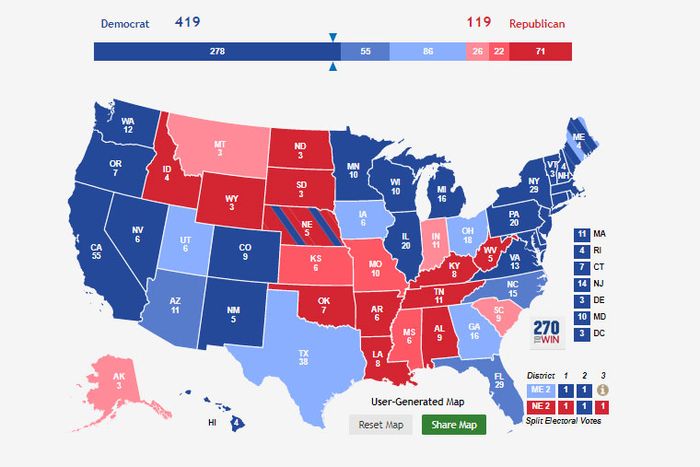
click image to enlarge.

Donald Trump's campaign strategy for 2020 of fanning hate and division, especial racial hate, in the hopes of mobilizing rural voters and non-college educated whites may not be playing out as planned based on new analysis of his state-by-state approval ratings. The picture looks very positive for Democrats and, if Trump were to fair as poorly as these analyses suggest, he could pull down with him many other Republican candidates. Here in Virginia, many hope the widespread anti-Trump feelings may be the added edge Democrats need to flip control of the Virginia General Assembly and thus flip the middle finger to Der Trumpenführer.  A piece in New York Magazine looks at the survey findings.  Here are highlights:
There has been a lot of discussion in political circles about Donald Trump’s job-approval ratings, what they portend, and Trump’s Electoral College strategy for 2020, which doesn’t necessarily require a popular-vote plurality. But in the end, of course, the conjunction of the Electoral College with Trump’s state-by-state popularity is where the deal will go down.
The online polling firm Civiqs has published a new set of state-by-state job-approval ratings for Trump as of August 11, and it shows how the president’s overall standing (a 43 percent approval rating nationally, which happens to match the current RealClearPolitics polling average) might translate into electorate votes. It’s not a pretty picture for the president, to put it mildly.
Civiqs shows [Trump's] the president’s net approval ratios being underwater (i.e., negative) in 10 states he carried in 2016: Arizona, Florida, Georgia, Iowa, Michigan, North Carolina, Ohio, Pennsylvania, Texas, and Wisconsin. If that were to represent how the 2020 elections turn out, Trump would have a booming 119 electoral votes.
He’s underwater by 12 points in Pennsylvania, 11 in Michigan, and nine in Arizona, North Carolina, and Wisconsin. And there’s virtually no indication that states that narrowly went for Clinton in 2016 are trending in Trump’s direction: His approval ratios are minus 18 in Colorado, minus 15 in Minnesota, minus 12 in Nevada, and minus 27 in New Hampshire. These are, by the way, polls of registered voters, not just “adults,” so they should be a relatively sound reflection of the views of the electorate.
[T]he other publicly available survey of state-by-state presidential job approval is from Morning Consult, and its latest numbers (as of July) are pretty similar. They show Georgia and Texas as positive for Trump, and North Carolina as very close. But all the other “battleground states” are quite the reach for the incumbent.
If you credit these polls at all, Trump’s reelection will require (1) a big late improvement in his approval ratings, which is possible but unlikely based on long-standing patterns during his polarizing presidency; (2) a campaign that succeeds in making the election turn on theoretical fears about his opponent rather than actual fears about a second Trump term, which won’t be easy either; (3) a big Republican turnout advantage, which is less likely among the larger presidential electorate than it was in 2018; or (4) some diabolical ability to thread the needle despite every contra
If anything, there’s evidence that he is likely to undershoot rather than overshoot his approval ratings as the sitting president of a country whose direction lacks any kind of public confidence. Beyond that, even those who succeed by selling their souls to the devil don’t have the collateral to pull that off twice.
One can only hope that these surveys prove accurate and that things only get worse for Trump and his fellow Republicans.

Sunday, January 22, 2017

Trump Attacks Women's March Participants


Still smarting from the low attendance turnout for his coronation inauguration, Der Fuhrer attacked those who participated in yesterday's Women's March.  The New York Daily News noted as follows:  
Trump, on his second full day in office, criticized the efforts of participants in Saturday’s Women’s March held in Washington, D.C.
“Watched protests yesterday but was under the impression that we just had an election!” Trump wrote on Twitter Sunday. “Why didn't these people vote? Celebs hurt cause badly.”
The White House – after remaining silent on the topic Saturday – released a statement earlier Sunday addressing the march, bemoaning the lack of attention surrounding the anti-abortion March for Life scheduled for Friday, Jan. 27.

A column in the Washington Post looks at the march and more importantly why the momentum must continue to fight and oppose every effort of Der Fuhrer and Congressional Republicans to roll back time and eliminate civil rights.  Here are excerpts:
Some descended on Washington’s Mall very early, and some joined later. Some stood in long lines outside Metro stations to get downtown. Others walked a long way.
The signs were almost all homemade. Many were clever, channeling humor and whimsy (“There will be hell toupee,” “Things are so bad even introverts have to protest”), as well as anger, determination and commitment.
And the crowd got so big that it broke into tributaries, marching in different directions. The tributaries eventually joined up to form a mighty stream of protest. No matter how much President Trump and his administration try to lie and spin, every objective indication is that far more people showed up to register dissent over his rise to power than to celebrate it.
It was a diverse crowd in many ways, more white than African American and Latino but with a fair representation across racial lines. It tilted young but included many among the middle-aged and the senior set. 
For many, it was a multi-generational day, a family affair: grandparents, parents and children, some in strollers. Women predominated, but a large minority was male, and a fair number of men carried signs suggesting, in various formulations, that real men, good men, supported the rights of their sisters and wives and mothers.
[I]t was at least as much a message to Trump and to the country: Less than 24 hours after the new president took the oath of office, hundreds of thousands of Americans came together to say that they would not stand by in silence if the new administration threatened basic freedoms or the advances of the past eight years, and the last 50.
The message of the Washington March was echoed by large crowds that gathered in cities and towns across the country. In their different ways, the marchers were saying that they would not be cowed into silence or demobilized into a sullen difference.
The anger and dismay over Trump was a dominant emotion, and judging by the signs, its sources were multiple: his attitude and behavior toward women especially, given the theme of the day, but also Russia’s role in the election and Trump’s bromance with Vladimir Putin.
There were loud calls for the defense of free speech and freedom generally. If Trump didn’t talk about freedom in his inaugural address, this crowd picked up the slack.
There was an acceptance of the reality that Trump is president but a stout rejection of who he is and what he stands for. That included expressions of a desire to drive him from office, with the inevitable breakout of “Hey hey, ho ho, Donald Trump has got to go” chants.
The politics of the next few months and years will depend a great deal on whether the energy displayed on Saturday is sustained through the hard work of political activism. I can imagine skeptics reading this and saying one day of protests will be very easy for Trump and the Republican Party to absorb (even if one can imagine Trump’s fury at not getting even a day’s peace).
But there is reason to believe this was not a one-off. First, there was not a single march in Washington but demonstrations all over the country. As the tea party showed, change comes from local actions coordinated nationally. There is clearly a large national base of opposition, community by community.
Second, the reaction to Trump is unprecedented. No other president faced such a wave of rallies immediately after he took office. No other president so quickly mobilized so many people against him. Trump really is special.
Third, the march here (and such evidence I have seen suggests this was true elsewhere) was strikingly nonsectarian. There were not people pushing very narrow ideological agendas or political subgroups insisting that they and only they had, in old left parlance, “the right line” on the future. Different parts of the anti-Trump coalition were generally happy to reinforce one another’s messages.
Finally, Trump’s election jarred many progressives and moderates from quiescence. If these marches were for women and against Trump, they were also marches against complacency. That may have been their most important message.


What I have found encouraging is that so many people I know who have not been political activists in the past turned out in March, including one of my sisters and both of my daughters.   The momentum must continue and Trump must be driven from office.