Showing posts with label employment discrimination. Show all posts

Saturday, January 25, 2020

LGBTQ Non-Discrimination Bill Advances in General Assembly

Like many LGBT Virginians I am watching the progress of bills in the Virginia General Assembly that would at long last end anti-LGBT discrimination and make me and others equal citizens under the law and protect us from being fired for who we are - something I suffered with devastating financial consequences.  As the Washington Post reports, legislation that would bar anti-LGBT discrimination in employment, housing, public accommodation, and credit applications is moving forward.  It's a bill Governor Northam has said he highly supports during personal conversations.  Sadly, most Virginia Republicans continue to support discrimination, most likely because they continue to prostitute themselves to hate groups like The Family Foundation (which in addition to being anti-LGBT has segregationist antecedents).  Here are article excerpts:  
A General Assembly subcommittee advanced a bill Thursday that would prevent discrimination on the basis of sexual orientation or gender identity in housing, public accommodations, employment and credit applications.
Lawmakers suggested expanding the focus of a bill introduced by Del. Delores McQuinn, D-Richmond, that would update the Virginia Fair Housing act to prevent discrimination on the basis of sexual orientation and gender identity in housing.
McQuinn’s bill was rolled into HB 1663, patroned by Del. Mark Sickles, D-Fairfax. Sickles’ bill, called the “Virginia Values Act,” includes additional protections against discrimination for LGBTQ Virginians in employment, public spaces and credit transactions and also outlines a process for civil action in a discrimination case.
The Virginia Fair Housing Law currently prevents housing discrimination on the basis of race, color, religion, national origin, sex, elderliness, familial status and disability. Sickles’ bill would add “pregnancy, childbirth or related medical conditions, marital status, sexual orientation, gender identity” or status as a veteran, to current law.
Equality Virginia, a group that advocates for LGBTQ equality, said the legislation is a step in the right direction and praised the delegates’ work.
“These protections are long overdue and an important step forward for Virginia’s LGBTQ community,” Vee Lamneck, executive director of Equality Virginia, said in a statement.
Similar bills have been introduced by both chambers in previous sessions. Though praised by the ACLU and LGBTQ advocacy groups, such bills passed the Senate with support from some Republican senators, but never could advance out of Republican-led House subcommittees.
Capital News Service reached out to Republicans who voted against previous legislation to gauge their support for the current bill, but none responded.
Sickles said in a statement that discrimination has no place in Virginia. “All Virginians deserve to be treated with dignity and respect, including LGBTQ people,” Sickles said.
Advocates expect HB 1663 to be heard in committee Tuesday. The companion bill sponsored by Sen. Adam Ebbin, D-Alexandria, is expected to be heard in a Senate committee the following day.
“In Virginia, although a gay couple can get married on Sunday, the sad reality is they can get fired on Monday, evicted on Tuesday morning and denied a hotel room Tuesday night,” Ebbin said in a press release. “This isn’t a theoretical issue, discrimination is happening today.”


Saturday, October 26, 2019

Neil Gorsuch Has Revealed Conservative Justices' Partisanship

Justices Gorsuch and Roberts.
Judges and Supreme Court Justices are supposed to base their rulings on the law, the Constitution and the facts yet increasingly we are witnessing the conservatives on the U.S.S Supreme Court and right wing Republican appointed judges - especially Trump appointees, a number of which have been rated as unfit by the American Bar Association - motivated by political ideology and partisan affiliation and even personal religious belief rather than basing rulings on the language of the Constitution, statutes and scientific and medical facts. In the recent oral arguments before the Supreme Court concerning whether LGBT Americans are protected by Title VII of the Civil Rights Act of 1964, Justice Gorsuch tipped his hand that he may be more worried by the reaction of the ugliest elements of the GOP base - think Christofascists and evangelicals - if the Court rules that it is illegal to discriminate against gays and transgender employees. Indeed, Gorsuch commented on potential "massive social upheaval" which suggests that had he been on the Court at the time of Brown v. Board of Education, we'd still have segregated schools.  A piece in The Advocate looks at Gorsuch's candid and dangerous agenda.  Here are excerpts:
As a frequent critic of the Supreme Court’s conservative majority and a long-standing activist for transgender rights, I am probably one of the few members of my community who feels grateful for Justice Neil Gorsuch’s acknowledgement that he fears extending employment non-discrimination protections to transgender Americans would unleash “massive social upheaval.” I found Justice Gorsuch’s remark — which many have interpreted as an indication that the Court may decline to protect transgender workers — to be refreshing for its honesty and transparency. If Gorsuch votes against extending protections, he acknowledged candidly, he would do so not on the basis of law, fairness, or judicial philosophy, but because of his assessment of public opinion, something Supreme Court justices rarely concede they take into consideration.
Integrity is obviously a crucial attribute of any judge, but has been sorely lacking in recent years among members of the Court’s conservative majority. To take an example I know well, earlier this year, a slim 5-4 majority accepted the Trump administration's false assertion that allowing transgender troops to serve posed a “risk to military effectiveness and lethality," thus allowing the president to reinstate the military’s transgender ban. But all service chiefs had testified that inclusive policy was a success, and the administration's claim about risk was based on medical arguments that the American Medical Association and former Military Surgeons General and U.S. Surgeons General had repudiated.
When a court’s rulings depend on the elision of fact, civil rights and even democracy itself can suffer, and the transgender military ruling, unfortunately, is far from exceptional. Critics have suggested that the Court’s most important decisions in recent years, including dismantling the Voting Rights Act and upholding the travel ban, have ignored key facts in service of partisan ends.
Given the conservative majority's arguably vexed relationship with evidence, Justice Gorsuch's integrity is admirable. But if his acknowledgment is refreshing for its candor, it is troubling at the same time, as the premise of his revelation — that a ruling extending protections would promote upheaval — has no basis in fact. Numerous polls confirm that the American public overwhelmingly supports extending non-discrimination protections to transgender employees. As a political science professor and LGBT advocate, I am unaware of any massive social upheaval in the 21 states whose laws explicitly protect transgender individuals . . . he is certainly entitled to his imagination. But his concerns have no basis in reality.
What likely worries Justice Gorsuch is that some conservatives believe that treating transgender employees equally violates their religious convictions. Setting aside that many evangelical Christians support employment non-discrimination for LGBT Americans, civil rights protected by laws and by the Constitution should not depend on the public’s comfort. Brown v. Board of Education, the 1954 ruling prohibiting states from establishing racial discrimination in public schools, led to social unrest. But it was unquestionably correctly decided. By revealing his concerns about social upheaval, Justice Gorsuch has given up the ghost on the conservative majority’s true partisan priority, whether the Court thinks the GOP’s base will like a decision. That is dangerous partisanship that has no place on the bench.
[I]t is ethically unacceptable to prioritize the religious injury that some employers might believe themselves to suffer if forced to treat transgender workers equally with the tangible injury that transgender employees suffer when they are denied employment on the basis of their gender identity. Some employers surely believe that they compromise their religious convictions when they are forced to treat women, racial minorities, and Muslims equally, but catering to such beliefs would be immoral. Whether one interprets religious objections to treating transgender employees equally as unreasonable animus or reasonable religious belief, there is no comparison between such objections and the consequences of being fired. That Gorsuch and his conservative colleagues on the bench would entertain the comparison is, at best, problematic.
Justice Gorsuch’s concern is even at odds with his judicial philosophy. Gorsuch professes a commitment to “textualism,” . . . . that explicitly disavows any concern for public opinion.
Eve Sedgwick, had an insightful reading of Justice Byron White's opinion in Bowers v. Hardwick—the now-overturned 1986 case that allowed states to criminalize same-sex sex: She demonstrated that White’s ruling against gays and lesbians depended on a refusal to recognize hard facts, a maneuver she labeled as "willful ignorance." According to Sedgwick, White's sidestepping of evidence he did not like was a “contemptuous demonstration that powerful people don't have to be acute or right."
Gorsuch’s stated concern about “massive social upheaval” smacks of the same conceit. As conservative jurists twist facts to sustain partisan rulings that injure everyday Americans, progressives are becoming increasingly vocal about the possible need for judicial reform. Hopefully, Justice Gorsuch and his colleagues will heed such warnings before driving the Court and the democracy itself off a cliff.

Wednesday, October 09, 2019

LGBT Americans Again Wait to See If They Are Equal Under the Law

In the eighteen years since I first admitted to myself and others that I am gay - have always been gay, despite decades of strenuous attempts to "pray away the gay" - I and others in the LGBT community have had to wait and worry for the courts and legislatures to rule or legislate that we are equal under the law and not condemned to an inferior status because of what ultimately is religious based discrimination nowadays principally championed by far right Christians at least in America.  First we watched and worried at how the Supreme Court would rule in Lawrence v. Texas in 2003 which ultimately struck down the sodomy laws in Texas, Virginia and eleven other states.  Until that ruling, gays faced possible felony convictions even for relations with those of the same gender even in the privacy of their own homes.  

Later, we watched to see if Congress would strike down Don't Ask, Don't Tell which made life a living hell for thousands of honorable and decent LGBT members in the nation's military.  I and many others in the LGBT community have friends who were forced out of the military because of this policy that, once again, had its basis in religious based bigotry that had nothing to do with one's ability to serve and lead.  Look no farther than Alexander the Great, the Sacred Band of Thebes, or America  Revolutionary War leader General Friedrich Wilhelm August Heinrich Ferdinand Steuben, also referred to as Baron von Steuben, to prove the lie of Christofascists arguments.

More recently, in 2014 and 2015, we watched and waited to see how the courts would rule on same sex marriage - the husband and I traveled to the District of Columbia to marry before the 4th Circuit struck down Virginia's ban - with the Supreme Court finally making same sex marriage a reality in the Obergefell ruling in June, 2015.  

Through out this slow process, here in Virginia and many other states (thanks to Republican legislators), LGBT citizens have been unprotected from being fired for being gay - something I know about first hand after being forced from a law firm for being gay.  I was told a gay partner would "offend the sensibilities of the firm's conservative clients."  I have never fully recovered from the financial ruin that firing triggered.  While I now work at a firm that cares nothing about me being gay, thousands of gays are not so lucky.  Now, we in the LGBT community again wait to see if the Supreme Court will grant us equality and equal protection under the nation's non-discrimination laws.  With that Court now in the grips of right wing justices, the verdict is anything but certain as a piece in The Atlantic notes.  Here are article highlights: 
A skydiving instructor in New York, a funeral-home director in Michigan, a child-welfare advocate in Georgia: Donald Zarda, Aimee Stephens, and Gerald Lynn Bostock are three people who seemingly have little in common, save for one extraordinary fact. Each claims to have been fired because they are gay or transgender, and all three will argue their cases before the U.S. Supreme Court this week.
The Court will decide whether existing federal civil-rights law protects millions of LGBTQ people from discrimination in the workplace, potentially clearing the way for new challenges across the legal system. But more important, the Court’s ruling will be a powerful symbol of the status of LGBTQ rights in America today. Faced with the legal mess America left behind when it moved on from its gay-rights moment following the legalization of same-sex marriage in Obergefell v. Hodges in 2015, the justices will decide whether the law actually reflects a culture that is radically more accepting than it was even a few years ago.
All three of the alleged wrongful-termination cases hinge on one word: sex. Under Title VII of the Civil Rights Act of 1964, employers cannot fire, refuse to hire, or otherwise penalize people because of their sex.
[T]he Court has long ruled that sex discrimination includes sex stereotyping, or generalizations about how a person should act or dress based on societal norms for men and women. In 1989, this was the basis of a major victory for a woman named Ann Hopkins, who sued her employer, the accounting firm then known as Price Waterhouse, for telling her she needed to wear makeup and otherwise play up her feminine charms to get promoted to partner. Over the past 30 years, LGBTQ advocates have argued that sex stereotyping is also what drives employers to discriminate against people who are lesbian, gay, bisexual, and transgender, believing LGBTQ people fail to meet society’s standards for how men and women should act.
But Katie Eyer, a law professor at Rutgers University, doesn’t think the Supreme Court’s decision in these cases will necessarily follow clear ideological lines. “I really do think this is a case in which people’s intuitions” about the justices’ ideology “are butting up against the methodological commitments of those same justices,” she told me.
The possibility for a surprise outcome, Eyer said, lies in the influence of textualism, the legal theory that guides certain conservative justices. While some scholars, such as Epstein, argue that Title VII should not cover LGBTQ people because Congress never meant for it to do so, “the basic premise of textualism is that we have to have our legal decisions controlled by the words that Congress used rather than any sort of subjective sense of what Congress intended,”
Eyer said. She believes the meaning of sex plainly includes expressions of gender and sexuality, and that at least one conservative justice might agree. As evidence, she cited the Court’s unanimous 1998 decision in Oncale v. Sundowner Offshore Services, Inc., in favor of a man, Joseph Oncale, who was sexually harassed by other men who worked with him on an oil rig in the Gulf of Mexico. The author of that decision was none other than the Court’s foremost champion of textualism, Antonin Scalia, who was replaced by an ardent admirer of his and who is also a committed textualist: Neil Gorsuch.
No matter what the Court decides, these cases will likely prompt a renewed push for federal legislation that clearly spells out Congress’s position on LGBTQ discrimination. Versions of this kind of bill have bounced around Congress for decades, but have always failed to pass, which Harper has called “shocking and appalling.” The latest iteration, called the Equality Act, easily passed in the House of Representatives this spring, but was essentially dead on arrival in the Senate. If the Supreme Court rules that Title VII does not currently bar employment discrimination based on sexual orientation and gender identity, Congress will be LGBTQ advocates’ last hope for protections.
On the other hand, if the Supreme Court rules in favor of the LGBTQ-rights argument, conservatives will likely race to protect religious institutions that fear they will be forced to comply with hiring standards that violate their teachings on gender and sexuality. Many LGBTQ advocates want to see their rights protected with explicit legislation, no matter what: It would send a “moral message,” Eyer said. “There is value to having Congress enact a law that says, explicitly, ‘This is a form of discrimination that we value—quite apart from sex discrimination—that we think should not exist in the workplace.’”
Ultimately, these cases are most significant because of their moral symbolism: While relatively few people end up suing their employers in federal court, laws help set norms about who is valued and protected in the United States. “Nobody wants the lawsuit,” Eyer said. “What they want is not to have experienced discrimination or harassment to begin with.”
Just a few years ago, a Supreme Court with a very different ideological makeup handed down a landmark ruling in Obergefell, establishing the right for all Americans to marry. That decision left many legal issues unresolved, however, including questions about LGBTQ discrimination. As it stands now, the Court may not be inclined to continue on its recent path of affirming LGBTQ rights.
Whatever it decides, however, America has fundamentally changed. The judgment of nine Supreme Court justices matters. But LGBTQ Americans are working toward something larger: acceptance.
I dream of a day when LGBT citizens are fully equal with everyone else under the law.  


Saturday, August 24, 2019

Trump Admin to Supreme Court: Allow Gays to Be Fired

I have written about the Trump/Pence regime's war against LGBT Americans before for the simple reason that it is never ending. Yesterday, the Trump Department of Justice filed a brief asking the U.S. Supreme Court to rule that none of the nation's non-discrimination laws protect LGBT individuals from being summarily fired simply because of who they are. One motivation for the regime is to thrill Christofascists - who are near orgasmic whenever Trump/Pence harms gays - to keep them loyal.  Another, in my view, is Pence's deep internalized homophobia that causes him to seek to inflict harm on other gays (Pence, in my view, bears all the hallmarks of a closeted gay like former Virginia Congressman Ed Schrock who I helped "out" over a decade ago).  This is an issue I am passionate about, having been forced from a law firm for being gay.  The financial and emotional harm was horrific and lead to two suicide attempts. Despite a job that has me making good money again, I will never be in the place I would have been but for being a target of anti-gay bigotry.  Should the Trump/Pence regime argument prevail, countless LGBT individuals will either suffer being fired or be forced to remain closeted at work, a truly stressful experience that harms both productivity and one's emotional health.  Here are highlights from The Advocate's review of Trump/Pence's latest assault against gay Americans:

As expected, Donald Trump’s administration has filed a brief with the Supreme Court urging the justices to rule that it’s legal to fire workers because of their sexual orientation.
The administration made the same argument last week regarding gender identity as the court prepares to hear cases October 8 involving employment discrimination against gay and transgender people.
That day the court will hear a consolidated case involving two incidents where workers say they were fired for being gay; one was a skydiving instructor in New York and the other a social worker in Georgia. It will also hear a case regarding a Michigan funeral director fired after her gender transition.
The cases turn on whether Title VII of the Civil Rights Act of 1964, which forbids sex discrimination, also applies to discrimination based on sexual orientation and gender identity. In the New York and Michigan cases, federal appeals courts ruled that it does, but in the Georgia case, the appeals court ruled that it does not.
Solicitor General Noel Francisco, whose position is part of the Department of Justice, today filed a friend-of-the-court brief arguing that it most definitely does not, . . . Lawyers and judges have contended that it’s reasonable to interpret a law banning sex discrimination as also banning sexual orientation discrimination — if a man who is attracted to men is treated differently from a woman attracted to men, it’s discrimination. 
Francisco’s latest brief echoes the language of the one he filed last week in the transgender case.
Last week’s was not a friend-of-the-court brief; it was filed because the federal government is a party to the case, with the Equal Employment Opportunity Commission having taken up the case of Michigan funeral director Aimee Stephens. (The Trump administration has now ordered the EEOC, a quasi-independent federal agency, to cease defending the rights of trans people.) Friend-of-the-court briefs are filed by individuals and organizations that are not directly involved in a case but have an interest in its outcome.
“The friend-of-the-court brief — which was completely voluntary — was among several filed this week urging the Supreme Court to rule anti-gay discrimination is permitted under federal law,” the Blade notes. “Other briefs include filings from the U.S. Conference of Catholic Bishops and the Alabama-based Foundation for Moral Law, which has ties to anti-LGBT Senate candidate Roy Moore.”
Not all Republicans endorse the administration’s position, however. A group of prominent Republicans, although not including any current officeholders, filed a friend-of-the-court brief in the upcoming cases to argue that Title VII indeed covers discrimination based on sexual orientation and gender identity. Physicians, clergy members, major businesses, and more have filed similar briefs.
But the administration’s stance belies Trump’s recent assertion that he’s “done very well” by LGBTQ people. It’s part of a pattern of endorsing discrimination, with the transgender military ban, revocation of trans-inclusive guidelines for public schools, and support for health care providers’ and federal contractors’ right to discriminate against anyone who offends their religious beliefs.
“This is the Trump Administration’s 124th attack on LGBTQ people since taking office and they join Roy Moore in opposition to workplace protections for LGBTQ people,” said a statement released by GLAAD.  A ruling in the discrimination cases is expected by next June.

Monday, August 19, 2019

The Unfinished Struggle for Gay Rights

Here in Virginia LGBT citizens can be fired for being LGBT and can face fully legal discrimination in housing.  Meanwhile, poll after poll reveals - both in Virginia and across America - most Americans believe that anti-LGBT discrimination is illegal even as the Trump/Pence regimes works to convince a rightward leaning U.S. Supreme Court that anti-LGBT discrimination should be fully legal and outside the protections of existing civil rights laws. In Virginia in November, 2019, the state of affairs can change if control of the Virginia General Assembly shifts to Democrats and Republicans are voted out of a majority in the Virginia Senate and House of Delegates.  In 2020, the same opportunity for change exists if (i) Trump is not re-elected, and (ii) Republicans lose control of the U.S. Senate. A piece in The Atlantic looks at the unfinished work to be done in the area of LGBT rights and the mess that exists in a majority of states where gays can marry on the weekend and be fired on Monday for being gay.  

To me, the ultimate irony is that civil rights laws are supposed to protect against immutable characteristics such as skin color, country of one's birth, age, sex.  Medical and medical health knowledge tells us that sexual orientation cannot be changed - despite the lies disseminated by Christofascist proponents of "conversion therapy."  Indeed, of currently protected categories, only one is NOT immutable: religion.  People can and do change religious affiliation all the time while others leave it entirely based on things ranging from Christian hypocrisy to the reality that neither science nor historical evidence confirm the gospel narratives.  If any category deserves not non-discrimination protection, it is religion. embracing myths and ignorance is a choice. One's sexual orientation is not. The Equality Act passed by the House of Representatives which contains no religious exemptions recognizes this simple reality. Here are article highlights:
Roughly half of Americans think federal law bans discrimination on the basis of sexual orientation. Despite four years of nationwide same-sex marriage, despite rapidly growing cultural acceptance for LGBTQ people, despite extensive annual Pride celebrations—these Americans are wrong. Now that all of this summer’s glitter floats have been dismantled and the rainbow confetti has been cleared, lawyers, legislators, and judges have turned back to the ongoing fight over whether federal law does, and should, specifically protect LGBTQ people from being fired, denied a rental lease, or refused service because of their sexual orientation or gender identity.
 This year will mark several important milestones in the battle over LGBTQ discrimination. In the spring, the House of Representatives passed the Equality Act, a sweeping bill that would prohibit anti-LGBTQ discrimination in all aspects of public and commercial life, without any religious exemptions. While the bill has basically no chance of gaining traction in this Senate, if Democrats sweep Congress in 2020, it will likely be high on the party’s priority list. In the fall, the Supreme Court will hear arguments in the case R. G. & G. R. Harris Funeral Homes v. EEOC & Aimee Stephens, about a former funeral director who was fired after coming out to her employer as transgender. The justices will consider whether existing workplace protections in Title VII of the Civil Rights Act of 1964 already cover discrimination on the basis of gender identity.
And yet, the legal status of LGBTQ rights remains murky. As the movement has gained cultural momentum, activists have largely moved away from a posture of compromise—they believe they can win full protections for LGBTQ people in any context, without exceptions. A small but significant group of conservative religious leaders has been working the middle ground, trying to build support for a bill that would protect LGBTQ people but leave space for institutions, such as Christian colleges and Catholic hospitals, to operate according to their religious teachings. But they’ve faced resistance from their right, with prominent pastors and conservative legal groups opposed to any kind of bill that would mark sexual orientation and gender identity as special legal categories.
As America has largely moved on from its gay-rights moment, with many Americans believing everything got taken care of with same-sex marriage, legal advocates on both sides have been left with bitter disagreements about where the country should go next—and the possibility that the status quo will perpetually remain in place.
[Lying and dishonest] Conservative advocates argue that LGBTQ people face little to no discrimination, and that their identities have been normalized . . . . Ask LGBTQ people themselves, however, and they consistently see discrimination in their daily lives: A recent study from the Williams Institute at UCLA found that lesbian, gay, and bisexual people reported much higher rates of being bullied, fired, or denied a job, promotion, or lease compared with heterosexual people. Still, these experiences can be subtle or hard to document. And the incentives for bringing a formal, legal complaint vary wildly, depending on where someone lives: 20 states fully prohibit discrimination based on sexual orientation and gender identity, while 28 states don’t. “Because it doesn’t look just like Jim Crow,” said Doug NeJaime, a law professor at Yale University who focuses on LGBTQ legal issues, conservatives argue that “it then doesn’t merit attention.” But, he said, “there’s lots of reasons why discrimination against LGBT people looks different than other forms of discrimination … [That] doesn’t mean it’s not discrimination that needs to be remedied.”
In the past 30 years, the Supreme Court has ruled sex stereotyping illegal; declared sodomy bans unconstitutional; struck down state measures blocking civil-rights protections for gays, lesbians, and bisexuals; and, of course, legalized same-sex marriage in all 50 states. But even as the inevitability of legalized gay marriage was becoming clear in the early 2010s, “the narrative really began to take hold that you could be married on Sunday and fired on Monday and lose your housing on Tuesday,”. . . . This question has been particularly fraught for transgender people, such as the plaintiff who will go before the Supreme Court this fall. Ironically, as LGBTQ rights have expanded, it has become harder for advocates to make their case to the public. Before the Supreme Court legalized gay marriage, “people could see very clearly the fact that same-sex couples couldn’t get married,” McBride said. “People have a more difficult time understanding the way civil rights work in our country, the absence of protections.” The movement has also developed powerful allies from Wall Street to Hollywood, and those alliances have been used against advocates. . . . “The irony about antidiscrimination laws is: Vulnerable groups don’t get protected until they’re actually … [able to] muster the political power to gain momentum.”
Still, that momentum has redoubled the resolve of LGBTQ activists. Maybe they won’t win at the Supreme Court this time, or get nondiscrimination legislation passed through this Congress. But, they believe, theirs is a cause of progress. They will eventually win it all.
And that has left a number of their opponents very, very nervous.
When the Equality Act passed in the U.S. House of Representatives this spring, there were no amendments on the floor—it was just an up or down vote. . . . The legislation won the vote of every Democrat in the House who participated in the roll call, along with eight Republicans—a clear sign of its broad support. The bill also sent another message: The days of compromise are over.
In recent years, claims of LGBTQ rights have been repeatedly brought into direct conflict with claims of religious conscience. Just this week, the Trump administration proposed a new rule that would allow federal contractors to make hiring and firing decisions based on their religious beliefs and practices; progressive advocates believe the rule will be used to target LGBTQ people.
The Equality Act specifically bars any group from using the Religious Freedom Restoration Act, known as RFRA, to try to opt out of the bill’s protections.
For religious groups and institutions that teach that homosexuality is a sin, and that men and women were created as such by God, the prospect of this kind of legislation is worrying. “It would be years of litigation . . . Hoogstra has been part of a coalition pushing an alternative to the Equality Act called Fairness for All. Her organization, along with groups such as the Church of Jesus Christ of Latter-day Saints and the Seventh-day Adventists, believes federal LGBTQ discrimination protections are inevitable—the Equality Act’s passage “was a proof point,” Hoogstra said. They want the final law, whenever it passes, to reflect their needs. . . much like exceptions that were written into parts of the original Civil Rights Act of 1964, which outlawed discrimination based on race, color, religion, sex, or national origin.
When the evangelical World Magazine broke the news that the CCCU and the National Association of Evangelicals (NAE), which claims to represent roughly 45,000 churches, had voted to support the Fairness for All effort, a prominent group of conservative religious leaders signed a letter of condemnation. . . . The signers included Franklin Graham, the evangelist Billy Graham’s son, who has been known to make inflammatory comments about homosexuality; but also Russell Moore, the head of the Southern Baptist Convention’s political arm, who is often seen as a moderating voice in the evangelical world.
If the Democrats make a full electoral sweep in 2020, holding on to the House, taking back the Senate, and winning the White House, it seems likely that the Equality Act will be on their agenda—and it’s unlikely the party’s leadership will be open to finding a middle ground. Meanwhile, the groups totally opposed to this kind of legislation are preparing for legal war.
The story of the LGBTQ movement has lately been one of triumph, but it’s not clear whether that will continue. Graham, of Georgia Equality, told me he believes some kind of federal legislation will eventually protect LGBTQ people from discrimination, “but I’m not optimistic that it will happen quickly,” he added. In this political environment, the possibility of moderation and dialogue seems almost antiquated. “It really feels,” he said, “like everything is a battle for the soul of the nation.”
My take away?  If one is LGBT or has family members or friends who are LGBT allies, the course of action is simple: vote a straight Democrat ticket in Virginia in 2019 and in the 2020 federal elections.  Religious based bigotry and ignorance has harmed lives for centuries.  It's time to make it illegal. 

Saturday, August 17, 2019

Trump Regime Asks SCOTUS To Legalize Firing People For Being Transgender


Just when one thinks the Trump/Pence regime cannot get any more hostile to the rights - indeed the very existence of - LGBT Americans, another shoe drops and it becomes clear that until gays, lesbians and the transgender in particular disappear from public view, the relentless attacks will only intensify.  Pence is hysterically anti-gay in the typical mold of a likely self-loathing closeted gay.  What Trump actually believes is unclear since his main quest is to thrill Christofascists and maintain his support among anti-modernity, knuckle dragging evangelicals. While evangelicals remain rabidly anti-gay, it is transgender individuals who most garner their open hatred, in my view, because they most challenge evangelicals 12th century views on sex and sexuality.  Therefore, they must be destroyed or at least driven from public view.  Playing to this animus, yesterday, the Trump/Pence regime filed a brief with the U. S. Supreme Court that argues that transgender individuals have zero non-discrimination protections.  A piece in BuzzFeed looks at the filing.  Here are highlights:  
The Trump administration on Friday took one of its most aggressive steps yet to legalize anti-transgender discrimination by telling the Supreme Court that federal law allows firing workers solely for being transgender, arguing a Michigan funeral home could fire a transgender woman because she wanted to wear women’s clothing on the job.
Although the administration was expected to take the stance — and had previously said firing workers on the basis of gender identity is legal under federal law — the latest court filing asks the nation’s top court to establish federal case law in a potentially sweeping setback for LGBTQ rights nationwide.
The case is a dispute over the word “sex.” Title VII of the Civil Rights Act of 1964 bans workplace discrimination because of sex, but the court’s justices have never decided what, precisely, the term means for LGBTQ workers.
The Justice Department’s brief on Friday contends the word refers to a person’s “biological sex” and, further, that transgender discrimination isn’t addressed by a 1989 Supreme Court ruling that found Title VII bans sex stereotyping.
“Title VII does not prohibit discrimination against transgender persons based on their transgender status,” says a filing by the Justice Department . . . Rather, the administration contends, “Title VII prohibits treating an individual less favorably than similarly situated individuals of the opposite sex.”
A Supreme Court ruling in favor of the administration’s position could set off cascading ramifications for LGBTQ Americans by asserting that laws banning sex-based discrimination must be construed narrowly, and it would have no application for sexual orientation or gender identity — a decision that would likely overflow far beyond workplaces.
No federal law explicitly bans anti-LGBTQ discrimination, but the term “sex” appears in countless state and federal laws, and various policies, that ban discrimination. They have often been used by courts and agencies to protect LGBTQ people in a range of settings — from jobs and schools to doctor’s offices — and a Supreme Court ruling that finds sex absolutely does not protect LGBTQ people could unravel previous court rulings and narrow the meaning of policies.
The administration’s argument against LGBTQ rights matches the advocacy of conservative Christian groups, which claim Congress only intended to ban discrimination because someone is male or female . . . .
The counterargument from LGBTQ advocates and several lower courts, however, is that the intent of lawmakers does not limit a law’s reach, but rather its meaning is defined by the statute’s plain text. They say anti-transgender discrimination can result from a person defying traditional sex stereotypes or because the person transitioned from one sex to another — and thus, it is inherently a type of sex discrimination.
The case at issue is one of three currently before the court about the rights of LGBTQ workers under Title VII — and the only one concerning a transgender worker.
Aimee Stephens had presented as a man when she started her job in 2007 at R.G. & G.R. Harris Funeral Homes in Michigan. Six years later, after Stephens announced plans to transition to a woman, the owner, Thomas Rost, fired her.
In siding with Stephens last year, a 49-page opinion led by Judge Karen Nelson Moore at the Court of Appeals for the 6th Circuit found that “The unrefuted facts show that the Funeral Home fired Stephens because she refused to abide by her employer’s stereotypical conception of her sex.”
But the Justice Department counters that when the Civil Rights Act passed in 1964, “the ordinary public meaning of ‘sex’ was biological sex. . . . In Stephens’ case, this means government lawyers now say it was legal to fire her — thereby holding the opposite position as the EEOC even though it is representing the EEOC. As such, it says the 6th Circuit ruling should also be reversed.
Represented by the Christian conservative group Alliance Defending Freedom, the funeral home filed a separate brief, filed Friday, that portrays the case as a fight over the essence of gender norms in society, playing off fears stoked by conservatives about transgender people preying on women in bathrooms.
There are ZERO cases of transgender people preying on women.  The same cannot be said for numerous Republican office holders or countless pastors and priests. Sadly, the ADF brief is yet another case of "conservative Christians" lying through their teeth and putting their hypocrisy on open display. If their lips are moving, the safest assumption is that they are lying.  Yes, I am passionate about this issue having been forced from a law firm years ago for being gay.

Sunday, July 07, 2019

Some Republicans Urge SCOTUS To Protect LGBT Employees

LGBT friendly Republicans are about as plentiful as unicorns (especially in the Virginia GOP), but believe it or not a group of Republicans - most former office holders since being gay friendly would guarantee a primary challenge for an incumbent - have filed an amicus brief with the Supreme Court of the United States ("SCOTUS") arguing for the Court to rule that Title VII of the Civil Rights Act of 1964 bans employment discrimination against LGBT employees. Their argument is that the plain language of the statute encompasses sexual orientation not just biological sex.  Two the United States Courts of Appeal have agreed with them while the 11th Circuit based in Atlanta unsurprisingly did not, reflecting the overall social and educational backwardness of the states within the 11th Circuit. A piece in The Advocate looks at this unlikely brief.  Here are article excerpts:
Donald Trump and his Justice Department may argue that current federal law doesn’t ban anti-LGBTQ discrimination, but many members of Trump’s party disagree.
More than 30 well-known current and former Republicans have filed a friend-of-the-court brief in the employment discrimination cases the U.S. Supreme Court will hear October 8, The New York Times reports. The court will consider the cases of two men who say they were fired for being gay and a woman who was fired for being transgender, and the signatories to the brief contend that those actions are illegal.
Lower courts have found that such discrimination violates the Civil Rights Act of 1964, holding that the act’s Title VII, banning sex discrimination, applies to discrimination based on sexual orientation and gender identity. The lawyers representing the employers have contested that interpretation and appealed the rulings to the Supreme Court.
The Republicans signing on to the brief, to be filed with the court this week, are led by Ken Mehlman, former chairman of the Republican National Committee and George W. Bush’s 2004 campaign manager. Mehlman came out as gay in 2010 and became an activist for marriage equality.
Other signatories include several former members of the U.S. House of Representatives, such as Ileana Ros-Lehtinen, Tom Campbell, Ryan Costello, and Christopher Shays; former U.S. Sen. Alan Simpson; Meg Whitman, the president and CEO of eBay and 2010 California gubernatorial nominee; 2012 presidential candidate Fred Karger; and staffers from the George W. Bush administration.
Numerous other friend-of-the-court briefs regarding these cases are expected to be filed this week; the deadline is Wednesday. More than 150 Democrats in Congress, led by Rep. David Cicilline and Sen. Jeff Merkley, are also filing a brief supporting this interpretation of Title VII. But the Republican brief, which is not endorsed by any current members of Congress, is more surprising.
The Republicans’ document calls for for an expansive reading of the civil rights law but does so using a conservative legal argument — one derived in part from the writings of the late Supreme Court Justice Antonin Scalia, certainly no supporter of LGBTQ equality. It quotes from a book by Scalia and Bryan Garner, saying, “The text [of a law] plainly applies or does not apply by its very words,” even if the legislators who crafted the law did not foresee a “particular circumstance” in which it would apply.
The text of Title VII, the brief says, makes clear that “it is unlawful for an employee’s sex to contribute to an employer’s decision to discharge or otherwise discriminate against the employee. Yet that is exactly what happened in all three cases on review. Two men were discharged because they were gay, which necessarily means that they lost their jobs because they were men who were attracted to men. Had they been similarly situated women — that is, women who were attracted to men — their employers would not have discharged them for such attraction.
“The other plaintiff is a transgender woman whose employer discharged her for representing herself as the woman she understood herself to be. The employer so acted because the employee declined to accede to the demand that employees who had been assigned ‘male’ at birth (or whom the employer otherwise believed to be male in essence) refrain from representing themselves as women. Had the plaintiff been assigned female at birth (or had the employer otherwise believed her to be female in essence), she would not have been discharged for representing herself as a woman. Thus, in all three cases, an employee was fired for attractions or actions that his or her employer would have tolerated for members of another sex.
The brief acknowledges that in 1964, Congress and the American public may not have envisioned the term “sex” applying to sexual orientation or gender identity, but argues that this is not relevant. “As this Court has repeatedly recognized, in Title VII cases as well as cases in other areas of the law, statutes often apply more broadly than their drafters anticipated, and extrinsic evidence of statutory ‘intent’ is irrelevant when the statute’s words are clear,” it states.
The Trump administration, through the Department of Justice, has argued that Title VII does not apply to sexual orientation or gender identity.  . . . .The Equality Act, pending in Congress, would amend the Civil Rights Act and several other federal laws to ban discrimination based on sexual orientation and gender identity, so the matter would no longer depend on courts’ interpretation. The House approved the Equality Act in May, with support mostly from Democrats. Whether it will even come to a vote in the Republican-controlled Senate is doubtful. Trump is on record as opposing the bill.
Mehlman also had an op-ed published in today’s Times arguing that these people suffered unlawful discrimination. “Such treatment is unethical and un-American, and the Supreme Court has the opportunity to read the clear language of Title VII and affirm that it is illegal,” he wrote. “No matter whether the justices take a textualist or practical interpretation, the answer is the same. …

Mehlman obviously doesn't speak for the Christofascists and professional Christians Trump panders to for whom mistreating others is a hallmark and raison d'etre.  For these self-centered hypocrites, it is ALWAYS about discriminating against and harming others.

Tuesday, July 02, 2019

200+ Major Companies Submit Supreme Court Brief in Favor of LGBT Employees

click image to enlarge.

On October 8, 2019, the U.S. Supreme Court will hear oral arguments in the cases Altitude Express v. Zarda and R.G. & G.R. Harris Funeral Homes v. EEOC and Aimee Stephens that will determine whether Title VII of the Civil Rights Act of 1964, which prohibits employment discrimination based on sex, prohibits discrimination against LGBT employees.  206 major companies have filed amicus briefs with the Court arguing that LGBT employees should not be subject to firing or other employment discrimination.  Opposed to this argument is the always vile and always disingenuous Alliance Defending Freedom - but only for Christofascists, of course - which continues the quest of evangelical extremists and far right Catholics to be placed above the laws that govern the rest of us. Selfishness and greed - as the prior post on taxpayer funding of religious schools notes - are the main attributes of these people.  NBC News looks at the companies opposing discrimination.  Here are excerpts: 
More than 200 major U.S. and international corporations signed an amicus brief submitted to the Supreme Court on Tuesday arguing that excluding sexual orientation and gender identity from federal civil rights law “would undermine the nation’s business interests.”
“The 206 businesses that join this brief as amici collectively employ over 7 million employees, and comprise over $5 trillion in revenue,” the brief states. “These businesses — which range across a wide variety of industries (and some of which are even competitors) — share a common interest in equality because they know that ending discrimination in the workplace is good for business, employees, and the U.S. economy as a whole.”
The signatories include Airbnb, Amazon, American Airlines, Apple, Bayer, Bank of America, Best Buy, Domino’s, Facebook, GM, Google, Hilton, IBM, JP Morgan Chase, Marriott, Macy’s, Morgan Stanley, Nike and Comcast-NBCUniversal, the parent company of NBC News.
The brief comes before the high court hears arguments Oct. 8 in three cases involving LGBTQ workplace discrimination. In Altitude Express v. Zarda, a skydiving instructor was fired after a customer complained that the instructor disclosed that he is gay. In R.G. & G.R. Harris Funeral Homes v. EEOC and Aimee Stephens, a trans woman was fired from her long-time job at a funeral home after she announced her gender transition. And in Bostock v. Clayton County, a man was fired from his job as a county child welfare services coordinator after his employer learned he is gay.
While lower courts ruled in favor of the employees in the first two cases, the 11th U.S. Circuit Court of Appeals ruled in favor of the employer in the Bostock case, setting up incongruity between the lower courts, and thus, a Supreme Court review. The high court justices are expected to rule on whether workplace discrimination based on one’s sexual orientation or gender identity violates Title VII of the Civil Rights Act of 1964, which “prohibits employment discrimination based on race, color, religion, sex and national origin.”
The Alliance Defending Freedom, a conservative [certified hate group] Christian legal group known for advocating against LGBTQ rights, is arguing for the court to reverse lower courts’ expanding definition of sex discrimination.
Without a federal law explicitly banning workplace discrimination based on sexual orientation and gender identity, a number of states across the United States have passed their own measures to outlaw such discrimination. However, it is currently legal in 26 states [including Virginia, thanks to Republicans in the General Assembly] to fire someone solely due to their sexual orientation or gender identity, according to the Movement Advancement Project, an LGBTQ think tank.
Should the Supreme Court side with the LGBTQ employees in the three cases at hand, discriminating against an employee due to their sexual orientation or gender identity would become illegal under federal civil rights law.
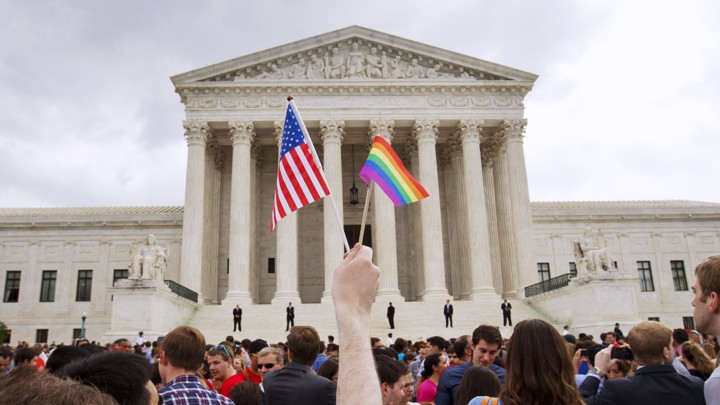
If one reads the wording atop the Supreme Court building, it says "equal justice under the law" - something that LGBT Americans in 26 states still do not enjoy.  I was forced from a law firm for being gay a decade and a half ago. It destroyed me financially and, while I am doing well financially again, I will never be in the financial position I would have enjoyed but for that bigotry based firing.  No one should have their life and their family harmed because of bigotry that clings to a selective parsing of Bronze Age myths and legends. 

And yes, I will continue to tell the truth about groups like Alliance Defending Freedom - and The Family Foundation - as long as they continue to disseminate lies about LGBT individuals and seek special rights for their knuckle dragging followers. . 

Sunday, June 02, 2019

Trump's Pride Tweets Explained: Be Grateful We Don't Execute You

As an LGBT activist one of the most maddening phenomenon is LGBT individuals who vote for Republicans even as the GOP continues to block, or in the case of Der  Trumpenführer and Mike Pence who are steadily waging a war against LGBT rights and promoting anti-LGBT discrimination.  Now these individuals - who to me are like 1930's German Jews supporting the Nazi Party - are breathlessly pointing out that Trump acknowledged the existence of Pride month in a tweet.  Never mind all of the anti-LGBT efforts the Trump/Pence regime has in progress, including filing briefs with the U.S. Supreme Court arguing that anti-gay discrimination by employers is absolutely fine and legal.   A column in The Advocate looks at what Trump's acknowledgement of Pride month really means and what ought to frighten every sentient LGBT American.  Here are column highlights:
Unlike his recent predecessors or challenger in the 2016 election, President Trump has never issued a proclamation commemorating LGBTQ Pride. He has yet to do so, but today issued tweets that supposedly honor the contributions of LGBT people, even though he's undermined and reversed progress for equality throughout his presidency. 
Trump's State Department did announce in February it was working to decriminalize homosexuality around the world — Trump himself was completely unaware of the plan — though we've seen little progress since then. In fact, Trump said nothing when Brunei enacted a new law that could result in stoning people to death for engaging in gay sex (after an outcry, the Brunei government said it won't enforce the law, but will keep it on the books as a warning). 
[Trump] The president and his administration love to point out the discrimination that LGBTQ people face in other parts of the world, especially in Muslim nations like Iran. As Out's Mathew Rodriguez pointed out, this is an "old racist tactic."
"[U.S. ambassador to Germany Richard Grenell's] sudden interest in Iran’s antigay laws is strikingly similar to Trump’s rhetoric after the 2016 Pulse massacre in Orlando, Fla.," Rodriguez wrote. "After the deadly shooting, Trump used the 49 deaths as a way to galvanize support for an anti-Muslim agenda rather than find a way to support LGBTQ+ people. In pushing for immigration restrictions and a Muslim ban, Trump argued, he was the true pro-LGBTQ+ candidate. Rather than honor those who died, Trump used the tragedy as a way to stoke fear among the American people, and Grenell is taking similar actions with Iran — trying to reach an economic goal by painting the administration’s opponent as antigay."
For everyone who may have forgotten, Trump, unlike Hillary Clinton, never once visited the Pulse nightclub, even though he campaigned across the street.
It's simply laughable — insulting, really — for Trump to try to honor LGBTQ achievements in this nation. He has not just ignored LGBTQ rights, he's gone out of its way to appease his far-right followers by reversing them. Trump has done some of the damage obliquely by installing anti-LGBTQ Supreme Court justices (Neil Gorsuch, Brett Kavanaugh), many antigay and anti-trans lower court judges, a homophobic secretary of State (Mike Pompeo) and chief of staff (Mick Mulvaney), all while the nation's most famous homophobe and transphobe serves as his vice-president (Mike Pence). 
Trump has also directly attacked the LGBTQ community by vowing to veto the Equality Act, rolling back protections for trans students, implementing a ban on trans people in the military, issuing an order allowing religiously affiliated health care providers to discriminate against LGBTQ patients, and stating he's fine with businesses discriminating against LGBTQ people. In all, GLAAD has counted 110 instances of Trump targeting the LGBTQ community.
"Actions speak louder than words," GLAAD stated in a press release. "This is a cheap political play and we see right through it. Your administration has attacked the rights of LGBTQ people more than 100 times. Attention media: It’s your responsibility to tell the real truth about President Donald Trump’s record on LGBTQ issues."
Trump's words are clear — disregard everything I've done to you, just be appreciative we don't jail you or hang you from a noose.


My gay Republican "friends" might do well to remember that wealthy and affluent European Jews thought their social status and business connections would protect them from the Nazis.  It did not turn out that way and many lost their lives and/or had their rights eliminated.   Trump's Christofascist base wants the same thing to happen to LGBT Americans. 

Tuesday, November 27, 2018

Norfolk Firefighter Says City Forced Him Out for Being Gay

UPDATED:  The case against the City of Norfolk is pending in the U.S. District Court for the Eastern District of Virginia under case No. 2:18-cv-00565-HCM-RJK and states that the City of Norfolk violated Title VII of the Civil Rights Act of 1964, 42 U.S.C. Sec. 2000e, et. seq.  

I recently wrote about the poor scores of cities in the Hampton Roads region on the Human Rights Campaign's Equality Index.  One of the main reasons for the poor scoring was the lack of meaningful non-discrimination protections for LGBT employees.citizens.  Why this is an important issue is underscored by a story in the Virginian Pilot concerning a Norfolk firefighter who is suing the City of Norfolk over his forced retirement from the Fire-Rescue department for being gay.  From my own experience with anti-gay Norfolk police officers who viewed gay bashing as a sort, I find the allegations all too believable.   The real solution is to have the Virginia General Assembly enact statewide non-discrimination protections binding on all cities and counties in Virginia.  Sadly, to date, Republicans in the General Assembly have blocked such legislation.   Here are article highlights:
For decades, Scott Phillips-Gartner served as a member of Norfolk Fire-Rescue, first as a 911 operator and later as an assistant fire marshal and bomb squad technician.  But then in October 2014 he married his longtime boyfriend, leading his bosses to find out he was gay.
Phillips-Gartner, 55, says the department ultimately stripped him of his rank and directed him to start working out of a temporary facility miles away from his usual office “with little to no job duties.”  “This was not the way he wanted to leave,” said attorney Barry Montgomery, explaining his client retired earlier this year amid threats he’d be fired if he didn’t. “It was humiliating.”
Phillips-Gartner is suing the city of Norfolk, accusing the department of creating a hostile work environment. The suit also alleges the city discriminated against him due to his gender – because he would have been treated differently if he were a woman who’d married a man – and retaliated against him for complaining to the U. S. Equal Employment Opportunity Commission. 
Norfolk implemented policies in December 2016 that prohibit employees, contractors and volunteers from discriminating against a person because of his or her sexual orientation, among other things. The City Council put similar protections into law in early 2017. The suit alleges Phillips-Gartner was well regarded in the department until October 2014, when he notified the city’s human resources department he had married his boyfriend. The suit said Battalion Chief Roger Burris verbally attacked Gartner throughout 2015 and generally treated him less favorably than heterosexual male employees. During a staff meeting that December, he specifically attacked Gartner's sexuality – asking “Where is Ms. Gartner?”
Gartner complained about Burris’ comments, prompting Fire Chief Jeffrey F. Wise to look into what was happening.
Things didn’t get better. The lawsuit said Wise “routinely belittled Gartner in front of colleagues” during the first three months of 2016.
Gartner subsequently complained to Norfolk's then-city auditor, John Sanderlin. Montgomery said he didn’t take action either.
The suit said Wise stripped Gartner of his law-enforcement powers in March 2017, as well as his city firearm, computer and cell phone. He was barred from using city vehicles and denied routine bomb squad training, the suit said.
The suit said Wise advised Gartner in November 2017 he wanted to fire him. In turn, Gartner “reluctantly” put in for retirement on Dec. 7, 2017. His last day was supposed to be Dec. 31, but it was eventually extended to January 31. “This disrupted his whole life,” Montgomery said.
Frankly, it sounds like Messrs Burris and Wise need to be fired and made an example for other homophones and bigots. 

Friday, February 09, 2018

Virginia Republicans Kill LGBT Bills, Give Amazon the Finger

Anti-gay bigot Del. Jason S. ­Miyares (R- Virginia Beach)
One hears Republicans ad nausea claiming to be the party of business and economic growth yet yesterday a small cabal of  Republicans on the House of Delegates General Laws subcommittee (i.e., Delegates Fowler, Wright, Knight, Bell, Richard P., Miyares) voted to kill four pro-LGBT bills and prevent them from getting a vote by the entire committee much less the full House.  And this was done in an atmosphere where Amazon is under growing pressure to turn down sites for its second headquarters with 50,000 jobs and a $5 billion investment. One of the bills killed would have afforded non-discrimination protections in housing. Another would have protected state employees from employment discrimination.  The excuse for action?  The usual bull shit about "protecting religious liberty" as if protecting bigots isn't a form of attack on those with differing religious beliefs.   With today's GOP, it is all about self-prostitution to the modern day Pharisee Christofascists.  The rights of so-called "Nones," Hindus, Muslims and others not subscribing to Christofacist hate and bigotry simply do not matter.  The lesson from this is that LGBT Virginians, their allies and Millennials MUST get organized and turn out at the polls in November, 2018, and again in November, 2019, and defeat Republicans in every election contest possible.  Locally, Del. Jason S. ­Miyares (R-Virginia Beach) and Barry Knight (R-Virginia Beach/Chesapeake) need to be targeted for defeat in 2019.  The Washington Post looks at yesterday's disgusting event.  Here are highlights:
Bills meant to protect gay and transgender people from housing and employment discrimination died in a Republican-dominated House panel Thursday, prompting jeers of “Shame!” from activists who packed a Capitol hearing room.
On a straight party-line vote, members of a General Laws subcommittee voted 5 to 2 to kill four bills, some of which had already cleared the Republican-controlled state Senate, which tends to be more socially moderate than the House.
“The vast majority of fair-minded Virginians support these long-overdue protections that were passed with strong bipartisan support in the Republican-controlled Senate,” said Marty Rouse, national field director of the Human Rights Campaign. “House Republican leaders are completely out of step with what voters made clear at the ballot box in November.”
Opponents of the bills contend that they could have interfered with religious freedom, with some suggesting that religious institutions such as Liberty University could be forced to let gay couples occupy its dorms for married students.
Only one Republican on the panel spoke to the measures before the votes. Del. Jason S. ­Miyares (R-Virginia Beach) said he was torn between the desire to “treat everybody with dignity and respect” and the need to protect religious freedom. He said he would be willing to work toward a compromise, but not this year. The four bills were all brought by Democrats, Sens. Adam P. Ebbin (Alexandria) and Jennifer T. Wexton (Loudoun) and Dels. Marcus B. Simon (Fairfax) and Mark H. Levine (Alexandria). Ebbin and Levine are two of only a few openly gay lawmakers. Last month, Gov. Ralph Northam (D) signed an executive order shortly after his inauguration banning such discrimination in government employment. One of the bills would have codified that into law. Jeff Caruso of the Virginia Catholic Conference said the bills could force faith-based colleges and organizations to violate their sincerely held religious beliefs. . . . Bill Janis of the Family Foundation suggested the measures were unnecessary because the largest employers in Richmond already prohibit anti-discrimination in hiring. 

Note the toxic influence of the Catholic Church which remains an enemy of LGBT individuals and The Family Foundation, Virginia's leading hate group, to whom Virginia Republicans bow and genuflect.