Showing posts with label special rights for Christofascists. Show all posts

Thursday, June 04, 2020

The Supreme Court Is on the Brink


While the Supreme Court made the right call late last Friday in rejecting a church challenge to California's shutdown order involving church services, what is disturbing is that four of the justices (two are Trump appointees) put right wing ideology and a preference to grant special rights to far right christian groups - I use a small "c" because many are Christian in name only - ahead of public safety and religious freedom for all citizens. But for Chief Justice Roberts' shift to vote with the so-called "liberals," gubernatorial orders across the nation would have been struck down.  These four justices exemplify the extremists and ideologues that Trump and his Senate Republican enablers are appointing to life time positions on the federal bench.  The harm being done will last literally for decades.  Should Trump get to appoint another justice to the Supreme Court, the damage could be irreparable during the lifetimes of anyone over 40 years of age.  It is yet another reason Trump must be defeated in November.  A piece in the New York Times looks at the politicizing of the Court by Trump and the far right.  Here are excerpts:
The Supreme Court made the indisputably right call last week when it refused to block California from limiting attendance at religious services in an effort to control the spread of Covid-19.
Given the obvious difference between walking through a store and sitting among fellow worshipers for an hour or more, as well as the documented spread of the virus through church attendance in such places as Sacramento (71 cases), Seattle (32 cases) and South Korea (over 5,000 cases traced to one person at a religious service), California’s limits are both sensitive and sensible, hardly the basis for constitutional outrage or judicial second-guessing.
So why did the court’s order, issued as midnight approached on Friday night, fill me with dread rather than relief?
It was because in a ruling that should have been unanimous, the vote was 5 to 4. And it was because of who the four dissenters were: the four most conservative justices, two of them appointed by the president who a couple of months ago was demanding that churches be allowed to open by Easter and who, even before the murder of George Floyd in Minneapolis, was openly encouraging protests in the capitals of states not reopening as quickly as he would like.
As an astonished country witnessed on Monday night, as he [Trump] held a Bible in front of a church near the White House after demonstrators were violently cleared from his path, Donald Trump is using religion as a cultural wedge to deflect attention from the consequences of his own ineptitude. The recognition that four Supreme Court justices — Clarence Thomas, Samuel Alito, Neil Gorsuch and Brett Kavanaugh — would have invoked the court’s power to undermine fact-based public policy in the name of a misbegotten claim of religious discrimination was beyond depressing. It was terrifying.
Take a look at Justice Kavanaugh’s dissenting opinion. “California’s latest safety guidelines discriminate against places of worship and in favor of comparable secular businesses,” he wrote. “Such discrimination violates the First Amendment.”
It’s interesting that while Justices Gorsuch and Thomas signed Justice Kavanaugh’s opinion, Justice Alito did not. Perhaps he’s just too good a lawyer to subscribe to the flimsy analysis underlying this opinion. . . . . but he evidently couldn’t be bothered to explain his own dissenting vote. And no less than his fellow dissenters, he obviously inhaled the unfounded claim of religious discrimination that the president has injected into an atmosphere already saturated with polarizing rhetoric.
The concept of discrimination, properly understood, simply doesn’t fit this case. California is not subjecting things that are alike to treatment that’s different. Churches are not like the retail stores or “cannabis dispensaries” in Justice Kavanaugh’s list of “comparable secular businesses.” Sitting in communal worship for an hour or more is not like picking up a prescription, or a pizza, or an ounce of marijuana. You don’t need a degree in either law or public health to figure that out. If anything, California is giving churches preferential treatment, since other places where people gather in large numbers like lecture halls and theaters are still off limits.
So what was the dissenters’ problem?
Last weekend was also Shavuot, a major Jewish holiday. But it’s the Christian calendar about which recently appointed federal judges seem exclusively concerned. In April, Judge Justin Walker of the Federal District Court in Louisville, Ky., blocked that city from enforcing a ban on drive-in church services. “On Holy Thursday, an American mayor criminalized the communal celebration of Easter,” his overheated opinion began.
The only other opinion filed in this case was that of Chief Justice John Roberts, explaining why the court was denying the church’s request. I am willing to bet that he never intended to write anything; orders denying applications of this sort are typically issued without explanation.
But he must have concluded that the Kavanaugh dissent couldn’t go unrebuted. Writing just for himself in five paragraphs devoid of rhetoric and labeled “concurring in denial of application for injunctive relief,” he offered a sober explanation of the obvious. He noted that “similar or more severe restrictions apply to comparable secular gatherings, including lectures, concerts, movie showings, spectator sports, and theatrical performances, where large groups of people gather in close proximity for extended periods of time.” The California rule, he observed, “exempts or treats more leniently only dissimilar activities, such as operating grocery stores, banks, and laundromats, in which people neither congregate in large groups nor remain in close proximity for extended periods.”
After noting the severity of the pandemic and the “dynamic and fact-intensive” question of how to respond to it, Chief Justice Roberts said that the politically accountable state officials charged with answering that question were entitled to act within “broad limits” and “should not be subject to second-guessing by an unelected federal judiciary, which lacks the background, competence, and expertise to assess public health and is not accountable to the people.”
Predictably, the chief justice was excoriated on the political right, in recognition that his vote was the one that mattered, just as in the Obamacare case eight years ago, for which the right has never forgiven him.
Everyone who cares about the Supreme Court is busy looking for signs of how John Roberts will navigate the political thicket in which the court finds itself, how he will reconcile his conservative heart and his institution- and history-minded head.
Justice Kavanaugh might have chosen to observe the norm, casting his vote without issuing an opinion that served only to raise the political temperature. Instead of that unspoken gesture toward collegiality, he gave us more proof that the polarization roiling the country has the Supreme Court in its grip. The court can’t save us; that much is clear. It can’t even save itself.

Sunday, May 31, 2020

Supreme Court Rejects Church's Challenge To Coronavirus Rules

I have followed extreme right wing "Christian" organizations and related "family values" groups for over a quarter of a century now and several things are a common theme with them: (i) they view themselves above the law, (ii) they want their toxic version of Christianity to be the established religion in America, (iii) their followers seemingly hate almost everyone, but especially gays, who don't embrace their ugly beliefs, and (iv) most have very strong white supremacist overtones and some groups, like The Family Foundation here in Virginia, traces their roots back to strident segregationists.  Simply put, they are NOT nice people and they hold constitutional democracy in contempt unless they are in control and can discriminate and harm those they dislike - which is most of the nation's population.  

In June, 2016, the leaders of these groups - some of which are certified hate groups - made a pact with Donald Trump where they agreed to support a man who embodies the seven deadly sins if he gave them special rights. They bear a huge responsibility for Trump being in the White House and for his part Trump has delivered in the form of reactionary ideologues being appointed to the federal courts, the undoing of Obama administration policies that protected gays and other minorities, and supporting the myth that they are being persecuted when in reality what they face is a majority of Americans saying they are tired of the hate and bigotry that these false Christians represent.  

Enter the Covid-19 pandemic and many of the right wing churches have objected to social distancing and shutdown orders implemented to control the spread of the virus.  Some filed federal lawsuits challenging such orders and claiming they "discriminated against religion (a church in Virginia among them).  Late Friday, in a 5-4 decision, the U.S. Supreme Court  rejected their self-centered and selfish claims and ruled against a church in California and several others.  The ruling should be dispositive of the Virginia lawsuit as well.  NPR looks at this welcome ruling that clearly states these people are not above the law.  Here are story excerpts:
The Supreme Court has rejected a California church's attempt to overturn the state's coronavirus restrictions on in-person religious services.
In a 5-4 decision issued late Friday, Chief Justice John Roberts sided with the court's liberal bloc in upholding the state's right to impose limits on congregations in order to slow the spread of COVID-19.
"Although California's guidelines place restrictions on places of worship, those restrictions appear consistent with the Free Exercise Clause of the First Amendment," Roberts said, in an opinion that denied a request by the South Bay United Pentecostal Church for relief from the rules.
The Chula Vista-based house of worship sued Gov. Gavin Newsom, a Democrat, over an order limiting congregations to 25% capacity or 100 attendees, whichever is lower. The plaintiffs told the court its services typically attract 200 to 300 congregants.
Worship services and nonessential retail were halted for more than two months in California, which has recorded nearly 107,000 confirmed cases of the coronavirus and more than 4,000 deaths.
During the lawsuit's path through the lower courts, the state issued guidelines earlier this week allowing for a limited reopening — but that did not satisfy the plaintiffs, who felt the eased restrictions remained unconstitutional.
In rejecting that challenge, Roberts wrote that the Constitution generally grants broad leeway to state leaders in circumstances of medical uncertainty. In particular, the chief justice found that Newsom's order was consistent in limiting not just religious services, but also various kinds of activities "where large groups of people gather in close proximity for extended periods of time."
"The notion that it is 'indisputably clear' that the Government's limitations are unconstitutional seems quite improbable," wrote Roberts.
The court's four reliably conservative justices — Samuel Alito Jr., Neil Gorsuch, Brett Kavanaugh and Clarence Thomas — dissented. Kavanaugh said the guidelines violate the First Amendment because they "discriminate against places of worship and in favor of comparable secular businesses."
In a separate case, the court also rejected a lawsuit from two churches in Illinois seeking to block Gov. J.B. Pritzker's rule limiting religious services to just 10 worshipers. Pritzker later modified the order to allow for up to 100 people at services, and the court denied the churches' request for relief without a noted dissent.
The limits on church services have been a flashpoint in the national conversation surrounding the coronavirus, with President Trump wading into the controversy earlier this month to push for churches' right to reopen. Even as many states — such as California and Illinois — have moved to loosen their restrictions in recent weeks, critics continue to argue that the rules on houses of worship are discriminatory. 
“The precise question of when restrictions on particular social activities should be lifted during the pandemic,” Roberts declared, “is a dynamic and fact-intensive matter subject to reasonable disagreement.” The Constitution leaves such decisions “to the politically accountable officials of the state,” whose decisions “should not be subject to second-guessing” by judges who lack “background, competence, and expertise to assess public health.” Multiple coronavirus outbreaks in California have been traced back to religious services. California has good reason to treat churches more like concerts—where people “congregate in large groups” and “remain in close proximity for extended periods”—than grocery stores, where they can social distance. For courts, that should be the end of the matter.
But Kavanaugh’s assertion that California treats churches and “comparable secular businesses” differently begs the question: what is a comparable secular business? When it comes to the spread of infectious disease, is a church really just like a grocery store, where people spend as little time as possible, separated by aisles and shopping carts, rarely speaking to one another? Or is it more like a concert, where people congregate for lengthy periods, shoulder to shoulder, often speaking or singing and thereby spreading droplets that may contain the coronavirus?
 What is genuinely shocking about Kavanaugh’s dissent is that he does not even address this question. The dispute lies at the heart of the case, and Kavanaugh ignores it. He simply takes it as a given that churches are “comparable” to grocery stores when it comes to risk of spreading COVID-19. By warping the facts, Kavanaugh paints California’s rules as irrationally discriminatory, when in fact they are based on medical advice Newsom has right now. If the justice wants to override public health measures during a pandemic, shouldn’t he at least admit that he’s substituting his own scientific judgment for that of a democratically elected lawmaker’s?
Roberts seems to think so. His opinion ends with a clear swipe at Kavanaugh: “The notion that it is ‘indisputably clear’ that the Government’s limitations are unconstitutional,” the chief justice wrote, “seems quite improbable.” Roberts went out of his way to telegraph his displeasure with the raft of lawsuits contesting COVID-19 restrictions as unconstitutional burdens on religious liberty. Even in borderline cases, he suggested, courts must defer to the people’s representatives if they decide the health crisis requires limitations on public assemblies.
Kudos to Roberts for putting science and medical knowledge above myths and superstition.  Let the charlatans in pulpits and scamvangelist - who put money ahead of public safety - continue to lose money as their flocks stay home.  

Saturday, May 02, 2020

Religious Services Shouldn’t be Exempted From State Pandemic Regulations

Since June of 2016 when he met with a who's who of the extreme "Christian Right" - folks who, in my view are neither Christian nor right - he has promised to give Christofascists special rights to discriminate and establish their perverse form of Christianity as a de facto established religion. The rights and even safety of all others must give way to the "godly folks'" bigotry and fantasy world view.  With lock downs across the country to protect the health of the public at large, large social gatherings of all types, including church services, have been banned.  In the minds of the Christofascists, this amounts to "persecution of Christians."  The lives and safety of other members of the public simply do not matter.  To pastors and scamvangelists, the real issue I suspect is all about money: no church service equals a drop in cash-flow and less luxurious living for those who fleece their gullible flocks. As a piece in The Atlantic by a former Republican lays out, Trump has been only too happy to fan the flames of the always aggrieved Christofascists.  Here are article highlights:
The antiviral lockdowns have banned most large gatherings: baseball games, sales conferences, college graduations, and religious services.
Religious services are governed by the same rule as other large gatherings. They are neither specially targeted nor specially exempted. Justice Antonin Scalia explained the justification for applying general rules to religious groups in a 1990 Supreme Court decision:
We have never held that an individual’s religious beliefs excuse him from compliance with an otherwise valid law prohibiting conduct that the State is free to regulate.
But over the past three weeks, some conservatives have argued louder and louder that the failure to exempt religious services from the general rules during the coronavirus pandemic constitutes an anti-constitutional attack on religion.
On April 8, the Fox News host Tucker Carlson lamented: “It’s possible that in five days we will see something that we never imagined in this country: Easter celebrations broken up by the police. Of course, you can still go to the grocery store and the pharmacy; you could still have Communion in the produce aisle at Safeway. But churches? We’ll find out if that’s allowed.”
The Fox News host Jeanine Pirro on April 15 praised Michigan protesters who resisted an unnamed “them” who “want to keep us away from churches and synagogues.”
On April 18, Donald Trump retweeted this complaint about Easter restrictions:
Let’s see if authorities enforce the social-distancing orders for mosques during Ramadan (April 23–May 23) like they did churches during Easter. . . . . He added: “They go after Christian churches, but they don’t tend to go after mosques.”
All of this might seem performative victimhood as usual, but on April 27, Attorney General William Barr issued a directive to the 93 U.S. attorneys and the civil-rights division of the Department of Justice to be “on the lookout” for state regulations that discriminate against religious institutions and religious believers.
The sense of persecution that pervades conservative talk has jumped to sway federal law enforcement.
It needs to be stressed at the outset that almost all faith groups in the United States have voluntarily and responsibly complied with public-health restrictions. Two dozen Muslim groups signed a statement on the eve of Ramadan urging Muslims to celebrate the holy month in rituals at home, not in mosques or Islamic centers. The Church of Jesus Christ of Latter-day Saints suspended all services worldwide on March 12. Catholic churches likewise suspended public Mass. Cellphone records confirm that the large majority of Christian worshippers marked Easter at home.
It’s not discrimination when the same health and safety rules are applied equally to all. When states enforce rules against such gatherings, they are not singling out “religious observance.” They are including religious observance on a list defined by the most neutral of possible terms: risk of infection. Churches are bound by fire codes, just like other institutions, and the same principle articulated in Scalia’s 1990 opinion in Employment Division v. Smith applies here.
It’s especially not discrimination to apply universal health and safety rules to religious assemblies when there is ample evidence that religious assemblies—much more than beaches or parks—have proved capable of spreading the virus. An outbreak in Georgia traces to a church funeral in Dougherty County, one in Louisiana to a megachurch that ignored social distancing.
It’s striking that nearly a month after conservative media began complaining, the Justice Department still cannot identify any instances of unfair treatment of worshippers beyond the wish of some megachurches to keep operating as usual in a time of pandemic.
But the purpose of the Trump administration and Barr’s Justice Department is not to defend genuine religious liberties from real-world threats. It is to stoke cultural resentment for political purposes. They are out to get you because they care more about alien Muslims than about authentically American Christians.
As MSNBC’s Joe Scarborough has aptly said, you cannot fight a culture war against a virus. The virus will always win.
But the Trump administration is not fighting the virus, not primarily anyway. Its priority is to fight an election—and to incite fights against governors who are making Trump look bad in comparison as a tactic in that election.
Inviting people of faith, and especially evangelical Protestants, to imagine themselves as victims is today’s incitement. Tomorrow there will be other incitements. And at every turn, public health will be sacrificed—and the people Trump supposedly champions will end up as the victims of the plague that Trump did not start, but that Trump is making so much worse than it had to be.

Saturday, April 25, 2020

Trump Regime Moves to Scrap Protections for LGBT Healthcare Patients

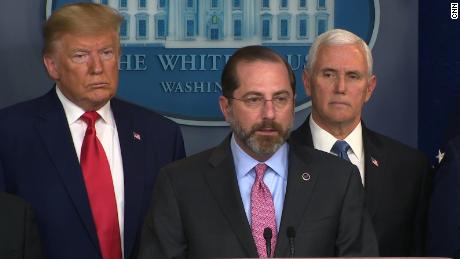
Trump, Pence and HHS Secretary Azar.
With the Covid-19 pandemic raging one would think that the main focus of the Trump/Pence regime would be on insuring that all Americans have access to quality healthcare without any obstacles.  Sadly, that would be a false assumption.  As Politico is reporting the Trump/Pence regime is continuing on its quest to roll back Obama administration policies that protected LGBT individuals from discrimination and the refusal of medical services which in the LGBT context are part of Trump's efforts to impose the anti-LGBT license to discriminate laws  Trump's motivation for with such vile actions?  To maintain his support among evangelical Christians and Christofascists who cannot tolerate any regulations or policies that restrict their ability to mistreat those they deem "other" and who have a sick need to look down upon others in order to feel superior.  Here are highlights from Politico:
The Trump administration is moving to scrap an Obama-era policy that protected LGBTQ patients from discrimination, alarming health experts who warn that the regulatory rollback could harm vulnerable people during a pandemic.

The health department is close to finalizing its long-developing rewrite of Obamacare’s Section 1557 provision, which barred health care discrimination based on sex and gender identity. The administration’s final rule on Thursday was circulated at the Justice Department, a step toward publicly releasing the regulation in the coming days, said two people with knowledge of the pending rule. The White House on Friday morning also updated a regulatory dashboard to indicate that the rule was under review. Advocates fear that it would allow hospitals and health workers to more easily discriminate against patients based on their gender or sexual orientation.
The Obama administration moved to create its non-discrimination protections in response to advocates and health care experts who said that LGBTQ patients were being turned away from necessary care or intimidated from seeking it out. The broad rule also offered specific protections for transgender patients for the first time and extended protections for women who had abortions. But a federal judge in 2016 blocked those protections following a lawsuit from religious groups, and the Trump administration has steadily worked to weaken the rule before it could take full effect.
In last year's proposal, the health department also proposed changes that went further than simply rolling back the new Obama protections, moving to eliminate similar nondiscrimination protections for LGBTQ patients that were contained in other regulations.
"If the final rule is anything like the proposed rule, HHS is adopting changes that would be harmful in the best of times but that are especially cruel in the midst of a global pandemic that is disproportionately affecting vulnerable communities and exacerbating disparities,” said Katie Keith, a lawyer and Georgetown professor who’s tracked the rule.
The health department's top civil rights official also defended the administration's approach to vulnerable populations. “As we have shown in our recent efforts to protect persons from disability and age discrimination during the pandemic, HHS will vigorously enforce civil rights laws as passed by Congress, before, during, and after any rulemaking,” Roger Severino, the HHS civil rights chief, said in a statement. Severino was an active critic of the Obama-era non-discrimination rules before joining the administration. Any rule issued by the Trump administration on LGBTQ protections could be short-lived. The Supreme Court is set to rule on whether the Civil Rights Act protects LGBTQ workers, which could create a new regulatory framework and force health officials to swiftly return to the drawing board.


Given the Trump/Pence regime's anit-LGBT agenda - and that of the GOP in general, I find it dumbfounding that a small percentage of gays continue to call themselves Republicans. It makes about as much sense as a 1930's German Jew joining the Nazi Party.

Sunday, February 16, 2020

Facing Reelection, Trump Expands His Anti-LGBT Agenda

In the ramp up to the 2020 presidential election, rather than build a wider base of support, Donald Trump, a/k/a  Der Trumpenführer, is working 24/7 to further divide the nation and to energize his Christofascist and white supremacist base by pandering to their prejudices and pushing an agenda to harm those that his toxic base hates. Among the Christofascists, no group is more hated than the LGBT community (followed by Hispanics, blacks and non-Christians).  As a consequence, Trump is rolling back policies adopted over the 8 years of the Obama administration and seeking to grant special rights to Christofascists to discriminate a will based upon claims that their religious beliefs are offended by the targets of their hatred. As we move through 2020, expect the Trump/Pence regime's anti-LGBT agenda to intensify.  The Advocate looks at both what has already been done to harm LGBT Americans and what may still be forthcoming.  Here are highlights:
In 2019, the Trump administration dramatically expanded upon discriminatory, anti-LGBTQ policies implemented in the first two years of this administration that are harming the health and well-being of LGBTQ people not just in America, but around the world.
It rolled back sexual orientation and gender identity nondiscrimination provisions in health care, employment, and housing. It appointed more anti-LGBTQ federal court judges. And it retreated even further from global leadership on the moral stance that LGBTQ rights are human rights.
Alarmingly, other policies that are not specifically aimed at LGBTQ people, such as restricting asylum hearings in the United States only to people who have been denied asylum in another country, and global religious “freedom” initiatives, are disproportionately affecting LGBTQ people.
Collectively, these policies are unwinding decades of progress that have been made by LGBTQ people and their allies to build access and equity for LGBTQ people in public life. Most tragically, people are dying as a result.
In June, the Department of Health and Human Services released a proposed rule that, if finalized, would reverse a provision in the Affordable Care Act which prohibits anti-LGBTQ discrimination in health care settings. Six regulations prohibiting anti-LGBTQ discrimination in health insurance and elder care were also repealed in 2019. In November, HHS released another proposed rule that would remove regulatory provisions that explicitly prohibit organizations that receive HHS grant funding from discriminating on the basis of sexual orientation, gender identity, sex, and religion. . . . . These programs are vital to millions of Americans, especially for marginalized communities, including LGBTQ people, who already experience pervasive discrimination that acts as a barrier to accessing care and services.
Last year also saw the implementation of discriminatory policies first announced in 2017. In April, a ban on transgender people serving in the U.S. military that was first announced via a series of tweets by President Trump in 2017 went into effect after the Supreme Court ruled in favor of the ban, lifting injunctions imposed by lower courts. An estimated 13,600 transgender servicemembers are now at risk of being discharged.
Things don’t look any better for 2020. On Martin Luther King, Jr. weekend, Vice President Mike Pence attended services at Holy City Church of God in Christ in Memphis, Tenn., where he also addressed the congregation. After Pence spoke, Bishop Jerry Wayne Taylor sermonized that LGBTQ people have been possessed by a “demonic spirit” and that the devil was “trying to destroy the foundation of marriage and cut off the reproductive process” because “two men can’t have a baby, two women can’t have a baby.” The service was streamed live over the White House’s YouTube channel, where it can still be viewed.
The harm experienced by LGBTQ people under the Trump administration is extensive and dangerous. We have every reason to believe things are only going to get worse in 2020. Simply hoping that these proposals never gain traction is not a strategy. We must mobilize to oppose and reverse them.
 If you have LGBT friends or family members, it is critical that you vote Democrat in November 2020 to end Trump's misrule. 

Wednesday, January 22, 2020

Diverting Taxpayer Funds to Religious Schools is Wrong

It has long been the goal of religious schools to divert public tax dollars to support private sectarian schools many of which discriminate against gays and those belonging to other denominations or faiths. The Trump/Pence regime, eager to sustain the loyalty of Christofascist voters supports this diversion of public monies to discriminatory religious schools.  A case before the U.S. Supreme Court, if decided wrongly could open the flood gates for taxpayer funds flowing to such schools while allowing such schools to openly discriminate against an array of students and/or parents.  Such a ruling would clearly violate the Establishment Clause of the First Amendment, yet the "conservative" majority on the Court may well be happy to allow taxpayer funded discrimination.  A column in the Washington Post looks at this dangerous situation.  Here are highlights:

Imagine a country where your hard-earned tax dollars must fund private religious schools that require students to have a personal relationship with Jesus Christ, or that expel students for being gay. Imagine that your state is forced to spend resources to help fund construction of a local house of worship of a faith you do not share, just because the state is also contributing to building a community center.
These scenarios are antithetical to the principles of religious freedom on which our nation was founded. And yet, this is the path we may be headed down as the U.S. Supreme Court gears up to hear oral arguments Wednesday in Espinoza v. Montana Department of Revenue.
The case arises out of a challenge to a Montana private-school voucher program. Because the Montana Constitution — like three-quarters of the states’ constitutions — specifically prohibits state dollars from funding religious education, the state limited its voucher program to secular schools. But some parents argued that if Montana funds private education at all, it must fund religious education. The Montana Supreme Court struck down the entire voucher program, resulting in all private schools being treated the same way: None of them get taxpayer dollars.
Now, however, the U.S. Supreme Court is poised to decide whether Montana’s earlier decision to fund some secular schools means that it must also fund religious schools — schools that teach religion, compel students to engage in religious activities and enforce religious codes of conduct. This case is not about what a state may do, but about what it must do. To hold that the U.S. Constitution requires taxpayers to fund religious education in this fashion would upset long-standing principles of religious freedom and separation of religion and government.
No taxpayer should be forced to fund religious education. . . . Private religious schools don’t adhere to the same nondiscrimination laws that public schools do. As a result, we have seen them turn students away because their families don’t share the school’s religious beliefs. They have barred admission because a student or parent is LGBTQ or a student has a disability. They have expelled students who engage in sex outside marriage. . . . . While not all private religious schools conduct themselves in this way, too many do, and taxpayers should not have to underwrite such discrimination.
Those challenging the Montana Constitution are not seeking a level playing field. Instead, they are asking the state to fund their religious schools and continue to extend to them exemptions from laws that apply to public and even secular private schools. That is not equal treatment — it’s religious privilege.


The Christofascists continue to demand special rights and the ability to discriminate at will - even when receiving taxpayer funds.  They are a clear and present danger to constitutional government. 

Friday, January 17, 2020

Trump Unveils More Anti-LGBTQ 'License to Discriminate' Plans

The Trump/Pence regime is continuing its attacks on the LGBT community and moving to grant a license to discriminate to religious - mostly conservative "Christian" - organizations that receive taxpayer funded support.  The goal is to (i) solidify evangelical support in advance of the 2020 presidential election, and (ii) prop up religious organizations that cannot survive financially without government funding, their respective denominations no longer being able to support their operations.  The Trump/Pence rule making is targeted to allow discrimination against not only LGBT individuals, but also those of other religions or no religion.  Stated another way, it is an effort to have a stated supported religion - conservative Christianity - in violation of the Establishment Clause of the U.S. Constitution.  A piece in The Advocate looks at this very dangerous and discriminatory agenda.  Here are excerpts:

Donald Trump’s administration has made yet another move to enable discrimination, including anti-LGBTQ discrimination, in the name of “religious freedom.”
On Thursday, National Religious Freedom Day, Trump announced his administration is issuing nine proposed rules that govern how faith-based nonprofits with government contracts interact with their clients, reversing regulations put in place under President Barack Obama.
Under the Obama-era regulations, these contractors “need to give beneficiaries notice of the providers’ religious character and the right to get services elsewhere,” The Washington Post reports. “The providers also have to make reasonable efforts to refer beneficiaries to another provider if the person receiving services is uncomfortable.” The Trump administration says these rules are unfair to faith-based providers because they don’t apply to secular organizations.
The newly proposed rules, which are subject to public comment before becoming final, would apply to organizations that provide a wide range of services through contracts with the departments of Veterans Affairs, Health and Human Services, Labor, Agriculture, Education, Justice, Homeland Security, and International Development. Services offered by these contractors include substance abuse treatment, adoption and foster care placements, refugee resettlement, and much more.
[W]e are talking about government grants to the tune of millions and millions of dollars,” she explained. “And increasingly, they are excluding members of the public from receiving services based on who they are.”
The rules would indeed enable faith-based contractors to turn away people who are LGBTQ or follow a different religion, according to the American Civil Liberties Union. “We will keep saying this as long as we have to: Religious freedom is a fundamental right, but it does not confer a license to discriminate,” said Heather Weaver, senior staff attorney with the ACLU Program on Freedom of Religion and Belief, in a press release. “Government-funded programs, including those operated by faith-based organizations, should not be able to discriminate against vulnerable people seeking help.
“The right to believe and to exercise one’s faith is a core American value. The right to discriminate with taxpayer dollars is not. These regulations would dismantle meaningful protections for beneficiaries of these federally funded programs and strip away basic notice requirements designed to ensure that beneficiaries know their rights to be free from discrimination and their right to an alternative, nonreligious provider. Taxpayer funds should not be used to allow discrimination.”
Today’s announcement comes on top of many other efforts by the Trump administration to establish a right to discriminate in the name of religion. In November, for National Adoption Month, HHS announced a new rule that would allow adoption agencies and other programs that receive HHS grants to reject same-sex couples and rainbow families on the basis of religious freedom. Other programs that stand to be affected include elder services, Head Start, refugee resettlement, HIV services, and programs for runaway and homeless youth.
The administration has finalized a so-called conscience protection rule allowing health care providers to opt out of procedures that offend their religious beliefs, but court challenges have kept the rule from going into effect. It also wants to eliminate provisions of the Affordable Care Act that ban anti-transgender discrimination and even allow homeless shelters to discriminate against trans clients.

Anyone who is not an evangelical "Christian" extremist should be very, very worried.  Yes, I have the word Christian in quotation marks because, in my view, the members of Trump's base are Christian in name only.  Look at Christ's social gospel message, and these people are the antithesis to that message.  Indeed, the make the Biblical Pharisees seem like good, upstanding people.

Saturday, November 23, 2019

Trump is Reversing LGBT Progress in Plain Sight

The Trump/Pence regime has been waging a relentless war against the LGBT community since day one.  Part of the motivation has been to maintain the support of gay hating evangelical Christians.  The rest seems to be based on simple anti-LGBT animus.  The result is that LGBT individuals - especially those without money and influence - are significantly less secure in their employment and health care access than was the case on the last day of the Obama administration.  In states with laws protecting LGBT rights, some of the threats are lessened at least in the realm of employment and public accommodation, but in the health care realm where federal rules often govern, dangers have increased.  In states without pro-LGBT laws, the situation can be bleak.  Thankfully, here in Virginia, there is about to be a sea change in LGBT protections with Governor Northam telling us recently that he wants to "be bold" on advancing LGBT rights in the next legislative session. Propublica has compiled a list of 31 ways in which the Trump/Pence regime has rolled back LGBT progress.  The list can be found here.  Here are some highlights (read the entire piece):

   When he campaigned for president, Donald Trump posed with the rainbow flag and became the first GOP nominee to mention LGBTQ citizens in his convention speech. . . . . stating he was “determined to protect the rights of all Americans, including the LGBTQ community.”
      Yet since taking office, Trump’s administration has acted to dismantle federal protections and resources for LGBTQ Americans, particularly those gained under President Barack Obama.
     In a reversal from the Obama administration, the Trump administration has repeatedly taken the position that laws and regulations that prohibit discrimination on the basis of sex do not cover a person discriminated against for being gay or transgender. The administration has also pushed for religious exemptions to civil rights laws, which experts say will make it easier to discriminate against LGBTQ individuals. The administration has taken particular aim at transgender people . . . . ProPublica reviewed actions taken by the Trump administration that could directly affect LGBTQ citizens. We found dozens of changes that represent a profound reshaping of the way the federal government treats the more than 11 million lesbian, gay, bisexual and transgender Americans.
Employment1.       On July 26, 2017, just months after taking office, the president tweeted that he planned to ban transgender people from military service. This announcement reportedly came as a surprise to the generals he claimed to have consulted.
 2.       Former Attorney General Jeff Sessions sent a memo that reversed the Justice Department’s position on whether the Civil Rights Act protects transgender people from workplace discrimination.
 3.       The Department of Justice, in accordance with Sessions’ memo, submitted a number of briefs in state and federal courts around the country arguing that employers could legally discriminate based on sexual orientation and gender identity. Among those were briefs filed in three cases currently in front of the Supreme Court that deal with the issue of workplace discrimination against LGBTQ people.
 4.       The Office of Personnel Management removed guidance written for federal agency managers on how to support transgender federal employees and replaced it with guidance that links to the DOJ’s reinterpretation of the Civil Rights Act, which says that Title VII does not prohibit discrimination based on gender identity.
 5.       The DOJ sent two memos to all executive branch departments that interpret religious liberty protections in ways that give broad exemptions from federal anti-discrimination laws to agencies and contractors.
 6.       The Department of Labor issued a directive to its staff to exempt contractors from compliance with federal nondiscrimination rules that cover employment if they conflict with a contractor’s religious beliefs. The directive specifically cites sexual orientation and gender identity, and it contradicts promises made by Trump in the early days of his administration that it would safeguard those rules. . . .
 7.       The Department of Labor proposed exempting providers of services and supplies for the military’s TRICARE health program from an executive order that prohibits employment discrimination on the basis of sexual orientation and gender identity by federal contractors.
Schools and Youth Groups1.       The day after Sessions was sworn in as attorney general, the DOJ withdrew the federal government’s challenge to an injunction against trans-inclusive Title IX guidance. Later that month, the DOJ and the Department of Education rescinded that guidance entirely.
 2.       The Department of Education confirmed to multiple news outlets that it was no longer investigating or taking action on complaints filed by transgender students who were barred from restrooms or other facilities that match their gender identity.
 3.       [T]he Trump administration’s Department of Education has drastically scaled back civil rights enforcement for LBGTQ students. The report found that complaints students filed alleging sexual orientation- and gender identity-based discrimination were nine times less likely to result in corrective action under the Trump administration than under the Obama administration.
 4.       According to an investigation by The Des Moines Register, the Department of Agriculture pushed the national 4-H youth organization to withdraw guidance aimed at welcoming and protecting LGBTQ members.
Health Care1.       The Department of Health and Human Services proposed a rule that would eliminate Obama-era regulations explicitly prohibiting discrimination on the basis of sex stereotyping — stereotypical notions of how those of a certain gender should look or act — and gender identity by federally funded health providers, programs and insurers . . .
 2.       In that same proposed rule, HHS said it planned to eliminate other Obama-era regulations that prohibited discrimination based on gender identity and sexual orientation in certain Medicaid, private insurance and education programs. According to the Kaiser Family Foundation, without these nondiscrimination prohibitions, health plan issuers could charge higher premiums or cancel or deny coverage to LGBTQ individuals, and Medicaid managed care programs could discriminate against LGBTQ beneficiaries in enrollment.
 3.       HHS dropped proposed requirements for hospitals to establish policies that prohibit discrimination on the basis of gender identity and sexual orientation in order to participate in Medicare and Medicaid.
 4.       This spring, the administration issued a new “conscience rule” aimed at significantly expanding protections for federally funded health care providers who refuse to provide some medical services because of religious or moral objections. The rule’s implementation, which had been delayed by legal challenges, was blocked by three federal judges this month.
 5.       The HHS Office for Civil Rights — the part of the agency that enforces health care-related anti-discrimination laws — has taken steps to shift the office’s emphasis from the protection of “equal access” for patients to the protection of “conscience and free exercise of religion” for providers. 6.       HHS announced a new proposed rule that would allow the agency to issue grants to organizations that deny services to LGBTQ people. Specifically, the administration announced that it would immediately drop enforcement of — and will be seeking to roll back — Obama-era regulations that prohibited grant recipients from denying services on the basis of sexual orientation, gender identity and religion.

Saturday, November 09, 2019

Federal Court Strikes Down Trump/Pence "Conscience Rule" Allowing Discrimination

One consistent trend of the Trump/Pence regime has been the effort to grant Christofascists special privileges and dispensation from complying with non-discrimination laws using a warped and toxic version of "religious freedom" to justify outright bigotry and discrimination.  One such example is the so-called "conscience rule" that would allow health care workers to refuse to treat anyone they disliked or disapproved so long as they could invoke the smoke screen of "religious belief."  The exemption is so broad that in theory even racial discrimination  - not to mention anti-LGBT animus - could be green lighted. The entire argument is an utter distortion of the Founders' view of religious freedom as written in the First Amendment and, as NPR pointed out, the Court noted, based on "false evidence" presented by the Trump/Pence regime:
. . . .that increase in the number of complaints is "demonstrably false," according to Engelmayer's ruling. Nearly 80% of all the complaints given to the court were about vaccinations — unrelated to health care workers and their religious beliefs in providing care. The judge writes that only 21 — or 6% — of the complaints that the government provided the court are even potentially related to providers' moral or religious objections. During oral arguments, the government's attorney conceded that the real number of complaints was "in that ballpark." "This conceded fact is fatal to HHS's stated justification for the Rule," Engelmayer writes. "Even assuming that all 20 or 21 complaints implicated the Conscience Provisions, those 20 or 21 are a far cry from the 343 that the Rule declared represented a 'significant increase' in complaints."

The rule was always about green lighting discrimination with the supposed justification fabricated after the fact. A piece in Mother Jones looks further at the Court's ruling and the insidious discrimination that the rule sought to allow (the Virginia GOP tried similar stunts that help lead to its historic defeat on Tuesday).  Here are article highlights:
The Trump administration’s “conscience rule,” which would have allowed health care providers to refuse to offer services such as abortions, contraceptive care, and vaccinations that they disagree with on religious or moral grounds, was declared unconstitutional by a federal judge on Wednesday. 
The rule, which was set to go into effect later this month, was voided by US District Court Judge Paul Engelmayer in Manhattan. In a 147-page opinion, Engelmayer stated that the administration did not have the authority to enact major portions of the rule change and that several parts of the Department of Health and Human Services’ argument in favor of the change were factually inaccurate. 
Had the rule, also known as the refusal-of-care rule, gone into effect, it would have enabled providers, pharmacists, and potentially employers to deny health care services, information, or referrals to patients on moral or religious grounds, even in emergencies. Hospitals that forced their employees to provide care over their personal objections would have been subject to penalties such as losing federal funding. The rule would also have allowed providers to decline to refer a patient to another provider in order to receive care based on personal objections to the service. 
The lawsuit that resulted in Wednesday’s ruling was brought by New York Attorney General Letitia James, nearly two dozen other states and cities, and two reproductive rights groups. “Once again, the courts have blocked the Trump administration from implementing a discriminatory rule that would only hurt Americans,” James said in a statement following the ruling. “The refusal of care rule was an unlawful attempt to allow health care providers to openly discriminate.”
Critics of the the rule argued that it would disproportionately affect the LGBTQ population by giving further protection to providers to deny care to patients based on their identities. 
“Today, the Trump administration was blocked from providing legal cover for discrimination,” Alexis McGill, acting president and CEO of Planned Parenthood, said in a statement. “As the federal district court made clear, the administration acted outside its authority and made false claims to try to justify this rule. This rule put patients’ needs last and threatened their ability to access potentially lifesaving health care.” 

Saturday, October 05, 2019

Is it Legal to Fire Someone for Being Gay?


As long time readers know, I was forced from a law firm years ago for being gay. It has taken years to rebuild my finances, although I will never be in a position equivalent to where I would have been but for the anti-gay discrimination I experienced first hand. Now, the U.S. Supreme Court is about to begin its term on October 8, 2019 (the first Monday in October) by hearing arguments in three cases in which the Trump/Pence Department of Justice is arguing that it is perfectly fine and legal to fire individuals for being LGBT.  The Christofascists are cheering this disturbing DOJ position that some are above non-discrimination and public accommodation laws, while decent people ought to be wondering who will be next to be targeted by Christofascists after gays. Ultimately, these religious extremists want to be able to discriminate against anyone who threatens their ignorance based Bronze Age beliefs.  Allowing discrimination based on cherry picked bible passages puts many at risk going forward, including blacks.  Countless lives would be harmed based on nothing than what boils down to ignorance and superstition. A lengthy piece in the Washington Post looks at the cases and what is at stake.  Here are highlights:

Aimee Stephens never saw how her colleagues at work would react to her gender transition. The owner of the funeral home where she worked fired her first.
Gerald Bostock claims everything was fine in his job as a social worker in Georgia until he joined a gay softball league. Then came the pink slip.
For skydiving instructor Donald Zarda, the termination came after the routine way he joked with a woman when the two had been strapped together shoulder-to-shoulder and hip-to-hip for a tandem jump. Something along the lines of, “Don’t worry, I’m gay.”
The three present the Supreme Court with a blockbuster question at the start of its new term: Is it legal to fire someone for being gay or transgender?
The cases will be argued Tuesday.
This is one of the most consequential issues of the term, with more than 70 friend-of-the-court briefs dividing states, religious orders and members of Congress. More than 200 of the nation’s largest employers are supporting the workers.
[G]ay rights leaders say “married on Sunday, fired on Monday” is a possibility in more than half of the United States, where there is no specific protection for gay or transgender workers.The states that prohibit discrimination are not uniform — some protect only gender identity or transgender status, and some differentiate between public and private employment.
The issue for the court is the reach of Title VII of the Civil Rights Act of 1964, which, besides protecting against workplace discrimination because of race, also prohibits discrimination “because of sex.”
For 50 years, courts read that to mean only that women could not be treated worse than men, and vice versa, not that discrimination on the basis of sex included LGBTQ individuals. The Trump administration says that is what the Supreme Court should find as well.
That puts the Trump administration at odds with the Equal Employment Opportunity Commission, which decided in 2015 that gay and transgender individuals were federally protected.
Treating a man who is attracted to men differently than a woman who is attracted to men is discrimination, the EEOC reasoned. . . . . Discrimination because of sexual orientation is the same thing, the EEOC said, because it relies on stereotypes about to whom men and women should be attracted.
The full U.S. Court of Appeals for the 2nd Circuit ruled for Zarda, and said its contrary past decisions on the issue were wrong.
Chief Judge Robert A. Katzmann wrote that “sexual orientation discrimination is motivated, at least in part, by sex and is thus a subset of sex discrimination.” (Zarda died in 2014, and his case is being advanced by his sister and partner.)
The U.S. Court of Appeals for the 6th Circuit came to a similar conclusion in Stephens’s case.
But in Bostock’s case, the U.S. Court of Appeals for the 11th Circuit went the other way, ruling for Clayton County, a suburb south of Atlanta, that Title VII did not protect on the basis of sexual orientation.
In previous rulings on gay rights, such as striking down a federal law that recognized only marriages between a man and a woman and state statutes that outlawed homosexual conduct, the Supreme Court relied on the Constitution.
These three cases concern the text of Title VII. No one argues that Congress in 1964 intended to protect LGBTQ individuals; homosexual conduct was illegal in the vast majority of the country. The solicitor general said that basic fact should decide the cases.
[T]he lawyers point to an unlikely ally: the late justice Antonin Scalia.  In a 1998 ruling in a case called Oncale v. Sundowner Offshore Services, Scalia wrote for the court that male-on-male sexual harassment was covered by Title VII even though it is not mentioned in the statute or envisioned by Congress.
“It is ultimately the provisions of our laws rather than the principal concerns of our legislators by which we are governed,” Scalia wrote, adding that same-sex harassment need not be “the principal evil Congress was concerned with.”
“We’re the textualists here,” said Ria Tabacco Mar, an attorney for the ACLU, which is representing the Zarda estate. “We’re the ones pointing to the words of the statute.”


But for the demands of Christofascists and the abhorrent and deceptively named Alliance Defending Freedom, these cases would never have reached the Supreme Court.  What we see is religion - which has caused so much death, destruction and human misery over the centuries - yet again seeking to inflict harm those who do not hold to Christofascist dogma.  The Court needs to reject their demands and make it clear that real or feigned religious belief does not elevate one above the law. Civil rights outweigh ignorance based religious dogma.