Showing posts with label anti-LGBT animus. Show all posts

Saturday, December 07, 2019

LGBT Discrimination Keeps Close Company with Racism

Democrat presidential candidate Pete Buttigieg has faced flake from some in the black community for making the statement that being gay allows him to empathize with the discrimination suffered by members of the black community. To some, sadly, they seemingly believe that they alone have a monopoly on being the victims of discrimination. I disagree with this mindset and, as a gay man who lost his job for being gay and who is still the victim of bigotry by the "godly" far right Christian crowd and the 12th century "natural law" of the Roman Catholic Church, I disagree that one who is a member of a minority group targeted for discrimination cannot feel special empathy for other groups and individuals who likewise face discrimination and bigotry.  Columnist Colbert King makes this argument in a column in the Washington Post that draws parallel's between homophobia and racism.  Here are column excerpts:

Mayor Pete Buttigieg has taken flak from some African Americans for suggesting that being gay helps him relate to the struggles of African Americans. Buttigieg, his critics say, is appropriating the black experience for his own selfish political agenda.
I’ll let them sort that out. But this I know: Being black causes me to feel empathy with the LGBTQ community and others who are victimized by bigotry.
Two situations cited in a column I wrote on discrimination nearly 30 years ago helped shape my feelings.
From the first: “Men on board ship live in particularly close association; in their messes, one man sits beside another; their hammocks or bunks are close together; in their common tasks they work side by side; and in particular tasks such as those of a gun’s crew, they form a closely knit highly coordinated team.
“How many white men would choose, of their own accord, that their closest associates in sleeping quarters, at mess, and in a gun’s crew should be of another race? How many would accept such conditions, if required to do so, without resentment and just as a matter of course?” 
These were not the musings of a member of the Ku Klux Klan, but the official statement of the chairman of the General Board of the Navy to the secretary of the Navy, Jan. 16, 1942. The subject: “Enlistment of men of colored race in other than messman branch.”
As to the question “how many white men would choose” associations with blacks, the General Board chairman said “the answer is ‘few, if any’ and . . . if the issue were forced, there would be a lowering of contentment, teamwork and discipline in the service.”
That view prevailed until July 26, 1948, when President Harry S. Truman issued an executive order that led to the end of racial segregation in the armed forces.
Then came this, 40 years after the Navy’s General Board spoke: “Homosexuality is incompatible with military service. . . . The presence of such members adversely affects the ability of the Military Services to maintain discipline, good order, and morale; to foster mutual trust and confidence among servicemembers . . . to facilitate assignment and worldwide deployment of servicemembers who frequently must live and work under close conditions affording minimal privacy.” — Defense Department Directive 1332.14, Jan. 28, 1982.
That pernicious Defense Department regulation against gays relied on the same stereotyping and myths that undergirded the military’s bias against African Americans.
The regulation was cited by U.S. District Judge Oliver Gasch in his Dec. 9, 1991, decision to uphold the Navy’s right to expel a gay midshipman from the U.S. Naval Academy.
The midshipman was within months of graduating in the top 10 percent of his class. He was on tap for a prestigious postgraduate assignment on a nuclear submarine. His talents as a singer enabled him to sing the national anthem before the Army-Navy game on nationwide TV during his senior year. He simply told a classmate he was gay. Once he said he was gay, he became unfit to associate with his classmates.
The Defense Department was judging men and women not on the basis of their ability to perform as sailors, soldiers or Marines or serve in the Air Force, but solely because of a distinction that should have been irrelevant: race in the first case, sexual orientation in the second.
Last year, President Trump imposed policies restricting Obama’s 2016 directive allowing transgender service members to serve openly.
Simply stated, LGBTQ discrimination keeps close company with racism.
So, yes, because I have been and am on the receiving end of racial prejudice, I can relate to others who fall victim to bigotry.
That may explain why I share, in a special way, the revulsion, pain and anger felt by many Jewish community members over the profane and viciously anti-Semitic seven-second Snapchat video recently recorded by two George Washington University students.
And why I recoil at the sight of torch-wielding white nationalists in Charlottesville marching and chanting “Jews will not replace us.” Change one word, and they are railing against me.
Yes, I can relate to the struggle of other groups. To feel otherwise is to be as callous as those who look the other way when blacks are in the bull’s eye.  Maybe that’s what Mayor Pete was trying to say.
Very well said.

Saturday, November 23, 2019

Trump is Reversing LGBT Progress in Plain Sight

The Trump/Pence regime has been waging a relentless war against the LGBT community since day one.  Part of the motivation has been to maintain the support of gay hating evangelical Christians.  The rest seems to be based on simple anti-LGBT animus.  The result is that LGBT individuals - especially those without money and influence - are significantly less secure in their employment and health care access than was the case on the last day of the Obama administration.  In states with laws protecting LGBT rights, some of the threats are lessened at least in the realm of employment and public accommodation, but in the health care realm where federal rules often govern, dangers have increased.  In states without pro-LGBT laws, the situation can be bleak.  Thankfully, here in Virginia, there is about to be a sea change in LGBT protections with Governor Northam telling us recently that he wants to "be bold" on advancing LGBT rights in the next legislative session. Propublica has compiled a list of 31 ways in which the Trump/Pence regime has rolled back LGBT progress.  The list can be found here.  Here are some highlights (read the entire piece):

   When he campaigned for president, Donald Trump posed with the rainbow flag and became the first GOP nominee to mention LGBTQ citizens in his convention speech. . . . . stating he was “determined to protect the rights of all Americans, including the LGBTQ community.”
      Yet since taking office, Trump’s administration has acted to dismantle federal protections and resources for LGBTQ Americans, particularly those gained under President Barack Obama.
     In a reversal from the Obama administration, the Trump administration has repeatedly taken the position that laws and regulations that prohibit discrimination on the basis of sex do not cover a person discriminated against for being gay or transgender. The administration has also pushed for religious exemptions to civil rights laws, which experts say will make it easier to discriminate against LGBTQ individuals. The administration has taken particular aim at transgender people . . . . ProPublica reviewed actions taken by the Trump administration that could directly affect LGBTQ citizens. We found dozens of changes that represent a profound reshaping of the way the federal government treats the more than 11 million lesbian, gay, bisexual and transgender Americans.
Employment1.       On July 26, 2017, just months after taking office, the president tweeted that he planned to ban transgender people from military service. This announcement reportedly came as a surprise to the generals he claimed to have consulted.
 2.       Former Attorney General Jeff Sessions sent a memo that reversed the Justice Department’s position on whether the Civil Rights Act protects transgender people from workplace discrimination.
 3.       The Department of Justice, in accordance with Sessions’ memo, submitted a number of briefs in state and federal courts around the country arguing that employers could legally discriminate based on sexual orientation and gender identity. Among those were briefs filed in three cases currently in front of the Supreme Court that deal with the issue of workplace discrimination against LGBTQ people.
 4.       The Office of Personnel Management removed guidance written for federal agency managers on how to support transgender federal employees and replaced it with guidance that links to the DOJ’s reinterpretation of the Civil Rights Act, which says that Title VII does not prohibit discrimination based on gender identity.
 5.       The DOJ sent two memos to all executive branch departments that interpret religious liberty protections in ways that give broad exemptions from federal anti-discrimination laws to agencies and contractors.
 6.       The Department of Labor issued a directive to its staff to exempt contractors from compliance with federal nondiscrimination rules that cover employment if they conflict with a contractor’s religious beliefs. The directive specifically cites sexual orientation and gender identity, and it contradicts promises made by Trump in the early days of his administration that it would safeguard those rules. . . .
 7.       The Department of Labor proposed exempting providers of services and supplies for the military’s TRICARE health program from an executive order that prohibits employment discrimination on the basis of sexual orientation and gender identity by federal contractors.
Schools and Youth Groups1.       The day after Sessions was sworn in as attorney general, the DOJ withdrew the federal government’s challenge to an injunction against trans-inclusive Title IX guidance. Later that month, the DOJ and the Department of Education rescinded that guidance entirely.
 2.       The Department of Education confirmed to multiple news outlets that it was no longer investigating or taking action on complaints filed by transgender students who were barred from restrooms or other facilities that match their gender identity.
 3.       [T]he Trump administration’s Department of Education has drastically scaled back civil rights enforcement for LBGTQ students. The report found that complaints students filed alleging sexual orientation- and gender identity-based discrimination were nine times less likely to result in corrective action under the Trump administration than under the Obama administration.
 4.       According to an investigation by The Des Moines Register, the Department of Agriculture pushed the national 4-H youth organization to withdraw guidance aimed at welcoming and protecting LGBTQ members.
Health Care1.       The Department of Health and Human Services proposed a rule that would eliminate Obama-era regulations explicitly prohibiting discrimination on the basis of sex stereotyping — stereotypical notions of how those of a certain gender should look or act — and gender identity by federally funded health providers, programs and insurers . . .
 2.       In that same proposed rule, HHS said it planned to eliminate other Obama-era regulations that prohibited discrimination based on gender identity and sexual orientation in certain Medicaid, private insurance and education programs. According to the Kaiser Family Foundation, without these nondiscrimination prohibitions, health plan issuers could charge higher premiums or cancel or deny coverage to LGBTQ individuals, and Medicaid managed care programs could discriminate against LGBTQ beneficiaries in enrollment.
 3.       HHS dropped proposed requirements for hospitals to establish policies that prohibit discrimination on the basis of gender identity and sexual orientation in order to participate in Medicare and Medicaid.
 4.       This spring, the administration issued a new “conscience rule” aimed at significantly expanding protections for federally funded health care providers who refuse to provide some medical services because of religious or moral objections. The rule’s implementation, which had been delayed by legal challenges, was blocked by three federal judges this month.
 5.       The HHS Office for Civil Rights — the part of the agency that enforces health care-related anti-discrimination laws — has taken steps to shift the office’s emphasis from the protection of “equal access” for patients to the protection of “conscience and free exercise of religion” for providers. 6.       HHS announced a new proposed rule that would allow the agency to issue grants to organizations that deny services to LGBTQ people. Specifically, the administration announced that it would immediately drop enforcement of — and will be seeking to roll back — Obama-era regulations that prohibited grant recipients from denying services on the basis of sexual orientation, gender identity and religion.

Sunday, October 13, 2019

Religion: The Elephant in the Room Behind Anti-Gay Discrimination’


The Founding Fathers had a very limited concept of freedom of religion.  It meant (i) being able to worship in the religion or denomination of one's choice, and (ii) not being forced to financially support an established church - - e.g., in colonial Virginia, all citizens paid taxes to support the Church of England churches whether they were members or not.  Religious belief did not exempt one from compliance with the the civil laws applicable to all citizens nor did it entitle religious institution to tax-exempt status.  

Beto O'Rourke is being pummeled for stating that  anti-gay churches should lose their tax exempt status, yet their tax -exempt status comes not from their religious nature but instead from the generally false assumption that they engage in charitable work and, because this status as a charity, deserve indirect public support via an exemption from paying taxes. If one looks at where the money of many religious institutions - churches in particular - often little or nothing goes to charitable works. Instead, moneys go to support facilities that are akin to a private club (often euphemistically called "fellowship halls") and activities that are in no wise involved in actual worship).  To the extent many of these churches engage in "education" it is actually indoctrination aimed at engendering hatred toward those who are not members of their "club" and/or who do not subscribe to their ignorance based beliefs.   

Turning back to the cases now before the U.S. Supreme Court that will decide whether or not the Title VII of the Civil Rights Act of 1964, the real issue - despite the supposed focus on the wording of that statute - ultimately comes down to evangelical Christians wanting to be above the law and entitled to use their real or feigned religious belief as a weapon against those they hate.  A piece in Religion Dispatches looks at this elephant in the room that opponents to LGBT rights are trying to make invisible.  Here are article highlights (note the disingenuous question by Chief Justice Roberts which ignores the reality that having gay or transgender employees in no way impinges on one's right to worship in the church or temple of their choice): 
“I think this whole category is the elephant in the room.”
That’s what Justice Stephen Breyer said, referring to religion and religious exemptions from laws that ban discrimination against LGBTQ people, during arguments Tuesday at the Supreme Court.
Breyer’s exchange with Solicitor General Noel Francisco came as battle between religious exemptions and LGBT rights returned to the Court in the form of three cases involving employees fired for being gay or transgender.
These disputes, . . . . turn on the interpretation of a provision of Title VII of the Civil Rights Act of 1964. The law provides that employers may not discriminate “because of” an employee’s or prospective employee’s “race, color, religion, sex, or national origin.” The fired employees are arguing that courts should interpret the word “sex” to include sexual orientation and gender identity, . . .
Both sides marshalled their favorite methods of statutory interpretation, disagreeing sharply on how courts might determine whether an employer had discriminated within the meaning of Title VII.
There’s much to say about these arguments, including the question of whether the employers were saying, in effect, that it is acceptable to discriminate against LGBTQ people so long as they discriminate against all LGBTQ people. But for those interested in the intersection of law and religion, one of the most curious features of Tuesday’s arguments was the way in which religion was rarely mentioned, yet somehow never quite out of the picture.
Chief Justice John Roberts raised the question of religious liberty in the first set of arguments the Court heard, concerning the gay employees who were fired on account of their sexual orientation. . . . How can the Court protect religious liberty in a nuanced way if its only choice is whether or not to read Title VII to encompass discrimination on the basis of sexual orientation?
Justice Breyer introduced hypotheticals about religion into both sets of arguments. Suppose that an employer objects neither to Catholics nor to Jews per se, he imagined, but is deeply opposed to interreligious marriage. If that employer fires a Catholic employee for marrying a Jew, how is that not discrimination on the basis of religion if the employer would not have fired the employee for marrying a Catholic? The same logic, Breyer suggested, applies here.
As Justice Breyer rightly observed, religion was lurking just under the surface of Tuesday’s arguments. Many disputes in recent years have involved claims that employers who hold certain religious beliefs deserve exemptions from generally applicable laws, including nondiscrimination laws designed to protect LGBTQ people.
But despite purporting not to be about religion, Tuesday’s cases attracted input from religious groups across the ideological spectrum. National evangelical associations and the U.S. Conference of Catholic Bishops filed amicus briefs on behalf of the employers, while progressive Muslim groups, Jewish groups, and liberal Protestant churches did so for the employees. As they did in Cakeshop and cases like it, the former trotted out visions of the coercion that they believe religious entities would be subject to if the Court were to read sexual orientation and gender identity into Title VII. The latter affirmed that their faith mandates that they recognize the inherent dignity of all people and seek to prohibit discrimination in a pluralistic public square.
Sometime in the first half of 2020, amidst a campaign that has already featured the country’s first out candidate for the presidency, the Court will hand down rulings that may well decline to expand LGBTQ rights in the context of private-sector employment.
It’s likely that the opinions will have little to say about religion, and Tuesday’s arguments only gingerly touched on a topic that evokes passion and pain on all sides. But whichever way the Court rules, it will not resolve the deep conflicts between conservative religious activism and LGBTQ rights that have divided the nation.

What we are seeing is an effort to far expand the freedom of religion envisioned by the Founders and turn it into a special right for certain religious groups that puts them above the law.  Sadly, it is more of the same horrible legacy that religion has visited on mankind through the centuries be it religious wars in the ancient world, the Spanish (and later American) massacres of Native Americans who were labeled "heathens", the Catholic massacres of Protestants in France during the 1600's, the 30's Years War in Europe, massacres between Hindus and Muslims, the religious wars in England and more recently in Northern Ireland, or the Buddhist massacres of Rohingya Muslims in Myanmar (formerly Burma)
.  Religion is too often a divider and a justification for visiting horrors on those of a different faith or no faith.

Sunday, August 25, 2019

LGBT Youth Continue to Lack Social Support


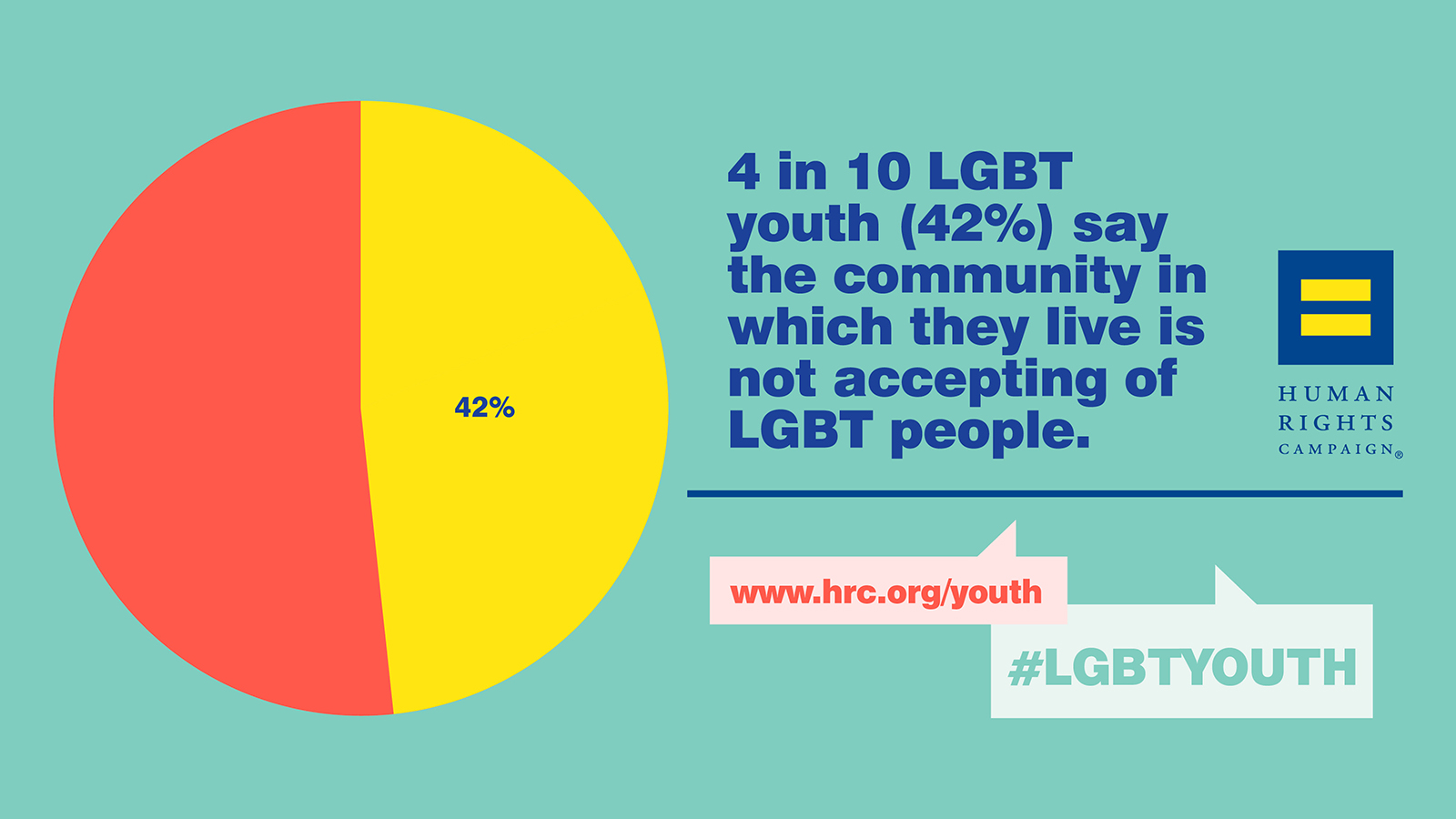
Growing up gay is not easy, especially at younger ages when one does not even know the term for who one is.  All you know is that you are different even if one cannot describe or quantify the difference.  As one gets older, the disconnect grows stronger and, in my case, high school was a nightmare, as I tried to hide my innate difference.  Today, things are far better for many LGBT youth, but for many others, little has changed over the last 50 years.  While there are now LGBT role models and celebrities and some schools have gay-straight alliances, church and family expectations and anti-gay bigotry still make lives of many LGBT youth a living hell.  Indeed, estimates are that 40% of all homeless youth are LGBT, often thrown out by parents or feeling forced to flee.  Now, with the Trump/Pence regime pushing the U.S. Supreme Court to legalize anti-LGBT discrimination, the stress many LGBT youth experience is likely to increase.  A piece in The Atlantic looks at the lack of social support so many LGBT youth experience.  Here are highlights:

The 12-year-old drag star Desmond Napoles is one of a growing number of kids who have embraced an LGBTQ identity at an early age. He has already come out as gay. Recent postings on his Instagram feed, which has 181,000 followers, feature him posing in a purple wig with red lips pursed, or in a rainbow dress at Brooklyn Pride. . . . “He is spreading the message that it is okay for kids to drag,” his mother, Wendy Napoles, told Gay Star News. And to “explore their identity and express themselves, without shame, without hiding.”
Her son may be precocious, but most queer kids remember feeling different very early in their lives. . . . . Years later, a family photo surfaces—of a boy holding a doll, say, as his brothers roughhouse nearby—that, in retrospect, makes the story seem obvious. These unwittingly campy childhood photos also communicate a reality generally overlooked in society: Budding queer identities have nonsexual elements that often form long before puberty, signaling what lies ahead.
Nevertheless, seeing preteens involved in drag shows—an age-old staple of LGBTQ culture, often performed in gay clubs—makes a lot of people uncomfortable. Critics have accused Desmond’s mother of allowing her son’s sexualization and exploitation. After another preteen boy performed drag in Ohio, state Republicans proposed legislation barring these performances, linking them, without evidence, to child trafficking.
Over time, American society has been steadily making peace with gay adults, gay marriages, even gay political candidates. Yet it still broadly pretends that people are straight until, at some point after age 18, they proclaim themselves otherwise. . . . . by this logic, all things LGBTQ should be relegated to adult spaces, preventing children’s premature sexualization. This explains why the backlash to preteen drag performers like Desmond has been so fierce—and why so many queer kids, with their difference manifesting as awkwardness, are forced to tread the rough waters of adolescence with no social support.
Numerous studies have shown that children who eventually come out as gay, lesbian, or bisexual—scientists call them pre-homosexual, or pre-GLB kids—demonstrate more childhood gender nonconformity in their speech, body language, and choice of activity than their pre-straight contemporaries do. These reports have also produced evidence of a “dosage effect”: The more gender nonconformity someone shows in childhood, the more likely they will identify as gay, lesbian, or bisexual as an adult.
Critics instead see adults in and aligned with the LGBTQ community as sexualizing children by exposing them to what a National Review writer calls a “deeply and perversely erotic subculture.” Conservative media have accused Wendy Napoles of endangering her son.
This adult disquiet allows for the continued neglecting of nascent queerness, leaving pre-GLB kids to be mocked, rather than affirmed, fostering another generation of queer people who carry scars into adulthood. “Growing up gay, it seems, is bad for you in many of the same ways as growing up in extreme poverty,” Michael Hobbes wrote in a much-discussed 2017 HuffPost article. A 2015 study showed that gay people as adults produce less cortisol, the hormone that regulates stress—–“their systems were activated, so constantly, in adolescence that they ended up sluggish as grownups”––than their straight counterparts. A 2014 study similarly showed that “stressful life events” inflict more damage on gay kids’ nervous systems than on their straight peers’ nervous systems.
Growing up LGBTQ is isolating, a reality pointedly depicted by a 2016 Saturday Night Live sketch titled “Wells for Boys.” . . . .To that script we might add: Some kids are straight; other kids are gay.
But pre-GLB kids, even if they’re not as forthright in their nonconformity as Desmond is, should not be forced to wait for adulthood to receive society's permission to be themselves. Instead, they need age-appropriate safe spaces—so they don’t have to co-opt more mature queer arenas—in which they can come to grips with their otherness. Queer kids know they’re different, even before most have the words to say so; for their sake, we need to listen a bit more closely.

Sunday, July 14, 2019

Letter in Opposition to the State Department's "Commission on Unalienable Rights"

A trio of clear and present dangers to human rights.
In a post yesterday I looked at the Trump/Pence regime's dangerous and disingenuous "Commission on Inalienable Rights" which appears designed to roll back LGBT and women's rights.  The Commission's membership is full of far right Christian extremists to the exclusion of legitimate experts on human rights issues.  Now, a letter has been made available to stand in opposition to the Commission and to demand that resources be directed to legitimate and non-sectarian resources to fight human rights abuses both in America and across the globe.  The letter, which I encourage  both individuals and organizations to sign can be found here.  Follow the instructions to join the list of signatories.  Here are excerpts from the letter:
We . . . . write to express our deep concern with the Department of State’s recently announced Commission on Unalienable Rights. We object to the Commission’s stated purpose, which we find harmful to the global effort to protect the rights of all people and a waste of resources; the Commission’s make-up, which lacks ideological diversity and appears to reflect a clear interest in limiting human rights, including the rights of women and LGBTQI individuals; and the process by which the Commission came into being and is being administered, which has sidelined human rights experts in the State Department’s own Bureau of Democracy, Human Rights, and Labor (DRL).

We urge you to immediately disband this body, and to focus your personal attention on the significant challenges currently facing the protection of human rights globally, including those threats to human rights generated by Trump administration policy and rhetoric.

We are likewise dismayed by the well-documented views of a significant majority of the Commission’s 10 members. Taken as a whole, the Commission clearly fails to achieve the legal requirement that a federal advisory committee “be fairly balanced in its membership in terms of the points of view represented and the functions to be performed.” Almost all of the Commission’s members have focused their professional lives and scholarship on questions of religious freedom, and some have sought to elevate it above other fundamental rights. The right to freedom of thought, conscience, and religion is a fundamental right, but one of among 30 such rights enshrined in the [1948 Universal Declaration of Human Rights] UDHR.
No Commissioner focuses nearly as exclusively on any other issue of pressing concern contained with the UDHR, including the right to asylum, the right to be free from torture, the right to equal protection against any discrimination, or any of the UDHR’s enumerated economic, social, and cultural rights, among other topics.
Moreover, the Commission’s chair and members are overwhelmingly clergy or scholars known for extreme positions opposing LGBTQI and reproductive rights, and some have taken public stances in support of indefensible human rights violations. The Commission’s chair has stated that marriage equality presents a danger to children. A Commission member has similarly stated that “the unavoidable message” of same-sex marriage “is a profoundly false and damaging one.” A third Commission member has argued publicly against the use of contraception even when that use is meant to limit the spread of deadly disease. A fourth has described questions of gender identity as “a matter of mental illness or some other pathology” and “a mark of a heartless culture.” A fifth has suggested that widespread outrage at the Saudi Arabian government’s premeditated murder and dismemberment of journalist and dissident Jamal Khashoggi is grounded in U.S. domestic political considerations. A sixth has described the government of the United Arab Emirates as one “committed to tolerance…committed to civil society,” despite that government’s egregious and well-documented human rights record at home and abroad.
Rather than continue with this Commission, we urge you to use the resources of your office to take action on the great many grave human rights issues facing the world today, including those you have the power to improve directly. These include actions that have exposed children and other migrants to acute distress and, in some instances, long-lasting psychological damage. They include extreme selectivity and hypocrisy in raising human rights concerns, and rhetoric from the president and administration supportive of many of the world’s leading human rights violators, from Kim Jong Un to Vladimir Putin to Mohammed bin Salman. They include routine attacks on a free press and independent judiciary, behaviors emulated and applauded by strongmen worldwide. And they include policies that will exacerbate the impacts of climate change, which threatens the rights of every one of us.


Join me in signing this letter.   A piece in Slate further elaborates on the danger this commission poses to human rights. 

Sunday, June 09, 2019

Some U.S. Embassies Hoist Rainbow Flags in Defiance of Trump

The Trump/Pence regime has been steadily pushing to make right wing evangelical Christianity the de facto established religion in America.  The religious freedom rights and beliefs of others simply do not matter and, if they offend the self-centered, hate-filled, divisive views of Christofascists, they are subject to being undermined and trampled upon. Trump/Pence trumpets support for "religious freedom," but that freedom only applies to white, far right evangelicals who through policies and Department of Justice initiatives are being placed above the laws that bind the rest of the populace.  Nowhere is this more true than in the area of LGBT rights where Mike Pence and Mike Pompeo, both far right "Christians," seek to convince Trump to roll back rights and to dish out slights wherever possible. Part of that agenda this year was banning U.S. embassies from flying rainbow flags during June, which is Pride month.  As the Washington Post reports, a number of embassies are defying the Trump/Pence regime's order.  Here are article excerpts:
Since the State Department began rejecting all embassy requests to hoist rainbow flags outside the mission buildings during LGBTQ Pride Month this year, some U.S. diplomats have been finding ways to defy, or at least get around, the new policy.
The facades of the U.S. missions in Seoul and Chennai, India, are partially hidden behind large rainbow flags, while the embassy in New Delhi is aglow in rainbow colored lights. The website for the embassy in Santiago, Chile, shows a video of the chief diplomat raising a rainbow flag last month for the International Day Against Homophobia, Transphobia and Biphobia.
The Vienna embassy’s website features a photo of a rainbow flag flying below Old Glory on a mast jutting from the building, a statement by Diplomats for Equality and a story about a professor lecturing on the visibility and growth of LGBT rights.
U.S. diplomats in Jerusalem joined a March for Pride and Tolerance, and several ambassadors have tweeted photos of themselves in local Pride parades or standing outside the embassies surrounded by employees holding up letters spelling PRIDE.
“This is a category one insurrection,” said one diplomat, who like others interviewed about the sentiment over the rejections, which were not made in writing, spoke on the condition of anonymity for fear of being fired.
A practice routinely approved for most of the decade at many embassies now requires top-level approval from the State Department. But this year, as first reported by NBC News, all requests were nixed.
In 2011, the Obama administration directed agencies involved with foreign policy to promote LGBT rights, a striking policy for an agency that, up to the early 1990s, considered homosexuality a security risk and cause for termination. . . . . By 2016, approvals were left up to each ambassador or chief of mission.
That process changed last year, after Mike Pompeo became secretary of state. An evangelical Christian who believes marriage should be defined as between a man and woman, Pompeo has said gay employees will be respected and treated like everyone else. But he has downplayed some symbols of LGBT rights, while introducing several new panels and envoys specializing in religious freedom issues.
The advisory cable that came out last year said diplomats are required to obtain top-level approval from approval from the State Department’s Office of Management to fly a rainbow flag.
Some gay employees in the foreign and civil service say the ban on flying the rainbow flag is just the tip of an iceberg of slights.
“Day by day, a death by a thousand cuts, our rights as lgbt+ Americans are being eroded with the removal of a guidance here, the rewriting of a policy there, or just the quiet disappearance of a web site,” Robyn McCutcheon, a transgender woman who has served in several posts abroad, wrote in her blog “Transgender at State,” lamenting what she has observed throughout the government in the past two years. “It should come as no surprise that this erosion would happen also at the U.S. Department of State.”
“We fly below the radar,” one employee said. “We survive because they don’t realize we’re here.”
Expect things to get even worse as Trump steps up anti-LGBT efforts to maintain the support from evangelicals and ultra-right wing Catholics, all of whom want to take America back to the 1950's, including new Jim Crow laws and gays being forced to hide from sight. 

Monday, January 07, 2019

Dropping the ‘LGBT’ From ‘LGBTQ’ Is a Bad Idea


Since "coming out" in mid-life, I have come to learn that the LGBT community is very diverse and as time has gone my, more letters have been - in my view - added by some to that acronym, turning it into an alphabet -soup list of letters in the quest of inclusiveness even as the end result becomes ridiculous.  Given the cumbersomeness of the terminology that this mindset has created, some are now arguing that all of us non-heterosexuals in society should be labeled as "queer," a term I find abhorrent and which plays directly into the hands of the enemies of gays, lesbians, the transgender, etc., citizens.  Indeed, one dictionary definition of "queer" means "differing from usual or normal" in some way, usually negatively.  Synonyms include odd, strange, freakish, peculiar, bizarre, weird, and unnatural. Why would anyone sane want to label themselves so that they encourage name calling and denigration?  Moreover, the agenda of LGBT rights is to achieve EQUAL treatment and rights and to educate the larger public that members of our community are "just like everyone else" save for our sexual orientation and/or gender expression.  A piece in The Atlantic blindly argues for the use of the single term "queer" which in my view would only fragment the non-heterosexual community and make some disavow those who are less conforming.  Here's a sampling of the batshitery: 
Frank Kameny, the last century’s greatest gay-rights activist, filed the first-ever Supreme Court petition challenging discrimination against homosexuals. He led some of the first gay-rights demonstrations. He was the first openly gay congressional candidate. He spearheaded the challenge to the psychiatric establishment’s categorization of homosexuality as a mental illness. He fought tirelessly against sodomy laws. He did a lot more than that. But there is one thing he never did—at least to my own recollection and that of associates of his whom I consulted. He did not use the term LGBTQ, or any of its variations.
This is partly because he was a creature of his era, born in the 1920s and active in an age when the whole argot was different. . . . . his friends say he abjured it. “My recollection is LGBT or its derivatives were expressly disliked by Frank,” one of them told me. “He would use gay to cover the full range; or gay and lesbian.” . . . . When it started in the ’80s with gay and lesbian, he correctly predicted that there would be no end of it.”
Kameny especially prized, among his many accomplishments, his slogan “Gay is good!”—a proud claim that homosexuals are heterosexuals’ moral as well as legal equals. He wasn’t excluding anyone by using the word gay. . . . He believed he was fighting for the values that define all Americans—the values he had fought for in combat during World War II. Gay rights, to him, meant American rights. Human rights.
In the past couple of years, however, I have come to believe, at long last, that Kameny was right. The alphabet-soup designation for sexual minorities has become a synecdoche for the excesses of identity politics—excesses that have helped empower the likes of Donald Trump. It’s time to retire the term and find a replacement. I propose a single letter: Q.
By 2007, when gay-rights advocates decided to make their support for a federal antidiscrimination bill conditional on the inclusion of protections for transgender people, it was clear that the gay-and-lesbian and trans movements had become politically joined at the hip; including the T made undeniable sense. Bisexual people, concerned that their issues would be overlooked, also sought acknowledgment, and their initial was stapled in too.
And so the unwieldy four-letter acronym reigned. It had its advantages. It signaled factional inclusion to those inside the movement, and factional solidarity to those outside the movement. In that sense, it was good politics and good symbolism. But it wasn’t stable. . . . Lately LGBTQ seems to have become the norm, on the assumption that Q, for queer, can stand in for all the rest.
LGBTQ is pointedly coalitional and inclusive, and we chose it ourselves. In that respect, its intended message is admirable. But it carries an unintended message as well: an embrace of the identity politics and group separatism that have soured millions of Americans on progressivism and egalitarianism.
For me, the ugliness and unwieldiness of LGBTQ add insult to injury. As does the fact that it is not a label that accurately describes me or any other American. It describes a coalition, yes, but not any actual person. Even as it seeks to explicitly include groups, the concatenation of initials implicitly blots out individuals.
Kameny’s preference for a single, simple, overarching designation was well founded. It deserves to be rediscovered. Today, however, that designation can no longer be gay, which, apart from being gendered, won’t do for transgender people. Queer is inclusive, but its radical baggage and derogatory undertones have precluded its mainstream acceptance. And so, herewith, my modest proposal: Q.
In my view, the author is delusional if he thanks "Q" won't immediately be substituted with "queer" by homophobes and anti-gay hate groups.  There’s more bloviating in the piece and what’s striking to me is that “queer” blots out individuals even more so than LGBT.  Plus, there is the reality that many of us, myself included, do NOT consider ourselves “queer” and loath that label.  The author's suggestion would do great harm to the movement in my opinion.  And lastly, I state for the record that any organization that tries to label me as “queer” and then asks for financial support from me will experience two things very quickly: (i) the monetary donations will cease immediately, and (ii) I will likely sever all ties with the organization. 

Thursday, October 25, 2018

Trump DOJ: Businesses Can Discriminate Against LGBT Workers

The Trump/Pence regime's war against LGBT Americans continues and the Trump Department of Justice filed a brief in a case pending before the Supreme Court  arguing that businesses can freely discriminate against LGBT workers without violating federal laws.  The move comes just days after the regime announced that it wants to define gender as one's physical attributes at birth - a total rejection of medical and mental health knowledge on transgender individuals who would technically cease to exist. Most amazing is the fact that despite all this anti-LGBT animus, "friends" remain surprised that I vigorously oppose the Trump/Pence regime and, by extension, its homophobic supporters.  A piece Bloomberg looks at this latest effort to make LGBT individuals the targets of animus and bigotry.  Here are excerpts:
The Justice Department today told the U.S. Supreme Court that businesses can discriminate against workers based on their gender identity without violating federal law.
Solicitor General Noel Francisco told the high court that a civil rights law banning sex discrimination on the job doesn’t cover transgender bias. That approach already has created a rift within the Trump administration, contradicting the Equal Employment Opportunity Commission’s view of the law it’s tasked with enforcing.
A Michigan funeral home wants the high court to overturn a U.S. Court of Appeals for the Sixth Circuit decision finding that the company violated federal workplace discrimination law when it fired Aimee Stephens, a transgender worker. The EEOC successfully sued on behalf of Stephens in that case, but the Justice Department has the sole authority to represent the government before the Supreme Court. The DOJ told the high court that the Sixth Circuit got the case wrong.
“The court of appeals misread the statute and this Court’s decisions in concluding that Title VII encompasses discrimination on the basis of gender identity,” Francisco said in a brief filed with the court.
The Supreme Court is expected to decide in the coming months whether to take up the case. It’s also been asked to consider two other cases testing whether sexual orientation bias is a form of sex discrimination banned under the existing law.
The DOJ’s brief follows a New York Times report that the Department of Health and Human Services is considering limiting its definition of gender to sex assigned at birth.
“This administration is not a friend of the LGBT community,” Greg Nevins, an attorney for Lambda Legal, told Bloomberg Law. “They can say what they’re going to say, but the courts will have the final word.”  The American Civil Liberties Union has intervened in the case and will represent Stephens if the high court decides to grant the funeral home’s request for review.
With its ruling in the funeral home case, the Sixth Circuit last year became the first federal appeals court in the country to conclude that transgender bias is sex discrimination under Title VII of the 1964 Civil Rights Act. It previously recognized transgender discrimination as a form of prohibited sex stereotyping. . . . “It is analytically impossible to fire an employee based on that employee’s status as a transgender person without being motivated, at least in part, by the employee’s sex,” Judge Karen Nelson Moore wrote for the Sixth Circuit.
Laws in 20 states and Washington, D.C., directly ban employment discrimination based on sexual orientation and gender identity.

In Virginia, thanks to Republicans in the General Assembly, there are ZERO non-discrimination protections for LGBT Virginians as I know first hand after being forced from a law firm a number of years ago for being gay.

Monday, January 15, 2018

The Proper Understanding of "Religious Freedom"


Being at the inaugural events this past weekend, including the the inaugural ceremony itself which is held on the south portico of the Virginia Capitol, it is hard not to feel the history of the ceremonies and, of course, the role of the Founding Fathers from Virginia.   Among those is Thomas Jefferson who designed the Capitol building, founded the University of Virginia, and authored the Declaration of Independence.  But Jefferson was equally proud of his authorship of the Virginia Statute for Religious Freedom, which in many ways lay the ground work for the First Amendment of the United States Constitution.  As evangelical Christians - the Christofascists - seek to exempt themselves from laws binding on the citizenry on the duplicitous claim that to do otherwise deprives them of "religious freedom," it is important to understand what Jefferson and his fellows understood religious freedom to be and that it is the exact opposite of what is now being put forth by Christofascists whom I suspect Jefferson would have loathed.  Indeed, the exemplify some of the evils of religion that Jefferson and the Founders decried.  A piece in Religion Dispatches by a legitimate historian (as opposed to faux historians favored by the "godly folk") reminds us of what religious freedom means and that it does not grant licences to discriminate.  Here are excerpts:
To listen to the Christian Right, which has been busy seeking religious exemptions from laws governing reproductive rights and LGBTQ rights, one might think that armies of secularists are swarming like locusts over the land, seeking to snuff out the light of religious freedom and ultimately, of faith itself.
Informed people on all sides also tend to agree that the taproot of religious freedom in the United States is the Virginia Statute for Religious Freedom, originally drafted by Thomas Jefferson in 1777 and shepherded through the Virginia legislature by James Madison in 1786. The following year, Madison served as the principal (but certainly not the only) author of the Constitution, and in 1789, as the principal author of the First Amendment.
Historian John Ragosta, author of Religious Freedom: Jefferson’s Legacy, America’s Creed (University of Virginia Press, 2013), has been writing about the origins of the U.S. approach to religious freedom, particularly the Virginia Statute, the circumstances that gave rise to it and what it means for understanding religion, law and politics in our time.
What exactly is the Virginia Statute for Religious Freedom and how did it come to be?
The Virginia Statute is probably the most robust and certainly the most poetic statement of religious freedom in our history.  . . . . it played a critical role in development of the First Amendment and in the way the states defined religious freedom. It was far better known in the nineteenth century when historians, students, newspaper editors and politicians regularly turned to the Statute to understand religious liberty.
Its history is equally important: After the American Revolution there was an effort to impose taxes to support all Christian religions; this was seen as an improvement over colonial laws which had favored specific Christian sects, e.g. Anglican or Congregational. If that effort had succeeded, we could say that America was somehow officially or legally a “Christian Nation.” Fortunately, James Madison and a broad coalition of evangelicals rose up to oppose state interference with religion, even support for religion, and instead managed to have Jefferson’s Statute enacted. 
Thomas Jefferson . . . wanted to be remembered as author of the Declaration of Independence, “Father of the University of Virginia,” and author of the Virginia Statute for Religious Freedom.
Jefferson saw these three things as the great accomplishments of his life: political freedom, religious freedom, and educational freedom and opportunity. Of the three, he thought religious freedom was the foundation because without freedom to think and believe, you could not have the other two. A republic could not work if government and church officials (what Jefferson referred to as an alliance of “kings, nobles, and priests”) were trying to control what we think or prescribe what was the “best” religion or which people were the “best” citizens based upon their religious beliefs. If people were to make informed political choices themselves, they had to be free to think for themselves, especially about religion. For Jefferson and his supporters, religious freedom for all was central to our democracy.
Jefferson emphasized that the bill was meant to protect everyone, including as he later wrote, “the Jew and the Gentile, the Christian and Mahometan, the Hindoo, and Infidel of every denomination.” This idea–that one’s religious identity should be neither an advantage nor a disadvantage under the law–seems to be as relevant today as it was then.
The Statute was intended to create a free market of ideas, including religious ideas. Religion would thrive based not on government decisions but on what people believed and chose to support–the “voluntary principle.” The result was an explosion in religious ideas and denominations, and religious leaders were held responsible to their congregants rather than the government.
At the same time, while belief is completely free from government regulation and government cannot directly regulate the free exercise of religion, government can pass “neutral” laws (not targeted at religion) which may happen to be inconsistent with a person’s beliefs.
The best modern example is laws against racial discrimination: While many people insisted that interracial dating or marriage violated their religion, the Supreme Court, in the 1983 case of Bob Jones University v. United States, rightly refused to grant an exemption to anti-discrimination laws based on religion.
This is exactly what is at issue in the claims for exemptions from laws dealing with LGBTQ rights. Government cannot tell a church that it must marry gay people (that would be a direct regulation of religion), but government can say that if you want to run a business (using public streets, public utilities, police and fire protection, etc.), you cannot discriminate against customers based on race, gender, or sexual orientation. Of course, if people don’t like particular laws, they can be changed, but Jefferson was very clear that you can’t use religion or religious freedom to claim an exemption from an otherwise valid law.
During a crisis, President Jefferson was asked to make an official proclamation calling on people to pray for the country; he refused, saying that it would violate the Constitution. Even if there was no criminal penalty or fine for not praying, Jefferson said that he believed the proclamation would give the erroneous idea that “good” citizens would join in prayer. This was the “tyranny over the mind of man” that Jefferson fought against.
The Declaration of Independence includes very broad and general language about a “creator,” but it is telling that the only reference to God or religion in the Constitution is Article VI which mandates that “no religious test shall ever be required as a qualification to any office or public trust.” This was not a mistake. These religious people decided that it would be better for the country, for both government and religion, to keep them separated.
Jefferson once suggested that perhaps the only thing that we should require of anyone to be tolerated in our society is their commitment to tolerate others.
Eighteenth century Presbyterians and Baptists would often note that if government could discriminate in favor of any religion, even all Christian religions, it also had the authority to attack a particular religion or all religions. They realized that complete separation of church and state was the best way to promote true religion.

Tuesday, November 28, 2017

Federal Court Slams Trump Attempted Transgender Ban

Trump with Christofascists in June 2016 at Trump Tower
As part of his promise to Christofascists that he would wage war on the LGBT community, Der Trumpenführer has sought to ban transgender individuals from serving in the U.S. Military.  This attempted ban would also involve the forced ejection of current transgender members of the military.  Der Trumpenführer's effort has been resisted by the Joint Chiefs of Staff and now a federal court has unequivocally said "no" to Trump's religious animus based effort.  A piece in the Washington Blade looks at this development that occurred yesterday.  Here are highlights:
In response to a request to clarify a court order against President Trump’s transgender military ban, a federal judge has ruled neither Trump, nor the Pentagon, may delay transgender enlistments any further than a Jan. 1 target date.
U.S. District Judge Colleen Kollar-Kotelly, a Clinton appointee, issued the clarification Monday in response to a request from the U.S. Justice Department in the case of Doe v. Trump, the initial lawsuit against the ban filed by the National Center for Lesbian Rights and GLBTQ Advocates & Defenders.
Mattis issued his memo on June 30 to delay transgender enlistments, which were set to begin at that time as result of a policy change during the Obama administration under Defense Secretary Ashton Carter, until Jan. 1 in response to a request from military service chiefs for more time to implement the policy. (Transgender people currently serving in the armed forces as a result of the Obama-era policy were allowed to stay.) Kollar-Kotelly explains her order intended to revert the military’s policy on transgender troops to the “status quo” before Trump issued his directive banning transgender military service, which means the Mattis memo is now lawful policy. Since Mattis is named defendant in the case, that prohibits him from delaying transgender enlistments any longer than Jan. 1 — the target date in his June 30 memo. At that time, the Trump administration will be required to allow qualified transgender people to enlist into the armed forces. The Justice Department has already appealed Kollar-Kotelly’s order — the first against Trump’s transgender military ban — to the U.S. Court of Appeals for the D.C. Circuit. Last week, U.S. District Judge Marvin Garbis issued a second order against Trump’s policy as a result of a separate lawsuit filed by the American Civil Liberties Union.
The two lawsuits are among four lawsuits filed against Trump’s transgender military ban. Another was filed by Lambda Legal and OutServe-SLDN, and another was filed by Equality California.